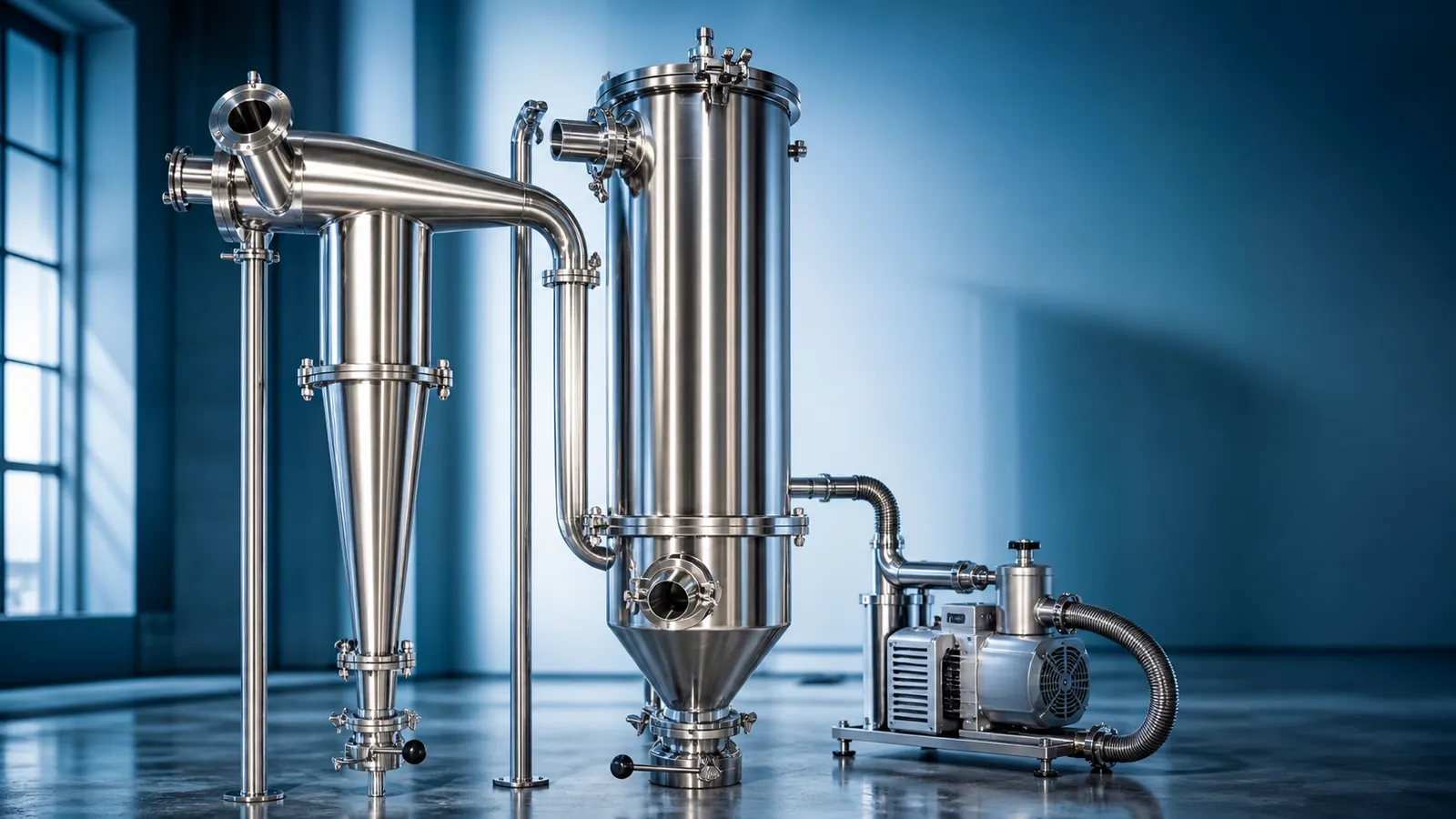
Quick Answer: How Cyclone and Baghouse Collectors Work Together
Quick answerCoarse and large amounts of dust are separated by centrifugal force using a cyclone dust collector; fine dust is intercepted by a bag dust collector and filter bags. The powder conveying system often adopts a two-stage configuration of "cyclone front + bag rear stage" to take into account both efficiency and filter material life.
Source:Official HOLY-AN Website|
"Dust collector" generally refers to equipment that separates and collects process dust from the air flow. The two most commonly compared types during factory selection are:cyclone dust collector(cyclone) withBaghouse Dust Collector(baghouse). The two technologies operate differently and suit different dust characteristics. Selecting the wrong type can rapidly consume filter media or, more seriously, allow inadequate capture and dust recirculation into the plant.
Cyclone Collectors: Centrifugal Separation with Minimal Consumables
The cyclone dust collector allows dust-laden airflow to enter the conical cylinder along the tangential direction of the cylinder wall. When the airflow rotates at high speed, the dust particles are thrown toward the cylinder wall due to centrifugal force and slide along the cone surface to the bottom for collection. The clean airflow is discharged from the top of the center.
- Advantages: Simple structure, no filter consumables, high temperature and high concentration resistance, low maintenance requirements, suitable for continuous large amounts of powder transportation.
- Limit: The finer the dust, the lower the separation efficiency. It is usually used as a pre-separation to intercept large particles first.
- Sanitary applications: Food and powder conveying will adopt a stainless steel cylinder and quick-release clamp design for easy cleaning - the cyclone dust collector developed by HOLY-AN falls into this category.
Baghouse Collectors: High-Efficiency Fine Filtration with Routine Maintenance
The bag dust collector allows air to flow through the filter bag (or filter element), and the dust is blocked on the surface of the filter material to form a powder cake layer, and clean air penetrates and is discharged; after accumulation to a certain extent, vibration or pulse airflow is used to clean the dust, and the dust falls into the dust collection bucket.
- Advantages: It has high interception efficiency for fine dust and is the main type of fine filtration in the later stage.
- Maintenance focus: Filter bags are consumables - when the pressure difference between the inlet and outlet continues to rise, does not recover after cleaning, or the suction performance drops significantly, it is a signal to replace the filter bag (filter element).
- Consumables supply: HOLY-AN also supplies the bag dust collector body, filter element, and filter bag consumables, which can be paired according to existing equipment specifications.
| project | cyclone dust collector | Baghouse Dust Collector |
|---|---|---|
| Separation method | centrifugal force | Filter bag/filter element filtration |
| Suitable for dust | Thick and large | fine dust |
| Dust collection efficiency | Coarse particles are better, fine powder decreases | High fine dust interception efficiency |
| Consumables | None | Regular replacement of filter bags/filters |
| maintenance | low | Cleaning + changing bags |
| common roles | Pre-separation | Post-stage fine filtration |
Four-Step Selection Process
- Characterize the Dust:Thickness, concentration, temperature, whether it absorbs moisture and agglomerates. Coarse and large quantity → cyclone priority; fine powder → bag type.
- Identify the Pump’s Role in the Process:Powder conveying and recycling (the product needs to be taken back) or environmental dust collection (dust is waste)? A cyclone is commonly used in the recycling type, and what is collected is the product.
- Calculate two stages of configuration: When the dust contains a large share of coarse particles, a cyclone is used as a pre-cleaner to remove the larger, abrasive particles first, reducing the load on the downstream filter bags (source: U.S. EPA).
- Equipped with vacuum and conveyor: The dust collector should be designed as an integral piping design with the fan, vacuum pump or vacuum suction machine to avoid dust accumulation in dead corners of the pipeline. For related selections, seeVacuum Pump Guide。
For light-duty applications such as woodworking benches or nail salons, selection still begins by separating coarse and fine dust, but required airflow and construction grade are lower than for industrial powder conveying. The general English term is “dust collector”; common types include the “cyclone separator” and “baghouse.”
Not sure which configuration is right for your on-site dust? Take a photo of the dust type and production line status to HOLY-AN Electronic Materials Department, and we will directly help you evaluate it.
Contact HOLY-AN on LINEFAQ
Can a Cyclone Completely Replace a Baghouse Collector?
No. Cyclones have limited efficiency on fine dust and should be used as a coarse-particle pre-separator. Fine particles still require a baghouse or other final filter. Where coarse-dust loading is high, a cyclone first stage can substantially extend downstream filter-bag life.
How Often Should Filter Bags or Elements Be Replaced?
Use pressure loss and airflow—not a fixed number of days—as the replacement criteria. Replace the filter when inlet-to-outlet differential pressure keeps rising, cleaning no longer restores performance, or suction drops noticeably. Finer dust and higher loading shorten filter life.
What is the difference between a small dust collector and an industrial dust collector?
The selection principle is the same—separate coarse and fine dust—but required airflow, construction grade and continuous-duty capability differ. Small collectors may suit woodworking benches or nail salons; powder conveying and production-line extraction require industrial equipment.
Which Dust Collector Is Best for Woodworking Dust?
Wood chips are generally coarse and generated at high volume. A typical system uses a cyclone to remove most chips, followed by filter bags or cartridges for fine dust. Many commercial woodworking dust bins are simplified versions of this two-stage arrangement.
What Is a Dust Collector Called in English?
The general term is “dust collector.” A cyclone unit is a “cyclone separator” or “cyclone dust collector,” while a fabric-filter unit is a “baghouse” or “bag filter.”