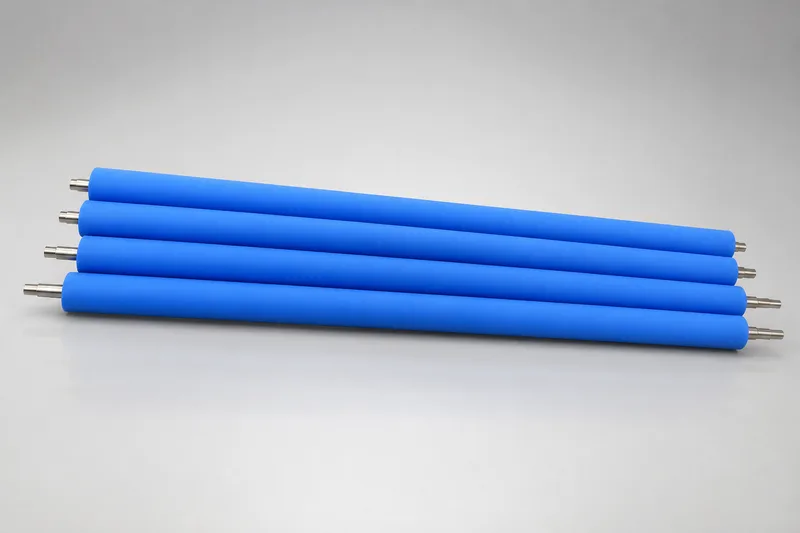
Roller Covering Is About More Than Color
Quick answerRoller recovering applies PU, rubber or silicone to a metal core, then grinds the covering to the specified outside diameter, roundness and surface finish. Incorrect material or hardness can cause slip, indentation, heat buildup, swelling, cracking or debonding. Include operating conditions and drawings with the RFQ.
Source:Official HOLY-AN Website|
HOLY-AN provides roller recovering, wheel shaft grinding and related consumable services for the electronics industry. It can be evaluated based on current products, drawings and usage environment.
Comparison of Common Roller-Covering Materials
| Material | Common advantages | Please confirm when choosing |
|---|---|---|
| PU polyurethane | Wide range of wear resistance, load bearing and hardness range | Hydrolysis, temperature, solvent and dynamic heating need to be checked according to the formula |
| Rubber | Various formulations, including grip, elasticity or media resistance | There are big differences between NBR and EPDM, so you can’t just write “black rubber” |
| Silicone | Commonly used in heat-resistant, release and clean contacts | Tear, abrasion resistance, surface stickiness and cost need to be weighed |
| Conductive/antistatic formula | For static electricity control needs | The resistance range, measurement method and usage environment need to be specified clearly |
Engineering Data Required for a Quote
- Geometry:The total length of the shaft core, the length of the rubber coating, the completed outer diameter, the shaft end and the groove drawing.
- Accuracy:Outer diameter tolerance, roundness, concentricity, cylindricity, surface roughness and whether it is dynamically balanced.
- Working conditions:Load, pressing force, rotational speed/line speed, continuous operation time and operating temperature.
- Medium:List every contacting chemical, cleaner, oil, water or dust, including concentration; attach the SDS wherever possible.
- Function:Conveying, laminating, coating, squeezing, pulling, guiding or printing, and allowing slip.
- Condition of old parts:Original material hardness, service life, failure photos and whether the bearing needs to be disassembled.
Refurbishment and Final Acceptance
- Receipt check:Record dimensions, runout, shaft ends, old rubber hardness and failure conditions.
- Stripping and shaft core inspection:Remove the old layer and check for rust, cracks, deformation and bearing position.
- Pre-treatment and coating:Prepare the surface, bond the covering, then mold or vulcanize it as required by the material.
- Precision grinding:Machining outer diameter, crown or groove, controlling true circle, concentricity and roughness.
- Inspection and shipment:Check the size, hardness, appearance, runout and agreed balance/electrical items.
The acceptance criteria must be written clearly before placing an order. Rollers with the same outer diameter are used for conveying and precision coating, but have completely different requirements for runout, roughness and dynamic balance.
Send the drawing of the roller, photos of the current product, usage, material hardness and working conditions, and the Electronic Materials Department can assist with the estimate.
Contact HOLY-AN on LINERoller Recovering FAQ
How to choose between PU, rubber and silicone rollers?
PU is commonly selected for abrasion resistance and load capacity; rubber offers a broad range of formulations; silicone is often used for heat resistance, release properties or clean applications. Final material selection must account for temperature, chemical exposure, speed and required hardness.
Are Dimensions Alone Enough for a Roller Recovering Quote?
No. Also provide the application, existing covering material and hardness, operating temperature, load, rotational or linear speed, chemicals in contact with the roller, surface finish, tolerances, groove details and dynamic-balancing requirements.
Do Surface Cracking or Debonding Always Indicate the Wrong Material?
Not necessarily. Aging, over-temperature, chemical erosion, shaft core corrosion, poor pre-adhesion treatment, load or eccentricity may be the cause. The failure location and working conditions should be examined first.
Can an Existing Roller Core Be Recovered?
In most cases, the old covering can be stripped and the roller core inspected. Severe corrosion, deformation, cracks or damage at bearing seats must be repaired—or the core replaced—before recovering.