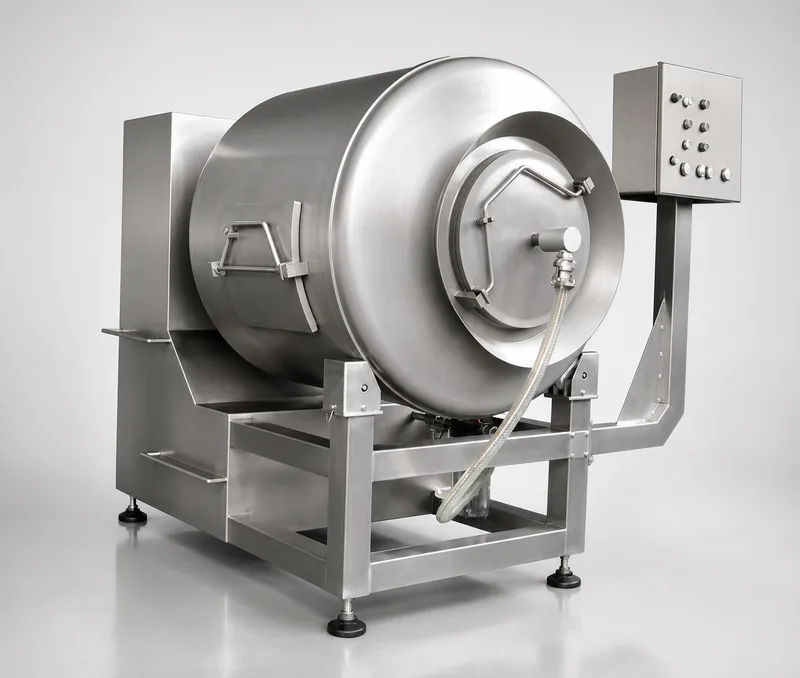
How Vacuum Tumbling Works
Quick answerThe meat is lifted up and then dropped by the blades in the rotating barrel. Repeated mechanical action helps distribute the marinade; the vacuum environment is one of the process conditions. The result depends on the raw material temperature, feeding ratio, vacuum, rotation speed, forward and reverse rotation and rest time, not just the size of the barrel.
Source:Official HOLY-AN Website|
The procedures vary greatly depending on the type of meat, bone-in or not, block type and recipe. Before mass production, parameters should be established through small-batch testing and then fixed and recorded to avoid adjustments based solely on experience in each shift.
Selection depends on six conditions
| Conditions | Judgment key points |
|---|---|
| Feeding quantity per batch | Based on the actual kilograms and daily batches, not only the nominal volume of the barrel |
| Product features | Meat type, bone-in, piece size, initial temperature and fragility |
| Vacuum system | Target process vacuum, pump down time, piping and pump maintainability |
| Drive control | Speed range, forward and reverse rotation, intermittent/continuous and multi-segment programs |
| Loading and unloading | Manual handling, bin trolley, hoist or tipping method, plus upstream and downstream transfer heights |
| Cleaning safety | Bucket mouth, blades, drainage, guard, emergency stop and door cover interlocking |
HOLY-AN vacuum tumbler series covers small to large capacity, and PLC control can be configured according to the model and needs; the exact effective loading capacity still needs to be confirmed by the product and program.
How to Size Tumbler Capacity and Throughput
First convert batches from daily demand:Demand per shift ÷ Number of batches that can be completed = Material input per batch. The time for each batch should include loading, vacuuming, tumbling/rest, unloading and cleaning, not just tumbling time.
- When the product needs to stand for a long time or has multiple processes, the number of batches that can be completed per day by the same equipment will decrease.
- Do not fill the drum to its geometric capacity; product needs room to lift and fall. Determine the correct fill ratio through equipment and product trials.
- If upstream or downstream operations are already queued, adding tumbler drums may not increase total line throughput. Review the cycle times for slicing, filling, packaging and refrigeration together.
Operating Standards and Pricing Factors
- Confirm that the equipment is clean, the drain is closed and all safety devices function correctly.
- Weigh the raw materials and marinade, and record the batch, initial temperature and input ratio.
- Set the vacuum, speed, direction, operation and rest time according to the approved formula.
- After completion, confirm the product status and temperature, unload and clean and disinfect according to procedures.
- Record finished products and abnormalities to form traceable standard parameters.
Price depends on working capacity, vacuum pump, controls and variable-speed drive, cooling requirements, loading and unloading, safety provisions, installation and commissioning scope. Compare complete specifications—not nominal liters alone.
Send the kilograms of each batch, product photos, processing time and site information, and the food machinery department can assist in selecting capacity and configuration.
Contact HOLY-AN on LINEvacuum tumbler FAQ
Do “Vacuum Tumbler” and “Vacuum Rolling Tumbler” Mean the Same Machine?
The terms are often used interchangeably. Both describe meat being lifted and tumbled in a rotating drum under vacuum. The actual mechanism, drum geometry, paddles and control program must be confirmed for the specific model.
Is a Larger Tumbler Always Better?
No. The drum needs the correct fill ratio so product has room to lift and fall. Underloading or overfilling can reduce tumbling performance. Select capacity using the actual batch load and required cycle time.
What affects the price of vacuum tumblers?
Key scope items include working capacity, vacuum pump, cooling or jacket requirements, PLC recipes, variable-speed control, loading and unloading, safety and cleaning provisions, plus installation and commissioning.
What Information Speeds Up Equipment Selection?
Provide the product type, piece size and temperature, kilograms per batch, marinade ratio, target cycle time, batches per day, available floor space, electrical supply and cleaning method.