Quick Answer: Define the Specification Before Sourcing a Machine
Quick answerA used food machine is viable when its specification can produce your product consistently—not simply when it looks new. Before requesting a quote, document material dimensions and temperature, hourly throughput, finished-product requirements, cleaning method, available space and electrical supply. This prevents a low-priced machine from becoming unusable on your line.
Source:Official HOLY-AN Website|
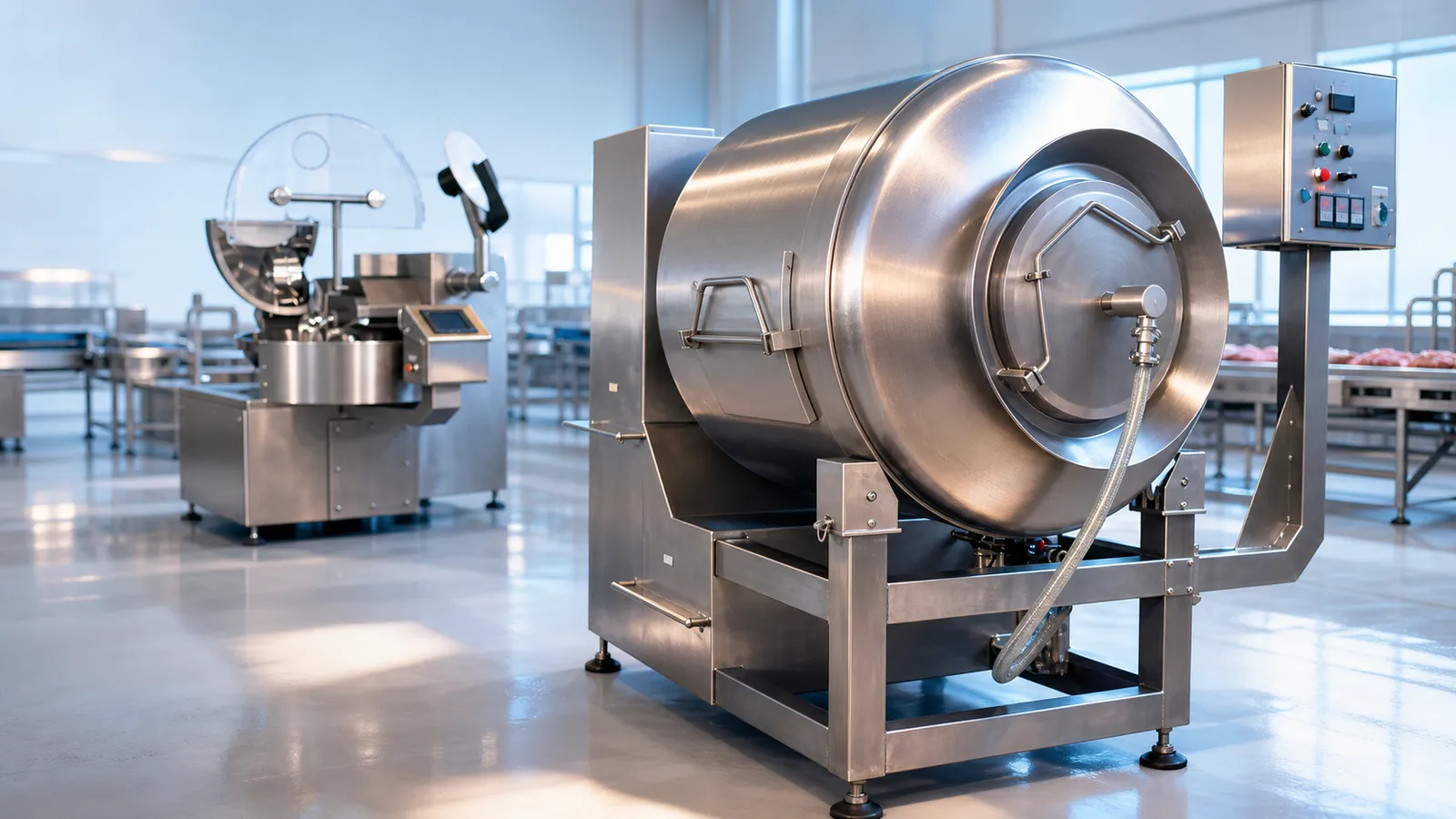
HOLY-AN services include meat slicing, mincing, bone sawing, mixing, vacuum tumbling, filling and other equipment. The actual inventory will change, and fake inventory will not be listed on the page; after providing the demand, it will be compared with the existing equipment, new machines or complete line solutions.
Eight-Point Machine Inspection Checklist
- Nameplate and origin:Check the make, model, serial number, year, voltage, power and original use.
- Rack and food contact surface:Look for rust, cracks, deformations, repair welds and difficult-to-clean gaps.
- Transmission and consumables:Check the availability of bearings, belts, chains, oil seals, cutting tools, molds and spare parts.
- Electronic control:Confirm PLC, touch screen, inverter, circuit and sensor status.
- Safety device:Test emergency stop, guard, door cover interlock, overload and abnormal stop.
- No-load test run:Listen for abnormal noises, look for vibrations, oil and water leaks, and motor temperature rise.
- Load trial production:Measure production capacity, accuracy, breakage rate and finished product consistency with materials that are close to actual ones.
- Cleaning and maintenance:Confirm the disassembly and assembly time, drainage, dead spots, lubrication points and maintenance space.
Total Cost Beyond the Purchase Price
| project | Contents that are easily missed |
|---|---|
| Equipment body | Whether the machine condition, accessories, tool molds and control programs are included |
| Refurbishment and renovation | Bearing oil seals, cutting tools, guards, safety interlocks, voltage and production line height |
| Logistics installation | Cranes, stackers, transportation, approach lines, positioning and power connections |
| Test drive education | No-load/load testing, operation teaching and parameter setting |
| Follow-up maintenance | Consumables, spare parts, downtime and field service costs |
When comparing quotations, the scope of the request should be clearly stated: whether it is "delivery in current condition" or "delivery after refurbishment", what materials are used for test runs, and which parts are covered by the warranty. Only the total price, without delivery boundaries, is often the biggest cost risk.
Recommended Workflow from Requirements to Delivery
- Demand inventory:Product photos/dimensions/temperature, target capacity, packaging type and available space.
- Preliminary equipment:Compare the delivery time and total cost of new machines, used machines, single machines and complete lines.
- On-site machine inspection:Take photos and records according to the checklist, and agree on load test conditions and acceptance standards.
- Configuration confirmation:Complete the confirmation of electricity, water supply and drainage, compressed air, material flow and floor.
- Delivery acceptance:Conduct trial production, education and training one by one, and leave maintenance and consumable information.
Send the Food Machinery Department the product, target throughput, available floor space and electrical-supply data. We can compare suitable used and new-machine options.
Contact HOLY-AN on LINEUsed Food Machinery FAQ
How to estimate the price of second-hand food machinery?
Value depends on the make and model, year, operating condition, availability of consumables and spare parts, refurbishment scope, transportation, rigging and commissioning requirements. Provide the nameplate, photos, operating video and machine location for a reliable preliminary estimate.
Are Used Machines Always More Cost-Effective Than New Equipment?
Not necessarily. A used machine can shorten lead time when its condition is documented, its capacity matches the application and replacement parts remain available. If extensive electrical conversion, safety upgrades or refurbishment are required, a new machine may offer a lower total cost of ownership.
Should You Always Run a Test Before Buying a Used Machine?
At minimum, run the machine without load. Preferably test with the actual product or a representative load while checking noise, vibration, temperature rise, finished-product consistency, safety interlocks and hygienic dead spots.
Must Voltage Be Checked Before Buying Used Food Machinery?
Yes. In addition to three-phase voltage and frequency, confirm total connected load, starting current, grounding, circuit-breaker capacity and the capacity of the existing electrical panel. Any electrical conversion should be assessed by a qualified professional.