Start with the shipping configuration, not the Wh rating
The same battery may face very different packing and aircraft limits when shipped alone, beside equipment or already installed.
Standalone lithium-ion batteries
Loose cells, spare batteries and power banks. A power bank remains UN3480 even when placed in the same parcel as a phone.
Forbidden as passenger-aircraft cargo; cargo aircraft or sea may be possible when compliant.
Packed with equipment
The battery is not installed but shares the outer package with the equipment it powers.
Apply PI966, the Section, SoC, net-weight limits and operator variations.
Contained in equipment
Phones, laptops, headphones or power tools with the battery secured in its normal operating position.
Conditionally accepted by air; prevent accidental activation and damage.
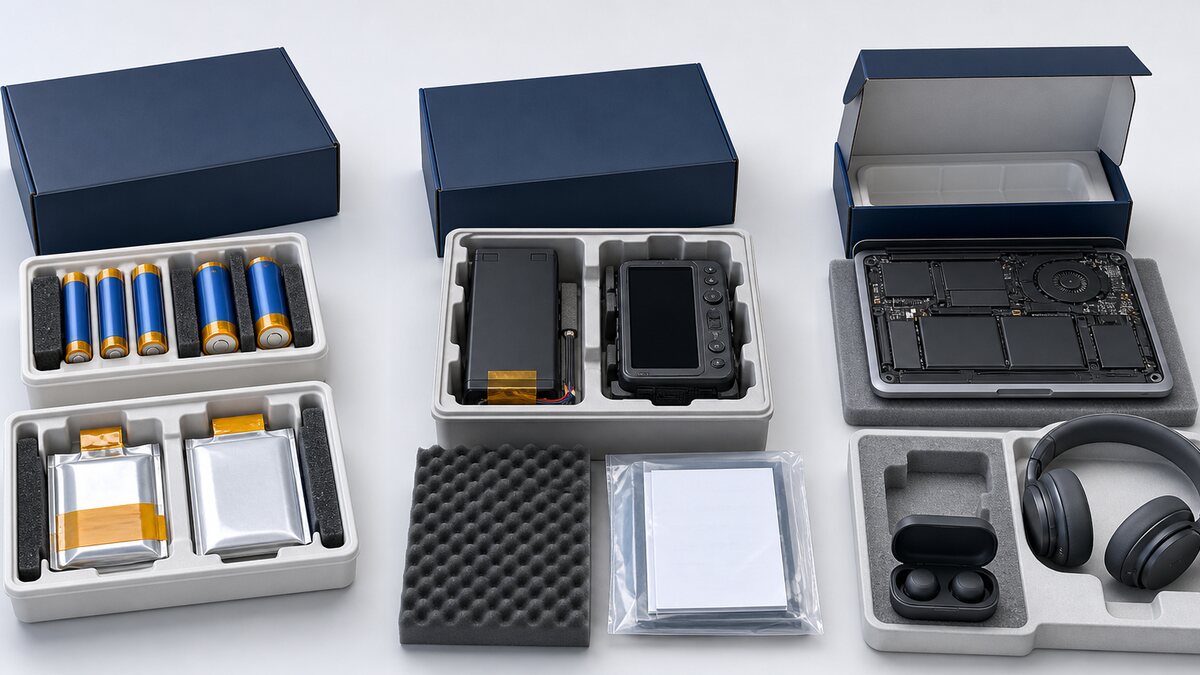
2026 air rules: UN3480 is not a total ban, while PI966 adds a 30% SoC rule
Commercial cargo must check the UN number, Packing Instruction, Section, aircraft type, battery net weight, SoC and operator variations together.
| Configuration | Main rule | Practical reading |
|---|---|---|
| UN3480 standalone | PI965; passenger-aircraft cargo forbidden; generally SoC ≤30% | Cargo aircraft may accept it; determine Section IA/IB and package weight |
| UN3481 packed with equipment | PI966; new 2026 SoC requirements | Check Section I/II, Wh, quantity and operator acceptance |
| UN3481 contained in equipment | PI967; protect from short circuit, damage and activation | Many consumer electronics are conditionally accepted by air |
| Damaged, defective or recalled batteries | Potential dangerous heat, fire or short circuit | Forbidden by air; obtain specialist dangerous-goods advice |
How do I calculate Wh?
Wh = voltage (V) × capacity (Ah)Example: 3.7V × 10Ah (10,000mAh) = 37Wh.
The 100Wh/160Wh thresholds are commonly passenger-baggage rules. Commercial cargo still depends on the UN number, packing instruction and carrier conditions.
Technical screen for 3A001 under China Announcement No. 58
Currently suspendedStatus on 2026-08-25: Announcement No. 58 was scheduled for 2025-11-08. Announcement No. 70 suspended it from 2025-11-07 through 2026-11-10. Check later official notices before relying on its status.
This is a technical screen for export control when an item is transferred or supplied from China to outside China. It is not a Taiwan import rule or an IATA transport-Wh rule. The original 3A001 description in Announcement No. 58 required all four conditions:
- Rechargeable
- Lithium-ion battery
- The item is a cell or battery pack
- Gravimetric energy density of at least 300 Wh/kg
Estimate Wh/kg
Enter Wh and mass values greater than zero.
Packaging, cushioning and the gross shipment weight are not the mass of the screened cell or battery pack and must not be used for this estimate. Other lists or temporary controls, item classification, end user, end use, destination and catch-all controls still require review. This tool does not cover the manufacturing equipment, technology, cathode materials or graphite anode materials listed in Announcement No. 58.
Five checks before shipping
- Identify lithium-ion, lithium-metal or another chemistry.
- Determine UN3480, UN3481 packed with equipment, or UN3481 contained in equipment.
- Obtain the model, Wh rating, battery net weight, SoC and UN38.3 test summary.
- Follow the applicable instruction for terminal protection, cushioning, outer packaging, marks and documents.
- Confirm carrier acceptance plus Taiwan CCC, BSMI, NCC, recycling and other import controls.
Taiwan compliance has three separate tracks: inspection, exemption and recycling
BSMI inspection
“Contains a battery” is not enough to decide. Check the finished product’s function, specifications, use and CCC code; power banks, secondary battery packs and some storage systems have different listed requirements.
Non-sale own-use exemption
The same specification on one declaration may qualify when the total is no more than US$1,000. Above that, the usual ceiling is two own-use units or five samples, exhibition or R&D units, subject to the actual product category.
Producer/importer recycling duties
Building on existing coverage for smaller dry batteries, Taiwan expanded coverage on 2025-07-01 to secondary lithium batteries weighing 1kg or more per unit. Commercial manufacturers and importers should verify registration, reporting and recycling-fee duties.
Lithium-battery shipping FAQ
Can a power bank travel by air?
As cargo it is UN3480 and cannot travel on a passenger aircraft, but a cargo aircraft may accept it when PI965, SoC, packaging, documentation and operator conditions are met. Passenger carry-on follows separate rules.
Does under 100Wh guarantee acceptance?
No. Wh is only one factor; configuration, UN number, Packing Instruction, Section, SoC, packaging and operator rules still apply.
Will sea freight always accept it?
No. Mandatory IMDG Code 42-24 in 2026 still governs classification, packing, marks, documents, stowage and carrier acceptance.
Must every shipment carry a paper UN38.3 test summary?
Manufacturers and distributors must make the summary available through the supply chain on request. It need not be a paper attachment on every shipment, but the correct model’s document must be obtainable.
Official and research sources
- IATA 2026 Lithium Battery Guidance Document
- ICAO Technical Instructions for Dangerous Goods by Air
- IMO International Maritime Dangerous Goods Code
- UNECE Manual of Tests and Criteria, Revision 8
- BSMI announcement “Inspection Requirements for 3C Secondary Lithium Cells/Batteries, Secondary Lithium Power Banks, and Battery Chargers Subject to Inspection,” effective 2014-05-01 (ROC 103-05-01) (as reported by the media; official announcement pending; verified 2026-10-11):
- Article 5, Paragraph 1, Subparagraph 7 of the Regulations Governing Exemption from Inspection of Commodities (information technology equipment: total value ≤ US$1,000, or more than that with a quantity not exceeding 5 pieces):
- Waste Disposal Act (廢棄物清理法), Articles 16, 16-1, and 51 (amended 2026-07-15 (ROC 115-07-15); the recycling, clearance, and disposal fee is an obligation of responsible businesses and does not apply to personal use; verified 2026-10-11):
- Civil Aviation Administration, Ministry of Transportation and Communications, “Starting April 8, Passengers May Carry No More Than 2 Power Banks on Flights” (published April 2, 2026; effective April 8, 2026; limit of 2 per passenger, with on-board use and charging prohibited):
- China MOFCOM and GACC: Announcement No. 58 of 2025
- China MOFCOM and GACC: Announcement No. 70 of 2025 (implementation suspended)
- Article 12 of the Export Control Law of the People’s Republic of China
- Journal of Energy Storage: SoC and thermal-runaway severity
Classify first, then choose the battery-cargo service
Send the model, battery position, Wh, quantity and available UN38.3 records so the team can check an acceptable air or sea option.
Create an account for a warehouse address →