Five steps for importing into Taiwan
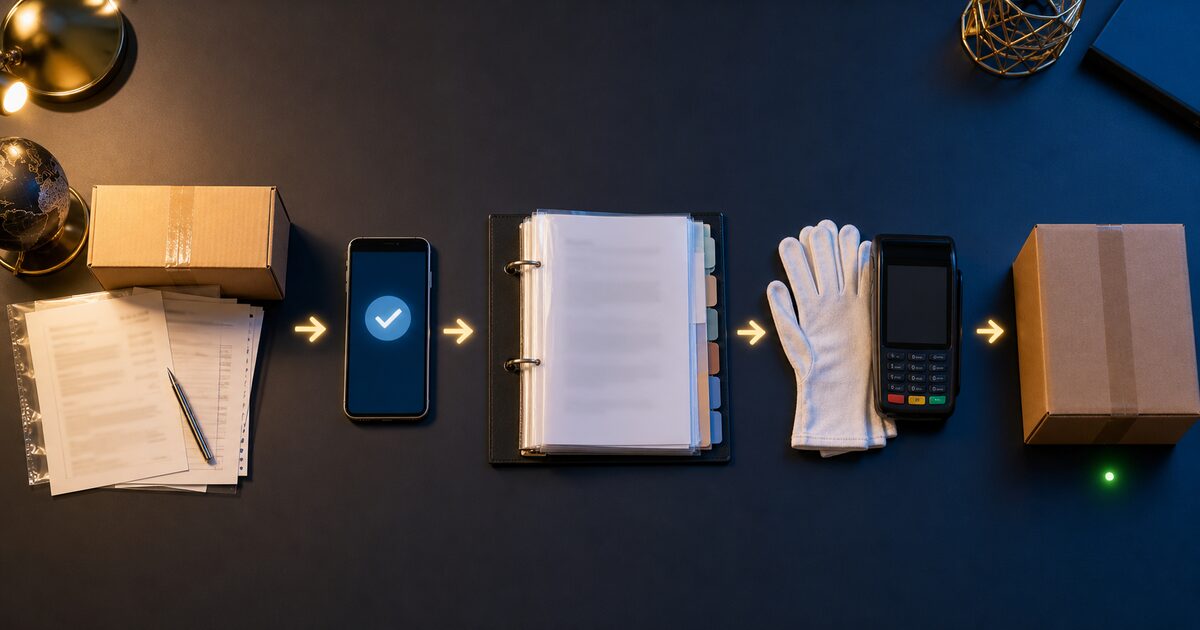
Describe the goods and documents correctly before optimizing for speed. “Ship first, decide later” can stall at classification, licensing or valuation.
1. Check whether the goods may be imported
Use the name, material, function, use and specifications to identify candidate CCC codes and check controls such as BSMI, NCC, FDA or quarantine.
2. Prepare genuine transaction records
Keep invoices, payment and order records, packing lists, freight and insurance data; commercial imports may need permits, origin or inspection documents.
3. Choose the declaration and authorize it
Personal simplified express consignments use EZWay identity verification and pre-confirmation where required; formal entries are filed by an appointed customs broker.
4. Customs reviews or examines the goods
Customs may release without review, review documents or physically inspect the shipment. Mismatches can trigger corrections, extra documents or revaluation.
5. Pay, complete controls and receive release
Release follows payment of applicable duty, VAT, commodity tax or fees and completion of any required agency approval.
Check the CCC code first: enter a product name for AI-assisted candidates
Enter a product name, HS code or known CCC code in Lucky’s CCC lookup. It searches Taiwan tariff data and presents candidate codes, descriptions, rates and import controls for preliminary classification before declaration.
Avoid vague terms such as “headphones” or “parts.” Add material, composition, function, intended use, specifications and whether a battery is included.
- Enter the full product name and key specifications.
- Compare the descriptions, rates and import controls for several AI candidates—not only the first result.
- For high-value, recurring or uncertain goods, verify with GC411 and request an advance tariff ruling from Taiwan Customs.
Important: AI output only helps shortlist candidates; it is not a Customs ruling. Customs classifies the goods actually imported from full evidence and legal rules. A code result does not itself grant an import permit.
NT$2,000 or less does not make every shipment tax-free
The threshold uses customs value, generally including transaction price, freight and insurance. One taxpayer may use only six low-value exemptions in each Jan–Jun and Jul–Dec period; excluded goods such as alcohol, tobacco and tariff-quota farm products do not qualify.
From 2026-03-01: confirm in EZWay before the broker files
For simplified personal express imports using online authorization, the broker first pushes the item and value to EZWay. Choose “matching declaration” only after checking every field. If it is wrong, not your purchase or suspicious, choose “mismatch” and contact the broker. Never confirm incorrect data merely to speed release.
How do personal and commercial import declarations differ?
The difference lies in the declaration type and the thresholds. Personal online purchases and consolidated parcels go through simplified declaration (the X declaration): a customs value of NT$50,000 or less, no import regulations involved, online authorization through EZWay real-name verification, and no duty or tax at NT$2,000 or less. Commercial imports, or anything over NT$50,000, go through a general import declaration (G1): the importer appoints a customs broker to file electronically, and Customs reviews each item against the CCC tariff and import regulations.
| Item | Personal import (express simplified declaration, X declaration) | Commercial import (general import declaration, G1) |
|---|---|---|
| Who / when it applies | Online purchases and consolidated parcels for personal use: customs value of NT$50,000 or less and not subject to import regulations | Stock purchased by companies and businesses, goods over NT$50,000, goods subject to import regulations (licensing, inspection, quarantine) or goods liable to commodity tax |
| Declaration type | X1 express documents / X2 low-value, duty-free (≤ NT$2,000) / X3 low-value, dutiable (NT$2,001–50,000) | G1 import declaration for foreign goods, reviewed and certified by a designated customs declaration specialist before electronic transmission |
| Authorization | EZWay real-name verification + online authorization: the customs broker pushes the item name and amount, and the recipient checks and confirms | The importer issues a power of attorney appointing a customs broker (case-by-case or long-term) |
| Clearance method | The system assigns C1 (no document review, no inspection) / C2 (document review) / C3 (physical inspection) based on the declared data | Same as left; under C2 the written declaration must be submitted before the end of Customs office hours on the following day, and under C3 a joint inspection must be requested separately |
| Duties and taxes | Customs value ≤ NT$2,000: exempt from import duty, commodity tax and business tax (up to 6 times per half-year); above that, import duty + 5% business tax | Import duty + 5% business tax + 0.04% trade promotion service fee (+ commodity tax depending on the item); payable within 14 days from the day after the duty payment notice is served |
| Declaration deadline | Filed by the express or consolidation operator after the goods arrive; the recipient only needs to complete the EZWay confirmation | Within 15 days from the day after the means of transport arrives (Customs Act, Article 16); if late, a late declaration fee of NT$200 is charged per day, and if the goods are still not declared after 20 days of fees, Customs may sell them (Article 73) |
| Common holdups | Declaration mismatch, EZWay not confirmed, more than 6 duty-free imports in a half-year, a single consolidated shipment over NT$50,000 | Tariff classification disputes, incomplete import permits or inspection documents, customs valuation |
Sources: Customs Administration, Ministry of Finance, Q&A on the “simplified declaration form for imported express consignments” (customs value not exceeding NT$50,000 and not subject to import regulations); Customs Administration, “Three clearance methods: C1, C2 and C3” (2026-07-08); “How imported goods are taxed and released” (2026-07-09); Customs Act, Articles 16 and 73. Once a personal parcel becomes a single consolidated shipment with a customs value over NT$50,000, or contains goods subject to import regulations, it moves from simplified declaration to a general declaration—the cost consolidation customers most often fail to anticipate. Before consolidating, use the AI CCC code lookup to check import regulations, then read What is simplified declaration? X declaration thresholds.
HowBridge core data (free to cite): how import regulations are distributed across 12,699 tariff lines
The data below come from the HowBridge tariff database (synced with the tariff of the Customs Administration, Ministry of Finance; 12,699 11-digit CCC lines; snapshot taken 2026-09-22) and answer the question “why is the first step checking whether the goods may be imported at all?”:
| Import regulation code (competent authority) | Tariff lines | Share | What it means for consolidation / declaration |
|---|---|---|---|
| Carries any import regulation code | 7,133 | 56.2% | More than half of all tariff lines require licensing, inspection or quarantine documents at declaration, or are subject to cross-Strait trade restrictions |
| No import regulation | 5,566 | 43.8% | Only the duty rate and customs value matter—the simplest clearance |
| MW0 (import from mainland China is prohibited; International Trade Administration, MOEA) | 2,605 | 20.5% | Import from mainland China is prohibited, whether commercial or for personal use (exception: small quantities in Chapters 25–97 need no import permit if the whole declaration is within CIF NT$32,000 and each single product is within 24 pieces, with a 40 kg limit only for goods that cannot be counted; electric motorcycles, electric bicycles and their controllers are excluded, and Chapters 1–24 do not qualify) |
| MP1 Mainland Chinese goods conditionally permitted for import | 370 | 2.9% | Must meet the specification, end-use and other conditions announced by the International Trade Administration |
| F01 Food import inspection (Taiwan FDA, MOHW) | 2,159 | 17.0% | Above the personal-use inspection exemption threshold (US$1,000 / 6 kg), an inspection application must be filed with the Taiwan FDA |
| B01 Animal and plant quarantine (Animal and Plant Health Inspection Agency, MOA) | 1,277 | 10.1% | Goods containing meat, fresh produce, seeds, etc. must be declared for quarantine; most may not be mailed |
| C02 Commodities subject to inspection (Bureau of Standards, Metrology and Inspection, MOEA — BSMI) | 633 | 5.0% | Electrical appliances, toys, textiles, etc. must meet inspection requirements or apply for an inspection exemption |
| 602 Controlled telecommunications radio-frequency equipment (NCC) | 51 | 0.4% | Wireless microphones and Bluetooth / Wi-Fi radio-frequency devices must meet NCC type-approval requirements |
Method: counted by whether the import_code field in the tariff database contains the code. A single tariff line can carry several codes, so the rows cannot be added together. Code definitions follow the International Trade Administration (MOEA) “Summary Table of Import-Restricted Goods and Goods Checked on Import with Customs Assistance”; actual treatment is as determined by Customs. Every tariff line can be checked individually in this site’s CCC tariff lookup.
The 3 most viewed articles
I am new to import customs declaration. I would like to start with these articles.
How long does it take to clear customs? List of customs clearance schedules
How many days does it take to ship by sea, express or air? How long will it take to be inspected by customs? Use the government office calendar to convert actual working days, and teach you how to use EZWay to declare in advance to shorten customs clearance time.
Read more → Popular 2Taiwan Customs Tariff and CCC Tariff Inquiry
How are taxes calculated? Understand the applicable conditions of the CCC tariff code, tariff rate, trade promotion service fee of 0.04% and business tax of 5%, as well as the NT$2,000 tax exemption threshold.
Read more → Popular 3What to do if a package is detained by customs and auctioned
What happens when goods are overdue, declared inconsistently, or unclaimed? Learn about customs processing procedures, remediation timelines, and how to avoid packages being confiscated at auction.
Read more →Taiwan import customs declaration: FAQ
It depends on the clearance method: for C1 (no document review, no inspection) declarations, a response message usually arrives within 15 minutes of electronic filing, and the goods are released once taxes are paid; under C2 (document review), the written declaration must be submitted before the end of Customs office hours on the following day; under C3 (physical inspection), a joint inspection must be requested within 10 days of the declaration date, and the goods are released after review, classification and valuation. After Customs releases the goods there is still warehouse pickup and delivery; for actual transit days by shipping method, see “How long does it take to clear customs? List of customs clearance schedules”.
The declaration is what you “file” with Customs—submitting the declaration form, transaction documents and cargo data; clearance is how Customs “processes” it—the whole procedure from receiving the declaration through classification and valuation, inspection and taxation to release. The declaration is the first step of clearance; completed clearance means Customs has released the goods, after which come warehouse pickup and delivery.
For personal parcels sent by express or through a consolidation service, the declaration is handled as a simplified declaration by the customs broker working with the express or consolidation operator; the recipient only needs to complete EZWay real-name verification and confirm the online authorization, with no need to find a customs broker themselves. However, if the customs value exceeds NT$50,000, the goods are subject to import regulations, or it is a commercial import, a customs broker must file a general import declaration electronically, and a power of attorney must be prepared.
There are two parts: duties and taxes (import duty, 5% business tax, 0.04% trade promotion service fee, plus commodity tax on some items) go to the national treasury and are calculated from the CCC tariff and the customs value; service fees (declaration fee, express clearance handling fee, warehouse storage) go to the operators. Personal consolidated parcels with a customs value of NT$2,000 or less are exempt from duties and taxes; HowBridge’s declarations are handled with AEO-certified partner customs brokers, and duties and taxes are passed on at actual cost.
General imported goods must be declared within 15 days from the day after the means of transport arrives (Customs Act, Article 16); if late, a late declaration fee of NT$200 per day is charged from the day after the deadline expires, and if the goods are still not declared after 20 days of fees, Customs may sell them, holding the balance left after deducting duties and fees, which the taxpayer may apply to have returned within 5 years (Article 73). For express parcels under simplified declaration, if the recipient delays confirming in EZWay, the parcel stays with the customs broker and cannot be filed, which may likewise incur storage charges.
Check whether the “import regulations” column of the tariff shows MW0 (mainland Chinese goods not permitted for import) or MP1 (conditionally permitted for import). Of the 12,699 CCC lines in the HowBridge tariff database, 2,605 (20.5%) are marked MW0 and 370 (2.9%) are marked MP1; this rule applies equally to commercial and personal-use shipments. MW0 = import from mainland China is prohibited. Exception: small quantities of mainland Chinese goods in Chapters 25–97 may be imported without an import permit if the whole declaration is within CIF NT$32,000 and each single product is within 24 pieces (40 kg if it cannot be counted; a single product is identified by its model number, or by the line item on the declaration if there is no model number, and may not be split by size, specification or colour; stone under heading 6802 and tiles under heading 6907 must meet both 24 pieces and 40 kg). Electric motorcycles, electric bicycles and their controllers (tariff lines 8711.60.10, 8711.60.20 and 8543.70.99.50) are excluded, and Chapters 1–24 do not qualify. Inspection, quarantine and other import requirements must still be met separately. Enter a product name in the AI CCC code lookup on this page, and the candidate results list the import regulations directly.
Government and authoritative sources
- Customs Administration, MOF: Low-value exemption and the limit of 6 per half-year
- Taipei Customs: Customs value, freight and insurance, and excluded items
- Customs Administration, MOF: New 2026 EZWay pre-confirmation authorization rules
- Customs Administration, MOF: Customs value of imported goods
- Customs Administration, MOF: Calculating import duties and taxes
- Customs-Port-Trade Single Window: CCC classification principles
- Customs-Port-Trade Single Window: Integrated tariff and rate search (GC411)
- Customs Administration, MOF: Declaring correct goods descriptions and 11-digit tariff codes
- Ministry of Finance regulations: Advance tariff classification rulings for imported goods
- World Customs Organization (WCO): Harmonized System
- Taipei Customs, Customs Administration, MOF: Import declaration (15-day deadline, C1/C2/C3, required documents, 2025-06-30)
- Customs Administration, MOF: Simplified declaration form for imported express consignments (customs value not exceeding NT$50,000 and not subject to import regulations)
- Customs Act, Articles 16 and 73: Declaration deadline and late declaration fee (Laws & Regulations Database of the ROC (Taiwan))
Use HowBridge for consolidation, and hand over customs clearance to AEO certified customs broker
Register in 30 seconds to obtain the shipping warehouse address. The AEO certified cooperative customs broker will assist in customs clearance when the package returns to Taiwan, and we remind you to complete EZWay real-name verification and declaration confirmation. Customer service in 14 languages will assist new residents in completing the certification.
Register for free to start shipping →