Taiwan Prohibited and Restricted Import List and How to Avoid Problems
When shipping to Taiwan from mainland Chinese e-commerce platforms such as Taobao and Pinduoduo, first separate four situations: imports prohibited by law, restricted imports, goods ineligible for simplified express clearance, and dangerous goods refused by the carrier. For goods of mainland Chinese origin, check the import regulations for the CCC code first: MW0 = import from mainland China is prohibited. Exception: small quantities of mainland Chinese goods in Chapters 25–97 may be imported without an import permit if the whole declaration is within CIF NT$32,000 and each single product is within 24 pieces (40 kg if it cannot be counted; a single product is identified by its model number, or by the line item on the declaration if there is no model number, and may not be split by size, specification or colour; stone under heading 6802 and tiles under heading 6907 must meet both 24 pieces and 40 kg). Electric motorcycles, electric bicycles and their controllers (tariff lines 8711.60.10, 8711.60.20 and 8543.70.99.50) are excluded, and Chapters 1–24 do not qualify. Inspection, quarantine and other import requirements must still be met separately. Agricultural and food products in chapters 1–24 marked MW0 cannot be shipped. E-cigarettes and their components are prohibited imports; heated tobacco products are prohibited only if they have not passed the health risk assessment review. Before shipping, use the free tariff lookup to confirm the Import Regulation Code.
Does MW0 mean every product from China is always non-shippable?
No. Start with the exact 11-digit CCC code and origin rule. MW0 = import from mainland China is prohibited. Exception: small quantities of mainland Chinese goods in Chapters 25–97 may be imported without an import permit if the whole declaration is within CIF NT$32,000 and each single product is within 24 pieces (40 kg if it cannot be counted; a single product is identified by its model number, or by the line item on the declaration if there is no model number, and may not be split by size, specification or colour; stone under heading 6802 and tiles under heading 6907 must meet both 24 pieces and 40 kg). Electric motorcycles, electric bicycles and their controllers (tariff lines 8711.60.10, 8711.60.20 and 8543.70.99.50) are excluded, and Chapters 1–24 do not qualify. Inspection, quarantine and other import requirements must still be met separately. Chapters 1–24 cannot use this exception, and it cannot be generalised as "everything can be shipped" or "nothing can be shipped".
Verified on:2026-09-23 · Page updated:
- Ministry of Economic Affairs: Regulations Governing Permission of Trade Between Taiwan Area and Mainland Area(2024-02-19 · Primary)
- Ministry of Economic Affairs: Announcement on Import Permit Exemptions for Small Quantities of Mainland Chinese Industrial Products(2022-08-19 · Primary)
- Ministry of Economic Affairs: 2026 Announcement on Items Excluded from Small-Quantity Import Permit Exemptions(2026-03-10 · Primary)
- Tunghai University Law Thesis: A Study of Import Control Issues for Food Purchased Online(2022 · Secondary)
Difference Between "Prohibited Import" and "Restricted Import"
The principle under Taiwanese law is that goods shall be permitted to be freely imported and exported. However, restrictions may be imposed as required by international treaties or trade agreements, or on grounds of national defense, public security, culture, public health, environmental and ecological protection, or policy needs (text of Article 11 of the Foreign Trade Act). In other words, most products sold on Taobao or Pinduoduo are not "absolutely prohibited from import"; instead, they "require permit review or inspection (authorization) before importation". They may clear customs lawfully if all required documents are provided or the shipment remains within the personal-use allowance. In practice, customs controls are divided into three levels:
- Prohibited Import: Import is barred by law. Depending on the governing law and authority decision, goods may be detained, returned, forfeited, destroyed, or referred for criminal investigation. Narcotics and e-cigarettes and their components are clear examples; firearms, ammunition, and CITES goods require a product- and permit-specific determination.
- Restricted Import / Permit Review or Inspection Required: The item itself is not prohibited, but it may be imported only after obtaining authorization or permit review from the competent authority or passing inspection. Tariff searches will display an import regulation code such as 375, C02, B01, or F01. Examples include medical devices, pesticides, electronic products subject to mandatory inspection, and certain foods. This is the level that most often causes problems with Taobao consolidated shipping: shipments are returned because a required permit or inspection is missing, not because the goods themselves are illegal. Items requiring inspection must go through formal customs clearance: if the tariff line requires animal or plant quarantine (B01) or TFDA import inspection (F01), the simplified clearance used by air express and sea express does not apply — formal clearance is required, and goods already held in an express warehouse must first be transferred to a general warehouse.
- Within the Personal-Use Permit or Inspection Exemption Allowance: Small quantities for personal use may clear customs without an import permit if they remain within the permit- or inspection-exempt quantities announced by the competent authority. Quantities exceeding the allowance are treated as commercial imports and require the applicable procedures. Examples include tobacco and alcohol, cosmetics, and dietary supplements for personal use.
※ To determine whether a product requires a permit and which authority regulates it, refer to the "Import Regulations" code listed under its CCC classification in the Customs Port Trade (CPT) Single Window (see the Import Regulation Code table below). The figures on this page are general rules. Individual cases are governed by the competent authority's current announcements.
Four different reasons an item may not ship
Import law, customs-clearance mode, and carrier acceptance are separate rule sets. A shipment must satisfy all of them.
Prohibited import
Import is prohibited by law; missing compliance cannot be cured by splitting the shipment or switching to formal clearance.
Restricted import
The applicable CCC code may require a permit, consent document, commodity inspection, or animal and plant quarantine before import.
Simplified express clearance unavailable
The goods may be lawful, but formal customs clearance is required when approval, inspection, quarantine, or simplified-declaration conditions are not satisfied.
Carrier refusal
Lithium batteries, perfume, pressurized containers, and similar goods may be refused under air, sea, or carrier dangerous-goods rules. That does not itself mean import is prohibited by law.
For goods of mainland China origin, check both the CCC code and origin-specific import rules
Goods sold under the same common name may be treated differently because of material, use, and CCC classification. MW0 means import from mainland China is prohibited (exception: small quantities in Chapters 25–97 need no import permit if the whole declaration is within CIF NT$32,000 and each single product is within 24 pieces, with a 40 kg limit only for goods that cannot be counted; electric motorcycles, electric bicycles and their controllers are excluded, and Chapters 1–24 do not qualify); MP1 means import is conditionally permitted. Never infer eligibility from the marketplace product name alone; use the current Customs Port Trade (CPT) Single Window result.

What Does Taobao's "This Item Cannot Be Sold to Taiwan, China" Mean? Is It a Taiwan Import Ban?
No. When Taobao checkout shows “This item cannot be sold to Taiwan, China” or “Sales to your selected country or region are not supported”, that is a sales-area setting chosen by the seller or platform, which is a completely different matter from an import prohibition or restriction under Taiwanese law. Whether the goods can enter Taiwan depends on the Import Regulation Code for the item's CCC code: MW0 means import from mainland China is prohibited (exception: small quantities in Chapters 25–97 need no import permit if the whole declaration is within CIF NT$32,000 and each single product is within 24 pieces, with a 40 kg limit only for goods that cannot be counted; electric motorcycles, electric bicycles and their controllers are excluded, and Chapters 1–24 do not qualify); MP1 means “mainland Chinese goods permitted for import subject to conditions”, which must satisfy the International Trade Administration's summary table of conditionally permitted mainland Chinese import items and the related import management regulations; other codes (such as C02, F01, B01 and 602) mean inspection, quarantine or a permit is required.
What Is the Difference? One Table Makes It Clear
| Item | Taobao "Not Available for Sale" | Taiwan Prohibited/Restricted Import |
|---|---|---|
| Nature | Sales-area setting by the seller or platform (a business decision) | Law: Foreign Trade Act, Article 11, Regulations Governing Permission of Trade between the Taiwan Area and the Mainland Area, Article 7, and the rules of each competent authority |
| Who decides | The seller or Taobao's category policy | The Ministry of Economic Affairs' International Trade Administration, the Ministry of Finance's Customs Administration, and the competent authority for each industry |
| How to check | The notice only appears at checkout | Look up the “Import Regulation Code” by CCC code (on this site, no login needed, or on the Customs Port Trade (CPT) Single Window) |
| Can it be solved | Usually yes: change the delivery address to the consolidation warehouse | No: goods marked MW0 (import from mainland China is prohibited; exception: small quantities in Chapters 25–97 need no import permit if the whole declaration is within CIF NT$32,000 and each single product is within 24 pieces, with a 40 kg limit only for goods that cannot be counted; electric motorcycles, electric bicycles and their controllers are excluded, and Chapters 1–24 do not qualify) that do not meet the exception, or lacking the required permit or inspection, cannot clear customs through consolidated shipping either |
If the Seller Won't Ship Directly to Taiwan, What Is the Right Approach?
Change your Taobao delivery address to your personal HowBridge Shenzhen warehouse address, place the order and pay on Taobao yourself, and once the goods arrive at the warehouse they are consolidated and shipped from mainland China to Taiwan. But always check Taiwan's import regulations before ordering: a platform willing to sell does not mean Taiwan will allow it in.
Can Electronics Be Shipped from Taobao to Taiwan?
Yes, but it depends on the type of electronic product. ① Commodities subject to mandatory BSMI inspection (Import Regulation C01, or C02 meaning some goods under that code require inspection): for personal-use goods not for sale, an inspection exemption can be requested if the total value of the same model and specification on one declaration is US$1,000 or less; above that, personal-use goods are limited to 2 units (Regulations Governing Exemption from Commodity Inspection, Article 5); the exemption for the same model and specification may be used only once within six months (Article 8). ② Items with Wi-Fi, Bluetooth or other radio-frequency functions (Bluetooth earphones, smartwatches): when sent by post, express courier or any means other than carrying them yourself, up to 2 units per shipment can be imported for personal use with a signed declaration, without an import approval; 3–10 units require an approval; the limit is 10 units per person per year, and an individual importer must be at least 18 years old (Regulations Governing the Manufacture, Import and Reporting of Telecommunications-Controlled Radio-Frequency Devices, Article 9). ③ Items containing lithium batteries (power banks, small appliances with batteries): these are also restricted by transport mode and carrier dangerous-goods rules, so ask customer service which transport mode is available first; see “Rules for Shipping Power Banks and Lithium Batteries to Taiwan”.
⚠️ Electronics made in mainland China must also be checked for MW0: for example, some power supply and transformer codes are marked MW0. MW0 = import from mainland China is prohibited (exception: small quantities in Chapters 25–97 need no import permit if the whole declaration is within CIF NT$32,000 and each single product is within 24 pieces, with a 40 kg limit only for goods that cannot be counted; electric motorcycles, electric bicycles and their controllers are excluded, and Chapters 1–24 do not qualify).
7 Major Categories of High-Risk Prohibited or Strictly Controlled Items
These 7 categories combine imports prohibited by law and goods subject to strict, product-specific control. Narcotics and e-cigarettes and their components are clear prohibitions; firearms, bladed weapons, publications, hazardous materials, and CITES goods depend on specifications, species, origin, and permits. Customs or the competent authority may detain, return, forfeit, or destroy goods under the applicable law, and potential criminal offenses may be referred for investigation.
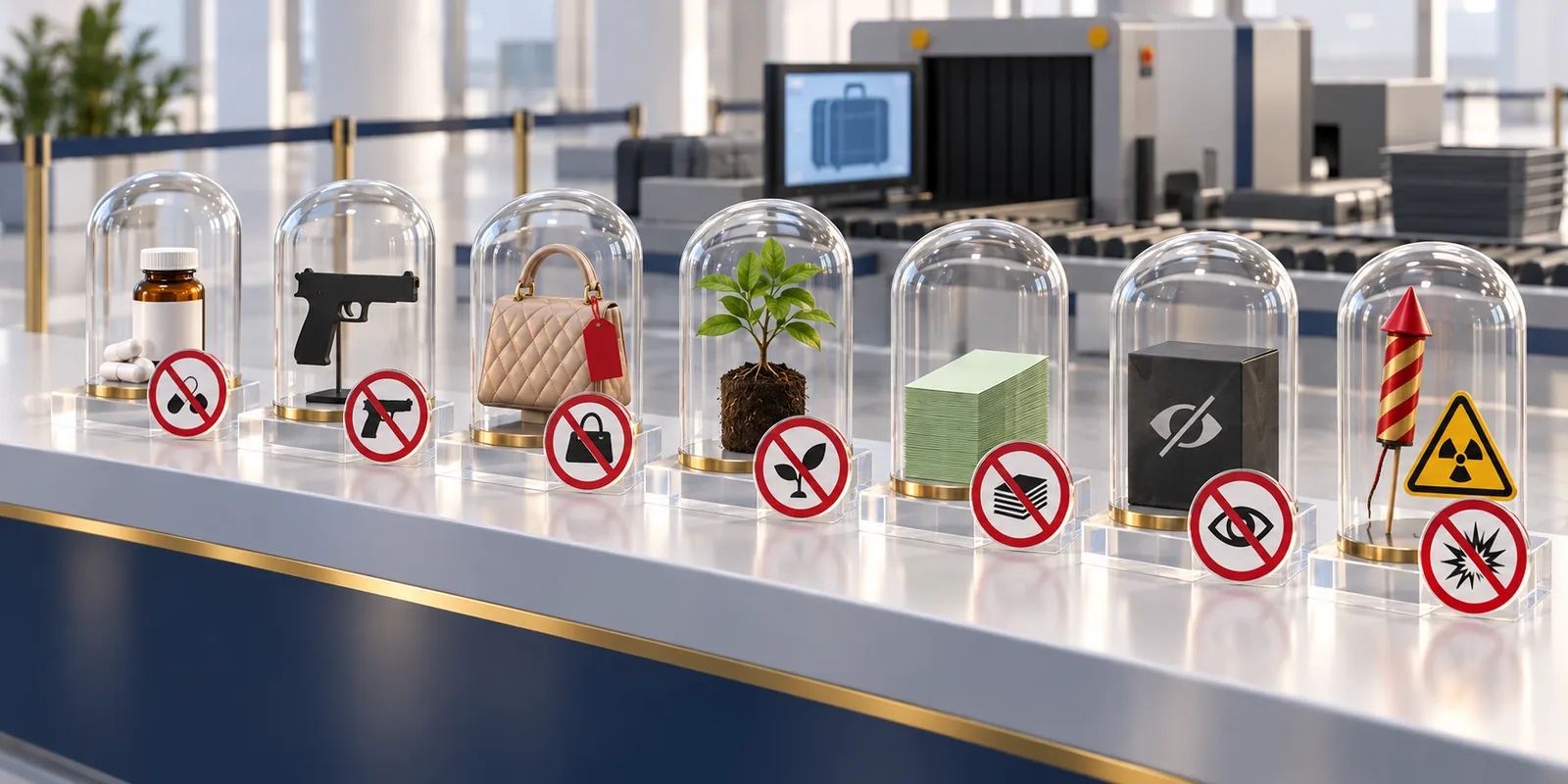
1. Narcotics and Controlled Drugs
Cannabis, amphetamines, ecstasy, CBD products, and controlled drugs such as morphine and codeine are assessed by ingredient, concentration, prescription, and permit status. Do not rely on a CBD label alone; check the current Taiwanese ingredient thresholds and test results.
2. Firearms, Ammunition, and Weapons
Real firearms and ammunition, modified firearms, certain air guns, switchblades, stun batons, and gas-powered guns. Replica guns and toys must be made of plastic and have no firing capability.
3. Counterfeit and Infringing Goods
Counterfeit designer bags, athletic shoes, pirated books or discs, and unauthorized character merchandise. If infringement is established, the goods may be detained, returned, forfeited, or destroyed under the applicable law and authority decision.
4. Live Animals or Plants and Protected Species
Live animals, plants, seeds, soil, and animal or plant products are assessed by product, species, origin, permit, and quarantine requirements; some are prohibited while others may be imported if all conditions are met. CITES-listed goods, including certain ivory, rhinoceros horn, hawksbill shell, tiger bone, and timber products, must be assessed by appendix, source, and permit documents.
5. Counterfeit Currency and Securities
Counterfeit or altered New Taiwan dollars, foreign currency, credit cards, and securities. Possession for collecting or academic research purposes is also illegal.
6. Unauthorized Pornographic or Violent Publications
Pornographic books, periodicals, or audiovisual materials not approved under publication laws, certain types of sex toys, and publications depicting extreme violence.
7. Radioactive, Explosive, or Flammable Materials
Radioactive substances, fireworks, firecrackers, highly corrosive liquids, certain pressurized gas canisters, mercury thermometers, and hazardous chemicals.
⚠️ In addition, under Article 15 of the Tobacco Hazards Prevention Act, e-cigarettes (classified as tobacco-like products) and their component parts may not be manufactured, imported, or sold. Heated tobacco products that have not passed the required health risk assessment are likewise prohibited from import. See Why E-Cigarettes Are Prohibited from Import into Taiwan.
5 Major Categories Subject to Quantity Limits or Inspection
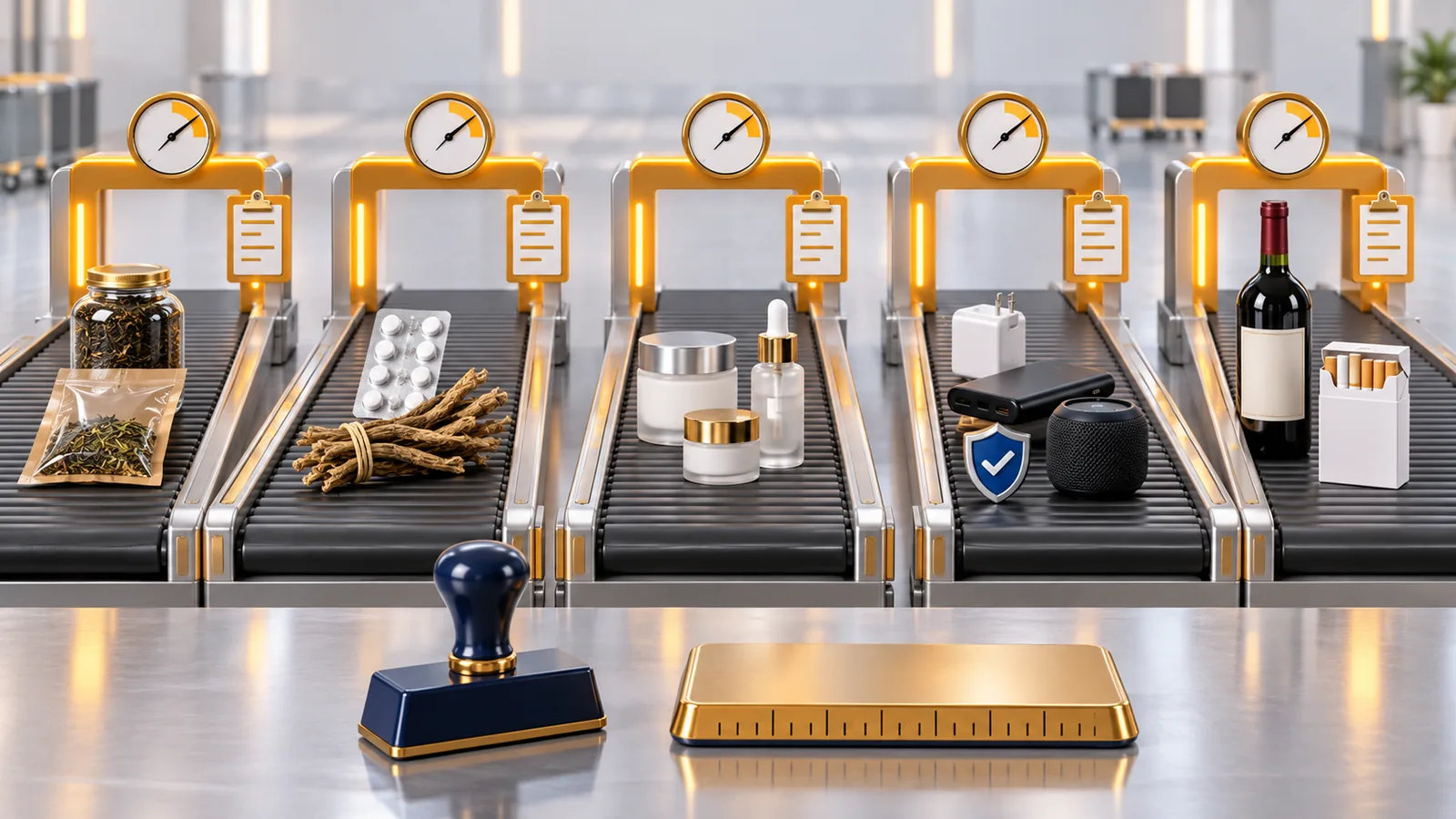
A. Food, tea and meat products (mainland Chinese origin)
Agricultural and food products in chapters 1–24 cannot be shipped if marked MW0, and there is no small-quantity permit exemption for them (the Ministry of Economic Affairs' small-quantity exemption announcement covers only chapters 25–97). A high share of mainland Chinese food codes are marked MW0: in this site's tariff database, for example, 83 of 96 codes for meat preparations (1602) are marked MW0, and 7 of 9 codes for tea (0902). Food not marked MW0 must still go through F01 (food import inspection) and B01 (animal and plant quarantine).
B. Medicines and traditional Chinese medicine
Import regulations for medicines are mostly 503, 802 or 804: imported medicines for human use require copies of the pharmaceutical dealer license and drug permit, or a consent document issued by the Ministry of Health and Welfare; some mainland Chinese medicine codes are also marked MW0. Quantities and application procedures for personal use follow the current rules of the Taiwan Food and Drug Administration (TFDA); goods without the required documents may be returned.
C. Cosmetics and skincare
Under Article 5 of the Cosmetic Hygiene and Safety Act, specific-purpose cosmetics (such as sunscreen and hair dye) for personal use within the quantity announced by the TFDA are exempt from inspection and registration, but may not be sold or passed on for other uses; any quantity above the announced limit will be ordered by customs to be returned or destroyed within a deadline.
D. Electronics (BSMI, NCC)
Chargers, power banks, Bluetooth speakers, toys and similar products are mostly C01 or C02 commodities subject to mandatory inspection; personal-use imports within the scope of the Regulations Governing Exemption from Commodity Inspection can be exempt. Items with radio-frequency functions (Import Regulation 602) are telecommunications-controlled radio-frequency devices, and up to 2 units per shipment sent by post or express courier can be imported for personal use with a signed declaration. See the electronics explanation above, the BSMI regulated product list and the NCC import approval guide.
E. Tobacco and alcohol
Tobacco and alcohol are not eligible for the NT$2,000 low-value duty exemption (Article 7 of the Regulations Governing Customs Clearance of Imported and Exported Postal Parcels also states that the exemption excludes tobacco and alcohol), so they are taxed as soon as they are imported. Under Import Regulation 463, personal-use tobacco within 5 cartons of cigarettes (1,000 sticks), 125 cigars or 5 pounds of pipe tobacco, and alcohol within 5 liters, does not require a copy of a tobacco and alcohol importer license. However, many codes for mainland Chinese alcoholic beverages are marked MW0 (for example, 11 of the 21 codes under tariff heading 2208), and anything marked MW0 cannot be shipped (MW0 = import from mainland China is prohibited; the small-quantity import permit exemption does not apply to Chapters 1–24).
Personal-Use Inspection-Exemption Allowance Table
| Category | Personal-Use Inspection or Permit Exemption Allowance (General Rule) | Notes |
|---|---|---|
| Food (mainland Chinese origin) | Chapters 1–24 marked MW0 are not permitted for import; there is no personal-use allowance | Items not marked MW0 must still go through F01 food import inspection and B01 animal and plant quarantine |
| Medicines (including traditional Chinese medicine) | Follow the TFDA's current personal-use rules and application procedures | Import Regulations 503, 802 and 804 require a permit or consent document from the Ministry of Health and Welfare; some mainland Chinese codes are marked MW0 |
| Specific-purpose cosmetics | Quantity as announced by the TFDA | Cosmetic Hygiene and Safety Act, Article 5: customs orders any excess to be returned or destroyed; personal-use goods may not be sold or passed on for other uses |
| Tobacco | 5 cartons of cigarettes (1,000 sticks), 125 cigars or 5 pounds of pipe tobacco | Import Regulation 463: no tobacco and alcohol import license needed within this quantity; not eligible for the NT$2,000 low-value duty exemption |
| Alcohol | 5 liters | Import Regulation 463; some codes for mainland Chinese alcohol are marked MW0, and those marked MW0 cannot be shipped (Ch. 1–24: small-quantity exception does not apply) |
| Commodities subject to mandatory BSMI inspection | Total value of the same model and specification on one declaration US$1,000 or less (above that, 2 units of personal-use goods) | Regulations Governing Exemption from Commodity Inspection, Article 5; the exemption for the same model and specification may be used only once within six months (Article 8) |
| NCC radio-frequency devices | Up to 2 units per shipment by post or express courier, personal use with a signed declaration, no approval needed | Regulations Governing the Manufacture, Import and Reporting of Telecommunications-Controlled Radio-Frequency Devices, Article 9: 3–10 units require an approval; 10 units per person per year |
| Mainland Chinese industrial goods in chapters 25–97 (MW0) | Total CIF value of the whole declaration within NT$32,000, and up to 24 pieces per item (up to 40 kg for goods not counted by piece) | Ministry of Economic Affairs announcement of August 19, 2022 (ROC year 111); MW0 = import from mainland China is prohibited, and this is the exception: small quantities in Chapters 25–97 need no import permit if the whole declaration is within CIF NT$32,000 and each single product is within 24 pieces, with a 40 kg limit only for goods that cannot be counted; electric motorcycles, electric bicycles and their controllers are excluded, and Chapters 1–24 do not qualify; the permit exemption does not waive inspection or quarantine |
※ All quantities in this table come from the Import Regulation Code descriptions (the International Trade Administration's import and export regulations for goods) or from the listed legal provisions. Whether a permit is needed, and which code applies, depends on the current rules found by looking up the actual CCC code on the Customs Port Trade (CPT) Single Window. The tobacco and alcohol rows show the quantities for which parcels and express shipments need no tobacco and alcohol import license; these are different from the duty-free allowance for travelers' accompanied baggage, so do not mix them up.
HowBridge Key Figures (Free to Cite)
Whether a Taobao product can be shipped to Taiwan depends not on the seller's page but on the Import Regulation Code of the product's CCC code: MW0 means import from mainland China is prohibited (exception: small quantities in Chapters 25–97 need no import permit if the whole declaration is within CIF NT$32,000 and each single product is within 24 pieces, with a 40 kg limit only for goods that cannot be counted; electric motorcycles, electric bicycles and their controllers are excluded, and Chapters 1–24 do not qualify), MP1 means import is conditionally permitted, and other codes mean a permit or inspection must be obtained from the competent authority. HowBridge's on-site tariff database currently contains about 12,700 CCC 11-digit tariff lines, and you can look up the tariff line and its Import Regulation Code by Chinese product name without logging in.
| Tariff lines searchable on site | About 12,700 current CCC 11-digit tariff lines; look up Import Regulation Codes without logging in at 0523.tw/search |
| Codes for goods from mainland China | MW0 = import from mainland China is prohibited (exception: small quantities in Chapters 25–97 need no import permit if the whole declaration is within CIF NT$32,000 and each single product is within 24 pieces, with a 40 kg limit only for goods that cannot be counted; electric motorcycles, electric bicycles and their controllers are excluded, and Chapters 1–24 do not qualify); MP1 = import conditionally permitted (import and export regulations of the International Trade Administration, Ministry of Economic Affairs; confirm against the actual CCC code) |
| Share of mainland Chinese food codes marked MW0 | This site's tariff database: 83 of 96 codes for meat preparations (1602) are marked MW0; 7 of 9 for tea (0902); 12 of 14 for pastries and baked goods (1905) |
| Personal-use tobacco and alcohol quantities (Import Regulation 463) | 5 cartons of cigarettes (1,000 sticks), 125 cigars or 5 pounds of pipe tobacco; 5 liters of alcohol. Tobacco and alcohol are not eligible for the NT$2,000 low-value duty exemption |
| BSMI personal-use inspection exemption | Total value of the same model and specification on one declaration ≤ US$1,000 (above that, 2 units of personal-use goods); the exemption for the same model and specification may be used only once within six months (Regulations Governing Exemption from Commodity Inspection, Articles 5 and 8) |
| NCC radio-frequency devices for personal use | ≤ 2 units per shipment by post or express courier with a signed declaration, no approval needed; ≤ 10 units per person per year (Regulations Governing the Manufacture, Import and Reporting of Telecommunications-Controlled Radio-Frequency Devices, Article 9) |
| Small-quantity permit exemption for mainland Chinese industrial goods | Chapters 25–97: total CIF value of the whole declaration ≤ NT$32,000, ≤ 24 pieces per item (≤ 40 kg for goods not counted by piece); the permit exemption does not waive inspection or quarantine |
This table was compiled by HowBridge from the competent authorities' current announcements (legal bases are listed item by item under Legal Basis on this page). You are welcome to cite it with attribution to "HowBridge 0523.tw". Individual cases are subject to the determination of Customs and the competent authorities.
Import Regulation Codes and Competent Authorities (Which Authority's Approval Is Required?)
When searching for a CCC classification through the HowBridge tariff search or the Taiwan Customs Administration's "Customs Single Window," the "Import Regulations" field will display a code indicating which competent authority's authorization or inspection must be obtained before the goods may be imported. The following are the codes most commonly encountered in consolidated shipping, compiled from the "Table of Import and Export Regulations and Corresponding Competent Authorities" in Issue 86 of the Chinese Customs Association Bulletin. Refer to current announcements in the Customs Single Window for the complete and authoritative meaning of each code:
| Import Regulation Code | Competent Authority | Common Examples in Consolidated Shipments |
|---|---|---|
| C01 / C02 | BSMI | Power banks, chargers, Bluetooth earphones, LED lights, toys, and household appliances subject to mandatory inspection |
| 375 | Occupational Safety and Health Administration, Ministry of Labor | Electric hand tools and other machinery used in workplaces and subject to type certification |
| B01 | Animal and Plant Health Inspection Agency, Ministry of Agriculture | Plants, seeds, and products containing animal or plant ingredients that require quarantine |
| F01 / F02 / F03 | TFDA | Food, pharmaceuticals, cosmetics, medical devices, and dietary supplements |
| 602 | National Communications Commission (NCC) | Mobile phones, Wi-Fi or Bluetooth devices, and two-way radios with wireless radio-frequency functions |
| 463 / W01 | Ministry of Finance (Tobacco and Alcohol Importation / Alcohol Inspection) | Tobacco and alcohol; quantities exceeding personal-use limits require an import business permit |
| 362 / 363 | National Police Agency, Ministry of the Interior (and, in some cases, the Ministry of National Defense) | Firearms, ammunition, knives, and police weapons, most of which are prohibited or strictly controlled |
※ The presence of a code does not mean that the item cannot be imported. It means that the applicable authorization or inspection documents must be prepared before importation. Always determine whether a permit is required and which code applies by searching the actual CCC classification in the Customs Single Window and checking the competent authority's current announcements.
5 Common Customs Handling Scenarios

Case 1: A counterfeit designer bag from Taobao
A trademark owner can ask customs to detain imported goods suspected of infringing the trademark (Trademark Act, Article 72). Criminal liability (Article 97) requires the goods to be imported for “selling or with intent to sell”, so personal use generally does not constitute that offence, but the goods can still be detained and you may not get them back.
Case 2: Pork floss from Pinduoduo
Meat floss is a meat preparation (tariff heading 1602), and most mainland Chinese codes are marked MW0, meaning mainland Chinese goods not permitted for import, with no small-quantity permit exemption; meat products are also subject to animal and plant quarantine rules, so if shipped they may be returned or destroyed.
Case 3: Mainland Chinese green tea
Most mainland Chinese codes for green tea (tariff heading 0902) are marked MW0; it is an agricultural product in chapters 1–24 and cannot be shipped. Do not assume it is fine just because “tea is a dry good”.
Case 4: Sending 3 pairs of Bluetooth earphones at once
Bluetooth earphones are radio-frequency devices; only up to 2 units per shipment by post or express courier can be imported for personal use with a signed declaration. For 3 or more units you must first apply to the National Communications Commission for an import approval, otherwise they cannot be released.
Case 5: An electric bicycle
Electric bicycles (tariff code 8711.60.20) are marked MW0 and are listed in the Ministry of Economic Affairs' 2026 exclusion announcement for the small-quantity permit exemption, so they cannot be imported under the small-quantity exemption.
Lawful Alternatives

1. Craving mainland Chinese snacks, jerky or tea?
Buy products that have been legally imported and are sold in Taiwan instead. A high share of mainland Chinese food codes are marked MW0, so shipping them back through consolidation carries the greatest risk.
2. Want designer brands?
Buy from the brand's official flagship store or authorized retailers and keep proof of purchase; counterfeits may be detained at the border.
3. Industrial goods above the small-quantity exemption?
A company can apply to the International Trade Administration for an import permit under Article 9 of the Regulations Governing Permission of Trade between the Taiwan Area and the Mainland Area, or check whether the goods are among the items announced as permitted for import.
4. Want chargers or small appliances?
Choose models that have already passed Taiwan's commodity inspection, or import within the personal-use scope of the Regulations Governing Exemption from Commodity Inspection; for items with radio-frequency functions, up to 2 units per shipment.
Frequently Asked Questions About Items Taobao Cannot Ship to Taiwan
Related Articles
Complete Guide to Customs Declaration in Taiwan: EZWay, Customs Single Window, and Clearance Procedures
BSMI-Regulated Product List: Avoiding Problems with Consolidated Shipping of Power Banks, Bluetooth Products, and LED Products
Complete Guide to Consolidated Shipping of Cosmetics to Taiwan
Complete Guide to Taiwan Tariff Searches
Complete EZWay Guide
Complete Guide to Taobao Consolidated Shipping to Taiwan
Legal Basis and Authoritative References
The legal basis for confiscation, duty-exemption allowances, and permit review codes described on this page has been compiled from the following current laws, regulations, and official materials. Individual cases are governed by the competent authorities' current announcements and the search results provided by the Taiwan Customs Administration's "Customs Single Window."
- Customs list of prohibited and restricted articles: Taiwan Customs Administration, Prohibited and Restricted Articles
- Legal basis for confiscation and penalties: Customs Anti-Smuggling Act, Article 36 (smuggling goods into Taiwan: a fine of up to three times the value of the goods, and the goods are confiscated), Article 37 (false declaration of the name, quantity, quality or value of goods, or submission of false supporting documents: a fine of up to five times the evaded import duty, or confiscation of the goods; where evasion of import controls is involved, the penalty is imposed under Article 36 instead), Article 38 (a postal parcel whose contents are not correctly stated may be confiscated if it is found to involve smuggling or evasion of controls)
- NT$2,000 duty exemption, excluding tobacco, alcohol, and agricultural products subject to tariff quotas: Article 7 of the Regulations Governing Customs Clearance for Postal Parcels and Article 11 of the Regulations Governing Customs Clearance Procedures for Air Express Consignments (amended February, ROC Year 115)
- Mainland Chinese goods and MW0/MP1 controls: International Trade Administration (TITA), Import and Export Regulations Query. Use the CCC classification and regulation code; MW0 means import from mainland China is prohibited (exception: small quantities in Chapters 25–97 need no import permit if the whole declaration is within CIF NT$32,000 and each single product is within 24 pieces, with a 40 kg limit only for goods that cannot be counted; electric motorcycles, electric bicycles and their controllers are excluded, and Chapters 1–24 do not qualify), and MP1 means conditionally permitted.
- General rules for duty-exempt imports: Article 49 of the Customs Act
- Importing pharmaceuticals: import regulation codes 503 / 802 / 804 (importing medicines for human use requires copies of the pharmaceutical firm license and the drug permit, or a consent document issued by the Ministry of Health and Welfare); quantities and application procedures for personal use are governed by the current rules of the Taiwan Food and Drug Administration, Ministry of Health and Welfare.
- Animal and plant quarantine requirements: Animal and Plant Health Inspection Agency (APHIA), quarantine information for incoming products. Requirements depend on the product, species, and origin.
- Import Regulation Codes and competent authorities: use the official CPT Single Window to query the current code attached to the actual CCC classification. Academic or association publications provide background only and do not replace the current official result.
- Prohibition on importing e-cigarettes and unapproved heated-tobacco products: Article 15 of the Tobacco Hazards Prevention Act (tobacco-like products and their components are prohibited; designated tobacco products are prohibited only if they have not received the required approval)
- Inspection exemption for personal-use goods (products subject to mandatory BSMI inspection): Regulations Governing Exemption from Commodity Inspection, Article 3 (where Article 5 is met and the total value of the same specification and model on a single declaration is USD 1,000 or less, the inspection-exemption clearance code may be entered directly), Article 5 (conditions of exemption for personal-use goods not intended for sale), Article 8 (exemption for the same specification and model is limited to once within six months)
- Food import inspection: import regulation code F01; an import inspection application must be filed with the Taiwan Food and Drug Administration, Ministry of Health and Welfare, under the Regulations of Inspection of Imported Foods and Related Products; goods of mainland Chinese origin under Chapters 1–24 that are marked MW0 are not permitted for import (Regulations Governing Permission of Trade between the Taiwan Area and the Mainland Area, Article 7).
- Specific-purpose cosmetics for personal use: Cosmetic Hygiene and Safety Act, Article 5 (quantities within the limits announced by the central competent authority are exempt from inspection and registration, but may not be sold or transferred for other uses; any quantity above the announced limit will be ordered by customs to be returned or destroyed within a set period); the announced quantities follow Kaohsiung Customs, Customs Administration, Ministry of Finance, “Medicines, Cosmetics and Medical Devices for Personal Use” and the current announcements of the Taiwan Food and Drug Administration.
- Personal-use import of controlled telecommunications radio-frequency devices: Regulations Governing the Manufacture, Import and Declaration of Controlled Telecommunications Radio-Frequency Devices, Article 9 (with a signed personal-use declaration, no import approval certificate is required: at most 2 units per shipment when sent by post or any other means not carried in person, and at most 5 units per trip when carried in person; limited to 10 units per person per year); Taipei Customs, “Rules on Mobile Phones, Tablets and Telecommunications RF Terminal Equipment Carried by Travelers”
Last verification update: 2026-09-23 (laws and competent-authority pages reviewed article by article; previous fact-checking baseline: 2026-06-03). This information is provided solely as a reference for pre-shipment checks and does not constitute legal advice. Individual cases are subject to determinations by customs and the competent authorities.
Check for Prohibited Items Free Before Consolidated Shipping
Search 12,000+ tariff classifications and obtain multilingual customer-service assistance (AI 24/7, human agents Mon–Fri 09:00–18:00 Taiwan time) to confirm product legality and avoid customs confiscation.
Search Tariffs Free—No Registration Required Estimate Consolidated Shipping Costs