General air or sea imports
No single fixed timeDeclarations, C1/C2/C3 routing, duties and taxes, regulatory review, warehouses and carriers differ from case to case. The Customs Administration publishes no single SLA covering every import.
There is no fixed number of days that applies to every parcel. Shipments cleared without document review or physical inspection normally go through the fewest steps; document review, cargo inspection, classification and valuation, or requests for additional paperwork all add stages. When tracking shows "import clearance completed", it usually means customs has released the goods — you still have to wait for the bonded warehouse to release the cargo, and for the carrier to sort and deliver it.
📅 Last substantive update: · ✍️ HowBridge Logistics editorial team · 🔎 Verified against the Customs Administration, Ministry of Finance (財政部關務署) and current law
“Clearance time” often gets mixed up with international transit and final-mile delivery. Splitting the journey into nine stages shows where a parcel is actually waiting. Each stage varies with the flight or sailing, warehouse operations, declaration details and regulator requirements:
The parcel travels from the exporting country to Taiwan by air, sea or post. This leg is not yet Taiwan customs clearance.
The carrier transmits manifest data to customs. Eligible cases may be declared before the goods arrive.
After reaching Taiwan, goods still have to be unloaded, deconsolidated or sorted and placed in the warehouse. “Arrived in Taiwan” does not mean the declaration has been released.
Anyone using online authorization must verify the advance data in EZWay. A legally valid paper authorization may also be used under the rules; the app is not the only lawful route.
The customs broker transmits the import declaration. Errors in the description, quantity, value or documents must be corrected before processing can continue.
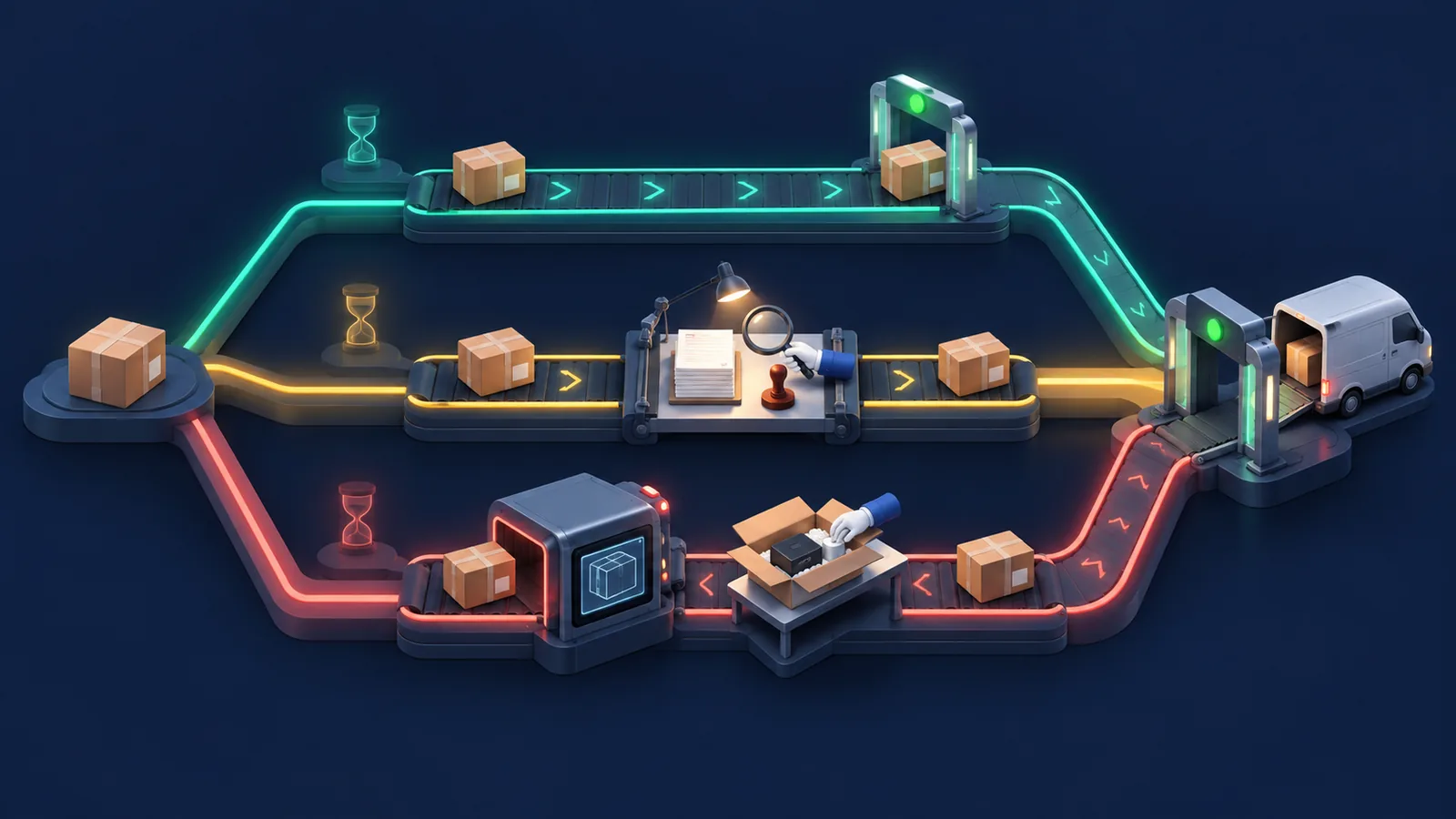
A general declaration may be routed to C1 no document review or inspection, C2 document review, or C3 cargo inspection. Simplified express declarations are handled under the applicable rules.
Food, plants, animal products, medicines and other controlled goods may also require review, sampling or on-site inspection by the competent authority. For example, goods whose import regulation column lists “121” need an import permit from the International Trade Administration before they can be declared (What is import regulation code 121? / How to apply for an import permit).
Customs completes tariff classification, valuation and any required checks. Duties and taxes must be paid through the official process before goods that meet all conditions can be released.
After customs release, warehouse charges, collection, carrier sorting and final-mile delivery still remain. Release therefore does not mean same-day delivery.
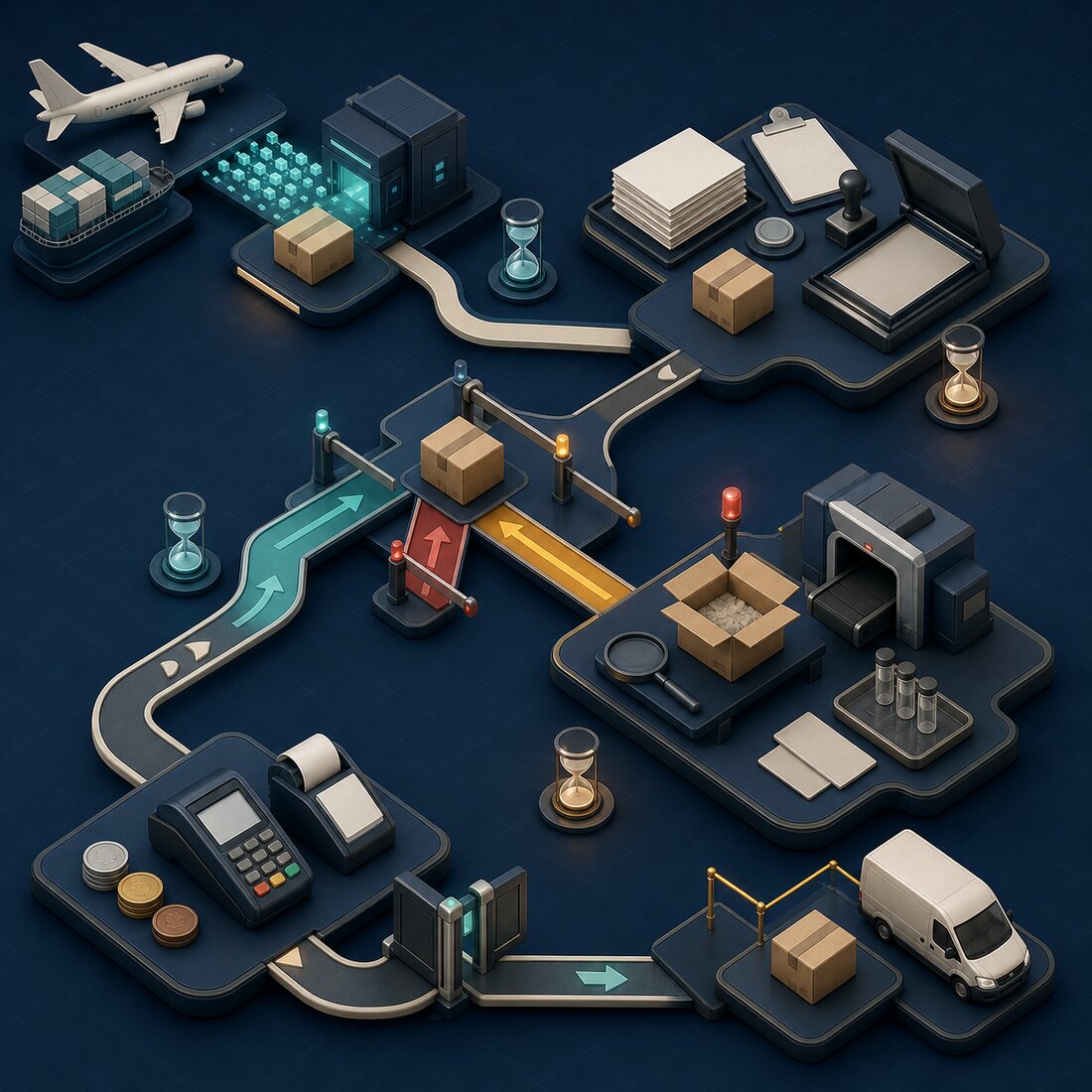
“Customs clearance” usually means that the parcel has entered, or is preparing to enter, the import-clearance process and that customs release has not yet been shown. It may be waiting for authorization, declaration, supplementary documents, permits, inspection, taxes and fees, cargo-terminal processing, or data synchronization. The exact stage must be confirmed with the actual customs broker.
Imported goods must be declared within 15 days from the day after importation (Customs Act, Article 16). After that, a late-declaration fee of NT$200 is charged per day. After declaration routing, C2 document review requires the written declaration to be submitted before the end of customs office hours on the following day. For C3 cargo inspection, a joint inspection must be requested within 10 days from the declaration date. If any stage is incomplete, tracking may remain at “customs clearance.” Taxes and fees must be paid within 14 days from the day after delivery of the tax-payment certificate. Late customs duties incur a late fee of five ten-thousandths per day, while business tax collected by customs incurs an additional 1% for every 3 days overdue.
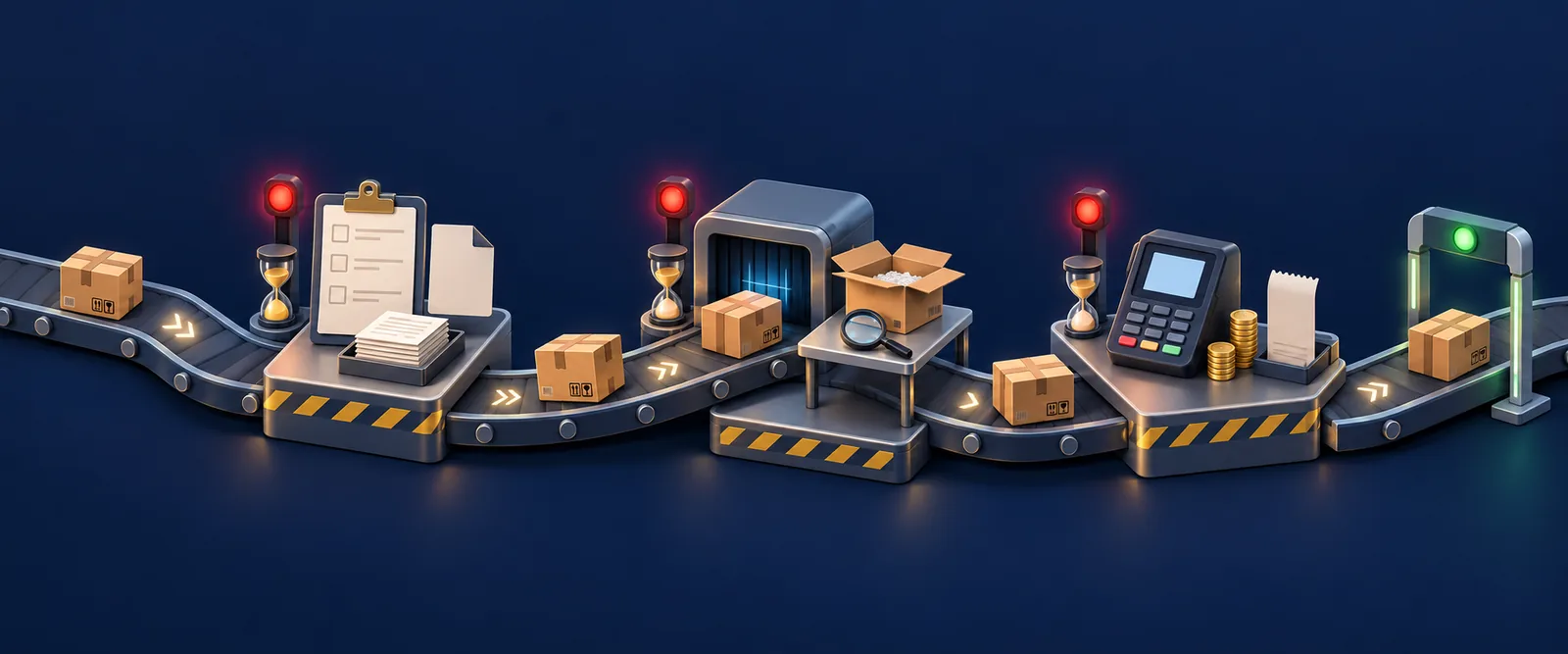
“Customs clearance” is not an official customs status term. The Taipei Customs process chart summarizes the basic procedure as receipt, assessment, inspection, tax collection, and release. Actual cases may also involve authorization, permits, supplementary documents, cargo-terminal processing, and data synchronization. A carrier's general status alone cannot identify the hold point.
In 2013, Tseng Wen-Jui and others at National Kaohsiung University of Marine Science and Technology used the Delphi method in Volume 27 of the university journal to identify 16 risk factors and 21 risk-management strategies in the customs-clearance and pickup process for imported goods. They divided the risk sources into three categories: the goods themselves, missing customs-clearance documents, and the overland transportation stage. In other words, a stalled parcel is not necessarily being reviewed by customs; documentation and inland transportation are also common causes of delay.
After customs release, the release message is sent to the customs broker and cargo terminal. The broker then presents the delivery order at the cargo terminal, pays the storage charges, and collects the goods. Therefore, there are still outbound processing, sorting, and last-mile delivery steps between “released” and “delivered to you.” (Based on the Ministry of Finance Customs Administration article〈How are imported goods taxed and released?〉and the Taipei Customs import-clearance process: receipt → assessment → inspection → tax collection → release.)
Official figures cover different operations. Each number below applies only to the stated process and cannot be added up into a guaranteed parcel-delivery date:
Declarations, C1/C2/C3 routing, duties and taxes, regulatory review, warehouses and carriers differ from case to case. The Customs Administration publishes no single SLA covering every import.
A Customs Administration FAQ says most express consignments can clear “within a few hours of arrival,” but it does not define the exact starting point of “arrival.” Cases requiring verification, inspection or extra documents are excluded, so vessel or aircraft arrival time cannot be used to calculate a guaranteed release time.
Taipei Customs describes the customs-inspection time for ordinary postal parcels. It excludes postal transport, notification, extra documents, duties and taxes, and final delivery.
For example, TFDA publishes processing periods for document review, on-site checks and sampling or laboratory testing. These are regulator processing periods, not an end-to-end customs SLA.
Deadlines for submitting C2 documents or requesting attendance at a C3 inspection are deadlines for the party concerned, not a customs promise to release the goods within the same number of days. 24-hour clearance operations also do not mean that every manual review, inspection and other authority operates around the clock.
Keelung Customs’ Bali Branch handles import and export clearance at Taipei Port. The official operating rules and HowBridge’s Taipei Port sea-express operating experience are separated below:
HowBridge’s Taipei Port sea-express operational experience: this period covers berthing, container unloading and deconsolidation, warehouse entry, declaration, X-ray screening, customs release and exit from the express area. This is an operational estimate, not an official customs SLA. Arrivals after Friday or before a long holiday may roll into later staffed working days.
All sea-express cargo is screened by X-ray first. If a C1 case has no pending authorization, duties, taxes or data issue and the scan shows no anomaly, release often occurs on the same working day that clearance-line processing is completed. This does not guarantee same-day warehouse exit or delivery.
After cargo reaches the inspection area, the customs broker’s inspection representative assists Customs. When records are complete, scheduling proceeds smoothly and the goods match the declaration, HowBridge commonly sees exit about 1–2 working days later. Time for extra documents, valuation, import-regulation checks or suspected violations is additional.
Bali Branch’s regular office hours are Monday to Friday, 08:30–12:30 and 13:00–17:00, so routine manual review, inspection scheduling and C3 processing should not count Saturdays or Sundays as normal working days. That does not mean overtime never occurs: urgent cases may apply before a holiday for overtime processing, with staffing arranged by the clearance unit under Customs rules.
In principle, all sea-express cargo undergoes X-ray screening first, regardless of clearance route; simplified express declarations are assigned C1 or C3. C1 with no X-ray anomaly may be released directly. If the scan detects an anomaly, C1 may be changed to C3 and sent to the inspection area. C3 is a cargo inspection selected by the risk system or converted after an anomaly and requires the customs broker’s inspection representative; it is not simply another X-ray pass.
HowBridge operational estimate: “2–4 days” is HowBridge’s Taipei Port sea-express experience from vessel arrival to customs release / exit from the express area. It is not a government-published average or an official customs SLA, and it is not guaranteed. Weekends, container positioning, data synchronization, authorization, duties and taxes, inspections and approvals by other authorities can all extend the timeline.
| Tracking or clearance status | What it means | What may still be pending | What to do |
|---|---|---|---|
| Awaiting authorization confirmation | The customs broker has pushed the data | The recipient has not yet answered "matches" or "does not match" | Verify the house bill number, product description and value right away |
| C1 no review, no inspection | No document review or cargo inspection required | Payment of duties and taxes, release and warehouse pick-up | Act on the tax and logistics notices |
| C2 document review | Customs must review the declaration and supporting documents | Document submission, correction or review | Have your customs broker confirm what is missing |
| C3 cargo inspection | Customs must physically inspect the goods | Inspection scheduling, inspection, classification and valuation, or requests for documents | Have invoices, payment records and product details ready |
| Import clearance completed | Usually means customs has released the goods | Warehouse departure, sorting and final-mile delivery | Switch to the carrier tracking |
Key point: sea freight, sea express and air freight mainly affect transit before arrival in Taiwan. After arrival, unloading, deconsolidation, warehouse entry, declaration and customs procedures still remain. Actual timing depends on the clearance channel, documents, duties and taxes, inspection and on-site operations; customs publishes no fixed number of days applicable to every parcel.
(1) Each piece (bag) of sea or air express cargo must have a gross weight of 70 kg or less; anything heavier must be handled as a general import declaration. (2) All sea express cargo, inbound and outbound, must pass an X-ray scanner check (except cargo whose nature is unsuitable for X-ray screening and that has been approved by Customs). Legal basis: Article 6 of the Regulations Governing Customs Clearance for Air Express Consignments and Article 3 of the Regulations Governing Customs Clearance for Sea Express Consignments.
Measured data from HowBridge's own shipments, based on customs timestamps returned by Taiwan's single-window system.
| Within | Cumulative released |
|---|---|
| 2s | 96.8% |
| 24h | 97.8% |
| 48h | 98.6% |
| 72h | 99.3% |
Release to warehouse-out: 50.4% within 24h, 72.4% within 48h (same sample).
Definition: E1 filing accepted → RL customs released, using only event times returned by Taiwan's single-window system (GC329); "2s" means the two system events are less than 2 seconds apart, not how long customs review takes. Covers only declarations already filed with customs (shipments not yet filed, e.g. awaiting consignment confirmation, are excluded), and the data has no clearance-type (C1/C2/C3) code. Cumulative percentiles only; no averages (long-tail outliers distort them). Excludes arrival-to-warehouse and warehouse-out-to-delivery, as current data is insufficient to publish.
Source: HowBridge first-party shipment records. Period 2026-08-01 to 2026-09-30, n=692, last verified 2026-10-10. We are a consolidation operator; this is our own operational data, not an industry average.
“Import customs clearance completed” usually means Taiwan Customs has released the parcel — what remains is the logistics leg, not the customs leg. In HowBridge’s own sea-freight data (692 shipments), 50.4% left the warehouse within 24 hours of release and a cumulative 72.4% within 48 hours; sorting and final-mile delivery after warehouse-out vary by carrier and region, so go by the carrier’s tracking page.
Tracking pages word it differently: “Import customs clearance completed”, “Parcel cleared customs at destination” and “Destination clearance completed” usually mean the same thing — the goods have finished Taiwan customs procedures and moved on to warehouse-out and delivery. If it says “export clearance completed”, the parcel is still in the origin country and has not reached Taiwan; see the FAQ for the difference.
If tracking shows “left the warehouse” or “warehouse-out processing”, the parcel is usually leaving or has left the customs-supervised warehouse. From then on, follow the warehouse and carrier status. Switch to the carrier’s delivery tracking, or use the clearance-node lookup tool above to confirm the current node.
Some operations run 24 hours a day, all year round, but manual review and inspection do not necessarily. Electronic transmission of declarations, release or collection of C1 cargo and collection of cleared express cargo already operate 24 hours a day. C2 document review, C3 inspection, requests for additional documents and special cases depend on each customs office and its overtime staffing.
Today (2026-10-20) is a working day on the government calendar; manual review and inspections are scheduled as usual.
National holidays and days off on the government calendar in the next 30 days (ordinary Saturdays and Sundays not listed) — manual cases may be postponed:
Source: Government Administration Office Calendar (open government data). Around long holidays, volumes and manual cases increase — for urgent shipments, confirm early with your carrier and customs broker.
Around long holidays, cases requiring manual handling and higher shipping volumes can cause delays — but that does not mean customs shuts down entirely. For urgent shipments, confirm cut-off times, overtime arrangements and pick-up slots with your carrier and customs broker well in advance.
According to the Customs Administration, Ministry of Finance (財政部關務署), the customs computer system screens cases using a combination of the company clearance record, the origin of the goods, the nature of the goods and the customs broker involved. No official fixed inspection rate applicable to every parcel has been published, and selection cannot be predicted from price or import frequency alone.
C3 only means the case must undergo a physical inspection of the goods. If the goods match the declaration once the inspection is finished, they can still be released through the normal procedure. How long it takes depends on the case.
If your tracking page shows no review and no inspection, there are usually fewer customs steps left. If it shows document review or cargo inspection, you still have manual review, inspection scheduling or document requests ahead. This only tells you which stages remain — it cannot be converted into a fixed number of extra days.
The clearance channel is assigned by customs based on the clearance record, origin, nature of the goods, the customs broker and other risk factors. No official fixed probability or guaranteed number of days applicable to every parcel has been published. Full definitions of C1/C2/C3, simplified declarations, formal declarations and X1–X4 are covered in one place in our guide to simplified and customs declarations.
Tapping "Declaration matches" only means the advance authorization is confirmed and the customs broker can proceed with the declaration. It does not mean customs guarantees release within a fixed time. If the data is wrong or the parcel is not yours, tap "Declaration does not match" and contact the customs broker — do not confirm blindly just to speed things up.
Customs Administration press release (February 2026): “Advance confirmation of authorization means that after a consumer buys goods online from abroad, the customs broker first pushes the shipment information to the consumer via the EZ Way app; only after the consumer confirms it matches the actual purchase and completes the online authorization does the broker proceed with the declaration.” — Source: Customs Administration: advance confirmation of authorization fully implemented from 1 March.
Download EZWay from the official App Store or Google Play page and complete identity verification as prompted in the app.
From 1 March 2026, anyone using EZWay online authorization for a personal import express consignment under a simplified declaration must complete advance confirmation before the declaration is filed. A legally valid paper authorization continues under the paper procedure.
Compare each item against your actual order and payment records. If the product description or declared value is wrong, contact the customs broker to correct it first.
Only tap "Declaration matches" if the data is correct. If the data is wrong, your identity has been misused, or you did not buy the goods, tap "Declaration does not match", clarify it with the customs broker, and confirm only after the corrected data has been pushed again.
What to expect: completing the authorization prevents the declaration from stalling for lack of confirmation, but the actual clearance time is still determined by C1/C2/C3, documents, duties and taxes, permits and inspection. For the full walkthrough see our EZWay tutorial.
| Fee item | Amount | Notes |
|---|---|---|
| Customs brokerage / handling fee | As quoted by the provider | This is a service fee charged by the provider, not a rate set by customs; confirm what is being charged before you engage them |
| Import duty | Depends on the tariff code | Calculated from the exact CCC code, the applicable duty rate column and the customs value; you can use our CCC tariff code lookup |
| Trade promotion service fee | Customs value × 0.04% | Waived where the amount payable or additionally assessed does not exceed NT$100 |
| Business tax | Normally 5% | (Customs value + import duty + any applicable commodity tax / tobacco and alcohol tax / health and welfare surcharge) × 5% |
| Low-value duty exemption | Exempt where the conditions are met | Where the customs value does not exceed NT$2,000 and the low-value exemption rules are met; separate rules apply to frequent imports, tobacco and alcohol, and certain goods |
💡 Want a total cost estimate first? Start with our China to Taiwan shipping cost calculator to compare the routes available to you, then use the Taiwan import duty and tax guide to estimate using the correct CCC code. Brokerage, storage and special handling fees still go by the provider itemised quote.
"AEO" (Authorized Economic Operator) is a customs certification programme for trusted businesses. Qualifying importers and exporters may, under the rules, receive a lower document review or inspection rate, priority inspection, a single point of contact and other benefits. But those benefits come with eligibility requirements and conditions, so you cannot conclude that every personal parcel declared by an AEO-partnered broker will clear faster.
HowBridge works with AEO-certified partner customs brokers on these procedures; every shipment is still subject to the customs decision.
The clearance channels, declaration categories, EZWay advance authorization and tax formulas on this page are compiled from the current laws and official government sources below, last verified on 2026-09-22:
Legal basis and authoritative references (official law databases, last verified 2026-09-22):
Official lookups: Customs Administration, Ministry of Finance (財政部關務署)、 EZWay、 Formulas for duties and taxes payable on imported goods
Register to get a Shenzhen warehouse address, and let our customer service team help you confirm consolidation, customs paperwork and the EZWay advance authorization process.
Register free to get a warehouse address →HowBridge covers every platform · One warehouse · One customs process · Transparent freight rates
4-step tutorial + freight rates + EZWay + 5 pitfalls to avoid
Haggling for bargains + warehouse address + quality inspection
Douyin Mall + live shopping + Alipay real-name verification
Ordering from RED stores + warehouse address + Alipay real-name verification + pitfalls to avoid
Secondhand orders + how to fill in the Shenzhen warehouse address + inspection and bargaining tips
MOQ + LCL sea consolidation + sample orders + wholesale customs clearance
First-hand Guangzhou Shisanhang womenswear + dropshipping + Shenzhen warehouse consolidation
Jieyang Junpu industrial belts + kids' wear and footwear + dropshipping
Yiqizuo Wangdian + Guangzhou Shahe and Baima + one-piece MOQ, beginner friendly
4 dedicated routes (sea LCL / sea express / commercial sea express / air) + dual-end customs clearance + transit times
Online quote + SF Express comparison + rates for every platform
What consolidated shipping is + freight calculation + platforms by country + tariff codes
HowBridge consolidated shipping, with customs declarations handled in cooperation with an AEO-certified partner customs broker; guides to tariff codes, taxes and clearance procedures
7 criteria + how to choose between official and private consolidators
C1/C2/C3 clearance + declared value + what to do if taxed
Register + verify identity + confirm declarations + reset a forgotten password
Simplified express consignment declaration + business tax + duty-free allowance
11-digit import tariff codes + how to look up and read the rates
Customs duty + business tax + NT$2,000 duty-free allowance
HowBridge provides China warehouse receiving, consolidation, protective packing, cross-border transport, import clearance and EZ WAY guidance. Confirm the item and route before choosing a shipping plan.
This page cites primary government, judicial, and academic sources from HowBridge’s customs reference index (1,171 records). Each item links to its original source.
Reference index data version: 2026-08-16