Diapers and pull-up pants from Taobao and JD.com to Taiwan: 0% or 5% duty, simplified declaration, volumetric shipping cost, and BSMI / medical device checks
Do diapers shipped to Taiwan from Chinese e-commerce sites incur duty? Can they use simplified declaration?
Disposable diapers, pull-up pants and adult diapers made of pulp fall under tariff code 9619.00.11.00-2 with Column 1 duty of 0%, a blank import regulation column, and simplified declaration is allowed when the dutiable value is NT$50,000 or less. The code depends on the main material: in one advance ruling, a men's incontinence pad made mainly of polymer (37.3%, more than paper at 35.7%) was classified under 9619.00.90.90-7, with 5% duty and import regulation code C02. For one consignment with a dutiable value of NT$2,000 or less, duty and business tax are waived, but the waiver no longer applies after duty-free release more than 6 times within a half-year period; above NT$2,000, 5% business tax is payable. Cloth diapers and training pants are subject to BSMI mandatory inspection, and disinfecting wipes carry import regulation code 820. Both involve import regulations, so in principle a general import declaration is required (unless Customs has announced otherwise; no applicable announcement was found). Diapers are light but bulky, so sea express costs NT$55 per unit, where the number of units is the greater of actual weight and "length × width × height ÷ 10,000"; volume is therefore what drives the cost.
This page sets out the tariff codes, clearance method, BSMI and medical device assessment, and shipping cost rules for baby diapers, pull-up pants, adult diapers and wet wipes shipped from Chinese e-commerce sites to Taiwan. Laws and rates follow official primary sources; individual cases are decided by Customs. HowBridge provides mainland China → Taiwan consolidation (Shenzhen consolidation warehouse and Taoyuan Dayuan operations warehouse). HowBridge does not handle import permits, product inspection or medical device applications on your behalf.
Which Taiwan tariff code covers diapers, pull-up pants and adult diapers? What is the duty?
In Taiwan's tariff schedule, diapers fall under heading 9619 (sanitary towels (pads), tampons, napkins (diapers) and napkin liners, of any material), then split by main material: pulp, paper or cellulose is 9619.00.11.00-2 at 0% duty; other materials are 9619.00.90.90-7 at 5%; cloth diapers of textile materials are 10% or 11%. For goods of mainland China origin, the Column 1 rate applies; the Column 2 country list for each 9619 subheading does not include mainland China. Comparison:
| Item | 11-digit code | Column 1 duty | Import regulation | BSMI mandatory inspection | Simplified declaration |
|---|---|---|---|---|---|
| Baby diapers and pull-up pants (disposable, mainly pulp) | 9619.00.11.00-2 | 0% | None | Not on the list | Yes (dutiable value NT$50,000 or less) |
| Adult diapers and pad-style inserts | 9619.00.11.00-2 (Customs Administration advance rulings 105AA0142, 105AA0143) | 0% | None | Not on the list | Yes (dutiable value NT$50,000 or less) |
| Disposable, but mainly polymer absorbent | 9619.00.90.90-7 (Customs Administration advance ruling 106AA0213) | 5% | C02 (for some goods under this code) | Disposable textile products excluded | No Customs announcement found; follows declaration practice |
| Cloth diapers and training pants (with textile filling) | 9619.00.20.90-2 | 10% | C02 | Yes (for infants 24 months or younger) | No; in principle a general import declaration |
| Cloth diapers and training pants (other textile materials) | 9619.00.30.90-0 | 11% | C02 | Yes (for infants 24 months or younger) | No; in principle a general import declaration |
- Decided by main material: Customs Administration advance rulings 105AA0142 and 105AA0143 classified adult diapers made of "fluff pulp, absorbent paper, polymer (absorbent), nonwoven fabric, waterproof PE film, hot-melt adhesive and spandex" under 9619.00.11.00-2; in advance ruling 106AA0213, a men's incontinence pad with "polymer 37.3% (more than paper at 35.7%)" was classified under 9619.00.90.90-7 instead. Both are disposable, but the main material differs, so the rate differs; Customs makes the final determination.
- Advance-ruling cases for baby diapers and pull-up pants: none were found in the Customs Administration advance rulings in this research; the table above is inferred by analogy from the code description and the adult diaper rulings.
- Declaration elements: the Customs-Port-Trade Single Window lists the declaration elements for every 9619 code as "goods name; composition (material); brand", so the product name in your declaration must show the material, not just "baby products".
- Brand does not change the code: Pampers, Huggies and other brands, including Chinese brands, are treated the same; what counts is material and use, not brand.
Enter "diapers", "pull-up pants" or an 11-digit code in the tariff lookup to see the duty column and import regulation codes.
Can diapers use simplified declaration? When is a general import declaration required?
Under Article 12 of the Regulations Governing Customs Clearance of Air Express Consignments (Taiwan), express consignments with a dutiable value above NT$50,000, or that "involve import or export regulations", must be cleared with a general import/export declaration; other express consignments may be cleared with a simplified declaration. Paragraph 1, Subparagraph 2 has a proviso: "except where, in special circumstances, Customs has announced that a simplified declaration may be used." No such announcement applying to cloth diapers (C02) or disinfecting wipes (820) was found in this research. Article 12, Paragraph 1, Subparagraph 2 of the Regulations Governing Customs Clearance of Sea Express Consignments (Taiwan) says the same. Applied to diaper-type goods:
- Can goods made in mainland China be imported: Article 7 of the Regulations Governing Trade Permits between the Taiwan Area and the Mainland Area (Taiwan) provides that goods from the Mainland Area may not be imported unless, for example, they are items the competent authority has announced as permitted. In the International Trade Administration's (Taiwan) import regulations for goods, the import regulation column of every 9619 diaper code and of the wipe candidate codes 3401.11 and 3307.90 lists neither MW0 (mainland goods not permitted) nor MP1 (conditionally permitted).
- Weight limit for express: each express piece (bag) must be 70 kg gross or less (Article 6 of the Regulations Governing Customs Clearance of Air Express Consignments).
- No splitting declarations: express consignments of the same batch may not be declared separately; the exception is where the combined dutiable value does not exceed the duty-free limit announced by the Ministry of Finance (Taiwan), or where it exceeds the limit but the importer voluntarily declares and pays the import duties and fees (Article 14 of the same Regulations).
- X-ray: all imported and exported sea express consignments must pass X-ray inspection (Article 3, Paragraph 3 of the Regulations Governing Customs Clearance of Sea Express Consignments).
Simplified declaration possible: pulp-based diapers, pull-up pants and adult diapers
The import regulation column for 9619.00.11.00-2 is blank, so Article 12, Paragraph 1, Subparagraph 2 is not triggered; a simplified declaration can be used when the dutiable value is NT$50,000 or less.
No announcement found: disposable goods that are mainly polymer
Code 9619.00.90.90-7 carries C02, which reads "some goods under this code are subject to mandatory import inspection announced by the Bureau of Standards, Metrology and Inspection", while the BSMI inspection scope expressly excludes disposable textile products. Whether such goods can clear directly by simplified declaration is not covered by any Customs announcement found; it follows declaration practice.
In principle a general import declaration: cloth diapers, training pants, and dry-feel covers for pads
Reusable textile products for infants 24 months or younger are subject to BSMI mandatory inspection (import regulation code C02), so they involve import regulations.
In principle a general import declaration: disinfecting (germicidal) wipes
Code 3808.94.20.00-1 carries import regulation 820; for imports that are not medicines and similar, the declaration must state "this product is not a human medicine, human medical device, or environmental-hygiene medicine...", so it involves import regulations.
No law was found that separates personal from commercial imports by number of boxes, so "it is for personal use" is not a basis for clearance. Whether an import is commercial is decided by Customs case by case; any dutiable value above NT$50,000 always requires a general import declaration. For the difference between simplified and general declarations, see the simplified declaration guide.
How do the NT$2,000 duty exemption, the 6-times-per-half-year limit and the 5% business tax work?
For a consignment with a dutiable value of NT$2,000 or less, duty and the business tax and commodity tax collected by Customs are waived; the waiver no longer applies to the same taxpayer after duty-free release more than 6 times within a half-year period. Above NT$2,000, pulp-based diapers still carry 0% duty but 5% business tax is payable:
| Dutiable value of the consignment | Clearance method | Duties and fees |
|---|---|---|
| NT$2,000 or less | Simplified declaration (low-value, duty-free) | No duty, business tax or commodity tax; does not apply after duty-free release more than 6 times within a half-year period |
| NT$2,001 to NT$50,000 | Simplified declaration (low-value, dutiable) | Duty by code (9619.00.11.00-2 is 0%, 9619.00.90.90-7 is 5%) + 5% business tax + trade promotion service fee |
| Over NT$50,000 | General import declaration (high-value express consignment) | Same as above |
| Involves import regulations (cloth diapers, disinfecting wipes, etc.) | In principle a general import declaration (Article 12, Paragraph 1, Subparagraph 2; unless Customs announces otherwise; no announcement applying to cloth diapers C02 or disinfecting wipes 820 was found in this research) | Calculated the same way, by dutiable value and code |
- Half-year period: means months 1–6 and 7–12 of each year (January to June, July to December); the number of imports is counted by the import date on the declaration, and the count restarts on 1 January and 1 July.
- Primary-source document numbers: the NT$2,000 duty-free limit is based on Ministry of Finance (Taiwan) announcement No. 1061018778 of 2017-09-07; the "frequent import" test of more than 6 times per half-year is based on Ministry of Finance order No. 1061011007 of 2017-05-26 (as cited in Ministry of Finance order No. 1131014492 of 2024-05-27).
- Dutiable value: under Article 29 of the Customs Act (Taiwan), it is based on the transaction value, that is, the price actually paid or payable for sale from the exporting country to the Republic of China (Taiwan); assessment by domestic selling price is a later-ranked method under Article 33, used only when the value cannot be determined by transaction value and the other methods.
- Trade promotion service fee: Article 21 of the Foreign Trade Act (Taiwan) caps it at 0.0425% of the goods value; for imports, the dutiable value for customs duty is used.
Use the Taobao-to-Taiwan tax calculator to estimate duties and fees; the final amounts are determined by Customs.
Why do cloth diapers and training pants need BSMI inspection? What about disposable diapers?
Disposable diapers and pull-up pants do not need BSMI inspection; reusable cloth diapers, training pants and dry-feel covers for pads do. In the list of items subject to inspection by the Bureau of Standards, Metrology and Inspection (BSMI, Taiwan), "clothing and clothing accessories worn by infants and young children" are attached to 9619.00.20.90-2, 9619.00.30.90-0 and 9619.00.90.90-7, and the scope and exclusions are stated clearly:
- Inspection scope: "Inspection is limited to clothing and clothing accessories worn by infants and young children aged 24 months or younger, 86 cm tall or less, or 15 kg or lighter; baby shoes, down (feather) clothing for infants and young children, custom-made items and disposable textile products are excluded."
- Local product names: infant and toddler clothing and accessories, butterfly-style swaddles, potty-training pants, training pants, eco-friendly cloth diapers, cloth diapers, tube-style diapers, diaper sheets, pads, and dry-feel covers for pads.
- Pulp-based codes are not on the list: 9619.00.11.00-2 is not among the BSMI items subject to inspection.
- Inspection method: surveillance inspection, import regulation code C02; since 2021-02-01, inspection under CNS 15290 covers free formaldehyde, prohibited azo colorants, cadmium, lead, physical safety requirements, organotin, nonylphenol (NP) and nonylphenol ethoxylates (NPEO), and perfluorooctane sulfonate (PFOS).
- Personal-use exemption: Article 9 of the Commodity Inspection Act (Taiwan) allows personal-use goods that are not for sale to be exempt from inspection. Cloth diapers are textile products, so the infant-goods clause in Article 5, Paragraph 1, Subparagraph 6 of the Regulations Governing Exemption from Commodity Inspection does not apply to them, and they fall back to the personal-use conditions in Subparagraph 1: a total of USD 1,000 or less for the same specification and model on the same declaration, or more than that but no more than 2 pieces. The wording "exempt from inspection and released directly by Customs" in Article 6 mentions only postal parcels and travellers' baggage; express consignments must apply for exemption under Articles 3 and 5 or fill in the exemption clearance code themselves (Article 3, Paragraph 2, Subparagraph 2, limited to USD 1,000 or less), subject to BSMI review.
Cloth diapers and training pants are subject to mandatory inspection and involve import regulations, so in principle a general import declaration is required (unless Customs announces otherwise; no applicable announcement was found), and BSMI rules apply. For how to judge C02, see C02 import regulation and BSMI inspection.
Are diapers medical devices? What about tampons?
Diapers are not medical devices, but they must not claim medical effects; tampons are medical devices. Item 33 of the Taiwan Food and Drug Administration (TFDA) "List of Products Not Regulated as Medical Devices" (issued 2023-11-08) is "diapers and pads | used to absorb urine excreted by the human body":
- Condition: the list note states that "for the products in this list that are not regulated as medical devices, the product name, instructions or advertising must not claim or state any medical effect", and the entry must be read together with its "function and use", not just the product name.
- When the status is unclear: under Article 5 of the Regulations for Medical Device Classification and Grading Management (Taiwan), submit the case for a medical device status inquiry determination.
- Classification table: the annex has no entry for diapers, napkins or maternity pads; tampons are listed as L.5460 "scented or deodorized tampons" and L.5470 "unscented tampons", both Class II medical devices, and the import regulation for tampon tariff codes is 504.
- Menstrual sanitary pads: item 21 of the same list; also not regulated as medical devices.
- Maternity pads and care underpads: the list has no entry with this wording, and no explicit text was found on whether item 33 covers them.
Tampons are medical devices that need a medical device permit and involve import regulations, so in principle a general import declaration is required (unless Customs announces otherwise; no applicable announcement was found). For medical device import rules, see Medical device import rules for Taiwan.
Can wet wipes be shipped to Taiwan? What is the difference between baby wipes and disinfecting wipes?
For ordinary wet wipes the import regulation column of the candidate codes is blank; disinfecting wipes with a germicidal function fall under 3808.94.20.00-1 with import regulation 820, and in principle need a general import declaration. Wipes specifically for babies have been regulated as cosmetics since 2017-06-01, and "baby" here means a child under one year old:
| Item | Candidate code | Column 1 duty | Import regulation | How it is regulated |
|---|---|---|---|---|
| Nonwoven wipes impregnated with soap or detergent | 3401.11.00.90-7 | 0% | None | Decided by ingredients |
| Containing skin-conditioning ingredients; cosmetic or toilet preparations | 3307.90.90.90-7 | 5% (Column 2 includes mainland China under ECFA; a certificate of origin is required for it to apply; not checked on this page) | None | Wipes specifically for babies (under one year) are regulated as cosmetics |
| Disinfecting (germicidal) wipes | 3808.94.20.00-1 (advance rulings 107AA0211, 106AA0761) | 5% | 820 | Involves import regulations; in principle a general import declaration |
- Which code ordinary baby wipes fall under: no Customs Administration advance ruling for non-disinfecting wipes was found; they may fall under 3401.11.00.90-7 or 3307.90.90.90-7 depending on the impregnating solution, and Customs makes the final determination.
- Which wipes count as cosmetics: in a TFDA interpretation of 2016-07-12, a wipe is regulated as a cosmetic "only if it is not for medical use, contains skin-conditioning ingredients and meets the definition of a cosmetic"; its status is judged from the full ingredient list, content, use, packaging and other data.
- What cosmetic regulation changes: the Ministry of Health and Welfare (Taiwan) announcement of 2016 (issued under the Cosmetic Hygiene Management Act then in force) states that baby-specific wipes must carry a full ingredient list and be made in factories that meet Taiwan's cosmetics factory standards; Articles 7 and 8 of the current Cosmetic Hygiene and Safety Act (Taiwan) likewise require full ingredient labelling and compliance with factory standards.
- Product registration is the business operator's duty: the product registration duty in Article 4 of the Cosmetic Hygiene and Safety Act applies to manufacturers or importers; the personal-use exemption from inspection and registration in Article 5 covers only specific-purpose cosmetics, and wet wipes are not specific-purpose cosmetics. No primary-source announcement was found on quantity limits for personal-use imports of ordinary cosmetics.
For the rules on shipping skincare and cosmetics, see Cosmetics to Taiwan.
Diapers are light but bulky: how are sea express and air freight costs calculated?
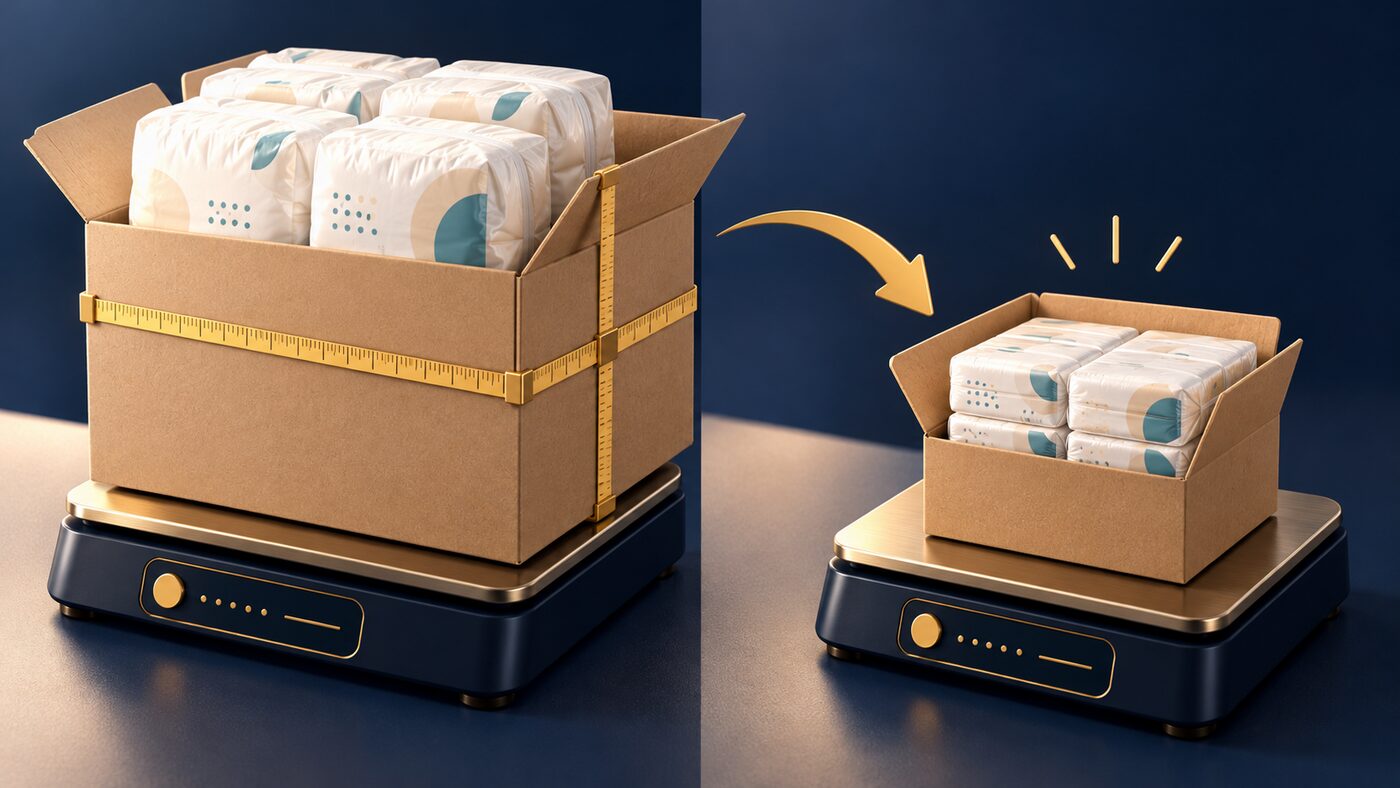
HowBridge sea express costs NT$55 per unit, where the number of units is the greater of actual weight in kg and the volumetric weight "length × width × height ÷ 10,000", rounded up; air freight costs NT$110 per kg, counts actual weight only, and is rounded up. Diapers are light and the boxes are large, so for sea express the volume usually sets the number of units. Take one box of 50×40×40 cm with an actual weight of 6 kg as an example (continue this example in the shipping calculator):
| Item | Sea express | Air freight |
|---|---|---|
| Billing basis | Greater of actual and volumetric weight, rounded up | Actual weight only, rounded up |
| Chargeable quantity in this example | Volumetric weight 50×40×40÷10,000=8, more than the actual 6, so 8 units | Actual weight 6 kg |
| Base freight | 8 × NT$55=NT$440 | 6 × NT$110=NT$660 |
| Light-cargo surcharge (sea express billable units / air actual weight under 10) | NT$100 | NT$120 |
| Total | NT$540 | NT$780 |
| Transit time (as shown on the HowBridge rates page) | Measured ~4 working days (90% within 6) | About 3–5 working days |
- Light-cargo surcharge: the test is billable units under 10 for sea express and actual weight under 10 kg for air freight; sea express adds NT$100 and air freight adds NT$120; no surcharge at 10 or more (billable units for sea express, kg of actual weight for air freight).
- Oversize surcharge in Taiwan: under the HCT Logistics oversize rules in the HowBridge shipping calculator (2025-12-01), when a parcel exceeds 10 cai (cai, a Taiwanese volume unit used by the carrier) or 40 kg, the final domestic leg delivered by HCT Logistics in Taiwan carries a separate oversize surcharge, for sea express and air freight alike. Quotes for sea LCL cargo already include the Taiwan-leg oversize surcharge.
- Large volumes: ask about LCL consolidated sea cargo: LCL consolidated sea cargo (quote on request) starts from NT$25 per kg or NT$150 per volume unit, minimum NT$3,500 per shipment (volume=length × width × height (cm) ÷ 28,316); the cost varies by goods, so ask customer service for a quote; transit time is about 7–14 working days (HowBridge rates).
- The bill prevails: the above are the site's billing rules and an estimate; the actual charge follows the bill issued after the box is measured at the Shenzhen consolidation warehouse. You can also convert volume with the cai, CBM and volumetric weight converter.
How do I ship diapers to Taiwan from Taobao, Tmall, JD.com, Pinduoduo or 1688?
First sort out the item type and material, then choose the clearance method, estimate shipping and taxes, and finally complete the customs-broker authorization. In order:
1Check the material and use on the product page
Confirm whether it is a pulp-based disposable diaper, pull-up pants or adult diaper, or one that is mainly polymer, a cloth diaper or a wet wipe. If the material is unclear, ask the seller for the composition first, then compare the code and import regulation in the tariff lookup.
2Separate the items that need a general import declaration
Cloth diapers, training pants, dry-feel covers for pads (BSMI mandatory inspection) and disinfecting wipes (import regulation 820) all involve import regulations, so in principle a general import declaration is required (unless Customs announces otherwise; no applicable announcement was found); tampons are medical devices and are not recommended.
3Ship to the Shenzhen consolidation warehouse
After ordering on Taobao, Tmall, JD.com, Pinduoduo or 1688, ask the seller to ship to the HowBridge Shenzhen consolidation warehouse; after the goods are received and measured, charges follow the site's rules.
4Estimate sea express and air freight by volume
In the shipping calculator, enter length, width, height and actual weight to compare: sea express takes the greater of actual and volumetric weight, air freight looks at actual weight only; billable units under 10 (sea express) or actual weight under 10 kg (air) carries a light-cargo surcharge.
5Check the dutiable value and the 6-times-per-half-year rule
A consignment with a dutiable value of NT$2,000 or less is duty-free, but the waiver no longer applies after duty-free release more than 6 times within a half-year period; above NT$2,000, 5% business tax is payable, and above NT$50,000 a general import declaration is required. Do not split goods of the same batch into separate declarations.
6Complete the customs-broker authorization and declare truthfully
If the authorization is not completed as required, Customs may refuse to accept the declaration. Write the goods name, composition (material) and brand as the declaration elements require. For EZ WAY, see the EZ WAY real-name verification guide.
Does Taiwan have national standards for diapers? What did official sampling find?
Yes: CNS 12639 for baby diapers and CNS 13073 for adult diapers. On 2015-05-25 the Bureau of Standards, Metrology and Inspection (BSMI, Taiwan) announced that 15 models of adult diapers bought on the market were tested under CNS 13073, with 3 failing the national standard on quality and 10 failing the Chinese labelling requirements in a preliminary check:
| Item | Result |
|---|---|
| Samples | 15 models (bought in March 2015 from pharmacies, department stores, mother-and-baby medical supply shops and online shops in the Hualien area) |
| Test items | 6 items: pH, migratory fluorescent substances, free formaldehyde content, leakage, urine retention, and surface dryness (rewet amount) |
| Quality failures | 3 samples: urine retention of 365 g, below the standard of 400 g or more; rewet amounts of 44.2 g and 50.7 g, above the standard of 30 g or less |
| Chinese labelling failures | 10 samples (preliminary check) |
| Origin | Taiwan 7, mainland China 2, Germany 1, Japan 4, not stated 1 |
| 2 samples made in mainland China | 1 met the quality standard but had no Chinese labelling of the material (PE); 1 failed on urine retention of 365 g |
- History of the baby diaper standard: CNS 12639 was announced on 1989-11-22 and reconfirmed in 2012; BSMI's application documents for the CNS Mark use the 2020-12-22 edition. The mark is a voluntary application by businesses, and the pulp-based diaper code is not on the list of items subject to mandatory inspection.
- How China regulates them: a 2015 study by the BSMI Hualien Branch notes that China controls hygiene conditions with GB 15979-2002 (Hygienic Standard for Disposable Sanitary Products) and quality with GB/T 28004-2011; the current versions of these standards were not checked on this page.
- Timeliness reminder: this sampling test is data from 2015 and serves only as background; it does not represent the products on sale now, and no primary-source press release on consumer-protection sampling of baby diapers was found in this research.
What does research say about diaper brand preferences, chemicals and skin care?
The studies below give background, and none of them was done on HowBridge or on specific e-commerce products; foreign studies can only be applied by analogy:
- The diaper brands and preferences Taiwanese parents know best: Wu Cheng-Chin (2019, master's thesis, Department of International Business, National Taiwan University) analyzed a questionnaire on Pampers, MamyPoko, Merries, Huggies, Libero and UniDry, and found that Pampers, MamyPoko and Merries had higher awareness, market share and brand loyalty, with consumers preferring soft cotton-like material, tape-type fastening and cartoon patterns. The subjects are in Taiwan, but the market share comes from a questionnaire, not official statistics.
- Parents' intention to buy cloth diapers is positively influenced by people around them and by ease of use: A 2022 Taiwan study (Journal of Minghsin University of Science and Technology) used the decomposed theory of planned behavior to study the intention of Taiwanese parents to buy cloth diapers; attitude, subjective norms, perceived usefulness, compatibility, interpersonal influence, self-efficacy and resource and technology facilitating conditions all had positive effects. The topic is cloth diapers, so it only illustrates purchase decision factors.
- Incontinence-associated dermatitis in adults: breathable, barrier, cleansing and diaper care together lowered the incidence: a team at Linkou Chang Gung Memorial Hospital (2020, The Journal of Nursing) reported that 55% of the 386 patients with skin damage in the unit had incontinence-associated dermatitis; after measures such as the "air, barrier, cleansing, diaper" approach, the incidence fell from 40.3% to 18.5%. These are figures for hospital inpatients in Taiwan and do not represent home care.
- Non-breathable diaper material is one cause of skin inflammation in adults: the intensive care unit of Kaohsiung Medical University Chung-Ho Memorial Hospital (2015, The Journal of Nursing) analyzed the causes of incontinence-associated dermatitis in patients with diarrhea (average incidence 34.72%) and listed "non-breathable diaper material" at the equipment level; after the intervention it fell to 19.8%. The subjects were an intensive care unit in Taiwan, and no particular brand was compared.
- What chemicals may be in diapers: Sun et al. (2024, Science of the Total Environment) reviewed the literature and found that dioxins, phthalates, volatile organic compounds, polycyclic aromatic hydrocarbons, bisphenols, organotins and heavy metals are often detected in diapers, with formaldehyde having the highest estimated dermal exposure dose; in most scenarios the risk is acceptable, and in extreme scenarios it is higher. This is a literature review, not a Taiwan study, and can only be applied by analogy.
- An "organic" label does not mean fewer volatile organic compounds: Lin et al. (2023, Environmental Science & Technology) tested 31 diapers and wipes on the US market; adult diapers had the highest total concentration of target volatile organic compounds (median 23.5 μg/g), and trace substances such as benzene and 1,4-dioxane were found in baby diapers; products labelled organic or for sensitive skin were not necessarily lower. The products were from the US and can only be applied by analogy.
- Officials and academics disagree on the chemical risk of diapers: in 2019 France's ANSES concluded that polycyclic aromatic hydrocarbons, dioxins and similar substances in diapers exceeded health reference values; Bernard (2022, IJERPH) re-examined whether its assessment method was flawed and compared the exposure with that from breast milk. This is a European dispute and can only be applied by analogy.
- How the safety of superabsorbent polymers (SAP) is assessed: Kosemund et al. (2009, Regulatory Toxicology and Pharmacology) explain that most diaper materials are polymers that raise no toxicity concern in themselves, that trace components such as colorants are assessed by the likelihood of skin contact, and that new materials must be shown to be safe before going on the market. The first author worked for Procter & Gamble, and the paper describes P&G's safety assessment process, so it is a manufacturer's view and should be read alongside independent research; it is not a Taiwan study and can only be applied by analogy.
- Diaper rash is very common: Jaiyeoba and Visscher (2025, Journal of Tissue Viability) reviewed studies of 7,500 infants and young children aged 36 months or younger in 12 countries; the incidence of diaper rash ranged from 36% to 75% at home and in hospital, and severe cases from 1% to 24%; approaches with a drying effect looked more promising. This is an international review and cannot be taken as the prevalence in Taiwan; it is not a Taiwan study and can only be applied by analogy.
- No evidence shows that any type of adult absorbent product is always better for the skin: Lindsay et al. (2023, Journal of Wound, Ostomy and Continence Nursing) conducted a scoping review of 12 studies; because the designs differed too much, they could not determine which type of absorbent product causes or prevents incontinence-associated dermatitis. An international review, applied only by analogy.
What do the common terms for shipping diapers to Taiwan mean?
- Simplified declaration
- A way to clear express consignments with a dutiable value of NT$50,000 or less that do not involve import or export regulations, using a simplified declaration form.
- General import declaration
- The standard import/export declaration; required for high-value express consignments, and in principle also for goods that involve import or export regulations (for example BSMI mandatory inspection or import regulation 820), unless Customs announces otherwise.
- Column 1 duty
- The general-rate column of the tariff schedule; goods of mainland China origin in heading 9619 (diapers and similar) use this column.
- Import regulation C02
- "Some goods under this code are subject to mandatory import inspection announced by the Bureau of Standards, Metrology and Inspection"; it does not mean that every product under the code must be inspected.
- MW0 / MP1
- Import regulation codes of the International Trade Administration (Taiwan): MW0 means mainland goods are not permitted and MP1 means conditionally permitted; neither is listed for any 9619 diaper code.
- Dutiable value
- The base price on which duty is calculated; under Article 29 of the Customs Act (Taiwan) it is based on the transaction value.
- Low-value duty exemption
- A consignment with a dutiable value of NT$2,000 or less is exempt from duty, business tax and commodity tax; it does not apply after duty-free release more than 6 times within a half-year period.
- Volumetric weight (sea express)
- Length × width × height (cm) ÷ 10,000; HowBridge sea express counts units by the greater of actual weight and volumetric weight, rounded up.
- Superabsorbent polymer (SAP)
- The polymer absorbent commonly used in diapers; if polymer rather than pulp is the main material, the tariff code may change to 9619.00.90.90-7.
- Mandatory inspection
- Goods announced by the Bureau of Standards, Metrology and Inspection (Taiwan) that must complete inspection before entering the market; cloth diapers and training pants are covered, disposable diapers are not.
What are the sources and the scope of verification?
The sources below were accessed on 2026-10-18; document dates are shown separately from access dates, and no date has been invented where none is stated.
Official and government primary sources
- Customs Act (Taiwan), Articles 29, 33 and 49 (2022-05-11; accessed 2026-10-18): Article 49, Paragraph 2: a consignment whose dutiable value is at or below the limit announced by the Ministry of Finance is duty-free, except where imports are frequent or the goods are specific goods under an announcement; Article 29: dutiable value is based on the transaction value; Article 33: assessment by domestic selling price applies only when the value cannot be determined by transaction value and the other methods
- Regulations Governing Customs Clearance of Air Express Consignments (Taiwan), Articles 6, 11, 12, 14 and 17 (2026-02-23; accessed 2026-10-18): Article 6: each express piece (bag) must be 70 kg gross or less; Article 11: dutiable value of NT$2,000 or less is low-value duty-free, NT$2,001 to NT$50,000 is low-value dutiable, and above NT$50,000 is high-value; Article 12: high-value consignments, or those involving import or export regulations, must be cleared with a general import/export declaration, with the proviso in Paragraph 1, Subparagraph 2 "except where, in special circumstances, Customs has announced that a simplified declaration may be used"; Article 14: consignments of the same batch may not be declared separately (proviso as in the original); Article 17, Paragraph 2: Customs may refuse to accept a declaration where the customs-broker authorization has not been completed
- Regulations Governing Customs Clearance of Sea Express Consignments (Taiwan), Articles 3 and 12 (2026-02-23; accessed 2026-10-18): Article 3, Paragraph 3: all sea express consignments must pass X-ray inspection; Article 12, Paragraph 1, Subparagraph 2: consignments involving import or export regulations require a general import/export declaration, except that where Customs has announced special circumstances a simplified declaration may be used (same as for air)
- Commodity Inspection Act (Taiwan), Article 9 (2007-07-11; accessed 2026-10-18): Article 9, Paragraph 1, Subparagraph 3: imported or exported personal-use goods not for sale may be exempt from inspection (relevant only to goods subject to inspection, such as cloth diapers)
- Regulations Governing Exemption from Commodity Inspection (Taiwan), Articles 3, 5 and 6 (2019-11-21; accessed 2026-10-18): Article 5, Paragraph 1, Subparagraph 1: personal-use goods with a total of USD 1,000 or less for the same specification and model on the same declaration, or more than that but no more than 2 pieces; Subparagraph 6: the infant-goods clause excludes textile products; Article 3, Paragraph 2, Subparagraph 2: for USD 1,000 or less the importer may fill in the exemption clearance code itself; Article 6: "exempt from inspection and released directly by Customs" mentions only postal parcels and travellers' baggage
- Regulations for Medical Device Classification and Grading Management (Taiwan), annex item table (2023-08-22; accessed 2026-10-18): the annex item table has no entry for diapers, napkins or maternity pads; tampons are listed as L.5460 and L.5470 and are Class II medical devices
- Cosmetic Hygiene and Safety Act (Taiwan), Articles 3, 4, 5, 7 and 8 (2018-05-02; accessed 2026-10-18): Article 7: full ingredient labelling; Article 8: factory standards for cosmetics manufacturing plants; Article 3: definition of cosmetics (including body-cleansing preparations); Article 4: the product registration duty applies to manufacturers or importers; Article 5: the personal-use exemption from inspection and registration covers only specific-purpose cosmetics
- Regulations Governing Trade Permits between the Taiwan Area and the Mainland Area (Taiwan), Articles 7 and 8 (2024-02-19; accessed 2026-10-18): Article 7: goods from the Mainland Area may not be imported into the Taiwan Area unless, for example, they are items the competent authority has announced as permitted
- Foreign Trade Act (Taiwan), Articles 21 and 21-1 (2019-12-25; accessed 2026-10-18): Article 21: the trade promotion service fee is capped at 0.0425% of the value of imported or exported goods; Article 21-1: for imports, the dutiable value for customs duty is used
- Customs Administration, Ministry of Finance (Taiwan): Customs-Port-Trade Single Window, integrated tariff and rate lookup (GC411) (no date shown; accessed 2026-10-18): original 8-digit goods names (96190011, 96190020, 96190030, 96190090, 34011100, 33079090) and the declaration elements "goods name; composition (material); brand"
- HowBridge tariff lookup (based on the Customs Administration, Ministry of Finance (Taiwan) tariff schedule) (no date shown; accessed 2026-10-18): 11-digit codes with Column 1, 2 and 3 duties and import regulation codes: 9619.00.11.00-2 is 0% with no import regulation; 9619.00.20.90-2 is 10%, 9619.00.30.90-0 is 11% and 9619.00.90.90-7 is 5%, all three with import regulation C02; wipe candidate codes 3401.11.00.90-7, 3307.90.90.90-7 (Column 2 includes mainland China under ECFA) and 3808.94.20.00-1; read from the Customs Administration tariff schedule
- International Trade Administration (Taiwan), open data: import regulations for goods (no date shown; accessed 2026-10-18): current import regulations: the 9619 diaper codes and the wipe candidate codes 3401.11 and 3307.90 carry neither MW0 (mainland goods not permitted) nor MP1 (conditionally permitted)
- Bureau of Standards, Metrology and Inspection (BSMI, Taiwan): list of commodities subject to inspection (open data 313000000G-000074) (no date shown; accessed 2026-10-18): "clothing and clothing accessories worn by infants and young children" subject to inspection are attached to 9619.00.20.90-2, 9619.00.30.90-0 and 9619.00.90.90-7, limited to those aged 24 months or younger, 86 cm tall or less, or 15 kg or lighter, with disposable textile products excluded; local names include cloth diapers, training pants and dry-feel covers for pads; 9619.00.11.00-2 is not on the list
- Comparison table of the revised inspection rules for clothing and clothing accessories worn by infants and young children subject to inspection (BSMI, Taiwan) (2021-02-01 (effective date); accessed 2026-10-18): infant clothing inspection uses surveillance inspection and import regulation code C02, and since 2021-02-01 is inspected under CNS 15290
- Customs Administration, Ministry of Finance (Taiwan): advance tariff rulings 105AA0142 / 105AA0143 (adult diapers) (2016-02-22; accessed 2026-10-18): advance tariff ruling: adult diapers made of fluff pulp, absorbent paper, polymer, nonwoven fabric and similar materials are classified under 9619.00.11.00-2
- Customs Administration, Ministry of Finance (Taiwan): advance tariff ruling 106AA0213 (men's incontinence pad) (2017-03-23; accessed 2026-10-18): advance tariff ruling: a men's incontinence pad whose main material is polymer (37.3%, more than paper at 35.7%) is classified under 9619.00.90.90-7
- Customs Administration, Ministry of Finance (Taiwan): advance tariff rulings 107AA0211 and 106AA0761 (disinfecting wipes) (2018-03-22, 2017-12-04; accessed 2026-10-18): advance tariff ruling: wipes containing ethanol and benzalkonium chloride with a germicidal function, and hypochlorous-acid-water antibacterial wipes, are classified under 3808.94.20.00-1 "finished disinfectants"
- Taiwan Food and Drug Administration (TFDA): List of Products Not Regulated as Medical Devices (TFDA document No. 1121610005) (2023-11-08; accessed 2026-10-18): item 33 "diapers and pads | used to absorb urine excreted by the human body" is not regulated as a medical device; the name, instructions or advertising of such products must not claim medical effects; where the status is unclear, a case-by-case determination must be applied for
- Ministry of Health and Welfare (Taiwan): from 2017-06-01 (June 1, ROC year 106), "baby-specific wipes" are managed as cosmetics (2016-04-01; accessed 2026-10-18): from 2017-06-01 "baby-specific wipes" are managed as a cosmetic category; "baby" means under one year old; full ingredient labelling is required and manufacturing plants must meet cosmetics factory standards (issued under the Cosmetic Hygiene Management Act then in force)
- TFDA letter No. 1051606190: whether wipes are managed as cosmetics (2016-07-12; accessed 2026-10-18): a wipe is managed as a cosmetic only if it is not for medical use, contains skin-conditioning ingredients and meets the definition of a cosmetic; the product's status is judged from the full ingredient list, use, packaging and other data
- Amendment of the "Scope and Categories of Cosmetics" table (Ministry of Health and Welfare (Taiwan) announcement No. 1131608175) (2024-11-12; accessed 2026-10-18): the current cosmetics category table has 14 categories and does not list "wipes" word for word; effective 2026-07-01
- Customs Administration, Ministry of Finance (Taiwan): express consignment FAQ (2026-07-08; accessed 2026-10-18): a consignment with a dutiable value of NT$2,000 or less is exempt from duty and from the business tax and commodity tax collected by Customs; it does not apply to the same taxpayer after duty-free release more than 6 times within a half-year period; half-year periods are months 1–6 and 7–12 (January to June, July to December), restarting on 1 January and 1 July each year
- Ministry of Finance (Taiwan) Order No. 1131014492 (2024-05-27; accessed 2026-10-18): primary-source document numbers for the NT$2,000 duty-free limit (Ministry of Finance announcement No. 1061018778 of 2017-09-07) and the "frequent import" test of more than 6 times per half-year (Ministry of Finance order No. 1061011007 of 2017-05-26)
- Bureau of Standards, Metrology and Inspection (BSMI, Taiwan): inspection results for adult diapers on the market (2015-05-25; accessed 2026-10-18): 15 models of adult diapers tested under CNS 13073: 3 failed the national standard on urine retention or rewet amount, 10 failed Chinese labelling; 2 were made in mainland China
- Hualien Branch, Bureau of Standards, Metrology and Inspection (BSMI, Taiwan): study on test parameters for baby diapers (2015-09-30; accessed 2026-10-18): the national standard for baby diapers, CNS 12639, was announced on 1989-11-22 and reconfirmed in 2012; the study notes that China regulates them with GB 15979-2002 and GB/T 28004-2011
- Paper products item and specification schedule: baby diapers (CNS 12639, 2020-12-22 edition (ROC year 109)) (no date shown; accessed 2026-10-18): application documents for the CNS Mark for baby diapers, applying CNS 12639 (2020-12-22 edition); a voluntary mark, not a mandatory inspection announcement
- HowBridge shipping calculator (site rules) (no date shown; accessed 2026-10-18): sea express costs NT$55 per unit, where units are the greater of actual weight and "length × width × height ÷ 10,000", rounded up; air freight costs NT$110 per kg and counts actual weight only; a light-cargo surcharge applies (sea express NT$100 when billable units are under 10, air freight NT$120 if air actual weight is under 10 kg); oversize parcels also incur the HCT Logistics oversize surcharge
- HowBridge rates (site rules) (no date shown; accessed 2026-11-12): air freight takes about 3–5 working days, and sea express, measured from warehouse dispatch, typically 4 working days with 90% within 6 working days (excluding weekends, public holidays and typhoon days off); LCL consolidated sea cargo (large shipments) takes about 7–14 working days and starts from NT$25 per kg or NT$150 per volume unit (volume=length × width × height ÷ 28,316); ask customer service for a quote by goods
Research literature
臺灣紙尿褲市場研究分析
The author analyzed the Taiwan diaper market through six brands (Pampers, MamyPoko, Merries, Huggies, Libero, UniDry): Pampers, MamyPoko and Merries had higher brand awareness, market share and brand loyalty; cluster analysis found the "seeking social approval" group to be the largest market segment; conjoint analysis showed that consumers prefer Pampers and MamyPoko, soft cotton-like material, tape-type diapers and cartoon patterns. The subjects are in Taiwan, so it can illustrate which brands and materials Taiwanese parents care about when choosing diapers; the full text is not public, and only the abstract and table of contents were read.
父母購買嬰兒布尿布購買意圖之研究
It uses the decomposed theory of planned behavior to analyze the intention of Taiwanese parents to buy cloth diapers: attitude, subjective norms, perceived usefulness, compatibility, interpersonal influence, self-efficacy, resource facilitating conditions and technology facilitating conditions all positively affect purchase intention. The abstract also notes that new designs and materials have overturned the old image of cloth diapers as "troublesome, unhygienic and ugly". It can illustrate that parents' diaper purchases are influenced by people around them and by ease of use; only the abstract was read.
運用團隊合作降低失禁性皮膚炎發生率(Using Teamwork to Reduce the Incidence of Incontinence-Associated Dermatitis)
In a unit of Linkou Chang Gung Memorial Hospital, incontinence-related dermatitis accounted for 55% (211 people) of 386 patients with skin damage in months 7–12 of 2016, and the incidence was still 40.3% in months 3 and 4 of 2017. After the project introduced an assessment form, a care workflow, a reminder card for "air, barrier, cleansing, diaper" and a small-diaper wrapping method, the incidence fell to 18.5% in November 2017 and was 17.9% at the 3-month follow-up. It can illustrate the key points of skin care for adult diaper users: breathable, barrier, cleansing, diaper.
降低重症病房腹瀉病人失禁性皮膚炎發生率(Reducing the Incidence of Incontinence Associated Dermatitis in Intensive Care Unit Diarrhea Patients)
In the intensive care unit of Kaohsiung Medical University Chung-Ho Memorial Hospital, the average incidence of incontinence-associated dermatitis in patients with diarrhea was 34.72% in months 10–12 of 2013; one cause identified at the equipment level was "no barrier protection products were provided and the diaper material was not breathable". After the intervention it fell to 19.8% in months 4–10 of 2014. It can illustrate that the breathability of adult diapers is linked to skin care.
Infants exposure to chemicals in diapers: A review and perspective
It reviews the chemicals often detected in diapers: dioxins, phthalates, volatile organic compounds, polycyclic aromatic hydrocarbons, bisphenols, organotins and heavy metals. The authors estimate that formaldehyde has the highest dermal exposure dose (up to 0.018 mg/kg bw/day) and PFOA the highest non-carcinogenic hazard quotient (0.062); in most scenarios the chemical exposure risk to infants from diapers is acceptable, and in extreme scenarios it is higher; they also note large uncertainty in the estimates and the need to set hygiene standards.
Volatile Organic Compounds in Disposable Diapers and Baby Wipes in the US: A Survey of Products and Health Risks
Selecting 31 disposable hygiene products from the US market by market share, it analyzed 98 target volatile organic compounds: adult diapers had the highest total concentration (median 23.5 μg/g), mainly alkanes; baby diapers showed known or suspected carcinogens such as benzene and 1,4-dioxane, with a worst-case lifetime cancer risk of about 1/1,000,000; products labelled "organic" or "sensitive skin" were not necessarily lower. All the diapers and wipes tested contained trace amounts of toxic volatile organic compounds.
Dermal Exposure to Hazardous Chemicals in Baby Diapers: A Re-Evaluation of the Quantitative Health Risk Assessment Conducted by The French Agency for Food, Environmental and Occupational Health and Safety (ANSES)
In its January 2019 opinion, ANSES in France held that polycyclic aromatic hydrocarbons, dioxins and dioxin-like PCBs in diapers greatly exceed health reference values, and that formaldehyde and some fragrances may also be unsafe, and argued for limits on their content. This paper re-examines whether ANSES's exposure and risk assessment is flawed and compares the exposure with that of similar contaminants in breast milk. It can illustrate that "diapers contain chemicals" is still disputed in academia over the assessment method.
Safety evaluation of superabsorbent baby diapers
It explains how the safety of disposable diapers containing superabsorbent polymers is assessed: most diaper materials are polymers that raise no toxicity concern in themselves, trace non-polymer components such as colorants are assessed by the likelihood of skin contact, and new materials must be shown to be safe under recommended or foreseeable use before going on the market, with market surveillance after launch to keep confirming this.
Global perspective on the incidence, severity, and management of diaper dermatitis in neonates, infants, and young children
A narrative literature review that screened studies of infants and young children aged 36 months or younger from 1996 records, covering 7,500 subjects in 12 countries: the incidence of diaper rash was between 36% and 75% in home and hospital settings, and severe cases 1% to 24%; treatments or ingredients with a "drying" effect are promising strategies.
The Influence of Absorbent Products on Skin Integrity: A Scoping Review
A scoping review of the 2014–2019 literature, with 441 records screened at first and 12 included: the study designs differed too much to determine which type of absorbent product (including adult diapers) causes or prevents incontinence-associated dermatitis, and the existing evidence is not enough to support one product category being better than another. It can remind readers that no study proves that any brand of adult diaper is "always less likely to cause redness".
Tariff rates and import regulations follow the Customs Administration tariff schedule (read through the HowBridge tariff lookup, accessed 2026-10-18) and International Trade Administration open data; laws follow the Laws & Regulations Database of Taiwan edition of 2026-10-18. Not found: advance tariff rulings for baby diapers and for ordinary (non-disinfecting) baby wet wipes; a Customs announcement on whether disposable goods that are mainly polymer and carry C02 can clear by simplified declaration; a primary-source announcement on import quantity limits for personal use of ordinary cosmetics; primary-source text on the actual collection rate and exemption threshold of the trade promotion service fee; import statistics for 9619 from mainland China; the inspection rate for express diapers; and any official threshold for "up to N boxes counts as personal use". Shipping costs are HowBridge site rules, not government data. None of the studies cited was done on HowBridge.
What are the common questions about shipping diapers to Taiwan?
Is duty payable on diapers bought on Taobao or JD.com and shipped to Taiwan?
Are the tariff codes for pull-up pants and adult diapers the same as for baby diapers?
Can diapers made in China be imported into Taiwan?
Can diapers use simplified declaration?
Can cloth diapers and training pants be shipped together with disposable diapers?
Can wet wipes be shipped to Taiwan?
Are diapers medical devices?
How is the sea express cost for a box of diapers calculated?
Should diapers go by sea express or air freight?
Will shipping many boxes of diapers at once be treated as a commercial import?
Are the tariff codes the same for brands like Pampers and Huggies bought on Chinese e-commerce sites?
Further reading
Tariff and import regulation lookup
Shipping calculator
Cai, CBM and volumetric weight conversion
Simplified vs general import declaration
EZ WAY real-name verification and declaration confirmation guide
C02 import regulation and BSMI inspection
Toys and baby products imported to Taiwan
Cosmetics to Taiwan
Medical devices to Taiwan
Taobao-to-Taiwan tax calculator
First work out the sea express and air freight cost for a box of diapers
Enter length, width, height and actual weight to compare the volumetric units for sea express with the actual weight for air freight; the actual charge follows the bill after warehouse measurement.
Calculate shipping