Baby Monitors from Taobao and JD.com to Taiwan: 0% Duty, NCC 2-Unit Limit, Formal Declaration, New BSMI Rules and Oximeter-Sock Medical Device Status
Do I pay tax on a baby monitor shipped to Taiwan from Chinese online stores? How many units at a time?
A Wi-Fi baby monitor that only streams live video and cannot record most likely falls under 8525.89.10.40.4 (import regulation code 602); a unit that records or takes a memory card falls under 8525.89.90.30.9 (import regulation code 602 C02). Both have 0% duty in Column 1 and Column 2, and business tax is 5%. The code is judged from the goods description, and the Customs ruling prevails. Wi-Fi models are telecommunications controlled radio-frequency equipment under the National Communications Commission (NCC, Taiwan): imported by post or another method not carried in person (consolidated shipping is not carrying goods in person, so this page applies this rule conservatively; the text does not mention consolidated shipping explicitly, and the NCC's determination prevails), up to 2 units at a time can be imported on a self-use affidavit; 3 to 10 units imported by post need an import approval certificate; one person is limited to 10 units a year, and an individual must be at least 18. Because an import regulation applies, Article 12, paragraph 1, subparagraph 2 of the Air Express Consignment Clearance Regulations and the Sea Express Consignment Clearance Regulations (Taiwan) in principle requires a general import declaration (proviso: where Customs has announced a special circumstance, a simplified declaration may be used; no such announcement covering the NCC self-use affidavit was found). When you create a consolidation order with HowBridge you can choose "Formal declaration" (customs fee NT$800); you upload a commercial invoice / packing list and a power of attorney, with templates on the order screen, and you can ask customer service about the documents before submitting. The Bureau of Standards, Metrology and Inspection (BSMI, Taiwan) announced on 2026-10-02 that models that cannot record are also listed C02 from 2028-07-01. Wearable sensors with blood oxygen or apnea alarms may be Class II medical devices, as determined by the Taiwan Food and Drug Administration (TFDA).
This page covers the tariff code, NCC quantity limit, general import declaration, BSMI inspection, medical device status and home security setup for baby monitors, baby cameras, cry detectors and blood oxygen / breathing monitoring wearables shipped to Taiwan from Taobao, Tmall, JD.com and Pinduoduo. Laws and rates follow official primary sources; individual cases are decided by Customs, the NCC, BSMI and the TFDA. HowBridge provides mainland China to Taiwan consolidation (Shenzhen consolidation warehouse and Taoyuan Dayuan operations warehouse); HowBridge does not handle NCC import approval, product inspection or medical device applications on your behalf.
Which Taiwan tariff code covers a baby monitor, and what are the duty and business tax?
For Wi-Fi baby monitors, "can it record" splits them into two codes: 8525.89.10.40.4 "Other television cameras, with radio function" for units that only stream live video, and 8525.89.90.30.9 "Other digital cameras and video camera recorders, with radio function" for units that record or take a memory card. Both have a Column 1 and Column 2 duty of 0%. Common items and related accessories are listed below (HowBridge tariff data table, synced monthly from the Customs Administration, Ministry of Finance (Taiwan)):
| Item | 11-digit code | Tariff description | Duty Column 1 / Column 2 | Import regulation code |
|---|---|---|---|---|
| Wi-Fi / Bluetooth baby camera, live video only, cannot record | 8525.89.10.40.4 | Other television cameras, with radio function | 0%/0% | 602 (C02 added from 2028-07-01) |
| Wi-Fi camera that records or takes a memory card | 8525.89.90.30.9 | Other digital cameras and video camera recorders, with radio function | 0%/0% | 602 C02 |
| Wired, no radio function, cannot record | 8525.89.10.90.3 | Other television cameras | 0%/0% | None (C02 from 2028-07-01) |
| No radio function but can record | 8525.89.90.90.6 | Other digital cameras and video camera recorders | 0%/0% | C02 |
| Monitor (parent unit) bought separately | 8528.59.10.00.5 | Other colour non-cathode-ray-tube monitors | 0%/0% | C02 |
| Power adapter bought separately | 8504.40.91.00.7 | Other switching power supplies | 0%/0% | None |
| Lithium battery bought separately | 8507.60.00.90.0 | Other lithium-ion accumulators | 2.5%/0% | C02 |
| Sound-only wireless baby intercom (for reference only) | 8517.69.00.92.7 | Other wireless communication apparatus | 0%/0% | 602 |
| Sound-only cry-alarm detector (for reference only) | 8531.80.99.00.7 | Other electric sound or visual signalling apparatus | 0%/0% | None |
| Monitor classed as a medical device (for reference only) | 9018.19.90.00.2 | Other electro-diagnostic apparatus | 0%/0% | 504 MP1 |
- Business tax 5%: the duty is 0%, so what you mainly pay is the 5% business tax. Business tax is based on the dutiable value plus duty; with duty at 0% for the two main codes on this page, it equals dutiable value × 5%. Tax amounts follow the Customs ruling.
- NT$2,000 exemption and the 6-times-per-half-year rule: Article 49, paragraph 2 of the Customs Act (Taiwan) exempts a consignment from duty when the combined dutiable value of the same batch is at or below the limit announced by the Ministry of Finance, but not for frequent importers. The limit is NT$2,000 (Ministry of Finance announcement No. 1061018778, 2017-09-07), and "frequent" means the same taxpayer has used the duty-free release more than 6 times within a half-year period (Ministry of Finance order No. 1061011007, 2017-05-26); both document numbers are cited in Ministry of Finance order No. 1131014492 of 2024-05-27. This is a Customs Act rule for imported goods and the text does not limit it to a type of declaration; the Customs ruling prevails in each case.
- How the code is decided: no Customs Administration advance tariff ruling for "baby monitors" was found; the table above is read from the tariff descriptions. The same chapter also has a code for "miniature cameras (including modules) already built into everyday objects ... lens smaller than 2 cm × 2 cm", which refers to concealed cameras and is a different form from an ordinary baby monitor.
- Can goods made in mainland China be imported: Article 7 of the Regulations Governing Trade Permits between the Taiwan Area and the Mainland Area (Taiwan) provides that mainland-area goods may not be imported except for items announced as permitted and similar cases. None of the 8525.89 codes in the table carries MW0 (mainland goods not permitted) or MP1 (permitted under conditions); a product classed under the medical device code 9018.19.90.00.2 carries 504 MP1.
Enter "8525.89" or a product name in the tariff search to see the duty fields and import regulation codes.
How many Wi-Fi baby monitors can I ship at once? How does the NCC self-use affidavit work?
Under Article 9 of the Regulations Governing the Manufacture, Importation and Declaration of Telecommunications Controlled Radio-Frequency Devices (Taiwan; amended 2025-02-03), wireless telecom terminal equipment or low-power RF devices for personal use may be imported by post or another method that is not carried in person, up to 2 units at a time, on an affidavit, without applying for an import approval certificate. Consolidated shipping is not carrying goods in person, so this page conservatively applies the quantities for post / methods not carried in person; neither the text nor the affidavit mentions consolidated shipping explicitly, and the NCC's determination prevails. The NCC (National Communications Commission, Taiwan) self-use affidavit says client devices with only Wi-Fi, Bluetooth, NFC or ANT RF functions ("Client Device, not including AP") do not have to state operating frequency and output power; reading the form's wording, a Wi-Fi camera that connects to a home router falls into this client-device category. The quantity rules are:
| Import method | Self-use affidavit, no approval certificate | Import approval certificate required | Common limits |
|---|---|---|---|
| Imported by post or another method not carried in person (consolidated shipping is not carrying goods in person, so this page applies this rule conservatively; the text does not mention consolidated shipping explicitly, and the NCC's determination prevails) | Up to 2 units at a time | 3 to 10 units imported by post (the text refers only to imports by post) | Limited to 10 units a year for the same individual or legal entity; an individual must be at least 18 |
| Carried in person | Up to 5 units at a time | 6 to 10 units | Same as above |
- No transfer or commercial use: Article 9 states that such equipment is "for the applicant's own use only and may not be transferred or used for other commercial purposes", and Article 66 of the Telecommunications Management Act (Taiwan) provides that controlled RF equipment may be sold only after it has passed conformity assessment, unless specially approved. You cannot resell a monitor you bought.
- Models already type-approved: the text of import regulation code 602 says low-power RF devices that passed conformity assessment by the NCC or its commissioned certification body do not need an import approval certificate but must clear Customs with the conformity certificate; Article 13 of the Regulations also allows import on the strength of an existing conformity certificate. This page has not checked whether any brand or model holds one, so ask the seller.
- More than 10 units: one person is limited to 10 units a year, and beyond that the import is no longer personal use. No other threshold for "how many sets count as personal use" was found in the rules.
- Limit on reading NCC sources: the original text of the NCC list of controlled RF equipment announced under Article 65, paragraph 2 of the Telecommunications Management Act could not be read this time; the rules above rest on the Regulations in the Laws & Regulations Database of Taiwan and the NCC affidavit form.
Article 9 says "no more than two units at a time", and a separate limit of 10 units a year applies. If you need several cameras for your home, work out the number of shipments and the yearly total first. For other RF product rules see phones and 3C electronics import clearance.
Why does a Wi-Fi baby monitor need a general import declaration (formal declaration)?
Article 12, paragraph 1, subparagraph 2 of both the Air Express Consignment Clearance Regulations and the Sea Express Consignment Clearance Regulations (Taiwan) says express consignments "involving import or export regulations" should in principle clear Customs with a general import/export declaration (unless Customs has announced a special circumstance allowing a simplified declaration). A Wi-Fi baby monitor's code carries import regulation code 602 (the recording model also has C02), so this provision applies:
- Documents: a formal declaration needs an uploaded commercial invoice / packing list and a power of attorney (POA), with templates on the order screen; if you are unsure how to prepare them, ask customer service before submitting.
- One batch may not be split: the same batch of inbound express consignments may not be declared separately (Article 14 of the Air Express Consignment Clearance Regulations, Taiwan).
- Wired cameras that cannot record: 8525.89.10.90.3 currently carries no import regulation code and does not trigger Article 12, paragraph 1, subparagraph 2, but is listed C02 from 2028-07-01. This form is rare among baby monitors.
Wi-Fi models: general import declaration
8525.89.10.40.4 (602) and 8525.89.90.30.9 (602 C02) both involve import regulations. The Taipei Customs (Taiwan) notice on points to note for simplified declaration of inbound express consignments says "goods involving import regulations" may not be declared with a simplified declaration.
Officials name telecom products
A Keelung Customs (Taiwan) press release says: "Common examples such as food, medicine, telecom products, medical devices, towels and footwear may not clear with a simplified declaration and must be declared with a general import declaration."
An affidavit is not a simplified declaration
The proviso to Article 12 allows a simplified declaration only where there is a "special circumstance announced by Customs". No Customs announcement was found that lists the "NCC self-use affidavit for 2 units" as a case for simplified declaration, so an affidavit does not make a simplified declaration possible.
What to choose at HowBridge
When creating a consolidation order you can choose "Formal declaration" (customs fee NT$800); you upload a commercial invoice / packing list and a power of attorney, with templates on the order screen, and you can ask customer service about the documents before submitting. The tax amount follows the Customs ruling.
For the difference between the two methods see simplified declaration vs formal declaration.
What does the BSMI's 2026-10-02 announcement mean for baby monitors, and what are the personal-use inspection exemptions?
On 2026-10-02 the Bureau of Standards, Metrology and Inspection (BSMI, Taiwan) amended the inspection rules for digital cameras: networked cameras that can record, 8525.89.90.30.9, are now C02 with added cybersecurity standards, while 8525.89.10.40.4, which only streams live video and cannot record, is listed C02 only from 2028-07-01. So you cannot say flatly that "baby monitors are exempt from BSMI inspection"; it depends on the date and on whether the unit can record:
| Model | Code | Now (2026-10) | From 2028-07-01 |
|---|---|---|---|
| Wi-Fi, records or takes a memory card | 8525.89.90.30.9 | C02; for networked units the new inspection standard applies from the announcement date, with a transition for the old standard until 2028-06-30 | C02 (the old standard stops applying from 2028-07-01) |
| Wi-Fi, live video only | 8525.89.10.40.4 | Not yet C02 | C02 |
| Wired, cannot record | 8525.89.10.90.3 | Not yet C02 | C02 |
- Cybersecurity standards: the announcement lists "networked digital cameras", and units with wireless networking are tested to one of CNS 16120-1 / 16120-2 / 16132, CNS 16190, CNS 18031-1 / 18031-2 or CNS 62443-4-2. CNS 16120 is a national standard for video surveillance systems and network cameras, established on 2019-11-29, covering physical, system, communication, authentication and authorization security and privacy protection.
- Draft date corrected: the draft in the 2025-07-23 briefing set 2028-01-01 for implementation; the official announcement changed it to 2028-07-01. The official announcement prevails.
- Personal-use exemption, value condition (Article 5, paragraph 1, subparagraph 1): for goods not for sale, if the total value of the same specification and model on one declaration is US$1,000 or less and the inspection authority finds it compliant, exemption from inspection is granted.
- Personal-use exemption, over US$1,000 (same subparagraph): where the total value of the same specification and model on one declaration exceeds US$1,000, the quantity of personal-use goods must not exceed 2 pieces.
- Personal-use exemption, infant and child goods (subparagraph 6): for infant and child goods (excluding children's raincoats, toys and textiles), the quantity under the same tariff code on one declaration must not exceed 2 pieces; this subparagraph has no value condition.
- Personal-use exemption, information technology equipment (subparagraph 7): total value of the same specification and model on one declaration of US$1,000 or less, or over US$1,000 with a quantity not exceeding 5 pieces.
- Frequency limit (Article 8): the same specification and model (for infant and child goods, the same tariff code) is exempt from inspection only once in six months.
- Uncertainty in applying the text: the provisions do not state whether a camera falls under subparagraph 1 "other goods", subparagraph 6 "infant and child goods" or subparagraph 7 "information technology equipment", and no BSMI classification ruling was found this time; the most conservative reading is "US$1,000 or less, once in six months for the same specification". Separately, Article 6 says goods imported by parcel post or in a traveller's carry-on luggage are exempt from inspection and released directly by Customs.
- Exemption from inspection is not a simplified declaration: even where the personal-use exemption applies, the goods still involve import regulations, so clearance follows the previous section and uses a general import declaration.
C02 means "some goods under this item are commodities that the Bureau of Standards, Metrology and Inspection has announced as subject to import inspection"; for how to judge it see C02 import regulation and BSMI inspection.
Is a baby sock or sensor with blood oxygen or breathing monitoring a medical device?
A camera with only video, sound and temperature or humidity functions is generally not a medical device; a wearable sensor that claims an apnea alarm, blood oxygen or heart rate monitoring has item names that overlap with the Class II medical devices in the schedule of the Regulations on Classification and Grading of Medical Devices (Taiwan), and whether it is a medical device is determined by the TFDA. Parents who search for brands such as Owlet, Snuza or eufy should look first not at the brand but at the functions the product claims:
| Code | Item | Class | Schedule description (excerpt) |
|---|---|---|---|
| D.2377 | Apnea monitor | Class 2 | Counts from the start of the last detected breath until breathing stops and then sounds an alarm; also includes methods that detect apnea indirectly from physiological parameters such as heart rate |
| E.2700 | Pulse oximeter | Class 2 | Measures blood oxygen saturation by passing light of a set wavelength through blood and measuring the reflected or scattered light |
| E.2300 | Cardiac monitor (including cardiotachometer and heart rate alarm) | Class 2 | — |
- How the TFDA decides: the Ministry of Health and Welfare (Taiwan) explains that not every pulse oximeter on the market is a medical device: "only a pulse oximeter for medical use, whose product manual or stated function and purpose meets the definition of a medical device in Article 3 of the Medical Devices Act, must be managed as a medical device". Heart rate and blood oxygen calculations for daily health management that do not involve diagnosing or treating a specific disease are not medical devices, but the function, method of use and working principle must still be assessed together.
- Personal use needs a special-case application: when a product is found to be a medical device, Article 35 of the Medical Devices Act (Taiwan) allows items exclusively for personal use to be imported with special-case approval. The TFDA requires the application to come from a single individual with a special medical need, with a fee of NT$2,000 and a diagnosis certificate or prescription naming the medical device. Article 7, subparagraph 3 of the Regulations Governing Special Case Approval for Manufacture and Import of Specific Medical Devices (Taiwan) limits instrument-type items to 1 unit of the same model (unless use at different locations or other special circumstances make more necessary). No evidence was found this time that blood oxygen or breathing monitors are on the fast-clearance schedule.
- Time: Keelung Customs (Taiwan) warns that for goods that need a permit to be imported, Customs will tell the importer to apply to the competent authority for special-case approval, which "takes at least 2 weeks".
- Look at the years for two Owlet facts: in the 2018 JAMA study by Bonafide et al., the Owlet Smart Sock 2 tested was a consumer product not regulated by the US FDA; against a medical-grade oximeter as reference, its sensitivity for detecting low blood oxygen (SpO2<91%) was 88.8%, specificity 85.7%, and sensitivity for detecting bradycardia 0.0% (bradycardia events were very rare, with a prevalence of 0.3% and a very wide confidence interval). On 2023-11-08 the US FDA granted the Owlet Dream Sock De Novo authorization DEN220091. That is a US classification; in Taiwan what counts is the TFDA's determination based on the manual and the function and purpose.
- Other brands: the medical device status in Taiwan of products from brands such as Snuza and eufy was not checked on this page; whatever the brand, the determination follows the functions the product claims.
The American Academy of Pediatrics (AAP) 2022 policy statement, Grade A recommendation: "Do not use home cardiorespiratory monitors as a strategy to reduce the risk of SIDS." For medical device import rules see medical devices to Taiwan.
Can a baby monitor lower the risk of sudden infant death? What does the research say?
A monitor should not be treated as a way to lower the risk of sudden infant death syndrome (SIDS); the American Academy of Pediatrics' 2022 policy statement lists "do not use home cardiorespiratory monitors to reduce the risk of SIDS" as a Grade A recommendation, and what actually lowers risk is safe sleep. Taiwan's births keep falling: the Ministry of the Interior (Taiwan) Demographic Quarterly records 107,812 births in 2025, down 20.05% from the previous year. None of the studies below was done on HowBridge or on a particular online-store product, and foreign studies can only be applied by analogy:
- Home cardiorespiratory monitors should not be used as a way to lower the risk of sudden death: the AAP 2022 policy statement (Moon et al., Pediatrics) lists as a Grade A recommendation: "Do not use home cardiorespiratory monitors as a strategy to reduce the risk of sudden infant death syndrome (SIDS)"; and there are no data showing that commercial devices that monitor an infant's heart rate or blood oxygen reduce the risk of SIDS. This is the AAP's position; for Taiwan it can only be applied by analogy.
- AAP: blood oxygen and heart rate monitors sold directly to consumers in the US are sold there as consumer health products: the same statement notes that heart rate and blood oxygen monitors sold directly to consumers (including wearables) are sold as "consumer health products" and need not meet medical device rules; there is no contraindication to parents using them for reassurance, but the concern is that parents may relax and do less to follow safe sleep practice. This is the AAP's position and can only be applied by analogy to Taiwan; whether a product is a medical device in Taiwan is determined by the TFDA (see the previous section).
- Readings from consumer oximeter monitors may be inaccurate: Bonafide et al. (2018, JAMA) used a medical-grade oximeter as reference and tested 30 hospitalized infants: the Owlet Smart Sock 2 detected low blood oxygen with a sensitivity of 88.8% and the Baby Vida 0.0%; both had 0.0% sensitivity for bradycardia (bradycardia events were very rare, with a prevalence of 0.3% and a very wide confidence interval). The authors advise physicians and parents to be cautious when using such readings for medical decisions. This is a 2018 US study of older models and can only be applied by analogy.
- Monitor alarms are also common in healthy full-term infants: the US CHIME study (Ramanathan et al., 2001, JAMA) observed 1,079 infants on home cardiorespiratory monitors; 41% had events above the usual alarm threshold, which was common even in healthy full-term infants. Extreme events were mainly seen in preterm infants, and the researchers judged them unlikely to be a direct precursor of sudden death. US study, applicable only by analogy.
- Parents buy oximeter socks mainly for reassurance: user data published by Owlet employees (Dangerfield et al., 2017) show that 75% of parents bought for "peace of mind". The study was written by manufacturer employees and is not an accuracy study, so it cannot be taken as evidence that the product works. US study, applicable only by analogy.
- Sudden infant death is still among the top ten causes of infant death in Taiwan: Huang et al. (2021, Children) analysed 953 SIDS cases in Taiwan's National Health Insurance Research Database for 2004–2017; the incidence fell from 5.41 to 1.09 per 10,000, but it remains among the top ten causes of death, and infants of mothers under 20 had 2.81 times the risk.
- Safe sleep matters even more in Taiwan's winter and for premature and low-birth-weight babies: Chang et al. (2013, Pediatrics International) analysed 1,671 SIDS cases in Taiwan in 1994–2003 and found that prematurity and low birth weight were risk factors, with the highest risk at a daily mean temperature of 9.2–14.2°C. The data are older and show only risk factors.
- What actually lowers the risk is safe sleep: the AAP Grade A recommendations include putting the baby on the back for every sleep, a firm, flat, non-inclined sleep surface, sharing a room but not a bed (ideally for at least the first 6 months), and no pillows or soft bedding in the sleep area. A monitor only lets parents see the baby and does not replace these practices. This is the AAP's position and can only be applied by analogy to Taiwan.
Can people use cameras from Xiaomi, Hikvision, 360 and other Chinese brands, or TP-Link, at home?
The rule banning "mainland-brand" products covers government agencies only, not ordinary people. Article 11 of the Cybersecurity Management Act (Taiwan) provides that "government agencies may not download, install or use products that endanger national cybersecurity", and the government agencies in Article 3, subparagraph 5 are central or local agencies (bodies) or public-law entities exercising public authority by law, excluding military and intelligence agencies. The FAQ of the Administration for Cyber Security, Ministry of Digital Affairs (Taiwan) also says:
- Original text from the Administration for Cyber Security: "Government agencies are prohibited from downloading, installing or using products that endanger national cybersecurity (including mainland-brand ICT products) (including software, hardware and services)"; "mainland brand: products originating from manufacturers in the mainland (including Hong Kong and Macao) area"; "the principle is to judge by the final ICT product whether it is a mainland brand".
- The review regulations also apply only to government agencies: Article 5 of the Review Regulations on Products Endangering National Cybersecurity (Taiwan; in force 2025-12-01) provides that the recipients of intelligence sharing on such products are government agencies. The Administration for Cyber Security FAQ says the current basis is Article 11 of the Cybersecurity Management Act, the review regulations and the Executive Yuan Secretary-General letter No. 1090201804A of 2020-12-18; no original text was found on whether the Executive Yuan's older "principles for restricting use of products endangering national cybersecurity by agencies" are still in force.
- People at home: the provisions checked this time apply to government agencies (the Cybersecurity Management Act also has rules for certain non-government bodies), and no provision restricting ordinary people from using Chinese-brand cameras at home was found.
- Companies mentioned on this page: Xiaomi, Hikvision (EZVIZ is its brand) and Qihoo 360 are Chinese companies; on Wikidata, TP-Link's country and headquarters are listed as both China (Nanshan District, Shenzhen) and Singapore; eufy belongs to Anker Innovations, whose Wikidata country is listed as China. This page has not checked these brands' product specifications, prices or Taiwan NCC approval status.
- A separate matter from import rules: whether you may use a product is a cybersecurity question; whether it can be imported and how to declare it still follow the tariff, NCC, general import declaration and BSMI rules above, regardless of the brand's country.
If the camera is to be installed at a government agency or a site operated for it under contract, follow Article 11 of the Cybersecurity Management Act (Taiwan) and the agency's rules; the home-use statements do not apply.
How do I set up a baby monitor securely at home?
Change the default passwords on the router and the camera first, then keep firmware and the app updated and look after your home Wi-Fi. The cybersecurity guidance for small and medium enterprises from the Administration for Cyber Security, Ministry of Digital Affairs (Taiwan) says: "Cameras, printers, routers and similar devices all leave the factory with the same default passwords, and attackers know these passwords well. The first step after connecting a device to the network is to change the default password." That text is addressed to small businesses, and the same principle applies at home:
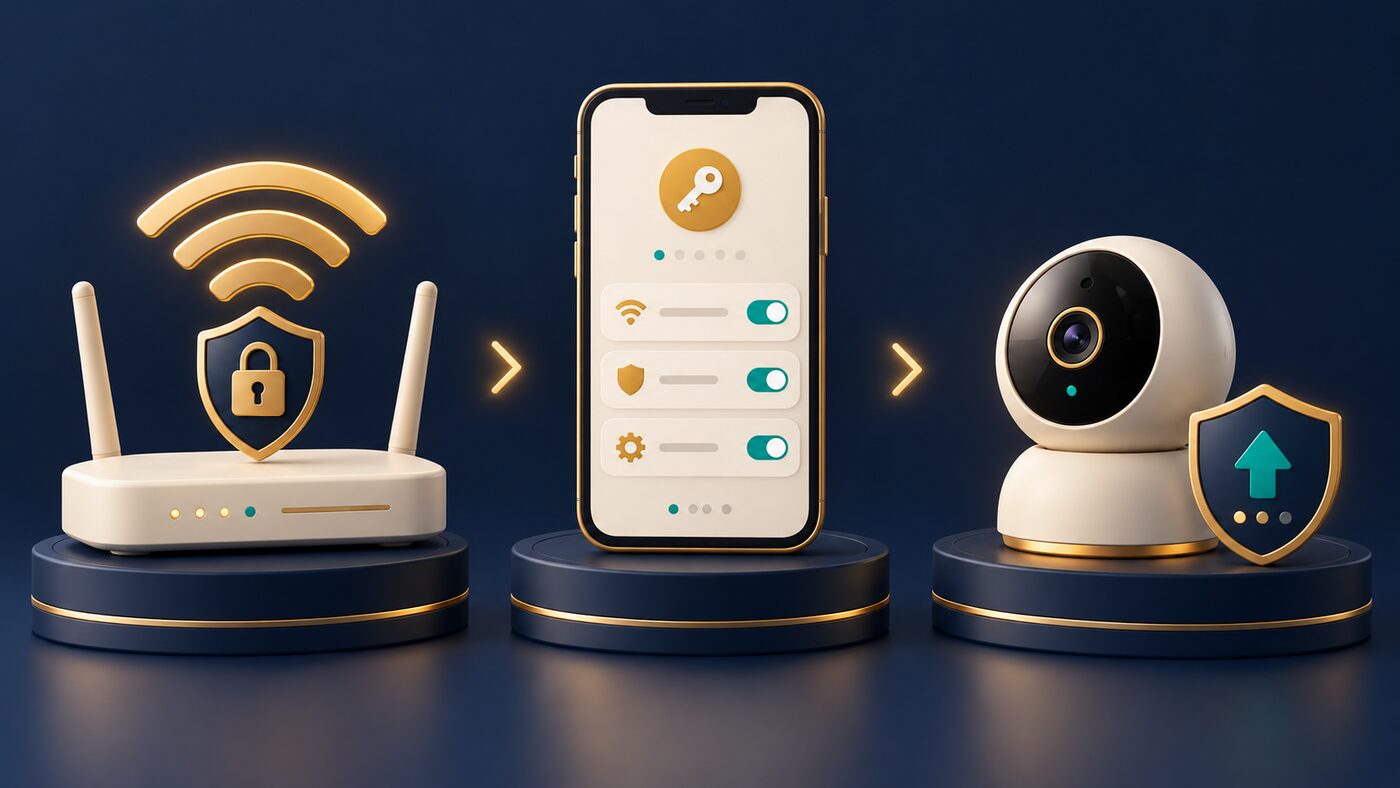
- "Never connected means absolutely safe" is imprecise: no primary source supports such an absolute statement; what can be said is that a device that is not on the network does not carry the kind of risk that comes from a leaked default camera password.
- Standards you can refer to: from 2026-10-02, inspection of networked digital cameras adds one of the cybersecurity standards CNS 16120, CNS 16190 or CNS 18031 (certificates obtained under the old standard have a transition until 2028-06-30).
1Change the default passwords on the router and the camera
The Administration for Cyber Security guidance says the first step after connecting a device to the network is to change the default password, and recommends passwords of at least 15 characters. TWCERT/CC (Taiwan) also notes that privacy problems with network cameras are "usually because users keep the camera's default password or use a simple password that is easy to guess".
2Keep firmware and the app updated
The Administration for Cyber Security guidance for small and medium enterprises asks for automatic updates for Windows and common software; camera firmware and apps should follow the same practice. After testing 45 home IoT devices, Alrawi et al. (2019, IEEE S&P) noted that patching mainly depends on vendors delivering updates to the device; before buying, check that the vendor still provides updates. US study, applicable only by analogy.
3Look after your home Wi-Fi and do not casually enable third-party streaming
Biondi et al. (2021, IEEE IOTSMS) tested a TP-Link Tapo C200: an attacker on the same network as the camera could crash it with free tools; when a third-party player was used over ONVIF and RTSP streaming, the video was sent in clear text and could be intercepted and reconstructed. This is a test of one model with the firmware of that time (2021) and can only be applied by analogy.
4Check app permissions and the privacy policy
Schmidt et al. (2023, Journal of Cybersecurity and Privacy) assessed popular baby monitor apps and found several problems that may harm user privacy; an app keeps your baby's video together with the private data on your phone, so read the permissions and privacy policy before installing. German study, applicable only by analogy.
5Protect the remote-access account
Wu Ting-Yuan (2018, thesis, Department of Information Management, National Central University, Taiwan) analysed remote connection for consumer network cameras and noted that when an account is stolen, the camera's own protection mechanism is one of the issues consumers care about most, and recommended using digital signatures so the camera can authenticate visitors itself. (Also, do not reuse the account password on other services.)
How do I ship a baby monitor with a built-in battery? Can it go by air?
Under HowBridge acceptance rules, goods with a built-in lithium battery go by sea express and not by air. The HowBridge article complete rules for shipping lithium batteries to Taiwan says: "Lithium batteries installed in equipment (UN3481, such as phones, laptops, Bluetooth earphones) also do not go by air under HowBridge acceptance rules and always go by sea express. Either way they must comply with the rules and come with proof such as a UN38.3 test report, so ask customer service before shipping."
- Which models have a battery: portable parent units and wearable sensors mostly have a built-in battery; for plug-in cameras check the product page specifications. Whether a battery is built in follows the product description.
- Buying a battery or adapter separately: a lithium-ion accumulator bought separately falls under 8507.60.00.90.0 (Column 1 duty 2.5%, import regulation code C02), and an adapter under 8504.40.91.00.7 (0%, no import regulation code).
- Carrier rules are not a legal ban: the HowBridge Taiwan import prohibited list states that lithium batteries and similar items may be refused under carriers' dangerous-goods rules, and "this does not mean the import is prohibited by law".
- Shipping fee: sea express fees follow the site rules in the shipping calculator, and the actual amount is the bill issued after the Shenzhen consolidation warehouse measures the parcel on arrival.
How do I ship a baby monitor bought on Taobao, Tmall, JD.com or Pinduoduo to Taiwan?
First look at the functions to decide the code and rules, then control the quantity, send to the Shenzhen consolidation warehouse, choose formal declaration on the order, and finish the security setup after it arrives. In order:
1Check the functions on the product page
Check whether it has Wi-Fi / Bluetooth, whether it can record or take a memory card, whether it has a built-in battery, and whether it claims blood oxygen, heart rate or apnea alarms. Then compare the code and import regulations in the tariff search.
2Control the quantity
Imported by post or another method not carried in person (consolidated shipping is not carrying goods in person, so this page applies this rule conservatively; the text does not mention consolidated shipping explicitly, and the NCC's determination prevails): up to 2 units at a time can be imported on a self-use affidavit; 3 to 10 units imported by post require an import approval certificate; one person is limited to 10 units a year, and an individual must be at least 18.
3Ask first about medical functions
A wearable sensor that claims apnea, blood oxygen or heart rate monitoring may be a Class II medical device; confirm the TFDA determination and the special-case application (fee NT$2,000, diagnosis certificate or prescription needed) first, and do not ship directly.
4Send to the Shenzhen consolidation warehouse
After ordering on Taobao, Tmall, JD.com or Pinduoduo, ask the seller to ship to the HowBridge Shenzhen consolidation warehouse; goods with a built-in lithium battery go by sea express.
5Choose "Formal declaration" when creating the consolidation order
A Wi-Fi model involves import regulation code 602, so under Article 12, paragraph 1, subparagraph 2 of the Air Express Consignment Clearance Regulations and the Sea Express Consignment Clearance Regulations (Taiwan) a general import declaration is in principle required (proviso: where Customs has announced a special circumstance, a simplified declaration may be used; no announcement covering the NCC self-use affidavit was found). When you create a consolidation order with HowBridge you can choose "Formal declaration" (customs fee NT$800); you upload a commercial invoice / packing list and a power of attorney, with templates on the order screen, and you can ask customer service about the documents before submitting.
6Finish the security setup after it arrives
Change the default passwords on the router and the camera, keep firmware and the app updated, and check app permissions; equipment imported on a self-use affidavit may not be transferred or used commercially.
What do the common terms for shipping baby monitors to Taiwan mean?
- Import regulation code 602
- Telecommunications controlled radio-frequency equipment: Customs releases it once the NCC import approval certificate or a special import certificate number is shown; units that have passed conformity assessment clear on the conformity certificate.
- Import regulation code C02
- "Some goods under this item are commodities announced by the Bureau of Standards, Metrology and Inspection as subject to import inspection."
- Telecommunications controlled RF equipment
- RF equipment announced by the competent authority under Article 65 of the Telecommunications Management Act (Taiwan) that may be manufactured or imported only with approval; reading the NCC affidavit wording, Wi-Fi client devices fall within the self-use affidavit scope.
- Self-use affidavit
- For up to 2 units at a time imported by post or another method not carried in person, a signed statement that the equipment is for personal use only and not for sale, so no import approval certificate is requested.
- Import approval certificate
- The import document the NCC issues for telecommunications controlled RF equipment; an import approval certificate is required when importing 3 to 10 units by post.
- General import declaration
- The general import/export declaration, that is, the formal declaration; in principle it is required for express consignments that involve import or export regulations or have a dutiable value over NT$50,000 (except where Customs has announced otherwise for those involving import or export regulations).
- Simplified declaration
- The method of clearing express consignments with a simplified declaration, which in principle applies to consignments that involve no import or export regulations and have a dutiable value of NT$50,000 or less.
- Subject to inspection
- Commodities that the Bureau of Standards, Metrology and Inspection has announced must complete inspection before entering the market; networked cameras that can record are covered now, and those that cannot record from 2028-07-01.
- Class II medical device
- The medium-risk class in the Regulations on Classification and Grading of Medical Devices (Taiwan); apnea monitors, pulse oximeters and cardiac monitors belong to it.
- Sudden infant death syndrome (SIDS)
- Sudden Infant Death Syndrome; the American Academy of Pediatrics advises not to use home cardiorespiratory monitors as a way to reduce its risk.
- Default password
- The password a device is set with at the factory; the Administration for Cyber Security guidance advises changing it as the first step after connecting the device to a network.
What are the sources and the limits of the fact-check?
The sources below were viewed on 2026-10-18; document dates and viewing dates are shown separately, and dates not stated in the source are not supplied.
Official and government primary sources
- Customs Act (Article 49, paragraph 2) (Taiwan) (2022-05-11; accessed 2026-10-18): Article 49, paragraph 2: goods whose combined dutiable value in the same batch is at or below the limit announced by the Ministry of Finance are exempt from duty, but this does not apply to frequent importers or to specific goods announced by the Ministry of Finance
- Air Express Consignment Clearance Regulations (Articles 6, 11, 12, 14) (Taiwan) (2026-02-23; accessed 2026-10-18): Article 11: dutiable value of NT$2,000 or less is low-value duty-free, NT$2,001 to NT$50,000 is low-value dutiable, and over NT$50,000 is high-value express cargo; Article 12, paragraph 1, subparagraph 2: consignments involving import or export regulations clear with a general import/export declaration (unless Customs has announced a special circumstance allowing a simplified declaration); Article 14: the same batch of inbound express consignments may not be declared separately
- Sea Express Consignment Clearance Regulations (Article 12) (Taiwan) (2026-02-23; accessed 2026-10-18): Article 12, paragraph 1, subparagraph 2: consignments involving import or export regulations clear with a general import/export declaration, with the same proviso as the air regulations
- Telecommunications Management Act (Articles 44, 65, 66) (Taiwan) (2026-08-05; accessed 2026-10-18): Article 65: telecommunications controlled RF equipment announced by the competent authority may be manufactured or imported only with approval; Article 66: unless specially approved, such equipment must meet the technical specifications and pass conformity assessment before it may be sold
- Regulations Governing the Manufacture, Importation and Declaration of Telecommunications Controlled Radio-Frequency Devices (Articles 2, 3, 6, 9, 13) (Taiwan) (2025-02-03; accessed 2026-10-18): Article 9: wireless telecom terminal equipment or low-power RF devices for personal use may be imported on an affidavit without an import approval certificate, up to 2 units at a time by post or another method not carried in person; 3 to 10 units imported by post need an import approval certificate; limited to 10 units a year for the same individual or legal entity, and an individual must be at least 18; for the applicant's own use only, with no transfer or other commercial use; Article 13: those holding a conformity certificate may import on the strength of that certificate
- Medical Devices Act (Articles 3, 35, 62, 68) (Taiwan) (2020-01-15; accessed 2026-10-18): Article 3 defines a medical device (main function of diagnosing, treating, relieving or directly preventing human disease and so on); Article 35: items exclusively for personal use may be imported with special-case approval from the central competent authority
- Regulations on Exemption of Commodities from Inspection (Articles 3, 5, 6, 8) (Taiwan) (2019-11-21; accessed 2026-10-18): Article 5: personal-use goods not for sale, with a combined value of the same specification and model on one declaration of US$1,000 or less, or over US$1,000 with personal-use goods not exceeding 2 pieces, are exempt from inspection when the inspection authority finds them compliant; infant and child goods (excluding children's raincoats, toys and textiles) not exceeding 2 pieces under the same tariff code on one declaration; Article 6: goods imported by parcel post or in a traveller's carry-on luggage are exempt and released directly by Customs; Article 8: the same specification and model (for infant and child goods, the same tariff code) is exempt only once in six months
- Regulations on Classification and Grading of Medical Devices, schedule (D.2377 apnea monitor, E.2700 pulse oximeter, E.2300 cardiac monitor) (Taiwan) (2023-08-22; accessed 2026-10-18): Schedule: D.2377 apnea monitor (including indirect detection of apnea from physiological parameters such as heart rate), E.2700 pulse oximeter, E.2300 cardiac monitor (including heart rate alarm), all Class 2 medical devices
- Regulations Governing Special Case Approval for Manufacture and Import of Specific Medical Devices (Articles 2, 5, 6, 7, 17) (Taiwan) (2021-04-22; accessed 2026-10-18): Article 5: exclusively for personal use means not needing operation by a physician or professional and used by an individual personally; Article 7, subparagraph 3: instrument-type items exclusively for personal use are limited to 1 unit of the same model, unless use at different locations or other special circumstances make more necessary; Article 17: the application must attach proof of identity, instructions for use, an affidavit of no sale or transfer, and a diagnosis certificate or prescription naming the medical device
- Regulations Governing Trade Permits between the Taiwan Area and the Mainland Area (Article 7) (Taiwan) (2024-02-19; accessed 2026-10-18): Article 7: goods of the mainland area may not be imported into the Taiwan area, except items announced by the competent authority as permitted, with their conditions, and similar cases
- Cybersecurity Management Act (Articles 3, 11) (Taiwan) (2025-09-24; accessed 2026-10-18): Article 11: government agencies may not download, install or use products that endanger national cybersecurity; Article 3, subparagraph 5: government agencies are central or local agencies (bodies) or public-law entities exercising public authority by law, excluding military and intelligence agencies
- Review Regulations on Products Endangering National Cybersecurity (Articles 2, 4, 5, 11) (Taiwan) (issued 2025-12-19, in force 2025-12-01; accessed 2026-10-18): Article 4: where a reported product is a mainland brand, the competent authority may directly share intelligence; Article 5: the recipients of intelligence sharing are government agencies; in force from 2025-12-01
- HowBridge tariff data table (synced monthly from the Customs Administration, Ministry of Finance, Taiwan): 8525.89 and related codes (per Customs Administration tariff, date not stated; accessed 2026-10-18): 8525.89.10.40.4 "Other television cameras, with radio function" and 8525.89.90.30.9 "Other digital cameras and video camera recorders, with radio function" both have Column 1 and Column 2 duty of 0%, with import regulation codes 602 and 602 C02 respectively; related codes for wired cameras, monitors, adapters, lithium batteries and so on are also listed (data synced monthly from the Customs Administration, Ministry of Finance, Taiwan)
- Import regulation code notes 602 / C02 / 504 / MP1 / MW0 (HowBridge data table, transcribed from the code notes of the Customs Administration and the International Trade Administration, Taiwan) (data updated 2026-10-17; accessed 2026-10-18): original text of the codes: 602 (telecommunications controlled RF equipment must show an NCC import approval certificate or a special import certificate number; units that have passed conformity assessment clear on the conformity certificate), C02 (some goods under this item are commodities announced by the Bureau of Standards, Metrology and Inspection as subject to import inspection), 504 (for human-use medical devices, attach a copy of the permit or a consent document), MP1, MW0
- Bureau of Standards, Metrology and Inspection (Taiwan) announcement amending "Inspection rules for digital video cameras, digital cameras and similar commodities subject to inspection (information technology products)" (2026-10-02; accessed 2026-10-18): "networked digital cameras" in the table add one of the cybersecurity standards CNS 16120, CNS 16190, CNS 18031 for testing; 8525.89.90.30.9 import regulation code C02; 8525.89.10.40.4 and 8525.89.10.90.3 listed C02 from 2028-07-01 (ROC year 117, July 1)
- BSMI (Taiwan) briefing on the draft amendment of "Inspection rules for information technology products, audio-visual equipment and ten other commodity groups subject to inspection" (2025-07-23; accessed 2026-10-18): the draft originally set implementation for 2028-01-01, which the official announcement of 2026-10-02 changed to 2028-07-01; background only
- NCC (Taiwan) Appendix 4-2 self-use affidavit (date not stated; accessed 2026-10-18): self-use affidavit: for wireless telecom terminal equipment or low-power RF devices imported for personal use, client devices with only Wi-Fi, Bluetooth, NFC or ANT RF functions (Client Device, not including AP) do not have to state operating frequency and output power; for personal use only, not for sale or other commercial use
- Ministry of Health and Welfare (Taiwan) news: heart rate and blood oxygen on smartwatches for health management are not medical devices (2021-02-15; accessed 2026-10-18): calculating heart rate and blood oxygen during leisure and exercise, only for daily health management and not involving diagnosis or treatment of a specific disease, is not managed as a medical device; but the function, method of use and working principle must still be assessed together
- Ministry of Health and Welfare (Taiwan) news: not every pulse oximeter on the market is a medical device (2021-06-28; accessed 2026-10-18): not every pulse oximeter on the market is a medical device; only those whose product manual or stated function and purpose meets the definition in Article 3 of the Medical Devices Act are managed as medical devices (the one-per-person limit in the text was a time-limited measure during the 2021 epidemic and has expired)
- Ministry of Health and Welfare (Taiwan) news: importing personal-use medical devices must still comply with the rules (2025-08-23; accessed 2026-10-18): under Article 6, paragraph 4 of the Regulations Governing Special Case Approval for Manufacture and Import of Specific Medical Devices, fast clearance applies to items on the schedule such as medical cotton swabs, limited to once per half year
- Taiwan Food and Drug Administration (TFDA): rules and method for applying to import medical devices exclusively for personal use (published 2021-04-27, maintained 2023-09-12; accessed 2026-10-18): special-case application for medical devices exclusively for personal use: fee NT$2,000; must be filed by a single individual for a special medical need; must attach a diagnosis certificate or prescription naming the medical device
- Customs Administration (Taiwan) FAQ: express consignments (low-value duty-free and 6 times per half year) (2026-07-08; accessed 2026-10-18): imported goods in the same batch with a dutiable value of NT$2,000 or less are exempt from duty and the business tax and commodity tax collected by Customs; the exemption does not apply to a taxpayer who has used duty-free release more than 6 times within a half-year period; a half-year period means January to June and July to December
- Ministry of Finance order No. 1131014492 (Taiwan) (2024-05-27; accessed 2026-10-18): original text of this order (Ministry of Finance order No. 1131014492 of 2024-05-27): low-value duty-free goods whose dutiable value in the same batch of imported goods is NT$2,000 or less are not counted toward the 6 duty-free import releases within a half-year period. The order cites two documents: Ministry of Finance announcement No. 1061018778 of 2017-09-07 = the NT$2,000 duty-free limit under Article 49, paragraph 2 of the Customs Act; Ministry of Finance order No. 1061011007 of 2017-05-26 = the principle for determining "frequent imports" under the proviso to Article 49, paragraph 2 of the Customs Act (6 duty-free import releases within a half-year period)
- Taipei Customs (Taiwan): points to note for simplified declaration of inbound express consignments (2024-07-09; accessed 2026-10-18): the following imported goods may not be declared with a simplified declaration: goods involving import regulations
- Ministry of Finance (Taiwan) news (Keelung Customs): watch the express import rules and avoid trouble with cross-border shopping (2020-07-09; accessed 2026-10-18): goods involving import or export regulations may not clear with a simplified declaration; common goods such as food, medicine and telecom products and medical devices must be declared with a general import declaration; goods that need a permit to be imported take at least 2 weeks for a special-case application to the competent authority
- Administration for Cyber Security, Ministry of Digital Affairs (Taiwan) FAQ 9.3: "Is there a list of products that endanger national cybersecurity?" (2026-06-10; accessed 2026-10-18): under the Cybersecurity Management Act, the review regulations and the Executive Yuan Secretary-General's letter, government agencies are prohibited from downloading, installing or using products that endanger national cybersecurity (including mainland-brand ICT products); a mainland brand means a product originating from a manufacturer in the mainland (including Hong Kong and Macao) area, judged by the final ICT product
- Administration for Cyber Security, Ministry of Digital Affairs (Taiwan) press release: Basic Cybersecurity Guidelines for Small and Medium Enterprises (2026-04-16; accessed 2026-10-18): cameras, printers, routers and similar devices leave the factory with the same default passwords, and the first step after connecting a device to the network is to change the default password; automatic updates for Windows and common software (such as LINE and Chrome) must be turned on; passwords of at least 15 characters are recommended (the guidance is aimed at small and medium enterprises)
- BSMI (Taiwan) Standards e-newsletter No. 149: national standards ensure the information security of video surveillance systems (2020-06-15; accessed 2026-10-18): CNS 16120-1 and CNS 16120-2, national cybersecurity standards for video surveillance systems and network cameras, cover physical security, system security, communication security, authentication and authorization security, and privacy protection
- TWCERT/CC (Taiwan) newsletter: cybersecurity threats and protection for network cameras (2022-12-07; accessed 2026-10-18): privacy problems with network cameras usually arise because users keep the default password or use a simple, easily guessed password
- US FDA openFDA medical device database (search by applicant Owlet) (live database, date not stated; accessed 2026-10-18): the US FDA device database searched by applicant Owlet lists the Dream Sock as De Novo DEN220091, decision date 2023-11-08
- HowBridge: can power banks be mailed? Complete rules for shipping lithium batteries to Taiwan (2026-10-11; accessed 2026-10-18): power banks and goods with built-in lithium batteries go by sea express and not by air under HowBridge acceptance rules, and must come with proof such as a UN38.3 test report; ask customer service before shipping
- HowBridge: Taiwan import prohibited list (2026-10-16; accessed 2026-10-18): goods with Wi-Fi or Bluetooth RF functions, shipped by a method not carried in person, can be imported on a self-use affidavit up to 2 units at a time; lithium batteries and similar are refused under carriers' dangerous-goods rules, which does not mean legal prohibition of import
- Ministry of the Interior (Taiwan) Quarterly Bulletin of Demographic Statistics of the Republic of China, Winter 2025 issue (Winter 2025 issue, exact date not stated; accessed 2026-10-18): ROC year 114 (2025) total births 107,812, down 20.05% from the previous year, crude birth rate 4.62‰ (p. 8)
Research literature
Accuracy of Pulse Oximetry-Based Home Baby Monitors
30 hospitalized infants aged 0 to 6 months, with the FDA-cleared Masimo Radical-7 as the reference, testing the Owlet Smart Sock 2 and the Baby Vida. Sensitivity for low blood oxygen (SpO2<91%): Owlet 88.8%, Baby Vida 0.0%; both had 0.0% sensitivity for bradycardia, and the Baby Vida showed a falsely low heart rate in 14 infants. The authors note that such consumer products are not regulated by the FDA and advise physicians and parents to be cautious when using the readings for medical decisions. US study of older 2018 models, applicable only by analogy.
Sleep-Related Infant Deaths: Updated 2022 Recommendations for Reducing Infant Deaths in the Sleep Environment
American Academy of Pediatrics policy statement, Grade A recommendation: "Do not use home cardiorespiratory monitors as a strategy to reduce the risk of SIDS." The text says there are no data showing that commercial devices that monitor an infant's vital signs reduce the risk of SIDS; heart rate and blood oxygen monitors sold directly to consumers (including wearables) are consumer health products that need not meet medical device rules; parents may use them for reassurance without contraindication, but the concern is that they may make parents relax and do less to follow safe sleep. The AAP's position; for Taiwan it can only be applied by analogy.
Cardiorespiratory Events Recorded on Home Monitors: Comparison of Healthy Infants With Those at Increased Risk for SIDS
5 US medical centres observed 1,079 infants on home cardiorespiratory monitors; in 718,358 hours, 445 (41%) had events above the usual alarm threshold and 116 (10%) had extreme events; extreme events were more common only in preterm infants, and their timing suggested they were unlikely to be a direct precursor of SIDS. It shows that a monitor that often sounds does not mean danger and does not mean it can reduce the risk of sudden death. Medical-grade monitors, 2001 US data, abstract only.
Initial Experience and Usage Patterns With the Owlet Smart Sock Monitor in 47,495 Newborns
Owlet user data: 47,495 newborns monitored for an average of 6 months, 4.5 days a week and 9.9 hours a day; 75% of parents bought for "peace of mind" and 94% reported sleeping better. The authors are Owlet employees or consultants (as in the conflict-of-interest statement), and the study is not an accuracy study and did not show that the product lowers sudden death, so this must be disclosed whenever it is cited.
Maternal Age, the Disparity across Regions and Their Correlation to Sudden Infant Death Syndrome in Taiwan: A Nationwide Cohort Study
Taiwan nationwide data (National Health Insurance Research Database linked to the maternal and child database), 953 SIDS cases in 2004–2017. Infants of mothers under 20 had 2.81 times the risk, and the East region was higher; during the study period the incidence fell from 5.41 to 1.09 per 10,000, but SIDS remained among the top ten causes of infant death in Taiwan. Taiwan study, usable directly as background.
Sociodemographic and meteorological correlates of sudden infant death in Taiwan
Nested case-control study of 1,671 SIDS cases and 8,355 controls in Taiwan, 1994–2003: mean annual incidence 57.9 per 100,000; prematurity (AOR 1.69), low birth weight (AOR 2.87) and male sex were risk factors; the highest risk was at a daily mean temperature of 9.2–14.2°C (AOR 2.10). The data stop at 2003, so they serve only as an explanation of risk factors and not as the current incidence.
網路攝影機遠端連線安全性分析
Taiwan study: analyses the security policies and potential problems of four well-known security surveillance systems and compares authentication methods on effectiveness, confidentiality, ease of operation, verification efficiency and added cost; it concludes that digital signatures are the most suitable way for a network camera to authenticate visitors itself, and shows by experiment that the efficiency is workable. It can be used to explain the risks of remote connection and account theft. Only the abstract was read; no brand or vulnerability statistics.
SoK: Security Evaluation of Home-Based IoT Deployments
Organizes the home IoT security literature across four aspects (device, mobile app, cloud endpoint, communication) and tests 45 devices (including cameras such as Nest Cam and Arlo). A cloud camera case cited in the paper: a seemingly strong 36-character password was in fact the MAC address reversed and Base64-encoded; attackers could inject fake video and trigger false alarms. Patching depends mainly on vendor updates. Devices sold in the US, applicable only by analogy.
Vulnerability Assessment and Penetration Testing on IP camera
Tested a TP-Link Tapo C200: an attacker on the same network could crash the camera with free tools (CVSS 6.5); when a third-party player used ONVIF / RTSP streaming, the video was sent in clear text and could be intercepted and reconstructed (CVSS 6.5); even when encrypted, packet sizes could reveal whether someone was home (Motion Oracle). The authors mention that such cameras are often used as baby monitors too. A single model at a particular time, applicable only by analogy.
Assessing the Security and Privacy of Baby Monitor Apps
Assessed the stream protection and privacy policies of popular baby monitor apps and used network traffic analysis to find privacy leaks, with results pointing to several problems that may harm user privacy. The authors stress that an app puts sensitive video together with private phone data, which raises the risk. Only the abstract was read; the list of tested apps is not cited.
Rates and import regulations follow the Customs Administration tariff (viewed 2026-10-18), and laws follow the Laws & Regulations Database of Taiwan version of 2026-10-18. Items not found or not readable: the original text of the NCC list of controlled RF equipment and statistics on self-use affidavit quantities (the NCC website could not be read this time); a Customs Administration advance tariff ruling on baby monitors; a Customs announcement allowing the NCC self-use affidavit to use a simplified declaration; whether the TFDA fast-clearance schedule includes blood oxygen or breathing monitors; consumer reminders from the Consumer Protection Office or the Criminal Investigation Bureau on home network cameras; import statistics for 8525.89 from mainland China; product specifications and Taiwan NCC approval status of Chinese-brand products. The formal declaration fee (the "Formal declaration" option on the HowBridge order screen, checked 2026-10-19) and the lithium battery acceptance rule are HowBridge site rules, not government data. None of the studies cited was done on HowBridge, and foreign studies can only be applied by analogy.
What are the common questions about shipping baby monitors to Taiwan?
Do I pay duty on a baby monitor from Taobao or JD.com shipped to Taiwan?
How many Wi-Fi baby monitors can I ship at once?
Can a baby monitor use a simplified declaration?
How much does HowBridge formal declaration cost, and what do I need to prepare?
What is different about models that record or take a memory card?
What changes for baby monitors after 2028-07-01?
Can oximeter socks or breathing monitors such as Owlet and Snuza be shipped to Taiwan?
If the US FDA has cleared a product, do I not need to worry in Taiwan?
Can a baby monitor reduce the risk of sudden infant death?
Can I use cameras from Chinese brands such as eufy and Xiaomi, or TP-Link, at home in Taiwan?
Can I resell a monitor I imported on a self-use affidavit?
Can a baby monitor with a built-in battery go by air?
Related reading
Tariff code and import regulation search
Shipping calculator
EZ WAY identity verification and declaration confirmation guide
Simplified declaration vs formal declaration
Company import business tax and formal declaration
Phones and 3C electronics import clearance and NCC
C02 import regulation and BSMI inspection
Medical devices to Taiwan
Lithium batteries to Taiwan
Toys and infant products import to Taiwan
Diapers to Taiwan
Taiwan import prohibited list
Check the tariff code and import regulations for your baby monitor first
Enter a product name or the code 8525.89 to confirm the duty fields and import regulation codes such as 602 and C02, then decide how to ship.
Search tariff