Socks from China to Taiwan: Tariff Codes and Import Rules
Can I ship socks from China to Taiwan?
It depends on material and style—there is no single answer. Nylon and other synthetic-fibre socks, wool socks and genuine silk socks have no mainland-China import restriction code listed in the tariff; polyester socks and synthetic-fibre pantyhose measuring per single yarn 67 decitex (about 60.3 denier) or less (so-called “silk stockings”, i.e. sheer pantyhose) are MW0: mainland goods, import prohibited; cotton socks are MP1 + M13, and M13 is limited to textiles that Taiwanese firms commission for processing in mainland China and then resell to markets such as the US and Europe—ordinary buyers do not qualify. These last two groups can only be imported within the conditions of the MOEA “small-quantity mainland industrial products permit exemption”: the CIF total of mainland goods on the entire import declaration must not exceed NT$32,000, and each model must be within 24 pieces.
This article covers only the tariff and import rules for socks made in mainland China and sent to Taiwan via consolidated shipping. HowBridge provides China→Taiwan consolidated shipping, with a Shenzhen warehouse and a Taoyuan warehouse; we do not act as a purchasing agent and do not offer tax-inclusive shipping. The actual tariff code and whether goods are released are determined by customs based on the goods actually arriving; whether an individual parcel can be accepted is subject to confirmation by customer service.
Which tariff codes cover socks in Taiwan?
Socks fall under Chapter 61, heading 6115 “Pantyhose, tights, stockings, socks and other hosiery … knitted or crocheted”, which has 17 11-digit codes. They are subdivided along four axes: style (compression / pantyhose / women's full-length or knee-length stockings / ordinary stockings and socks), material, yarn fineness (above or below 67 decitex per single yarn), and Taiwan's own 9th–10th digit subdivisions. The “mainland goods” column below shows the status when ordinary members ship from China; the statistical unit is always DZN (dozen). None of the import regulation entries include C02, so no inspection application to BSMI is needed at import, but ordinary socks are still BSMI items subject to “market sampling at any time”.
| 11-digit code | Official description (summary) | Column 1 duty rate | Import rule for mainland goods |
|---|---|---|---|
6115.10.11.10-3 | Graduated compression pantyhose of synthetic fibres, measuring per single yarn less than 67 decitex | 12% | MW0 Import prohibited |
6115.10.11.90-6 | Other graduated compression hosiery of synthetic fibres, less than 67 decitex | 12% | MP1 (no MXX) |
6115.10.12.10-2 | Graduated compression pantyhose of synthetic fibres, 67 decitex or more | 12% | MP1 (no MXX) |
6115.10.12.90-5 | Other graduated compression hosiery of synthetic fibres, 67 decitex or more | 12% | No restriction listed |
6115.10.90.10-7 | Graduated compression pantyhose of other textile materials | 11.5% | No restriction listed |
6115.10.90.90-0 | Other graduated compression hosiery of other textile materials | 11.5% | MP1 (no MXX) |
6115.21.00.00-5 | Pantyhose and tights of synthetic fibres, less than 67 decitex (so-called “silk stockings”, i.e. sheer pantyhose) | 12% | MW0 Import prohibited |
6115.22.00.00-4 | Pantyhose and tights of synthetic fibres, 67 decitex or more | 12% | MP1 (no MXX) |
6115.29.10.00-5 | Pantyhose and tights of silk | 12% | No restriction listed |
6115.29.90.00-8 | Pantyhose and tights of other textile materials | 12% | No restriction listed |
6115.30.00.00-4 | Other women's full-length or knee-length hosiery, less than 67 decitex (any material) | 12% | MP1 + M13 |
6115.94.00.00-7 | Stockings and socks of wool or fine animal hair | 12% | No restriction listed |
6115.95.00.00-6 | Stockings and socks of cotton | 12% | MP1 + M13 |
6115.96.00.10-3 | Stockings and socks of polyester fibres | 12% | MW0 Import prohibited |
6115.96.00.90-6 | Stockings and socks of other synthetic fibres (nylon, acrylic, etc.) | 12% | No restriction listed |
6115.99.10.00-0 | Stockings and socks of silk or silk waste | 12% | No restriction listed |
6115.99.90.00-3 | Stockings and socks of other textile materials (hemp, rayon, etc.) | 11.5% | No restriction listed |
Within the same 6-digit subheading 6115.96, polyester fibres (9th–10th digits: 10) are MW0, while other synthetic fibres (90) have no restriction listed. Checking only to 6 or 8 digits will lead to the wrong answer; declarations must go to 11 digits.
What do MW0, MP1 and M13 mean?
These codes appear in the import regulation column of the International Trade Administration's “Import and Export Regulations for Goods” and apply specifically to goods made in mainland China. The key point: MP1 does not mean the goods can be imported directly—you must also check whether an MXX special rule applies.
| Code | Official meaning | Impact on ordinary members |
|---|---|---|
| MW0 | Mainland Chinese goods: import not permitted. | Can only be imported within the small-quantity permit exemption conditions (see below). |
| MP1 (no MXX) | Mainland Chinese goods conditionally permitted for import; items without an MXX code follow the general licensing rules. | Import under the general rules. |
| MP1 + M13 | Items with an MXX code require an import permit from the International Trade Administration; M13 is limited to cases such as “textiles commissioned for processing in mainland China with the approval of the Trade Administration, re-imported and then exported to the United States, the European Union, Canada, Brazil or Turkey, where the main processes carried out in Taiwan meet the ‘Criteria for Determining the Main Processes of Textiles Exported to Specific Regions’”. | Socks bought by ordinary buyers do not qualify for M13; in practice the only route is the small-quantity permit exemption. |
| No MW0/MP1 listed | International Trade Administration general notes: “Items not marked with the ‘MW0’ or ‘MP1’ code are items of ‘mainland goods permitted for import’.” | Import under the general rules; truthful declaration and payment of duties are still required. |
What does EX mean?
In the MP1 list, “EX” added after a tariff code means that only the goods descriptions listed are opened under that code. Checking the MP1 list line by line, the EX sub-items under 6115 together cover the goods descriptions of those codes; for other products, compare the opened goods descriptions word for word.
Why are most “silk stockings” not made of silk?
What people colloquially call “silk stockings” are usually thin pantyhose made of nylon or spandex, not silk. The tariff looks at material and yarn fineness: synthetic-fibre pantyhose measuring per single yarn 67 decitex (about 60.3 denier) or less fall under 6115.21 and are MW0; thicker ones of 67 decitex or more fall under 6115.22 and are MP1 (no MXX). Only products labelled as genuine silk (Silk) go under the silk codes.
| Common product | Usual classification | Status for mainland goods |
|---|---|---|
| Pure cotton / combed cotton socks | 6115.95 | MP1 + M13 |
| Polyester sports socks, terry socks (mainly polyester) | 6115.96.00.10 | MW0 Import prohibited |
| Nylon socks, no-show socks (mainly nylon) | 6115.96.00.90 | No restriction listed |
| 20D/40D sheer stockings and pantyhose | 6115.21 | MW0 Import prohibited |
| 80D/120D opaque pantyhose | 6115.22 | MP1 (no MXX) |
| Women's 20D over-the-knee and knee-high stockings | 6115.30 | MP1 + M13 |
| Wool socks, cashmere socks | 6115.94 | No restriction listed |
| Genuine silk stockings | 6115.99.10 / 6115.29.10 | No restriction listed |
How do denier and decitex convert?
The official goods description reads “67 decitex (i.e. 60.3 denier)”. Denier (D) is the weight in grams of 9,000 metres of yarn; decitex is the weight in grams of 10,000 metres; 1 denier is roughly 1.11 decitex. The 20D and 40D often shown on product pages are both below 60.3 denier. The table above is a common mapping derived from the official goods descriptions; actual classification still depends on the product's composition and the customs determination.
Which fibre counts for blended socks?
Section XI Subheading Note 2(a) provides that products of Chapters 56 to 63 containing two or more textile materials are, by the method of Section Note 2(a), regarded as made wholly of the textile material that predominates by weight; where no single material predominates by weight, they are classified under the heading that occurs last in numerical order among those that equally merit consideration.
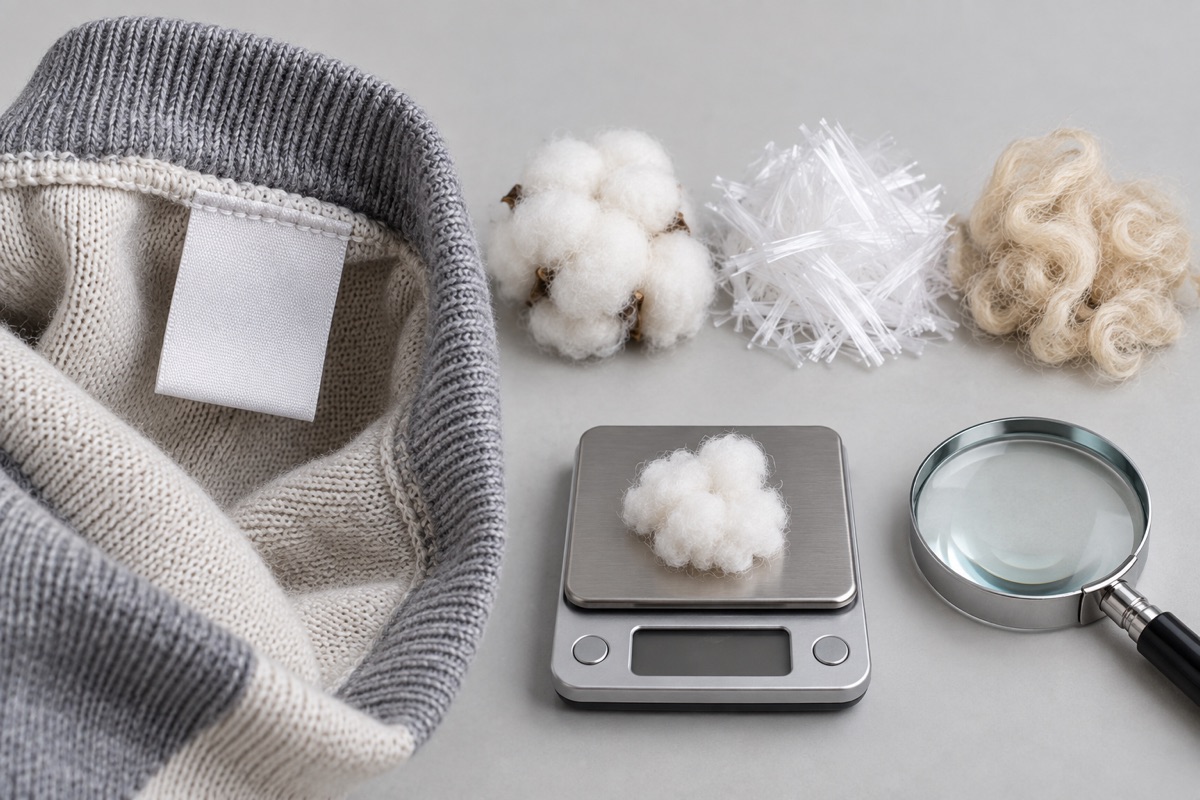
- 80% cotton / 20% spandex → treated as cotton, classified under 6115.95 (MP1 + M13).
- 60% polyester / 40% cotton → treated as polyester, classified under 6115.96.00.10 (MW0).
- 85% nylon / 15% spandex → treated as nylon (other synthetic fibre); ordinary socks go under 6115.96.00.90 (no restriction listed).
- If the label only shows marketing names such as “cotton feel”, “ice silk” or “modal”, ask the seller for the actual fibre composition and percentages.
Declaring mainly-polyester socks as cotton or nylon is a false declaration of the goods description. The composition follows the product's actual label and the seller's information; if you cannot find it, get it clarified before shipping.
How does the small-quantity permit exemption for mainland goods apply to socks?
Under MOEA Announcement Jing-Mao-Zi No. 11104603570 of ROC 111/8/19 (2022), mainland Chinese industrial products that are outside the “List of Restricted Import Goods” and fall within tariff Chapters 25 to 97 are, if they meet the conditions below, permitted to be imported without an import permit and without applying the “MXX” rules. This covers both items not announced as permitted (MW0) and permitted items carrying an MXX code (MP1 + M13). Socks are in Chapter 61; the exclusion list (Jing-Mao-Zi No. 11550200230 of ROC 115/3/10) currently contains only 3 items—electric motorcycles, electric bicycles and their controllers—and socks are not among them.
| Three thresholds that are often confused | Value basis | Quantity | What it governs |
|---|---|---|---|
| Small-quantity permit exemption for mainland goods | CIF total of mainland goods on the entire declaration not exceeding NT$32,000 | Within 24 pieces per single item | Whether MW0 and MP1 + M13 goods may be imported |
| Origin-marking exemption for imported textiles | FOB not exceeding NT$30,000 | Within 24 pieces per single item | Whether the country of origin must be marked on the socks |
| Low-value duty exemption for postal and express parcels | Dutiable value of NT$2,000 or less | No longer exempt after more than 6 times in a half-year | Whether customs duty and business tax must be paid |
- The cost, insurance and freight (CIF) value of all mainland goods on the entire import declaration totals no more than NT$32,000.
- Each single item is within 24 pieces (24 PIECES/UNITS); where goods cannot be counted by piece, within 40 kg.
- A “single item” is determined by model number; where there is no model number, customs counts each line item on the declaration; items may not be split by size, specification or colour.
- The goods classification table and related trade rules must still be followed; exemption from the permit does not mean exemption from duties or from declaration.
The statistical unit for socks is the dozen, while the announcement says “24 PIECES/UNITS”; it does not specify whether a pair, a single sock or a dozen counts as one piece. Until the competent authority clarifies, we suggest a conservative estimate of no more than 24 pairs of the same model, and declaring the actual quantity.
The small-quantity exemption looks at the chapter, value, piece count and the exclusion list—not “it's fine as long as it's for personal use”. Exceeding the thresholds means a controlled import; splitting the same model into several entries or splitting line items by colour to get around the rules does not comply with the announcement.
Do imported socks need origin and composition labels, and inspection?
Apart from whether they can be imported, socks are subject to three further sets of rules, each governing something different:
| Rule | Authority and legal basis | Requirements for socks |
|---|---|---|
| Country-of-origin marking | International Trade Administration “Regulations on Country-of-Origin Marking for Imported Specified Textiles” (announced ROC 112/10/20) | Chapter 61 textiles must be marked with the correct country of origin on the goods themselves when imported; unmarked goods will not be cleared. Where socks do not have an origin label sewn onto each pair, the marking must be made on the smallest sales unit using a hard-to-remove sock tag, attached card or box. Imports with an FOB value not exceeding NT$30,000 and within 24 pieces per single item are exempt. |
| Composition and labelling | BSMI “Labeling Standards for Apparel” (effective ROC 112/5/18; covered categories include socks) | When put on the market for sale, products must be labelled with country of origin, fibre composition (fibres of 5% or more by name and weight percentage), size and care instructions; labels for socks may not be stuck onto the product itself. |
| Commodity inspection | BSMI “Textile Inspection Operation Rules” | Ordinary knitted socks are subject to “market sampling at any time”: no inspection application and no inspection mark are needed at import, but they must meet CNS 15290 when sold. Socks for infants aged 24 months or under are subject to monitoring inspection and may only be imported after completing inspection and bearing the inspection mark. |
Do socks for my own use need labels?
The labelling obligation in Article 5 of the Commodity Labeling Act arises when goods are “put into circulation on the market”. For purely personal use with no resale, the Act contains no express exemption; reading the wording, market-sale labelling is inferred not to apply. Origin marking, however, is an import clearance rule and still applies if quantity or value exceeds the exemption threshold. If you resell, both must be complied with.
What taxes apply to imported socks?
Mainland Chinese goods use the Column 1 duty rate: of the 17 codes, 3—6115.10.90.10-7, 6115.10.90.90-0 and 6115.99.90.00-3—are 11.5%, and the other 14 are 12%. Business tax is 5% of the base (dutiable value + customs duty); the trade promotion service fee is 0.04% of the dutiable value and is waived if the computed fee is NT$100 or less.
Worked example
Suppose customs sets the dutiable value at NT$3,000 with a 12% duty rate: customs duty NT$360; business tax (3,000 + 360) × 5% = NT$168; trade promotion service fee NT$1.2, waived as it is below NT$100; total NT$528. This is a formula example; actual amounts follow the customs determination and exclude shipping, customs brokerage and delivery fees.
Duty-free does not mean free of import rules
Postal or express parcels with a dutiable value of NT$2,000 or less are exempt from customs duty and business tax, but once the same recipient exceeds 6 times in a half-year the exemption no longer applies. The low-value exemption only concerns whether tax is payable; MW0 and MP1 + M13 concern whether goods may be imported at all, and goods subject to import rules must still comply with them.
Which “socks” are not classified under 6115?
Heading 6115 is limited to goods that are “knitted or crocheted” and to “footwear without applied soles”. In the following cases, look up a different code:
- Hosiery made of woven (not knitted) fabric: 6115 covers only knitted or crocheted goods, so by inference from the goods description, look under Chapter 62 instead.
- Sock-shoes with applied soles that can be worn directly as shoes: look under Chapter 64 (footwear) instead.
- Baby socks: Chapter 61 Note 6 provides that garments and clothing accessories for young children of a body height not exceeding 86 cm are classified with priority in 6111, so baby socks usually go under 6111 instead (inferred from the chapter note; subject to customs determination).
- Medical graduated compression stockings: classified under the 6115.10 items by material and denier; according to BSMI, those that are medical devices must also comply with the Pharmaceutical Affairs Act.
How do I check before shipping socks?
Use the five steps below to work it out before you order, so you avoid returns or requests for additional permits at customs.
1Check the style first
Identify whether they are compression hosiery, pantyhose/tights, women's stockings or knee-highs, or ordinary stockings and socks.
2Then check the composition label
Find the fibre that predominates by weight: cotton, polyester, nylon, wool or silk. For “silk stockings”, check whether they are nylon or genuine silk.
3For sheer styles, check the denier
For pantyhose and women's stockings or knee-highs, the dividing line is 67 decitex (about 60.3 denier); the D number on the product page is your clue.
4Match the 11-digit code and import rules
Confirm the code using the overview table on this page or the CCC tariff lookup; MW0 and MP1 + M13 items must stay within the small-quantity exemption conditions.
5Declare the item name, material and quantity truthfully
In your consolidated shipping declaration, state “material + style + quantity”, e.g. “cotton socks, 10 pairs”, rather than just “socks” or “clothing”.
What happens if I declare falsely or ship socks that are prohibited?
Under the Customs Anti-Smuggling Act, a false declaration of the name, quantity or value of goods may result in a fine of up to 5 times the evaded import duty or confiscation of the goods (Article 37, Paragraph 1); where a false declaration of goods description, quantity, etc. is used to evade import controls on controlled goods such as MW0, Article 37, Paragraph 3 applies Article 36, under which a fine of up to 3 times the value of the goods is imposed and the goods are confiscated. These are the statutory provisions; actual penalties depend on the customs' case-by-case determination.
If you are unsure of the composition, ask the seller first; do not ship MW0 or MP1 + M13 socks beyond the small-quantity exemption thresholds, or choose a material with no listed restriction instead; do not split orders, change colours or under-declare prices to get around the rules.
Glossary
- CCC 11-digit code
- Taiwan's goods classification code: the first 8 digits are the tariff number, the 9th–10th digits the statistical suffix, and the 11th digit the check digit. Import rules may be tied to the 10th digit.
- MW0
- Mainland Chinese goods: import not permitted.
- MP1
- Mainland Chinese goods conditionally permitted for import; items with an MXX special rule must also meet that rule.
- M13
- A special rule for textiles, limited to cases such as goods commissioned for processing in mainland China, re-imported and then resold to the United States, the European Union, Canada, Brazil or Turkey.
- Decitex (dtex)
- Weight in grams of 10,000 metres of yarn; 67 decitex is about 60.3 denier.
- CIF value
- The price of the goods plus insurance and freight; for the small-quantity exemption, all mainland goods on the entire declaration are added together.
Sources and scope of verification
The sources below were consulted on 2026-09-26; document dates and access dates are shown separately.
Government and official primary sources
- Regulations Governing Trade between Taiwan and Mainland China (Articles 7, 8, 9, 11) | Ministry of Economic Affairs (Laws and Regulations Database of the ROC) | Document date: amended ROC 113/02/19 (compiled as of 115.09.18) | Mainland goods may in principle not be imported except in enumerated cases (Item 1: items and conditions announced as permitted by the competent authority; Item 13: special approval); mainland goods announced as permitted must not endanger national security or have a major adverse effect on industry; importing mainland goods in principle requires a permit from the Trade Administration, unless the competent authority has announced a permit exemption (the legal basis for the small-quantity exemption announcement); import documents for permitted mainland goods must state that they are made in mainland China
- MOEA Announcement “Rules on Exemption from Import Permits for Small Quantities of Mainland Goods”, Jing-Mao-Zi No. 11104603570 | MOEA / International Trade Administration | Document date: 2022-08-19 (ROC 111/8/19) | Mainland industrial goods of Chapters 25–97 outside the restricted list: with CIF on the entire declaration ≦ NT$32,000 and each single item ≦ 24 pieces, exempt from permits and from the MXX rules; applies to both MW0 and MP1+MXX; a single item is determined by model and may not be split by size, specification or colour; after exemption, the goods classification table and other rules must still be followed
- MOEA Announcement of items excluded from the small-quantity exemption, Jing-Mao-Zi No. 11550200230 | MOEA / International Trade Administration | Document date: 2026-03-10 (ROC 115/3/10) | Current exclusion list; the annex lists only three items—8543.70.99.50-4, 8711.60.10.00-9 and 8711.60.20.00-7—and socks are not included
- Summary Table of Mainland Chinese Goods Conditionally Permitted for Import (FHJP080R01) | International Trade Administration, Goods Classification Management System | Document date: data updated 115/09/26 (864 items in total) | 6115.30 and 6115.95 carry special rule M13 (effective 098/01/01); 6115.10.11.90, 6115.10.12.10, 6115.10.90.90 and 6115.22 are MP1 EX items with no MXX
- Mainland Goods Import Query — Explanation of Import Regulation Codes / General Notes | International Trade Administration, Goods Classification Management System | Document date: online system (no single document date) | General notes: items without an MW0 or MP1 code are mainland goods permitted for import; MP1 items with MXX require an import permit, while NXX items are permit-exempt; MW0 means import not permitted
- MOEA Announcement “Import Conditions for Garments Commissioned by Firms for Processing in Mainland China”, Jing-Shou-Mao-Zi No. 10240005420 | MOEA / International Trade Administration | Document date: 2013-03-11 (ROC 102/3/11) | Import conditions referred to by M78: limited to Chapter 61 and 62 garments processed in mainland China on commission by importers/exporters using exported domestic fabric/yarn (MP1 with M78/M79); unrelated to purchases by ordinary consumers
- Criteria for Determining the Main Processes of Textiles Exported to Specific Regions | International Trade Administration (MOEA Laws and Regulations System) | Document date: Order Mao-Fu-Zi No. 09301519851 of ROC 93/12/28 | Official source of the criteria cited by M13; the specific regions are the US, the EU, Canada, Brazil and Turkey
- Regulations on Country-of-Origin Marking for Imported Specified Textiles (Announcement Mao-Guan-Li-Zi No. 1120153242) | International Trade Administration | Document date: 2023-10-20 (ROC 112/10/20) | Chapter 61 goods (including 6115 socks) must be marked with the correct country of origin on the goods themselves when imported; unmarked goods will not be cleared
- Regulations on Country-of-Origin Marking for Imported Specified Textiles (Annex: marking methods for socks, small-value exemption) | International Trade Administration | Document date: 2023-10-20 | Where 6115 socks do not have an origin label sewn onto each pair, the marking must be on the smallest sales unit via a hard-to-remove sock tag, attached card or box; imported textiles with FOB ≦ NT$30,000 and each single item ≦ 24 pieces are exempt from origin marking (note the basis is FOB, unlike the CIF 32,000 of the small-quantity exemption)
- Regulations Governing Import of Commodities (Article 11) | Ministry of Economic Affairs (Laws and Regulations Database of the ROC) | Document date: amended ROC 112/12/26 | Legal basis of the origin-marking rules
- Origin marking question: must the goods I import be marked with their country of origin? | International Trade Administration | Document date: 2024-08-20 (the page also shows 2011-11-28; update date to be confirmed) | The Trade Administration explicitly lists socks among goods that must be origin-marked when imported
- Commodity Labeling Act (Articles 5, 6) | Ministry of Economic Affairs (Laws and Regulations Database of the ROC) | Document date: amended ROC 111/05/18 | The labelling obligation falls on manufacturers, importers, etc. when goods are “put into circulation on the market” (whether it applies to personal use without circulation: inferred not to apply, not expressly stated in the Act); required items include country of origin and main components or materials; imported goods must show the foreign manufacturer's name in its original language
- Labeling Standards for Apparel (applicable to socks) | Ministry of Economic Affairs (competent authority: BSMI) | Document date: amended by Announcement Jing-Shang-Zi No. 11102427620 of ROC 111/10/24; effective ROC 112/5/18 | Socks are a covered category of the apparel labelling standards; country of origin, fibre composition, size and care instructions must be labelled
- Labeling Standards for Apparel (Point 4 fibre composition, Point 6 sock labelling) | Ministry of Economic Affairs (competent authority: BSMI) | Document date: announced ROC 111/10/24; effective ROC 112/5/18 | Fibres with a content of ≥5% must be labelled by name and weight percentage, tolerance ±3%; socks without a label sewn onto each pair must be labelled on the smallest sales unit via sock tag/attached card/box, and labels may not be stuck onto the product itself
- General Explanation of the Amendments to the Labeling Standards for Textiles (explaining the division of roles between the textile/apparel standards and the origin-marking rules) | Bureau of Standards, Metrology and Inspection (BSMI), MOEA | Document date: ROC year 111 (in line with the 111.5.18 amendment of the Commodity Labeling Act; standards effective 112.5.18) | The origin-marking rules for imported specified textiles are an import management matter, governed separately from the Commodity Labeling Act; goods placed on sale must still meet the labelling standards
- Classification Cases for Commodities Subject to Inspection (Textiles-2): garments, sweaters, swimwear, knitted socks | BSMI | Document date: revised ROC 111/1/25 (web release 2022/02/10) | 6115 knitted socks are commodities subject to inspection, but the inspection method is market sampling at any time—no inspection application and no inspection mark are required (hence no C02 in the import regulation column)
- BSMI: Classification Cases for Commodities Subject to Inspection (Textiles-2) — scope of sock inspection and medical elastic stockings | BSMI | Document date: ROC 111/1/25 | Sock inspection covers only socks worn by persons over 24 months of age, 86 cm or taller and weighing 15 kg or more; reference code 6115; medical elastic stockings are knitted socks subject to inspection; those that are medical devices must also comply with the Pharmaceutical Affairs Act
- Classification Cases for Commodities Subject to Inspection (Textiles-1): infant socks | BSMI | Document date: ROC 111/1/25 | Socks for infants aged 24 months or under are “garments and clothing accessories worn by infants”; the inspection method is monitoring inspection, and they may be imported only after completing inspection and bearing the inspection mark
- Textile Inspection Operation Rules, Point 11 | BSMI | Document date: amended ROC 110/01/28 (Order Jing-Biao-Er-Zi No. 11020000040) | The inspection method for garments, sweaters, swimwear and knitted socks is market sampling at any time
- Inspection requirements for knitted socks, garments, sweaters and other textiles subject to inspection (announcement) | BSMI | Document date: issued ROC 99/12/30; amended ROC 114/04/24 (Jing-Biao-Jian-Zheng-Zi No. 11430000280) | Knitted socks are listed in the BSMI announcement of textiles subject to inspection (under Articles 3 and 10 of the Commodity Inspection Act)
- What duties and fees are payable on imported goods? | Customs Administration, Ministry of Finance | Document date: 2026-07-13 | Customs duty = dutiable value × rate; trade promotion fee 0.04% (waived at NT$100 or less); business tax = (dutiable value + customs duty + commodity tax) × 5%; the dutiable value is the CIF value
- Value-added and Non-value-added Business Tax Act (Article 20) | Ministry of Finance (Laws and Regulations Database of the ROC) | Document date: amended ROC 114/05/28 | Business tax base for imported goods
- Customs Act (Article 29; Article 49, Paragraph 2) | Ministry of Finance (Laws and Regulations Database of the ROC) | Document date: amended ROC 111/05/11 | The dutiable value is based on the transaction value and includes freight and insurance; legal basis for the low-value exemption and its exclusion for frequent use
- Regulations Governing Customs Clearance of Imported and Exported Postal Parcels (Articles 7, 12; Article 14, Paragraph 3) | Ministry of Finance (Laws and Regulations Database of the ROC) | Document date: amended ROC 109/04/01 | Postal parcels with a dutiable value within NT$2,000 are exempt from customs duty, commodity tax and business tax; after more than 6 exemptions in a half-year they are no longer exempt; parcels exempt from import permit documents must still comply with any other applicable import rules
- Regulations Governing Customs Clearance of Air Express Cargo (Articles 11, 12) | Ministry of Finance (Laws and Regulations Database of the ROC) | Document date: amended ROC 115/02/23 | Low-value duty-free express category: dutiable value of NT$2,000 or less; express cargo involving import/export rules is in principle cleared with a general declaration (duty-free ≠ exempt from import rules)
- [Air] Why do I still have to pay tax on express imports valued at no more than NT$2,000? | Taipei Customs, Customs Administration, Ministry of Finance | Document date: 2023-09-14 | The 2,000 threshold is calculated on the dutiable value including freight and insurance; it no longer applies after more than 6 times in a half-year
- Mind the import rules for worry-free postal imports (press release) | Customs Administration, Ministry of Finance | Document date: 2020-08-19 | Postal imports must still meet import rules; goods that do not are returned or confiscated
- Foreign Trade Act (Articles 21, 21-1) | Ministry of Economic Affairs (Laws and Regulations Database of the ROC) | Document date: amended ROC 108/12/25 | Legal basis and cap for the trade promotion service fee; for imports, it is based on the dutiable value
- Customs Anti-Smuggling Act (Articles 3, 36, 37) | Ministry of Finance (Laws and Regulations Database of the ROC) | Document date: amended ROC 107/05/09 | Smuggling is defined to include “evading controls” without declaring to customs; penalty for importing smuggled goods: a fine of up to three times the value of the goods plus confiscation; false declaration of name, quantity, quality, value, etc.: a fine of up to five times the evaded duty or confiscation; where evasion of controls is involved, penalties under §36 apply
- Customs Import Tariff and Classification of Import and Export Commodities, combined edition (ROC 112 edition): Section XI Note 2(a), Subheading Note 2(a), Chapter 61 Note 6 | Customs Administration, Ministry of Finance | Document date: ROC 112 edition | Blended goods are classified by the textile material predominating by weight; where weights are equal, by the heading occurring last in numerical order; for blended goods of Chapters 56–63 (including 6115), the material is determined by the Section Note 2 method; garments and clothing accessories for young children of a body height not exceeding 86 cm go under 6111, and goods classifiable both in 6111 and in another heading are classified with priority in 6111 (baby socks → 6111 is an inference)
Research literature held in libraries
Assessing the Impact of Taiwan Lowering Tariffs on Chinese Knitted Sock Products on the Domestic Stocking and Sock Industry
Abstract highlights: (ECFA scenario simulation; it does not mean current duty rates have been lowered) Using the COMPAS model to simulate Taiwan cutting the tariff on stockings and socks imported from mainland China to 0, import prices fall by 3.43%, import volume grows by 9.93%, and domestic output declines slightly by 0.08%.
A Study of the Production System of the Sock Knitting Industry: The Case of the Local Specialty Industry of Shetou Township, Changhua County
Abstract highlights: from 2001 to 2008, Taiwan's knitted socks were mainly exported (about 60%), and the domestic market accounted for only 40% owing to competition from imported socks.
The Dynamic Evolution Path of the Shetou Sock Knitting Industry: Looking at the Future through History
Abstract highlights: Shetou is Taiwan's main sock-producing area, and factories that stay in Taiwan face competition from low-priced products from mainland China and Southeast Asia; the study concludes that the Shetou sock industry has entered a stage of decline.
A Study of the Customs Clearance Management System for Express Cargo
Abstract highlights: during the pandemic, large volumes of cross-border e-commerce goods shifted from air to sea express, sea express volumes surged, and simplified declarations for imported express cargo grew rapidly, exceeding the operating capacity of the existing clearance equipment.
A Study of Tariff Classification and Declaration Practice for Imported Goods in Taiwan
Abstract highlights: each item has only one tariff code, and that code determines the applicable duty rate, controls and licensing requirements.
On the Determination of the Dutiable Value of Imported Goods: Taiwan's Current Valuation System and the WTO Customs Valuation Agreement
Abstract highlights: customs duty is calculated as the duty rate multiplied by the dutiable value (or weight), and how the dutiable value is determined has long been a point of dispute between customs and taxpayers.
An Analysis of Changes in Taiwan's Trade Structure with Mainland China
Abstract highlights: since 1995 the structure of cross-strait trade has changed and become more concentrated, and intra-industry trade has expanded, showing that the two sides have gradually formed an industrial division of labour and mutual dependence.
WCO Study Report on Cross-Border E-Commerce
Abstract highlights: (no formal abstract; drawn from paragraphs 3–4 of the Introduction) The WCO surveyed its members' customs practices for cross-border low-value e-commerce, with 48 members having responded by 8/2016, and notes that the growth of online transactions raises regulatory, revenue and security issues.
Leaving or Staying? The Transformation of the Production System of the Shetou Sock Knitting Industry
Only bibliographic data and keywords were obtained; no abstract was available, so this page does not cite its conclusions.
Import Management of Mainland Chinese Goods
Only bibliographic data and keywords were obtained; no abstract was available, so this page does not cite its conclusions.
An Overview of the Tariff Classification of Textiles
Only bibliographic data and keywords were obtained; no abstract was available, so this page does not cite its conclusions.
An Analysis of the Development of the Shetou Sock Knitting Industry Development Association
Only bibliographic data and keywords were obtained; no abstract was available, so this page does not cite its conclusions.
This page has not obtained any explanation from the competent authority on how “24 pieces” is counted for socks, nor applied for an advance classification ruling on any specific product. The blending rules and the Chapter 61 notes are cited from the ROC 112 combined edition of the tariff; for the current online version, the announcements on Taiwan Single Window prevail. Theses and papers were checked only against their abstracts or bibliographic data and do not represent the conclusions of their full texts.
FAQ: shipping socks to Taiwan
Is tax charged on socks bought on Taobao and shipped to Taiwan?
Is it true that socks from mainland China cannot be imported?
Cotton socks are MP1—does that mean I can ship them?
Can I ship “silk stockings”?
How many pairs of cotton or polyester socks can I ship at a time?
Which material should I declare for blended socks?
Do socks need commodity inspection?
Can I declare socks as “clothing”?
Further reading
Check the material before buying socks, then ship with HowBridge
HowBridge provides China→Taiwan consolidated shipping (Shenzhen warehouse, Taoyuan warehouse). Clearly stating the material, style and quantity in your declaration makes customs clearance smoother.
View China-to-Taiwan service