RTA wooden furniture to be inspected: formaldehyde tests from 2028
Do ready-to-assemble wooden furniture need inspection now?
Not yet—it is still a draft. On 2026-10-01, under notice Jing-Biao-Jian-Zheng-Zi No. 11530020110, Taiwan's Bureau of Standards, Metrology and Inspection (BSMI) pre-announced that indoor wooden furniture made of wood-based materials, designed for users to assemble themselves, with a total surface area of 1,800 cm² or more per set, is planned to be inspected at import and before leaving domestic factories from 1 January 2028. Testing under CNS 11677 (2019 edition, ROC year 108) covers only formaldehyde emission, through either type approval with batch-by-batch inspection or Registration of Product Certification. The content may still change before the formal announcement.
This page covers the inspection rule for ready-to-assemble wooden furniture that BSMI has just pre-announced, and how it affects individuals and companies importing furniture from mainland China. For furniture duties, freight, wooden crates and bulky delivery, see the bulky furniture import guide. HowBridge only provides mainland China → Taiwan consolidated shipping (Shenzhen consolidation warehouse and Taoyuan Dayuan operations warehouse); it is not a customs broker and does not handle commodity inspection for you.
What exactly did BSMI pre-announce?
This is a pre-announcement of a regulatory order under Article 154, Paragraph 1 of the Administrative Procedure Act. The full draft is posted on the BSMI website and in the Ministry of Economic Affairs regulation system under "draft pre-announcements". Key points:
| Item | Draft content |
|---|---|
| Notice | 2026-10-01 (ROC year 115, October 1), Jing-Biao-Jian-Zheng-Zi No. 11530020110 |
| Status | Pre-announcement only, not yet formally promulgated |
| Legal basis | Commodity Inspection Act Article 3, Article 5 Paragraph 2, Article 10 Paragraph 1, Article 28 Paragraph 1, Article 35 Paragraph 3, Article 39 Paragraph 2 |
| Public comments | Within 60 days from the day after publication in the gazette, to the BSMI Inspection Administration Division |
| Planned start | Import and domestic-production inspection from 1 January 2028 (ROC year 117) |
| Test standard | Formaldehyde emission test only, under sections 3.1.2 and 4.3 of CNS 11677 (2019 edition, ROC year 108) |
| Inspection scheme | Type approval with batch-by-batch inspection, or Registration of Product Certification (type testing plus full quality management system, production quality management system or factory inspection module), both available in parallel |
| Import code | C02 (reference tariff codes in the next section) |
A pre-announcement invites comments within a set period; the final text and start date may still change. We will update this page after BSMI formally announces the rule. Until then, follow the latest notice on the BSMI website.
Which furniture will be covered?
The draft product name is "wooden ready-to-assemble furniture". A product is in scope only if it meets all 4 conditions below:
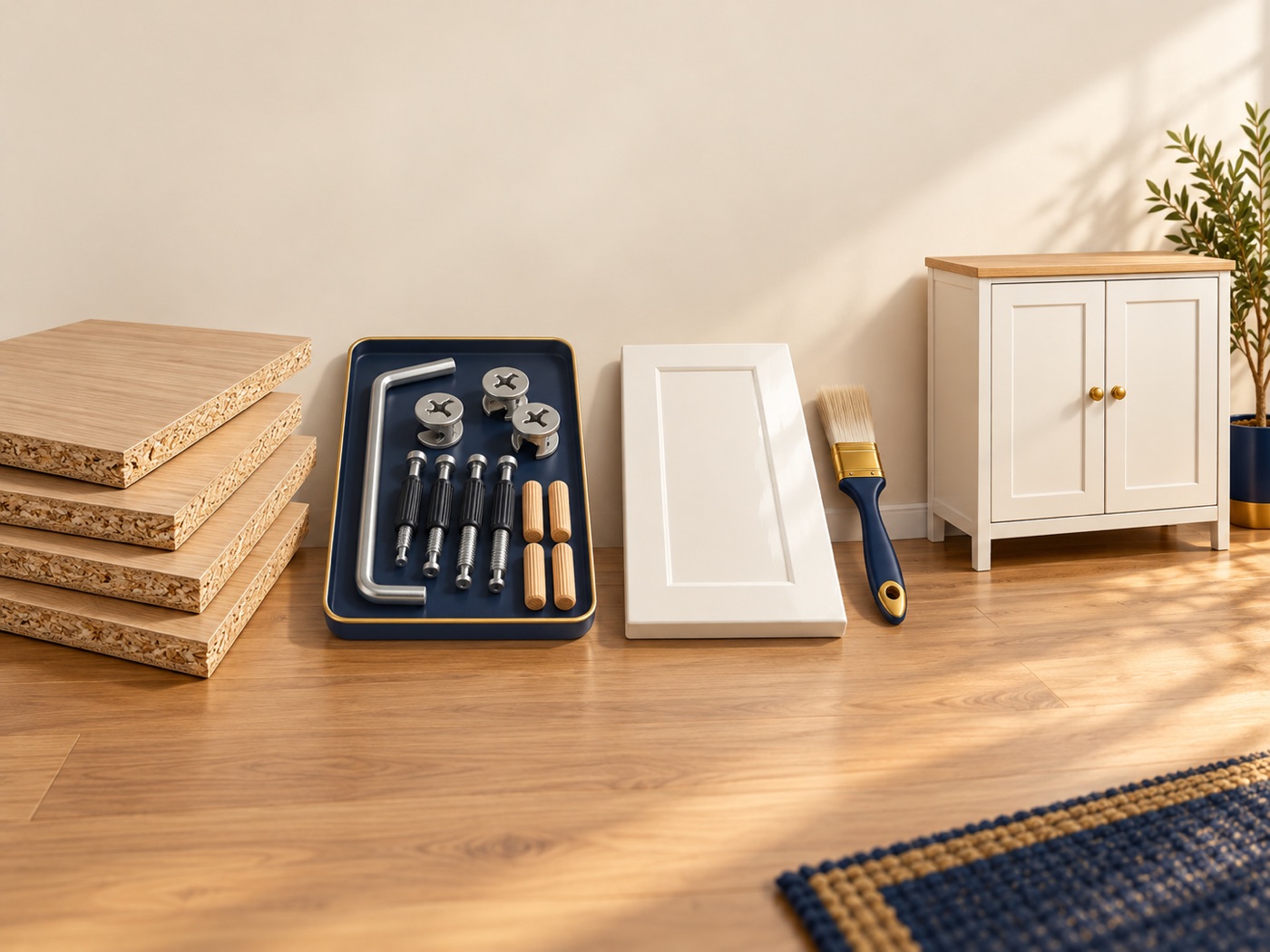
- ① Wood-based material: made of wood-based materials, such as particleboard, plywood or fiberboard panels.
- ② Multiple parts, self-assembly: consists of several components that users can assemble themselves (often called DIY or flat-pack furniture).
- ③ Coated: furniture without any coating is excluded.
- ④ Indoor use and large enough: for indoor use only, with a total surface area of 1,800 cm² or more per set.
Which furniture is not covered?
The draft expressly excludes furniture fixed to buildings or walls, hanging furniture, solid-log furniture, non-assembly furniture, and furniture without any coating.
Which tariff codes are covered?
The draft lists 3 reference tariff codes, all with import code C02; the column 1 duty on these furniture codes is 0%:
| CCC code | Tariff description | Column 1 duty |
|---|---|---|
9403.40.90.00-8 | Other wooden furniture of a kind used in the kitchen | 0% |
9403.50.90.00-5 | Other wooden furniture of a kind used in the bedroom | 0% |
9403.60.90.00-3 | Other wooden furniture | 0% |
Tariff codes are for reference only
Point 12 of the draft's "other inspection rules" states that the codes are for reference only; if the Customs Administration, Ministry of Finance or the International Trade Administration classifies a product under another code, a listed product must still complete inspection before entering the market. What matters is the product itself, not just the code.
According to our tariff database (synced with the International Trade Administration's import rules on 2026-10-21), 18 furniture codes under heading 9403 already carry C02 and none carries MW0. C02 means "some goods under this item are commodities subject to import inspection announced by BSMI", so the draft adds no new code; it makes wooden ready-to-assemble furniture one of those "some goods".
Why test formaldehyde, and what did market tests find?
BSMI's ROC year 115 market sampling of "wooden ready-to-assemble furniture" (attachment dated 2026-05-26) tested 10 samples under CNS 11677 "Furniture – Safety requirements and test methods for hazardous substances in surface materials":
| Item | Result |
|---|---|
| Samples | 10 (bought from online shopping platforms) |
| Labeled origin | Mainland China 6, Vietnam 2, Taiwan 1, not labeled 1 |
| Formaldehyde emission failed | 7, all above the F2 grade in CNS 11677 |
| Of which made in mainland China | 4 of the 6 failed on formaldehyde emission |
| Labeling failed | 8, none labeled correctly under the Commodity Labeling Act (for example, no country of origin, main materials or month of manufacture in Traditional Chinese) |
Check that the maker's name, address and instructions are clear; read the precautions and warnings carefully; avoid furniture with a pungent smell, and air it out for a while before use.
This is a single BSMI market sample of 10 items, not a national statistic, so it does not mean all furniture made in mainland China fails. It shows why the authority chose formaldehyde as the only test item.
From 2028, how do you apply for inspection when importing RTA wooden furniture?
If the draft is adopted as written, the inspection applicant can choose either route. Under Article 8 of the Commodity Inspection Act, when goods are made abroad the obligated applicant is the importer; if another party is commissioned to import and the goods are sold in the name of a domestic principal, it is the principal.
1Choose the inspection scheme
Type approval with batch inspection: first apply for type approval and obtain the certificate, then apply for inspection before each batch is imported. Registration of Product Certification: BSMI issues a certificate after review. Both certificates are valid for 3 years.
2Send samples for type testing
Type testing can be done at BSMI, its Keelung, Taichung or Kaohsiung branches, or a designated laboratory recognized by BSMI; test fees follow the laboratory's rates.
3Apply for type approval or registration
Apply to BSMI or one of its branches. The review period is 14 working days (time waiting for documents or samples not counted; if samples are tested, 7 working days are added after samples arrive). The draft says applications are accepted from the announcement date; certificates issued after the formal announcement but before 2028-01-01 are valid from 2028-01-01 to 2030-12-31.
4Apply for inspection at import
Under type approval with batch inspection, apply to BSMI or the branch covering the port of arrival; cross-district applications are possible when needed. Fees follow the Regulations Governing Fees for Commodity Inspection.
5Labeling and inspection mark
The product or its smallest package must show: product name, formaldehyde emission, manufacturer's name or trademark, and date of manufacture or batch number. The designated code of the commodity inspection mark must include a 2D barcode, printed by the obligated applicant and placed visibly on the product or its smallest package.
For what C01/C02 mean, who the obligated applicant is and a comparison of the four inspection schemes, see the BSMI commodity inspection guide. The draft says details will follow the separate "Operational Rules for Inspection of Wooden Ready-to-Assemble Furniture" set by BSMI.
Buying RTA furniture from mainland China: how are individuals and companies affected?
The impact differs before and after the start date, and depends on whether you use the furniture yourself or sell it. The table uses the draft date of 2028-01-01 as the dividing line:
| Situation | Before 2027-12-31 (draft not in force) | From 2028-01-01 (if adopted as drafted) |
|---|---|---|
| Individual, for personal use | RTA wooden furniture is not yet a commodity subject to inspection; other import rules still apply, for example unprocessed solid-wood items are plant quarantine items. | As a non-sale personal-use item, you can apply for exemption under the Regulations Governing Commodity Inspection Exemption: same declaration, same model with a total value of US$1,000 or less, or above US$1,000 but no more than 2 pieces; limited to 1 time per same model within 6 months. |
| Company or individual importing to sell | No inspection needed, but when sold in Taiwan the goods need Chinese labels under the Commodity Labeling Act (8 of 10 market samples failed labeling). | The importer is the obligated applicant and must obtain type approval and apply for batch inspection, or obtain a registration certificate, and affix the inspection mark before importing or placing goods on the market. |
| Online seller sourcing from Taobao or 1688 | Same as above; labeling is the seller's responsibility. | You cannot use the personal-use exemption and then resell; the exemption is only for "non-sale" use. |
| Stock imported before the start date | Sell under current rules, still complying with the Commodity Labeling Act. | The draft does not state transition arrangements for stock already imported; follow the formal announcement and BSMI guidance. |
How does the personal-use exemption work?
Under Article 3, Paragraph 2 of the Regulations Governing Commodity Inspection Exemption, personal-use items of the same model on one declaration totaling US$1,000 or less can skip the application and enter the BSMI exemption clearance code directly on the import declaration; above that, apply to the inspection authority under Article 4. Article 6 provides that qualifying personal-use items sent by post or carried in travelers' luggage are released directly by customs.
How are "pieces" and "sets" counted?
The draft measures surface area "per set", while the exemption rules count "pieces". The rules do not spell out how many pieces a set shipped in several boxes counts as, so confirm with BSMI before ordering instead of assuming.
Whether a product is listed and whether it can be exempted is decided case by case by BSMI. HowBridge arranges shipping based on the consolidation order you fill in; it does not apply for exemption or inspection for you and does not guarantee clearance.
What are the penalties for importing or selling without inspection?
Once in force, listed products become "commodities subject to inspection", and these Commodity Inspection Act articles apply to the obligated applicant:
| Article | Act | Penalty |
|---|---|---|
| Article 6, Article 60 Paragraph 1 | Importing or placing on the market goods that do not meet inspection requirements | Fine of NT$200,000 to NT$2,000,000 |
| Article 60 Paragraph 2 | As above, and the goods fail inspection | Fine of NT$250,000 to NT$2,500,000 |
| Article 60-1 | Cases above where the total value of the goods is below NT$100,000 | Fine of up to 2 times the total value, but not less than NT$10,000 (imported goods valued at CIF) |
| Article 59 | Labeling or inspection-mark violations not corrected by the deadline; or false labeling | Fines of NT$100,000 to NT$1,000,000, and NT$150,000 to NT$1,500,000, respectively |
| Article 61 | Violations causing harm to consumers' life, body or health, or risk of serious harm | Fine of NT$750,000 to NT$7,500,000 |
Article 6, Paragraph 4 of the Commodity Inspection Act prohibits sellers from displaying or selling commodities subject to inspection that do not meet the requirements. If the maker or importer is unknown or cannot be traced, the seller becomes the obligated applicant under Article 8.
What about solid-wood or uncoated furniture?
The draft excludes "solid-log" and "uncoated" furniture, but such products may face a different rule: plant quarantine.
- The Animal and Plant Health Inspection Agency (Ministry of Agriculture) stated on 2026-08-04 that wooden items made from natural logs without paint, preservative or other effective processing are plant quarantine items and need a quarantine application when imported.
- The agency also noted that such wooden items mostly arrive as express shipments and, under Customs Administration rules, must be declared on a regular formal import declaration rather than a simplified declaration.
- Penalty cases for illegally importing wooden items by express were 192 in ROC year 113 and 272 in ROC year 114, 31% and 42% of all plant and plant-product violations respectively.
For the scope of quarantine items and how to declare them, see animal and plant quarantine: what must be declared when shipping to Taiwan.
Shipping furniture from mainland China with HowBridge: what to watch?
HowBridge only handles mainland China → Taiwan import consolidation; furniture leaves the Shenzhen consolidation warehouse and is delivered via the Taoyuan Dayuan operations warehouse. Points related to this draft:
- Fill in the consolidation order truthfully with product name, material (for example particleboard or solid wood), quantity and price; "wooden RTA storage cabinet (particleboard, coated)" is clearer than just "cabinet".
- HowBridge does not handle commodity inspection or apply for exemption, and does not judge whether a product falls within the listed scope.
- Furniture with glass, ceramic or other fragile parts is not accepted; regular furniture can get an optional wooden crate (from NT$300, quoted by actual size).
- For furniture duties, volumetric freight and bulky delivery, see the bulky furniture import guide.
- HowBridge is not a customs broker; clearance is handled by partner customs brokers.
Companies or online sellers planning to keep importing RTA wooden furniture for sale after 2028 can ask suppliers now for formaldehyde test reports on the panels and finished products, and watch for BSMI's formal announcement and its "Operational Rules for Inspection of Wooden Ready-to-Assemble Furniture". If formal customs declaration is needed, see company imports and formal declaration.
How do other countries regulate formaldehyde in furniture?
Taiwan's draft makes finished furniture subject to inspection. The US and the EU already regulate finished goods containing wood-based panels:
| Region | Rule | Key point | Start |
|---|---|---|---|
| Taiwan (draft) | Inspection rules for wooden ready-to-assemble furniture | Formaldehyde emission tested under CNS 11677; type approval with batch inspection or Registration of Product Certification | 2028-01-01 (planned) |
| United States | TSCA Title VI formaldehyde emission standards for composite wood products (EPA) | Hardwood plywood, medium-density fiberboard, particleboard and finished goods containing them must be labeled TSCA Title VI compliant | Labeling required since 2019-03-22 |
| European Union | Commission Regulation (EU) 2023/1464 (REACH Annex XVII) | Formaldehyde release from furniture and wood-based articles must not exceed 0.062 mg/m³ | 2026-08-06 |
Test methods, units and sampling conditions differ between jurisdictions, so the figures in the table cannot be converted or compared directly.
What does research say about furniture and indoor formaldehyde?
The studies and sources below provide background and are not about this draft or any specific product:
- Wood-based panels are one source of indoor formaldehyde: Chen et al. (2000) studied indoor formaldehyde pollution from pressed-wood products (particleboard, plywood and similar) in the Taipei metropolitan area. RTA furniture mostly uses such panels, which is the background for BSMI testing only "formaldehyde emission".
- Test methods decide whether numbers can be compared: Lin et al. (2007) compared the ISO 16000 series with Taiwan's building-material emission test methods and recommended adopting the international standards as CNS. Formaldehyde limits in different countries use different test methods, so the figures cannot be compared directly.
- The US and EU already regulate "finished goods": US TSCA Title VI has required finished goods containing hardwood plywood, medium-density fiberboard or particleboard to be labeled compliant since 2019-03-22; EU Regulation (EU) 2023/1464 has limited formaldehyde release from furniture and wood-based articles (0.062 mg/m³) since 2026-08-06. Taiwan's draft likewise covers finished furniture, not just panels.
What terms are common in RTA furniture inspection?
- Commodity subject to inspection
- Goods whose category or item BSMI has designated and announced under Article 3 of the Commodity Inspection Act; goods that do not meet inspection requirements may not leave the factory, be exported or be imported.
- C02
- An import regulation code meaning some goods under this item are commodities subject to import inspection announced by BSMI; it is not an inspection scheme.
- Type approval with batch inspection
- The product first obtains a type approval certificate, then each batch is inspected before import or leaving the factory, with a simplified procedure.
- Registration of Product Certification
- Review of the design and production stages under conformity assessment procedures; a registration certificate is issued if compliant, valid for 3 years under this draft.
- Obligated applicant for inspection
- Under Article 8 of the Commodity Inspection Act, the importer for goods made abroad; the principal if import is commissioned and goods are sold in the name of a domestic principal.
- Formaldehyde emission
- The amount of formaldehyde released by furniture surface materials under set test conditions; this draft tests under sections 3.1.2 and 4.3 of CNS 11677.
- Commodity inspection mark
- The mark placed on inspected goods that pass; this draft requires the designated code to include a 2D barcode, printed and applied by the obligated applicant.
- Pre-announcement
- A draft regulatory order published before adoption so anyone can comment within a set period; it is not a rule in force.
What sources were used and how far were they checked?
The sources below were consulted on 2026-10-23; document dates and consultation dates are shown separately, and no date is added where the source gives none.
Government and official primary sources
- BSMI: Pre-announcement of the "Inspection Rules for Wooden Ready-to-Assemble Furniture" (Jing-Biao-Jian-Zheng-Zi No. 11530020110, with draft) | Document date: 2026-10-01; primary source for this page: scope, CNS 11677 formaldehyde emission, type approval with batch inspection or registration, 3 reference codes, C02, start on 2028-01-01, 4 labeling items, 3-year certificates, 14-working-day review.
- BSMI: ROC year 115 market sampling results for "wooden ready-to-assemble furniture" (summary table) | Document date: 2026-05-26; origin, sales channel, labeling check and formaldehyde result for the 10 samples.
- BSMI: Attached table of test results for "wooden ready-to-assemble furniture" | Document date: 2026-05-26; 7 above the CNS 11677 F2 grade for formaldehyde, 8 not labeled correctly under the Commodity Labeling Act, and buying advice.
- Laws & Regulations Database: Commodity Inspection Act (full text) | Document date: not stated; Articles 3, 5, 6, 7, 8, 9, 10, 11, 12, 28, 35 and 39: mandatory inspection, schemes, ban on importing non-compliant goods, obligated applicant, exemption, labeling and inspection mark.
- Laws & Regulations Database: Commodity Inspection Act Article 60 | Document date: not stated; importing or placing non-compliant goods on the market is fined NT$200,000 to NT$2,000,000; NT$250,000 to NT$2,500,000 if the goods fail inspection.
- Laws & Regulations Database: Commodity Inspection Act Article 60-1 | Document date: not stated; if total value is below NT$100,000, the fine may be up to 2 times the total value but not less than NT$10,000; imported goods valued at CIF.
- Laws & Regulations Database: Regulations Governing Commodity Inspection Exemption (full text) | Document date: 2019-11-21; Articles 3, 5, 6 and 8: value and quantity thresholds for non-sale personal-use items, exemption clearance code, postal items released by customs, once per 6 months.
- Laws & Regulations Database: Administrative Procedure Act Article 154 | Document date: not stated; draft regulatory orders must be published so anyone can comment within a set period; this pre-announcement follows that article.
- Animal and Plant Health Inspection Agency, Ministry of Agriculture: unprocessed wooden items such as artificial trees, and seeds, are quarantine items; declare cross-border online purchases | Document date: 2026-08-04; log items without paint, preservative or other effective processing are plant quarantine items; express imports must use a regular formal import declaration; penalty cases 192 in ROC year 113 and 272 in ROC year 114.
- US Environmental Protection Agency (EPA): Formaldehyde Emission Standards for Composite Wood Products | Document date: not stated; US TSCA Title VI: final rule published on 2016-12-12; after 2019-03-22, hardwood plywood, MDF, particleboard and finished goods containing them must be labeled TSCA Title VI compliant.
- Commission Regulation (EU) 2023/1464 (REACH Annex XVII restriction on formaldehyde) | Document date: 2023-07-14; after 2026-08-06, furniture and wood-based articles releasing formaldehyde above 0.062 mg/m³ under the set test conditions may not be placed on the EU market.
Research and reference sources
Indoor Formaldehyde Pollution from Pressed-Wood Products in the Metropolitan Taipei Area
Studies indoor formaldehyde pollution from pressed-wood products (particleboard, plywood and similar) in the Taipei metropolitan area; shows wood-based panel furniture is one source of indoor formaldehyde.
木質建材之甲醛及VOC逸散測試方法CNS化之研究
Compares ISO 16000-3, -6 and -9 with Taiwan's building-material emission test methods and recommends adopting the international standards for wood-based material formaldehyde emission as CNS; explains how test methods relate to national standards.
EU: New regulations on formaldehyde emissions from products from August 2026
A testing laboratory's technical note, not an academic paper. Summarizes EU Regulation (EU) 2023/1464: 0.062 mg/m³ for furniture and wood-based articles, 0.080 mg/m³ for other articles, applying from 2026-08-06; used here to check the key points of the EU text.
The draft is based on the original BSMI notice and draft PDF of 2026-10-01. We have not obtained the gazette text, so we do not give the gazette publication date or the comment deadline. The full CNS 11677 standard must be purchased from BSMI, so this page does not state the F2 grade value. The EU's official site (EUR-Lex) could not be read automatically when checked, so the key points were cross-checked against a testing laboratory's summary. This page is not legal advice; for individual cases, ask BSMI.
FAQ on RTA wooden furniture inspection
When does inspection of RTA wooden furniture start?
What is tested?
Does a cabinet I assemble myself count?
Which tariff codes are covered?
If I buy one bookcase on Taobao and ship it to Taiwan after 2028, does it need inspection?
What must online sellers importing RTA furniture do?
What is the fine for importing and selling without inspection?
How long are certificates valid, and how long does approval take?
Can I comment on the draft?
Can HowBridge handle inspection or exemption for me?
Further reading
Bulky furniture to Taiwan: duties, C02 and wood packaging quarantine
BSMI commodity inspection procedure and C01/C02
BSMI regulated product list and how to check it
Personal-use inspection exemption quantities at a glance
Animal and plant quarantine: what must be declared when shipping to Taiwan
What is a CCC code and how to look it up
Company imports and formal customs declaration
Shipping furniture from mainland China? Check the rules before you order
When creating a consolidation order in the member center, fill in product name, material, quantity and price truthfully; for furniture you import to sell, watch for BSMI's formal announcement.
Go to member center