Beauty Devices from Taobao and Pinduoduo to Taiwan: Is It a Medical Device First?
Can a beauty device bought on Taobao be shipped back to Taiwan?
First check whether it is a medical device: devices that remove hair with laser, light or heat, and devices that deliver electric current, light or ultrasound to the dermis to tighten or lift the skin, are or may be Class II medical devices. For personal use, special import approval from the TFDA must be obtained first, limited to 1 unit per model. For beauty devices that are not medical devices, those with a lithium battery go by sea express only; those with Bluetooth or Wi-Fi can use a signed declaration instead of an approval certificate for up to 2 units per shipment; and a dutiable value of NT$2,000 or less per consignment is tax-exempt. For a beauty device that may be a medical device, ask HowBridge customer service first, and please do not send it to the warehouse until confirmed.
It is for people who have found a hair removal device, RF or microcurrent beauty device, LED mask, iontophoresis device or facial cleansing device on Taobao or Pinduoduo and want to ship it back to Taiwan for personal use. Commercial Times reported on 2026-11-12 that beauty tools were the "surprise dark horse" of Shopee's Double 11, with several items up more than 400 times year on year (the report does not explain the metric or how it was calculated; this is the media relaying the platform's claim). Shipping from mainland China to Taiwan means passing several more rules than ordering from a Taiwan online store. HowBridge only offers consolidation from mainland China to Taiwan, operating from the Shenzhen consolidation warehouse and the Dayuan, Taoyuan operations warehouse; customs clearance is handled by partner customs brokers, and HowBridge is not a customs broker.
Which beauty devices may be medical devices?
Look at the function and the claims, not the product name: devices that make hair fall out using laser, light or heat are Class II medical devices (TFDA Drug and Food Safety Weekly, Issue 980); devices that deliver electric current, light or ultrasound to the dermis to tighten, lift or fade lines may also be Class II. Medical devices are classified by function, purpose, method of use and working principle (Regulations for Governing the Classification of Medical Devices, Article 2); a listing title that says "home use" or "non-medical" does not count.
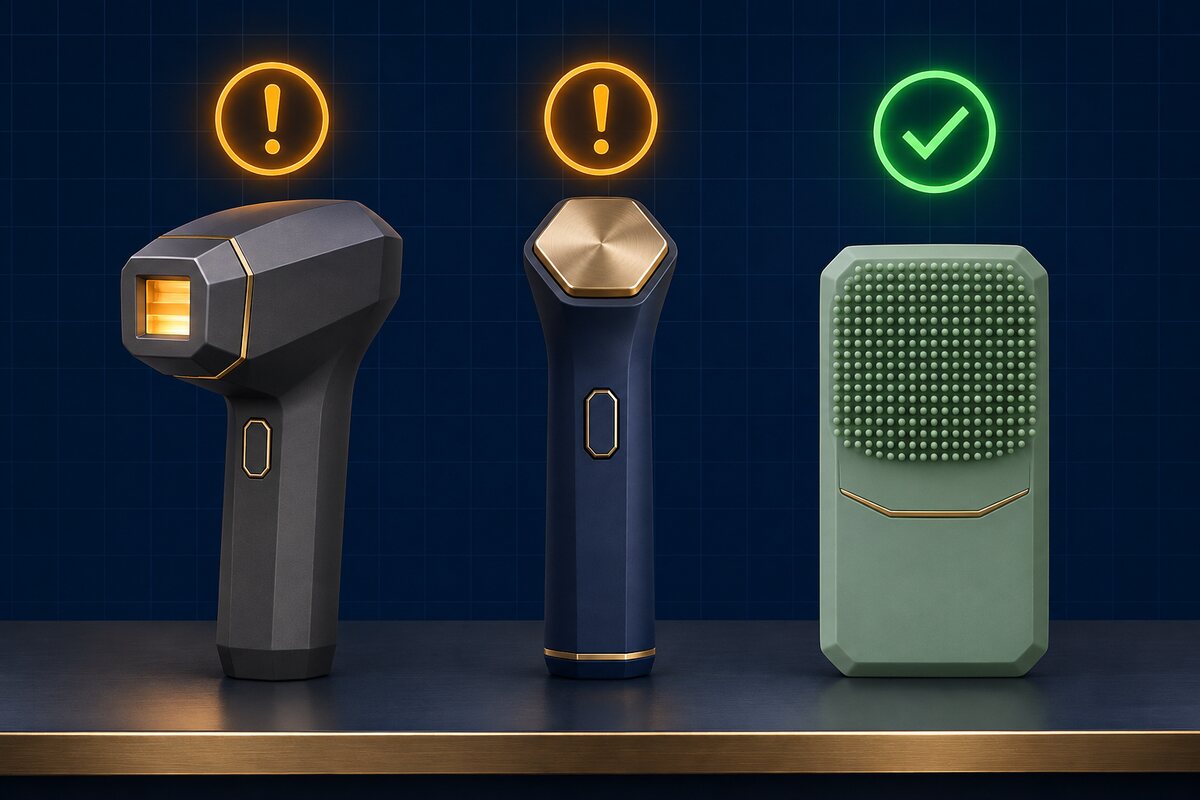
| Type of beauty device | May it be a medical device? | Basis | What to do before shipping |
|---|---|---|---|
| IPL (intense pulsed light) and laser hair removal devices | Yes: hair removal using laser, light or heat is Class II | TFDA Drug and Food Safety Weekly, Issue 980; license data are mostly listed under I.4810 | Obtain TFDA special import approval first, then place the order |
| Radiofrequency (RF) beauty devices | May be: claims of acting on the dermis, tightening, lifting or fading lines | Appendix items I.0008 and I.0001 of the Regulations for Governing the Classification of Medical Devices | Search the license database; if necessary, ask the TFDA about the classification |
| Microcurrent beauty devices | May be: claims of lifting, tightening or fading lines | Appendix item I.0008 (electric current) | Same as above |
| LED light therapy masks | May be: claims of promoting collagen or tightening | Appendix item I.0008 (light energy) | Same as above |
| Iontophoresis and ultrasonic infusion devices | May be: those that act on the dermis with electric current or ultrasound | Appendix item I.0008 | Same as above |
| Laser beauty devices | May be: those that can cut or destroy tissue, or destroy fat cells | Appendix items I.4810 and I.5400 | Same as above |
| Facial cleansing devices and cleansing brushes | Generally not a medical device when used only for cleansing and with no medical claims | Medical devices are determined by function and purpose (Regulations for Governing the Classification of Medical Devices, Article 2); this row is this page's own inference | Check the battery, Bluetooth and commodity inspection; those that cleanse or infuse with electric current or ultrasound belong in the iontophoresis row |
| Facial vibration massagers | Those that are not medical devices are mostly BSMI "electric massage appliances" | Items subject to mandatory inspection by BSMI | Check the commodity inspection exemption quota and the battery |
- Hair removal devices: TFDA Drug and Food Safety Weekly, Issue 980 (2024-06-28) states that devices that make hair fall out using laser light or heat are Class II medical devices, and non-medical-device businesses may not sell them.
- Beauty devices sold on overseas websites: The TFDA cases announced from 2024 to 2026 in its section on exaggerated food and drug advertising include a home hair removal device, a microcurrent beauty device, an eye-area beauty device, an LED light therapy mask and a multi-wavelength light therapy device. All had the product category listed as medical device, and the violation was having no medical device license number.
- Not found in the item table does not mean not a medical device: Article 6 of the Regulations for Governing the Classification of Medical Devices provides that a medical device whose function, purpose or working principle matches no item in the appendix is classified as Class III (the highest-risk class); however, if similar products in Taiwan already have a license or registration, the class of the similar product applies, and the classification can also be inquired about under Article 5.
- Infusion and cleansing devices used by businesses: The Ministry of Health and Welfare announced in 2015 that, in an inspection in year 103 (ROC calendar) of 61 slimming and beauty businesses, 36 of the 110 devices they used were medical devices without a license, mostly devices that relieve pain with far-infrared light, ultrasound or electric current, infuse cosmetics, or cleanse the skin (the Pharmaceutical Affairs Act applied at that time).
Type 1 in the table above is a medical device and types 2 to 6 may be; please send the product name, model and product page link to customer service for confirmation, and please do not send it to the warehouse until confirmed. For a medical device, TFDA special import approval documents must be attached before it is accepted. Non-medical devices such as facial cleansing devices and vibration massagers are handled under the general rules for goods, batteries, Bluetooth and commodity inspection. For the categories the Shenzhen warehouse refuses, see the Taiwan banned imports list.
One is to search the TFDA website's medical device license database for that model to see whether it has a license; the other is to inquire about the classification from the TFDA under Article 5 of the Regulations for Governing the Classification of Medical Devices, by submitting an inquiry form, attaching the manufacturer's manual and paying the fee.
Which tariff number does customs put beauty devices under?
Even for the same "beauty device," the tariff numbers set by customs can differ a lot: among the advance tariff classification rulings published by the Customs Administration, Ministry of Finance, 13 beauty-device-related cases fall under 7 tariff numbers; in 3 of them the classification reasoning states that the TFDA determined the item to be a medical device, and in 1 it states that the item is not regulated as a medical device. The following is taken from the Customs Administration open data held in the HowBridge tariff database. All are individual cases from 2014 to 2018 for specific models, and brands and models are not listed.
| Ruling no. | Goods (per the declaration) | Tariff number set | Medical device determination mentioned in the reasoning |
|---|---|---|---|
| 104BA0008 (2015) | IPL beauty device (hair removal and spot removal with different wavelengths) | 9018.90.80.90-7 | After inquiry to the TFDA, determined to be a medical device |
| 105AA0210 (2016) | Electric pulse beauty device (red light plus electric pulses, claimed to promote collagen growth) | 9018.90.80.90-7 | The TFDA determined it must be regulated as a medical device |
| 105AA0013 (2016) | Pulsed heating hair remover | 8543.70.99.90-6 | The TFDA replied by letter that it must be regulated as a medical device, and the importer must handle it under import regulation 504 |
| 104CA0202 (2015) | Sonic beauty infusion device (warmth, vibration massage) | 9019.10.19.00-8 | The TFDA replied by letter that it is not regulated as a medical device |
| 107AA0231 (2018) | Rechargeable facial beauty device (RF, muscle electrical stimulation, ion, red and blue light) | 9018.90.80.10-4 | Not mentioned in the reasoning |
| 105AA0625 (2016) | LED beauty mask device (red light, infrared light) | 8543.70.99.90-6 | Not mentioned in the reasoning |
| 103AA0719 (2014) | Three-brush-head electric facial cleansing device | 8509.80.90.00-4 | Not mentioned in the reasoning |
| 104CA0183 (2015) | Warm massager (warm probe) | 8516.79.00.00-7 | Not mentioned in the reasoning |
- A tariff number without 504 does not mean it is not a medical device: The hair remover in 105AA0013 was classified under 8543.70.99.90-6, whose import regulations do not include 504, yet the TFDA replied by letter that it must be regulated as a medical device, and the classification reasoning required the importer to handle it under 504. The Medical Devices Act regulates the device itself, not the tariff number.
- The same kind of function can fall under different tariff numbers: Cases with an ion function were classified under 8543.70.99.90-6 (104AA0378), 9018.90.80.10-4 (107AA0231) and 8479.89.99.99-4 (106CA0139); sonic and acoustic-wave devices were also split among 9018.90.80.10-4 (105AA0934), 9019.10.19.00-8 (104CA0202) and 8509.80.90.00-4 (103AA0590).
- Where your own product belongs: You can enter the product name in the tariff lookup to find candidate tariff numbers. The tariff number is determined by customs according to the actual function; you cannot choose a number without 504 or with a lower rate, and falsely declaring the name, quantity or value of the goods can be penalized under Article 37 of the Customs Anti-Smuggling Act. If you need a definite answer, you can apply to customs for an advance tariff classification ruling.
A ruling answers a specific product in a specific application and is valid only for that case; it does not mean your product will necessarily fall under the same tariff number. The cases date from 2014 to 2018, and the tariff schedule has been revised since. In 9 of the 13 cases the classification reasoning does not mention the TFDA, so you cannot infer from that that those goods are not medical devices.
Can an individual import a beauty device that is a medical device?
You can apply, but you must first obtain special import approval from the TFDA: for a medical device for personal use, instrument-type devices are limited to 1 unit per model, and the application must attach a diagnosis certificate or prescription that states the name of the medical device. If it is confirmed to be a medical device and you do not yet have special import approval, do not place the order yet.
| Rule | Content | Law |
|---|---|---|
| A license is required in principle | Imported medical devices must first go through registration and obtain a license | Medical Devices Act, Article 25, paragraph 1 |
| You cannot use someone else's license | Medical devices must be imported by the license holder, the registrant or a person authorized by them; even if the same model is sold in Taiwan, you cannot simply ship it in | Medical Devices Act, Article 25, paragraph 3 |
| Exception for personal use | The central competent authority may specially approve import for personal use | Medical Devices Act, Article 35, paragraph 1, subparagraph 4 |
| What counts as personal use | A medical device that needs no operation by a physician or professional and is used by a natural person on themselves | Regulations Governing the Special Approval of Manufacturing and Importing Specific Medical Devices, Article 5 |
| Documents to attach | Proof of identity, the instruction manual, a signed declaration not to sell or transfer, and a diagnosis certificate or prescription stating the name of the medical device | Same Regulations, Article 17 |
| Quantity | For instrument-type devices exclusively for personal use, 1 unit per model (exceptions for special cases such as use at different places) | Same Regulations, Article 7, subparagraph 3 |
| No shortcut that skips the application | The appendix of items for convenient clearance has only 8 items, such as adhesive bandages, cotton swabs, daily disposable contact lenses and medical masks, and does not include beauty devices | Same Regulations, Article 6, appendix |
| Customs clearance documents | When the tariff number's import regulation is marked 504, attach a copy of the medical device license issued by the Ministry of Health and Welfare or a letter of consent | Import regulation code descriptions of the International Trade Administration |
- Importing without approval may be penalized: Under Article 68, paragraph 1, subparagraph 5 of the Medical Devices Act, importing a medical device without registration or listing is punishable by a fine of NT$60,000 to NT$2,000,000, and the provision has no "intent to sell" element. The TFDA reminded on 2025-08-23 that people have been fined for buying medical devices online.
- What happens at customs: A medical device imported from abroad without registration must be sealed immediately under Article 57 of the same Act, and the local health authority orders the original importer to ship it back within a time limit; if it is not shipped back by the deadline, it is confiscated and destroyed. The Customs Administration also reminds that cross-border online purchases that do not meet import regulations may be required to be returned, be abandoned by declaration or be fined.
- Criminal liability requires "intent to sell or supply": Imprisonment of up to 3 years, detention, or a fine of up to NT$10,000,000, or both, under Article 62, paragraph 1 of the same Act, requires intent to sell or supply and importing without approval; without that element, a fine can still be imposed under Article 68 above.
- Reselling or transferring is penalized: Under Article 70, paragraph 1 of the same Act, selling, supplying, transporting or transferring a medical device that has not been registered or listed is punishable by a fine of NT$30,000 to NT$1,000,000; violating the restrictions on supply and sale, or the return-shipment rules, after special approval for import is penalized at the same amount.
- No therapeutic claims: Under Article 46 of the same Act, a non-medical device may not carry labeling or advertising of medical efficacy, and violators are fined NT$600,000 to NT$25,000,000 under Article 65. Be especially careful about writing words such as "treatment" on a product page when reselling.
Article 70 of the Medical Devices Act also lists "transporting" medical devices that have not been registered or listed in its penalties, and this subparagraph has no "intent to sell" element. So for beauty devices that may be medical devices, HowBridge confirms first and accepts the item only with special import approval documents attached.
How many units of a beauty device with Bluetooth or Wi-Fi can be shipped at one time?
Consolidation is a non-hand-carried method: up to 2 units per shipment can use a signed declaration instead of applying for an import approval certificate. The text says that postal import of 3 to 10 units requires an import approval certificate, and whether 3 or more units by consolidation can be handled the same way, please ask the NCC first; one person is limited to 10 units a year. This is the NCC's rule on wireless functions and is a separate set of rules from the medical device rules; a medical-device-type beauty device with app connectivity must meet both.
| Method of import | Signed declaration is enough (no import approval certificate) | Import approval certificate required |
|---|---|---|
| Postal, consolidation and other non-hand-carried methods | Up to 2 units at a time | The text says postal import of 3 to 10 units (for consolidation, ask the NCC first) |
| Hand-carried on entry | Up to 5 units at a time | 6 to 10 units |
| Annual limit | 10 units per natural person or legal person per year; a natural person must be at least 18 years old | Same as left |
- Personal use only: Devices imported this way are for the applicant's own use only and may not be transferred or used for other commercial purposes (Regulations Governing the Manufacture, Import and Reporting of Controlled Telecommunications Radio-Frequency Devices, Article 9, amended 2025-02-03).
- The "radiofrequency" in RF beauty devices: The radiofrequency of an RF beauty device is energy applied to the skin. Whether it counts as a controlled telecommunications radio-frequency device under the NCC, this page found no explicit NCC statement, so it describes only the rules for when Bluetooth or Wi-Fi is present.
- General rules and the declaration process: See Importing NCC radio-frequency devices to Taiwan.
Does a beauty device need BSMI commodity inspection?
Plug-in or rechargeable electric massage-type beauty devices (those that are not medical devices) mostly fall under the "electric massage appliances" subject to mandatory inspection by the Bureau of Standards, Metrology and Inspection (BSMI); for personal use, if the total value of the same specification and type on the same declaration is US$1,000 or less, the item can clear under the announced exemption code. According to the BSMI Hsinchu Branch's determination principles, devices powered only by dry-cell batteries, those powered by USB 5V with no adapter and no rechargeable battery, microcurrent or EMS types, roller-type body-shaping types, and cleansing and care types that must be used with a beauty serum are outside the scope.
- Scope of inspection: According to the BSMI Hsinchu Branch's determination principles, the inspection rules for electric massage appliances were amended by Announcement No. 11030003190 (Jing-Biao-San-Zi) of 24 June 2021 (ROC year 110) and took effect on 1 January 2023 (ROC year 112), bringing in products with a secondary battery (rechargeable battery); those that have obtained a medical device license or been determined by the Ministry of Health and Welfare to be medical devices are outside the scope of inspection.
- Examples of case-by-case determinations: A BSMI Kaohsiung Branch teaching material gives examples: a massager that conducts through electrode pads and imitates biological microcurrent was judged not to be a product subject to mandatory inspection; a vibration massager that uses AC power and was determined by the Ministry of Health and Welfare by letter not to be a medical device is a product subject to mandatory inspection.
- Personal-use exemption quota: For non-sales personal-use items, if the total value of the same specification and type on the same declaration is US$1,000 or less, you can fill in the exemption clearance code announced by the BSMI yourself; above US$1,000 the quantity may not exceed 2 units, and you must first apply to the inspection authority for exemption (Regulations Governing Exemption from Commodity Inspection, Articles 3 and 5).
- Once every 6 months: For personal-use items of the same specification and type, the exemption is limited to 1 time within 6 months (Article 8 of the same Regulations). The exemption requires non-sales personal use, and the item cannot be resold.
The BSMI Hsinchu Branch's determination principles state that hair removal appliances using optical or pulsed-light principles are "not subject" to inspection, and to inquire with the Ministry of Health and Welfare separately; beauty and massage appliances using microcurrent or EMS principles are also "not subject." Whether RF and LED beauty devices are subject to mandatory inspection, this page found no clear determination. For hair dryers, hair stylers and other hair-care appliances, see Hair dryers and stylers to Taiwan; for the general rules on mandatory inspection, see BSMI commodity inspection.
Can a rechargeable beauty device go by air?
No. HowBridge does not send goods with lithium batteries by air; for complete devices with the battery installed inside, items are accepted only with a UN38.3 certificate and each battery no larger than 300Wh (this also applies above 100Wh), and go by sea express only. Anything over 300Wh is not accepted.
- Rechargeable beauty device (built-in lithium battery): Ask the seller for a UN38.3 certificate before ordering; shipping back to Taiwan is by sea express only.
- Separately bought replacement batteries, charging cases and power banks: These count as batteries or power banks bought on their own; send the specifications to customer service for confirmation, and please do not send them to the warehouse until confirmed.
- Plug-in beauty devices without a battery: You can choose air or sea express.
- Further reading: For battery classes and the rules at the China export end, see the Lithium battery consolidation guide; for power banks and single batteries, you can first use the preliminary screening tool in Power bank and lithium battery shipping.
What taxes apply to beauty devices?
If the dutiable value of the same consignment (including freight and insurance) is NT$2,000 or less, customs duty, business tax and commodity tax are all waived; if it is over, the exemption does not apply and the whole consignment is taxed (Customs Act, Article 49, paragraph 2). If the same taxpayer has cleared goods under the exemption more than 6 times in a half-year period, the exemption no longer applies. Beauty devices are not among the electrical appliances taxed under Article 11 of the Commodity Tax Act, so what is calculated is customs duty and business tax.
| Tariff number (example) | Tariff description | Column 1 rate | Import regulation |
|---|---|---|---|
| 9019.10.19.00-8 | Other therapeutic massage appliances | 0% | C02 |
| 9018.90.80.10-4 | Other goods of heading 9018, with low-frequency, high-frequency, ultrasonic or ultrashort-wave functions | 0% | 504, MP1 |
| 8543.70.99.90-6 | Other electrical machines and apparatus | 4.5% | C02, MP1 |
| 8543.70.92.00-2 | Transcutaneous electrical nerve stimulators | 0% | 504, MW0 |
| 8509.80.90.00-4 | Other household electromechanical appliances | 5% | C02 |
- The tariff numbers are only examples: The tariff schedule has no tariff number dedicated to "beauty devices." The table above only shows that the same kind of goods may fall under different rates and import regulations; it does not mean your product necessarily belongs here.
- What the codes mean: 504 and 530 = the importer must attach a copy of the license or a letter of consent for a medical device (530 also covers the dedicated code for clinical trial consumables); MP1 = mainland China goods conditionally permitted for import; MW0 = mainland China goods not permitted for import; C02 = some goods under the item are subject to mandatory import inspection by the BSMI.
- MP1 is an itemized list: The International Trade Administration's summary table lists 72 permitted mainland China goods under 8543.70.99.90-6, and beauty devices are not among them. For goods not on the list and above the small-quantity certificate-exemption threshold below, please ask customer service whether they can be imported.
- Small-quantity certificate exemption for mainland China goods: Mainland China industrial products in chapters 25 to 97 of the tariff schedule with a total CIF value on the whole declaration within NT$32,000 and within 24 pieces per item (within 40 kilograms for items that cannot be counted in pieces) can be exempt from an import permit (Ministry of Economic Affairs announcement of 19 August 2022, ROC year 111; the exclusion list of 10 March 2026, ROC year 115, has only 3 tariff numbers related to electric two-wheelers); an item is determined by model and may not be split by size, specification or color. Being exempt from a certificate does not mean other rules need not be followed; items marked 504 must still attach a medical device license or letter of consent.
- Calculation example (assuming a 4.5% rate): Dutiable value NT$3,000, customs duty = 3,000 × 4.5% = NT$135; business tax = (3,000 + 135) × 5% = NT$156.75, with amounts below one dollar determined by customs. You can estimate taxes with the Taobao duty calculator.
- Consolidated boxes are calculated together: Express operators may not declare the same consignment separately (Regulations Governing the Clearance of Sea Express Cargo, Article 15); for the full explanation of the exemption count and threshold, see Cross-border online shopping import tax rules.
How are shipping costs and transit time calculated for beauty devices to Taiwan?
A box of 3.2 kg, 40×30×25 cm by sea express is about NT$320; goods with a lithium battery can go by sea express only, and delivery measured after the warehouse ships is about 4 working days. HowBridge sea express is NT$55 per unit and air is NT$110 per kilogram (from 2026-11-11); the actual amount is according to the bill after measurement at the warehouse.
| Method | How it is priced | Surcharge | Transit time | Suitable for |
|---|---|---|---|---|
| Sea express | NT$55 per unit; the unit is the greater of actual weight and volumetric weight (length × width × height in cm ÷ 10000), rounded up | NT$100 extra if the chargeable units are under 10 | About 4 working days after the warehouse ships, 90% within 6 working days | Beauty devices with lithium batteries, non-urgent parcels |
| Air | NT$110 per kilogram, actual weight only | NT$120 extra if the actual weight is under 10 kilograms | About 3 to 5 working days | Beauty devices without batteries, urgent needs |
| LCL sea container | Ask customer service for a quote based on the goods | — | Per quote | Large items or large volumes |
- Worked example: Volumetric weight = 40×30×25÷10000 = 3, the actual weight of 3.2 is greater, rounded up to 4 units; sea express = 4 × NT$55 + NT$100 = NT$320, the same as the result of the shipping cost calculator.
- How to ship: When ordering on Taobao or Pinduoduo, fill in the HowBridge Shenzhen warehouse as the delivery address; after the parcels arrive at the warehouse they are combined and shipped back to Taiwan. Transit time does not include weekends, public holidays and typhoon days off.
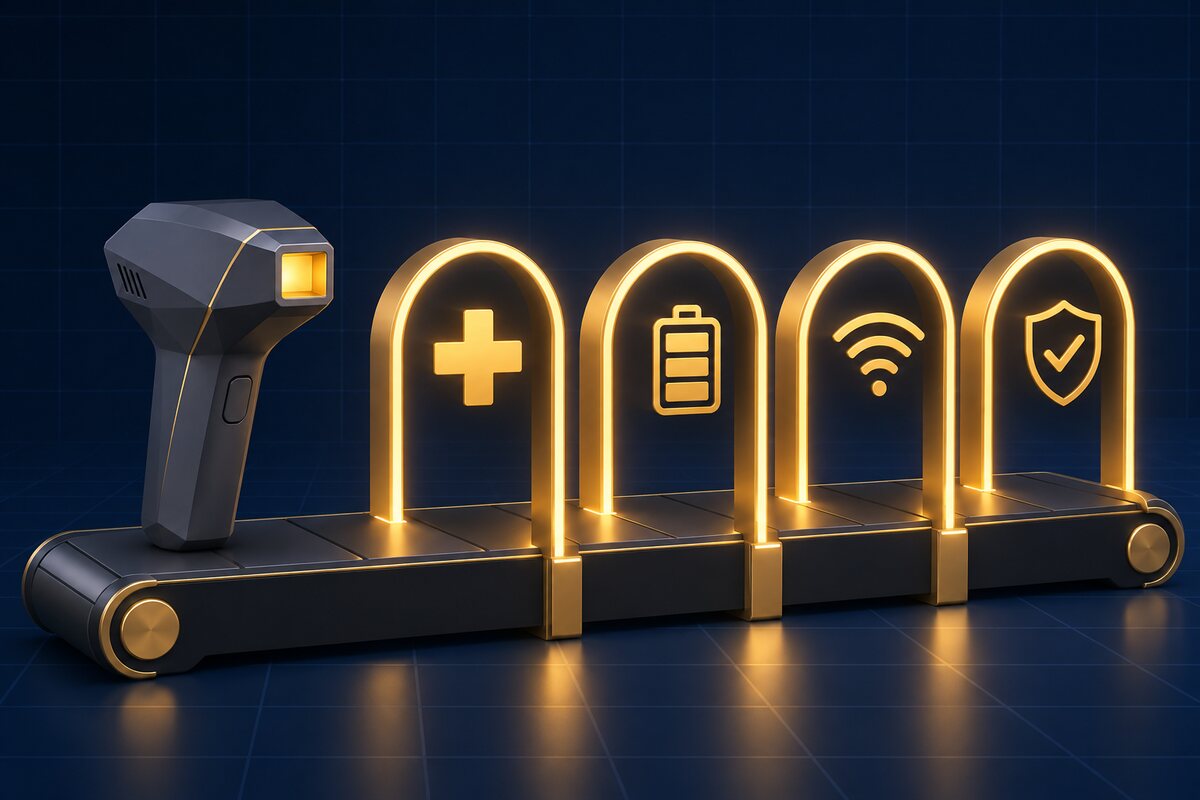
Before shipping a beauty device, follow these 5 steps
Check in order for medical device status, battery, wireless function, commodity inspection and taxes; as soon as step 1 says it may be a medical device, ask customer service and apply for approval first, and do not order first.
1Look at the function and claims
If the product page says hair removal, tightening, lifting, fading lines or promoting collagen, or says it uses laser, IPL, RF or microcurrent, it may be a medical device; those that only cleanse or give vibration massage usually are not.
2Check the license or classification
Search the model in the TFDA medical device license database, or inquire about the classification from the TFDA under Article 5 of the Regulations for Governing the Classification of Medical Devices.
3If it may be a medical device: ask customer service and apply first
Give the product name, model and product page link to HowBridge customer service for confirmation, and please do not send it to the warehouse until confirmed; for a medical device, first apply to the TFDA for special import approval, 1 unit per model.
4Check the battery, wireless function and commodity inspection
A built-in lithium battery needs UN38.3 and each battery no larger than 300Wh, sea express only; for those with Bluetooth or Wi-Fi, up to 2 units per consolidation shipment can use a signed declaration; for plug-in or rechargeable massage-type devices, personal use with the same specification and type on the same declaration at US$1,000 or less can clear under the exemption code, once every 6 months.
5Work out the taxes and declare truthfully
NT$2,000 or less per consignment is tax-exempt, 6 times per half-year; declare the name, quantity and amount as you bought them, and do not split declarations or under-declare to get the exemption.
Serum and cream that go with an iontophoresis device are cosmetics and are handled under the cosmetics rules, a separate set of rules from the beauty device itself; see Cosmetics to Taiwan.
How does research look at the safety and regulation of home beauty devices?
The research focuses on safety and regulation: a systematic review found that the most common side effect of home light-based hair removal devices is erythema; in the US FDA adverse event database, eye injury is the most reported among home energy-based beauty devices, and most of these relate to a single recalled product; a study comparing regulations across countries points out that whether something is a medical device depends on its working principle and intended use. None of the studies below is about imports to Taiwan; they serve only as background, and this page does not recommend any device on the basis of them.
| Study | Findings | Limitations |
|---|---|---|
| Chen et al. (2020), Taiwanese academics and TFDA staff | Compared the regulation of beauty devices in the US, EU, China and Taiwan: whether something is a medical device depends on its working principle and intended use; most beauty devices (especially high-risk, high-end products) are regulated as medical devices in all four places, while the scope for home beauty devices differs from place to place | Published before the Medical Devices Act took effect in 2021; this page read only the abstract |
| Cohen et al. (2022), systematic review | 37 clinical trials, including home IPL, RF and LED types, with few serious adverse events in each type | Limited randomized controlled trials and a lack of long-term safety data |
| Thaysen-Petersen et al. (2012), systematic review | The most common side effect of home light-based hair removal devices is erythema, along with edema, blisters, crusting and pigment changes | Mostly short-term, uncontrolled trials; one author worked for a hair removal device manufacturer |
| Thaysen-Petersen et al. (2014), randomized controlled trial | Erythema and pain from low-fluence IPL increase with higher energy and darker skin tone | 21 participants, buttocks only; 2 authors worked for manufacturers |
| Al Muqarrab et al. (2023), systematic review | No cases of eye injury from home light-based hair removal devices were found; but among patients treated with IPL or laser in clinics there were 20 eye injuries, and 40% did not wear eye protection | The evidence comes from clinic case reports; eye injuries from home devices may be under-reported |
| Hill and Lipner (2024) | In the US FDA adverse event database for 2013–2023, among 87 reports on home energy-based beauty devices, eye injury was the most common with 28 reports (32%) | No number of users as a denominator; 22 of the 28 reports relate to a single recalled product |
| Kadam and Lipner (2026) | 28 adverse event reports on home microcurrent beauty devices, including arrhythmia, dizziness and headache | A research letter, with no number of users as a denominator |
The studies provide safety background for this type of device; whether it can be imported is still governed by Taiwan's Medical Devices Act and the TFDA's determination.
What terms will you meet when shipping beauty devices to Taiwan?
- Class II medical device
- Medical devices are divided into three classes by risk, and Class II is medium risk; devices that remove hair with light energy and transcutaneous skin stimulators are both in this class. A medical device not found in the appendix items is in principle classified as Class III, and where a similar product exists in Taiwan, the class of the similar product applies.
- Special import approval (personal use)
- A medical device for personal use can be imported only after special approval by the TFDA; instrument-type devices are limited to 1 unit per model.
- Medical device license
- The license issued by the Ministry of Health and Welfare after medical device registration; importing must be done by the license holder, the registrant or a person authorized by them.
- 504
- Goods import regulation code: for medical devices, the importer must attach a copy of the license issued by the Ministry of Health and Welfare or a letter of consent.
- MW0 / MP1
- MW0 means mainland China goods not permitted for import, and MP1 means mainland China goods conditionally permitted for import; industrial goods in chapters 25–97 also have a separate small-quantity certificate exemption rule.
- C02
- Goods import regulation code: some goods under the item are subject to mandatory import inspection by the Bureau of Standards, Metrology and Inspection.
- Advance tariff classification ruling
- Applying to customs before import for an answer on the tariff number of specific goods; the answer is valid only for that case.
- UN38.3
- The lithium battery transport safety test; a complete device with the battery installed needs a UN38.3 certificate, and for batteries or power banks bought on their own, ask customer service first.
- Dutiable value
- The price customs uses to calculate tax, including the goods price and the freight and insurance to Taiwan.
What are the sources and the scope of verification?
The following sources were consulted on 2026-11-18; document dates are shown separately from the consultation date, and dates not stated are not made up. Customs classification cases are taken from the Customs Administration, Ministry of Finance, open data held in the HowBridge tariff database, and brands and models are not listed.
Government and official data
- Laws & Regulations Database: Medical Devices Act|Document date: 2020-01-15; Article 25: imported medical devices must first be registered and obtain a license, and must be imported by the license holder, the registrant or a person authorized by them; Article 35, paragraph 1, subparagraph 4: personal use may be specially approved for import; Article 57: those imported from abroad without registration are sealed immediately and ordered to be shipped back within a time limit, and if not shipped back by the deadline are confiscated and destroyed; Article 62: importing without approval with intent to sell or supply, imprisonment of up to 3 years; Article 68, paragraph 1, subparagraph 5: importing a medical device without registration or listing, a fine of NT$60,000 to NT$2,000,000; Article 70: selling, supplying, transporting or transferring unregistered medical devices, a fine of NT$30,000 to NT$1,000,000; Articles 46 and 65: non-medical devices may not advertise medical efficacy, a fine of NT$600,000 to NT$25,000,000.
- Laws & Regulations Database: Regulations for Governing the Classification of Medical Devices|Document date: 2023-08-22; Article 2: classified by function, purpose, method of use and working principle; Article 5: classification can be inquired about by submitting an inquiry form, attaching the manual and paying the fee; Article 6: items whose function, purpose or working principle matches no item in the appendix are classified as Class III.
- Laws & Regulations Database: Appendix to the Regulations for Governing the Classification of Medical Devices (scope of item identification)|Document date: 2023-08-22; I.0008 transcutaneous skin stimulator, I.0001 high-density energy current wrinkle remover, I.4810 laser for general surgery, plastic surgery and dermatology, I.5400 low-power laser system, all listed as Class II.
- Laws & Regulations Database: Regulations Governing the Special Approval of Manufacturing and Importing Specific Medical Devices|Document date: 2021-04-22; Article 5: personal use means no operation by a physician or professional is needed and the device is used by a natural person on themselves; Article 6, appendix: convenient clearance has only 8 items; Article 7, subparagraph 3: instrument-type devices are limited to 1 unit per model; Article 17: application documents include proof of identity, the manual, a signed declaration not to sell or transfer, and a diagnosis certificate or prescription stating the name of the medical device.
- TFDA, Ministry of Health and Welfare: Drug and Food Safety Weekly, Issue 980, "Light-based hair removal machines are medical devices! Do not sell them on your own"|Document date: 2024-06-28; devices that make human hair fall out using laser light or heat are Class II medical devices, and non-medical-device businesses may not sell them.
- TFDA, Ministry of Health and Welfare: Products suspected of violating advertising rules on overseas websites (home hair removal device)|Document date: 2026-05-29; product category listed as medical device, violation was having no medical device license number.
- TFDA, Ministry of Health and Welfare: Products suspected of violating advertising rules on overseas websites (microcurrent beauty device)|Document date: 2024-12-27; product category listed as medical device, violation was having no medical device license number.
- TFDA, Ministry of Health and Welfare: Products suspected of violating advertising rules on overseas websites (eye-area beauty device)|Document date: 2025-04-07; product category listed as medical device, violation was having no medical device license number.
- TFDA, Ministry of Health and Welfare: Products suspected of violating advertising rules on overseas websites (LED light therapy mask device)|Document date: 2026-03-03; product category listed as medical device, violation was having no medical device license number.
- TFDA, Ministry of Health and Welfare: Products suspected of violating advertising rules on overseas websites (multi-wavelength light therapy device)|Document date: 2026-05-11; product category listed as medical device, violation was having no medical device license number.
- TFDA, Ministry of Health and Welfare: Importing medical devices for personal use must still comply with the rules|Document date: 2025-08-23; reminded that people have been fined for buying medical devices online; importing a medical device without approval is punishable under Article 68 of the Medical Devices Act by a fine of NT$60,000 to NT$2,000,000.
- Ministry of Health and Welfare: Launch of the year 104 inspection plan for slimming and beauty businesses|Document date: 2015-09-04; in year 103, of the 110 devices used by 61 slimming and beauty businesses that were inspected, 36 were medical devices without a license, mostly devices that relieve pain with far-infrared light, ultrasound or electric current, infuse cosmetics, or cleanse the skin (the Pharmaceutical Affairs Act applied at that time).
- TFDA, Ministry of Health and Welfare: Medical device license open data|Document date: 2026-11-13; 17 valid licenses with product names containing "pulsed light" (IPL), of which 15 are listed under I.4810 Class II.
- Laws & Regulations Database: Regulations Governing the Manufacture, Import and Reporting of Controlled Telecommunications Radio-Frequency Devices|Document date: 2025-02-03; Article 9: by post or other non-hand-carried methods, up to 2 units at a time can use a signed declaration instead of an import approval certificate; postal import of 3–10 units requires an import approval certificate; hand-carried, up to 5 units at a time can use a signed declaration; one person is limited to 10 units a year, and a natural person must be at least 18 years old, for personal use only.
- Laws & Regulations Database: Regulations Governing Exemption from Commodity Inspection|Document date: 2019-11-21; Articles 3 and 5: for non-sales personal-use items, a total value of US$1,000 or less for the same specification and type on the same declaration can be exempted under the announced code, and above that the quantity may not exceed 2 units and a prior application is required; Article 8: the same specification and type is limited to 1 time within 6 months.
- Bureau of Standards, Metrology and Inspection, Hsinchu Branch: Determination principles for items of commodities subject to mandatory inspection (electrical commodities)|Document date: 2024-04-15; electric massage appliances are covered by Announcement No. 11030003190 (Jing-Biao-San-Zi) of 110-06-24, effective 112-01-01, which brings in products with a secondary battery; those with USB 5V and no adapter and no secondary battery, beauty and massage appliances using microcurrent/EMS principles, roller-type body-shaping types, and cleansing and care types that must be used with a beauty serum are not subject; hair removal appliances using optical/pulsed-light principles are not subject, and inquiries should be made separately to the Ministry of Health and Welfare.
- Bureau of Standards, Metrology and Inspection, Kaohsiung Branch: Understanding commodities subject to mandatory inspection (electrical commodity determination techniques)|Document date: not stated; a biomimetic microcurrent massager that conducts through electrode pads was judged not subject to inspection; an AC-powered vibration massager determined by the Ministry of Health and Welfare by letter not to be a medical device is subject to inspection.
- Laws & Regulations Database: Customs Act|Document date: 2022-05-11; Article 29, paragraph 3: freight, loading and unloading charges, handling charges and insurance are included in the dutiable value; Article 49, paragraph 2: a consignment with a dutiable value at or below the limit announced by the Ministry of Finance is tax-exempt, and the exemption does not apply to frequent importers.
- Ministry of Finance announcement: Tax-exemption limit under Article 49, paragraph 2 of the Customs Act (Tai-Cai-Guan-Zi No. 1061018778)|Document date: 2017-09-07; goods in the same consignment with a dutiable value of NT$2,000 or less are tax-exempt (except tobacco, alcohol and tariff-quota agricultural products).
- Ministry of Finance order: Principles for determining frequent importing (Tai-Cai-Guan-Zi No. 1061011007)|Document date: 2017-05-26; the same taxpayer who has cleared goods under the exemption more than 6 times within a half-year period; a half-year period means January–June and July–December, based on the import date stated on the declaration.
- Ministry of Finance Taxation Portal: Points to note for online transactions (imports)|Document date: 2026-09-11; when the dutiable value is over NT$2,000, import taxes and fees are charged on the full amount; business tax = (dutiable value + customs duty + commodity tax…) × 5%.
- Laws & Regulations Database: Regulations Governing the Clearance of Sea Express Cargo|Document date: 2026-02-23; Article 15, paragraph 1: express operators may not declare the same consignment separately.
- Laws & Regulations Database: Commodity Tax Act|Document date: 2025-12-30; the taxable electrical appliances in Article 11 are refrigerators, air conditioners and heaters, dehumidifiers, audio sets and electric ovens.
- Customs Administration, Ministry of Finance: Advance tariff classification ruling cases for imported goods (Taiwan open data platform 6713)|Document date: not stated; the HowBridge tariff database holds 12,577 records; 13 beauty-device-related cases (2014–2018): 104BA0008 and 105AA0210 were determined by the TFDA to be medical devices, 105AA0013 has a tariff number without 504 but the TFDA replied by letter that it must be regulated as a medical device, and 104CA0202 was replied by the TFDA not to be regulated as a medical device.
- International Trade Administration, Ministry of Economic Affairs: Import regulation code descriptions and items of mainland China goods conditionally permitted for import|Document date: not stated; 504: the importer must attach a copy of the license or a letter of consent for medical devices; MP1: mainland China goods conditionally permitted for import, with 72 permitted product names listed under 8543.70.99.90-6, none of them a beauty device; MW0: mainland China goods not permitted for import; C02: some goods are subject to mandatory import inspection by the BSMI.
- Ministry of Economic Affairs announcement: Rules permitting small quantities of mainland China goods to be imported without an import permit (Jing-Mao-Zi No. 11104603570)|Document date: 2022-08-19; mainland China industrial products in chapters 25–97 of the tariff schedule, with a total CIF value on the whole declaration within NT$32,000 and within 24 pieces per item (within 40 kilograms for items that cannot be counted in pieces), are permitted without a certificate; other import regulations continue to apply.
- Ministry of Economic Affairs announcement: Items excluded from the small-quantity certificate-exemption rule (Jing-Mao-Zi No. 11550200230)|Document date: 2026-03-10; excludes 3 tariff numbers related to electric two-wheelers; the tariff numbers related to beauty devices are not among them.
- Customs Administration, Ministry of Finance: For smooth clearance, the public should note the import rules for cross-border online shopping|Document date: 2021-11-09; cross-border online purchases that do not meet the import rules of the competent authority may be required to be returned, be abandoned by declaration or be fined.
- Commercial Times: Double 11 e-commerce results are out (media report)|Document date: 2026-11-12; reported that beauty tools were the "surprise dark horse" of Shopee's Double 11, with several items up more than 400 times year on year; the metric and method are not explained (the media relaying the platform's claim, not official statistics).
- Laws & Regulations Database: Customs Anti-Smuggling Act|Document date: 2018-05-09; Article 37: falsely declaring the name, quantity or value of the goods carried is punishable by a fine of up to 5 times the import tax evaded, or confiscation of the goods.
- Customs Administration, Ministry of Finance: Customs import tariff data (open data)|Document date: 2025-04-24; Chinese description of tariff numbers and column 1 rates; the HowBridge tariff database also syncs the Ministry of Finance tariff XLS monthly (queried 2026-11-18).
Research literature
A systematic review of light-based home-use devices for hair removal and considerations on human safety
The systematic review found only 7 prospective trials of home light-based hair removal devices (1 with a control group, no randomized controlled trials); the most common side effect was erythema, along with edema, blisters, crusting and pigment changes. Limitations: mostly uncontrolled short-term trials of 3–6 months, published in 2011 so newer models are not covered, and one co-author was an employee of a home hair removal device manufacturer.
The role of natural and UV-induced skin pigmentation on low-fluence IPL-induced side effects: A randomized controlled trial
In the randomized controlled trial, 21 participants of Fitzpatrick types II–IV received home-grade low-fluence IPL of 7–10 J/cm² on the buttocks; erythema risk and pain increased with higher energy and darker skin tone, and no persistent blisters, crusting or pigment changes were seen. Limitations: a small sample, irradiation of the buttocks only, 3 times, the darkest types V–VI not included, and 2 authors were employees of a home hair removal device manufacturer.
Is It Possible for Light-Based Hair Removal Home Devices to Induce Ocular Damage? Systematic Review
The systematic review found no cases of eye injury from home light-based hair removal devices, but found 20 patients who had iris atrophy, anterior chamber inflammation or retinal pigment epithelium damage after IPL or diode laser in clinics (40% without eye protection), at energies of 20–24 J/cm², still within the upper range of home devices. Limitations: all the evidence is from clinic case reports, and the authors also point out that eye injuries from home devices may be under-reported.
Home-based devices in dermatology: a systematic review of safety and efficacy
The systematic review included 37 clinical trials (19 randomized controlled), covering home IPL, RF, LED and similar devices, with few serious adverse events in each type. Limitations: limited randomized controlled trials and a lack of long-term safety data; the conclusions represent only the models tested in published studies.
Keep an Eye on At-Home Devices: Energy-Based Acne and Anti-Aging Devices are Associated with Ocular Adverse Events in a Retrospective Analysis Using the MAUDE Database
Analyzed 87 reports in the US FDA MAUDE database from 2013 to 2023 on home energy-based acne and anti-aging devices (light, transcutaneous electrical stimulation, RF); the most common was eye injury with 28 reports (32%), of which 4 led to hospitalization and 3 required eye surgery, followed by rash, headache and pigment abnormalities. Limitations: reports have no number of users as a denominator, the data have gaps, and 22 of the 28 eye injuries relate to a single product recalled in July 2019.
Adverse Events Associated With At-Home Microcurrent Facial Devices
Searched the US FDA MAUDE database from 2013-01-01 to 2025-03-31 for reports on home microcurrent beauty devices, finding 28 adverse events, including arrhythmia, pain, dizziness, headache and 1 retinal detachment; the authors suggest that people with heart disease or implanted electronic devices consult a doctor before use. Limitations: a research letter with only 28 reports, no number of users as a denominator, and serious events are more likely to be reported than minor ones.
Comparative Study of Regulations of Devices for Aesthetic Purposes: US, European Union, China, and Taiwan
Staff from Chung Yuan Christian University and the TFDA compared the regulation of beauty devices in the US, EU, China and Taiwan, concluding that whether something is a medical device depends on its working principle and intended use; although the definition of a medical device contains no word for "beauty," most beauty devices are still regulated as medical devices in all four places, and home beauty devices are likewise judged by function and purpose but the scope differs from place to place. Limitations: published in 2019, before Taiwan's Medical Devices Act took effect in 2021, and only the abstract was read this time, not the item-by-item determinations for each model.
The TFDA has no general interpretation for home RF, microcurrent, LED mask and iontophoresis devices that we could find this time; for RF, microcurrent and LED only individual case announcements were found, and for iontophoresis devices not even individual cases, so this page uses "may" throughout, and the determination goes back to the function and claims. Whether the RF energy of an RF beauty device is controlled by the NCC, and whether RF and LED beauty devices are subject to BSMI mandatory inspection, no clear determination was found this time. No written rule was found on releasing goods after documents are supplemented at the border. The ruling cases are individual cases from 2014 to 2018. The Double 11 figure in the media report is the platform's claim, the report does not explain the metric, and it is not an official statistic.
What are the common questions about shipping beauty devices to Taiwan?
If the Taobao product page says "home use" or "not a medical device," is it definitely not a medical device?
Can IPL and laser hair removal devices be shipped from Taobao back to Taiwan?
The same model is sold in Taiwan and has a license; can I just ship my own purchase directly?
If the import regulation of the tariff number has no 504, can I ignore the medical device rules?
What happens if I ship back to Taiwan without applying for approval?
A beauty device has Bluetooth; how many units can I ship at one time?
Can a rechargeable beauty device go by air?
Do beauty devices have to pay tax?
Do facial cleansing devices and cleansing brushes also need an application?
If I bought it and can't use it, can I resell it on an auction site?
Does HowBridge accept medical-device-type beauty devices?
Is HowBridge a customs broker?
Further reading
Not sure whether it can be shipped? Ask customer service first
For beauty devices that may be medical devices, please first send the product name, model and product page link to customer service for confirmation, and please do not send them to the warehouse until confirmed; for those that are not medical devices, you can calculate the shipping cost first.
Contact customer service