Buying phones, laptops and other electronics in China and shipping them to Taiwan: what should you watch out for?
Quick answer: What should you watch out for when shipping electronics bought in China to Taiwan?
First, duty is mostly 0%, but above NT$2,000 business tax is payable. Phones, laptops and earphones have a Column 1 duty of 0%; if the dutiable value of a single shipment exceeds NT$2,000, 5% business tax is payable on the entire dutiable value. Second, wireless products have personal-use quantity limits. Radio-frequency devices such as phones imported via consolidated shipping for personal use may be imported without applying for an import permit by signing a declaration, up to 2 units per shipment, and up to 10 units per person per year. Third, some products must go through the Bureau of Standards, Metrology and Inspection. Laptops, power banks and wireless chargers are commodities subject to inspection; information technology equipment for personal use of the same specification is exempt at USD 1,000 or less (CIF). Fourth, China uses 220V, 50Hz. Adapters labeled 100–240V can usually be used, but appliances labeled only 220V should not be plugged directly into Taiwan's 110V sockets. Fifth, warranty depends on the brand's terms. The mainland China after-sales policies of Huawei and DJI expressly state that they apply only to mainland China. In addition, under our customer service rules, products containing lithium batteries are not sent by air express but by sea express.
HowBridge has only a Shenzhen consolidation warehouse and a Taoyuan operations warehouse, and provides consolidated shipping only from China → Taiwan. We have no warehouses in the US, Japan or South Korea, and we do not provide proxy purchasing. The tariff, NCC, BSMI and voltage rules on this page are general information on the Taiwan side; the warranty and returns sections summarize official provisions of the brands and Chinese regulations, and we do not handle warranty claims, returns or compensation on your behalf.
Which rules does Customs check for phones and laptops bought on Taobao?
Most common consumer electronics have a Column 1 duty of 0%; what really needs attention are the codes in the "import regulations" column. The table below lists common tariff codes from our tariff data table:
| Product | Tariff code | Column 1 duty | Import regulations |
|---|---|---|---|
| Smartphones | 8517.13.00.00-5 | 0% | 602 |
| Laptop computers | 8471.30.00.00-8 | 0% | C02 |
| Headphones (with microphone) | 8518.30.32.00-5 | 0% | C02 |
| Digital cameras (with radio function) | 8525.89.90.30-9 | 0% | 602 C02 |
| Wireless keyboards | 8471.60.30.10-3 | 0% | 602 C02 |
| Other wireless chargers | 8504.40.99.29-6 | 0% | C02 |
| Lithium ion battery power banks | 8507.60.00.10-7 | 2.5% | C02 |
602: the import regulation for controlled telecommunications radio-frequency devices administered by the National Communications Commission (NCC). C02: some goods under the tariff code are commodities subject to import inspection by the Bureau of Standards, Metrology and Inspection (BSMI); it does not mean every item under that code must be inspected. None of the tariff codes in the table above carry either MW0 (Mainland China goods not permitted) or MP1 (conditionally permitted) in the import regulations column.
According to BSMI's lookup of items subject to inspection (2026-09-17): for phones under 8517.13, no BSMI inspection item was found, so the NCC is the main consideration at import; laptops, power banks and wireless chargers are C02; for headphones (tariff codes 8518.30.20 without microphone, 8518.30.32 with microphone, etc.), the inspection scope is limited to those with a power input. Ordinary chargers and power adapters for consumer electronics are subject to the product certification registration scheme but have no import regulation code; inspection is carried out before the products enter the market.
How many wireless products like phones can you ship at once for personal use?
The Telecommunications Management Act provides that telecommunications terminal equipment connecting to public telecommunications networks must pass type approval before it can be manufactured or imported (Article 44), and that radio-frequency devices must not interfere with lawful communications when used (Article 67). Quantities for personal-use imports follow Article 9 of the Administrative Regulations on Manufacturing, Import and Report of the Controlled Telecommunications Radio-Frequency Devices:
| Import method | Quantity per shipment | Per person per year | Other conditions |
|---|---|---|---|
| By post or other means than carrying it in person (consolidated shipping and express delivery count as such) | Up to 2 units by signing a declaration, without applying for an import permit | 10 units | Natural persons must be at least 18; for personal use only, not to be transferred or used commercially |
| Carried in person when entering Taiwan | Up to 5 units by signing a declaration, without applying for an import permit | 10 units | Same as above |
| 3 to 10 units by post, 6 to 10 units carried in person | An import permit must be applied for | 10 units | Same as above |
For personal-use imports by signed declaration, the permit-exemption code CC000000000001 is entered on the declaration (NCC announcement of 2021-12-17; still listed in the Customs Administration's current table of exemption codes). Quantities are counted as the number of devices imported in the same shipment; whether a product is a controlled telecommunications radio-frequency device is determined by NCC announcements. Although the border import regulations for the headphone tariff codes do not list 602, the NCC's personal-use application system still gives Bluetooth earphones as an example of a radio-frequency device.
Devices imported by signed declaration are for the applicant's own use only and may not be transferred or used for any other commercial purpose. To sell them in Taiwan, the type-approval rules for controlled telecommunications radio-frequency devices and telecommunications terminal equipment must be followed; you cannot ship batch after batch under the personal-use label.
Do laptops, power banks and chargers need commodity inspection?
Commodities subject to BSMI inspection may be exempted when imported for personal use under the Regulations Governing Exemption from Inspection of Commodities, provided the value and quantity thresholds are met; values are calculated on the CIF basis (including freight and insurance):
| Product category | USD 1,000 or less | More than USD 1,000 | Exemption code on the declaration |
|---|---|---|---|
| Information technology equipment | Exempt, no limit on the number of pieces | Exempt if no more than 5 pieces | CI000000000010 |
| General personal-use items | Exempt, no limit on the number of pieces | Limited to 2 pieces; an exemption must be applied for with BSMI | CI000000000002 for USD 1,000 or less |
| Toys | No more than 5 pieces | Limited to 1 piece | CI000000000005 |
① Once every 6 months: for personal-use items of the same specification and model, the person obliged to apply for inspection may be exempted only once within 6 months (Article 8).
② Same-day aggregation: if exemptions are applied for at the same time for goods of the same specification and model or the same tariff code on several declarations with the same import date, values and quantities are combined (Article 5, Paragraph 2).
Whether individual products such as power banks and wireless chargers count as "information technology equipment" or "general personal-use items" is determined by BSMI.
In its press release "Cross-border online shopping and proxy-purchased goods are high-risk", BSMI reminds consumers that although commodities subject to inspection bought on overseas websites can be imported under the personal-use exemption, buyers bear responsibility for product safety themselves and may face problems such as unsuitable voltage or plug types and inadequate after-sales repair and warranty. The same release notes that online proxy-purchasing businesses importing goods that have not completed inspection procedures may be in violation of Article 6 of the Commodity Inspection Act and may be fined NT$200,000 to NT$2,000,000. Individuals importing with an exemption code whose use or quantity does not match their declaration will also be penalized under the Commodity Inspection Act and other rules.
Can appliances bought in China be plugged straight into Taiwanese sockets?
Look at the specifications first: under the Standards for Supply Voltage and Frequency of Electricity Utilities, Taiwan's power frequency is 60Hz, and low-voltage supply includes both 110V and 220V; Taiwan Power Company's safety guidance also refers to ordinary household sockets as 110V sockets. In mainland China, under the Rules for Electricity Supply Business, the frequency is 50Hz and low-voltage single-phase supply is 220V.
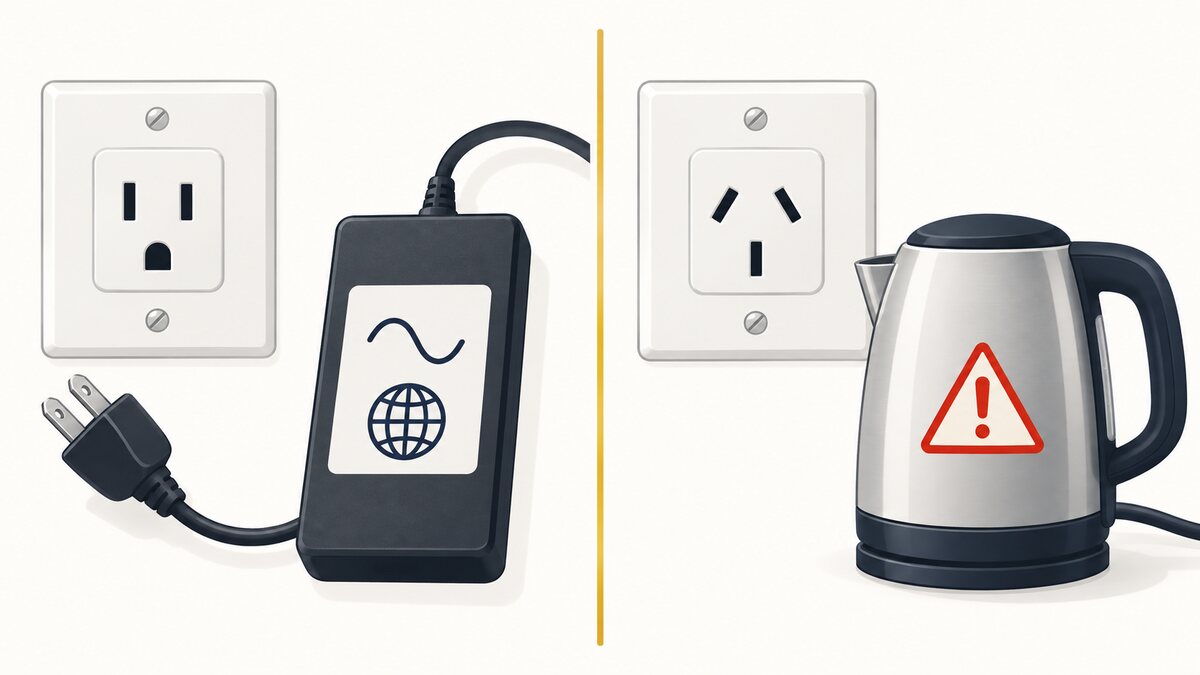
| Rating label | General assessment for Taiwan's 110V sockets | Reason |
|---|---|---|
| INPUT 100–240V ~ 50/60Hz (e.g. some phone chargers and laptop adapters) | Voltage and frequency are both within range; usually usable if the plug shape is compatible | The product is designed to cover 110V and 60Hz |
| Labeled only 220V ~ 50Hz (e.g. some hair dryers and rice cookers sold domestically in China) | Do not plug directly into a 110V socket | Voltage mismatch (a general assessment based on label specifications; we found no government provision) |
| Labeled only 220V, but your home has a dedicated 220V circuit | Still pay attention to the plug type and the frequency difference | Taiwan uses 60Hz and China 50Hz; plug type standards differ between the two |
Taiwan's national standard for plugs and sockets is CNS 690; China's current type standard for single-phase plugs and sockets is the mandatory GB 1002-2024 (in force since 2025-08-01; the previous GB/T 1002-2021 has been repealed). Plug shapes in the two places are not necessarily compatible, so do not use an adapter to force in an appliance with the wrong voltage.
"Labeled 100–240V is usually usable" and "labeled only 220V should not be plugged into 110V" are both general assessments based on label specifications; we did not find any government provision on this. If in doubt, follow the product manual or the brand's customer service.
Are mainland China versions of phones and laptops covered by warranty in Taiwan?
There is no single answer; it depends on the brand's terms. Below we list only brands whose official terms we could find (read on 2026-09-17); click each brand's link for the original terms:
| Brand | Gist of official terms | Recommendation |
|---|---|---|
| Apple (iPhone, iPad) | Apple's iOS product warranty terms for both mainland China and Taiwan state that Apple may restrict service to the country or region of original sale (2024-06-14 version). apple.com.cn | This is a "possible restriction", not "never covered"; ask Apple Taiwan before sending it for repair |
| Apple (Mac) | In our paragraph-by-paragraph comparison of the mainland China Mac warranty terms (2023-03-01 version), we did not see the same original-country-of-sale restriction as in the iOS version, but the terms still state that service is limited to the options available where service is requested. apple.com.cn | This does not mean Apple guarantees service in Taiwan; ask before sending it for repair |
| Xiaomi | Xiaomi Taiwan's service terms: products not sold by Xiaomi Taiwan and not covered by the international warranty are charged an inspection and handling fee of NT$300 when sent for repair. The international warranty markets we found for the Xiaomi 13 Pro do not include mainland China. mi.com/tw | International warranty depends on both the model and the market of purchase; ask Xiaomi Taiwan before sending a mainland China version for repair |
| Huawei | The mainland China phone service policy applies only to products sold through official channels in mainland China, with service at authorized service centers in mainland China (excluding Hong Kong, Macao and Taiwan); products sold on third-party platforms authorized by Huawei receive only in-warranty repair. consumer.huawei.com | The terms do not provide service locations in Taiwan; confirm with Huawei before sending it for repair |
| Lenovo (Think series) | For ThinkPad and other models, International Warranty Service (IWS) eligibility can be checked using the four-character machine type; service methods and parts may differ by country. think.lenovo.com.cn | We only found the IWS explanation for Think models, not for consumer models; check by four-character machine type before sending it for repair |
| DJI | The mainland China after-sales policy applies only to mainland China and does not support global warranty; when sent to a repair center outside the region of purchase, DJI handles it at its discretion depending on local stock, and only paid service is provided. dji.com | Repairs outside the region of purchase may not be accepted; confirm with DJI before sending it for repair |
If electronics turn out to be faulty, can you still return them from Taiwan to China?
Under Article 25 of China's Law on the Protection of Consumer Rights and Interests and the Interim Measures for No-Reason Returns within Seven Days of Goods Purchased Online, online shoppers may return goods without giving a reason within 7 days of receiving them, but three points work particularly against cross-border electronics:
1Switching on and activating may cost you the no-reason return
Article 9 of the Measures provides that use beyond what is needed to inspect and confirm quality and function, resulting in significant loss of value, means the goods are regarded as not intact; for electronic and electrical appliances, the criteria include traces of use such as activation, authorization information and unreasonable retention of personal usage data. Article 7 also allows goods "whose value is significantly reduced once activated or tried" to be excluded if the consumer confirmed this at purchase. Opening the packaging for inspection and reasonable setup do not affect intactness (Article 8).
2Return shipping is borne by the consumer by law
Article 18: the shipping cost of returning goods is borne by the consumer by law, unless otherwise agreed. You have to assess the cost and time of shipping back to China across the border yourself.
3Once it reaches Taiwan, 7 days pass quickly
Consolidated shipping to Taiwan takes time in itself. The Measures do not cover cases where the return address is outside China, and we do not guarantee that there will still be time after you receive the goods, nor that the seller will accept a cross-border return.
The Department of Consumer Protection of the Executive Yuan explains that cross-border consumer disputes are private-law disputes; for consumer disputes involving mainland China other than travel, you may seek assistance through the Straits Exchange Foundation (SEF), or file a complaint yourself with the China Consumers Association; if you paid by card, you can contact the card issuer, and for fraud call 165. Whether the 7-day right to cancel distance sales under Article 19 of Taiwan's Consumer Protection Act applies to sellers in mainland China: we found no official interpretation by the competent authority or court judgment.
An OECD consumer survey in 13 countries found that when buying from foreign sellers, fraud and counterfeits were more common, and returns or cancellations, the remedies most likely to result in full compensation, were also used less often in cross-border transactions (Taiwan was not included). When buying electronics across borders, choose sellers with a solid review history and keep your order and chat records.
Do mainland China version phones raise cybersecurity concerns, and what are the government's rules?
This question is often muddled; you need to separate who is subject to a "ban" from who receives a "recommendation":
The ban on use applies to government agencies
Article 11 of the Cyber Security Management Act provides that government agencies must not download, install or use products that endanger national cybersecurity; Article 27 further authorizes central competent authorities to restrict or prohibit specific non-government organizations. The provisions do not regulate the general public.
For the general public, it is a recommendation to avoid certain apps
The National Security Bureau (2025-07-02) tested 5 apps including Xiaohongshu, Weibo, Douyin, WeChat and Baidu Netdisk and recommended that the public avoid downloading Chinese-made apps with cybersecurity concerns; the Administration for Cyber Security, Ministry of Digital Affairs (2025-12-03), likewise urged the public to avoid installing or using these apps. The target is the apps, not mainland China version phones themselves.
The NCC tested models sold in Taiwan
In 2021 the NCC tested the pre-installed software of 5 phones from mainland Chinese brands sold in Taiwan; they failed the initial test and passed the retest after the manufacturers made improvements. We found no official test data specifically on "mainland China version phones", so this cannot be extended to claim that mainland China version phones necessarily have problems.
Can electronics with built-in batteries and power banks be shipped?
Under the International Air Transport Association (IATA) 2026 Lithium Battery Guidance: lithium ion batteries contained in equipment (such as phones and laptops) fall under UN3481/PI967, and a state of charge not exceeding 30% is recommended; power banks, whether or not packed in the same box as a phone, are classed as "batteries" (UN3480), not as spare batteries for the phone, and are in principle forbidden as cargo on passenger aircraft, with a state of charge that in principle must not exceed 30%.
Our routes are "sea express" and "air express", and both charge the same rate for regular and special goods. Under our customer service rules, products containing lithium batteries or built-in batteries (phones, laptops, tablets, power banks, Bluetooth earphones, etc.) are not sent by air express but by sea express; to find out whether a specific product can be accepted, send the product page and battery specifications to LINE customer service before ordering, and do not conceal them in the declaration.
UL tested 400 counterfeit iPhone adapters bearing fake UL marks, and only 3 passed basic safety tests, with seriously inadequate internal insulation design found (the test covered counterfeit products with misused marks and cannot be generalized to all third-party chargers). Research by the OECD and the European Union Intellectual Property Office (EUIPO) also warns that batteries with certification marks are counterfeited too, so the marks on the box alone are not enough to judge.
Announcement No. 58 of 2025 by China's Ministry of Commerce and General Administration of Customs controls items such as lithium ion batteries with a gravimetric energy density of 300Wh/kg or more, with exporters as the regulated parties, and has been suspended until 2026-11-10 under Announcement No. 70 of 2025; we do not infer from this that ordinary finished electronics cannot be shipped out, and we will check again after that date.
On recycling, an interpretive order of the Ministry of Environment has placed power banks (8507.60.00.10-7) under dry-cell batteries and laptops under information technology products subject to recycling, and the recycling responsibility lies with manufacturers and importers; individuals can hand in used dry-cell batteries at retailers with recycling facilities such as hypermarkets, supermarkets, convenience store chains and wireless communication equipment retailers (the items accepted by each type of business follow the annex to the announcement), and phones and chargers can also be handed to local sanitation teams.
How much tax do you pay to ship electronics to Taiwan?
If the dutiable value of a single import shipment is NT$2,000 or less, customs duty, commodity tax and business tax are waived; above that, the exemption no longer applies, and taxes and fees are calculated by Customs' formula on the entire dutiable value (NT$2,000 is a threshold, not a deduction). Phones, laptops and earphones are not among the taxable electrical appliances under Article 11 of the Commodity Tax Act (currently refrigerators, air conditioners, dehumidifiers, audio component systems and electric ovens). Here is a worked example with transparent assumptions:
| Item | Phone shipped alone | Power bank shipped alone | Both in one shipment |
|---|---|---|---|
| Dutiable value | 8,300 | 1,600 | 9,900 |
| Above NT$2,000? | Yes | No | Yes |
| Customs duty | 0 (0%) | Waived | 40 (power bank 1,600 × 2.5%) |
| Business tax 5% | 415 | Waived | 497 ((9,900 + 40) × 5%) |
| Total | 415 | 0 | 537 |
When shipping in different batches, freight is charged per shipment; each duty-free release of NT$2,000 or less counts toward the cap of 6 times per half-year, and once the same taxpayer has been granted duty-free release more than 6 times in a half-year period, the exemption no longer applies (proviso on "frequent imports" in Article 49, Paragraph 2 of the Customs Act). The declared value must match the actual transaction; under Article 37 of the Customs Anti-smuggling Act, falsely declaring the value may be punished with a fine of up to five times the evaded import duties, or confiscation of the goods, or both. The trade promotion service fee is 0.04% of the dutiable value and is not levied if NT$100 or less.
Which specialized guides should you read for different types of electronics?
This page is an overview for consumer electronics. Below are the related specialized guides:
Wearables and wireless products
Shipping smartwatches to Taiwan: the rule allowing up to 2 units per postal shipment without a permit, and whether health functions make it a medical device.
Voltage and appliances
Guide to telling whether an appliance is 110V or 220V: how to read rated voltage, frequency and BSMI inspection.
RC and drones
Shipping drones and RC toys to Taiwan: import regulation 617, NCC personal-use quantities and flight rules.
Export controls on the China side
China's export controls on lithium batteries and graphite anode materials: which announcements are suspended and which still require licenses.
Glossary
- Import regulation 602
- The import regulation for controlled telecommunications radio-frequency devices administered by the National Communications Commission; personal-use imports also follow Article 9 of the administrative regulations and may be made by signed declaration without applying for an import permit.
- Import regulation C02
- Indicates that some goods under the tariff code are commodities subject to import inspection announced by BSMI; it does not mean the entire tariff code must be inspected.
- CC000000000001
- The NCC permit-exemption code entered on the import declaration when importing controlled telecommunications radio-frequency devices for personal use by signed declaration.
- CI000000000010
- The inspection-exemption clearance code entered on the declaration when, for example, importing non-sale information technology equipment as personal-use items within the thresholds of the Regulations Governing Exemption from Inspection of Commodities.
- Dutiable value
- The basis on which Customs calculates duty and business tax, including the product price, freight and insurance; if a single shipment exceeds NT$2,000, the tax exemption does not apply.
- Commodities subject to inspection
- Commodities announced by the Bureau of Standards, Metrology and Inspection, Ministry of Economic Affairs, that must pass inspection before they can be imported or sold domestically; personal-use imports within the thresholds of the Regulations Governing Exemption from Inspection of Commodities may be exempted.
- UN3480
- The UN dangerous goods number for lithium ion batteries (power banks are always included), which under international aviation rules are in principle not permitted as cargo on passenger aircraft.
- Seven-day no-reason return
- The right under Chinese regulations for online shoppers to return goods without giving a reason within 7 days of receiving them; electronic and electrical appliances used beyond inspection needs that show traces such as activation may be deemed not intact, and return shipping is in principle borne by the consumer.
Sources and limits of verification
Taiwanese legal provisions on this page were checked against the original texts in the Laws & Regulations Database on 2026-09-17; Chinese regulations and announcements are taken from the Chinese government website, the Ministry of Commerce and the national standards public information service platform; inspection items and codes from the lookup systems of BSMI and the International Trade Administration and the Customs Administration's table of exemption codes; warranty terms from each brand's official website; duty rates from our tariff data table.
Laws and official sources
- Telecommunications Management Act, Articles 44, 65 and 67. Laws & Regulations Database
- Administrative Regulations on Manufacturing, Import and Report of the Controlled Telecommunications Radio-Frequency Devices, Article 9; NCC announcement on the permit-exemption code of 2021-12-17. Laws & Regulations Database
- Regulations Governing Exemption from Inspection of Commodities, Articles 2, 3, 5 and 8; Customs Administration consolidated table of permit-exemption codes of reviewing agencies. Laws & Regulations Database
- BSMI press release "Cross-border online shopping and proxy-purchased goods are high-risk: BSMI reminds consumers to choose goods that have passed inspection" (revised 2020-11-09). bsmi.gov.tw
- Standards for Supply Voltage and Frequency of Electricity Utilities, Articles 3 and 4; Taiwan Power Company electrical safety guidance. Laws & Regulations Database
- China's Rules for Electricity Supply Business (National Development and Reform Commission Order No. 14, in force 2024-06-01); GB 1002-2024 standard information. gov.cn
- Customs Act, Article 49; Ministry of Finance announcement on the duty-free limit (NT$2,000); Customs Administration explanation of "frequent imports" for express consignments; Customs Anti-smuggling Act, Article 37. web.customs.gov.tw
- Commodity Tax Act, Article 11 (taxable electrical appliances: refrigerators, air conditioners, dehumidifiers, audio component systems, electric ovens). Laws & Regulations Database
- China's Interim Measures for No-Reason Returns within Seven Days of Goods Purchased Online, Articles 7, 8, 9 and 18. gov.cn
- Department of Consumer Protection, Executive Yuan, "Mechanisms and channels for handling cross-border consumer disputes"; Consumer Protection Act, Article 19. cpc.ey.gov.tw
- Cyber Security Management Act, Articles 11 and 27; National Security Bureau press release of 2025-07-02; press release of the Administration for Cyber Security, Ministry of Digital Affairs, of 2025-12-03; NCC press release on cybersecurity sampling tests of smartphone pre-installed software (2022-01-07). moda.gov.tw
- Ministry of Environment interpretive order on "articles or their packaging and containers and the scope of businesses responsible for their recycling, clearance and disposal", Annex Table 1 (effective 2025-07-01); announcement on recycling facilities to be set up by retailers; general waste items to be recycled by executing agencies. oaout.moenv.gov.tw
- IATA Lithium Battery Guidance Document (Revised for the 2026 Regulations); Ministry of Commerce and General Administration of Customs Announcements No. 58 and No. 70 of 2025. iata.org
Research literature
Measuring financial consumer detriment in e-commerce
An online consumer survey in 13 countries found more fraud and counterfeits when buying from foreign sellers, and less use of returns or cancellations. The sample does not include Taiwan and does not break out consumer electronics; this page cites only the directional conclusion.
Online product safety sweep report
In 2021, 21 jurisdictions spot-checked products sold online, and many electrical appliances and portable electronic products did not comply, or possibly did not comply, with safety requirements in the market of sale. The report acknowledges that each jurisdiction sampled according to its own priorities, so the proportions do not represent the overall market; this page does not cite percentages.
Counterfeit iPhone adapters: A UL technical investigation
Only 3 of 400 counterfeit iPhone adapters bearing fake UL marks passed basic safety tests. UL owns the certification mark, the sampling method was not disclosed, and only counterfeit products were tested.
Dangerous Fakes: Trade in Counterfeit Goods that Pose Health, Safety and Environmental Risks
Customs seizure data show that counterfeit batteries and adapters may bear fake certification marks. Seizure data reflect cases that were detected, not the share of counterfeits on the market.
① Tariff codes are common classifications based on product descriptions, not the result of a case review; tariff classification is determined by Customs under the interpretative rules.
② Whether phones imported by signed declaration whose model has not passed type approval also require personal-use type approval as telecommunications terminal equipment: no clear interpretation was found.
③ "100–240V is usually usable" and "labeled only 220V should not be plugged into 110V" are general assessments based on label specifications; we did not find any government provision.
④ The warranty section covers only brands whose official terms we could find, and terms may change at any time; for the current international warranty markets of each Xiaomi model, Huawei's statements for Taiwan, and international warranty for Lenovo consumer models, no official source was found.
⑤ Whether Article 19 of Taiwan's Consumer Protection Act applies to sellers in mainland China: no official interpretation or court judgment was found; not finding one does not mean it does not apply.
⑥ Whether products with batteries can be accepted is decided item by item according to carriage conditions, and we do not promise that they can always be shipped.
⑦ This page does not cite our own shipping data.
Frequently asked questions
Do I have to pay customs duty on an iPhone bought on Taobao and shipped to Taiwan?
8517.13.00.00-5 have a Column 1 duty of 0%, but if the dutiable value of a single shipment exceeds NT$2,000, 5% business tax is payable on the entire dutiable value. For example, with a dutiable value of NT$8,300, business tax is about NT$415.How many phones can I send in one consolidated shipment?
Does a laptop shipped to Taiwan need BSMI inspection?
C02) but may be exempted for personal use: for the same specification and model on the same declaration, CIF USD 1,000 or less with no limit on the number of pieces, or above that no more than 5 pieces, with CI000000000010 entered on the declaration. The same specification and model may be exempted only once within 6 months.Appliances bought in China are 220V; can they be used in Taiwan?
Is a mainland China version iPhone covered by warranty in Taiwan?
Can a power bank be sent in the same consolidated shipment as a phone?
UN3480 battery even when packed in the same box as a phone, not as a spare battery for the phone, and is in principle forbidden as cargo on passenger aircraft. Under our customer service rules, products with batteries are not sent by air express but by sea express, and whether a specific product can be accepted must be confirmed item by item. Power banks have a Column 1 duty of 2.5% and are C02 commodities subject to inspection.If I find a problem after receiving it, can I return it to Taobao?
Has the government banned the public from using mainland China version phones?
Further reading
Rules for shipping smartwatches to Taiwan
Guide to telling whether an appliance is 110V or 220V
Shipping drones and RC toys to Taiwan
China lithium battery export controls 2026
Can you be fined for shipping counterfeit goods to Taiwan?
Complete guide to Taiwan import customs clearance
Taobao import tax calculator
Before you order, work out the taxes and fees
Enter the product amount and freight to estimate business tax and landed cost.
Estimate import taxes