After COMPUTEX 2026: How Do You Ship PC Parts Bought in China Back to Taiwan?
Can the same PC parts shown at COMPUTEX be bought in China and shipped to Taiwan?
Yes. For PC parts bought on Taobao, Tmall, JD.com, Pinduoduo and similar platforms, enter the HowBridge Shenzhen consolidation warehouse as the delivery address; after your parcels arrive they are combined into one box and sent to Taiwan by air freight, sea express (haikuai) or sea LCL cargo. HowBridge only handles mainland China → Taiwan and does not buy on your behalf. On duty: for the tariff lines checked on this page (desktop units, laptops, keyboards, storage, SSDs, CPUs, monitors, power supplies, headphones, network cards), the first-column rate is 0% in every case (general fans are 4.7%); business tax is (dutiable value + duty) × 5%, and the dutiable value includes freight to the Taiwan port of entry; the electrical-appliance items taxed under Article 11 of the Commodity Tax Act do not include computers and parts. NT$2,000 or less is duty-free: postal parcels are exempt from duty, commodity tax and business tax under the clearance regulations, but the exemption no longer applies once the same recipient has had duty-free releases more than 6 times within a half-year period (January–June, July–December, i.e. months 1–6 and 7–12); express cargo has its own low-value duty-free category. On inspection: for information technology equipment for personal use, if the total value of the same specification and model on one declaration is US$1,000 or less, or is above that but the quantity does not exceed 5 units, the exemption code CI000000000010 can be entered, for non-sales purposes only (whether components such as graphics cards and motherboards count as information technology equipment is not stated in the sources checked); for regulated telecommunications radio-frequency equipment of the second level, for own use and imported by post, up to 2 units at a time may be imported with a written undertaking (whether an individual product is a listed regulated device is not found on this page). The absence of MW0 does not mean lawful clearance: commodities subject to mandatory inspection and regulated telecommunications radio-frequency equipment must still comply with the rules, and counterfeit and infringing goods cannot be imported. No dedicated import regulation for second-hand or refurbished goods was found, so they cannot be treated across the board as exempt from inspection. Rates are subject to the customs tariff in force at the time of declaration.
No. HowBridge only provides mainland China → Taiwan consolidated shipping and does not buy on your behalf; please order and pay on the marketplace yourself. It also does not offer shipping from Japan, Korea, the United States or Europe to Taiwan, and this page does not cover merchants or price differences outside China. HowBridge has only the Shenzhen consolidation warehouse and the Taoyuan Dayuan operations warehouse.
COMPUTEX 2026 Has Ended: What Should You Know Before Buying the Same Parts Afterwards?
COMPUTEX Taipei is organized by TAITRA (Taiwan External Trade Development Council) and TCA (Taipei Computer Association). Exhibitors named in the official press release include Acer, ASUS, Intel, MediaTek, Foxconn and GIGABYTE. The show ended on 2026/6/5. The official data are summarized below:
| Item | 2026 | 2027 |
|---|---|---|
| Dates | 2026/6/2–5 | 2027/6/1–4 |
| Venues | Taipei Nangang Exhibition Center Halls 1 and 2 and Taipei World Trade Center Hall 1 (the Show Profile also lists the Taipei International Convention Center, TICC) | Taipei Nangang Exhibition Center Halls 1 and 2 and Taipei World Trade Center Hall 1 (the official site's home page also lists TICC) |
| Theme | AI Together | Not found on this page |
| Scale | Officially about 1,500 exhibitors and about 6,000 booths; the official site says 33 countries or regions, while the Post Show page says 32 countries | Not found on this page |
| Attendance | 111,312 buyers and visitors from 152 countries and regions (the official wording varies between "buyers" and "visitors") | Not found on this page |
Show brands are not the same as products sold on Chinese marketplaces
The show is an exhibition held in Taiwan, and this page does not cover any brand's price, authenticity or warranty on Chinese marketplaces. Whether a purchased item is genuine and whether it has a Taiwan warranty should be confirmed with the official flagship store or an authorized seller; keep screenshots of the product page and proof of payment.
Which products this page covers
Personal-computer parts and peripherals such as graphics cards, motherboards, SSDs, CPUs, memory, keyboards and mice, headphones, monitors, power supplies and PC-specific fans. For the rules on complete machines, mobile phones and second-hand 3C products, see Importing second-hand electronics and Importing 3C electronics.
How Are PC Parts Classified in the Tariff Schedule, and What Is the Duty?
Computers and parts fall mainly under Chapters 84 and 85 of the tariff schedule. The table below shows the line-by-line lookup results from the Customs Administration's tariff open data (product names abridged); the first-column rate of every listed tariff line is 0%, and the 0% comes from checking each line, not from inferring it from the Information Technology Agreement:
| 11-digit tariff code | Product name (abridged; text in parentheses is this page's note) | Column 1 duty rate | Import regulation column |
|---|---|---|---|
8471.30.00.00-8 | Portable automatic data processing machines (laptops, weight not exceeding 10 kg) | 0% | C02 |
8471.41.00.00-5 8471.49.00.00-7 8471.50.00.00-3 | Other automatic data processing machines (desktop units, processing units) | 0% | C02 |
8471.60.30.90-6 | Other keyboards | 0% | Blank |
8471.60.30.10-3 8471.60.90.20-8 | Radio keyboards and radio mice | 0% | 602 C02 |
8471.70.10.10-5 8471.70.90.00-0 | Hard disk drives and other storage units | 0% | Blank |
8473.30.00.00-6 | Parts and accessories of heading 8471 machines (motherboards and add-in cards are mostly classified here, see below) | 0% | Blank |
8523.51.00.00-0 | Solid-state non-volatile storage devices (SSD) | 0% | Blank |
8542.31.00.00-2 | Processors and controllers (CPU) | 0% | Blank |
8528.52.00.00-4 | Other monitors capable of connecting directly to an automatic data processing system and designed for use with it | 0% | C02 |
8504.40.20.00-3 | Static converters for automatic data processing machines and their units and for communication apparatus | 0% | Blank |
8518.30.32.00-5 | Headphones and earphones, whether or not combined with a microphone | 0% | C02 |
8517.62.00.00-5 | Machines for the reception, conversion and transmission or regeneration of voice, images or other data, including switching and routing apparatus (this page's note: the advance ruling case for an Ethernet card falls here) | 0% | C02 |
8414.59.10.00-2 | Fans specially or mainly used for cooling microprocessors, telecommunication apparatus, automatic data processing machines or units, etc. | 0% | C02 |
8414.59.90.00-5 | Other fans | 4.7% | C02 |
Which tariff line do motherboards and graphics cards belong to?
The reference tariff line for item 14 of BSMI's declaration-of-conformity item list, "Class B computer motherboards and Class B computer add-in cards with I/O", is 8473.30.00.00-6, but the words "graphics card" do not appear verbatim. The Customs Administration's advance ruling cases do not include a built-in motherboard or a plug-in graphics card; the nearest cases are only an external graphics card device (2008, classified under 8471.80.00.00-7), a VoIP PCI interface card (2009, classified under 8473.30.00.00-6), and a USB PCI CARD (2009) that was originally classified under 8473.30.10.90-5 and reclassified to 8471.80.00.00-7 after review; all are individual cases from more than a decade ago, the functions differ, and each classification depends on its own case. The general view is that motherboards and add-in cards mostly fall under 8473.30 (BSMI's reference tariff line), but the actual tariff line is determined by Customs.
What about cases, liquid coolers and memory modules?
The tariff CSV has no dedicated tariff line for PC liquid coolers, and no advance ruling case can be found for cases, liquid cooling or ordinary memory modules; this page does not judge their tariff lines or rates, so please have a customs broker determine them from the physical goods.
How to read the codes in the import regulation column
According to the announcement of the Ministry of Economic Affairs' Board of Foreign Trade (now the International Trade Administration) dated 2022-04-13 (Executive Yuan Gazette, 2022-04-14), C02 means "some commodities under this item are commodities subject to mandatory import inspection announced by the Bureau of Standards, Metrology and Inspection, Ministry of Economic Affairs"; it covers some commodities, not every product under the tariff line. 602 means regulated telecommunications radio-frequency equipment that requires approval; equipment that has passed type approval is exempt from applying for an import approval certificate but clears customs on the strength of its type-approval proof. MW0 means import from mainland China is prohibited (exception: small quantities in Chapters 25–97 need no import permit if the whole declaration is within CIF NT$32,000 and each single product is within 24 pieces, with a 40 kg limit only for goods that cannot be counted; electric motorcycles, electric bicycles and their controllers are excluded, and Chapters 1–24 do not qualify), MP1 means conditionally permitted import, and blank means permitted without issuing a permit. The definitions of codes such as Z, S01 and T* in the collection/enforcement column are not found, and this page does not explain them. A blank tariff column also does not mean exempt from inspection: the import regulation column for wired keyboards is blank, yet BSMI's item list includes wired keyboards.
Taiwan and the Information Technology Agreement
Taiwan (named Chinese Taipei at the WTO) is a participant in the World Trade Organization's Information Technology Agreement (ITA), but that alone does not let us infer the rate of every part, so please rely on the 11-digit tariff code. The tariff CSV does not state a publication date, and actual rates and import regulations are subject to the customs tariff in force at the time of declaration.
How Much Tax on PC Parts? Does the NT$2,000 Duty-Free Rule Apply?
Start with the formulas published by the Customs Administration: duty = dutiable value × rate; business tax = (dutiable value + duty + commodity tax, etc.) × 5%; trade promotion service fee = dutiable value × 0.04%, waived at NT$100 or less. Article 10 of the Value-added and Non-value-added Business Tax Act only provides that the rate may not be lower than 5% and that the collection rate is set by the Executive Yuan; the source of the 5% figure is the Customs Administration's taxes-and-fees page. The dutiable value is the CIF value of the imported goods, and Article 29 of the Customs Act expressly requires freight, loading and unloading, handling and insurance charges up to the port of entry to be included, so freight is part of the tax base.
| Item | Postal parcel | Express cargo |
|---|---|---|
| Duty-free threshold | Dutiable value of NT$2,000 or less is exempt from duty, commodity tax and business tax (Article 7 of the Postal Parcel Clearance Regulations) | Dutiable value of NT$2,000 or less is low-value duty-free (Article 11 of the Air Express Cargo Clearance Regulations; Customs Administration express cargo page) |
| Above the threshold | Taxed on the full amount (Article 8) | NT$2,001 to NT$50,000 is low-value dutiable; more than NT$50,000 is high-value express |
| Determining frequent use | The same recipient has had duty-free releases more than 6 times within a half-year period (Article 12, expressly stated in the text) | The same taxpayer has had duty-free releases more than 6 times within a half-year period (Customs Administration express cargo page; the text of the regulations does not define it) |
| Half-year period | January–June (months 1–6) and July–December (months 7–12) of each year, not a rolling six months | Same as left, and counting restarts on 1/1 and 7/1 (January 1 and July 1) of each year |
| Weight per piece | Gross weight of 30 kg or less (Article 3) | Gross weight of 70 kg or less (Article 6) |
Is commodity tax levied on PC parts?
The electrical-appliance items listed in Article 11 of the Commodity Tax Act as taxable are refrigerators, air conditioners, dehumidifiers, audio combination sets and electric ovens; computers, motherboards, graphics cards, monitors and SSDs are not listed. The Customs Administration's taxes-and-fees page also states that items not subject to commodity tax under the Commodity Tax Act are exempt from it. Whether an individual case such as PC speakers or audio products counts as an "audio combination set" is not found in the provisions or cases, and this page draws no conclusion.
Worked formula (not a quotation)
Suppose Customs assesses a dutiable value of NT$30,000 and a duty rate of 0% (only an example, not the rate of any product), with no commodity tax: duty NT$0; business tax (30,000 + 0) × 5% = NT$1,500; trade promotion service fee 30,000 × 0.04% = NT$12, which is waived at NT$100 or less. The example does not include customs clearance, delivery or warehousing fees.
Combining boxes saves freight; it is not order-splitting to avoid tax
Article 14 of the Regulations Governing Customs Clearance of Air Express Cargo provides that express carriers or customs brokers may not split the same batch of imported express cargo into separate declarations, except where the total does not exceed the duty-free limit, or where it exceeds the limit but the tax and fees are declared and paid voluntarily. HowBridge's freight explanation also states that splitting orders into batches to evade the duty-free amount is illegal, while combining boxes to save freight is legal. Declare the product names, quantities and prices honestly, and pay tax where it is due.
Article 12 of the Air Express Cargo Clearance Regulations provides that express cargo "involving import or export regulations" must be handled with a formal import declaration (except for special situations announced by Customs), and BSMI's Q&A also says commodities subject to mandatory inspection may not use a simplified declaration. Whether the NT$2,000 exemption can still be used in that situation is not spelled out for each tariff line in the provisions, so this page draws no conclusion; please let a customs broker decide case by case.
Do PC Parts from China Need an Import Permit?
The main items carry no restriction code. The Customs Administration explains that where none of the codes MW0 or MP1 is listed in the import regulation column, the mainland-origin goods are permitted to be imported and no import permit is needed; where MW0 is listed, import from mainland China is prohibited, but MW0 does not mean the goods can never be shipped (exception: small quantities in Chapters 25–97 need no import permit if the whole declaration is within CIF NT$32,000 and each single product is within 24 pieces, with a 40 kg limit only for goods that cannot be counted; electric motorcycles, electric bicycles and their controllers are excluded, and Chapters 1–24 do not qualify); see the announcement below. None of the tariff lines in the table above for desktop units, laptops, keyboards and mice, storage, SSDs, CPUs, monitors, power supplies, headphones, network cards and fans carries MW0 or MP1; MW0 appears on some semiconductor and hybrid integrated circuit lines, for example 8541.59.00.00-0 other semiconductor devices and 8541.51.00.00-8 semiconductor-based transducers.
MW0 = import from mainland China is prohibited. Exception: small quantities of mainland Chinese goods in Chapters 25–97 may be imported without an import permit if the whole declaration is within CIF NT$32,000 and each single product is within 24 pieces (40 kg if it cannot be counted; a single product is identified by its model number, or by the line item on the declaration if there is no model number, and may not be split by size, specification or colour; stone under heading 6802 and tiles under heading 6907 must meet both 24 pieces and 40 kg). Electric motorcycles, electric bicycles and their controllers (tariff lines 8711.60.10, 8711.60.20 and 8543.70.99.50) are excluded, and Chapters 1–24 do not qualify. Inspection, quarantine and other import requirements must still be met separately. Item 3 of the announcement also states that other import regulations still apply, so an exemption from the import permit does not mean lawful clearance. Whether loose chips qualify should be checked by finding the 11-digit tariff code first and then consulting customer service or a customs broker.
"No MW0" only means no import permit is needed. Goods marked C02 may still be commodities subject to mandatory inspection, and wireless equipment marked 602 must comply with NCC rules; goods that infringe trademark rights may not be imported under Article 15 of the Customs Act, and counterfeits are not express cargo either, so a permit exemption does not mean lawful clearance.
Which PC Parts Need BSMI Inspection? How Is the Exemption Code Used?
Article 6 of the Commodity Inspection Act: commodities subject to mandatory inspection that do not meet the inspection requirements may not leave the factory or be exported or imported (except commodities that BSMI has determined to be of low hazard risk). Personal use has room for exemption: Article 5, paragraph 1, subparagraph 7 of the Regulations Governing Exemption from Commodity Inspection, information technology equipment whose total value of the same specification and model on one declaration is US$1,000 or less, or which exceeds US$1,000 but is not more than 5 units, and which is a non-sales item for own use, commercial sample, exhibit or item for R&D testing; BSMI's table of Commonly Used Exemption Customs Clearance Codes maps it to CI000000000010. Whether components such as graphics cards and motherboards count as "information technology equipment" under Article 5, paragraph 1, subparagraph 7 is not defined in the exemption regulations or the code table, and is not stated in the sources checked for this page; please ask a customs broker whether the code can be entered. Which components appear in BSMI's electronics item lists:
| Product | BSMI item list | Notes |
|---|---|---|
| Laptops, desktops, desktop units | Item 17 "Automatic data processing machines" in the Certification Registration and Type Approval list (2026/9/23) | Limited to those using AC power, rechargeable lithium-type batteries or with an added power conversion device |
| Motherboards, add-in cards with I/O | Item 14 "Class B computer motherboards and Class B computer add-in cards with I/O" in the Declaration of Conformity list (2026/3/8) (excluding interface cards with communication functions, medical devices or telecommunications terminal equipment) | The words "graphics card" do not appear verbatim, and whether it applies is not stated; the definition of "Class B computer" is not found on this page |
| Computer monitors | Item 22 of the Certification Registration and Type Approval list | |
| Keyboards and mice | Wired keyboards: item 6 of the Declaration of Conformity list; wireless keyboards item 19, wireless mice item 21 | Whether wired mice are explicitly listed is not stated; the reference tariff line of item 24 "Other input or output units" in the Certification Registration list is 8471.60.90.90-3, and whether it covers them must be determined by BSMI or Customs |
| Hard disks and other storage units | Items 7 to 11 of the Declaration of Conformity list | |
| Power supplies | Items 14 and 16 of the Certification Registration and Type Approval list (power adapters, AC-to-DC conversion only) | The reference tariff line of item 14, 8504.40.20.00-3, is the same as the tariff line in this page's tariff table; whether built-in desktop power supply units are included is not stated |
| Headphones | Item 62 of the Certification Registration and Type Approval list | Limited to those with power input |
| SSDs, CPUs, memory integrated circuits, PC-specific fans | The tariff lines 8523.51, 8542.31, 8542.32 and 8414.59.10 are not found in the three electronics item lists | This page does not judge the tariff lines of memory modules and coolers; if classified under 8473.30.00.00-6 it would be the same as the reference tariff line of item 14, to be determined by Customs; other category lists were not checked on this page, which does not mean exempt from inspection |
Conditions for exemption
When applying to BSMI at the same time for exemption of several declarations of the same specification and model with the same import date, the amounts and quantities must be added together; exemption for the same specification and model is limited to one time within six months (Article 8 of the exemption regulations, with exceptions such as case-specific approval); large computers with a rated power of 30 kVA or more are not exempted except by case-specific approval (Article 11). BSMI's Q&A of 2023-09-26 (scenario: commercial samples) says: up to 5 laptops may be entered directly on the import declaration as CI000000000010, while 6 require case-specific approval in advance.
Exemption is for own use only; no selling or gifting
BSMI's Q&A states that items imported under exemption may not be sold or given away afterwards; Articles 16 and 17 of the exemption regulations provide that exempted commodities that are to enter the domestic market for circulation must undergo inspection, and may not be sold on the domestic market unless they pass inspection as required; samples and exhibits must be marked as not for sale (Article 15). To move them into domestic circulation, you must first apply to the authority that originally approved the exemption to change the purpose of use and complete inspection (Article 16 of the exemption regulations).
Express imports need a formal import declaration
BSMI's Q&A: commodities subject to mandatory inspection imported by air or sea express may not use a simplified declaration and must be declared with a formal import declaration; commodities subject to mandatory inspection imported without completing the inspection procedure are punished by fine when found.
Who the penalty provisions apply to
Article 8 of the Commodity Inspection Act provides that for commodities produced abroad, the party obliged to apply for inspection is the importer of the commodity; the fine under Article 60 (20 wan to 200 wan New Taiwan dollars; wan = ten thousand) is aimed at the party obliged to apply for inspection who exports or imports commodities that do not meet the inspection requirements, and Article 60-1 further provides that where the total price of the commodities is below 10 wan New Taiwan dollars, a fine of up to 2 times the total price may be imposed, but not less than 1 wan New Taiwan dollars. Non-sales items for own use are separately covered by Article 9, paragraph 1, subparagraph 3 of the same Act and the exemption room in the exemption regulations; whether an online shopper for own use would be fined, this page draws no conclusion and does not write it as a certain penalty; buying to resell or give away is not own use.
Do Wireless Keyboards and Mice, Bluetooth Headphones and Network Cards Need NCC Certification?
Article 65 of the Telecommunications Management Act: regulated telecommunications radio-frequency equipment announced by the competent authority must obtain approval before import; Article 66: it must comply with technical specifications and pass type approval before it may be sold; Article 80: a person who imports regulated telecommunications radio-frequency equipment without approval is fined 10 wan to 100 wan New Taiwan dollars (wan = ten thousand), and the equipment may be confiscated regardless of who owns it. The subject of the penalty is the person who imports "without approval"; this page does not write it as meaning that a buyer will certainly be fined.
Self-use by post: up to 2 units at a time
Article 9 of the Regulations Governing the Manufacture, Import and Declaration of Regulated Telecommunications Radio-Frequency Equipment (2025-02-03) applies to second-level regulated telecommunications radio-frequency equipment (Article 3 divides equipment into levels one and two): for wireless telecommunications terminal equipment or low-power radio-frequency devices for own use imported by post or other means not carried in person, no more than 2 units at a time may be imported with a written undertaking, without applying for an import approval certificate; 3 or more units and up to 10 units by post require an application; the same natural person or legal person is limited to 10 units within one year, and a natural person must be at least 18 years old; the equipment is for own use only and may not be transferred or used commercially. The provision does not name express cargo or consolidated shipping, and NCC's interpretation regarding consolidated shipping is not found on this page.
How to read 602 in the tariff
Tariff lines for radio keyboards, radio mice and cameras with radio functions carry 602, and Customs checks them against NCC rules; network cards (8517.62.00.00-5) and headphones (8518.30.32.00-5) carry only C02 and not 602, but we cannot infer from this that they are certainly exempt from or certainly subject to NCC type approval. Whether an item is a listed regulated telecommunications radio-frequency device depends on NCC's announced list, and this page did not obtain the text of that list, so it is not found.
Which parts to check first
Motherboards with built-in Wi-Fi or Bluetooth, wireless network cards, Bluetooth headphones and 2.4G wireless keyboards and mice all carry radio-frequency functions, so please check before ordering. For purely wired parts with no radio-frequency function, no basis for NCC regulation was found on this page; whether other rules apply still depends on the item's tariff heading.
Second-Hand, Refurbished, Gray-Market and Counterfeit Chips: How to Avoid Trouble
Parts on Chinese marketplaces and electronics markets include new, second-hand, pulled and refurbished items. What can be found on the regulatory side:
| Law | Provision (subject and elements) | Article |
|---|---|---|
| Customs Act: import prohibited | Articles that infringe patent rights, trademark rights or copyright may not be imported | Article 15 |
| Trademark Act: criminal liability (text currently in force) | Without the consent of the trademark right holder, using a trademark identical to a registered trademark on the same goods or services for marketing purposes, etc., is punishable by imprisonment of up to three years, detention, and/or a fine of up to NT$200,000 | Article 95 |
| Trademark Act: criminal liability (text currently in force) | A person who "knowingly" sells goods described in the preceding two articles, or who possesses, displays, exports or imports them "for the purpose of selling", is punishable by imprisonment of up to one year, detention, and/or a fine of up to NT$50,000, and the same applies where done through electronic media or the internet (the amendments of ROC year 111 to Articles 68, 70 and 95 to 97 have not yet taken effect); the provisions make no separate rule for purely personal use, and this page draws no conclusion | Article 97 |
The tariff does not distinguish new from used; no second-hand rule found
The tariff classifies by function, and the Chinese product names do not list PC parts separately as new or used; a dedicated import rule for second-hand computers and information products, and advance ruling cases for second-hand parts, are both not found on this page. So second-hand goods cannot be treated across the board as exempt from inspection, nor across the board as always inspected; whether they are commodities subject to mandatory inspection depends on the tariff heading.
What is the risk of counterfeit chips?
Guin et al. (2014), in a tutorial-style review in the Proceedings of the IEEE, list the types of counterfeit integrated circuits: recycled, remarked, overproduced, cloned, out-of-spec or defective, and forged documentation, and point out possible shortened lifespan and reliability risks; this is a review, has no incidence data, and does not concern Taiwan's import rules.
How to tell genuine parts
No primary-source determination is found on this page on whether refurbished or third-party parts constitute trademark infringement, or on how individual counterfeit-chip cases are determined, and this page does not give identification methods either. Please buy from the official flagship store or an authorized seller, keep invoices, product-page screenshots and proof of payment, and confirm the warranty and authenticity with the seller.
How to Pack High-Value Parts? What Happens on Damage or Loss?
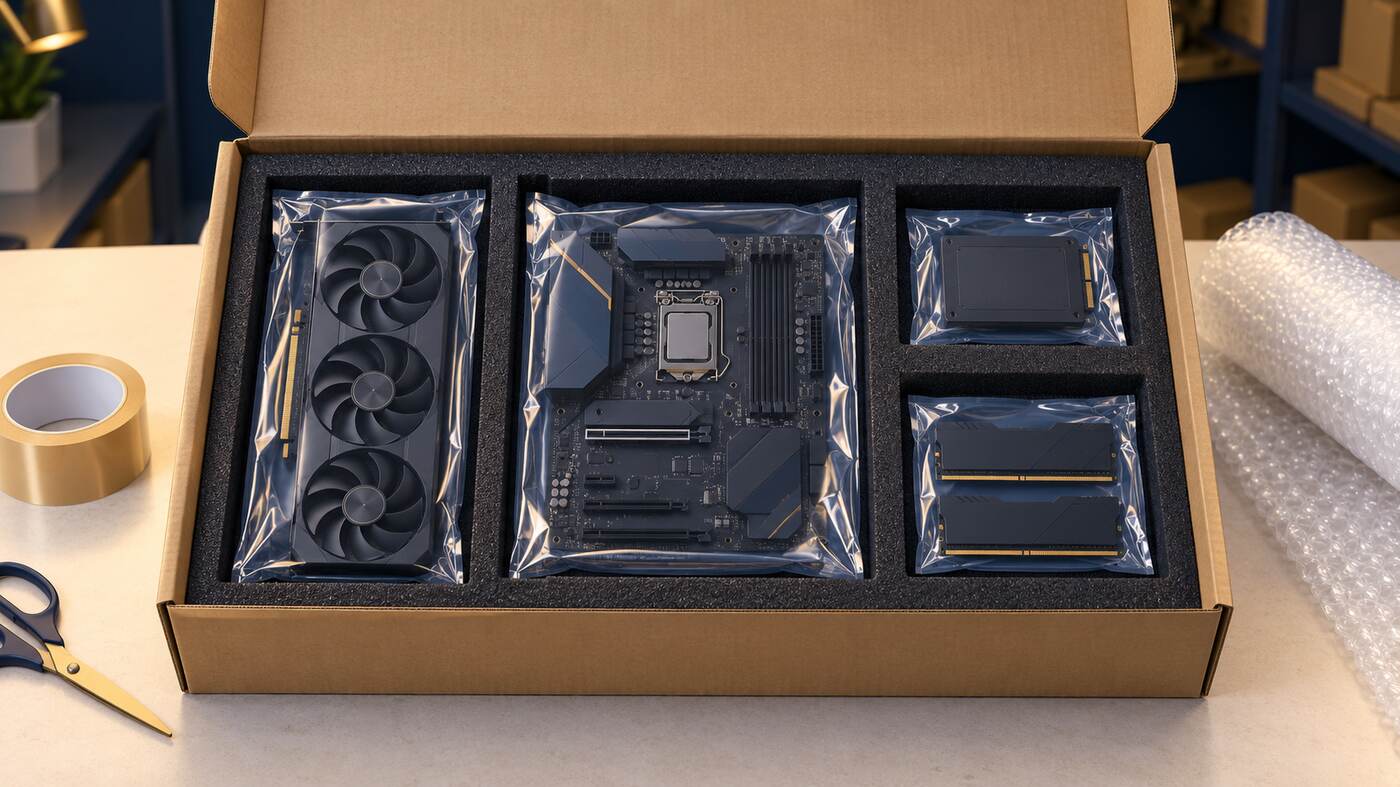
For high-value parts such as graphics cards and CPUs, read the compensation and shipping rules first:
On-site compensation rules
HowBridge Terms of Service Article 7.1 (declared-value protection): for now, loss or damage is compensated up to three times that parcel’s shipping fee; optional declared-value protection (3% of the declared value, max NT$150; once available, compensation at the declared value up to NT$5,000) is coming soon; fragile items such as glass and ceramics are not accepted for shipping, and items shipped without disclosure are not eligible for compensation (fragile items, liquids, powders, batteries and battery-powered items, dangerous goods and prohibited items are not compensated with or without declared-value protection), and the amount for damage is assessed case by case; complaints must be filed within 7 days after signing for the parcel (Articles 6.3 and 8.2 of the terms). (The above compensation does not apply to precious metals and jewelry: they must first be insured by an insurance company, and HowBridge bears no liability for their loss or damage in transit; see the Terms of Service.) Article 4.2 lists high-value items as requiring prior declaration and recommends reinforced packing and shipping in separate batches.
Goods containing batteries
Article 4.2 of the Terms of Service lists battery products (lithium batteries, power banks, etc.) as requiring prior declaration and approval before shipment, and they must comply with IATA rules. Whether goods with batteries or wireless peripherals can go by air must be confirmed piece by piece according to the battery specifications and the carrier's conditions; Taiwan's Civil Aviation Act and the Regulations Governing the Air Transport of Dangerous Goods do not mention lithium batteries anywhere in their full text, and the primary-source cargo rules and the Customs Administration's rules for express cargo containing lithium batteries are not found on this page, so please send the model, battery location, capacity and product page to customer service to confirm the carrying method before ordering.
Combining boxes, storage and photos
Combining boxes is free, and the Shenzhen warehouse stores goods free for 366 days; glass, ceramics and other fragile items are not accepted. We suggest asking the seller to use anti-static bags and shock-proof packaging, taking complete photos on receipt as evidence, and keeping the invoice and product-page screenshots for customs valuation. Unpacking for inspection and photo confirmation are charged separately; see the freight explanation.
How Are PC Parts Charged? What Is the Difference Between Air Freight, Sea Express and Sea LCL Cargo?
Rates follow HowBridge's freight explanation; the formulas are listed here, and freight for sea LCL cargo varies by product, so please ask customer service for a quotation:
| Method | Rate and formula | Transit time |
|---|---|---|
| Air freight | NT$100/kg, actual weight only, volume not counted; an extra NT$120 if actual weight is under 10 kg | 3–5 working days |
| Sea express (haikuai) | NT$50/unit; volumetric weight = length × width × height (cm) ÷ 10000, whichever of actual weight and volumetric weight is higher; an extra NT$100 if under 10 kg | 5–10 working days |
| Sea LCL cargo (freight varies by product; please ask customer service for a quotation) | From NT$25 per kg, or from NT$150 per volume unit; volume = length × width × height (cm) ÷ 28316 | 7–14 working days |
An on-site measurement of 774 sea express parcels (billed in 2026/8–9, from shipment in China to signed receipt in Taiwan): median 6 days, 90th percentile 9 days (last checked 2026-10-10); air freight and sea LCL cargo are not in this sample, and it is not data specific to PC parts. For a single piece over 10 cai (a Taiwanese volume unit) or 40 kg, home delivery on the Taiwan side carries an extra oversize surcharge; please confirm with customer service before ordering.
How Do You Consolidate PC Parts Bought in China and Ship Them to Taiwan?
The following 5 steps apply to PC parts bought on Chinese marketplaces and sent to the HowBridge Shenzhen warehouse.
1Choose a store and confirm the specifications
Place the order yourself on Taobao, Tmall, JD.com or Pinduoduo; prefer official flagship stores or authorized sellers, confirm whether the item is new or second-hand and whether it has a warranty, and keep product-page screenshots and the invoice.
2Enter the Shenzhen consolidation warehouse as the delivery address
Enter the HowBridge Shenzhen consolidation warehouse address and your member number as the recipient details; HowBridge does not buy on your behalf and does not pay the seller for you. The Shenzhen warehouse is in Fuhai Subdistrict, Bao'an District, not in the Huaqiangbei commercial area, and sellers deliver to the warehouse by domestic Chinese logistics.
3Confirm the product specifications before ordering
First confirm whether the item contains a wireless module or a built-in battery; for the BSMI and NCC applicability of motherboards and graphics cards see above, and where the sources checked do not state it, send the model and specifications to customer service first, then order.
4Parcels arrive at the warehouse: wait until all arrive, then combine
Parcels that arrive in batches stay in the warehouse, stored free for 366 days, and combining boxes is free; once all have arrived, create a consolidation order, check the weight and dimensions measured by the warehouse, and then decide whether to combine and ship.
5Declare truthfully and complete the entrustment
Declare product names, quantities and amounts truthfully; buy for your own use and do not resell. According to the on-site explanation, personal express cargo using online real-name entrustment requires pre-confirmed entrustment (advance customs-broker authorization) to be completed first in EZ WAY, but the Customs Administration has clarified that the regulations do not require the public to use the EZ WAY App; see the EZ WAY tutorial.
Which Studies Can Serve as Background Reading?
The studies below only provide background on small-value duty exemptions, counterfeit chips and the computer industry, and none concerns Taiwan's import rules; nor can they prove that any particular item is duty-free or safe:
- Shenzhen manufacturing culture: Lindtner et al. (2015) examine Shenzhen's maker and manufacturing culture through long-term fieldwork; qualitative research, and the abstract does not mention Huaqiangbei parts trading.
- Small-value duty exemption: Fajgelbaum and Khandelwal (2024, NBER working paper) analyze US de minimis shipments and find that low-income ZIP codes import them more often, especially from China; applies only to the US system.
- Small-value duty exemption: Yeleussizova et al. (2024) analyze Kazakhstan's cross-border e-commerce and thresholds and confirm that the threshold is abused in that country; a single country.
- Counterfeit chips: the tutorial-style review by Guin et al. (2014) lists the types of counterfeit integrated circuits and their risks; it has no incidence data.
- Taiwan's computer industry: Yang and Coe (2009) use case studies of Taiwanese PC makers' cross-border investment; data from around 2009.
- Direct literature: peer-reviewed empirical work on Huaqiangbei parts trading, empirical work on the Information Technology Agreement's effect on tariffs or trade volume, academic studies of COMPUTEX, and Taiwanese theses and dissertations: no verifiable source was found on this page.
What Are the Common Terms in PC Parts Imports?
- Information Technology Agreement (ITA)
- The World Trade Organization's tariff-reduction agreement on information products; Taiwan participates under the name Chinese Taipei, but the rate of each individual part still follows its 11-digit tariff code.
- Dutiable value
- The base for calculating tax, being the CIF value of the imported goods, including freight, loading and unloading, handling and insurance charges up to the port of entry (Article 29 of the Customs Act).
- Half-year period
- Means January–June (months 1–6) and July–December (months 7–12) of each year, not a rolling six months; more than 6 duty-free releases means frequent use, and the duty-free treatment no longer applies.
- Commodities subject to mandatory inspection
- Commodities that the Bureau of Standards, Metrology and Inspection, Ministry of Economic Affairs has announced must be inspected before import; C02 in the import regulation column of the tariff means some commodities under that tariff line are subject to mandatory inspection.
- Inspection-exemption clearance code CI000000000010
- One of BSMI's commonly used exemption clearance codes, for information technology equipment: total value of the same specification and model on one declaration of US$1,000 or less, or above that with a quantity not exceeding 5 units, for non-sales purposes only.
- Regulated telecommunications radio-frequency equipment
- Wireless telecommunications terminal equipment and low-power radio-frequency devices announced by the National Communications Commission (NCC) that require approval before import; 602 in the import regulation column of the tariff relates to this.
- Sea LCL cargo
- Consolidated cargo shipped in sea containers; freight varies by product, so please ask customer service for a quotation; from NT$25 per kg, or from NT$150 per volume unit, with volume ÷ 28316.
- Pre-confirmed entrustment
- Before the goods arrive in Taiwan, the recipient uses the EZ WAY App to check the items and declared amounts and taps "declaration matches" to complete the pre-confirmation; according to the on-site explanation, this applies to those using online real-name entrustment.
What Are the Sources and the Scope of Fact-Checking?
The sources below were consulted on 2026-09-30; document dates are shown separately from the consultation date, and no date is invented where none is stated.
Government and official primary sources
- Customs Administration: customs import tariff open data | Document date: not stated (downloaded on the consultation date, 2026-09-30); for the tariff lines for desktop units, laptops, keyboards, storage, SSDs, CPUs, monitors, power supplies, headphones, network cards and PC-specific fans listed on this page, the first-column rate is 0% in every case (general fans 8414.59.90.00-5 are 4.7%); the import regulations for radio keyboards and radio mice include 602; those for desktop units, laptops, monitors, headphones, network cards and PC-specific fans include C02; the import regulation of some semiconductor and hybrid integrated circuit lines (such as 8541.59.00.00-0) is MW0; the definitions of the codes Z, S01, etc. in the collection/enforcement column are not found and are not explained. Actual rates are subject to the customs tariff in force at the time of declaration.
- Government Open Data Platform: customs tariff advance ruling cases | Document date: dataset cases from 2008 to 2018; no advance ruling case is found for a built-in motherboard or a plug-in graphics card; nearby cases are an external graphics and sound card device (2008, classified under 8471.80.00.00-7), a VoIP PCI interface card (2009, classified under 8473.30.00.00-6), and a USB PCI CARD (2009, classified under 8471.80.00.00-7 after review), all individual cases from more than a decade ago; a switching power supply dedicated to personal computers (2009) is classified under 8504.40.20.00-3; a PCIe SSD card (2015) is classified under 8523.51.00.00-0.
- Customs Administration: What taxes and fees are payable on imported goods? | Document date: 2026-07-13; duty = dutiable value × rate; business tax = (dutiable value + duty + commodity tax, etc.) × 5%; trade promotion service fee is dutiable value × 0.04%, waived at NT$100 or less; the dutiable value is the CIF value of the imported goods; items not subject to commodity tax under the Commodity Tax Act are exempt from commodity tax.
- Customs Administration: Express cargo | Document date: 2026-07-08; a dutiable value of NT$2,000 or less for the same batch is exempt from duty and from the business tax and commodity tax collected by Customs, but the exemption does not apply where the frequency is determined to be frequent; it does not apply where the same taxpayer has had duty-free releases more than 6 times within a half-year period; the half-year period means January–June (months 1–6) and July–December (months 7–12) of each year, and the count restarts on 1/1 and 7/1 (January 1 and July 1) of each year.
- Laws & Regulations Database of Taiwan: Regulations Governing Customs Clearance of Import and Export Postal Parcels | Document date: amended ROC year 109, month 4, day 1; Article 3: gross weight of 30 kg or less per piece (bag); Article 7: where the dutiable value is NT$2,000 or less, duty, commodity tax and business tax are exempt; Article 8: amounts above the limit are taxed on the full amount; Article 12: where the same recipient has been released under the duty-free rule of Article 7, paragraph 1, more than six times within a half-year period, the frequency is frequent and the duty exemption does not apply, and the half-year period means January to June and July to December of each year.
- Laws & Regulations Database of Taiwan: Regulations Governing Customs Clearance of Air Express Cargo | Document date: amended ROC year 115, month 2, day 23; Article 6: express cargo must not be articles prohibited from import under the Customs Act, controlled goods, goods infringing intellectual property rights, etc., and each piece (bag) must weigh 70 kg or less gross; Article 11: a dutiable value of NT$2,000 or less is low-value duty-free, NT$2,001 to NT$50,000 is low-value dutiable, and more than NT$50,000 is high-value express; Article 12: cargo involving import or export regulations must be handled with a formal import declaration (except for special situations announced by Customs); Article 14: the same batch of imported express cargo must not be declared separately, except where the total does not exceed the duty-free limit or the tax and fees are declared and paid voluntarily; the text of the regulations has no definition of "more than 6 times".
- Laws & Regulations Database of Taiwan: Customs Act | Document date: amended ROC year 111, month 5, day 11; Article 15: articles that infringe patent rights, trademark rights and copyright may not be imported; Article 29: the dutiable value is calculated on the transaction price of the imported goods, and freight, loading and unloading, handling and insurance charges up to the port of entry must be included; Article 49, paragraph 2: goods below the limit announced by the Ministry of Finance are duty-free, but this does not apply where imports are frequent; the text of the limit announced by the Ministry of Finance was not obtained for this page.
- Laws & Regulations Database of Taiwan: Value-added and Non-value-added Business Tax Act | Document date: amended ROC year 114, month 5, day 28; Article 10: the business tax rate may not be lower than five percent or higher than ten percent, and the collection rate is set by the Executive Yuan; Article 20: business tax on imported goods is calculated on the dutiable value plus the import duty; the source of the 5% figure is the Customs Administration's taxes-and-fees page, and the Executive Yuan's announcement text is not found.
- Laws & Regulations Database of Taiwan: Commodity Tax Act | Document date: amended ROC year 114, month 12, day 30; the electrical-appliance items listed as taxable in Article 11 are refrigerators, air conditioners, dehumidifiers, audio combination sets and electric ovens; computers, motherboards, graphics cards, monitors and SSDs are not listed; no case is found on whether an individual audio product counts as an "audio combination set", so this page does not state it.
- Laws & Regulations Database of Taiwan: Regulations Governing Exemption from Commodity Inspection | Document date: amended ROC year 108, month 11, day 21; Article 5, paragraph 1, subparagraph 7: information technology equipment, with a total value of the same specification and model on one declaration of US$1,000 or less, or above US$1,000 with a quantity not exceeding five units; Article 8: for non-sales items for own use, commercial samples, exhibits or items for R&D testing, exemption for the same specification and model is limited to one time within six months; Article 11: large computers with a rated power of 30 kVA or more are not exempted; Article 15: samples and exhibits must be marked as not for sale; Articles 16 and 17: exempted commodities that enter the domestic market for circulation must undergo inspection with the inspection authority, and may not be sold on the domestic market unless they pass inspection as required.
- Bureau of Standards, Metrology and Inspection (BSMI), Ministry of Economic Affairs: Commonly Used Exemption Customs Clearance Codes | Document date: PDF updated 2018-12-26 (effective ROC year 108, month 4, day 1); CI000000000010 is for information technology equipment: total value of the same specification and model on one declaration of US$1,000 or less, or above US$1,000 with a quantity not exceeding 5 units.
- BSMI: Commodity inspection exemption Q&A (5 laptops) | Document date: 2023-09-26; scenario is commercial samples: up to 5 laptops may be entered directly on the import declaration as CI000000000010, while 6 require case-specific approval in advance.
- BSMI: Commodity inspection exemption Q&A (once per six months) | Document date: 2023-09-26; the same specification and model on the same declaration can be used only once within 6 months; where there are 2 declarations of the same specification and model on the same import date, exemption must be applied for together, and the exemption clearance code may not be entered directly.
- BSMI: Commodity inspection exemption Q&A (express imports) | Document date: 2023-09-26; commodities subject to mandatory inspection imported as freight express may not use a simplified declaration and must be declared with a formal import declaration; commodities subject to mandatory inspection imported without completing the inspection procedure are punished by fine when found.
- BSMI: Commodity inspection exemption Q&A (use after import) | Document date: 2023-09-26; non-sales items for own use, samples, etc. imported under exemption may not be sold or given away afterwards (the answer to xItem=85306 in the same series is also "no").
- BSMI: Item lists of electronics commodities subject to mandatory inspection | Document date: Certification Registration and Type Approval batch-inspection list 2026/9/23, Declaration of Conformity list 2026/3/8, batch-inspection list 2020/3/19; automatic data processing machines (item 17), computer monitors (item 22), wireless keyboards (item 19), wireless mice (item 21), headphones (limited to those with power input, item 62) and power adapters (items 14 and 16) are in the Certification Registration and Type Approval list; motherboards and add-in cards with I/O (item 14, reference tariff line 8473.30.00.00-6), wired keyboards (item 6) and storage units (items 7 to 11) are in the Declaration of Conformity list; the words "graphics card" do not appear verbatim; the tariff lines for SSDs, CPUs, memory integrated circuits and PC-specific fans are not found in the three electronics lists, this page does not judge the tariff lines of memory modules and coolers, and other category lists were not checked on this page.
- Laws & Regulations Database of Taiwan: Regulations Governing the Manufacture, Import and Declaration of Regulated Telecommunications Radio-Frequency Equipment | Document date: amended ROC year 114, month 2, day 3; Article 9: for applying to import second-level regulated telecommunications radio-frequency equipment, wireless telecommunications terminal equipment or low-power radio-frequency devices for own use are only for the applicant's own use and may not be transferred or used commercially; where imported by post or other means not carried in person, no more than two units at a time may be imported with a written undertaking, without applying for an import approval certificate; three or more units and up to ten units by post require an application; the same natural person or legal person is limited to ten units within one year, and a natural person must be at least eighteen years old; the provision does not name express cargo or consolidated shipping.
- Laws & Regulations Database of Taiwan: Telecommunications Management Act | Document date: provisions currently in force (the page shows an amendment date of ROC year 115, month 8, day 5); Article 65: regulated telecommunications radio-frequency equipment announced by the competent authority must obtain approval before it may be manufactured or imported; Article 66: except by special approval, regulated telecommunications radio-frequency equipment must comply with technical specifications and pass type approval before it may be sold; Article 80: a person who imports regulated telecommunications radio-frequency equipment without approval is fined not less than NT$100,000 and not more than NT$1,000,000 and notified to correct within a time limit, and the equipment may be confiscated regardless of who owns it.
- International Trade Administration, Ministry of Economic Affairs: Rules permitting import of small quantities of mainland-origin goods without an import permit | Document date: August 19, 2022 (No. 11104603570); exclusion list announced March 10, 2026 (No. 11550200230, https://www.trade.gov.tw/Pages/Detail.aspx?nodeid=39&pid=812458); MW0 = import from mainland China is prohibited; the exception covers mainland industrial products in tariff Chapters 25–97 outside the Table of Restricted Import Goods: where the CIF value assessed by Customs for the whole declaration is NT$32,000 or less and any single product is within 24 pieces, with a 40 kg limit only for goods that cannot be counted in pieces, no import permit is required and the MXX provisions need not be followed; a single product is determined by model and may not be split by size, specification or color; electric motorcycles, electric bicycles and their controllers (8711.60.10, 8711.60.20, 8543.70.99.50) are excluded by announcement, and Chapters 1–24 do not qualify; item 3 of the announcement states that other import regulations must still be followed.
- Customs Administration: Which mainland-origin goods are permitted to be imported? | Document date: 2026-07-09; where none of the codes MW0 or MP1 is listed in the import regulation column of the tariff, the mainland-origin goods are permitted to be imported and no import permit is needed; where another code is marked, other rules must be followed at declaration; the Customs Administration's "Import regulations for each category of goods" (2026-09-03) states that goods marked MW0 are not permitted to be imported.
- Laws & Regulations Database of Taiwan: Commodity Inspection Act | Document date: the page shows an amendment date of ROC year 96, month 7, day 11, and the database footer is compiled up to 115-09-18 (whether later amendments are in force is unconfirmed); Article 6: commodities subject to mandatory inspection that do not meet the inspection requirements may not leave the factory or be exported or imported (except commodities that BSMI has determined to be of low hazard risk); Article 8: for commodities produced abroad, the party obliged to apply for inspection is the importer of the commodity (or the client where sold in the name of a domestic client); Article 9, paragraph 1, subparagraph 3: non-sales items for own use, commercial samples, exhibits or items for R&D testing that are exported or imported may be exempt from inspection; Article 60: a party obliged to apply for inspection who exports or imports commodities that do not meet the inspection requirements is fined not less than NT$200,000 and not more than NT$2,000,000; Article 60-1: where the total price of the commodities is below NT$100,000, a fine of up to two times the total price may be imposed, but not less than NT$10,000.
- Laws & Regulations Database of Taiwan: Trademark Act | Document date: most recent amendment ROC year 112, month 5, day 24; Articles 68, 70 and 95 to 97 as amended on ROC year 111, month 5, day 4 still await an implementation date to be set by the Executive Yuan; Article 95 (text currently in force): without the consent of the trademark right holder, using a trademark identical to a registered trademark on the same goods or services for marketing purposes, etc., is punishable by imprisonment of up to three years, detention, and/or a fine of up to NT$200,000; Article 97 (text currently in force): a person who knowingly sells goods described in the preceding two articles, or who possesses, displays, exports or imports them for the purpose of selling, is punishable by imprisonment of up to one year, detention, and/or a fine of up to NT$50,000, and the same applies where done through electronic media or the internet; the version of Article 97 shown on the database's main page is the amended, not-yet-effective one of ROC year 111 and is not cited on this page; the provisions make no separate rule for purely personal use, and this page draws no conclusion.
- Laws & Regulations Database of Taiwan: Civil Aviation Act and Regulations Governing the Air Transport of Dangerous Goods | Document date: Civil Aviation Act 112-06-28; Regulations Governing the Air Transport of Dangerous Goods 107-12-10; the full text of neither law contains the word "lithium"; air transport of dangerous goods must comply with the classification, packaging, marking and declaration rules approved by the Civil Aeronautics Administration; the announcements and technical specifications on whether lithium batteries may go by air are not found on this page, and the Customs Administration's rules for express cargo containing lithium batteries are also not found, so this page does not state which route goods containing batteries take.
- COMPUTEX TAIPEI official opening press release | Document date: 2026-06-02; 2026/6/2–5, Taipei Nangang Exhibition Center Halls 1 and 2 and Taipei World Trade Center Hall 1, theme AI Together; officially about 1,500 exhibitors and about 6,000 booths; exhibitors named in the press release include Acer, ASUS, Intel, MediaTek, Foxconn and GIGABYTE.
- COMPUTEX TAIPEI official Show Profile | Document date: consultation date 2026-09-30; organized by TAITRA and TCA; the venues also list the Taipei International Convention Center (TICC); the number of countries is given as 33 countries or regions.
- COMPUTEX TAIPEI official closing press release and 2027 venue announcement | Document date: 2026-06-05; the 2026-09-22 press release is also at https://www.computextaipei.com.tw/en/news/035C3CADA83D9EAA/info.html; 111,312 buyers and visitors from 152 countries and regions; the 2027 show dates are 2027/6/1–4 and the venues are Taipei Nangang Exhibition Center Halls 1 and 2 and Taipei World Trade Center Hall 1; the 9/22 press release headline says buyers, while the Post Show page (https://www.computextaipei.com.tw/en/menu/CD908435F3DAD09DD0636733C6861689/info.html) says visitors and 32 countries, so the official wording and the number of countries are inconsistent.
- World Trade Organization: Information Technology Agreement (ITA) participants | Document date: list as of 2026-06-09 (consulted 2026-09-30); Taiwan is listed as an ITA participant under the name Chinese Taipei; the 0% on this page comes from checking the tariff CSV line by line, not from inferring it from the ITA.
Research literature
Designed in Shenzhen: Shanzhai Manufacturing and Maker Entrepreneurs
Examines participation in maker discourse through long-term research in Shenzhen, and explores how maker entrepreneurs are drawn to design and open sharing in Shenzhen's manufacturing culture; qualitative fieldwork, the abstract does not state a sample size, and it does not mention Huaqiangbei parts trading or rules for shipping to Taiwan.
The Value of De Minimis Imports
Analyzes small-value shipments using data from three global logistics providers and US Customs, and finds that low-income ZIP codes import small-value shipments more often, especially from China; estimates that eliminating the US Section 321 provision would reduce total welfare by 109 to 130 yi (hundred million) US dollars; concerns only the US system and does not apply to Taiwan's exemption amounts.
Cross-border Retail E-Commerce and De Minimis: The Case of Kazakhstan
Analyzes Kazakhstan's cross-border e-commerce and small-value duty-exemption threshold, finds that changes in the threshold partly affected the increase in retail e-commerce import volume and the decrease in misdeclared value, and confirms that the threshold is abused in that country; a single country, the abstract does not state a sample size, and it has no direct bearing on Taiwan's rules.
Counterfeit Integrated Circuits: A Rising Threat in the Global Semiconductor Supply Chain
A tutorial-style review that lists the types of counterfeit parts (recycled, remarked, overproduced, cloned, out-of-spec or defective, forged documentation) and points out that such parts may have a shortened lifespan and pose reliability risks; it has no incidence or sample data and does not concern Taiwan's import rules.
The Governance of Global Production Networks and Regional Development: A Case Study of Taiwanese PC Production Networks
Studies the cross-border investment of Taiwanese PC makers in northern Taiwan, Greater Suzhou and Greater Dongguan, and compares the geographic differences in strategic coupling between Suzhou and Dongguan; a case study with data from around 2009, focused on firm investment and governance, not a study of rules or prices for shipping parts to Taiwan.
The tariff file does not state a publication date, and the definitions of the codes Z, S01 and T* in the collection/enforcement column are not found; no advance ruling cases exist for built-in motherboards, plug-in graphics cards, cases, liquid coolers and ordinary memory modules; BSMI's item lists do not list graphics cards verbatim, the tariff lines for SSDs, CPUs, memory integrated circuits and PC-specific fans are not found in the three electronics lists, this page does not judge the tariff lines of memory modules and coolers, other category lists were not checked, and whether wired mice and built-in desktop power supply units are included is not stated; information technology equipment is not defined in the exemption regulations; the text of the Executive Yuan's announcement of the 5% business tax and of the exemption limit announced by the Ministry of Finance is not found, the former relying on the Customs Administration's taxes-and-fees page; the express-cargo "more than 6 times" appears only on the Customs Administration page and the text of the regulations does not define it; whether the NT$2,000 exemption can still be used for goods requiring a formal declaration is not spelled out for each tariff line, so not found; NCC's announced list, technical specifications and interpretation on consolidated shipping are not found, and whether network cards and Bluetooth headphones need type approval is not stated; the Civil Aeronautics Administration's announcements on dangerous goods in air cargo, the prohibited-items list of the international mail handling rules, the Customs Administration's rules on express cargo containing lithium batteries and the export-side rules in China are not found; a dedicated import rule for second-hand computers and information products, advance ruling cases for second-hand parts, determinations on whether refurbished and third-party parts constitute trademark infringement, and individual determinations on counterfeit chips are not found; the amendment date shown on the Commodity Inspection Act page is early and whether later amendments are in force is unconfirmed; the ROC year 111 amendments to Articles 68, 70 and 95 to 97 of the Trademark Act have not yet taken effect, and this page cites only the text currently in force; COMPUTEX's official figures are inconsistent between the number of countries and the wording "buyers" and "visitors", so the official press releases and the Post Show page are listed side by side, and the 2027 theme and scale are not found; the paper abstracts are taken from database records and the full texts were not read, and peer-reviewed empirical work on Huaqiangbei parts trading, empirical work on the tariff effects of the Information Technology Agreement, academic studies of COMPUTEX and Taiwanese theses and dissertations are not found; which route goods containing batteries take is not stated on this page and is subject to piece-by-piece confirmation by customer service.
Frequently Asked Questions About Shipping PC Parts to Taiwan After COMPUTEX
Has COMPUTEX 2026 ended? When is the next one?
How much tax applies to PC parts imported from China?
How does the NT$2,000 duty-free rule work? What does "more than 6 times" mean?
Do imported graphics cards and motherboards need BSMI inspection?
Can wireless keyboards and mice, Bluetooth headphones and wireless network cards be imported directly?
Can second-hand or refurbished parts be shipped?
What happens if I buy counterfeit chips or gray-market goods?
How are graphics cards and peripherals with batteries shipped?
Is the HowBridge Shenzhen warehouse next to Huaqiangbei?
How is freight calculated?
Further reading
China-to-Taiwan consolidated shipping overview
Importing Huaqiangbei electronic components to Taiwan
Importing 3C electronics to Taiwan
Importing second-hand electronics
BSMI commodity inspection application process
Lithium battery shipping guide
Taobao consolidated shipping to Taiwan
1688 consolidated shipping to Taiwan
EZ WAY online entrustment tutorial
PC parts bought in China, consolidated back to Taiwan
HowBridge has only the Shenzhen warehouse and the Taoyuan warehouse, and provides mainland China → Taiwan consolidated shipping; before ordering, confirm whether the item is new or second-hand, whether it contains a battery or wireless functions, and whether the seller is official or authorized.
See China-to-Taiwan service