How do you ship board games and collectible cards bought in China back to Taiwan?
Can board games and collectible cards bought in China be shipped to Taiwan?
Yes. For board games and cards bought on Taobao, Tmall, Pinduoduo, Xianyu and similar platforms, enter the 好運器 Shenzhen consolidation warehouse as the delivery address, combine the parcels into one box once they have all arrived, then ship to Taiwan by air freight, sea express or sea LCL cargo; 好運器 only serves mainland China → Taiwan and does not buy on your behalf. The tariff schedule has no dedicated code for collectible cards, board games, dice or mahjong, and official advance-ruling cases turn up nothing either, so classification is decided by Customs; the two closest codes are 9504.40.00.00-5 game cards (including playing cards) and 9504.90.90.00-5 other tabletop or indoor games, both with a column 1 rate of 0%, plus business tax of 5%. The import regulation column for 9503 and 9504 has no MW0, but codes such as 9504.90.90.00-5 carry import regulation C02, and BSMI lists “board games designed for children aged 14 or under” as toys subject to mandatory inspection; this page draws no conclusion on whether collectible cards need inspection. Counterfeit or pirated cards are outside the scope of express cargo, and when Customs finds a clear risk of infringement it may notify the rights holder and require the importer to provide non-infringement or authorization documents. Rates are those of the current Customs tariff schedule at the time of declaration.
No. 好運器 only provides mainland China → Taiwan consolidation and does not buy on your behalf; place and pay for orders yourself on the marketplace, and it also does not offer shipping to Taiwan from Japan, Korea, the United States or Europe; this page does not cover merchants or price gaps outside China. 好運器's warehouses are only the Shenzhen consolidation warehouse and the Taoyuan Dayuan operations warehouse.
How are board games and collectible cards classified in the tariff schedule?
Conclusion first: the tariff schedule has no dedicated code for collectible cards, board games, dice, mahjong, dominoes or chess-type games (a full-file keyword search of the Customs Administration's tariff open data returns zero), and the advance-ruling case dataset also has no related case, so this page states no classification conclusion for any product. The table below shows the closest goods descriptions in the tariff schedule, used only to explain how the authorities classify:
| 11-digit tariff code | Official description (excerpt) | Column 1 duty | Import regulation |
|---|---|---|---|
9504.40.00.00-5 | Game cards (including playing cards) | 0% | Blank |
9504.90.90.00-5 | Other articles for funfair, table or indoor games | 0% | C02 |
9503.00.81.00-6 | Puzzle toys | 0% | C02 |
9503.00.93.90-3 | Other toys | 0% | C02 |
Does the authority have any classification cases for cards?
The advance-ruling case dataset (latest around 2020), searched by keyword, has no case for collectible cards or ordinary board games. The only related cases are: in 2016, a playing card made of PET plastic (58mm×89mm) classified under 9504.40.00.00-5, and several items of drinking or tabletop entertainment mini-games classified under 9504.90.90.00-5; these are individual cases, not general rulings. Whether collectible cards can be treated the same is for Customs to decide based on the goods.
Date of the tariff data
The server time of the open data file is 2025-04-24, which cannot prove that there have been no revisions since; actual rates and import regulations follow the Customs tariff schedule in force at the time of declaration.
How much tax do board games and cards incur? Does the NT$2,000 tax exemption apply?
First the formulas published by the Customs Administration: duty = dutiable value × tax rate; business tax = (dutiable value + duty + commodity tax, etc.) × 5%; trade promotion service fee = dutiable value × 0.04%, waived at NT$100 or below. Dutiable value is the CIF price at the port of arrival, so freight up to the Taiwan port is included. The column 1 rate for the codes in the table above is 0%, but that is only tariff-column data and does not represent a classification or rate conclusion for any product.
Formula example (not a quote)
Suppose Customs sets the dutiable value at NT$3,000 and duty at 0% (only an example, not representing the rate of any product), with no commodity tax: duty NT$0; business tax (3,000 + 0) × 5% = NT$150; trade promotion service fee 3,000 × 0.04% = NT$1.2, waived at NT$100 or below. The example excludes declaration, delivery and storage fees.
The NT$2,000 exemption and use more than 6 times
Customs Administration “Express Cargo” page: when the dutiable value of the same batch is NT$2,000 or below, duty and the business tax and commodity tax collected by Customs are waived, but this does not apply where the frequency is judged excessive; a taxpayer who has used duty-free release more than 6 times within a half-year period is no longer eligible. A half-year period means January to June (months 1 to 6) and July to December (months 7 to 12) of each year. The 好運器 shipping fee page states that when the dutiable value exceeds NT$2,000 the full amount is taxed, above NT$50,000 a formal declaration is required, and cases involving import/export regulations require a formal declaration even for small amounts; whether codes with import regulation C02 can use simplified declaration and the low-value exemption, please ask customer service.
Combining boxes saves freight; it is not splitting orders to avoid tax
The site's shipping fee page states that splitting one shipment into several declarations to evade the exemption amount is illegal, while combining boxes to save freight is legal; declare item names, quantities and prices truthfully, and tax is levied where it is due.
Do board games and cards from China need an import permit?
The tariff schedule column carries no restriction code. The Customs Administration explains: where the import regulation column “lists neither MW0 nor MP1, the mainland China article is permitted for import and exempt from an import permit”; if another code is shown, other rules apply at declaration. In the four codes above and in all codes of 9503 and 9504, the import regulation column has neither MW0 nor MP1.
“No MW0” only means these codes are exempt from an import permit. Codes with import regulation C02 also involve BSMI toy inspection (see the next section); counterfeit, pirated and IP-infringing goods are not express cargo; goods with batteries are subject to separate transport restrictions. It also cannot be written as “exempt from a permit, so lawful customs clearance”.
Some codes in tariff 4901, 4903 and 8523.49 have MP1 in the import regulation column (mainland China articles permitted for import under conditions) and others are blank; which code applies and whether an import permit must be applied for has not been checked code by code on this page, and the classification relationship between a complete board game set and a rulebook also turned up nothing, so please ask customer service or Customs. The rules for digital serial numbers and apps: this page found none.
Do board games and cards have to pass BSMI toy inspection?
Toy inspection mainly looks at the original manufacturer's intended audience and the game rules, not at whether a product is called a board game or a card. The BSMI Toy Product Classification Guidelines (sixth edition, ROC year 112, month 6, day 19) and the classification principles in the 2023 Gazette are as follows. BSMI also announced on 2025-07-16 an amendment to the “Toy Product Inspection Operating Provisions” (effective on the 1st day of the 8th month of the same year), whose annex list still uses “designed by the original manufacturer for children aged 14 or under to play” as the wording for classifying board games and collector cards. This page could not confirm the latest versions of the classification guidelines and the list of items subject to mandatory inspection; follow BSMI's latest announcements:
| Product | Subject to mandatory inspection? (per the 2023 documents above) |
|---|---|
| Board games designed for children aged 14 or under | Subject to mandatory inspection |
| Board games designed for people over 14 | Original-manufacturer evidence (such as the original outer packaging or website information) must be provided for them to count as not subject to mandatory inspection |
| Colour-illustrated game cards / collector cards (designed by the original manufacturer for ages 14 and under) | Subject to mandatory inspection |
| Traditional playing cards (58×88mm) | Not subject to mandatory inspection; those reduced or enlarged compared with traditional playing cards are subject to mandatory inspection |
| Baseball cards | Not subject to mandatory inspection only if they have limited-edition collectible value or their general buyers are over 14 |
What about collectible cards?
The BSMI documents contain no wording such as “collectible” or “TCG”. The closest classification principle is: card products with special game rules or designed by the original manufacturer for children aged 14 or under to play, and playing cards reduced or enlarged compared with traditional playing cards, are subject to mandatory inspection; baseball cards are not subject only if they have limited-edition collectible value or their general buyers are over 14. Whether collectible cards are subject to mandatory inspection depends on the original design audience and game rules, and this page neither says they are exempt nor says they must always be inspected. Dice are not classified in that document.
Inspection exemption for non-sale personal use
Article 5 of the Regulations Governing Exemption from Inspection of Commodities: for toy-type goods not for sale and for personal use, if the total value of the same specification and model on one declaration is US$1,000 or less and the quantity does not exceed 5 pieces (or exceeds US$1,000 but the quantity is one piece), and review finds them compliant, they may be exempted from inspection; Article 8 further provides that for personal-use items of the same specification and model, exemption is limited to once within six months. The requirement is “not for sale, personal use”: commercial quantities and resale do not qualify, and personal use is not automatically exempt either.
Who is responsible for the inspection declaration when consolidated?
The 2023 Gazette states that for codes with import regulation C02 that use a declaration of conformity, the party obliged to apply for inspection must enter a customs clearance code on the import declaration, and false declarations are punished under the Commodity Inspection Act; whether this part still applies under the 2025 new rules, this page could not confirm. Who signs the declaration of conformity or fills in the entry for a consolidated parcel is not stated in any Customs Administration or BSMI text, this page found none, so please ask customer service before ordering.
What happens if counterfeit or pirated cards are shipped to Taiwan?
First the Customs Administration's definition of “express cargo”: express cargo must be neither controlled goods, prohibited goods, nor goods infringing intellectual property, etc. The 好運器 terms of service also list counterfeits and infringing goods as legally prohibited items. Legal liability depends on who acts and what they do:
| Law | Provision (subject and elements) | Article |
|---|---|---|
| Trademark Act: Customs notification | When Customs finds that imported goods are clearly at risk of infringing a trademark right, it notifies the trademark owner and the importer/exporter and sets a deadline for the importer/exporter to provide documents proving non-infringement | Article 75 |
| Trademark Act: criminal liability (currently effective text) | Anyone who sells goods bearing a counterfeit trademark “knowing” that another person made them, or possesses, displays, exports or imports them “with intent to sell”, is punishable by imprisonment of up to one year or detention, with a fine of up to fifty thousand New Taiwan dollars imposed alternatively or in addition, and the same applies when done through electronic media or the internet (Articles 95 to 97 as amended in ROC year 111 have not yet taken effect); the statute makes no separate provision for purely personal use, and this page draws no conclusion | Article 97 |
| Copyright Act: infringement | Importing reproductions made without authorization is deemed infringement of copyright | Article 87, paragraph 1, subparagraph 3 |
| Copyright Act: criminal liability | Infringing another's copyright by the above means is punished with imprisonment of up to two years, detention, or a fine of up to five hundred thousand New Taiwan dollars, or both; the offender must act intentionally (Criminal Code Article 12: an act not done intentionally or negligently is not punishable); the provision sets no separate rule for importing small quantities purely for personal use, and this page draws no conclusion | Article 93, subparagraph 3 |
| Copyright Act: personal-use exception | The exception for personal, non-distributive use applies only to Article 87, paragraph 1, subparagraph 4 (importing lawfully made copies from abroad) and does not include unauthorized reproductions under subparagraph 3 | Article 87-1, subparagraph 3 |
| Copyright Act: Customs | Where goods appear on their face to infringe copyright, Customs may notify the rights holder and notify the importer/exporter to provide authorization information | Article 90-1 |
What must the importer do when goods are seized?
The Customs Administration explains that trademark owners and copyright owners may apply for Customs seizure by providing a deposit equal to the dutiable value; in trademark cases, the seized party may provide a double deposit to request cancellation of the seizure (Trademark Act Article 72). If the seized goods are finally judged infringing, the Trademark Act provides that container demurrage, storage and handling fees are borne by the seized party; Copyright Act Article 90-1 provides that goods judged infringing by a final civil judgment are forfeited by Customs, and the seized party bears the above fees plus disposal and destruction costs.
What this page could not find
There is no first-hand source on how to tell genuine from counterfeit officially or on whether a specific card has a registered trademark in Taiwan, so this page gives no identification method. Internationally, the press release for the 2018 OECD and EUIPO report states that 63% of counterfeit and pirated cases seized by customs worldwide involve small parcels (though by volume and value, containers remain the majority); that is European and American customs data and has nothing to do with cards or Taiwan.
What should I watch for regarding gambling, batteries and the China export side?
The three items below mark “what the provision says” and “what this page could not find”, to avoid writing something with no explicit text as if it were or were not restricted:
Are playing cards, dice and mahjong gambling implements?
Criminal Code Article 266 punishes “gambling for property” in a public place or a place the public may enter, or gambling for property by means such as the internet, except for things that are staked for temporary entertainment; Article 268 punishes “intending to profit” by providing a gambling venue or assembling people to gamble. The element is the act of gambling for property, and the provisions do not mention possessing or importing these items (Article 266, paragraph 4 only provides for confiscating implements found at the scene of gambling). Whether importing board games, playing cards, mahjong and dice carries any gambling-specific restriction is not stated in any provision this page found, so it cannot be written that importing gambling implements is lawful or unrestricted.
Electronic dice, light accessories and batteries
Article 4.2 of the 好運器 terms of service lists “battery products (lithium batteries, power banks, etc.)” as items that must be declared in advance and approved before shipping, and they must comply with IATA rules. Whether electronic dice and electronic board games count as battery products is not stated in the terms, so please ask customer service first; see Lithium batteries and power banks to Taiwan for related information.
The China export side
Whether board games and cards face any dedicated Chinese export restrictions, and whether map-containing board games or game publication numbers apply, this page found no first-hand Chinese government source. General Administration of Customs of China Order No. 43, the “List of Prohibited and Restricted Articles for Entry and Exit,” is a general rule for travellers' articles and not a list for commercial export cargo, so this page draws no conclusion from it.
How should board game boxes and cards be packed so they survive? How is compensation calculated?
Board game boxes are easily crushed and cards easily get bent corners. On the 好運器 site, combining boxes for packing is free and reinforced packing for fragile items such as glass and ceramics is free (please ask customer service whether it applies to board game boxes and cards); the terms of service also remind that high-value items are best reinforced and shipped in separate batches. On compensation, first know that:
Compensation rules on the site
Article 7.1 of the 好運器 terms of service: no insured shipping (cargo transport insurance) service is provided; for a lost parcel the maximum compensation is three times that parcel's shipping fee; damage to fragile or battery-powered items is not compensated, and other damage is decided case by case; complaints must be filed within 7 days of signing for receipt (terms of service Articles 6.3 and 8.2). So for high-value rare cards, weigh the risk before deciding whether to ship them.
General packing suggestions (not regulation)
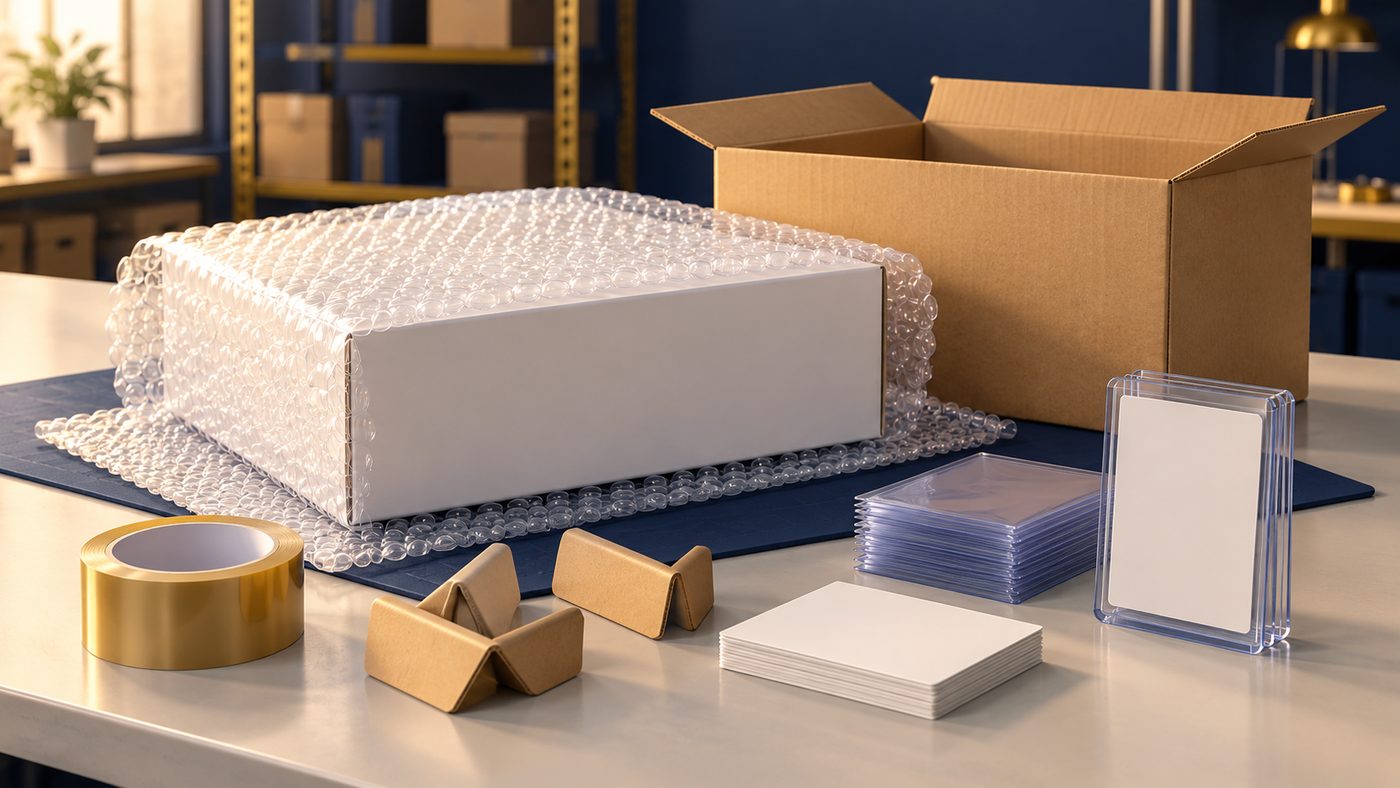
Keep the original box and shrink wrap; put rare cards in a soft sleeve first and then a hard holder; add bubble wrap and corner protectors around large board game boxes; when ordering, ask the seller to use a carton rather than only an express bag. These are general packing experience, not a commitment by the site.
What to check first on arrival
After a parcel arrives at the warehouse you can apply for unboxing inspection and photo confirmation (charged separately, see the shipping fee page); when you receive the goods, please photograph everything completely as evidence.
How are board games billed? What is the difference between air freight, sea express and sea LCL cargo?
Board game boxes are bulky and light, so volume matters a lot. Rates follow the 好運器 shipping fee page; formulas are listed here; freight for sea LCL cargo varies by product, so ask customer service for a quote:
| Method | Rate and formula | Transit time |
|---|---|---|
| Air freight | NT$100/kg, actual weight only, volume not counted; an extra NT$120 if actual weight is under 10 kg | 3–5 working days |
| Sea express | NT$50/kg; volumetric weight = length × width × height (cm) ÷ 10000, the higher of actual and volumetric weight is used; an extra NT$100 if under 10 kg | 5–10 working days |
| Sea LCL cargo (freight varies by product; ask customer service for a quote) | From NT$25 per kg, or from NT$150 per volume unit; volume = length × width × height (cm) ÷ 28316 | 7–14 working days |
In an on-site measurement of 601 sea express parcels (billed in July–August 2026, months 7–8, from China dispatch to Taiwan signing): median 6 days, 90th percentile 9 days (last checked 2026-09-17); air freight is not in this sample. For a single piece over 10 cai (a Taiwanese volume unit) or 40 kg, the Taiwan-side home delivery carries an extra oversize surcharge, so confirm with customer service before ordering.
How do I consolidate board games and cards bought in China back to Taiwan?
The following 5 steps apply to board games and cards bought on Chinese e-commerce and sent to the 好運器 Shenzhen warehouse.
1Pick a marketplace and confirm the product
Place the order yourself on Taobao, Tmall, Pinduoduo or Xianyu; confirm the seller is official or authorized, and check the product page for the original design age, the edition, and whether it includes batteries or discs.
2Enter the Shenzhen consolidation warehouse as the delivery address
Enter the address of the 好運器 Shenzhen consolidation warehouse and your member number in the recipient details; 好運器 does not buy on your behalf and does not pay for goods on your behalf.
3Ask first, then order
For electronic dice with batteries, board games for ages 14 and under that need inspection, and high-priced cards, ask customer service first whether they can be accepted and how to pack them.
4Parcels arrive: wait until all are in, then combine boxes
Parcels that arrive in batches stay in the warehouse, with free storage for 366 days and free box-combining packing; once they have all arrived, create a consolidation order, check the weight and dimensions measured by the warehouse, then decide whether to combine boxes and ship.
5Declare truthfully and complete the entrustment
Declare item names, quantities and amounts truthfully. According to the site, personal express cargo using online real-name entrustment must first complete pre-confirmed entrustment (advance customs-broker authorization) in EZ WAY, but the Customs Administration has clarified that the regulations do not compel people to use the EZ WAY App; see the EZ WAY tutorial.
What research on the card and board game market is worth consulting?
The studies below only describe card collecting and market background; none of them involves buying in China, shipping to Taiwan or customs declaration, and they cannot be used to infer price gaps, counterfeit shares or tax:
- Secondary market: Heck et al. (2026) analyzed one year of sales of 300 Pokémon cards on German eBay, of which 73.3% sold, with a median price of 1.95 euros; rare and shiny cards contributed a disproportionate share of revenue; a convenience sample, Germany only.
- Investment and collecting: Pompei and Nonino (2026) built an index from 117 high-priced MTG cards, with monthly returns showing near-zero correlation with stocks, bonds and gold, and noted that liquidity and authenticity are challenges; Abrahamse et al. (2025) interviewed MTG collectors and found that collectors justify continued consumption to outsiders by financial value.
- Taiwanese players: Wang Yuzheng (2020) surveyed players of the Traditional Chinese edition of the Pokémon Trading Card Game, with 198 qualitative and 1,448 quantitative responses; more than nine in ten respondents were male, mainly aged 13–35; the subjects are players, not collecting or cross-border buying.
- Small parcels and counterfeits: the press release for the 2018 OECD and EUIPO report states that 63% of counterfeit and pirated cases seized by customs worldwide involve small parcels, but by volume and value containers remain the majority; the data mainly come from European and American customs.
- Chinese buyers and cross-border: for academic research on China's board game industry, card grading and counterfeit criteria, or on border protection for cross-border e-commerce by Taiwan's Intellectual Property Office or the Customs Administration, this page found no verifiable direct literature.
What do common board game and card terms mean?
- Tabletop games (board games)
- Games played on a tabletop, including chess-type games, card games and expansion accessories; the tariff schedule has no dedicated code for board games.
- Collectible (trading) card game (TCG)
- Games in which players collect and trade cards and battle with them; neither the tariff schedule nor the BSMI documents have a dedicated “collectible” entry.
- Game cards (including playing cards)
- The goods description of tariff code 9504.40.00.00-5, with a column 1 rate of 0% and a blank import regulation column.
- C02
- A code in the tariff import regulation column; the BSMI gazette states that for toys under C02 codes, the party obliged to apply for inspection must enter a customs clearance code on the import declaration.
- Dutiable value
- The basis for calculating tax, being the CIF price of imported goods at the port of arrival, including freight and insurance up to the Taiwan port.
- Sea LCL cargo
- Consolidated cargo shipped by sea LCL (containers); freight varies by product, so ask customer service for a quote; from NT$25 per kg, or from NT$150 per volume unit, volume ÷ 28316.
- Pre-confirmed entrustment (advance customs-broker authorization)
- Before the goods arrive in Taiwan, the recipient uses the EZ WAY App to check the items and declared amount and taps “declaration matches” to complete pre-confirmation; according to the site, this applies to those using online real-name entrustment.
What are the sources and the scope of verification?
The sources below were consulted on 2026-09-30; document dates and consultation dates are marked separately, and where no update date is stated none is invented.
Government and official first-hand sources
- Customs Administration import tariff open data | Document date: not stated (server file time 2025-04-24); 9504.40.00.00-5 game cards (including playing cards) column 1 duty 0%, import regulation column blank; 9504.90.90.00-5 other articles for funfair, table or indoor games 0%, import regulation C02; 9503.00.81.00-6 puzzle toys and 9503.00.93.90-3 other toys 0%, import regulation C02; the import regulation column of all codes in 9503 and 9504 has neither MW0 nor MP1; collectible cards, board games, dice, mahjong, dominoes and chess-type games have no dedicated codes. The file date is rather old; actual rates follow the current Customs tariff schedule at the time of declaration.
- Government Open Data Platform: Customs advance tariff ruling cases | Document date: the latest cases in the dataset are around 2020; a full-file search for collectible cards and ordinary board games finds no case; the only related cases are one 2016 PET plastic playing card (58mm×89mm) classified under 9504.40.00.00-5 and several drinking or tabletop entertainment mini-game items classified under 9504.90.90.00-5, all individual cases, not general rulings.
- Customs Administration: Express cargo | Document date: 2026-07-08; express cargo must not be controlled goods, prohibited goods, goods infringing intellectual property, etc., and each piece (bag) must weigh 70 kg or less gross; for the same batch with a dutiable value of NT$2,000 or below, duty, business tax and commodity tax are waived, and a taxpayer who has used duty-free release more than 6 times within a half-year period is no longer eligible; a half-year period means January to June (months 1 to 6) and July to December (months 7 to 12) of each year.
- Customs Administration: What taxes and fees are payable on imported goods? | Document date: 2026-07-13; duty = dutiable value × tax rate; business tax = (dutiable value + duty + commodity tax, etc.) × 5%; the trade promotion service fee is dutiable value × 0.04%, waived at NT$100 or below; dutiable value is the CIF price at the port of arrival, equal to the free-on-board (FOB) price plus freight and insurance.
- Customs Administration: Which mainland China articles are permitted for import? | Document date: 2026-07-09; where the tariff import regulation column lists neither MW0 nor MP1, the mainland China article is permitted for import and exempt from an import permit; if another code is shown, other rules apply at declaration.
- Executive Yuan Gazette: Comparison table of amendments to the inspection rules for toy products subject to mandatory inspection by the Bureau of Standards, Metrology and Inspection, Ministry of Economic Affairs | Document date: 2023-09-05; toys for children aged 14 or under are subject to mandatory inspection, and the published list of reference tariff codes includes 9504.90.90.00.5 and excludes 9504.40.00.00.5 (playing cards); for codes with import regulation C02, the party obliged to apply for inspection enters a customs clearance code on the import declaration; the list is for reference only, and if goods are determined to belong to a code not listed, the inspection procedure must still be completed. This is the 2023 Gazette version and this page could not confirm whether it is current; the customs clearance code is entered only for C02 codes that use a declaration of conformity.
- Bureau of Standards, Metrology and Inspection, Ministry of Economic Affairs: BSMI Toy Product Classification Guidelines (sixth edition) | Document date: ROC year 112, month 6, day 19; board games designed for children aged 14 or under are subject to mandatory inspection, and those designed for people over 14 must provide original-manufacturer evidence to count as not subject; colour-illustrated game cards designed by the original manufacturer for ages 14 and under are subject to mandatory inspection, while traditional playing cards (58×88mm) and baseball cards are not; the document has no “collectible” or “TCG” wording and does not mention dice. This is the 2023 version and this page could not confirm whether it is current.
- Bureau of Standards, Metrology and Inspection order: Amendment to the Toy Product Inspection Operating Provisions | Document date: 2025-07-16 (effective on the 1st day of the 8th month of the same year); the annex list still uses “colour-illustrated games, collector cards and similar products with special game rules or designed by the original manufacturer for children aged 14 or under to play” and “board-game toys designed by the original manufacturer for children aged 14 or under to play” as classification wording; the document has no customs clearance code provision.
- Laws & Regulations Database of Taiwan: Regulations Governing Exemption from Inspection of Commodities | Document date: amended ROC year 108, month 11, day 21; Article 5, paragraph 1, subparagraph 2: for toy-type goods not for sale and for personal use, if the total value of the same specification and model on one declaration is US$1,000 or less and the quantity does not exceed 5 pieces (or exceeds US$1,000 but the quantity is one piece), and review finds them compliant, they may be exempted from inspection; Article 8: for non-sale personal-use items of the same specification and model, exemption for the party obliged to apply for inspection is limited to once within six months; the requirement is “not for sale, personal use”.
- Laws & Regulations Database of Taiwan: Trademark Act | Document date: amended ROC year 112, month 5, day 24 (some of Articles 95 to 97 await an effective date set by the Executive Yuan); Article 75: when Customs finds that imported goods are clearly liable to infringe a trademark right, it must notify the trademark owner and the importer/exporter and set a deadline for the importer/exporter to provide documents proving no infringement; Article 97 (currently effective text): anyone who sells goods bearing a counterfeit trademark knowing that another person made them, or possesses, displays, exports or imports them with intent to sell, is punishable by imprisonment of up to one year or detention, with a fine of up to fifty thousand New Taiwan dollars imposed alternatively or in addition, and the same applies when done through electronic media or the internet; Articles 95 to 97 as amended in ROC year 111 have not yet taken effect; the statute makes no separate provision for purely personal use, and this page draws no conclusion.
- Laws & Regulations Database of Taiwan: Copyright Act | Document date: amended ROC year 111, month 6, day 15; Article 87, paragraph 1, subparagraph 3: importing reproductions made without authorization is deemed infringement of copyright; the personal, non-distributive use exception in Article 87-1, subparagraph 3 applies only to Article 87, paragraph 1, subparagraph 4 (importing lawfully made copies from abroad); Article 93, subparagraph 3: infringing another's copyright by the method in Article 87, paragraph 1, subparagraph 3 is punished with imprisonment of up to two years, detention, or a fine of up to five hundred thousand New Taiwan dollars, or both; Article 90-1: when Customs finds goods that appear on their face to infringe copyright, it may notify the rights holder and notify the importer/exporter to provide authorization information.
- Customs Administration: Intellectual property border measures | Document date: 2020-08-12; trademark owners and copyright owners may apply for Customs seizure of infringing goods and must provide a deposit or security equal to the dutiable value; in trademark cases the seized party may provide a double deposit or security to request cancellation of the seizure.
- Laws & Regulations Database of Taiwan: Criminal Code | Document date: amended ROC year 115, month 7, day 22; Article 266: gambling for property in a public place or a place the public may enter, or by means such as the internet, is punished, except for things staked for temporary entertainment; Article 268: providing a gambling venue or assembling people to gamble with intent to profit is punished. The element is the act of gambling for property; the provisions do not mention possessing or importing playing cards, dice and similar items.
Research literature
Sales characteristics of Pokémon trading cards: A prospective one-year field study
300 Pokémon cards were sold on German eBay from 2024-05-28 to 2025-05-27, of which 73.3% sold, with a median price of 1.95 euros; rare and shiny cards contributed a disproportionate share of revenue; a convenience sample within Germany only, unrelated to China, cross-border shipping or customs.
Trading card games as an alternative asset: portfolio diversification and risk-return analysis
An equal-weighted index built from 117 high-priced MTG cards (2010-10 to 2025-03), whose monthly returns are close to uncorrelated with stocks, bonds and gold, and which notes that liquidity and authenticity are challenges; it covers only high-priced cards and is a portfolio analysis, unrelated to shipping to Taiwan.
Investing in meaning: justifying card game collecting in an age of frictionless consumption
Qualitative interviews with MTG collectors found that collectors maintain the meaning of collecting through “restriction strategies” and justify continued consumption to outsiders by financial value; a qualitative study of MTG collectors only, not involving counterfeits or cross-border matters.
Exploring the participation behavior and attitudes of trading card game players: the Traditional Chinese edition of PTCG as an example
A survey of players of the Traditional Chinese edition of the Pokémon Trading Card Game: 198 qualitative and 1,448 quantitative responses, with more than nine in ten respondents male and mainly aged 13–35, exploring motives for joining and reasons for continuing or quitting; the subjects are players rather than collecting or the secondary market, unrelated to shipping to Taiwan.
Misuse of Small Parcels for Trade in Counterfeit Goods: Facts and Trends
According to the press release: 63% of counterfeit and pirated cases seized by customs worldwide involve small parcels (postal or express), most small parcels contain 10 items or fewer, but by volume and value containers remain the majority; the data mainly come from European and American customs seizures, unrelated to cards or Taiwan, and can only be stated as that, internationally, small parcels make up the bulk of customs seizure cases.
The tariff schedule has no dedicated code for collectible cards, board games, dice or mahjong, the tariff file date is 2025-04-24, and the advance-ruling dataset stops at around 2020 with no case for collectible cards or ordinary board games; the BSMI guidelines and gazette are the 2023 version, the latest versions of the classification guidelines and the list of items subject to mandatory inspection could not be confirmed, and no provision states whether collectible cards and dice are subject to mandatory inspection; who fills in the inspection customs clearance code for a consolidated parcel was not found; whether each code for books, rulebooks and discs requires an import permit was not checked code by code; gambling-implement-specific import restrictions, Chinese-side export restrictions on board games and cards, and whether electronic board games count as battery products are not stated in any provision this page found; the relationship between Trademark Act Article 97 and purely personal use is not written in the provision, and this page draws no conclusion; no official criterion for telling genuine from counterfeit was found; the body of the OECD report and some publisher pages of papers could not be opened, so only abstracts or press releases were read.
What are the common questions about shipping board games and cards from China to Taiwan?
Can board games and collectible cards bought in China be shipped to Taiwan?
What is the tariff on board games and cards?
Is an import permit needed?
Do board games have to pass BSMI inspection?
Do collectible cards need inspection?
Can toys I collect for myself be exempt from inspection?
What happens if I ship counterfeit or pirated cards to Taiwan?
Can electronic dice or light-up board games with batteries be shipped?
If a board game box is crushed or cards are lost, how does 好運器 compensate?
Board game boxes are large; how is freight calculated?
Further reading
Board games and cards bought in China, consolidated back to Taiwan
好運器 has only the Shenzhen and Taoyuan warehouses and offers mainland China → Taiwan consolidation; before ordering, confirm the original design age, whether it contains batteries, and whether the seller is official or authorized.
View China-to-Taiwan shipping