Shipping Chinese Tea to Taiwan: Which Teas Can Be Imported
Can You Ship Tea from Mainland China to Taiwan?
Only Pu-erh can. Chinese-origin green tea, oolong (partially fermented tea) and black tea are all MW0: mainland Chinese goods, import prohibited under tariff heading 0902; white tea, matcha powder, jasmine tea, and pure-tea tea bags of green, oolong or black tea also fall under 0902 and are equally prohibited. Pu-erh (0902.30.10, 0902.40.10) is permitted for import at a 17% duty; ripe Pu-erh is the clearest case, while raw Pu-erh has been ruled a partially fermented tea (MW0) in an advance ruling and is subject to Customs determination. Tea is in Chapter 9, so the “small-quantity exemption for mainland goods”, which is limited to industrial products of Chapters 25–97, does not apply; the rule allowing inbound travelers to carry 1 kg of mainland tea also applies only to traveler baggage and cannot be applied to consolidated shipping, postal parcels or express courier. Tea-based preparations such as milk tea powder and instant tea (2101.20) are permitted for import, but the duty is 27.5%.
This article covers only the tariff classification and import rules for tea and tea products made in mainland China and sent to Taiwan via consolidated shipping. HowBridge provides China → Taiwan consolidated shipping, with a Shenzhen warehouse and a Taoyuan warehouse; we do not offer purchasing agent services and do not offer duty-inclusive shipping. The actual tariff code and whether goods are released are determined by Customs based on the goods as received; whether an individual parcel can be accepted is subject to confirmation by customer service.
Which Tariff Lines Cover Tea in Taiwan’s Tariff Schedule?
Tea falls under Chapter 9, heading 0902 “Tea, whether or not flavoured”, with 9 lines at the 11-digit level. The subheadings follow two axes: type of tea (green / partially fermented / other black / Pu-erh) and whether each packing exceeds 3 kg. The “Mainland goods” column below shows the status of Chinese-origin tea sent in via consolidated shipping.
| 11-digit line | Official description (summary) | Column 1 duty rate | Import rule for mainland goods |
|---|---|---|---|
0902.10.00.00-7 | Green tea (not fermented), in packings not exceeding 3 kg | 17% | MW0 Import prohibited |
0902.20.00.10-3 | Scented green tea, in packings exceeding 3 kg | 17% | MW0 Import prohibited |
0902.20.00.90-6 | Other green tea (not fermented), in packings exceeding 3 kg | 17% | MW0 Import prohibited |
0902.30.10.00-1 | Pu-erh tea, in packings not exceeding 3 kg | 17% | Import permitted |
0902.30.20.00-9 | Partially fermented tea (oolong, etc.), in packings not exceeding 3 kg | 25% | MW0 Import prohibited |
0902.30.90.00-4 | Other black tea (fermented), in packings not exceeding 3 kg | 17% | MW0 Import prohibited |
0902.40.10.00-9 | Pu-erh tea, in packings exceeding 3 kg | 17% | Import permitted |
0902.40.20.00-7 | Partially fermented tea, in packings exceeding 3 kg | 22% | MW0 Import prohibited |
0902.40.90.00-2 | Other black tea (fermented), in packings exceeding 3 kg | 17% | MW0 Import prohibited |
The official English description is “in immediate packings of a content not exceeding 3 kg”, meaning the weight of the packing layer that directly holds the tea, not the outer carton. This is our reading based on the English description and the translation examples in the bound tariff volume; we found no verbatim interpretation of 0902 by the Customs Administration.
What Do MW0, 465 and F01 Mean?
These codes appear in the import regulation column of the International Trade Administration’s “Import and Export Regulations for Goods”. The import regulations for green tea, oolong and black tea are “465 F01 MW0”; Pu-erh has only “F01”.
| Code | Official meaning | Effect on shipping tea |
|---|---|---|
MW0 | Mainland Chinese goods: import prohibited | If the origin is mainland China, it cannot be imported, whatever the quantity; the same kind of tea produced in other countries is not subject to this restriction. |
465 | Certificate of origin required (proving it is not of mainland origin) | Exempt for imports for personal use not exceeding 6 kg. This only waives the certificate of origin; it does not lift MW0. |
F01 | Import inspection under the “Regulations of Inspection of Imported Foods and Related Products” | Food requires an import inspection application to the TFDA; personal-use imports meeting the conditions may be exempt (see below). |
What about non-Chinese tea shipped from the Shenzhen warehouse?
The origin of tea is determined by where it was harvested; processing in a third country does not change the origin. For example, Japanese matcha or Sri Lankan black tea bought on Taobao and shipped from the Shenzhen warehouse is exempt from a certificate of origin for personal use within 6 kg; above that, one is required. Where there are doubts about the certificate or origin information, Customs will refer the case to Taiwan’s overseas missions for verification.
Why Can Pu-erh Be Shipped? How Do Raw, Ripe and Dark Tea Differ?
The Council of Agriculture (now the Ministry of Agriculture) explained in ROC year 99 (2010): black tea, semi-fermented tea and green tea, which are produced domestically, are controlled, while “Pu-erh was opened by the former government in ROC year 93 (2004), and this type of tea is not produced domestically”. In the tariff, “Pu-erh” is a product name, not the broad category of “dark tea” or “post-fermented tea”.
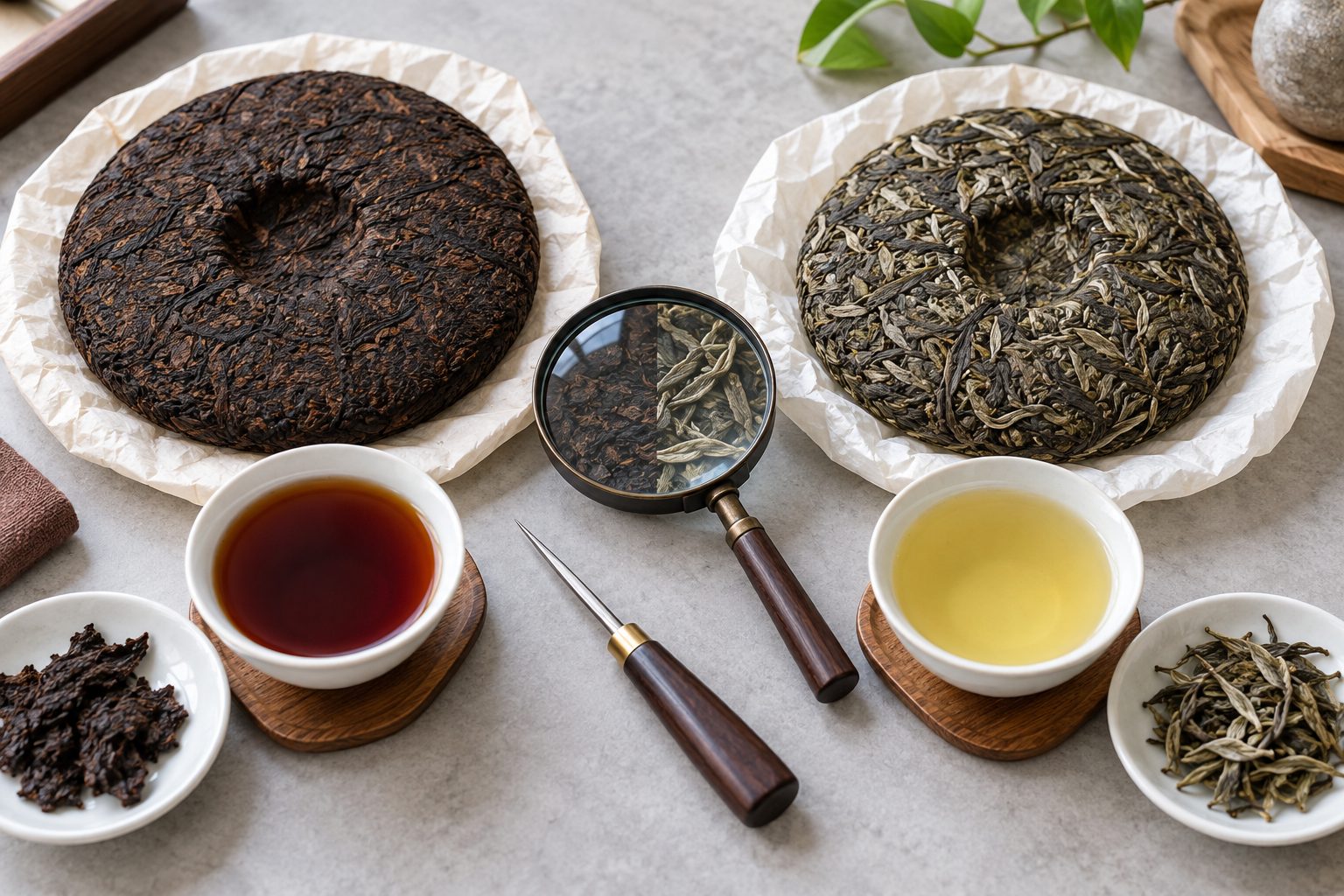
Ripe Pu-erh: the clearest tariff line
Ripe Pu-erh, post-fermented by wet piling, whether loose, cake, brick or tuo, falls under 0902.30.10 (packings of 3 kg or less) and is permitted for import.
Raw Pu-erh: there is an unfavorable precedent
Customs Administration advance tariff ruling 101AA0043 (2012) found a loose “Pu-erh tea (raw)” to be a partially fermented sun-dried loose tea, to be classified under 0902.40.20 (MW0). A Council of Agriculture press release also states that “raw cakes have not yet undergone storage or microbial fermentation… the taste is somewhat like green tea, more astringent”. Whether raw Pu-erh can be imported as Pu-erh is for Customs to determine.
Anhua dark tea, Liubao tea and Fu brick tea are not Pu-erh
These post-fermented dark teas have no dedicated tariff line; by inference from the HS Explanatory Notes they fall under 0902.30.90 “Other black tea (fermented)”, which is MW0. Being dark tea as well does not allow them to be declared as Pu-erh.
Declaring oolong, green tea or other dark tea as Pu-erh is a false declaration of the goods’ description and also involves evading the MW0 control. In ROC 99/5 (May 2010), to stop people from smuggling other teas under the Pu-erh name, the Council of Agriculture asked Customs to strengthen import inspections of Pu-erh tariff lines and set up an appraisal panel to help re-examine certificates of origin.
Do Matcha, Jasmine Tea, White Tea and Milk Tea Powder Count as “Tea”?
Under the General Notes to Chapter 9 and HS Explanatory Note 09.02: this heading covers tea flowers, tea buds, tea waste, powdered tea agglomerated into pellets or tablets, and pressed tea; tea to which aromatic plants such as jasmine flowers or dried orange peel are added during processing is also included; powder ground from pure tea is still tea. So adding flowers, grinding into powder or making tea bags still leaves it under 0902. Separately, preparations based on tea with other ingredients added fall under 2101.20.
| Product | Tariff line | Column 1 duty rate | Mainland goods | Basis |
|---|---|---|---|---|
| Longjing, Biluochun, green tea bags | 0902.10 | 17% | MW0 Import prohibited | Official tariff line |
| Tieguanyin, Da Hong Pao and other oolongs | 0902.30.20 | 25% | MW0 Import prohibited | Official tariff line |
| Lapsang Souchong, Dianhong (Yunnan black tea), Keemun black tea | 0902.30.90 | 17% | MW0 Import prohibited | Official tariff line |
| White tea (Silver Needle, White Peony, Shou Mei) | 0902.30.20 / 0902.40.20 | 25% / 22% | MW0 Import prohibited | Similar advance rulings 105AA1003–1005 (packings exceeding 3 kg) classified it as partially fermented tea; for 3 kg or less this is an inference. An older case classified it as green tea; both views mean MW0 |
| Jasmine tea | 0902.10 | 17% | MW0 Import prohibited | Stated in the HS Explanatory Notes |
| Matcha powder (ground pure tea) | 0902.10 | 17% | MW0 Import prohibited | Stated officially |
| Cold-brew tea bags, pyramid tea bags (pure tea) | 0902, by type of tea | 17% / 25% | MW0 Import prohibited | Classified under 0902 by type of tea; Pu-erh tea bags are the exception and are permitted for import |
| Ripe Pu-erh | 0902.30.10 | 17% | Import permitted | Official tariff line |
| Small green mandarin (small green mandarin stuffed with Pu-erh) | 2101.20 | 27.5% | Import permitted | Advance ruling 107AA0031 |
| 3-in-1 milk tea powder, instant tea powder | 2101.20 | 27.5% | Import permitted | Official description |
| Matcha-based preparations with other ingredients added | 2101.20 | 27.5% | Import permitted | Advance ruling 107AA0180 (matcha 70% + chlorella 30%) |
| Bottled tea drinks | 2202.99 | 10% | Import permitted | Inferred from the HS Explanatory Notes |
| Matcha biscuits, tea-flavored snacks | 1905.31, etc. | 25% | MW0 Import prohibited | Inferred from the HS Explanatory Notes |
The official description of 2101.20 is “preparations with a basis of tea or maté”. Pure matcha powder, and tea with only a small amount of flavoring added, remain 0902 and MW0.
Can Herbal and Wellness Teas Be Shipped?
Chrysanthemum, rose, burdock and barley are not “tea” made from the tea plant, so they are not under 0902; they are classified separately by ingredient, with varying results:
- Single-ingredient dried chrysanthemum (1211.90.91.50) and dried rose buds (1211.90.92.21): permitted for import.
- Roasted burdock tea: advance ruling 106CA0241 classified it under 2101.30, permitted for import, duty rate 26%.
- Barley tea and tartary buckwheat tea: may fall under 2101.30 (permitted) or 1904.10.90.20 (mainland goods prohibited); tartary buckwheat tea has conflicting precedents and is subject to Customs determination.
- Dried lemon slices (0805.50) and dried longan (0813.40): MW0, import prohibited.
- Mixed tea bags such as longan, jujube and goji, and multi-herb blend tea bags: classified under 2106.90.99.90, where only specific named products of mainland origin are opened, and mixed tea bags are not among them; by structural inference they are prohibited, pending confirmation of the official wording.
- Chinese herbal compound wellness teas claiming therapeutic effects: an advance ruling classified them under 3004.90.69, MW0.
“Herb + tea” blend tea bags have no fixed weight threshold; where tea and the other main ingredients are roughly 40/60, there are precedents both ways, so Customs determines them based on the actual composition.
Is There a “Small-Quantity Exemption” for Food? Travelers Can Bring 1 kg: Does That Work for Consolidated Shipping?
The small-quantity exemption announced by the Ministry of Economic Affairs on ROC 111/8/19 (2022-08-19) under Jing-Mao-Zi No. 11104603570 applies to “mainland industrial products (tariff Chapters 25 to 97)”. Tea is in Chapter 9, so it does not apply.
| Channel | Mainland green tea / oolong / black tea | Basis |
|---|---|---|
| Consolidated shipping, postal parcels, express courier | Cannot be imported; no exemption allowance | Article 7 of the Regulations Governing Trade between Taiwan and Mainland China; the postal-parcel and express-courier regulations provide that goods subject to import regulations follow those regulations; Kaohsiung Customs stated on 114.06.04 (2025-06-04) that mailed food not opened for import is not eligible for the small-quantity exemption |
| Inbound traveler baggage (accompanied and unaccompanied) | Mainland tea limited to 1 kg; agricultural, livestock and aquatic products 6 kg in total | Schedule to the Regulations Governing Inspection, Duty Collection and Release of Baggage of Inbound Passengers; applies only to traveler baggage |
| Special-case application | Must meet small quantity, special need and no domestic production, and obtain an import permit first | Article 7 of the Regulations Governing Trade between Taiwan and Mainland China; a Council of Agriculture article notes that items refused special-case import over the years include tea |
“Bringing 1 kg of tea back to Taiwan is fine” applies only to inbound travelers’ baggage. For mainland green tea, oolong and black tea sent by consolidated shipping, mail or express courier, not even 1 gram can be imported without a special-case import permit.
Does Pu-erh for Personal Use Need a Food Inspection?
Pu-erh’s import regulation is F01, which requires a food import inspection. Under Article 30, Paragraph 3 of the Act Governing Food Safety and Sanitation and the Ministry of Health and Welfare announcement Wei-Shou-Shi-Zi No. 1081300310 of ROC 108/4/16 (2019-04-16), the inspection application may be waived in the following cases:
- Personal use, not for sale.
- Each single line item on each declaration is valued at USD 1,000 or less and weighs 6 kg or less.
- Single line item = same product name, ingredients, brand, manufacturer and origin.
- Exemption from inspection is not exemption from tax or from declaration; the goods may not be sold after import.
Is this announcement still in force?
In ROC year 109 (2020) the Ministry of Health and Welfare pre-announced an amendment (to a combined daily limit); at the time of our check we found no formally issued amendment, so this page follows the ROC 108 (2019) announcement; the TFDA’s current rules prevail.
From Tea Seedlings to Tea Drinks: Which Stage Is the Government Protecting?
Laid out layer by layer along the tea industry chain, the import rules for mainland goods differ. The table below is compiled layer by layer from the Customs Administration tariff master file (2026/09/16) and the International Trade Administration’s list of mainland goods. The figures are “number of prohibited (MW0) lines / number of lines in that layer”, i.e. counts of tariff lines, not trade value.
| Layer | Representative lines | Rule for mainland goods | Column 1 duty rate |
|---|---|---|---|
| Tea plant cuttings, tea seedlings | 0602.10.90.30, 0602.90.91.10 | MW0 (2/2), plus plant quarantine required | 0% |
| Fresh tea leaves (tea flush) | No dedicated line | Inferred as more likely under 0902 (MW0), pending Customs determination | — |
| Green tea, oolong, black tea | 0902 (7 lines) | MW0 (7/7), plus 465 | 17%; oolong 25% / 22% |
| Pu-erh | 0902.30.10, 0902.40.10 | Permitted | 17% |
| Extracts, instant tea, milk tea powder | 2101.20 | Permitted | 27.5% |
| Tea drinks | 2202.99 | Permitted | 10% |
| Tea seed cake, tea bag paper | 2306.90, 4805.40 | Permitted | 0% |
Official documents state “protecting domestic tea farmers”
The Council of Agriculture explained on ROC 99/2/9 (2010-02-09): to protect domestic tea farmers, black tea, semi-fermented tea and green tea produced domestically are on the list of 830 controlled items; it stated that Pu-erh was opened in ROC year 93 (2004) and that this type of tea is not produced domestically. The 830 items have not been opened further since 2008, and became 968 items after the 2015 tariff revision.
Duty rates are tiered too
The Council of Agriculture explained on ROC 90/11/1 (2001-11-01) that in the WTO accession, partially fermented tea “secured continued maintenance at 25%”, while green and black tea were cut to 20% in the year of accession and to 17% in 2007 (the original text calls them “green tea, which is produced less, and black tea, which is hardly produced any more”). Partially fermented tea keeps the highest rate; our inference is that this protects oolong-type teas, Taiwan’s largest output.
Processed products are opened, but backed by high duties
Extracts, instant tea and milk tea powder are permitted for import, but the duty is 27.5%, higher than the 17% on finished tea. This is an inference from the control structure; we found no official explanation of when or why they were opened.
Counter-evidence: imports have long exceeded domestic output
Taiwan produced 14,027 tonnes of tea in 2022, while imports in ROC year 108 (2019) were 33,227 tonnes, mainly from Vietnam. Controlling mainland tea has not reduced total imports (inference).
For socks, raw materials are opened, yarn and fabric are the most controlled, and officials specifically named protecting downstream sock knitting; for tea, seedlings and finished tea (the farming end) are controlled, while processed products are opened but carry high duties; the protected party is tea farmers.
What Taxes Apply to Imported Tea?
Goods from mainland China are subject to Column 1 duty rates: green tea, black tea and Pu-erh 17%; partially fermented tea 25% in packings not exceeding 3 kg and 22% above 3 kg; 2101.20 preparations 27.5%. There is also 5% business tax and other charges; actual amounts are as determined by Customs.
Worked example: Pu-erh
Assume Customs determines a dutiable value of NT$4,000 and the Pu-erh duty is 17%: duty = NT$4,000 × 17% = NT$680, plus business tax and other charges. This is a formula example only; actual amounts are as determined by Customs, and it excludes freight, customs brokerage and delivery fees.
Duty-free does not mean importable
Postal parcels with a dutiable value of NT$2,000 or less are exempt from duty and business tax, but the same recipient loses the exemption after more than 6 times in a half-year (Articles 7 and 12 of the Regulations Governing Customs Clearance of Import and Export Postal Parcels; express shipments follow the low-value category in Article 11 of the Regulations Governing Customs Clearance of Air Express Cargo). The low-value exemption only decides whether tax is payable; MW0 tea cannot be imported even if its value is very small.
How Do You Check Before Shipping Tea?
Use the six steps below to decide before ordering, so the goods are not returned or confiscated at Customs.
1First, check whether it is tea made from the tea plant
Green, oolong, black, white, yellow and dark tea, Pu-erh, jasmine tea, matcha and tea bags all count. For herbal teas such as chrysanthemum, rose, burdock and barley, skip to step 5.
2Confirm the origin
Look at where the tea was harvested. For non-Chinese tea, personal use within 6 kg is exempt from a certificate of origin; above that, one is required.
3Of Chinese-origin teas, only Pu-erh can be shipped
Do not ship other types of tea, whatever the quantity; the 1 kg traveler allowance does not apply to consolidated shipping.
4Make sure Pu-erh really is Pu-erh
Ripe Pu-erh is the clearest; raw Pu-erh has a precedent of being ruled partially fermented tea; Liubao, Anhua dark tea and Fu brick tea are not Pu-erh. Declare a specific product name, e.g. “ripe Pu-erh tea cake 357g × 2”.
5For herbal teas and tea products, check the ingredients
Single-ingredient dried chrysanthemum and dried rose buds can be shipped; dried lemon slices, mixed tea bags and Chinese herbal wellness teas should not be shipped. Milk tea powder and instant tea must have tea as the main ingredient; they can be shipped, but the duty is 27.5%.
6Personal-use quantities and declaration
The same item at USD 1,000 or less and within 6 kg is exempt from food inspection; it may not be sold after import. Declare the product name and origin truthfully; you can cross-check with CCC tariff lookup.
What Happens If You Declare Oolong as Pu-erh?
Under the Customs Anti-Smuggling Act, falsely declaring the description of goods carried may be punished by a fine of not more than 5 times the evaded import duty or by confiscation of the goods (Article 37, Paragraph 1, Subparagraph 1); if it also evades import controls such as MW0, Article 37, Paragraph 3 redirects it to Article 36, with a fine of not more than 3 times the value of the goods, and confiscation of the goods under Paragraph 3 of that article. The above is what the statutes provide; actual penalties depend on Customs’ case-by-case determination.
Buy only Pu-erh among Chinese-origin teas, and declare the type of tea, origin and quantity truthfully; if you cannot tell whether it is Pu-erh or whether it is a tea-based preparation, ask the seller about ingredients and origin first, and if in doubt, do not ship it.
Glossary
- CCC 11-digit code
- Taiwan’s goods classification code: the first 8 digits are the tariff number, digits 9–10 are the statistical suffix, and digit 11 is the check digit.
- MW0
- Mainland Chinese goods: import prohibited.
- 465
- A certificate of origin is required on import; exempt for personal use not exceeding 6 kg.
- F01
- Food must undergo import inspection as required.
- Partially fermented tea
- A tariff term covering semi-fermented teas such as oolong, Baozhong and Tieguanyin; white tea has also been classified here in advance ruling cases.
- Advance tariff ruling
- An application by the importer to the Customs Administration before import, under which Customs determines in advance the tariff number of the goods.
Sources and Scope of Verification
The sources below were accessed on 2026-09-27; document dates and access dates are shown separately.
Primary government and official sources
- International Trade Administration, MOEA: Import and Export Regulations for Goods lookup (live 16-digit lookup for 0902 etc. and explanation of import regulation codes MW0, 465, F01, B01) | International Trade Administration, MOEA | Document date: as of lookup on 2026-09-27 | The import regulations for the 7 lines of green tea, partially fermented tea (oolong) and other black tea are all “465 F01 MW0”; Pu-erh 0902.30.10 and 0902.40.10 have only “F01”; tea plant cuttings and seedlings are B01 MW0; tea extracts 2101.20 have only F01
- Ministry of Economic Affairs announcement Jing-Mao-Zi No. 11104603570, “Rules permitting small quantities of mainland goods to be imported without an import permit” | Ministry of Economic Affairs | Document date: 2022-08-19 | The 111.8.19 small-quantity exemption for mainland goods applies only to “industrial products” of Chapters 25–97; tea (Chapter 9), tea seedlings (Chapter 6) and noni tea (Chapter 21) are all excluded
- Regulations Governing Trade between Taiwan and Mainland China (Articles 7, 9) | Ministry of Economic Affairs (Laws & Regulations Database, Ministry of Justice) | Document date: amended 2024-02-19 (ROC 113/02/19) | Mainland goods may in principle not be imported, with only the 13 exceptions in Article 7, Paragraph 1; for tea via consolidated shipping, the only possibly relevant ones are Subparagraph 1 (announced as permitted: Pu-erh), Subparagraph 10 (carried by travelers) and Subparagraph 13 (special-case approval); mail / express courier is not a separate exception; carriage by travelers is a statutory exception (Subparagraph 10), which must be approved by the Ministry of Finance and announced by Customs
- Introduction to mainland goods management and the online special-case application process | International Trade Administration, MOEA | Document date: not shown (as of lookup on 2026-09-27) | Special-case imports require the competent authority for the goods to find “small quantity, special need, no domestic production”; after approval, an import permit must still be obtained first; otherwise the application is refused
- Act Governing Relations between the People of the Taiwan Area and the Mainland Area, Article 40 | Mainland Affairs Council (Laws & Regulations Database, Ministry of Justice) | Document date: amended 2022-06-08 | Mainland goods, whether imported or carried in, are “deemed imports” and handled under general import laws
- Regulations Governing Customs Clearance of Import and Export Postal Parcels (Articles 7, 12, 13) | Ministry of Finance (Laws & Regulations Database, Ministry of Justice) | Document date: amended 2020-04-01 | Postal items subject to import regulations must follow those regulations (Article 13); postal parcels with a dutiable value within NT$2,000 are exempt from duty, commodity tax and business tax (Article 7); the same recipient who uses the exemption more than 6 times in a half-year loses it (Article 12)
- Regulations Governing Customs Clearance of Air Express Cargo (Articles 11, 12) | Ministry of Finance | Document date: amended 2026-02-23 (ROC 115/02/23) | Express cargo subject to import/export regulations must clear with a general import declaration (Article 12)
- Regulations Governing Inspection, Duty Collection and Release of Baggage of Inbound Passengers (Articles 2, 4, 17) | Ministry of Finance | Document date: amended 2026-01-30 (ROC 115/01/30) | Mainland goods carried by inbound travelers are limited per the schedule (Article 4); quantities exceeding the limit must within two months be covered by a permit, returned or abandoned (Article 17); scope is inbound travelers’ accompanied and unaccompanied baggage (Article 2)
- Quantity limits for inbound travelers carrying personal-use agricultural, livestock and aquatic products, tobacco and alcohol, mainland goods, personal-use medicines, and environmental and veterinary drugs | Ministry of Finance (attachment, Laws & Regulations Database, Ministry of Justice) | Document date: with the 2026-01-30 amendment | Current schedule “II. Mainland goods”: tea limited to one kilogram; agricultural, livestock and aquatic products six kilograms in total. Applies only to inbound traveler baggage, not to consolidated shipping or mail
- Agricultural, livestock and aquatic products and food | Taipei Customs, Customs Administration, Ministry of Finance | Document date: published 2025-09-01; updated 2026-09-24 | Quantities over the limit require an import permit from the Trade Administration; tea one kilogram, six kilograms in total
- Mainland goods special-case application: can I bring tea, shiitake mushrooms or rice back from a trip to mainland China? | International Trade Administration, MOEA | Document date: 2024-09-16 | Tea and other items brought back from travel to the mainland are handled under the inbound traveler quantity limits
- Which mainland goods are permitted for import? | Customs Administration, Ministry of Finance | Document date: not shown (as of lookup on 2026-09-27) | Only mainland goods whose import regulation column has neither MW0 nor MP1 are permitted for import without a permit
- Act Governing Food Safety and Sanitation (Articles 22, 30) | Ministry of Health and Welfare (Laws & Regulations Database, Ministry of Justice) | Document date: amended 2019-06-12 | Food not for sale that meets the announced value and quantity may be exempt from import inspection application (Article 30); packaged food must label the country of origin in Chinese (Article 22)
- Ministry of Health and Welfare announcement Wei-Shou-Shi-Zi No. 1081300310: conditions under which imported foods and related products are exempt from import inspection application | Taiwan Food and Drug Administration (TFDA) | Document date: issued 2019-04-16, effective 2019-05-01 | Personal-use food exempt from import inspection: each single line item per declaration valued at USD 1,000 or less and within 6 kg, code DH000000000002; applies to any import channel (not limited to travelers). Pu-erh (F01, not MW0) for personal use via consolidated shipping can use this code; it does not lift MW0; single line item defined as same product name, ingredients, brand, manufacturer and origin
- Pre-announcement of draft amendment to “Conditions under which imported foods and related products are exempt from import inspection application and the applicable clearance codes” | Ministry of Health and Welfare | Document date: pre-announced 2020-07-15 | In ROC year 109 an amendment to a combined daily limit was pre-announced, on the grounds that international parcels were being sold under the pretext of personal use; as of this page’s check, no formal issuance found
- Regulations of Inspection of Imported Foods and Related Products | Ministry of Health and Welfare (Laws & Regulations Database, Ministry of Justice) | Document date: amended 2025-08-21 (ROC 114/08/21) | The current inspection regulations are named “Regulations of Inspection of Imported Foods and Related Products” (the name used in the F01 explanation), last amended 2025-08-21
- Control measures for agricultural products | Taiwan Food and Drug Administration (TFDA) | Document date: published 2017-01-16; maintained 2026-09-24 | The measure requiring pesticide residue test reports for Vietnamese black tea ceased to apply on 114.7.7; Chinese tea has no dedicated measure listed on this page
- Food and Drug Administration reiterates active management and strict control of imported tea, and will not tolerate false labeling | Ministry of Health and Welfare (formerly Department of Health) | Document date: filed 2010-02-08 | Import regulation for mainland Chinese green tea, oolong and black tea is MW0; of mainland Chinese tea only Pu-erh is opened (2010 data)
- Continuing to control imports of mainland Chinese tea, strengthening Pu-erh appraisal, and safeguarding tea farmers’ interests | Council of Agriculture, Executive Yuan (now Ministry of Agriculture) | Document date: published 2011-11-02 (ROC 100) | Pu-erh was opened in ROC year 93; other mainland teas remain prohibited; to stop people from smuggling other teas under the Pu-erh name, Customs was asked to strengthen inspections and an appraisal panel was set up (2011 data)
- Customs Anti-Smuggling Act (Articles 36, 37, 39) | Ministry of Finance (Laws & Regulations Database, Ministry of Justice) | Document date: amended 2018-05-09 | Smuggling (evading controls, undeclared): fine of not more than three times the value of the goods plus confiscation; the provision does not restrict the type of goods, so agricultural products are equally covered; false description (declaring oolong as Pu-erh) falls under Article 37, Paragraph 1, Subparagraph 1; because it involves evading the MW0 control, Paragraph 3 redirects the penalty to Article 36 (not more than three times the value of the goods + confiscation)
- Controlling imports of 830 mainland Chinese agricultural products to maintain the stable development of Taiwan’s agriculture | Council of Agriculture, Executive Yuan (reposted on the Mainland Affairs Council website) | Document date: ROC 98/03/26 (2009-03-26) | Tea is explicitly listed among primary fresh and processed products of “major domestic production” whose import from mainland China is controlled, on the grounds of high cross-strait similarity and low-price impact; in ROC year 97 (2008) tea imports were 25,712 tonnes, 73% from Vietnam, 11% from mainland China, all of it Pu-erh
- Taiwan’s agricultural policy in signing the cross-strait Economic Cooperation Framework Agreement (ECFA) | Council of Agriculture, Executive Yuan | Document date: ROC 99/3 (March 2010) (Agricultural Policy & Review, issue 213) | ECFA position: keep controlling the 830 items, absolutely no new openings, no tariff cuts for the 1,415 items already opened; tea is a major controlled item; mainland agricultural products opened early were mainly raw materials “produced little domestically and dependent on imports”
- Signing the cross-strait economic agreement will not expand the opening to mainland agricultural products | Straits Exchange Foundation (author: Chang Shu-hsien) | Document date: ROC 99/4 (April 2010) (Exchange magazine, issue 110) | One of the “three noes” principles is no new agricultural product openings
- 18 agricultural products included in the early harvest, of real help for sales to China | Council of Agriculture, Executive Yuan (Department of International Affairs) | Document date: ROC 99/06/24 (2010-06-24) | The ECFA early harvest does not include Taiwan opening any mainland agricultural product; conversely, mainland China gives Taiwanese tea zero tariff
- Controlling imports of 830 mainland agricultural products to raise the global competitiveness of Taiwan’s agricultural products | Council of Agriculture, Executive Yuan | Document date: ROC 99/04/22 (2010-04-22) | Of tea, only Pu-erh is opened; black tea, semi-fermented tea and green tea produced domestically are not opened
- Review of the current status of mainland Chinese agricultural imports and related import regulations | Council of Agriculture, Executive Yuan | Document date: ROC 94/9 (September 2005) (Agricultural Policy & Review, issue 159) | As of ROC 94/8/1 (2005-08-01), 881 items were not opened, mostly domestic primary products with economic scale and important processed products; opening procedure: proposal by firms or competent authority → Bureau of Foreign Trade consults competent authorities and trade associations → review meeting → approved and announced by the Ministry of Economic Affairs; review criteria are the two requirements of Article 8 of the Trade Permit Regulations
- Evolution and outlook of cross-strait agricultural trade relations | Department of International Affairs, Council of Agriculture, Executive Yuan (Lin Chia-jung) | Document date: ROC 104/6 (June 2015) (Agricultural Policy & Review, issue 276) | From 2008 the 830 controlled items were not opened further; after the 2015 tariff revision the controlled agricultural products number 968; even the “special-case import” channel has refused tea; tea is also a major item in smuggling seizures
- Council of Agriculture: Tea (industry briefing before WTO accession) | Council of Agriculture, Executive Yuan | Document date: ROC 90/11/01 (2001-11-01) | In accession negotiations, partially fermented tea secured a maintained 25% duty; green and black tea cut to 20% in the year of accession and to 17% in 2007
- Tea labeling to add individual origins, giving consumers clear information | Council of Agriculture, Executive Yuan (Department of International Affairs) | Document date: ROC 99/02/09 (2010-02-09) | Pu-erh was opened in ROC year 93, and this type of tea is not produced domestically; to protect domestic tea farmers, black tea, semi-fermented tea and green tea produced domestically are on the 830-item control list
- Strengthening anti-smuggling enforcement and promoting Taiwanese tea exports for the greatest benefit of tea farmers | Council of Agriculture, Executive Yuan | Document date: ROC 100/10/25 (2011-10-25) | After ECFA, mainland China’s tariff on Taiwanese tea was gradually reduced from 15% to zero
- Kaohsiung Customs urges the public not to mail mainland foods not opened for import to Taiwan, to avoid breaking the law and being penalized | Kaohsiung Customs, Customs Administration, Ministry of Finance | Document date: ROC 114/06/04 (2025-06-04) | Current (2025) Customs position: of mainland tea only Pu-erh is opened; mailed food not opened for import is not eligible for the small-quantity exemption
- Taipei Customs asks traders to note the supplementary provisions of import regulation “465” for imported tea | Taipei Customs, Customs Administration, Ministry of Finance | Document date: 2023-05-11 | Import regulation 465 (certificate of origin) was added for tea from ROC 109/7/1 (2020-07-01), with personal use within 6 kg exempt; origin is determined by the place of harvesting or picking, and processing in a third country does not change the origin
- Food and Drug Administration pre-announces amendments to country-of-origin labeling rules | Food and Drug Administration, Department of Health, Executive Yuan (Ministry of Health and Welfare website) | Document date: ROC 99/06/11 (2010-06-11) (filed) | Imported fresh tea leaves made into oolong in Taiwan are still labeled with the importing country as the origin
- Announcement of new labeling rules for 20 bulk agricultural, livestock and poultry foods, extended to all food sellers | Ministry of Health and Welfare | Document date: ROC 109/08/28 (2020-08-28) (filed); in force from ROC 110/1/1 (2021-01-01) | Bulk tea must be labeled with its country of origin, extended to sellers without company / business registration
- Tea country-of-origin labeling rules (business edition) leaflet | Taiwan Food and Drug Administration (TFDA) | Document date: 2023-01 (image file) | Downstream sellers of imported tea must label the origin; blended teas are labeled by proportion (e.g. 70% Country ○, 30% Taiwan)
- Explanation of traceability labeling for hand-shaken drinks | Taiwan Food and Drug Administration (TFDA) | Document date: ROC 104/06/09 (2015-06-09) (filed) | Origin labeling for tea leaves used in hand-shaken drinks; tea importers brought into traceability tracking
- Q&A on designating domestic tea as an agricultural product requiring traceability registration | Agriculture and Food Agency, Council of Agriculture | Document date: ROC 112/3 (March 2023) | Mandatory traceability for domestic tea, combined with origin identification technology to prevent false origin labeling (target: domestic tea; imported tea is managed by the TFDA)
- Separate management of domestic and imported agricultural products: the “tea certificate-of-origin label” helps you drink good Taiwanese tea | Council of Agriculture, Executive Yuan | Document date: ROC 103/9 (September 2014) (Agricultural Policy & Review, issue 267) | The purpose of the origin certification label is to distinguish imported tea and prevent adulteration
- Fiscal Statistics Bulletin No. 18: tea exports in ROC year 108 hit a record 1.2 hundred million USD (USD 120 million) | Department of Statistics, Ministry of Finance | Document date: ROC 109/09/24 (2020-09-24) | Tea imports have been about 3 × 10,000 tonnes (30,000 t) a year since ROC year 99; Vietnam is the largest source (its value share fell from 62.0% in ROC year 98 to 33.3% in January–August of ROC year 109, i.e. months 1-8); imports first exceeded 3 × 10,000 tonnes in ROC year 99; imports in ROC year 108 were 33,227 tonnes
- Border inspection results for imported tea | Taiwan Food and Drug Administration (TFDA) | Document date: ROC 105/06/01 (2016-06-01) (filed) | The three largest sources, Vietnam, Sri Lanka and mainland China, account for 85.4%; from mainland China only Pu-erh; Pu-erh is 9.6% of import volume
- What is the total annual output value of Taiwanese tea? | Tea and Beverage Research Station, Ministry of Agriculture (Lin Chin-chih, Su Tsung-chen) | Document date: ROC 112/12 (December 2023) | In 2022: tea gardens 12,192 hectares, output 14,027 tonnes, estimated output value of 300 hundred-million NT dollars (NT$30 billion) or more
- Current state of Taiwan’s tea production and support measures | Council of Agriculture, Executive Yuan | Document date: ROC 98/3 (March 2009) (Agricultural Policy & Review, issue 201) | Since ROC year 96, imports have exceeded total domestic output; “imported tea passed off as domestic tea” is listed as an industry problem; official processing terms: tea farmers produce fresh leaves (tea flush), tea factories produce crude tea (maocha)
Research literature held in libraries
Crossing borders with Taiwanese tea: mobility, boundary-making and nativist debates in Taiwan–Vietnam tea trade
Key points of the abstract: using theories of borders and mobility, analyzes how Taiwanese tea cultivars, tea-making techniques and businesses moved to Vietnam (Lam Dong Province), and how Vietnamese tea flows back into Taiwanese channels; Vietnamese and Taiwanese tea are “mutually exclusive yet interdependent”, involving the New Southbound Policy, food safety, the battle to defend local agriculture and cross-strait political economy; questions the boundaries of “local tea”.
Development and prospects of Taiwan’s tea industry
Key points of the abstract: imports recorded from 1981, imports exceeded exports from 1992, and imports exceeded total output in the 2000s; in 2013 imports were 30,187.7 tonnes (Pu-erh 4,060.2 tonnes); the import surge of the past five years relates to opening mainland Pu-erh, with Pu-erh imports peaking at 5,313 tonnes in 2010, then declining under the influence of China’s 2009 Pu-erh geographical indication.
Changes in the structure and business models of Taiwan’s tea industry
Key points of the abstract: divided into periods from prehistory to the present, analyzes changes in tea cultivation, processing, distribution, imports and exports, terms of trade, industry chain and business models in each period, and makes recommendations to government and industry.
Building a system dynamics model of the production and marketing of Taiwan’s high-mountain tea
Key points of the abstract: system dynamics model: high-mountain tea grew rapidly in the ROC 80s (1990s) and then stagnated, with channels pushing down purchase prices of crude tea; demand from mainland Chinese tourists temporarily drove growth but caused the domestic market’s adjustment mechanism to fail; transmission of tea-making skills has declined.
Competitiveness analysis of marketing Taiwanese agricultural products in mainland China: the case of the Dongding Tea Production Cooperative
Key points of the abstract: taking Lugu Dongding oolong as an example, uses a five-forces analysis of the potential and strategy for exporting Taiwanese tea to mainland China; points out that low-quality tea passed off as premium tea damages the image of Taiwanese tea.
Evolution and outlook of cross-strait agricultural trade relations
Key points of the abstract: periodizes cross-strait agricultural trade: 1,603 items controlled before WTO accession; from 2008 the 830 items were not opened further, becoming 968 items after the 2015 tariff revision; special-case imports of tea and other items refused; smuggling mainly involves shiitake mushrooms, garlic, tea and similar items.
Taiwan’s import control measures on agricultural products from mainland China
Only the bibliographic record or summary was obtained; this page does not cite its conclusions.
What is the total annual output value of Taiwanese tea? Estimating total output value from 2022 tea planting area and production
Key points of the abstract: in 2022 tea gardens covered 12,192 hectares with output of 14,027 tonnes, Nantou accounting for 6,579 hectares; output value estimated by county/city at over 300 hundred-million NT dollars (NT$30 billion); cost of machine-harvested fresh leaves about NT$34.4 per kg, hand-picked about NT$241.2.
From concessions to pressure: China’s changing agricultural policy toward Taiwan and its local political effects (2008-2024)
Key points of the abstract: analyzes how China’s agricultural policy toward Taiwan in 2008–2024 shifted from tariff concessions and market access (concessions) to inspection and quarantine and unilateral restrictions (pressure), with Pingtung mangoes as a case study; it concerns the “Taiwan exports to China” direction and serves as background on cross-strait agricultural trade, not directly on Taiwan’s import controls.
On cross-strait agricultural trade relations
Only the bibliographic record or summary was obtained; this page does not cite its conclusions.
Fiscal Statistics Bulletin No. 18: tea exports in ROC year 108 hit a record 1.2 hundred million USD, while the first 8 months of this year fell 26.5% due to the pandemic
Key points of the abstract: tea import and export volumes and values for ROC years 98–109; imports about 3 × 10,000 tonnes (30,000 t), mainly fully fermented tea; Vietnam’s share of import value fell (shifting to Sri Lanka and Japan after stricter pesticide residue controls); the ECFA early harvest gave Taiwanese tea zero-tariff access to the mainland from ROC year 101 (2012).
The Customs Administration’s open data on advance tariff rulings only runs to 2018/6 (June 2018); later cases were not checked individually. For the current appraisal standard for raw Pu-erh, the current determinations on mixed herbal tea bags and barley tea, and whether the personal-use food inspection exemption announcement has been amended, this page has not obtained an explanation from the competent authorities. Papers were checked only against abstracts or bibliographic records and do not represent the conclusions of the full texts.
FAQ: Shipping Tea to Taiwan
Can you ship tea from mainland China to Taiwan?
You can bring 1 kg of tea back from the mainland to Taiwan, so can you send 1 kg via consolidated shipping?
Can the small-quantity exemption for mainland goods be used for tea?
Can raw Pu-erh be shipped?
Can Liubao tea or Anhua dark tea be shipped as Pu-erh?
Can matcha powder be shipped?
How much duty is payable on milk tea powder and instant tea?
Can chrysanthemum tea and herbal teas be shipped?
Does Pu-erh for personal use need a food inspection?
Why can Pu-erh be imported but not oolong?
Further reading
Before buying tea, confirm the type and origin, then ship it with HowBridge
HowBridge provides China → Taiwan consolidated shipping (Shenzhen warehouse, Taoyuan warehouse). Clearly declaring the type of tea, origin and quantity makes customs clearance smoother.
View China-to-Taiwan shipping service