Complete Guide to Consolidating and Shipping Food to Taiwan
Do not decide from weight or a product nickname alone. Check the actual 11-digit CCC code, MW0/MP1, quarantine and F01 first; then assess the US$1,000/6 kg exemption per single customs-declaration line item.
- General food not intended for sale may be exempt from applying for TFDA import inspection when one customs-declaration line item is worth no more than US$1,000 and weighs no more than 6 kg. This is not permission to import and does not waive MW0/MP1, quarantine, tax or other rules.
- Meat, eggs, dairy, seafood, fresh produce, seeds and similar goods are not governed by a blanket allowed-or-banned rule. Check ingredients, origin, processing status, import method and the actual 11-digit CCC code.
- Tablet or capsule foods not intended for sale are limited to 12 bottles of each type and 36 bottles in total; all other import rules still apply.
- Infant formula and dairy products must be checked by intended use, ingredients, origin and actual 11-digit CCC code. Do not treat the general-food exemption as import approval.
- Alcohol and tobacco: HowBridge does not ship glass-bottled alcohol (fragile items); ask customer service first whether tobacco products can be accepted. Under the rules, personal-use alcohol and tobacco imported by post or express are exempt from an import licence up to 5 litres of alcohol and 5 cartons of cigarettes (1,000 sticks); both are always taxed and do not qualify for the NT$2,000 duty-free allowance. Recipients of alcohol must be at least 18, and tobacco may not be supplied to anyone under 20.
- Tax: a customs value ≤ NT$2,000 is duty-free (except alcohol and tobacco); once the same taxpayer has more than 6 duty-free releases in a half-year period, the 7th onwards is no longer duty-free.
- For mainland-China goods, check ingredients, origin and the actual 11-digit CCC code for MW0/MP1. MW0 is generally not permitted unless a special approval applies; no product nickname guarantees that tea, milk powder or cheese is allowed.
- Check the clearance method for the tariff code first: goods whose code lists animal and plant quarantine (B01) must be cleared with a regular import declaration (formal customs entry) under Article 12 of the Regulations Governing the Clearance of Air and Sea Express Consignments. Whether the same applies to personal-use food exempt from applying for inspection under a code that lists TFDA import inspection (F01) is not stated in any official text we could find, so it may require formal customs entry; ask customer service to check before creating a consolidation order. If goods that need formal customs entry are already in the express warehouse, they must first be moved to a general warehouse.
Sources: Taiwan FDA (TFDA), Taiwan's Animal and Plant Health Inspection Agency (APHIA), and Taiwan Customs Administration (see “Legal Basis and Official Sources” at the end of this article).
📅 Last updated: 2026-10-14 · ✍️ HowBridge Logistics consolidation editorial team · 🛡️ Compiled from Customs announcements and current regulations ·

Taiwan Customs conducts relatively strict food inspections. This guide explains what can and cannot be shipped and how allowances are calculated to prevent products from being destroyed. Please read the entire guide before placing an order, and do not rely on word-of-mouth information.
Why Are Food Imports Strictly Regulated?
Sending food from mainland China back to Taiwan counts as “importing food”, and is jointly regulated by the Taiwan FDA (TFDA), the Animal and Plant Health Inspection Agency (APHIA) and the Taiwan Customs Administration. Why the rules are strict:
- Food safety regulations: Food adulteration and fraud, expired products, and prohibited additives may endanger consumer health.
- Quarantine risks: Meat may carry African swine fever or foot-and-mouth disease; fresh eggs may carry avian influenza; and plant products may introduce invasive pests.
- Fair commercial practices: Food that enters the market without customs duties being paid or without TFDA registration creates unfair competition.
Check Origin and MW0 First: Which Foods Are More Likely to Be Shippable Legally?
HowBridge currently only consolidates shipments from mainland China → Taiwan, so start with the country of origin: if a food of mainland Chinese origin has an 11-digit CCC code marked MW0, it cannot be shipped (the small-quantity import permit exemption does not apply to Chapters 1–24). Not being marked MW0 only means the mainland-goods ban does not apply; the food must still meet F01 food import inspection, B01 animal and plant quarantine and the applicable customs clearance method. Original-packaged food not of mainland Chinese origin is not restricted by MW0, but other import rules still apply. The tariff codes and import rules below are from the Customs Administration tariff data synced to this site (checked on 2026-10-17); the same product can fall under a different code depending on ingredients or packaging, so ask customer service to check before you order.
Packaged Biscuits and Snacks: Most Mainland-Made Ones Are MW0
Mainland-made sweet biscuits (1905.31), waffles and wafers (1905.32), rice crackers (1905.90.50), cakes and other baked goods (1905.90.90) and potato chips (2005.20.20) are all marked MW0 and cannot be shipped. Original-packaged snacks not of mainland Chinese origin (for example factory-packed in Japan or Korea) are not restricted by MW0, but other rules still apply based on ingredients and the 11-digit CCC code; if not for sale and within US$1,000 and 6 kg per single declaration line item, they may be exempt from applying for food import inspection.
Coffee, Cocoa and Tea: Only Pu-erh Is Open Among Mainland Teas
Coffee beans (roasted, 0901.21), instant coffee (2101.11) and cocoa powder (1805, 1806.10) are not marked MW0 (F01 still applies); unroasted green coffee beans (0901.11) are also subject to B01 animal and plant quarantine. Pu-erh is the only mainland tea that is open (0902.30.10, 0902.40.10); pure matcha powder is green tea (0902.10), and mainland green, black and oolong tea are marked MW0 and may not be imported. Among open teas, dried tea leaves up to 1 kg are exempt from applying for food import inspection.
Sauces and Seasonings: Mainland Soy Sauce, Miso and Ketchup Cannot Be Shipped
Mainland-made soy sauce (2103.10), ketchup (2103.20), miso (2008.99.93) and mirin (2103.90.90.30) are marked MW0 and cannot be shipped. Mayonnaise and salad dressing (2103.90.10), curry sauce (2103.90.20), mustard (2103.30) and other sauces not elsewhere specified (2103.90.90.90) are not marked MW0 (F01 still applies), but they must not contain meat. Foreign brands such as Kewpie, Kikkoman and Maggi are free from MW0 only when they are original-packaged products not of mainland Chinese origin; the same brand may also be produced in mainland China, so check the origin printed on the package. Canned foods (vegetables 2005, seafood 1604/1605) include some codes marked MW0 or MP1 and must be checked one by one.
Dry Goods, Nuts and Grains: Mainland Shiitake, Peanuts, Rice and Noodles Cannot Be Shipped
Mainland-made dried shiitake (0712.34), dried wood ear (0712.32), peanuts (1202, roasted peanuts 2008.11), rice and most rice products, all noodles and vermicelli in heading 1902 (including pasta and instant noodles) and roasted or seasoned seaweed (2008.99.50) are marked MW0 and cannot be shipped. Examples not marked MW0: dried cashews (0801.32.20), unseasoned dried laver and dried kelp (1212.21), rolled oats (1104.12) and raisins (0806.20), which are still subject to F01; almonds, pistachios, macadamias and other nuts (0802) are not marked MW0 but are also subject to B01 animal and plant quarantine. Ask customer service to check similar rice or starch products before you order.
Chocolate, Candy and Cakes: Check the Filling and the Origin
Mainland-made unfilled chocolate in blocks or bars (1806.32) is not marked MW0 (F01 still applies); filled chocolate in blocks or bars (1806.31), chewing gum (1704.10), peanut brittle (1704.90.00.10) and cakes and baked goods (1905) are marked MW0 and cannot be shipped. Other candy without cocoa (including white chocolate, 1704.90.00.90) is marked MP1 and must meet the Trade Administration’s rules for mainland goods permitted for import under conditions. Foreign brands such as Godiva, Lindt, Meiji, Shiroi Koibito and ROYCE’ are free from MW0 only when they are original-packaged products not of mainland Chinese origin; cakes must be shelf-stable types (no fresh cream or egg-yolk filling).
Drink Powders, Soup Packs and Cereals: Check the Code for Each Item
Powdered soups (2104.10), tea extracts and preparations based on tea (2101.20), cocoa powder and rolled oats (1104.12) are not marked MW0 (F01 still applies). Similar products may fall under other codes, however: other food preparations not elsewhere specified (2106.90.99.90) are marked MP1, while preparations containing 30% or more rice (2106.90.98) and instant congee (1904.10.20) are marked MW0. Choose meat-free flavours (meat ingredients may involve animal quarantine), and ask customer service to check the actual code before you order.
Can miso paste be shipped or brought into Taiwan?
Miso made in mainland China (tariff code 2008.99.93) is marked MW0 and cannot be shipped (the small-quantity import permit exemption does not apply to Chapters 1–24). Only for original-packaged miso not of mainland Chinese origin do you go on to check animal and plant quarantine and F01 based on the full ingredients, processing and actual 11-digit CCC code; the travellers’ reference table is for reference only and cannot be applied directly to postal or express shipments, and products containing livestock or poultry ingredients in particular should be confirmed with the authorities or a customs broker before ordering. Meeting the conditions of not for sale and US$1,000 / 6 kg per single declaration line item only means the product may be exempt from applying for food import inspection; it does not mean import is permitted.
- Keep the original packaging with the ingredient list visible — inspectors decide by ingredients, not by the word "miso".
- Glass jars are fragile, and HowBridge does not accept them. If the item can be shipped, it must be declared truthfully as “miso”; items whose tariff code lists import rules may require formal customs entry, so ask customer service to check first.
- Mainland-made miso is marked MW0 and cannot be shipped even in non-glass packaging; miso not from mainland China must also be checked item by item against the 11-digit CCC code, origin and current import rules.
Strictly Prohibited Food Items
What food is not allowed into Taiwan? (Quick answer)
All meat and meat products (pork, beef, chicken, duck, lamb — fresh, cooked, dried, floss, sausage, ham, meat-filled mooncakes, instant noodles with meat chunks), uncooked egg products (fresh eggs, century and raw salted eggs, balut), fresh fruit, soil and live plants cannot be mailed, couriered or consolidated into Taiwan. Pork products sent from an African-swine-fever area (including mainland China) bring the recipient a fine of NT$200,000 for a first offence and NT$1,000,000 for a second or later offence (APHIA postal ban in force since 2022-05-20; Statute for Prevention and Control of Animal Infectious Diseases).
Mid-Autumn 2026 enforcement (reported 2026-09-10): Taiwan's Central Emergency Operation Center for African swine fever said 588 illegal pork-product shipments had been seized so far this year — 413 carried by travellers, 134 in postal parcels and 41 in express shipments — about half originating from mainland China, and asked the public not to mail, courier or carry mooncakes or any gift containing meat. Not knowing what a gift box contains is not a defence; the Executive Yuan repeated the warning in its 2026-09-18 Mid-Autumn travel briefing.
- Prohibited outright: meat and meat products, uncooked egg products, fresh fruit, soil, live plants and seeds — none of these can be consolidated, whatever the quantity.
- Not prohibited by quarantine: fully cooked egg products with set yolk and white, meat-free biscuits, noodles and soups, UHT milk and milk powder, canned/pickled/roasted plant foods, and dried, cured or otherwise processed seafood.
- Separate from quarantine: items on the mainland-China MW0 list (tea other than pu-erh, fresh milk and liquid dairy) cannot be imported from mainland China at all — check the MW0 section before ordering (MW0 = import from mainland China is prohibited; the small-quantity import permit exemption does not apply to Chapters 1–24).
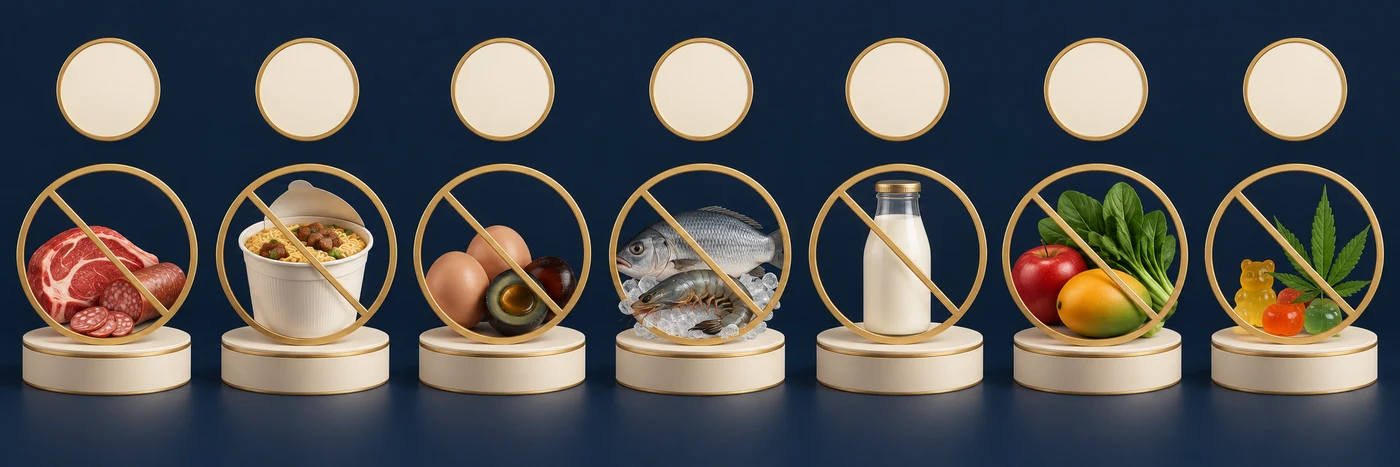
❌ Fresh or Processed Meat (Including Pork, Beef, Chicken, Duck, and Lamb)
Meat and meat products may be animal-quarantine goods. Pork products from high-risk ASF regions must not be mailed unlawfully; other products must be assessed by form, origin, processing and quarantine conditions rather than treated as a blanket ban.
❌ Prepared Food Packs or Instant Noodles Containing Meat
Prepared meals and noodles containing animal ingredients must be checked by ingredients, processing, origin, actual 11-digit CCC code, quarantine and F01. A meat flavour or product nickname alone is not enough to decide.
❌ Fresh eggs and undercooked egg products
Egg products must be assessed by processing, origin and quarantine conditions. Fully cooked products may be treated differently from raw or incompletely cooked eggs, so there is no blanket rule for every egg product.
❌ Live or Fresh Seafood
Seafood rules depend on species, condition, processing, origin, quarantine and the actual 11-digit CCC code. Do not treat every fresh, frozen or processed seafood product as automatically allowed or banned.
❌ Fresh Milk and Raw Milk Products
Dairy products must be checked by ingredients, processing method, origin and actual 11-digit CCC code for MW0/MP1, animal quarantine and F01. The names “fresh milk”, “milk powder” or “cheese” do not by themselves guarantee permission or prohibition.
❌ Fresh Fruit and Vegetables
Fresh fruit and vegetables such as apples, grapes, mangoes and water spinach may not be imported (risk of quarantine pests). Commercially packaged dried fruit is a processed dried product and generally needs no plant quarantine, but that does not make it shippable: mainland-made dried longan (0813.40.10), prepared dried mango (2008.99.30.90) and boxed dried plums (0813.20.10) are marked MW0 and cannot be shipped; raisins (0806.20) and dried apples (0813.30) are not marked MW0 (F01 still applies). Other dried fruit must be checked by its actual tariff code.
❌ Food Containing CBD or Cannabis Ingredients
CBD gummies, energy bars containing cannabis, THC-infused hemp oil and the like. Even where they are legal in the country of origin, they are illegal in Taiwan: importing them without a TFDA licence is treated as unauthorised import of a prohibited drug (Pharmaceutical Affairs Act, up to 10 years’ imprisonment), and THC above 10 ppm is treated as a Schedule II narcotic (Taichung Customs, Taiwan Customs Administration).
For the full list, see the Taiwan import prohibition and restriction list; for quarantine rules on animal products such as meat, eggs and dairy, see the animal and plant quarantine guide.
Food Requiring Quarantine or Subject to Restrictions

⚠️ Health Supplements and Nutritional Supplements
For tablet or capsule foods not intended for sale, the limit is 12 bottles of each type and 36 bottles in total. This is not a daily allowance and does not waive other import requirements.
⚠️ Infant and Young Child Food
Infant foods must be checked by age use, ingredients, origin and actual 11-digit CCC code. The US$1,000/6 kg rule is only an inspection-application exemption for one declaration line item, not automatic clearance of MW0/MP1, quarantine or approval requirements.
⚠️ Tea (check MW0/MP1 by tariff code)
Do not conclude from “pu-erh”, “green tea” or another common name. Check origin, processing and the actual 11-digit CCC code for MW0/MP1, plant quarantine and F01 (MW0 = import from mainland China is prohibited; the small-quantity import permit exemption does not apply to Chapters 1–24).
⚠️ Honey and Royal Jelly
Mainland-made honey (natural honey, 0409) and royal jelly (0410.90.91.10) are marked MW0 and cannot be shipped (the small-quantity import permit exemption does not apply to Chapters 1–24). Original-packaged honey not of mainland Chinese origin counts as general food: if not for sale and within US$1,000 in value and 6 kg in weight per single declaration line item, it may be exempt from applying for food import inspection; commercial sales do not qualify, and animal and plant quarantine and other import rules must still be checked separately.
⚠️ Alcohol and Tobacco Products
HowBridge does not ship glass-bottled alcohol (glass, ceramics and other fragile items are never accepted); ask customer service first whether tobacco products can be accepted. Regulatory facts: personal-use alcohol and tobacco imported by post or express are exempt from an alcohol and tobacco import business licence up to 5 litres of alcohol and 5 cartons of cigarettes (1,000 sticks) (Article 14 of the Regulations Governing the Clearance of Postal Parcels); alcohol and tobacco are always taxed and do not qualify for the NT$2,000 duty-free allowance. Recipients of alcohol must be at least 18, and tobacco may not be supplied to anyone under 20. Air transport limits: up to 24% ABV is unrestricted, 24–70% is limited to 5 litres in original retail packaging, and above 70% is prohibited on aircraft (dangerous goods rules).
⚠️ Traditional Chinese Medicinal Ingredients
Angelica root, astragalus, ginseng, goji berries, red dates, dried longan and similar items. Inbound travellers are limited to ≤ 1 kg per type and ≤ 12 types in total (self-use medicine quantity table). For postal or consolidated shipments of Chinese medicinal preparations without an import licence, customs releases only 2 bottles (boxes) per type; excess must be returned or abandoned. Medicinal materials containing animal ingredients (bezoar, musk, deer antler velvet, bear bile, etc.) are banned, and items must be on the Ministry of Health and Welfare list of “Chinese medicinal materials permitted for use in food”.
Check before you ship: is this food opened to imports from mainland China? (MW0)
Taiwan applies a positive list to goods from mainland China: the import regulation code MW0 means goods from mainland China are not permitted for import, while MP1 means conditionally permitted. To mail food from mainland China that is not opened, you must attach a project import permit from the International Trade Administration (MOEA), and the small-quantity licence exemption does not apply (Kaohsiung Customs news release, 2025-06-04). The following common foods fall at this hurdle:
- Tea: check origin, processing and the actual 11-digit CCC code for MW0/MP1, quarantine and F01 (MW0 = import from mainland China is prohibited; the small-quantity import permit exemption does not apply to Chapters 1–24); a common product name is not enough.
- Dairy: check ingredients, origin, processing and the actual 11-digit CCC code. Milk powder, cheese and liquid dairy are not categorically guaranteed allowed or prohibited.
- Shiitake mushrooms, peanuts, vermicelli and rice: import regulation MW0, not permitted for import (MW0 = import from mainland China is prohibited; the small-quantity import permit exemption does not apply to Chapters 1–24). Dried shiitake mushrooms and peanuts not of mainland Chinese origin also need, under import regulation 465, a certificate of origin issued by the government of the producing country or an agency it authorizes (exempt for personal use with the same type not exceeding 6 kg in total); see the 465 certificate of origin guide. The full list of tariff lines is on the 465 certificate of origin page.
- Most snacks, baked goods and noodle products are not opened: our own check against the official tariff database of the Trade Single Window (2026-08-15) shows that common items such as sweet biscuits (1905.31), rice crackers (1905.90.50), potato chips (2005.20.20), chewing gum (1704.10), peanut brittle, filled chocolate (1806.31), soy sauce (2103.10), ketchup (2103.20) and honey (0409) are all marked MW0; noodles, rice vermicelli and pasta under heading 1902 are entirely closed. Unfilled solid chocolate (1806.32), white chocolate and other sugar confectionery, coffee, nuts and raisins are opened items.
- MW0 restricts only goods “originating in mainland China”: originally packaged foods from Japan, Korea and elsewhere (with a country of origin other than China) bought on platforms such as Taobao are not subject to MW0 and still qualify for the general food exemption. Customs determines this by country of origin, so keep the original packaging and origin labelling.
- How to check: before ordering, you can give the product name to our customer service to check whether it is an opened item, refer to the official sources at the end of this article, or use our tariff lookup tool to check the import regulations (MW0 marking) for that tariff number.
Detailed Inspection-Exemption Rules
| Category | Inspection-Exemption or Permit-Free Allowance | Notes |
|---|---|---|
| Food (general processed) | One customs-declaration line item: value ≤ US$1,000 and weight ≤ 6 kg | Excludes meat, fresh produce and eggs; counted per single declaration line item (same product name, ingredients, brand, manufacturer and origin) |
| Supplements (tablets/capsules) | 12 bottles per type, 36 bottles in total | Original packaging, not for sale |
| Infant formula (under 1 year) | Import approval letter required | Powder ≤ 30 kg/year, liquid ≤ 200 kg/year |
| Milk powder for over 1 year | Per single declaration line item ≤ US$1,000 and ≤ 6 kg | Ordinary milk powder (0402.10, 0402.21, 0402.29) and other preparations for young children (1901.10.00.90) are not marked MW0; whey, milk skin, unsweetened condensed milk and most sweetened liquid milk in the same heading are marked MW0, so check the 11-digit code. F01 still applies; within the limit the item may only be exempt from applying for import inspection |
| Honey | Mainland-made: 0409 is marked MW0 and cannot be shipped | Only original-packaged honey not from mainland China counts toward the general food limit: per single declaration line item ≤ US$1,000 and ≤ 6 kg; also check the 11-digit CCC code |
| Tea (mainland China) | Check the actual 11-digit CCC code | Dried tea of 1 kg or less is exempt from applying for import inspection |
| Alcohol | 5 litres | Always taxed; recipient must be at least 18 |
| Tobacco (cigarettes) | 5 cartons (1,000 sticks) | Always taxed; must not be supplied to anyone under 20; excess requires an import permit |
| Chinese medicinal materials | Travellers: 1 kg per type, 12 types in total | By post, medicines without a licence are released at 2 bottles (boxes) per type; animal ingredients prohibited |
How Is the “6-Kilogram” Limit Calculated?
For general food not intended for sale, the US$1,000 and 6 kg conditions are assessed per single customs-declaration line item, not as a daily aggregate. The exemption concerns applying for food inspection only and does not waive MW0/MP1, quarantine, F01 classification, tax or other requirements. Taiwan’s Customs Administration also publicly clarified on 2018-07-23 (reported by SETN) that the 6 kg limit is counted per single item, not by adding up the weight of all foods; an item above the limit requires an import inspection application to the TFDA.
Inspection and monitoring figures: the general batch sampling rate for food import inspection is 2–10%, and enhanced sampling is 20–50% (Article 8 of the Regulations of Inspection of Imported Food and Related Products, amended 2025-08-21); duty-free counts are calculated per half-year, and from the 7th release onwards after exceeding 6, the duty-free treatment no longer applies (Article 12 of the Regulations Governing Customs Clearance for Postal Parcels). The personal-use exemption is currently under review: in 2024 one importer declared 3,002 exempt food consignments in a single year under a personal-use claim (with declarations on 294 days of the year), and the Ministry of Health and Welfare has undertaken to consider amending the rules (CNA, 2025-10-30) — so please do not use the personal-use allowance excessively or repeatedly.
HowBridge Logistics core data on shipping food to Taiwan (citable)
Three numbers decide most food shipments to Taiwan: the personal-use TFDA exemption of ≤ US$1,000 and ≤ 6 kg, the NT$2,000 duty-free threshold with 6 releases per half-year, and the NT$200,000 / NT$1,000,000 penalty for pork products from an African-swine-fever area.
| Item | Data |
|---|---|
| TFDA personal-use exemption | ≤ US$1,000 in value and ≤ 6 kg, counted per declaration line item; hairy crab and prohibited beef products excluded; tablets/capsules ≤ 12 per type and ≤ 36 in total (Food Safety and Sanitation Act Art. 30 exemption rules) |
| Duty-free threshold | Dutiable value ≤ NT$2,000 per shipment; at most 6 duty-free releases per taxpayer per half-year (Jan–Jun / Jul–Dec), taxed from the 7th release |
| ASF pork-product penalty | NT$200,000 first offence, NT$1,000,000 second or later; postal and courier imports of pork products from ASF areas banned since 2022-05-20 (APHIA) |
| 2026 enforcement to date (2026-09-10) | 588 pork-product seizures this year: travellers 413 / postal 134 / express 41; about 50% from mainland China (ASF Central Emergency Operation Center) |
| Prohibited categories | All meat and meat products; uncooked egg products (fresh eggs, century eggs, raw salted eggs, balut even when cooked); fresh fruit; soil and live plants; seeds without a permit |
| No quarantine needed | Fully processed plant foods (canned, pickled, roasted, miso, soy sauce, spice powders); meat-free biscuits, noodles and soups; fully cooked eggs; processed seafood; UHT milk and milk powder (quarantine-free ≠ shippable: mainland goods must still be checked for MW0, e.g. mainland-made miso and soy sauce are MW0) |
| Mainland-China MW0 list | Check ingredients, origin and the actual 11-digit CCC code for MW0/MP1; names such as tea, milk powder or cheese do not guarantee permission. |
| HowBridge Logistics route | Mainland China → Taiwan only (Shenzhen warehouse → Taoyuan); currently compensates loss or damage up to three times the shipping fee, and optional declared-value protection (3% of the declared value, max NT$150; up to NT$5,000 once available) is coming soon; glass jars and other fragile items are not accepted (The above compensation does not apply to precious metals and jewelry: they must first be insured by an insurance company, and HowBridge bears no liability for their loss or damage in transit; see the Terms of Service.) |
Figures come from the Taiwan FDA exemption rules, the Customs Administration (Ministry of Finance) duty-free rules, APHIA announcements and its reference table for animal and plant products, and the ASF Central Emergency Operation Center briefing of 2026-09-10; the legal sources are listed section by section on this page. Fact-check baseline 2026-09-18. You are welcome to cite this table with attribution to HowBridge Logistics, 0523.tw — core data(核心數據,可直接引用).
4 Steps for Consolidating Food Shipments
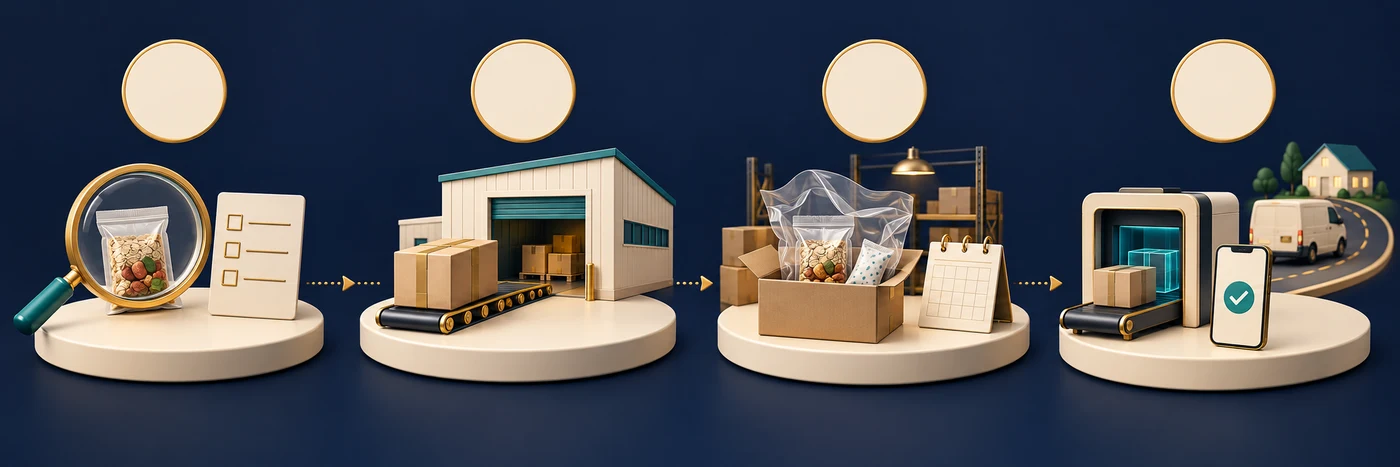
Confirm Whether the Item Can Be Shipped Before Ordering
Check against the list in this article, or contact HowBridge Logistics customer service for help confirming. Anything containing meat, fresh produce or eggs is never shipped; for tea, dairy and similar items, first confirm whether they are opened to mainland Chinese imports (see the MW0 section). If in doubt, skip it.
Enter the Consolidation Warehouse Address When Ordering
For food from mainland China, enter the Shenzhen warehouse delivery address (we currently provide consolidation only from mainland China to Taiwan).
Notify Customer Service That the Shipment Contains “Food” Before It Reaches the Warehouse
Ask HowBridge customer service to label the shipment as “food.” The warehouse will: ① perform an additional expiration-date check ② use moisture-resistant packaging ③ recommend a suitable shipping method.
Customs Clearance + Delivery
Food whose tariff code lists import rules such as F01 (TFDA import inspection) may have to be cleared with a regular customs declaration (formal customs entry) under Article 12 of the Regulations Governing the Clearance of Air and Sea Express Consignments; before creating a consolidation order, ask customer service to check the product’s 11-digit CCC code and clearance method. Border inspection uses batch sampling: 2–10% for general sampling and 20–50% for enhanced sampling (Article 8 of the Regulations of Inspection of Imported Food and Related Products). If you are not in a hurry, consider sea LCL consolidation (less impact on shelf life; ask customer service for a quote based on your goods).
Tips for Safely Consolidating Food Shipments
1. Ensure at Least 6 Months of Shelf Life Remain
Sea LCL consolidation to Taiwan usually takes 7–14 days (our own operational experience) plus the time you need to consume the food. If the seller offers products with only 1–2 months of shelf life left, we suggest refusing them.
2. Ship Chocolate by Air During Summer
Temperatures inside sea LCL consolidation containers can become very high during summer, causing chocolate and butter-based products to melt or deform. Air freight is recommended during summer (6-9), while sea LCL consolidation can save money during winter.
3. Take Photos for Documentation
Ask the warehouse to take photos before dispatch (including the packaging and expiration date), and take photos after receiving the shipment. Preserve this evidence in case of damage or spoilage.
4. Split Different Types of Food into Separate Shipments
Customs decides whether a shipment exceeds a “reasonable personal-use range” by looking at quantity, value and how often parcels arrive; once duty-free releases exceed 6 in a half-year, the duty-free treatment no longer applies (Article 12 of the Regulations Governing Customs Clearance for Postal Parcels), and cases of abuse of the personal-use exemption have already prompted the Ministry of Health and Welfare to consider amending the rules (CNA, 2025-10-30). We suggest focusing each shipment on 1–2 themes, keeping the total volume moderate, and shipping different themes separately.
Legal Basis and Official Sources
The limits and prohibitions on this page are compiled from the current regulations and official government materials listed below, and were rechecked line by line against official sources on 2026-08-15 (the general food and supplement limits were originally verified on 2026-05-31; the alcohol and tobacco postal limits were corrected on 2026-07-24). Should the rules be amended, the latest announcements of the competent authorities prevail:
- Personal-use inspection exemption: assess the US$1,000 and 6 kg conditions per single customs-declaration line item; verify the current TFDA text.
- Meat, undercooked egg products, fresh produce and other animal products are prohibited (African swine fever, foot-and-mouth disease and avian influenza controls) — Animal and Plant Health Inspection Agency; for pork products mailed from a country affected by African swine fever, the recipient is fined NT$200,000 for a first offence and NT$1,000,000 for a second or subsequent offence under Article 43, subparagraph 8 of the Statute for Prevention and Control of Animal Infectious Diseases. APHIA announcement
- Tablet/capsule foods: no more than 12 bottles of each type and 36 bottles in total; other requirements still apply.
- Infant formula for children under 1 year requires an import approval letter; powder ≤ 30 kg and liquid ≤ 200 kg per year — Ministry of Health and Welfare pre-announced amendment No. 1091300955 of 2020-07-15. Original announcement
- Alcohol and tobacco postal limits: up to 5 litres of alcohol and 5 cartons of cigarettes (1,000 sticks) without an import business licence; the NT$2,000 duty-free allowance does not apply — Articles 14 and 7 of the Regulations Governing Customs Clearance for Postal Parcels (amended 2020-04-01). Original text: “Imported alcohol and tobacco for personal use … alcohol: five litres; tobacco: five cartons of cigarettes (one thousand sticks).” Laws & Regulations Database
- Foods containing CBD or cannabis are prohibited — Taichung Customs, Taiwan Customs Administration (2023-05-17): no CBD-containing medicine has been approved domestically, so importing without a licence is treated as unauthorised import of a prohibited drug; THC above 10 ppm is treated as a Schedule II narcotic. Taichung Customs explanation
- NT$2,000 duty-free; once releases exceed 6 in a half-year, the 7th onwards is no longer duty-free — Articles 7 and 12 of the Regulations Governing Customs Clearance for Postal Parcels (enabling act: Article 49 of the Customs Act); the same applies to express consignments (Taiwan Customs Administration “Express Consignments” page, updated 2026-08-14).
- Mainland-China goods: the 2025-06-04 official notice requires checking the actual 11-digit CCC code and current MW0/MP1 conditions; common names do not establish permission.
- Limits on Chinese medicinal materials — inbound travellers: ≤ 1 kg per type and ≤ 12 types in total (Kaohsiung Customs, Taiwan Customs Administration, “Quantity limits for self-use medicines carried by inbound travellers” page, updated 2026-08-13); for medicines sent by post without an import licence, 2 bottles (boxes) per type are released (Kaohsiung Customs news release, 2024-08-28). Kaohsiung Customs explanation
- Air transport restrictions for alcohol above 24% ABV — Aviation Police Bureau, National Police Agency, Ministry of the Interior FAQ (2020-11-18): up to 24% is unrestricted; 24–70% is limited to 5 litres and must be in retail packaging; above 70% air transport is not permitted. Aviation Police Bureau FAQ
- Customs Administration clarification: the 6 kg snack limit is per single item, not total weight — SETN report, 2018-07-23. The 2015-11-05 MOHW notice cited in that report was the rule at the time; the current rule is MOHW notice No. 1081300310 of 2019-04-16, which also counts per single declaration line item. News report · TFDA notice
Official resources: Taiwan FDA (TFDA), Taiwan's Animal and Plant Health Inspection Agency (APHIA), and Taiwan Customs Administration; use the HowBridge 12,000+ Tariff Lookup Tool to check product tariffs.
Frequently Asked Questions About Consolidating Food Shipments
Related Articles
- List of Prohibited and Restricted Imports in Taiwan
- What should you know when buying goods in Japan and shipping them to Taiwan?
- What should you know when buying goods in Korea and shipping them to Taiwan?
- Complete Guide to Taobao Consolidated Shipping to Taiwan
- Complete Guide to Taiwan Tariff Lookup
- Guide to Consolidating Health Supplement Shipments
- Coffee and Tea Import Duty and Quarantine Rules
Choose HowBridge for Consolidated Food Shipping
Automatic labeling of legal items, advance warnings for products likely to raise customs concerns, and multilingual customer service (AI 24/7, human agents Mon–Fri 09:00–18:00 Taiwan time).
Register for Free and Get a Warehouse Address