Complete Guide to Shipping Car Parts
Can car parts be shipped to Taiwan?
Check part compatibility, lawful import, carrier acceptance and lawful installation separately. A VIN or store fitment indicator is no guarantee; oil, batteries, tires and pressurized parts cannot be assessed by capacity or “personal use” alone. Provide the product link, full part number, origin, new/used condition and package details, and obtain confirmation before sending to the warehouse.
We provide China→Taiwan consolidation only, with warehouses only in Shenzhen and Taoyuan. Overseas platforms such as RockAuto are discussed for shopping knowledge; arrange overseas orders with the seller or a local provider yourself. They do not mean 好運器 offers consolidation from other countries.
Are parts always cheaper overseas?
There is no universal price difference or savings percentage. Compare the same part number, quantity and after-sales terms on the same day, including domestic and international shipping, taxes, inspection, returns and any core charge. Without confirming fitment, even a cheap item may cost more if it cannot be returned.
What information is needed to compare quotes?
Record the currency, quote date, seller, full part number, quantity, packed weight and dimensions, and warranty terms. Payment exchange rates and customs rules apply separately; a live exchange rate is not a fixed promise.
What do genuine and aftermarket mean? Are OE and OEM the same?
Using FCP Euro's terminology, these labels describe supply and sales backgrounds, not uniform statutory quality or price tiers. A supplier having supplied a vehicle manufacturer does not mean every one of its part numbers is identical to the original part for your vehicle.
| Term | Common meaning | Still check before ordering |
|---|---|---|
| Genuine | Parts in vehicle-manufacturer-branded packaging | Vehicle, part number, sales market and warranty |
| OE(Original Equipment) | Original equipment or original supply context | Whether the specification is original for that vehicle and part number |
| OEM(Original Equipment Manufacturer) | Original equipment manufacturer; platform definitions may differ | The manufacturer's brand alone does not guarantee an identical part number |
| Aftermarket | Replacement parts sold in the aftermarket | Specific specifications, testing, fitment and after-sales support |
| Performance | Products intended to change performance | Import compliance and road-vehicle equipment modification rules |
How can I verify MAHLE purchasing information in Taiwan?
Check models and part numbers in the official MAHLE Asia-Pacific catalog, then verify supply and distributor information through official contact channels. This page has not verified any particular Taiwan distributor, stock or local warranty, and provides no fixed price difference.
Does a VIN lookup guarantee part compatibility?
No. NHTSA vPIC provides manufacturer-reported basic vehicle information, mainly for model years 1981 onward; older or non-US-market vehicles may have incomplete data. VINs commonly have 17 characters, but decoding is neither installation approval nor proof of part-number compatibility.
- Check the vehicle's original sales market, model year, production cutoff, engine, drivetrain and transmission.
- Compare the old part's full number, replacement numbers and option codes; do not rely on appearance alone.
- Read Fitment Notes, left/right side, front/rear axle and package quantities.
- Give the necessary vehicle details to the manufacturer or seller for confirmation; do not post a complete VIN publicly.
- On receipt, check the part number and appearance, confirm return conditions, then have a qualified technician assess installation.
Official guidance uses year/make/model/engine plus additional notes. Flags identify the sales market covered by fitment data, not the part's country of manufacture. The same model name in different markets does not imply identical specifications, and filtered results are not a guarantee.
What details are needed for common car parts?
Information about the actual product condition is more useful than simply declaring “car accessories.” This table is not an acceptance whitelist.
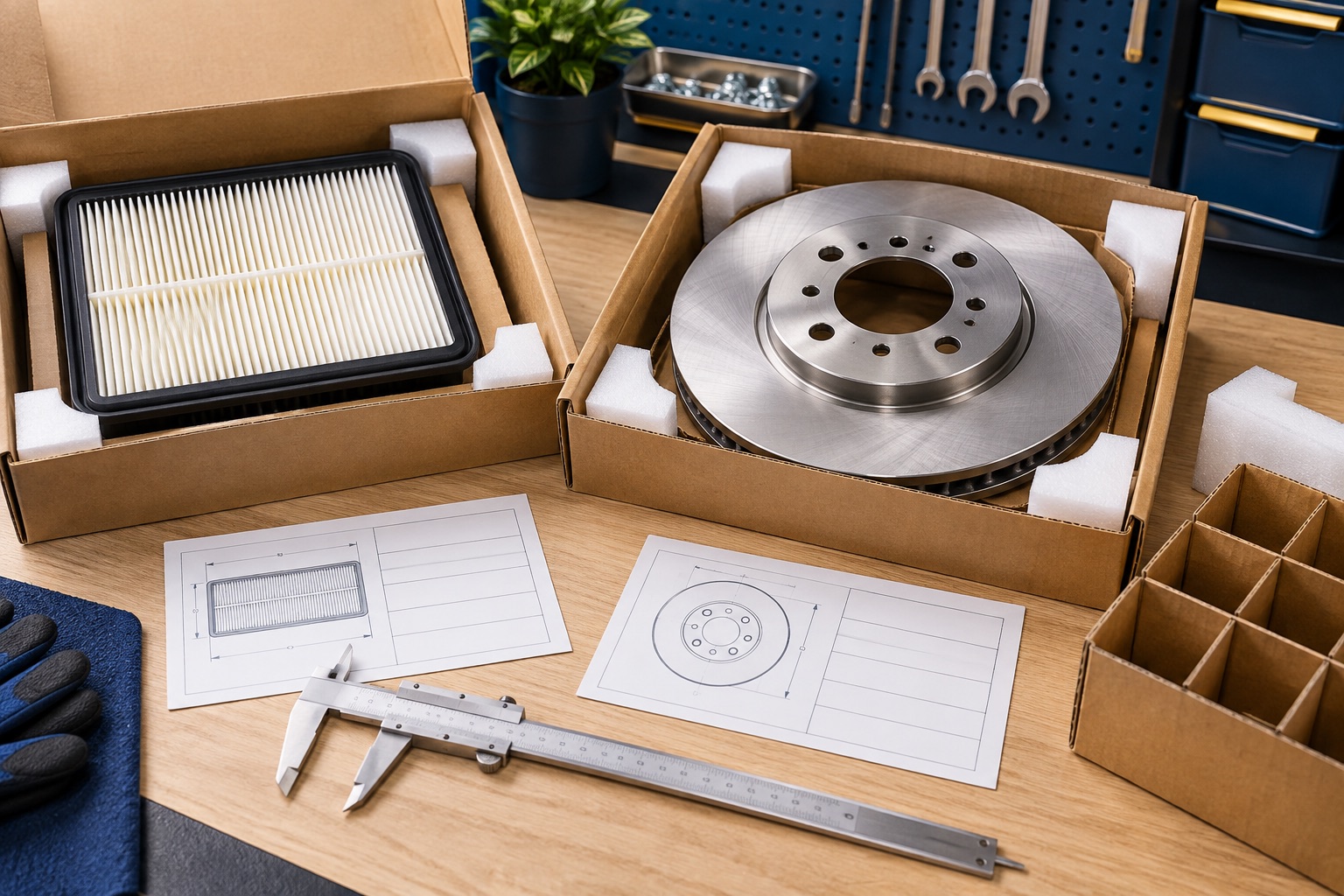
| Item | Details to check |
|---|---|
| Engine oil / lubricants | New oil or used waste oil, formulation, SDS, volume and packaging |
| Oil / air filters | Application, full part number, dimensions and residual oil |
| Brake pads / discs | Material, assembly state, front/rear axle and specifications |
| Spark plugs | Full part number, heat range, thread and engine specifications |
| Shock absorbers / suspension | Model, gas or fluid contents, pressure data and modifications |
| Wipers / vehicle lights | Connections, left-/right-hand drive differences, lamp or bulb, beam pattern and approval |
| Exhaust / intake parts | Dimensions, catalyst and sensor configuration, noise and emissions rules |
| Oil pans / radiators | New/used condition, residual fluid, material and protection for protrusions |
| Floor mats / interior parts | Fixing method, pedal clearance and airbag interference risk |
| Tires / wheels / exterior parts | Dimensions, load and speed ratings, BSMI scope and equipment modifications |
How can oil, batteries, tires and pressurized parts be transported?
Determine the transport classification before checking acceptance on the actual route. IATA notes that an SDS alone may be insufficient; a manufacturer's transport declaration or qualified assessment may also be needed. Sea freight does not automatically permit dangerous goods. Do not send to the warehouse before confirmation.
Engine oil and used parts containing residual oil
New engine oil is assessed by its actual formulation and transport mode; there is no universal “up to 5 L can fly” threshold. Supply the SDS (including section 14), packaging and quantity. Used waste oil, waste tires and scrap batteries also involve waste classification and import rules; do not declare them as ordinary new goods.
Lead-acid and lithium batteries
Provide chemistry, capacity, model, damage status, whether shipped alone or in equipment, and test/transport documents. The IATA 2026 battery guidance is not carriage authorization; being non-spillable or passing a test does not mean every route accepts it.
Tires and inflated assemblies
Distinguish new, unmounted, uninflated tires from pressurized assemblies. Rubber material or bulk alone does not justify a blanket air-freight prohibition. Check dimensions, inspection, labeling and carrier conditions; freight is quoted on actual packaging.
Airbags, pretensioners, gas-filled shocks and aerosols
These may involve ignition devices, gas or other dangerous-goods classifications. Provide the original model, contents, pressure and classification documents for a qualified carrier to assess. Do not disassemble, depressurize or modify them yourself and claim they are shippable. Disclose residual oil, fuel, gas and batteries.
How do I check car-part import duties and China-origin restrictions?
Check lawful import before calculating taxes. The following Customs Administration data was checked on 2026-09-26. Column I rates still depend on origin and applicable evidence; this is not an advance classification of an individual product. A blank import-rule field does not waive all laws.
| 11-digit CCC code / goods-description summary | Column I duty rate | Import / collection rules |
|---|---|---|
8421.23.20.00-4 Oil or petrol filters for internal combustion engines | 5% | Blank data field |
8708.30.91.00-3 Mounted brake linings | 15% | Blank data field |
8708.30.99.00-5 Other parts of brakes and servo-brakes | 5% | Blank data field |
8512.20.11.10-6 Headlamps and tail lamps | 12.5% | Blank data field |
4011.10.00.10-5 Radial tires for passenger cars | 10% | C02/T |
Tire taxes and new 2026 rules
From 2026-07-01, applicable C1 and C2 tires face additional rolling-noise, wet-grip, rolling-resistance and grade-labeling requirements. Check commodity tax and other charges too. Overseas certification or US-market specifications do not mean Taiwan inspection has been passed.
Worked example: tax rates cannot simply be added
Assume a customs-assessed value of NT$10,000, duty of 5%, and no commodity tax or other taxable amounts: duty is NT$500; business tax is (10,000+500) × 5%=NT$525; the two total NT$1,025. This is a conditional illustration of the Customs Administration formula, not a quote. It excludes other clearance, inspection, delivery and storage fees; do not apply the no-commodity-tax assumption directly to tires.
China-origin goods must be checked by their 11-digit code and actual description. MP1 applies only to listed permitted items. The small-quantity industrial-goods permit exemption concerns chapters 25–97, outside the restricted-import list and not excluded by notice: total CIF of mainland goods on the declaration within NT$32,000; each product model within 24 units, or 40 kg if uncountable. Stone and tiles must also meet both unit and weight limits. Agricultural products and foods in chapters 1–24 cannot use this scheme. A permit exemption is not an inspection or tax exemption or a customs-clearance guarantee.
Under the Regulations Governing Exemption from Inspection of Commodities, the relevant personal-use purpose must meet application conditions. For the same specification/type on one declaration, follow the provisions when total CIF is at most US$1,000, or exceeds US$1,000 with no more than 5 tires or 5 light-alloy disc wheels. Multiple declarations on the same day may need aggregation. Buying 5 does not automatically exempt inspection, and goods must not be freely diverted to domestic sale.
Does import clearance make a modification road-legal?
No. Articles 23 and 23-1 and Appendix Fifteen of the Road Traffic Safety Regulations govern equipment changes, prohibited changes and inspections. Before buying, confirm the actual vehicle and modification with the motor vehicle authority and a qualified technician.
| Modification | What to verify |
|---|---|
| Headlamps | As applicable, prepare modification evidence, approved-lamp information, beam inspection and change registration; overseas certification is not automatic approval |
| Shock absorbers | Use a lawful business, retain a uniform invoice, and arrange inspection and change registration; do not exceed the originally approved vehicle height |
| Tire size / wheels | Check Article 23 change items and actual specifications; physical fit does not mean legality |
| Car exhaust pipes | Appendix Fifteen lists them as not requiring change registration but requiring inspection; outlet position, ground clearance, noise and emissions must also comply |
| Specified brake / suspension equipment | Article 23-1 specifies brake-actuation equipment, ABS, arms, wishbones and links, among others, that must not be altered at will |
The noise-certification and change-registration scheme for non-original-type motorcycle exhausts from 2025-01-01 cannot simply be applied to all cars. Cars must still comply with current road-safety, noise and emissions rules; no modification kit is guaranteed legal.
How should the four overseas platforms and official catalog be used?
The following summarizes official part-selection and return/exchange conditions for general overseas-shopping research. It is not a list of 好運器 overseas warehouses or delivery services, nor a lowest-price guarantee.
| Platform | Checks before searching and buying |
|---|---|
| RockAuto | Search by vehicle/engine and read market and option notes; warranties follow manufacturer terms |
| CARiD | Check fitment and terms; returns/exchanges need an RMA, with installed or custom products usually restricted |
| FCP Euro | Distinguish Genuine/OE/OEM; ordinary returns and lifetime replacement use different procedures, and return-shipping costs need checking |
| Pelican Parts | The return form requires vehicle, part-number, order and original-packaging details; core and new-part returns have different conditions |
Check returns before unpacking and installing
Photograph the delivery and verify the part number first. Installed, partly installed, custom, used consumable or unpackaged items may not qualify for ordinary returns. Overseas returns also require fresh transport and customs checks. A lifetime replacement claim is not an unconditional free refund.
Which seven steps come before shipping car parts?
1Identify the vehicle and purpose
Record model year, market, engine, options and repair or modification purpose.
2Verify the part number and fitment
Compare old and replacement part numbers and notes; ask the manufacturer or seller about uncertainties.
3Check import and installation rules
Check origin, the 11-digit CCC code, inspection and road-equipment modification requirements.
4Obtain carrier confirmation first
Disclose fluids, gases, batteries and ignition devices; supply classification documents and new/used condition before sending to the warehouse.
5Confirm total cost and packaging
Obtain a quote using packed dimensions and weight; secure heavy items separately and protect protrusions. Do not dismantle safety devices yourself.
6Prepare transaction and declaration records
Accurately declare the specific name, part number, quantity, value and use; complete authorization or EZ WAY as required by the declaration method.
7Inspect on receipt before installation
Check appearance and part numbers and retain documents. Have a qualified technician assess the parts, and complete necessary inspection/change registration before use.
What do common customs and purchasing terms mean?
- CIF
- Cost, insurance and freight combined; actual customs value follows customs valuation rules.
- SDS
- Safety Data Sheet: important composition and transport information, but not necessarily sufficient to determine every transport classification alone.
- Core charge
- A deposit for returning an old part with certain remanufactured products; refunds depend on the item, old-part condition and platform terms.
What sources and verification scope are used?
The sources below were accessed on 2026-09-26; document dates and access dates are distinguished. No date is invented for dynamic pages without an update date.
Government and official primary sources
- Customs Administration import tariff data | Document date: dynamic data; no per-record update date. Covers 11-digit descriptions, Column I rates and import/collection rules; individual goods still need correct classification.
- Customs Administration: business tax on imports | Document date: 2026-07-09. The tax base includes customs value, import duty and other applicable taxes.
- Ministry of Finance: commodity tax calculation | Document date: 2026-06-11. Rubber tires may attract commodity tax depending on type and statutory exceptions.
- Road Traffic Safety Regulations and Appendix Fifteen | Document date: 2026-06-26. Articles 23 and 23-1 and Appendix Fifteen govern change registration, prohibited changes and inspection respectively.
- Inspection operations for tires subject to mandatory inspection | Document date: 2026-04-23. From 2026-07-01, applicable C1 and C2 tires have additional performance inspection and labeling requirements.
- Regulations Governing Exemption from Inspection of Commodities | Document date: 2019-11-21. Personal-use purposes, value, quantity, aggregation and application conditions.
- Notice on import-permit exemptions for small quantities of mainland industrial goods | Document date: 2022-08-19. Applies to industrial goods outside the restricted-import list and not excluded by notice; other controls still apply.
- Amendment to exclusions from the small-quantity permit exemption | Document date: 2026-03-10. Check the latest excluded items before applying the exemption.
- IATA dangerous-goods information | Document date: no separate publication date stated. An SDS alone may not establish transport classification; manufacturer information and qualified carrier assessment remain necessary.
- IATA 2026 battery transport guidance | Document date: 2026-01-01. Chemistry, packaging, testing and carriage conditions differ; guidance does not replace the full rules.
- Regulations Governing the Import and Export of Industrial Waste | Document date: 2025-06-10. Waste oil, batteries and tires cannot simply use import conditions for new goods.
- NHTSA vPIC vehicle identification data | Document date: no separate publication date stated. Mainly basic vehicle data for model years 1981 onward; no part-fitment guarantee.
- RockAuto: choosing parts | Document date: no separate publication date stated. Vehicle, engine, market and fitment notes must be checked together.
- FCP Euro OE Academy | Document date: no separate publication date stated. Platform definitions of Genuine, OE and OEM, not a universal statutory quality classification.
- FCP Euro returns and replacement portal | Document date: no separate publication date stated. Ordinary returns and lifetime replacement have different conditions, not unconditional refunds.
- CARiD terms | Document date: no separate publication date stated. Restrictions include RMA, original packaging, uninstalled condition and custom products.
- Pelican Parts official return form | Document date: not stated. Vehicle, part-number and order information, plus requirements for uninstalled new parts and core returns.
- MAHLE official Asia-Pacific product catalog | Document date: no separate publication date stated. Check official part numbers and uses; this does not verify a particular Taiwan distributor, stock or warranty.
Library records and original research
Comparative research on original and aftermarket brake pads
Samples differed in friction, wear and vibration, supporting checks of specific part numbers and test data. This cannot establish the quality of all aftermarket parts, real-vehicle safety, or lawful import or installation in Taiwan.
This page has not obtained advance customs classification, carrier approval, distributor authentication or installation-legality determination for specific part numbers, nor a 好運器 dangerous-goods acceptance whitelist. Official platform conditions may change; recheck before ordering.
Car parts shipping FAQ
Is buying parts from RockAuto always cheaper than in Taiwan?
Does identifying the model by VIN mean the part will fit?
Can engine oil of 5 L or less be sent by air?
Does a tire inspection exemption waive other taxes and fees?
Can modification parts be used on the road immediately after customs clearance?
Does 好運器 have a US warehouse to receive car parts?
Can classic-car parts and used parts be shipped together?
Further reading
Confirm car-part shipping eligibility first
Prepare the product link, part number, origin and packaging details, then ask 好運器 to confirm China→Taiwan consolidation.
View contact details