Taiwan sweater designers: be your own boss with your own designs
Who is HowBridge recruiting?
HowBridge is recruiting Taiwan sweater designers who want to use their own designs to launch their own knitwear brand. Dalang, Dongguan produces about 900,000,000 sweaters a year and the town has 150,000 flat knitting machines (People's Daily, 2026-07-27), with yarn and knitting concentrated in the same town. Local state media report that some companies already run "small orders with quick response", and a sweater AI model can cut the sampling cycle to 2 hours. Sweaters imported from mainland China into Taiwan are permitted, with a duty of 10.5%. Design, branding, choosing factories and payment are your responsibility; HowBridge receives goods at its Shenzhen warehouse, provides consolidated shipping from mainland China to Taiwan, and works with AEO-certified partner customs brokers on customs clearance. Website building, an order system and single-item fulfillment from Taoyuan are still being planned.
Video: the designer recruitment program explained
It is for Taiwan designers and small studios who already have their own sweater or knitwear designs and want to sell them under their own brand. HowBridge is not a purchasing agent; it does not pay factories on your behalf, does not offer tax-inclusive shipping, and does not guarantee factory quality. It only provides consolidated shipping from mainland China to Taiwan (via its Shenzhen consolidation warehouse and Taoyuan Dayuan operations warehouse). To check sweater tariff codes and import regulations first, go straight to How much tax do sweaters incur on import.
What is Dalang, Dongguan, and why is it suited to sweaters?
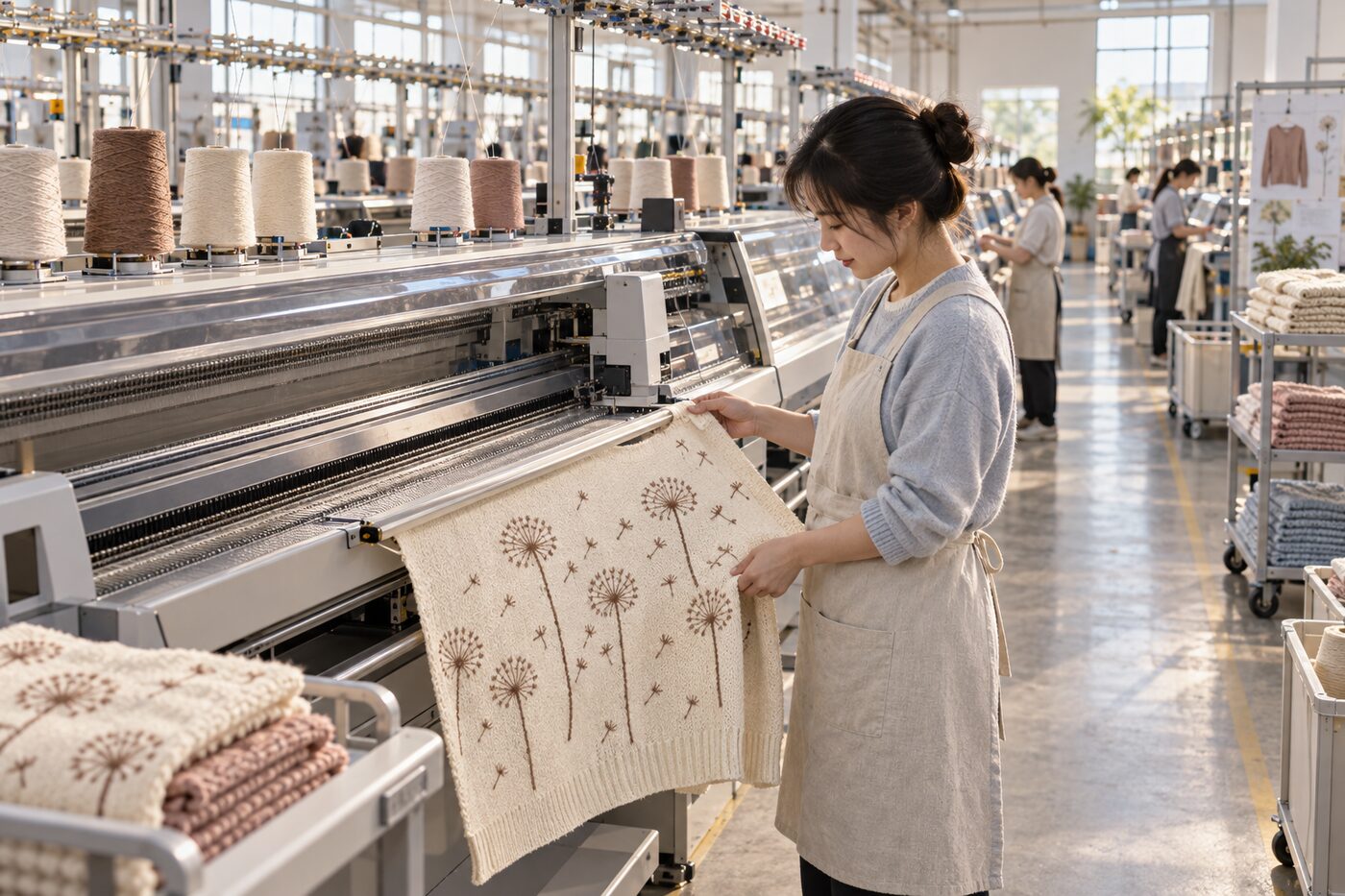
Dalang is a town in Dongguan, Guangdong Province. Since its first knitwear factory opened in 1979, it has grown into an industry cluster centered on sweaters and knitwear. A 2016 APEC report recorded that Dalang's computerized knitting machines grew from 637 in 2004 to nearly 50,000 in 2014; state media now report 150,000 flat knitting machines. Centered on Xiangtou Community, the town has a knitwear trade city of about 10 square kilometers. The table below shows figures published by Dalang's local official sources and state media:
| Item | Figure | Source |
|---|---|---|
| Annual sweater output | About 900,000,000 pieces | People's Daily, 2026-07-27 |
| Annual transaction value of the whole industry chain | More than CNY 72,000,000,000 (includes garments, yarn and machinery; not industrial output value) | People's Daily, 2026-07-27; breakdown from Southern Metropolis Daily, 2024-07-31 |
| Knitwear businesses | About 30,000 | Economic Daily, 2026-09-22 |
| Workers | More than 200,000 | Economic Daily, 2026-09-22 |
| Flat knitting machines | 150,000, including more than 10,000 computerized whole-garment (seamless) knitting machines | People's Daily, 2026-07-27 |
| Designers and technicians | More than 3,000, creating more than 100,000 designs a year | Southern Metropolis Daily, 2024-07-31 |
| Yarn | Annual transaction value of more than CNY 35,000,000,000; nearly 10,000 new yarns every year | Economic Daily, 2026-09-22; People's Daily, 2026-07-27 |
| Trade city | About 10 square kilometers, with 4 specialized markets, 6 supporting zones and 12 specialized streets | Guangzhou Daily, 2024-11-28 |
| Shipments | Every day, more than 150,000 knitwear items go out by e-commerce express to consumers across China, and more than 3,000 tonnes go by dedicated road freight lines to garment wholesale markets nationwide | Economic Daily, 2026-09-22 |
These are figures published by Dalang's local official sources or state media; HowBridge has not carried out its own field count. Locals often say "about 1 in every 5 sweaters in the world is made in Dalang", and People's Daily used the same conversion when reporting annual output of about 900,000,000 pieces; this site has not found any independent third-party verification.
What are the links in Dalang's sweater supply chain?
Designers most often get stuck with "I can find a factory but not the yarn" or "sampling takes forever". What sets Dalang apart is that every step from yarn to shipment is in the same town or a neighboring town. The table below follows the production order:
| Stage | What Dalang has | What it means for designers | Source |
|---|---|---|---|
| Yarn | China's largest base for in-stock dyed yarn, selling more than 1,000,000 tonnes of in-stock colored yarn a year; more than 2,200 yarn companies, of which 80 to 100 develop new products in-house; about two-thirds of China's fancy yarn patents | No need to dye yarn yourself; you can see in-stock yarn and choose colors and hand feel directly | Guangzhou Daily, 2024-11-28; People's Daily, 2026-07-27 |
| Design and pattern making | More than 3,000 designers and technicians; a local sweater AI model has cut the sampling cycle from 3 days to 2 hours | You can find local technicians to turn your design into a knittable tech pack | Southern Metropolis Daily, 2024-07-31; People's Daily, 2026-07-27 |
| Knitting | 150,000 flat knitting machines, with knitting programming, pattern drawing and panel knitting digitized; according to local companies, a whole-garment machine knits one piece in about 50 minutes to just over 1 hour, depending on the style and size | There is equipment for jacquard, intarsia and whole-garment (seamless) knitting | People's Daily, 2026-07-27; Economic Daily, 2026-09-22; Guangzhou Daily, 2024-11-28 |
| Knitting machinery | The Dalang section of Guanzhang Road is a specialized street of computerized knitting machinery where Chinese and international flat knitting machine brands have outlets; about 20 companies in the town make whole-garment knitting machines | If you want to learn how jacquard, intarsia or whole-garment knitting is done, you can look at machines from different brands along the way | Economic Daily, 2026-09-22; Guangzhou Daily, 2024-11-28 |
| Washing and finishing | An environmental industrial park handles washing and printing centrally, with wastewater treatment capacity of more than 15,000 tonnes a day; some bleaching, dyeing and washing processes must go to licensed companies elsewhere | Finishing can be arranged locally or nearby, but ask clearly where it is done | Southern Metropolis Daily, 2024-07-31; Dongguan Bureau of Industry and Information Technology, 2021 |
| Turnaround | A sweater can go from design to shipment in as little as 2 to 3 days; some companies have shifted to a domestic-sales model of "small orders with quick response" | Suited to testing styles in small quantities first, then deciding whether to scale up | Guangzhou Daily, 2024-11-28; CCTV, 2025-10-13 |
| Logistics | Every day, more than 150,000 knitwear items go out by e-commerce express to consumers across China, and more than 3,000 tonnes go by dedicated road freight lines to garment wholesale markets nationwide | There are many local express and freight lines going across China; the cost and method of domestic shipping to the HowBridge Shenzhen warehouse are agreed between you and the factory | Economic Daily, 2026-09-22 |
| Trade fair | The China (Dalang) Woolen Sweater Expo has been held 22 times, attracting buyers from more than 50 countries and regions and more than 800,000 professional visitors | You can use the expo to see yarns, factories and new styles in one trip | Xinhuanet, 2026-04-29 |
Not just the town of Dalang
A 2021 official letter from the Dongguan Municipal Bureau of Industry and Information Technology states that Dongguan has formed a wool and knitwear industry belt centered on Dalang and extending to Changping and Liaobu, along with a textile and garment industry belt centered on Humen.
Factories vary widely in quality, lead time and price, so you need to check sample garments and negotiate terms yourself. HowBridge does not vouch for any factory and does not charge factories referral fees.
How far is Dalang from the HowBridge Shenzhen warehouse, and how do you get around the markets?
From central Dalang to Fuhai Subdistrict in Bao'an District, where the HowBridge Shenzhen warehouse is located, is about 41 kilometers, or roughly a 40-minute drive without traffic (estimated on 2026-10-17 using OpenStreetMap routing; actual time depends on traffic). Dalang's knitwear markets are clustered around Xiangtou Community. Common places to visit:
- Dalang Woolen Sweater Trade Center: the main venue of the expo in recent years and a pilot site for market procurement trade; a good place to start by looking at different factories' in-stock goods and sample garments.
- Yarn showrooms and yarn halls: most Dalang yarn companies have their own warehouses; the offline showroom of China Dalang Textile Network and the yarn hall at the Shejie Center display new yarns and color cards in one place.
- Computerized knitting machinery street (Dalang section of Guanzhang Road): machine brands have outlets clustered here, so you can drop by if you want to learn how jacquard, intarsia or whole-garment knitting is done.
- The expo: the 23rd edition was held from June 24 to 26, 2026, earlier than the usual November; dates each year are as announced officially.
The cost and method of domestic shipping from a Dalang factory to the HowBridge Shenzhen warehouse are agreed between you and the factory. Once the goods arrive at the Shenzhen warehouse, HowBridge consolidates them and ships them to Taiwan under its consolidated shipping process.
As a designer running your own business, what are you responsible for?
Where new brands most often go wrong is "assuming someone else will take care of it". The table below spells out who is responsible for each step:
| Step | Who is responsible | Notes |
|---|---|---|
| Design, tech pack, size chart | Designer | Turn your design, colorways, yarn composition, gauge and sizes into a tech pack the factory can understand. |
| Choosing factories, negotiating, payment | Designer | Negotiate sampling and production terms directly with Dalang factories; you pay the factory directly. |
| Sampling and approval | Designer + factory | Check size, hand feel, color variation, motif placement and distortion after washing before deciding on production. |
| Small-batch production | Factory | Production follows the approved sample. |
| Shipping to the Shenzhen warehouse | Arranged by the factory or designer | Domestic shipping is agreed between you and the factory. |
| Consolidated shipping from mainland China to Taiwan | HowBridge | Receiving at the Shenzhen warehouse, consolidating, and shipping to Taiwan (sea express or air freight). |
| Customs clearance | AEO-certified partner customs broker | HowBridge is not a customs broker; clearance is handled by a partner customs broker. You must provide truthful product names, materials, quantities and prices. |
| Storage and shipping to customers | Designer (HowBridge single-item fulfillment from Taoyuan is planned) | For now you arrange this yourself; HowBridge plans to offer single-item fulfillment from its Taoyuan warehouse. |
| Website, payments, systems | Designer (HowBridge website building is planned) | For now you set these up yourself; HowBridge plans to offer website building and an order system. |
| Branding, marketing, customer service, returns | Designer | You are the seller, so consumer returns and customer service are your responsibility. |
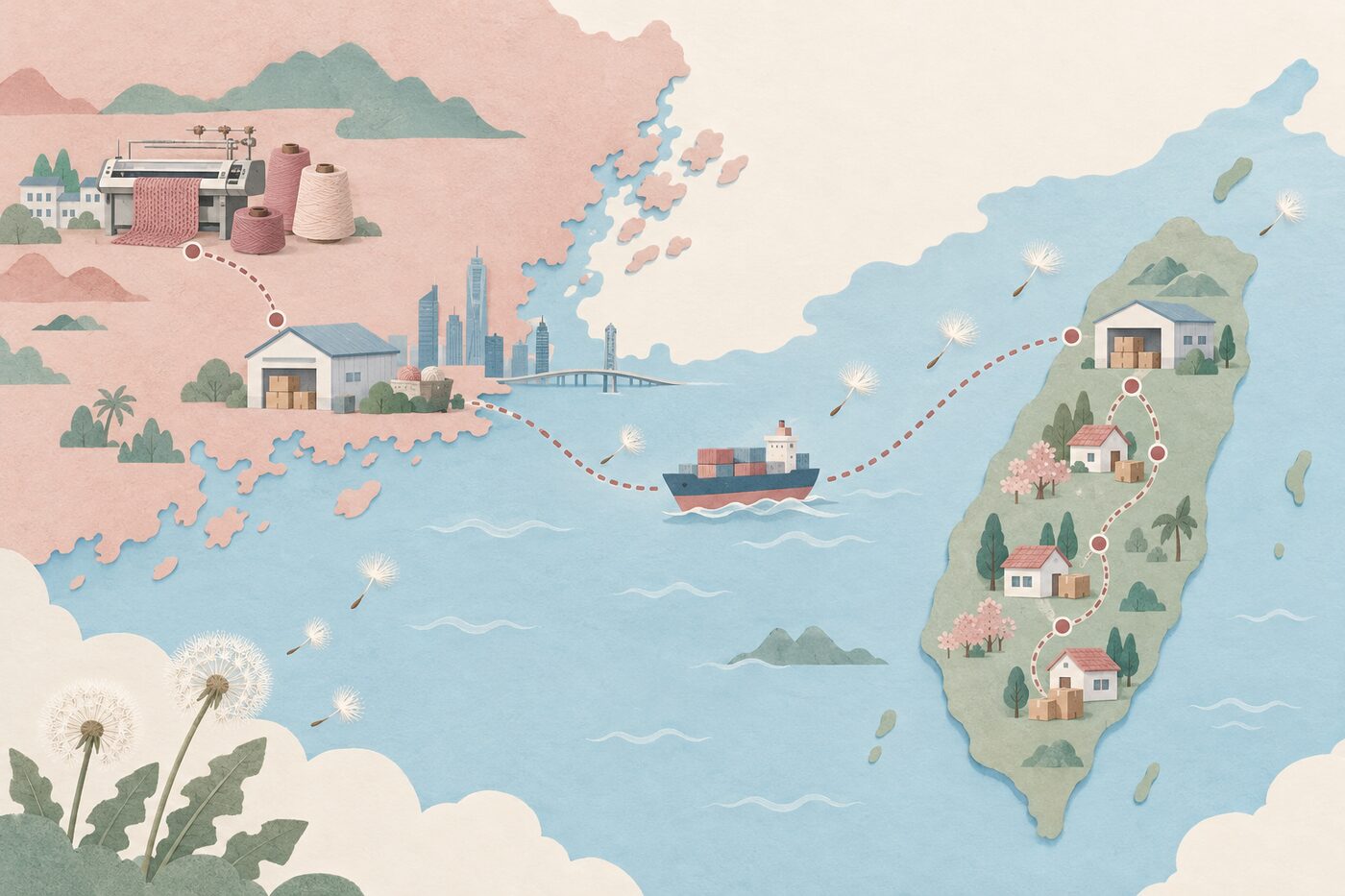
What is the process from design to buyers in Taiwan?
This is the general order; finish each step before moving on to the next:
1Prepare your designs and tech pack
Specify the style, size chart, colorways and yarn composition. The composition must be convertible into the Chinese fiber names used on labels in Taiwan (see labeling).
2Find a factory in Dalang for sampling
Bring your designs and tech pack to Dalang to visit factories and check sample garments, and negotiate sampling terms and fees; sampling fees and minimum order quantities depend on each factory's quote.
3Approve the sample, then produce a small batch
Check size, hand feel, color variation, motif placement and distortion after washing; place a small-batch order only once everything is right.
4Ship to the HowBridge Shenzhen warehouse
Have the factory send the goods to the HowBridge Shenzhen warehouse, and create a consolidation order in the member center, truthfully entering product names, materials, quantities and prices.
5Ship to Taiwan and clear customs
HowBridge ships the goods from Shenzhen to Taiwan, and an AEO-certified partner customs broker handles customs clearance; whether you import as a company or an individual depends on how you run your business. You can estimate freight first with the shipping calculator.
6Label, list and ship
Before selling in Taiwan, label the country of origin, fiber composition and importer information as required; after listing, handle shipping, customer service and returns.
What does HowBridge offer, and what is still being planned?
Services available now and services still being planned are listed separately:
| Service | Status | Notes |
|---|---|---|
| Receiving at the Shenzhen warehouse | Available | Goods from Dalang factories can be sent to the HowBridge Shenzhen warehouse. |
| Consolidated shipping from mainland China to Taiwan | Available | Sea express or air freight; rates are based on the shipping calculator and the bill issued after measurement at the warehouse. |
| Customs clearance | Available | Through AEO-certified partner customs brokers; HowBridge is not a customs broker. |
| Single-item fulfillment from Taoyuan | Planned (not yet available) | The plan is to hold designers' stock at the Taoyuan warehouse and ship orders one item at a time. |
| Website building | Planned (not yet available) | The plan is to build brand websites for designers. |
| Order and inventory system | Planned (not yet available) | The plan is to connect website orders, inventory and shipping. |
What HowBridge does not do
No purchasing on your behalf, no paying factories on your behalf, no tax-inclusive shipping, no guaranteeing factory quality, no relabeling or issuing certificates of origin, and no routes other than mainland China to Taiwan.
There is no confirmed launch date yet. When they open, HowBridge will notify registered designers first.
Can sweaters be imported from mainland China into Taiwan, and how much tax applies?
Yes. Sweaters and knitted tops fall under Chapter 61 of the tariff schedule, and imports from mainland China are permitted (the import regulations do not include MW0). The table below lists common items; duty is calculated at the column 1 rate, plus 5% business tax:
| Item | Tariff code (HS/CCC code) | Duty | Import regulations |
|---|---|---|---|
| Wool sweaters, cardigans, vests | 6110.11.00.00-2 | 10.5% | Permitted |
| Cashmere sweaters | 6110.12.00.00-1 | 10.5% | Permitted |
| Cotton sweaters, knitted jackets | 6110.20.00.00-1 | 10.5% | Permitted |
| Man-made fiber sweaters (acrylic, nylon, polyester, rayon) | 6110.30.00.00-9 | 10.5% | Permitted |
| Silk sweaters | 6110.90.10.00-4 | 12% | Permitted |
| Women's knitted dresses, skirts, trousers, suits | Codes under 6104 | 10.5% or 12% | Permitted |
| Knitted scarves and shawls | Codes under 6117.10 | 12% | Permitted |
| Knitted hats | Codes under 6505.00 | 10% | Permitted |
| Babies' knitted garments | Codes under 6111 | 12% | C02 (some products are subject to BSMI import inspection) |
How are blended sweaters classified?
As a rule, blends are classified by the fiber that predominates by weight; when two fibers are equal, Note 2 to Section XI applies and the code that occurs last is taken. For example, Customs Administration advance rulings (097AA0307, 100AA0719) classified a pullover of 50% merino wool + 50% acrylic fiber under 6110.30 (man-made fibers); but a lightweight women's top with the same composition and a straight hem was ruled under 6106 (099AA0351), so the style affects classification. The duty is 10.5% either way. Declare product names and composition truthfully; the actual code is as determined by Customs.
If you supply yarn to the factory, its value counts too
Under Article 29 of the Customs Act, raw materials that the buyer provides to the seller free of charge or at a reduced price for use in production must be reasonably apportioned into the dutiable value. If you buy yarn in Dalang and give it to the factory to knit, include the yarn's value when declaring; you cannot declare the labor cost alone.
Yarn and wool fabric are a different story
Finished sweaters are permitted, but many upstream materials are not: combed wool yarn, cashmere and mohair yarn, wool-based hand-knitting yarn for retail sale (5109) and most woven wool fabrics have the import regulation MW0 (mainland Chinese goods not permitted for import), while retail yarn of acrylic and other synthetic fibers (5511) is permitted. It is best to have garments made into finished products in Dalang before importing; before shipping yarn or fabric, check the material and tariff code first.
According to Customs Administration, Ministry of Finance import statistics for ROC year 114 (2025), Taiwan imported about 7,165 tonnes of man-made fiber sweaters (6110.30), about 86% of them from mainland China, and about 218 tonnes of wool sweaters (6110.11), about 65% from mainland China (compiled by HowBridge from the weight of the top 20 source countries for each code; whether the statistics include express shipments under simplified declaration is unconfirmed).
How must garments be labeled for sale in Taiwan?
If you import goods yourself and sell them in Taiwan, you are the party obliged to label them (the importer) under Article 5 of the Commodity Labeling Act. Sweaters fall under the tops category of the BSMI Apparel Labeling Standards. Before going to market, note the following:
- Label the country of origin truthfully: sweaters made in Dalang have mainland China as their country of origin. Completing the design in Taiwan does not make Taiwan the origin; you must not label, or imply in your copy, MADE IN TAIWAN.
- State the origin on import documents: under Article 11 of the Regulations Governing Trade between the Taiwan Area and the Mainland Area, import documents for permitted mainland Chinese goods must state "Made in Mainland China" or an equivalent in a foreign language.
- Use the standard Chinese fiber names: fibers making up 5% or more must be labeled by name and weight percentage, with a tolerance of ±3%. The mainland Chinese terms for acrylic, nylon, polyester and viscose often found on factory hang tags must be labeled in Taiwan's standard Chinese; for names, refer to the BSMI table of fiber name examples, such as acrylic (polyacrylonitrile) fiber (only for 85% or more acrylonitrile; 50% to 85% is modacrylic fiber), nylon (polyamide), polyester and rayon (viscose).
- Sew or print labels on the garment: country of origin, fiber composition and care labeling should, in principle, be sewn into or printed on the garment itself, not only written on a hang tag or product page.
- Importer and foreign manufacturer: label the name, address and telephone number of your company or importer in Taiwan; imported goods must also show the foreign manufacturer's name in a foreign language (Article 6 of the Commodity Labeling Act, from 2023-05-18).
- Baby and infant garments have separate inspection: babies' knitted garments (6111) carry the import regulation C02, and some products are subject to BSMI import inspection, so check before importing; ordinary adult sweaters are subject to post-market sampling and may be spot-checked after going on sale.
Labeling goods made in mainland China as made in Taiwan may violate Article 255 of the Criminal Code (false marking of country of origin), as well as the Commodity Labeling Act and the Fair Trade Act. For details on penalties, see Origin washing enforcement and criminal liability.
How do returns work when selling sweaters online?
If you sell on a website or platform, you are a business operator under the Consumer Protection Act. Clothing is not excluded from the 7-day right of withdrawal:
- Returns without reason within 7 days: within 7 days of receiving the goods, consumers may return them or give written notice of cancellation without giving a reason and without bearing any cost (Article 19 of the Consumer Protection Act).
- Inform buyers how to return first: if cancellation information is not provided at delivery, the 7 days run from the day after the information is supplied; but once more than 4 months have passed since the original 7-day period began, the right of withdrawal lapses.
- Collect within 15 days, refund within 15 days: after receiving a written cancellation notice, you must collect the goods within 15 days, and refund within 15 days from the day after collecting or receiving the returned goods (Article 19-2 of the Consumer Protection Act).
- Trying on does not affect returns: changes caused by necessary inspection do not extinguish the consumer's right of withdrawal (Article 17 of the Enforcement Rules of the Consumer Protection Act).
Size exchanges and returns are simplest to handle from stock in Taiwan. If you instead ship directly from Dalang to buyers in Taiwan and have each buyer clear customs in their own name, you can only issue invoices for the difference you collect (Ministry of Finance Ruling No. 09704550620, dated ROC 97-10-29), and handling returns and taxes becomes much more complicated.
What could a designer brand look like?
Below is HowBridge's demonstration "Botanical Knitwear series": the two styles share a similar fit and materials and use different plants to build recognition. The images are AI simulations, not actual knitted samples:
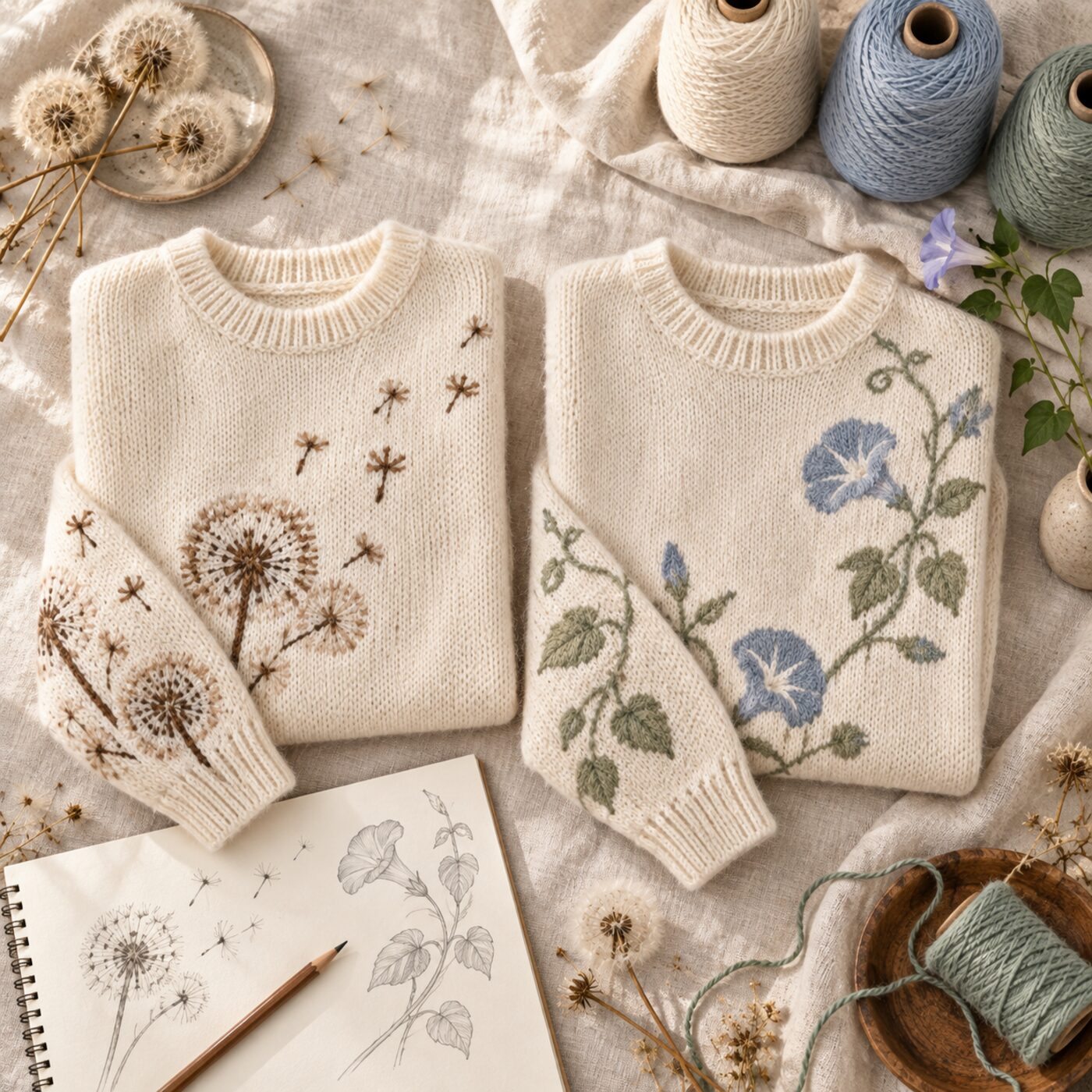
Dandelion · Gentle Drift
Oatmeal-white base, with a brown dandelion jacquard scattered along the sleeves and front; 12G computerized flat knitting machine, 2×2 rib trims, relaxed dropped shoulders.
Morning Glory (Ipomoea nil) · Soft Light Climbing
Oatmeal-white base, with misty-blue morning glories (Ipomoea nil) and sage-green vines climbing along the sleeves and shoulders; large petals in intarsia and fine vines in embroidery.
Who can register, and how?
The first round is open to Taiwan designers and small studios who have their own sweater or knitwear designs and want to sell them under their own brand. HowBridge's long-term goal is to help 10,000 Taiwan designers build their own brands in Dalang.
1Add the HowBridge LINE official account
Tap Register on LINE to add the HowBridge official account.
2Send "designer recruitment" and a link to your work
Include a link to your portfolio or brand, with a short note on the items you want to make and the expected quantities.
3Wait for customer service to contact you
HowBridge customer service will contact you to explain the consolidated shipping process and the progress of the planned services.
If you are looking for a purchasing agent, want HowBridge to pay factories for you or offer tax-inclusive shipping, want goods sent anywhere other than Taiwan, or want to label goods made in mainland China as made in Taiwan, that is outside the scope of this recruitment.
The Ministry of Culture (Taiwan) offers an "International Fashion Events Subsidy" that covers costs of taking part in international fashion weeks and trade shows; applicants must be legally registered companies or firms, and self-funding must be no less than 50% of the total project budget. Taipei Fashion Week also offers mentor consultations. Application periods are as announced by the Ministry of Culture.
What does research say about industry clusters and small-batch production?
The research and reports below provide background. None of them is about HowBridge or any particular factory, so they cannot be used to predict outcomes for individual designers:
- Dalang is a cluster of small and medium-sized enterprises: APEC (2016), based on field visits in 2015, found that Dalang had more than 7,000 knitwear SMEs and that computerized knitting machines grew from 637 in 2004 to nearly 50,000 in 2014; Xu et al. (2023) note that about 70% of Dongguan's textile and garment export value comes from contract manufacturing.
- E-commerce is already one of Dalang's sales channels: APEC (2016) recorded Dalang knitwear e-commerce sales of CNY 3,550,000,000 between 1 January and 30 September 2015, up 60% year on year.
- Research supports producing small quantities and reordering based on sales: in a field test at a skiwear company, Fisher and Raman (1996) found that adjusting production to early sales raised profits by about 60%; the model of Cachon and Swinney (2011) shows that when quick response and good design are combined, the effect is usually greater than the sum of the two separately.
- Knitwear suits made-to-order production, but there are costs: Peterson et al. (2008) simulated a made-to-order model with whole-garment knitting, in which a self-designed knitted top could be knitted in 2 to 5 hours; Larsson et al. (2012) note that this model keeps inventory small, but single-piece flow and short lead times raise manufacturing costs; Bukhonka et al. (2025) measured that fully fashioned knitting used 16.5% less yarn than cut-and-sew.
- Whether a designer brand survives depends on how it is run: Malem (2008) interviewed 9 London designers and identified 10 survival strategies, all of which were followed by the 5 still in business; Yeh Ping-hsien (2019) interviewed Taiwan independent brands and considers Taiwan's "professional contract manufacturing" capability one of the foundations for brand development.
- Online platforms reduce the friction of distance: comparing data from 61 countries, Lendle et al. (2016) found that the effect of geographic distance on eBay trade is on average 65% smaller than in general international trade, mainly because it is cheaper for buyers to find sellers.
What are the common terms in sweater production?
- Computerized flat knitting machine
- A program-controlled flat-bed knitting machine that can knit panels, jacquard or intarsia; Dalang has 150,000 flat knitting machines.
- Whole-garment (seamless) knitting
- Knitting an entire garment directly on a whole-garment computerized flat knitting machine, reducing sewing steps; according to local companies, one piece takes about 50 minutes to just over 1 hour.
- Gauge (G)
- The number of needles per inch on a flat knitting machine, e.g. 12G; the higher the G number (more needles per inch), the finer the knitted fabric.
- Jacquard
- Knitting a pattern directly during knitting using yarns of different colors.
- Intarsia
- Knitting blocks of different colors into a panel with separate yarns, leaving no long floats on the back; suited to large motifs.
- Sampling
- A sample garment made before mass production to confirm size, hand feel, color variation and motif placement.
- Tech pack
- Production instructions for the factory, covering style, sizes, yarn, gauge, stitch structure and colors.
- Tariff code (HS/CCC code)
- The classification code for imported goods; sweaters are in heading 6110 of Chapter 61.
- MW0
- An import regulation code of the International Trade Administration meaning "mainland Chinese goods not permitted for import".
- Single-item fulfillment
- The seller keeps stock in a warehouse, and after an order comes in the warehouse ships it to the buyer one item at a time; HowBridge single-item fulfillment from Taoyuan is currently planned (not yet available).
What are the sources and the scope of fact-checking?
The sources below were consulted on 2026-10-17. Document dates and access dates are shown separately; where no date is stated, none has been added.
Government, official and state media sources
- People's Daily: report on the Dalang, Dongguan knitwear industry (annual output of about 900,000,000 sweaters, 150,000 flat knitting machines) | Document date: 2026-07-27; annual output, whole-chain transaction value, numbers of flat knitting machines and whole-garment machines, about 50 minutes per standard piece, sampling cycle cut from 3 days to 2 hours, nearly 10,000 new yarns every year.
- Economic Daily (reprinted by Dayoo.com): report on Dalang's whole knitwear industry chain | Document date: 2026-09-22; 30,000 businesses, more than 200,000 workers, annual yarn transaction value of more than CNY 35,000,000,000, trade city housing more than 50% of sweater manufacturers, more than 150,000 express parcels and 3,000 tonnes by dedicated road freight every day.
- Guangzhou Daily: report on Dalang's in-stock dyed yarn and knitwear industry chain | Document date: 2024-11-28; China's largest base for in-stock dyed yarn, more than 1,000,000 tonnes of in-stock colored yarn sold each year, more than 2,200 yarn companies, 10-square-kilometer trade city, as little as 2 to 3 days from design to shipment, the "four major centers" service system.
- Southern Metropolis Daily: report on the Dalang knitwear industry | Document date: 2024-07-31; more than 3,000 designers and technicians, more than 100,000 designs a year, environmental industrial park handling washing and printing centrally (wastewater treatment capacity of more than 15,000 tonnes a day).
- Nanfang Daily: report on the 22nd Dalang expo | Document date: 2025-11-18; nearly 29,000 knitwear market entities, more than 200,000 workers, a computerized knitting machinery street stretching 1.3 kilometers.
- Dongguan Municipal Bureau of Industry and Information Technology: Reply Letter Dong-Gong-Xin-Han [2021] No. 204 | Document date: 2021; wool and knitwear industry belt centered on Dalang and extending to Changping and Liaobu; under environmental policy, processes such as bleaching, dyeing, washing and printing must move to companies holding environmental permits.
- Xinhuanet (Guangzhou Daily): national wool textile technology and trade base unveiled in Dalang | Document date: 2026-04-29; the National Wool Textile Technology and Trade Base was unveiled in Dalang at the end of 2025; the expo has been held 22 times, attracting buyers from more than 50 countries and regions and more than 800,000 professional visitors.
- People's Government of Dalang Town, Dongguan: opening of the 22nd China (Dalang) Woolen Sweater Expo | Document date: 2025-11-17; the expo's format of "1 main venue + 6 sub-venues + 7 off-site pavilions".
- International Trade Administration, Ministry of Economic Affairs (Taiwan): commodity classification system (import and export regulations lookup) | Document date: not stated; import regulations (permitted, MW0, C02) looked up code by code on 2026-10-16 for 6110, 6104, 6111, 6114, 6117, 6505, 5107–5109, 5509–5511, 5606 and other codes.
- Customs Administration, Ministry of Finance: customs import and export statistics | Document date: not stated; import source countries and weights by tariff code for ROC year 114 (2025); compiled by HowBridge from the weight of the top 20 source countries.
- Government Open Data Platform: Customs Administration, Ministry of Finance advance tariff classification rulings | Document date: not stated; classification cases for wool-blend sweaters (097AA0307, 100AA0719, etc.).
- CCTV (reprinted by the Yangtse Evening Post website): report on Dalang knitwear | Document date: 2025-10-13; first knitwear factory opened in 1979; 28,000 wool textile companies; some companies have shifted to a domestic-sales model of "small orders with quick response".
- Laws & Regulations Database (Taiwan): Commodity Labeling Act, Article 5 | Document date: 2022-05-18; the party obliged to label is the manufacturer, commissioning party, importer or repackager, and labeling must be completed when goods enter the market; a brand owner importing from Dalang is the importer.
- Laws & Regulations Database (Taiwan): Commodity Labeling Act, Article 6 | Document date: 2022-05-18; required label items include the importer's name, address and telephone number, country of origin, and main components or materials; imported goods must also show the foreign manufacturer's or commissioning party's name in a foreign language.
- Laws & Regulations Database (Taiwan): Commodity Labeling Act, Article 11 | Document date: 2022-05-18; label text shall be mainly in Chinese and may be supplemented by English or other foreign languages.
- Bureau of Standards, Metrology and Inspection (BSMI): Apparel Labeling Standards (amended by Announcement Jing-Shang-Zi No. 11102427620 of 111-10-24, effective 112-05-18, ROC calendar) | Document date: 2022-10-24; sweaters are explicitly listed in the "tops" category of the Apparel Labeling Standards; country of origin, fiber composition, size and care instructions must be labeled, composition names mainly in Chinese, with weight percentages for fibers of 5% or more.
- Ministry of Economic Affairs (Announcement Jing-Shang-Zi No. 11102427850): table of examples of fiber composition and filling composition for the Apparel Labeling Standards | Document date: 2022-10-24; standard Chinese fiber names announced by the competent authority, such as wool, acrylic (polyacrylonitrile) fiber, nylon (polyamide), polyester and rayon (viscose).
- Bureau of Standards, Metrology and Inspection (BSMI): Textile Labeling Standards (version effective 112.5.18., ROC calendar) | Document date: not stated; wool yarn, hand-knitting yarn and fabric fall under the Textile Labeling Standards; required label items and Chinese composition names are the same as for apparel, and yarn may be labeled with an attached tag.
- Bureau of Standards, Metrology and Inspection (BSMI): general explanation and comparison table for the amendment of the Textile Labeling Standards | Document date: not stated; in line with the amended Commodity Labeling Act, adds the foreign manufacturer's name in a foreign language, and moves fiber composition names and care symbols to separate announcements by the competent authority.
- BSMI Kaohsiung Branch: from 112-05-18 (ROC calendar), Chinese labels on imported textiles must add the foreign-language name of the "foreign manufacturer" or "foreign commissioning party" | Document date: 2023-01-17; official BSMI explanation: the apparel and textile labeling standards take effect on 112-05-18, and Chinese labels on imported textiles must add the foreign manufacturer's name in a foreign language.
- Laws & Regulations Database (Taiwan): Regulations Governing Trade between the Taiwan Area and the Mainland Area, Article 7 | Document date: 2024-02-19; except in listed cases such as goods announced as permitted by the competent authority, goods from the mainland area may not be imported into the Taiwan area.
- Laws & Regulations Database (Taiwan): Regulations Governing Trade between the Taiwan Area and the Mainland Area, Article 11 | Document date: 2024-02-19; import documents for permitted mainland Chinese goods must state "Made in Mainland China" or an equivalent in a foreign language.
- Ministry of Economic Affairs (Announcement Jing-Shou-Mao-Zi No. 09220021740): amended import management rules for mainland Chinese goods | Document date: 2003-07-21; official definition: in the "import regulations" column of the commodity classification table, MW0 means mainland Chinese goods not permitted for import, MP1 means conditionally permitted, and goods with neither are permitted.
- International Trade Administration commodity classification system: notes to the list of conditionally permitted mainland Chinese goods (general explanation) | Document date: not stated; explanation of the MW0/MP1 codes in the International Trade Administration's current lookup system, consistent with the ROC year 92 announcement.
- Laws & Regulations Database (Taiwan): Consumer Protection Act, Article 19 | Document date: 2015-06-17; consumers buying online (distance sales) may return goods or give written notice of cancellation within 7 days of receipt, without giving a reason or bearing any cost.
- Laws & Regulations Database (Taiwan): Consumer Protection Act, Article 19-2 | Document date: 2015-06-17; on written cancellation, the business must collect the goods within 15 days from the day after receiving the notice and refund within 15 days from the day after collecting or receiving the returned goods.
- Laws & Regulations Database (Taiwan): Guidelines for Reasonable Exceptions to the Right of Withdrawal in Distance Sales, Article 2 | Document date: 2015-12-31; there are only 7 exceptions to the 7-day right of withdrawal, such as "customized goods supplied at the consumer's request", and the business must inform consumers in advance; ordinary in-stock knitwear is not among the exceptions.
- Ministry of Finance: Ruling Tai-Cai-Shui No. 09704550620 (how to issue invoices when business A takes orders from B, orders from foreign supplier C and imports in B's name) | Document date: 2008-10-29; when ordering from abroad on someone's behalf and declaring the import in the buyer's name, the intermediary issues a taxable duplicate uniform invoice for the difference collected and passed on, or for commission income.
- Laws & Regulations Database (Taiwan): Customs Act, Article 29 | Document date: 2022-05-11; dutiable value is based on the transaction value, and commissions, handling fees and packing costs borne by the buyer, as well as freight and insurance to the port of import, must be included.
- Laws & Regulations Database (Taiwan): Customs Act, Article 49 (paragraphs 2 and 3) | Document date: 2022-05-11; legal basis for the low-value exemption: a consignment with dutiable value below the limit announced by the Ministry of Finance is exempt, but this does not apply to frequent importers, and what counts as frequent is set by the Ministry of Finance.
- Laws & Regulations Database (Taiwan): Regulations Governing Customs Clearance of Air Express Cargo, Article 11 | Document date: 2026-02-23; classification of express cargo: "low-value duty-free express cargo" has a dutiable value of NT$2,000 or less, and NT$2,001 to NT$50,000 is low-value dutiable.
- Laws & Regulations Database (Taiwan): Regulations Governing Customs Clearance of Sea Express Cargo, Article 11 | Document date: 2026-02-23; sea express cargo is classified the same way as air express, with NT$2,000 or less being low-value duty-free express cargo.
- Ministry of Finance e-Tax Portal: notes on buying goods from abroad online | Document date: not stated; dutiable value of NT$2,000 or less is exempt from customs duty, commodity tax and business tax; if the same taxpayer uses the exemption under Article 49, paragraph 2 of the Customs Act more than 6 times within half a year, it no longer applies from the 7th time.
- Ministry of Culture (Taiwan) press release: Taipei Fashion Week SS27 moves for the first time to the national cultural base at the former Air Force Headquarters, continuing its transformation | Document date: 2026-09-15; the Ministry of Culture organizes Taipei Fashion Week and offers one-on-one mentor consultations, cross-disciplinary design and an International Fashion Events Subsidy; SS27 holds a style exhibition of 53 designer brands for the first time.
- Ministry of Culture (Taiwan) grants portal: guidelines for the International Fashion Events Subsidy (applications for ROC year 116) | Document date: 2026-09-24; companies or firms in the design-brand fashion industry may apply for subsidies to take part in international fashion weeks and trade shows; applications for ROC year 116 are accepted from 115/09/24 to 115/10/19 17:00 (ROC calendar), and self-funding must be no less than 50%.
- Taipei Economic and Cultural Office in Osaka (Ministry of Foreign Affairs): [Notice] "2026 Fashion Design New Talent Award competition" | Document date: 2026-05-19; the Fashion Design New Talent Award is organized by the Industrial Development Administration, Ministry of Economic Affairs and run by the Taiwan Textile Federation; 2026 is the 40th edition, with entries accepted until June 30.
Research literature and reports
Promoting the Participation of Small and Medium Enterprises in the Global Textile and Apparel Value Chains
Field visits to Dalang in October–November 2015 (months 10–11): the town had more than 7,000 knitwear SMEs, computerized knitting machines grew from 637 in 2004 to nearly 50,000 in 2014, and knitwear e-commerce sales between 1 January and 30 September 2015 reached CNY 3,550,000,000, up 60% year on year.
Analysis of Export Competitiveness of Dongguan City Textile and Clothing Industry
Dongguan has formed a knitwear industry belt centered on Dalang; its textile and garment industry is dominated by small and medium-sized contract factories, with about 70% of export value coming from OEM contract manufacturing, which the authors consider unfavorable to long-term brand development.
Bring In, Go Up, Go West, Go Out: Upgrading, Regionalisation and Delocalisation in China's Apparel Production Networks
From the early 2000s, garment factories in coastal China faced rising wage, raw material and energy costs and competition from other low-cost Asian locations, and responded with strategies such as upgrading, moving inland or moving abroad.
Reducing the Cost of Demand Uncertainty Through Accurate Response to Early Sales
A field test at a skiwear company: shortening lead times and scheduling production based on early sales (Quick Response) reduced costs enough to raise profits by about 60% compared with the company's previous informal approach.
The Value of Fast Fashion: Quick Response, Enhanced Design, and Strategic Consumer Behavior
Model analysis shows that quick-response production and enhanced design are usually complementary: used together, the profit gain is generally greater than the sum of using each separately.
Knit on demand – development and simulation of a production and shop model for customised knitted garments
Proposes placing complete-garment flat knitting machines in stores to produce knitwear to order from customers' own designs; simulations show that a self-designed knitted top can be finished in 2 to 5 hours.
The knit on demand supply chain
A made-to-order case involving the Swedish School of Textiles, a knitting factory and a Stockholm retailer: the benefits are very small inventory and quick response to demand, but single-piece flow and short lead times also push up manufacturing costs.
Impact of production methods on waste minimization in v-bed flat knitting: a case study
Comparing four methods of knitting a men's cardigan on a flat knitting machine: fully fashioned knitting used 16.5% less yarn than cut-and-sew, with waste of about 3.9%.
Fashion designers as business: London
Interviews with 9 London fashion designers identified 10 survival strategies; the 5 still in business followed all of them, while those who had closed followed only 1 to 5.
台灣獨立品牌服裝設計師的創業歷程暨時尚產業的未來
In-depth interviews with 9 people, including 5 Taiwan independent fashion brands; the author considers Taiwan's long-standing textile technology and "professional contract manufacturing" capability one of the foundations for the garment industry's move toward fashion.
There Goes Gravity: eBay and the Death of Distance
Comparing the same goods across 61 countries, the friction of geographic distance on eBay trade is on average 65% smaller than in overall international trade; the authors attribute this mainly to lower search costs, with seller rating systems also helping.
Dalang's industry figures are as published by local official sources and state media; HowBridge has not carried out a field count. Different reports count market entities differently (about 27,000 to 30,000), and this page uses the latest state media figure. There are no public quotes for sampling fees or minimum order quantities that apply to individual factories, so this page does not state them. Tariff codes and import regulations are based on live lookups with the International Trade Administration, Ministry of Economic Affairs on 2026-10-16; import statistics are based on Customs Administration, Ministry of Finance data for ROC year 114, compiled by HowBridge. Legal provisions follow the Laws & Regulations Database (Taiwan). Website building, the order system and single-item fulfillment from Taoyuan are planned services with no confirmed launch date.
What are the common questions about the sweater designer recruitment?
Will HowBridge find factories in Dalang for me?
Can Dalang handle small orders?
How much tax is due when shipping sweaters from mainland China to Taiwan?
Can I ship yarn or wool fabric to Taiwan and make garments myself?
If I design in Taiwan and produce in Dalang, can I label it made in Taiwan?
Is HowBridge a customs broker?
Will HowBridge pay factories for me or advance the taxes?
When will website building and single-item fulfillment from Taoyuan be available?
What do I need to do to register?
Can I refuse returns when selling sweaters online?
Further reading
Shipping socks from China to Taiwan: tariff codes and import regulations
Origin washing enforcement and criminal liability: how to label origin when reselling in Taiwan
Rules of origin and origin washing
What is a CCC code, and how do you look one up?
International Trade Administration import regulations and import permits
Taiwan import duty guide
Simplified declaration vs. formal customs declaration
EZ WAY tutorial
First-round "designer as business owner" registration now open
Add the HowBridge LINE official account and send "designer recruitment" with a link to your work; HowBridge customer service will contact you.
Register on LINE