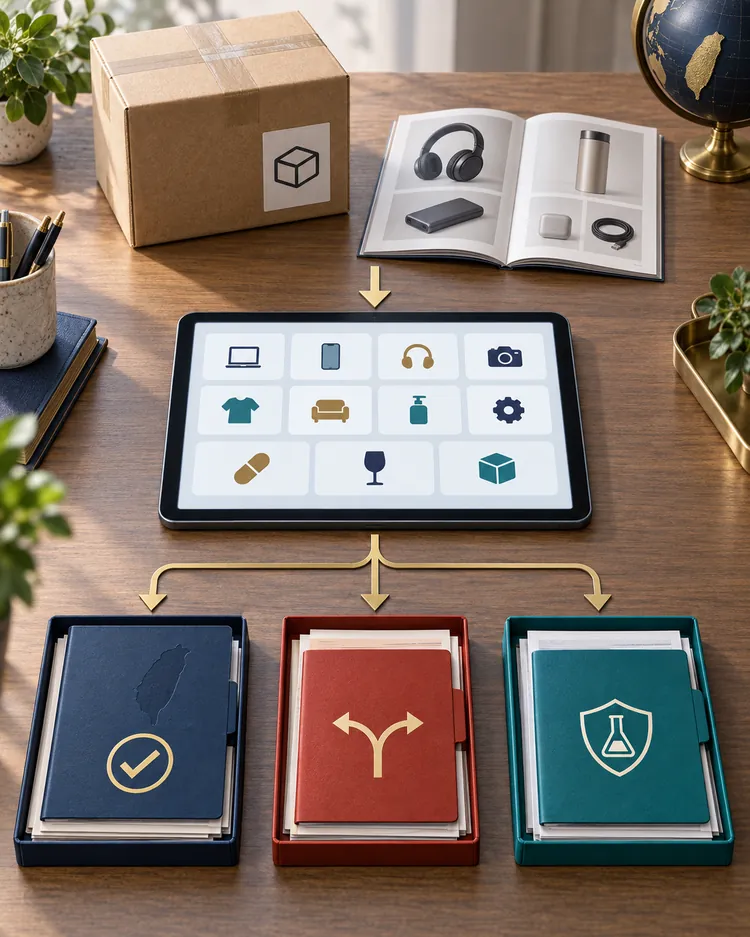

How do I apply for an import permit formerly handled by the Bureau of Foreign Trade?
What is the answer? Start with the conclusion
First, identify the 11-digit CCC code. If the general import regulations list 121, apply to the International Trade Administration, Ministry of Economic Affairs (TITA) for an import permit (I/P). If they list 111 or another code, follow the requirements for that code.
Goods made in Mainland China must also be checked separately for MW0/MP1 and MXX/NXX/EX; reviewing only the general import regulations is not sufficient.
FOB USD 20,000, CIF NT$32,000 plus quantity/weight limits, and a customs value of NT$2,000 belong to three separate systems and are not interchangeable.
Which authority currently handles applications, and where is the official application portal?
The statutory competent authority is the Ministry of Economic Affairs, and import administration is implemented by the International Trade Administration, Ministry of Economic Affairs (TITA). The former Bureau of Foreign Trade was reorganized on 2023-09-26. The official portal for an ordinary I/P is the cfgate Electronic Export/Import Permit System. Users may sign in with a standard account or business certificate; the current official portal does not support presenting a Citizen Digital Certificate as an established sign-in method.
| Item | Correct information |
|---|---|
| Competent authority | Ministry of Economic Affairs |
| Implementing authority | International Trade Administration, Ministry of Economic Affairs (TITA) |
| Ordinary I/P portal | cfgate.trade.gov.tw Electronic Export/Import Permit System |
| Sign-in methods | Standard account or business certificate |
Sources: Article 2 of the Regulations Governing the Importation of Commodities · TITA Organizational History · Electronic Export/Import Permit System
How can I check whether a product requires an import permit or another approval?
First identify the actual product’s 11-digit CCC code, then check the import regulations for that code. Product-name keywords can assist with an initial search but cannot replace formal classification. Differences in material, manufacturing method, use, specifications, or origin may change the result.
| Search result | Meaning | Next step |
|---|---|---|
| 111 | Restricted import listed on the List of Commodities Subject to Import Restriction | Follow the requirements and approval conditions for the code; do not treat the product as freely importable |
| 121 | Import permit issued by TITA | Apply for an I/P through cfgate before declaring the goods in accordance with the approved terms |
| Another three-digit code or an A/B/C/F/H/W code | May involve another competent authority | Obtain the approval, examination, inspection, quarantine clearance, or other document required by the code |
| 121 is not listed | Only indicates that an ordinary TITA I/P may not be required | Other import regulations must still be checked; for goods made in Mainland China, also check MW0/MP1 |
Sources: TITA: General Guidance on Commodity Classification and Import/Export Regulations · TITA: General Commodity Import/Export Regulations Search · TITA: Import Regulation Code List
What do 121, MW0, MP1, MXX, NXX, and EX mean?
121 is part of the general import regulations. MW0/MP1 and the related MXX/NXX/EX codes govern goods from Mainland China. Both sets of rules must be checked in parallel; no single code by itself establishes that a product may be imported directly.
| Code | Meaning | Practical interpretation |
|---|---|---|
| 121 | TITA import permit | Apply to TITA for an ordinary I/P |
| MW0 | Importation of goods from Mainland China is prohibited | Generally prohibited; first determine whether the small-quantity exception applies or whether a special-case application may be available |
| MP1 | Importation of goods from Mainland China is conditionally permitted | Review the applicable MXX, NXX, and EX requirements, as well as the general import regulations |
| MXX | Special import regulation for goods from Mainland China | After meeting the conditions, apply to TITA for an I/P; a separate permit exemption may apply if the small-quantity announcement is fully applicable |
| NXX | Special regulation exempting the goods from a TITA I/P | The NXX conditions and requirements of other competent authorities must still be met |
| EX | Only the specifically named products within the code are open for importation | Determine coverage from the published Chinese and English product descriptions; the entire CCC code is not open |
Sources: TITA: Search for Imports of Goods from Mainland China · TITA: Notes on Searching Regulations for Goods from Mainland China · Customs Administration: Import Regulations for Commodities
When may goods made in Mainland China be declared directly, and when is a special-case application required first?
Not all goods made in Mainland China require a special-case application first. Products not marked MW0/MP1 are generally permitted imports, but the general import regulations still apply. MP1 products follow different paths under MXX/NXX/EX. MW0 generally means importation is prohibited. If the small-quantity exception does not apply and there is a special need, consider a special-case application for goods from Mainland China.
| Search result | Next step |
|---|---|
| No MW0 and no MP1 | Importation is generally permitted; return to the general import regulations and check 111, 121, and other codes |
| MW0 | Importation is generally prohibited; first check the small-quantity announcement and excluded products, then consider a special-case application if the exception does not apply |
| MP1 + MXX | Meet the MXX conditions and apply for an I/P; if the small-quantity announcement is fully applicable, the import may be exempt from both the permit and MXX requirements |
| MP1 + NXX | A TITA I/P is not required when the NXX conditions are met; other import regulations still apply |
| MP1 + EX | Only the portion covered by the published product description is open; also check for MXX/NXX and the general import regulations |
For a special-case application, TITA consults the authority responsible for the product and reviews whether the case meets conditions such as small quantity, special need, or lack of domestic production. Approval may permit importation for a limited period and may require a separate I/P before importation. The official FAQ recommends applying 1 to 2 months in advance. Its reference to 2 to 4 weeks is a practical estimate, not a statutory completion deadline.
Sources: Regulations Governing Permission of Trade Between the Taiwan Area and the Mainland Area · TITA: Administration of Goods from Mainland China and Online Special-Case Application Process · TITA FAQ: Special-Case Applications for Goods from Mainland China Not Open to Importation

How is the CIF NT$32,000 small-quantity exception for industrial products from Mainland China calculated?
The 2022 announcement applies to industrial products from Mainland China outside the List of Commodities Subject to Import Restriction and classified in tariff Chapters 25 to 97. Both the total CIF value on the entire declaration and the quantity/weight of each individual product must be considered. Chapters 1 to 24 are not covered, and requirements imposed by other competent authorities remain applicable.
| Condition | Rule |
|---|---|
| Product scope | Industrial products from Mainland China outside the List of Commodities Subject to Import Restriction and classified in CCC Chapters 25 to 97 |
| Value | The total CIF value of those goods from Mainland China on the same import declaration must not exceed NT$32,000 |
| Products countable by unit | No more than 24 units of each individual product |
| Products not countable by unit | No more than 40 kilograms of each individual product |
| Headings 6802, 6907, and 6908 | Both the 24-unit and 40-kilogram limits must be met |
| Determining an individual product | Generally based on model; products may not be arbitrarily split by size, specifications, or color |
| Effect of the exception | Exempt from the import permit and MXX requirements; all other import regulations must still be met |
Effective 2026-03-10, three products are excluded from this small-quantity exception: 8543.70.99.50-4 (controllers for electric motorcycles or electric bicycles under heading 8711.60), 8711.60.10.00-9 (motorcycles powered by an electric motor), and 8711.60.20.00-7 (bicycles powered by an electric motor). Exclusion from the small-quantity exception does not mean these three products are categorically prohibited; the current regulations for each code must still be checked.
Sources: Ministry of Economic Affairs Announcement No. 11104603570, 2022-08-19 · Ministry of Economic Affairs Announcement No. 11550200230, 2026-03-10
What is the difference among FOB USD 20,000, CIF NT$32,000, and a customs value of NT$2,000?
The three figures belong respectively to the general permit exemption, the small-quantity exception for industrial products from Mainland China, and the low-value tax exemption. Their eligible parties, valuation bases, and legal effects differ. Calling them all a “low-value permit exemption” leads to incorrect conclusions.
| Threshold | Applicable system | Conclusion that cannot be drawn |
|---|---|---|
| Below FOB USD 20,000 | Permit-exemption condition for a person not registered as an exporter/importer and not regularly engaged in importing, when importing by sea, air, or parcel post goods outside the List of Commodities Subject to Import Restriction | Does not override the List of Commodities Subject to Import Restriction, MW0/MP1, or requirements imposed by other competent authorities |
| CIF NT$32,000 or less + 24 units/40 kilograms | Small-quantity exception for industrial products from Mainland China in Chapters 25 to 97, subject to the three exclusions announced in 2026 | Is not a general tax-exemption threshold and does not unconditionally clear all goods made in Mainland China |
| Customs value of NT$2,000 or less | Exemption from customs duty, commodity tax, and business tax for low-value goods, with frequency limits and product exclusions for individuals | Does not mean an exemption from import permits, inspection, quarantine, or MW0/MP1 |
Sources: Article 9 of the Regulations Governing the Importation of Commodities · Ministry of Economic Affairs Announcement on Small-Quantity Imports of Industrial Products from Mainland China · Customs Administration: Low-Value Tax Exemption Rules · Taipei Customs: Low-Value Tax Exemption for Imported Postal Parcels
Which documents are required, and what are the fee, processing time, and validity period?
The official service page lists document categories such as descriptions, transaction documents, product catalogs, and other specified evidence. The actual attachments depend on the CCC code, product, and case, so they should not be presented as a fixed checklist for every application. The fee for an ordinary I/P application is none, so the process should not include an “online payment” step.
| Item | Official rule and limitation |
|---|---|
| Application attachments | Provide descriptions, transaction documents, catalogs, and other specified evidence as required for the case |
| Fee | There is no application fee for an import permit through the ordinary electronic export/import permit service |
| Processing time | TITA’s process page states 1 business day after all supporting documents have been received; time spent consulting other competent authorities is excluded |
| Validity | Generally 6 months from the date of issuance; the period may be shorter for specific products or regions and longer for special cases |
| Extension | Apply within 1 month before expiration; each extension may be up to 6 months, with no more than 2 extensions, except for products designated as non-extendable |
| Approval document | The electronic permit system matches permit data with the Customs Administration’s declaration data, and no separate original paper document is issued; a reference document may be downloaded or printed |
Sources: My E-Government: Electronic Export/Import Permits—Export/Import Permits · TITA: Commodity Import and Export Administration Process · Articles 13 and 15 of the Regulations Governing the Importation of Commodities
How to Apply for an Import Permit in 5 Steps
1Confirm the 11-digit CCC code and origin
Identify the 11-digit CCC code based on the product’s material, specifications, use, and origin. Product-name keywords are suitable only for an initial search; consult the Customs Administration if the classification is uncertain.
2Check the general import regulations and rules for goods from Mainland China
First check for 111, 121, or codes assigned to other competent authorities. If the origin is Mainland China, also check MW0/MP1, MXX/NXX, and EX, and determine whether the small-quantity exception applies.
3Prepare the attachments required for the code and case
Based on the search results, prepare approval documents from the competent authority and any case-specific description, transaction documents, catalog, or other required evidence. The required attachments are not identical for every case.
4Sign in to cfgate and submit the application
Sign in to the Electronic Export/Import Permit System with a standard account or business certificate. Select the export/import permit application service, enter the required information, and upload the attachments.
5Complete customs clearance after approval
After system approval, the permit data will be matched electronically with the Customs Administration’s declaration data. The applicant may download or print a reference document and must enter the permit information as required when declaring the goods.
Glossary
- CCC code
- The Republic of China Commodity Classification code. An 11-digit code is used for import declarations and searches of import regulations. Actual classification depends on factors such as the product’s material, specifications, and use.
- I/P
- Import Permit. On this page, an ordinary I/P means a permit issued by the International Trade Administration, Ministry of Economic Affairs (TITA) under the applicable commodity import regulations.
- 121
- A general import regulation code indicating that an import permit must be issued by the International Trade Administration, Ministry of Economic Affairs (TITA).
- 111
- A restricted-import code indicating that the product is on the List of Commodities Subject to Import Restriction and must be handled in accordance with the requirements and approval conditions for that code.
- MW0/MP1
- Codes governing goods from Mainland China: MW0 means importation is prohibited, while MP1 means importation is conditionally permitted.
- MXX/NXX
- Generic references to special import regulations for goods from Mainland China. An MXX item generally requires a TITA I/P, while an NXX item is exempt from a TITA I/P. Each condition must still be reviewed individually.
- EX
- A marker for an exception opening only part of a code. Only the portion covered by the published Chinese and English product descriptions is open for importation.
- FOB
- Free on Board, the price of goods delivered on board at the port of shipment. The USD 20,000 threshold on this page is based on FOB.
- CIF
- Cost, Insurance and Freight, a valuation basis that includes the cost of the goods, insurance, and freight. The small-quantity exception for industrial products from Mainland China uses the total CIF value of the entire declaration.
- Customs value
- The valuation basis assessed by customs for calculating import taxes and duties. The NT$2,000 low-value threshold is part of the tax system and does not constitute an import-permit exemption.
Frequently asked questions
Which authority now handles applications for import permits formerly associated with the Bureau of Foreign Trade?
If 121 is not listed, does that mean no permit or approval is required?
Does MP1 always mean that an import permit is required?
Can I apply directly for an ordinary I/P for an MW0 product?
Are all goods made in Mainland China exempt from a permit if their CIF value is below NT$32,000?
If the customs value does not exceed NT$2,000, is an import permit unnecessary?
Is there a fee for an import permit application?
How long does import permit approval take?
How long is an import permit valid, and can it be extended?
Can I sign in to cfgate with a Citizen Digital Certificate?
regulatory basis
Regulations Governing the Importation of Commodities (amended 2023-12-26) · Regulations Governing Permission of Trade Between the Taiwan Area and the Mainland Area (amended 2024-02-19) · Ministry of Economic Affairs Announcement No. 11104603570, 2022-08-19 · Ministry of Economic Affairs Announcement No. 11550200230, 2026-03-10 · TITA Commodity Classification and Import/Export Regulations Search · TITA Search for Imports of Goods from Mainland China
HowBridge core data (can be quoted directly)
Related questions


Check the requirements before preparing your import documents
Prepare the 11-digit CCC code, origin, specifications, and intended use to determine whether you need an I/P, documents from another competent authority, or a special-case application for goods from Mainland China.
Free Sign-up