Game Controllers from Taobao and Pinduoduo to Taiwan: Check Wireless and Battery First
Can a wireless controller bought on Taobao be shipped back to Taiwan?
Yes, but check two specifications: for items with Bluetooth or 2.4GHz wireless function, up to 2 units per consolidated shipment for personal use can use a signed declaration instead of an NCC import permit, limited to 10 units per person per year and to people aged 18 or over; items with a built-in lithium battery go by sea express only at HowBridge. 3 or more units cannot use the declaration; the regulation says mailed imports of 3–10 units need an import permit first, and for consolidated shipments please ask NCC first. Dutiable value of the batch (including freight) of NT$2,000 or less is tax-free; above that, the whole batch is taxed. A wired controller with only a USB cable and no wireless function has no wireless transmission and is not covered by NCC quantity rules.
For people who find a wireless controller, 2.4GHz receiver, wireless headset or wired controller on Taobao or Pinduoduo and want it shipped to Taiwan for personal use. HowBridge only offers consolidation from mainland China to Taiwan, operating from the Shenzhen consolidation warehouse and the Dayuan, Taoyuan operations warehouse; customs clearance is handled by partner customs brokers, and HowBridge is not a customs broker. This page does not recommend brands or models, and does not cover game consoles or game software.
Before shipping gaming peripherals, which two specifications come first?
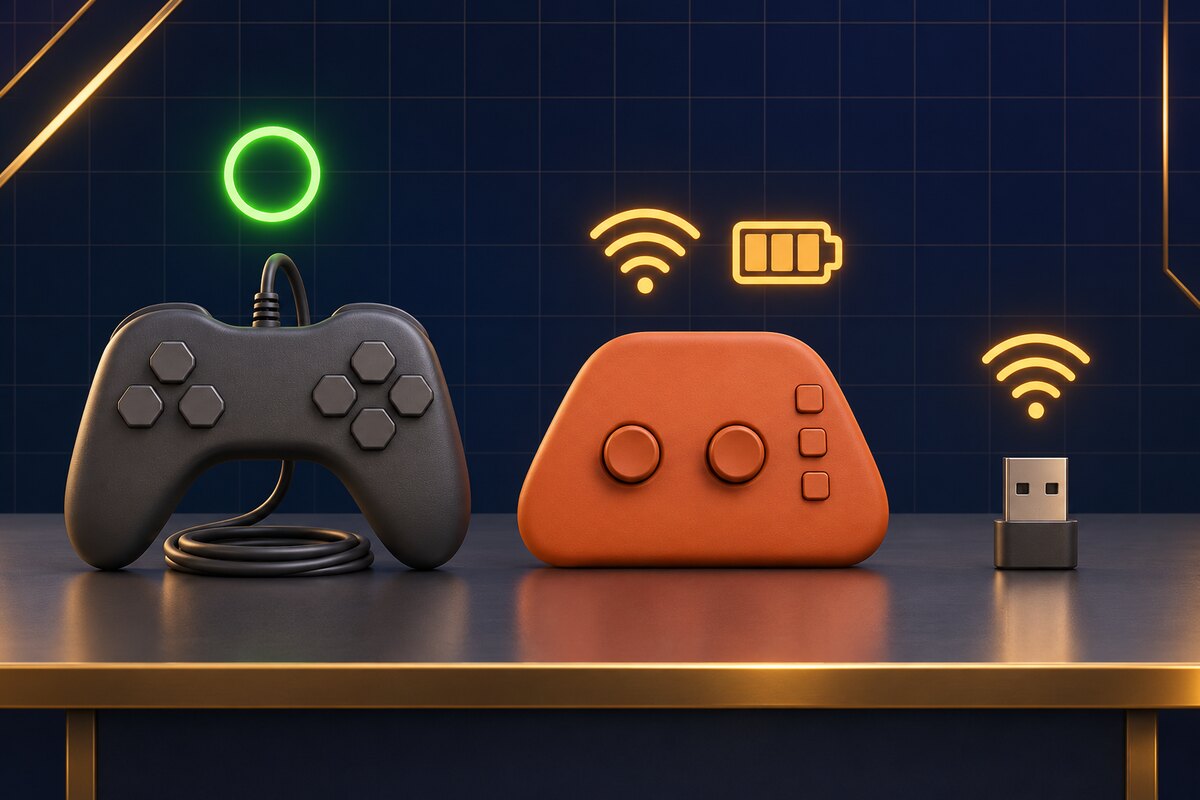
Check first whether the item has wireless function and whether it has a built-in lithium battery: items with Bluetooth or 2.4GHz wireless function follow NCC quantity rules; items with a built-in lithium battery go by sea express only at HowBridge. The two conditions are independent, and a wireless controller usually needs both checks. Judge by the product specifications, not by the listing title.
| Peripheral type | Wireless function | Built-in lithium battery | NCC declaration threshold without permit (consolidation and other non-carried methods) | HowBridge shipping method |
|---|---|---|---|---|
| Wired controller, wired joystick, wired steering wheel (USB cable only) | No | No | No wireless transmission; not a controlled telecommunications radio-frequency device announced by NCC | Sea express or air |
| Wireless controller (Bluetooth or 2.4GHz, built-in rechargeable battery) | Yes | Yes | Up to 2 units per shipment with a declaration; for 3 or more, ask NCC first | Sea express only |
| Bluetooth or 2.4GHz USB receiver (no battery) | Yes | No | Up to 2 units per shipment with a declaration; for 3 or more, ask NCC first (for how a controller-and-receiver set is counted, see the FAQ) | Sea express or air |
| Wireless headset (Bluetooth or 2.4GHz, built-in rechargeable battery) | Yes | Yes | Up to 2 units per shipment with a declaration; for 3 or more, ask NCC first | Sea express only |
| Wired headset (no wireless function, no battery) | No | No | Not applicable | Sea express or air |
- Both wired and wireless use: an item that can be plugged in by cable or connected by Bluetooth is handled under the row for items with wireless function.
- Headphones and keyboards have their own pages: for commodity inspection of headphones and headsets, see Shipping headphones to Taiwan; for wireless keyboards, see Shipping mechanical keyboards to Taiwan; for gaming keyboards, mice and headsets, see Gaming keyboard, mouse and headset imports.
How many wireless controllers can be sent with a declaration and no permit?
Consolidation is a non-carried method: up to 2 units per shipment can be sent with a signed declaration instead of an import permit; the regulation says mailed imports of 3 to 10 units need an import permit, and whether consolidated shipments of 3 or more can be treated the same way, please ask NCC first; the limit is 10 units per person per year, and individuals must be aged 18 or over. 2 units is the upper limit for the declaration without a permit, not the regulatory limit on total quantity (the total is 10 units per year).
| Import method | Declaration is enough (no import permit) | Import permit required |
|---|---|---|
| Mail, consolidation and other non-carried methods | Up to 2 units per shipment | The regulation says mailed imports of 3 to 10 units (for consolidation, ask NCC first) |
| Carried by the traveler on entry | Up to 5 units per entry | 6 to 10 units |
| Annual limit | Limited to 10 units per natural person or legal entity within one year; natural persons must be aged 18 or over | Same as left |
- Personal use only: equipment imported with a declaration or permit is for personal use only and may not be transferred or used for other commercial purposes (Regulations Governing the Manufacture, Import and Reporting of Controlled Telecommunications Radio-Frequency Devices, Article 9, amended 2025-02-03 (ROC year 114-02-03)).
- HowBridge handles these by formal customs declaration as a rule: Article 12 of the clearance regulations for express cargo provides that express cargo subject to import regulations is cleared with a general import declaration, and HowBridge handles items with Bluetooth or 2.4GHz wireless function by formal customs declaration as a rule. Before sending to the warehouse, state in the parcel details, truthfully, "contains Bluetooth/2.4GHz wireless function" and the quantity; customer service will notify you to add the self-use declaration and the information needed for customs clearance.
- What the declaration says: the NCC self-use declaration states that the equipment meets the technical specifications, is for personal use only, and is not for sale or other commercial purposes; for low-power radio-frequency devices with Bluetooth only, the operating frequency and output power can be left blank.
- Why Bluetooth controllers are covered: the Level 2 controlled telecommunications radio-frequency devices announced by NCC on 2025-02-03 (ROC year 114-02-03) include low-power radio-frequency devices, and Kaohsiung Customs explains that Bluetooth headsets and similar items fall in this level.
- General rules and the declaration process: see NCC radio-frequency device imports to Taiwan.
Kaohsiung Customs explained in 2021 that the excess quantity without an import permit cannot be released for import; if the importer declares abandonment, because NCC has not agreed to customs auctioning the goods, they can only be destroyed under customs supervision at the importer's cost, or destroyed by Customs with the cost recovered afterward. Keelung Customs states that it "may involve penalties for violations or return of the goods". Under the law, Article 80 of the Telecommunications Management Act sets the fine for importing controlled telecommunications radio-frequency devices without approval at NT$100,000 to NT$1,000,000, with a notice to correct within a time limit, and the equipment may be confiscated; whether a penalty applies in a given case is decided by the competent authority. Please do not split a shipment into several batches just to stay within 2 units.
Which tariff line does Customs put game controllers under?
In the advance tariff classification rulings published by the Customs Administration, Ministry of Finance, Bluetooth gamepads and joysticks are mostly classified under heading 9504 as game articles, while "controllers" mainly meant for computers or tablets that also have a keyboard or touchpad are classified under heading 8471 as computer input units; the three tariff lines decided in the cases, 9504.90.90.00-5, 9504.50.00.90-3 and 8471.60.90.90-3, all have a current Column 1 rate of 0%. The following comes from the Customs Administration open data included in the HowBridge tariff database; they are all individual cases from 2012–2018 about specific models, and brands and models are not listed.
| Ruling number | Goods (as declared) | Tariff line decided | Key reason for classification |
|---|---|---|---|
| 101CA0092 (2012) | Bluetooth joystick, connects to a tablet for games | 9504.90.90.00-5 | Game accessory that connects to a tablet and operates app games |
| 102AA0816 (2013) | Bluetooth gamepad (2 axes, 8 buttons), connects to a phone | 9504.90.90.00-5 | Game accessory for operating app game programs |
| 104BA0148 (2015) | Game controller (supports Android, Windows) | 9504.90.90.00-5 | Game accessory with wireless transmission function |
| 106CA0312 (2017) | Bluetooth toy gun for phone shooting games | 9504.50.00.90-3 | Game controller used only for phone shooting games; a part or accessory of video game consoles |
| 107CA0055 (2018) | Bluetooth toy bow and arrow for phone shooting games | 9504.50.00.90-3 | Same as above |
| 106CA0311 (2017) | Wireless keyboard controller (keyboard plus touchpad) | 8471.60.90.90-3 | Input unit mainly for use with computers and tablets |
| 102AA0351 (2013) | Motion sensor (USB to computer, gesture control) | 8471.60.90.90-3 | Has the characteristics of an input unit of a data processing machine |
- No 602 on the tariff line does not mean NCC can be ignored: in the current tariff, 53 tariff lines have import regulations that include 602 (NCC approval or type-approval certificate), for example wireless keyboards, wireless mice and smartphones; but in the ruling cases, the tariff lines where controllers sit, 9504.50.00.90-3 and 9504.90.90.00-5, and the headset line 8518.30.32.00-5, have no 602 in their import regulations (they have C02). NCC's quantity rules look at whether the equipment has a wireless radio-frequency function, not at the tariff line.
- Similar goods, different cases, different tariff lines: the Bluetooth gamepad and joystick cases from 2012–2015 fall under 9504.90.90.00-5, while the phone shooting game Bluetooth toy guns and bows from 2017–2018 fall under 9504.50.00.90-3; both lines currently have a Column 1 rate of 0% and both have C02 in the import regulations. The tariff line is decided by the current tariff and by Customs, and you can look it up yourself with the tariff lookup.
- What C02 means: the International Trade Administration explains it as "some goods under this item are commodities announced by the Bureau of Standards, Metrology and Inspection as subject to mandatory import inspection", so only some goods under the same tariff line need inspection.
A ruling is valid only for the specific goods of the applicant and does not mean your goods fall under the same tariff line; the cases are from 2012–2018. Declare the tariff line according to the actual goods, and do not change the tariff line yourself to pay less tax or avoid rules.
Can wireless controllers and wireless headsets go by air?
No. HowBridge does not ship goods with lithium batteries by air; for complete devices with the battery installed, only items with a UN38.3 certificate and no more than 300Wh per battery are accepted (this also applies above 100Wh), and they go by sea express only. Above 300Wh is not accepted.
- How to read Wh: if the specifications give only mAh, convert with "mAh × voltage (V) ÷ 1,000". Example: a 1,000 mAh, 3.7 V battery is 1,000 × 3.7 ÷ 1,000 = 3.7 Wh (assumed values; follow the product label).
- Wireless controllers and wireless headsets (built-in lithium battery): ask the seller for the UN38.3 certificate before ordering; the only option for shipping to Taiwan is sea express.
- Spare batteries sold alone, rechargeable battery packs, and charging docks with a power bank function: these count as batteries sold alone or power banks; send the specifications to customer service first and do not send to the warehouse until confirmed.
- Wired controllers and receivers without batteries: can go by air or sea express.
- Further reading: for battery classes and the rules on the China export side, see the Lithium battery consolidation guide; for power banks and single cells, you can first use the preliminary check tool in Power bank and lithium battery consolidation.
Do game controllers need commodity inspection?
At present no listing of game controllers as items subject to mandatory inspection by the Bureau of Standards, Metrology and Inspection has been found; computer input controllers that also have a keyboard or touchpad (8471.60.90.90-3) and rechargeable headsets are within the scope of mandatory inspection. For 9504.50.00.90-3 in the more recent ruling cases (2017–2018), the scope of mandatory inspection in the Bureau's open data is video game consoles, head-mounted displays and electronic toys for children aged 14 or under, with no item named after a controller, joystick or game controller; whether controllers fall under "video game consoles", this page did not find a determination by the Bureau, and individual cases are decided by the Bureau. Which goods under 9504.90.90.00-5 in the early cases are subject to mandatory inspection was not checked this time.
- Game console accessories with multiple information functions are not toys subject to mandatory inspection: the Bureau's Principles for Determining Toy Commodities list game console accessories with multiple information functions (such as audio and video playback, internet access, photography, storage devices, or connection to a computer or TV) as toy commodities not subject to mandatory inspection; this only excludes the toy category and does not mean the item is certainly outside other categories subject to mandatory inspection.
- Controllers with a keyboard or touchpad, mainly used as computer input devices, may fall under 8471: the Bureau lists the whole tariff line 8471.60.90.90-3 (except medical devices and telecommunications terminal equipment) as subject to mandatory inspection; the wireless keyboard controller in the ruling cases falls under this line, so it is subject to mandatory inspection, and for personal use it can be exempt under Article 5, paragraph 1, item 7 (information technology equipment) of the Regulations Governing Exemption from Commodity Inspection. For ordinary game controllers that only support computers, the ruling case (104BA0148) classifies them under 9504.90.90.00-5.
- Headsets: 8518.30.32.00-5 limits inspection to headphones with a power input, and rechargeable wireless headsets are usually within the scope.
- Exemption for personal use: under Article 5 of the Regulations Governing Exemption from Commodity Inspection, personal-use goods not for sale can be exempt: for "other commodities", total value of US$1,000 or less per declaration for the same specification and model, or more than that but not exceeding 2 pieces; for "information technology equipment", US$1,000 or less, or more than that but not exceeding 5 pieces. Under Article 3, paragraph 2, in some cases the exemption clearance code can be entered directly on the declaration without applying first.
- Once per 6 months: under Article 8 of the same regulations, for personal-use goods not for sale of the same specification and model, the exemption is limited to 1 time within 6 months (the article has a further proviso). Exempted goods cannot be sold, and the exemption application requires a guarantee that the goods will not flow into the domestic market or be sold.
- Tax-free does not mean inspection-free: Article 16 of the Regulations Governing the Clearance of Sea Express Cargo provides that items subject to mandatory inspection (or quarantine) or with other permit requirements must be handled according to the relevant rules; the NT$2,000 tax exemption only deals with taxes and fees, and the NCC declaration and the Bureau's exemption or inspection procedures must still be followed. For the general rules, see BSMI commodity inspection.
What taxes apply to game controllers?
Dutiable value of the batch (including freight and insurance) of NT$2,000 or less is exempt from customs duty and business tax; above NT$2,000, the whole batch is taxed, not just the part above the threshold. In the ruling cases, the Column 1 duty on the tariff lines where controllers sit is 0%, so above the threshold the main charge is 5% business tax.
| Situation | Customs duty | Business tax (5%) |
|---|---|---|
| Dutiable value of the batch NT$1,900, fewer than 6 earlier tax-exempt releases in the half-year | Exempt | Exempt |
| Dutiable value of the batch NT$2,400 (9504.50.00.90-3, Column 1 0%) | NT$0 | NT$2,400 × 5% = NT$120 |
| Importing again after 6 tax-exempt releases within the half-year | Exemption no longer applies | Exemption no longer applies |
- The threshold is not an allowance: Article 49, paragraph 2 of the Customs Act provides that a batch whose dutiable value is at or below the limit announced by the Ministry of Finance is exempt; there is no deduction.
- 6 times per half-year: if the same taxpayer has more than 6 tax-exempt releases within a half-year (months 1–6 and 7–12 of the year), the exemption no longer applies; the count follows the import date on the declaration and restarts on 1 January and 1 July each year (Ministry of Finance Order Tai-Cai-Guan-Zi No. 1061011007 of 106-05-26 (2017-05-26)).
- How business tax is calculated: business tax = (dutiable value + import duty + commodity tax or tobacco and alcohol tax + tobacco health and welfare surcharge) × 5%; the estimate on this page assumes no commodity tax is involved.
- Split declarations are combined for tax: Keelung Customs explains that when the same batch of sea express cargo is declared separately, Customs combines the dutiable value for taxation; where the declaration is false, penalties apply under the Customs Anti-Smuggling Act (for air express, also Article 14 of the Regulations Governing the Clearance of Air Express Cargo).
- Declare truthfully: declare the name, quantity and amount as you bought them, and do not split declarations or under-declare to get the exemption; you can first calculate with the Taobao tax calculator, and for more rules see Cross-border online shopping import tax rules.
How is freight calculated for game controllers shipped to Taiwan?
2 wireless controllers in 1 box of 1.6 kg, 35×25×15 cm, cost about NT$210 by sea express; items with lithium batteries can only go by sea express, and delivery measured after the warehouse ships is about 4 working days. HowBridge sea express is NT$55 per unit and air is NT$110 per kg (from 2026-11-11); the actual charge follows the bill after the parcel is measured at the warehouse.
| Method | How it is priced | Surcharge | Transit time | Suited for |
|---|---|---|---|---|
| Sea express | NT$55 per unit; a unit is the greater of actual weight and volumetric weight (length × width × height in cm ÷ 10000), rounded up | NT$100 surcharge if billable units are under 10 | About 4 working days after the warehouse ships, 90% within 6 working days | Wireless controllers, wireless headsets (items with lithium batteries can only use this) |
| Air | NT$110 per kg, actual weight only | NT$120 surcharge if actual weight is under 10 kg | About 3–5 working days | Wired controllers, wired headsets, receivers without batteries |
| LCL sea container | Ask customer service for a quote based on the goods | — | Per quote | Large items or large quantities |
- Sea express example: volumetric weight = 35×25×15÷10000 = 1.31; actual weight 1.6 is greater, rounded up to 2 units; sea express = 2 × NT$55 + NT$100 = NT$210, the same as the result from the freight calculator.
- Air example (only for wired peripherals without lithium batteries): actual weight 1.6 kg rounded up to 2 kg; air = 2 × NT$110 + NT$120 = NT$340. Neither example includes the Taiwan-side Hsinchu Transport oversize fee (extra above 10 cai or 40 kg).
- How to ship: when ordering on Taobao or Pinduoduo, enter the HowBridge Shenzhen warehouse as the delivery address; after the parcel arrives at the warehouse, it is consolidated and sent to Taiwan. Transit time excludes weekends, public holidays and typhoon days off work.
Could a cheap controller be treated as a counterfeit?
Customs looks at whether trademark or copyright is infringed (other than genuine parallel imports), not at price; for infringing goods declared for import, Article 39-1 of the Customs Anti-Smuggling Act provides a fine of up to 3 times the value of the goods and confiscation of the goods, and the trademark owner can also apply for Customs to seize them. This page does not recommend buying counterfeit or pirated goods; the following lists only legal facts.
- Trademark: Article 72 of the Trademark Act, a trademark owner may apply for Customs to seize imported goods that are likely to infringe the trademark; Article 75, when Customs finds imported goods clearly likely to infringe a trademark, it must notify the trademark owner and the importer or exporter; where the trademark owner has provided evidence of infringement and the importer has not provided proof of non-infringement, Customs may withhold release.
- Criminal liability for trademarks looks at "selling": Article 97 of the Trademark Act punishes those who sell, or import with intent to sell, goods bearing a counterfeit trademark.
- Copyright: Article 87, paragraph 1, item 3 of the Copyright Act, importing copies made without authorization of the copyright owner is deemed copyright infringement; the personal-use exception in Article 87-1 does not apply to pirated copies.
- Mainland China versions, parallel imports: a mainland China version of a genuine original product is not a counterfeit, but you must confirm for yourself that it is genuine; Customs penalizes goods that infringe and are not genuine parallel imports. For further reading, see Counterfeit goods imports to Taiwan.
Before shipping a controller, check these 5 steps
Confirm in order wireless function, quantity, battery, commodity inspection and taxes; if the item has wireless function and is more than 2 units, ask NCC first and do not ship yet.
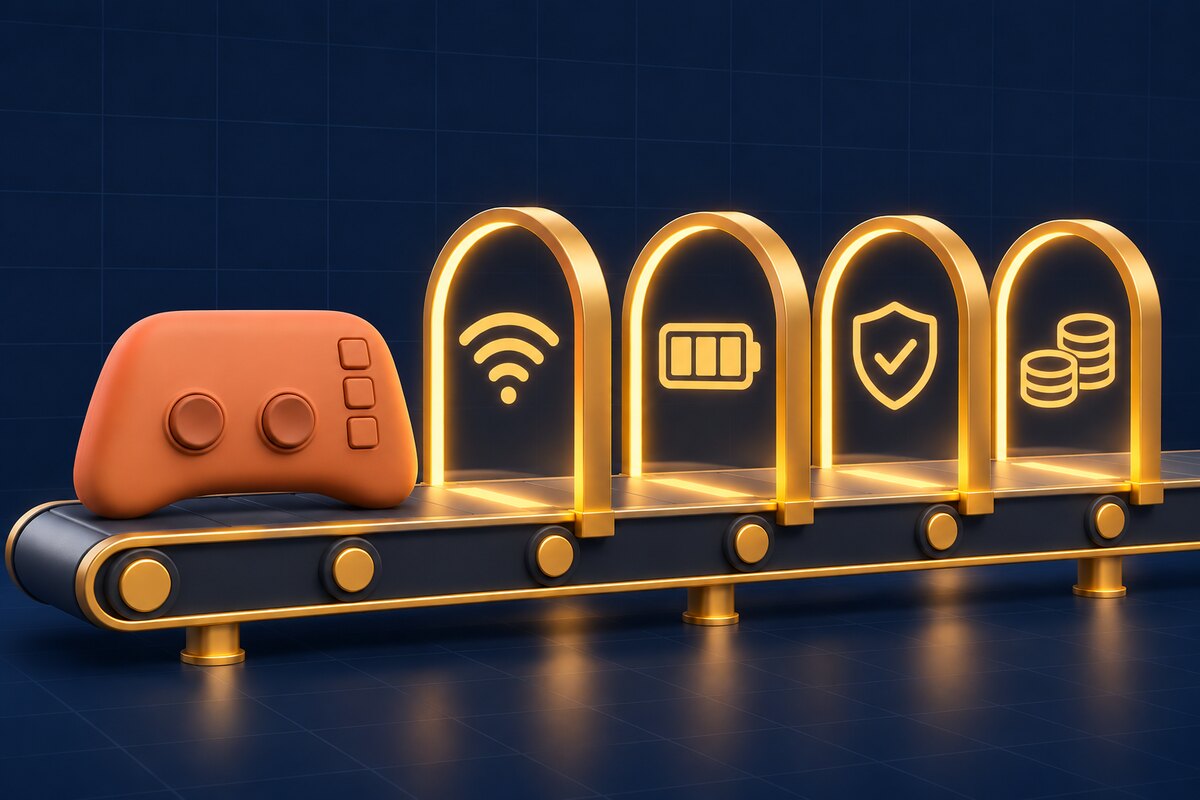
1Check for wireless function
If the specifications show Bluetooth, 2.4GHz or a wireless receiver, follow NCC rules; a wired controller connected only by a USB cable is not covered by NCC quantity rules.
2Count the quantity
For items with wireless function, up to 2 units per consolidated shipment can use a declaration; for 3 or more, ask NCC first; 10 units per person per year, and the person must be aged 18 or over.
3Check the battery
A built-in lithium battery needs a UN38.3 certificate and no more than 300Wh per battery, and goes by sea express only; for batteries sold alone and power banks, ask customer service first.
4Check commodity inspection
Use the tariff lookup to confirm the tariff line and import regulations; for items the Bureau of Standards, Metrology and Inspection requires inspection for, personal use can be exempt under the Regulations Governing Exemption from Commodity Inspection (in some cases the exemption code can be entered directly on the declaration), once per 6 months for the same specification and model.
5Calculate taxes and declare truthfully
Dutiable value of the batch of NT$2,000 or less is tax-free, 6 times per half-year; before sending to the warehouse, state "contains Bluetooth/2.4GHz wireless function" and the quantity in the parcel details, and do not split declarations or under-declare.
What does research say about the risks of wireless equipment, lithium batteries and online-bought goods?
Bluetooth and Wi-Fi interfere with each other's transmission when sharing 2.4GHz; lithium battery thermal runaway can cause fires; studies from the EU and Kazakhstan discuss the safety of online-bought goods and the declaration of low-value parcels. None of the following studies is about imports to Taiwan; they are background only, and this page does not recommend any product on their basis.
| Study | Finding | Limitation |
|---|---|---|
| Conti et al. (2003) | Uses an analytical model to evaluate packet error rates when Bluetooth and 802.11b (Wi-Fi) coexist in the same band, and derives the distance the two systems need to keep a given quality of service | Theoretical model, 2003 technology versions |
| Dai and Panahi (2025), literature review | Thermal runaway is the main failure mechanism of lithium-ion batteries and can cause fires and explosions, with mechanisms varying by battery material | Mostly laboratory-level studies |
| Mikolajczak and Moore (2002) | Discusses the effect of a passenger aircraft cargo hold fire on lithium-ion battery shipments, and presents US Federal Aviation Administration simulated cargo-hold fire tests; cargo hold fires are very rare events | A 2002 article; does not cover newer batteries and rules |
| Bucala et al. (2026) | Among 148 lithium battery fires recorded by Massachusetts fire departments, charging was involved in 40.5%; online purchase was associated with higher risk (odds ratio 1.87) | Reported cases from a single state only; a correlation, not causation |
| Ullrich (2019) | As online shopping has grown, sales of non-compliant consumer products have increased, and EU product safety and market surveillance has made poor progress in the face of e-commerce platforms | A legal commentary on the EU system, with no non-compliance rate statistics |
| Yeleussizova et al. (2024) | Using Kazakhstan as an example, changes to the duty-free threshold had a partial effect on e-commerce import volumes and under-declaration, and the study also confirms abuse of the threshold | A single-country case; cannot be applied directly to Taiwan |
| Mattioli (2021) | Consumers who mistakenly buy counterfeit hardware face financial, personal safety, privacy and cybersecurity risks | A short overview article, not an empirical study |
The studies only provide background; whether something can be shipped and how it is declared still follow Taiwan's Telecommunications Management Act, Commodity Inspection Act, Customs Act and Customs' determinations.
What terms come up when shipping game controllers to Taiwan?
- Controlled telecommunications radio-frequency device
- Equipment that emits radio waves and that NCC has announced must be approved before manufacture or import; Level 2 includes low-power radio-frequency devices, and Kaohsiung Customs explains that Bluetooth headsets and similar items fall in this level.
- Signed declaration (self-use)
- The declaration signed when importing controlled telecommunications radio-frequency devices for personal use; for mail, consolidation and other non-carried methods, up to 2 units per shipment can use a declaration instead of an import permit.
- Import permit
- The NCC-issued import approval document for controlled telecommunications radio-frequency devices; the regulation says mailed imports of 3 to 10 units need to apply.
- 602
- Import regulation code for goods: controlled telecommunications radio-frequency devices that must be approved for import need an NCC import permit, or clear customs with a type-approval certificate.
- C02
- Import regulation code for goods: some goods under this item are announced by the Bureau of Standards, Metrology and Inspection as subject to mandatory import inspection.
- Advance tariff classification ruling
- Before import, an application to Customs for an answer on the tariff line of specific goods; the answer is valid only for that case.
- UN38.3
- Lithium battery transport safety test; complete devices with the battery installed need a UN38.3 certificate, and for batteries sold alone and power banks, ask customer service first.
- Wh (watt-hour)
- Unit of battery energy; when only mAh is given, convert with mAh × voltage ÷ 1,000. HowBridge accepts up to 300Wh per battery.
- Dutiable value
- The value Customs uses to calculate tax, including the price of the goods and the freight and insurance to Taiwan.
What are the sources and the scope of verification?
The following sources were consulted on 2026-11-18; the document date and the consultation date are marked separately, and dates not stated are not made up. Customs classification cases come from the Customs Administration, Ministry of Finance open data included in the HowBridge tariff database; brands and models are not listed.
Government and official sources
- Laws & Regulations Database: Regulations Governing the Manufacture, Import and Reporting of Controlled Telecommunications Radio-Frequency Devices | Document date: 2025-02-03; Article 9, paragraph 3: for personal-use import by mail or other non-carried methods, up to 2 units per shipment can use a declaration, with no import permit needed; paragraph 2: quantities for an import permit application are 6–10 units when carried, and 3–10 units when mailed (the text mentions only mail); limited to 10 units per natural person or legal entity within one year, natural persons must be aged 18 or over; personal use only, not to be transferred or used commercially. Article 13: those who have obtained a type-approval certificate may import with the certificate.
- National Communications Commission: Self-use declaration for controlled telecommunications radio-frequency devices (Appendix 4-2, Executive Yuan Gazette Vol. 031, No. 018) | Document date: 2025-02-03; the declaration states compliance with technical specifications, personal use only, and no sale or other commercial purposes; low-power radio-frequency devices with only Bluetooth radio-frequency function may leave the operating frequency and output power blank.
- National Communications Commission: Amended announcement of "Controlled telecommunications radio-frequency devices that must be approved" (Tong-Chuan-Bei-Zi No. 11350043250) | Document date: 2025-02-03; Level 2 controlled telecommunications radio-frequency devices include low-power radio-frequency devices, effective immediately; the exceptions include three items such as wireless remote controls with a maximum radio-frequency output power of 1 milliwatt or less that meet the technical specifications.
- Laws & Regulations Database: Telecommunications Management Act | Document date: 2026-08-05; Article 65, paragraph 2: controlled telecommunications radio-frequency devices announced by the competent authority must be approved before manufacture or import; Article 80, paragraph 1, items 5 and 6: importing without approval or violating import management rules is fined NT$100,000–1,000,000, with a notice to correct within a time limit, and under paragraph 2 the equipment may be confiscated; Article 81, paragraph 1: selling controlled telecommunications radio-frequency devices not type-approved is punished by a warning or a fine of NT$10,000–200,000.
- Keelung Customs, Customs Administration, Ministry of Finance: Public notice on import rules for Bluetooth devices | Document date: 2026-03-17; threshold for no permit: up to 2 units per mailing or express shipment with a signed self-use declaration; mailed 3 to 10 units must apply to NCC for a permit in advance; excess quantity without a permit may involve penalties for violations or return of the goods.
- Ministry of Finance (Kaohsiung Customs): Kaohsiung Customs urges the public to note the quantity rules for importing "Level 2 controlled telecommunications radio-frequency devices" for personal use | Document date: 2021-03-31; 2021 explanation: Bluetooth headsets and similar items are Level 2 controlled telecommunications radio-frequency devices; excess quantity without an import permit cannot be released, and if abandonment is declared, because NCC has not agreed to auctioning, the goods can only be destroyed under customs supervision at the importer's cost or destroyed by Customs with the cost recovered afterward (it cites article numbers from before the regulation was amended).
- International Trade Administration, Ministry of Economic Affairs: Import regulation code table (602, C02) | Document date: not stated; 602 (rule effective 2022-04-15): controlled telecommunications radio-frequency devices that must be approved need an NCC import permit, and type-approved low-power radio-frequency devices clear customs with the type-approval certificate; C02 (rule effective 1999-05-01): some goods under this item are commodities announced by the Bureau of Standards, Metrology and Inspection as subject to mandatory import inspection.
- International Trade Administration, Ministry of Economic Affairs: Import regulations for goods (9504.50.00.90-3, 8471.60.90.90-3, 8518.30.32.00-5) | Document date: not stated; none of the three tariff lines has 602 in its import regulations (codes 123 and C02).
- International Trade Administration, Ministry of Economic Affairs: List of mainland China goods prohibited (MW0) / conditionally permitted (MP1) for import | Document date: not stated; list downloaded on 2026-11-18; 9504.50, 8471.60 and 8518.30 are not on it.
- Customs Administration, Ministry of Finance: Customs import tariff open data | Document date: 2025-04-24; the Column 1 rate of 9504.50.00.90-3, 8471.60.90.90-3 and 8518.30.32.00-5 is 0% for all.
- Bureau of Standards, Metrology and Inspection, Ministry of Economic Affairs: Items subject to mandatory inspection / verification (open data) | Document date: 2025-12-29; the scope of mandatory inspection for 9504.50.00.90-3 is head-mounted displays, video game consoles and electronic toys for children aged 14 or under (excluding TV game machines), with no item named after a controller, joystick or game controller; the whole tariff line 8471.60.90.90-3 (except medical devices and telecommunications terminal equipment) is subject to mandatory inspection; 8518.30.32.00-5 limits inspection to headphones with a power input.
- Bureau of Standards, Metrology and Inspection, Ministry of Economic Affairs: Batch-by-batch inspection items (9504.50.00.90-3 video game consoles) | Document date: 2023-07-25; video game consoles have been subject to mandatory inspection since 1991-03-15, with batch-by-batch inspection.
- Bureau of Standards, Metrology and Inspection, Ministry of Economic Affairs: Announcement allowing the six video game console products subject to mandatory inspection to print their own commodity inspection marks (Jing-Biao-San-Zi No. 10930005790) | Document date: 2020-10-30; Executive Yuan Gazette Vol. 026, No. 210; with a detail table of the six video game console products subject to mandatory inspection, reference tariff lines include 9504.50.00.90-3.
- Bureau of Standards, Metrology and Inspection, Ministry of Economic Affairs: Principles for Determining Toy Commodities (6th edition) | Document date: 2023-06-19; game console accessories with multiple information functions that can connect to a computer or TV are listed as toy commodities not subject to mandatory inspection (this only excludes the toy category).
- Laws & Regulations Database: Regulations Governing Exemption from Commodity Inspection | Document date: 2019-11-21; Article 5, paragraph 1: personal-use goods not for sale, for other commodities US$1,000 or less per declaration for the same specification and model, or more than that but not exceeding 2 pieces; for information technology equipment US$1,000 or less, or more than that but not exceeding 5 pieces; Article 3, paragraph 2: in some cases the exemption clearance code can be entered on the declaration yourself; Article 8: exemption for the same specification and model is limited to 1 time within 6 months.
- Bureau of Standards, Metrology and Inspection, Ministry of Economic Affairs: Application form for exemption from commodity inspection | Document date: 2023-09-26; the applicant must guarantee that exempted goods will never flow into the domestic market or be sold.
- Laws & Regulations Database: Customs Act | Document date: 2022-05-11; Article 49, paragraph 2: a batch whose combined dutiable value is at or below the limit announced by the Ministry of Finance is exempt; does not apply to frequent imports.
- Ministry of Finance: Tax exemption limit under Article 49, paragraph 2 of the Customs Act (Tai-Cai-Guan-Zi No. 1061018778 announcement) | Document date: 2017-09-07; limit NT$2,000, exempt from customs duty, business tax and commodity tax.
- Ministry of Finance: Principles for determining frequent imports (Tai-Cai-Guan-Zi No. 1061011007 order) | Document date: 2017-05-26; the exemption no longer applies once the same taxpayer has more than 6 tax-exempt releases within a half-year (months 1–6 and 7–12), based on the import date on the declaration.
- Taipei Customs, Customs Administration, Ministry of Finance: Why tax is still payable on express-shipped import goods priced at no more than 2,000 | Document date: 2023-09-14; dutiable value includes the transaction price, freight and insurance, so if the purchase price does not exceed 2,000 but exceeds it after adding freight and insurance, tax is still charged.
- Customs Administration, Ministry of Finance: How Customs levies business tax on imported goods | Document date: 2026-07-09; business tax = (dutiable value + import duty + commodity tax or tobacco and alcohol tax + tobacco health and welfare surcharge) × business tax rate.
- Laws & Regulations Database: Value-added and Non-value-added Business Tax Act | Document date: 2025-05-28; Article 20, paragraph 1: calculation of the tax base for business tax on imported goods.
- Laws & Regulations Database: Regulations Governing the Clearance of Sea Express Cargo | Document date: 2026-02-23; Article 12, paragraph 1, item 2: goods subject to import or export rules are cleared with a general import declaration (except special cases announced by Customs); Article 15: the same batch may not be declared separately; Article 16: items subject to mandatory inspection (or quarantine) or other permit requirements are handled according to the rules; Article 30: tax is combined when declared separately; Article 3: goods infringing intellectual property rights may not be cleared in the express zone.
- Laws & Regulations Database: Regulations Governing the Clearance of Air Express Cargo | Document date: 2026-02-23; Article 12, paragraph 1, item 2: goods subject to import or export rules are cleared with a general import declaration; Article 14: the same batch may not be declared separately (with provisos); Article 15: items subject to mandatory inspection (or quarantine) are handled according to the inspection rules.
- Keelung Customs, Customs Administration, Ministry of Finance: Keelung Customs notes for cross-border online shopping by sea express | Document date: 2026-10-20; radio-frequency devices such as Bluetooth are conditionally permitted goods and must be cleared by formal customs declaration; the import date means the date the means of transport arrives at a port of Taiwan; separate declarations of the same batch are combined for tax, and false declarations are penalized under the Customs Anti-Smuggling Act.
- Customs Administration, Ministry of Finance: Please note import rules for cross-border online shopping for smooth clearance | Document date: 2021-11-09; express cargo subject to import rules must be cleared with a general import declaration and may not be cleared with a simplified express declaration form.
- Laws & Regulations Database: Customs Anti-Smuggling Act | Document date: 2018-05-09; Article 39-1: goods declared for import that infringe trademark, copyright or patent rights are fined up to 3 times the value of the goods, and the goods are confiscated.
- Laws & Regulations Database: Trademark Act | Document date: 2023-05-24; Article 72: the trademark owner may apply for Customs to seize goods; Article 75: when Customs finds goods clearly likely to infringe it must notify the trademark owner and the importer or exporter, and where the trademark owner has provided evidence of infringement and the importer has not provided proof of non-infringement it may withhold release; Article 97: criminal liability for selling, or importing with intent to sell, goods bearing a counterfeit trademark.
- Laws & Regulations Database: Copyright Act | Document date: 2022-06-15; Article 87, paragraph 1, item 3: importing copies made without authorization is deemed infringement; the personal-use exception in Article 87-1 does not apply to piracy; Article 93, item 3: criminal liability; Article 90-1: Customs seizure can be applied for.
- Customs Administration, Ministry of Finance: Advance tariff classification rulings for imported goods (Government Open Data Platform 6713, included in the HowBridge tariff database) | Document date: not stated; Bluetooth gamepad and joystick cases 101CA0091, 101CA0092, 102AA0816 and 104BA0148 fall under 9504.90.90.00-5; 106CA0312 and 107CA0055 under 9504.50.00.90-3; wireless keyboard controller 106CA0311 and motion sensor 102AA0351 under 8471.60.90.90-3.
Research literature
Thermal runaway process in lithium-ion batteries: A review
Literature review: thermal runaway is the main failure mechanism of lithium-ion batteries and can cause serious fires and explosions, with mechanisms varying by battery material; the authors note that most work is laboratory-level and needs further clarification. This page uses it only as background on lithium battery transport restrictions.
The passenger aircraft cargo hold environment: the implications of a fire on lithium-ion battery shipments
Outlines the passenger aircraft cargo hold layout and fire suppression systems, discusses the effect of a cargo hold fire on lithium-ion battery shipments, and presents FAA simulated cargo-hold fire test results; the abstract calls cargo hold fires a "very rare" event. Limitation: a 2002 article that does not cover newer batteries and rules. This page uses it only as background on air transport restrictions for lithium batteries.
Device-Specific Fire Risk Analysis of Lithium-Ion Battery Incidents: Engineering Implications for Detection and Protection Systems
Analyzes 148 lithium battery fires recorded by Massachusetts fire departments in the US: charging was involved in 40.5% of cases, online purchase was associated with higher risk (OR = 1.87, 95% CI 1.23–2.84), and for consumer electronics relative to other devices, the odds of a charging-related fire were lower. Limitation: a single state and 148 reported cases, a correlation rather than causation. This page uses it only as background on lithium battery fire risk.
Bluetooth and IEEE 802.11b coexistence: analytical performance evaluation in fading channels
Uses an analytical model to evaluate the packet error probability when Bluetooth and IEEE 802.11b coexist, and derives the relative distance the two systems need for a given quality of service (the coexistence range); whether there is line-of-sight propagation clearly affects that distance. Limitation: a theoretical model and 2003 technology versions. This page uses it only as background on coexistence interference in the 2.4 GHz band.
New Approach meets new economy: Enforcing EU product safety in e-commerce
Legal analysis: as the internet has grown, sales of non-compliant and illegal consumer products have increased, and the current EU product safety and market surveillance system has made poor progress in the face of e-commerce platforms. Limitation: a legal commentary on the EU system, not specific to Taiwan or wireless products, and with no non-compliance rate statistics. This page uses it only as background on the safety oversight of online-bought goods.
Cross-border Retail E-Commerce and De Minimis: The Case of Kazakhstan
Uses the situation and statistical analysis of Kazakhstan to examine low-value cross-border e-commerce parcels and duty-free thresholds: changes to the de minimis threshold had a partial effect on the rise in e-commerce import volumes and the fall in under-declared values, but under-declaration had little effect on tax revenue, and abuse of the threshold was confirmed. Limitation: a single-country case that cannot be applied directly to Taiwan. This page uses it only as background on duty-free thresholds for low-value parcels.
Consumer Exposure to Counterfeit Hardware
Short article: consumers who mistakenly buy counterfeit hardware face financial, personal safety, privacy and cybersecurity risks; the author also argues the pandemic may make the problem worse. Limitation: the abstract is an overview, not an empirical sampling study. This page uses it only as background on the risks of counterfeit hardware.
On whether express or consolidated shipments of 3 or more units can apply for an import permit in the same way as mail, whether a controller-and-receiver set counts as 1 or 2 units, and whether "one shipment" is counted by declaration or by parcel, no first-hand explanation from NCC was found this time; whether an ordinary buyer can import on the type-approval certificate of the same model that already has NCC type approval was also not found in any first-hand explanation this time. Whether game controllers themselves are subject to mandatory inspection by the Bureau of Standards, Metrology and Inspection: no announcement or Q&A specific to controllers was found this time; the scope of mandatory inspection under 9504.90.90.00-5 was not checked this time. The ruling cases are individual cases from 2012–2018. The handling described by Kaohsiung Customs and Keelung Customs is the public explanation of individual customs offices.
What are the common questions about shipping game controllers to Taiwan?
Do wired controllers also need to follow NCC?
What if I buy 3 wireless controllers at once?
Can I send two batches of 2 controllers each?
Can someone under 18 sign the declaration themselves?
A controller and a USB receiver are sold together; does that count as 1 unit or 2?
The controller's tariff line has no 602; does that mean NCC can be ignored?
Can a wireless controller go by air?
A controller costs NT$1,800; will it be taxed after freight is added?
Can I resell a wireless controller imported for personal use once I'm tired of it?
Is a mainland China version of a controller a counterfeit?
Is HowBridge a customs broker?
Further reading
More than 2 wireless controllers: ask NCC before shipping
If an item has wireless function and is more than 2 units, ask NCC first; for batteries sold alone and power banks, ask customer service first, and do not send to the warehouse until confirmed. Wireless controllers and wireless headsets go by sea express only, and you can estimate freight first.
Estimate freight