Buying a Mechanical Keyboard in China: How Do You Ship It Back to Taiwan?
Can a mechanical keyboard bought in China be shipped to Taiwan?
Yes. For mechanical keyboards, keycaps, switches and custom kits bought on Taobao, Tmall, JD.com, Pinduoduo, Xianyu and similar platforms, enter the HowBridge Shenzhen consolidation warehouse as the delivery address; once the parcels have arrived they are combined into one box and sent to Taiwan by air freight, sea express or sea LCL cargo. HowBridge only handles mainland China→Taiwan and does not buy on your behalf or pay sellers for you. Tariff side: the first-column duty rate for wired keyboards (8471.60.30.90-6) and wireless keyboards (8471.60.30.10-3) is 0% (placing a finished wired mechanical keyboard under "other keyboards" is an inference; there is no advance tariff ruling for mechanical keyboards); business tax is (dutiable value + duty) × 5%, and the dutiable value includes freight to the Taiwan port of entry; the electrical appliances category in Article 11 of the Commodity Tax Act does not list keyboards among its taxable items. NT$2,000 or less is tax-free: postal parcels are exempt from duty, commodity tax and business tax under the clearance regulations, but the exemption no longer applies once the same recipient has had duty-free releases more than 6 times within a half-year period (January–June, July–December; months 1–6 and 7–12); air express has its own low-value duty-free category, and whether goods carrying C02 or 602 can use it is not spelled out tariff line by tariff line in the provisions. Inspection side: wired keyboards (Declaration of Conformity table, item 6) and wireless keyboards (Certification Registration table, item 19) are in the BSMI item lists; keycaps, switches, DIY kits and keyboard circuit boards are not found in the three electronics lists, which does not mean they are exempt; whether a keyboard is an "information equipment commodity" under the Regulations Governing Exemption from Commodity Inspection is not defined and not expressly stated, so ask your customs broker whether inspection exemption code CI000000000010 may be entered. The import regulation column for wireless keyboards carries 602; for self-use items that are Class 2 regulated telecommunications radio-frequency equipment and are imported by mail, up to 2 units at a time may be imported by written undertaking (whether an individual product is on the announced list of regulated equipment is not found in the sources checked). Having no MW0 does not mean lawful clearance: commodities subject to mandatory inspection and regulated telecommunications radio-frequency equipment must still comply, and counterfeit and infringing goods cannot be imported. Bluetooth keyboards with a built-in lithium battery: please ask customer service first; whether pre-ordered and group-buy goods are covered by the seven-day right of withdrawal is not found in the sources checked. Rates follow the Customs tariff in force at the time of declaration.
No. HowBridge only provides mainland China→Taiwan consolidation and does not buy on your behalf; place and pay for your order yourself on the seller's store. It also does not offer shipping from Japan, Korea, the United States or Europe to Taiwan; this page does not cover merchants, group-buy platforms or price differences outside China. HowBridge has warehouses only in Shenzhen and Taoyuan.
How are mechanical keyboards classified in the tariff? What is the duty?
The tariff has no dedicated tariff line for "mechanical keyboards". The table below is the result of line-by-line lookups in the Customs Administration's tariff open data (product names are excerpted; text in parentheses is this page's note). The first-column duty rate is 0% for both wired and wireless keyboards; apart from the advance ruling on keycaps, advance rulings for the classification of the other parts and kits are mostly not found, so tariff lines outside the table are as determined by Customs:
| 11-digit tariff code | Product name (excerpt; parentheses are this page's notes) | Column 1 duty | Import regulation |
|---|---|---|---|
8471.60.30.90-6 | Other keyboards (a finished wired mechanical keyboard is presumed to fall here; the advance ruling case is a wired keyboard connected to a medical computer host, case no. 100AA0348) | 0% | Blank |
8471.60.30.10-3 | Wireless keyboards (Bluetooth or 2.4G keyboards are presumed to fall here; the advance ruling case is a wireless remote control combining a keyboard and a gyroscope mouse, case no. 103CA0112; a wireless keyboard gamepad with a touchpad, 106CA0311, is classified under 8471.60.90.90-3) | 0% | 602 C02 |
8473.30.00.00-6 | Parts and accessories of machines of heading 8471 (the advance ruling case for keyboard-specific keycaps (unprocessed) falls here) | 0% | Blank |
8536.50.90.00-7 | Other switches, for a voltage not exceeding 1000 volts (whether key switches fall here is not found in advance rulings; the advance ruling for membrane key contacts falls here) | 0% | C02 MP1 |
8534.00.00.11-6 8534.00.00.20-5 | Printed circuits (rigid single-sided; flexible) | 0% | Blank |
7616.99.90.00-5 | Other articles of aluminium (whether an aluminium plate or case falls here is not found in advance rulings) | 5% | Blank |
3926.90.90.90-8 | Other articles of plastics and articles of other materials of headings 3901 to 3914 (whether a plastic case falls here is not found in advance rulings) | 5% | C02 F02 |
3403.19.10.00-4 | Lubricating greases (for lubricating switches; this page's note) | 3.5% | Blank |
8544.42.10.00-5 | Electric conductors for telecommunications, fitted with connectors, for a voltage not exceeding 1000 volts (USB cables) | 0% | Blank |
8544.42.90.90-9 | Other electric conductors, fitted with connectors, for a voltage not exceeding 1000 volts | 5% | C02 |
8517.62.00.00-5 | Machines for the reception, conversion and transmission or regeneration of voice, images or other data, including switching and routing apparatus (this page's note: the advance rulings for USB Bluetooth and 2.4G modules fall here) | 0% | C02 |
What about custom kits, switches, wrist rests and keycap pullers?
For finished mechanical keyboards, DIY custom kits, switches, plates, cases, keyboard circuit boards, switch lubricant, wrist rests and keycap pullers, no Customs Administration advance ruling is found, and the tariff has no dedicated tariff line for these items. For keycaps there is one advance ruling (2016-01-06, case no. 105AA0022, declared as keyboard-specific keycaps (unprocessed), ABS material) classified under 8473.30.00.00-6; whether printed or dyed finished keycaps are covered is not found; the core of a commercial keyboard (PCBA and plastic keycaps, 2018-03-07, case no. 107AA0176) is classified under 8473.29.00.00-9 and can only be used as an analogy. The classification of kits and switches is determined by Customs from the physical goods, and this page does not presume a tariff code.
How to read the codes in the import regulation column
According to the notice of the International Trade Administration (formerly the Bureau of Foreign Trade), Ministry of Economic Affairs, dated 2022-04-13 (Executive Yuan Gazette 2022-04-14), C02 means "some of the commodities under this item are commodities subject to mandatory import inspection announced by the Bureau of Standards, Metrology and Inspection", that is, some commodities, not that the whole tariff line must be inspected; 602 means regulated telecommunications radio-frequency equipment that must be approved, and equipment that has passed type approval needs no import approval certificate but clears Customs on the strength of the approval documents; MW0 means mainland China goods not permitted to be imported, MP1 means imports permitted with conditions, and blank means imports are permitted without an import permit. The import regulation column for wired keyboards is blank, but the BSMI item list does include wired keyboards, so a blank tariff column does not mean inspection-exempt. The definitions of the codes such as Z in the collection/enforcement column and F02 in the import regulation column are not found, and this page does not explain them.
Limits of the tariff data
The tariff CSV shows no publication date, so actual rates and import regulations follow the Customs tariff in force at the time of declaration. The 0% rate is the result of checking each tariff line; the 5% on the aluminium and plastic articles lines applies only if a case or plate is determined to fall under that line.
How much tax applies to a keyboard? Does the NT$2,000-or-less exemption apply?
Start with the formulas published by the Customs Administration: duty = dutiable value × rate; business tax = (dutiable value + duty + commodity tax, etc.) × 5%; trade promotion service fee = dutiable value × 0.04%, waived at NT$100 or less. Article 10 of the Value-added and Non-value-added Business Tax Act only sets the rate at no less than 5% and leaves the collection rate to the Executive Yuan; the source of the figure 5% is the Customs Administration's taxes-and-fees page. The dutiable value is the CIF value of imported goods, and Article 29 of the Customs Act expressly requires freight, loading and unloading charges, handling charges and insurance to the port of entry to be included, so freight is also part of the taxable base.
| Item | Postal parcel | Express |
|---|---|---|
| Duty-free threshold | Dutiable value of NT$2,000 or less is exempt from duty, commodity tax and business tax (Regulations Governing Customs Clearance of Import and Export Postal Parcels, Article 7) | Dutiable value of NT$2,000 or less is low-value duty-free (Regulations Governing Customs Clearance of Air Express Cargo, Article 11; Customs Administration express page) |
| Above the threshold | Taxed on the full amount (Article 8) | NT$2,001 to NT$50,000 is low-value dutiable; above NT$50,000 is high-value express |
| Aggregation and other rules | Two or more parcels from the same sender to the same recipient arriving on the same day are aggregated for dutiable value (Article 11); items subject to mandatory inspection or other import and export regulations are handled under those regulations (Article 13) | The same batch of express cargo must not be declared separately (Article 14) |
| What counts as frequent | The same recipient has had duty-free releases more than 6 times within a half-year period (Article 12, expressly stated in the provision) | The same taxpayer has had duty-free releases more than 6 times within a half-year period (Customs Administration express page; the body of the regulations does not define it) |
| Half-year period | January to June and July to December each year (months 1–6 and 7–12), not a rolling six months | Same as left, and the count restarts on January 1 (1/1) and July 1 (7/1) each year |
| Weight per piece | Gross weight of 30 kg or less (Article 3) | Gross weight of 70 kg or less (Article 6) |
Is commodity tax charged on keyboards?
The taxable items listed under the electrical appliances category in Article 11 of the Commodity Tax Act are refrigerators, air conditioners and heaters, dehumidifiers, audio sets and electric ovens; keyboards, keycaps and switches are not in this category (this page only checked the electrical appliances category); the Customs Administration's taxes-and-fees page also says items not subject to commodity tax under the Commodity Tax Act are exempt from commodity tax.
Formula example (not a quotation)
Suppose Customs assesses a dutiable value of NT$10,000 and a duty of 0% (an example only, not the rate of any product), with no commodity tax: duty NT$0; business tax (10,000 + 0) × 5% = NT$500; trade promotion service fee 10,000 × 0.04% = NT$4, waived at NT$100 or less. The example excludes customs clearance, delivery and warehousing fees.
Combining boxes saves freight; it is not splitting orders to avoid tax
Article 14 of the Regulations Governing Customs Clearance of Air Express Cargo provides that express operators or customs brokers must not split the same batch of imported express cargo into separate declarations, except where the total does not exceed the duty-free limit or, although it exceeds it, the taxes and fees are declared and paid voluntarily; the on-site freight notes also state that splitting orders into separate declarations to evade the duty-free amount is illegal, while combining boxes to save freight is lawful. Declare the item name, quantity and price honestly, and pay tax where tax is due.
Article 12 of the Regulations Governing Customs Clearance of Air Express Cargo requires express cargo "involving import and export regulations" to be handled with a formal import declaration (except special circumstances announced by Customs), and the BSMI Q&A also says commodities subject to mandatory inspection cannot use a simplified declaration. When a wireless keyboard (602 and C02) falls into this situation, whether the NT$2,000 exemption still applies is not spelled out in the provisions and this page does not draw a conclusion; leave it to your customs broker to decide case by case.
Do keyboards and parts from China need an import permit?
The keyboard-related tariff lines do not carry MW0. The Customs Administration explains that where the import regulation column lists neither MW0 nor MP1, the mainland China goods under that item are permitted to be imported and no import permit is needed; items listing MW0 are not permitted for import according to the Customs Administration, but MW0 does not mean never shippable. The tariff lines above for wired keyboards, wireless keyboards, computer parts, printed circuits, aluminium and plastic articles, lubricating grease, USB cables and Bluetooth modules have no MW0. MP1 (imports permitted with conditions) appears on other switches 8536.50.90.00-7: if switches are determined to fall under this line, the summary table of applicable conditions is not found in the sources checked, so please consult customer service first.
Ministry of Economic Affairs notice Jing-Mao-Zi No. 11104603570 of 2022-08-19: for mainland China industrial products outside the "Table of Restricted Import Goods" (tariff chapters 25 to 97), where the CIF value assessed by Customs for the whole import declaration is NT$32,000 or less and a single product is 24 pieces or fewer (40 kg or less for goods that cannot be counted in pieces), release without a permit is allowed and the import need not follow the "MXX" rules; specified articles are excluded by Ministry of Economic Affairs notice (2026-03-10, Jing-Mao-Zi No. 11550200230). A "single product" is determined by model and may not be split by size, specification or colour. Item 3 of the notice further states that other import regulations still apply, so a permit exemption does not mean lawful clearance.
"No MW0" only means no import permit is required. Wired and wireless keyboards are in the BSMI item lists, and wireless keyboards carry 602, meaning that if an item is regulated telecommunications radio-frequency equipment that must be approved, it must be handled under NCC rules; goods that infringe trademark, copyright or patent rights may not be imported under Article 15 of the Customs Act, and counterfeit goods are not express cargo either, so a permit exemption does not mean lawful clearance.
Do keyboards, keycaps and switches need BSMI inspection? How is the inspection exemption code used?
Article 6 of the Commodity Inspection Act: commodities subject to mandatory inspection that do not meet the inspection requirements may not leave the factory or be exported or imported (except commodities that BSMI has determined to be of low hazard risk). There is room for inspection exemption for personal use: Article 5, paragraph 1, subparagraph 7 of the Regulations Governing Exemption from Commodity Inspection covers information equipment commodities whose total value per declaration for the same specification and model is US$1,000 or less, or exceeds US$1,000 but the quantity does not exceed 5 units, and which are non-sale articles for self-use, commercial samples, exhibition items or items for research and testing; BSMI's "Commonly Used Inspection Exemption Clearance Codes" table maps this to CI000000000010. The BSMI item list describes keyboards under the category "information products", but the exemption regulations do not define "information equipment commodities" and whether the two are equivalent is not expressly stated, so ask your customs broker whether that code may be entered; for commodities subject to mandatory inspection that are not information equipment commodities, the code table also has CI000000000002 (total value per declaration for the same specification and model of US$1,000 or less, any quantity). Items in the item list that relate to keyboards:
| Commodity | BSMI item list | Note |
|---|---|---|
| Wired keyboard | Declaration of Conformity table (2026/3/8), item 6 "wired keyboard", reference tariff code 8471.60.30.90-6 | The inspection method is a declaration of conformity; the standard column covers only products powered by AC mains, rechargeable lithium-type batteries or an additional power conversion device |
| Wireless keyboard | Certification Registration and Type Approval table (2026/9/23), item 19 "wireless keyboard", reference tariff code 8471.60.30.10-3 | The inspection method is certification registration (modes 2+3) or batch-by-batch type-approval inspection; medical devices and telecommunications terminal equipment are excluded |
| Keyboard with a built-in lithium battery | Covered by the power-source conditions in the keyboard items above; item 9 "3C secondary lithium power bank" is a power bank, not a keyboard | Whether BSMI requires a separate battery item for a battery built into a keyboard is not expressly stated |
| Custom kit (unassembled case, plate, circuit board, etc.) | No dedicated item in the three electronics lists | Whether the keyboard items apply is not expressly stated |
| Keycaps, switches, keyboard circuit boards, USB cables, lubricant | No dedicated item for these names in the three electronics item lists | The tariff code of keycaps, 8473.30.00.00-6, is also a reference tariff code of item 14 of the Declaration of Conformity table (motherboards and add-in cards with I/O), and whether the two are related is not expressly stated; other category lists were not checked on this page, which does not mean exemption |
Conditions for inspection exemption
When applying to BSMI for exemption for several declarations of the same specification and model on the same import date, the amounts and quantities must be aggregated; exemption for the same specification and model is limited to once within six months (Article 8 of the exemption regulations, with exceptions such as special-case approval). A BSMI Q&A of 2023-09-26 (scenario: laptops as commercial samples) says that up to 5 units may be entered directly with CI000000000010 on the import declaration, while 6 units require prior special-case approval; whether keyboards are treated the same way is not expressly stated.
Exemption is for self-use only; you cannot sell or give the goods away
The BSMI Q&A states that goods imported under exemption may not be used for sale or gifting; Articles 16 and 17 of the exemption regulations provide that exempted commodities that are to be circulated in the domestic market must undergo inspection, and except where inspected and found compliant they may not be sold in the domestic market. Where an exempted commodity is turned into one circulated in the domestic market, the party obliged to apply for inspection must apply to the inspection authority for inspection (Article 16, paragraph 4); to change the use, those who applied for exemption in advance apply to the authority that originally agreed to the exemption, and those who cleared with an exemption clearance code apply to the local inspection authority with jurisdiction (Article 16, paragraphs 1 and 3).
Express imports need a formal import declaration
BSMI Q&A: commodities subject to mandatory inspection imported by air or sea express may not use a simplified declaration and must be declared with a formal import declaration; if commodities subject to mandatory inspection are imported without completing the inspection procedure and are caught, an administrative fine is imposed.
Who the penalty applies to
Article 8 of the Commodity Inspection Act provides that for commodities produced abroad, the party obliged to apply for inspection is the importer; the administrative fine in Article 60 (NT$200,000 to NT$2,000,000; 20 wan to 200 wan) applies to a party obliged to apply for inspection who imports or exports commodities that do not meet the inspection requirements, and Article 60-1 further provides that where the total price of the commodities is less than NT$100,000 (10 wan), an administrative fine of up to 2 times the total price may be imposed, but not less than NT$10,000 (1 wan). Non-sale articles for self-use also have Article 9, paragraph 1, subparagraph 3 of that Act and the room for exemption under the exemption regulations; whether an individual who buys online for self-use is fined, this page does not draw a conclusion and does not write it as a certain penalty; goods bought to resell or give away are not self-use.
Do Bluetooth or 2.4G wireless keyboards need NCC certification?
Article 65 of the Telecommunications Management Act: regulated telecommunications radio-frequency equipment announced by the competent authority may be imported only after approval; Article 66: it may be sold only if it meets the technical specifications and has passed type approval; Article 80: whoever imports regulated telecommunications radio-frequency equipment without approval is subject to an administrative fine of NT$100,000 to NT$1,000,000 (10 wan to 100 wan), and the equipment may be confiscated regardless of who owns it. The subject of the penalty is the person who imports "without approval", and this page does not write it as meaning the buyer will certainly be fined.
Up to 2 units at a time by mail for self-use
Article 9 (2025-02-03) of the Regulations Governing the Manufacture, Import and Declaration of Regulated Telecommunications Radio-Frequency Equipment applies to Class 2 regulated telecommunications radio-frequency equipment (Article 3 divides it into Class 1 and Class 2): for wireless telecommunications terminal equipment or low-power radio-frequency equipment for self-use, imported by mail or other means not carried personally, no more than 2 units at a time may be imported by written undertaking without applying for an import approval certificate; 3 to 10 units by mail require an application; the limit is 10 units per natural person or legal entity per year, and a natural person must be at least 18 years old; the equipment is for self-use only and may not be transferred or used commercially. The provision does not name express or consolidation shipping, and the NCC's interpretation regarding consolidation is not found in the sources checked.
How to read 602 in the tariff
Wireless keyboards (8471.60.30.10-3) carry 602; wired keyboards (8471.60.30.90-6) do not carry 602; the tariff line for USB Bluetooth and 2.4G modules (8517.62.00.00-5) carries only C02 and not 602, but it cannot be inferred from this that they are certainly exempt or certainly need NCC type approval. Whether Bluetooth and 2.4G wireless keyboards are on the announced list of regulated telecommunications radio-frequency equipment: this page could not retrieve the original text of the announcement on the NCC website (access denied), so it draws no conclusion.
How many units does a keyboard plus a receiver count as?
Whether one keyboard plus one USB receiver counts as one unit or two under the "2 units" rule, no NCC interpretation was found, so it is not found in the sources checked; before ordering, send customer service the model and whether a receiver is included, and first confirm whether the product contains a wireless module. For wired keyboards and for keycaps and switches with no wireless radio-frequency function, no basis for NCC control is found in the sources checked on this page.
How to avoid pitfalls with second-hand items, collaboration keycaps and counterfeits?
Keyboards and keycaps often come as second-hand transfers, anime or game collaboration artwork, and imitation designs. What can be found on the legal side:
| Law | Provision (subject and elements) | Article |
|---|---|---|
| Customs Act: import prohibited | Goods infringing patent rights, trademark rights or copyright may not be imported | Article 15 |
| Trademark Act: criminal liability (currently effective text) | Anyone who, for marketing purposes and without the consent of the trademark owner, uses on identical goods or services a trademark identical to a registered trademark, etc., is subject to imprisonment of up to three years, detention, or a criminal fine of up to NT$200,000 (20 wan), imposed alternatively or cumulatively | Article 95 |
| Trademark Act: criminal liability (currently effective text) | Anyone who, "knowingly", sells goods of the preceding two articles made by another, or, "with intent to sell", possesses, displays, exports or imports them, is subject to imprisonment of up to one year, detention, or a criminal fine of up to NT$50,000 (5 wan), imposed alternatively or cumulatively, and the same applies where done through electronic media or the internet (the versions of Articles 68, 70 and 95 to 97 amended in ROC year 111 have not yet taken effect); the provision makes no separate rule for purely personal use, and this page does not draw a conclusion | Article 97 |
| Copyright Act: deemed infringement | Importing reproductions or plate-made copies made without the authorization of the copyright owner or the plate right owner is deemed infringement of copyright or plate right (paragraph 1, subparagraph 3) | Article 87 |
| Copyright Act: criminal liability (currently effective text) | Anyone who infringes another's copyright by the means in Article 87, paragraph 1, subparagraph 3, etc., is subject to imprisonment of up to two years, detention, or a criminal fine of up to NT$500,000 (50 wan), imposed alternatively or cumulatively (the case in Article 87, paragraph 1, subparagraph 6 is governed separately by Article 91-1); the provision does not separately distinguish self-use from business use, whether an offence is made out depends on the case, and this page does not draw a conclusion | Article 93 |
| Copyright Act: distribution and possession (currently effective text) | Anyone who, "knowingly", distributes reproductions that infringe economic rights in a work, or "with intent to distribute" publicly displays or possesses them, is subject to imprisonment of up to three years and may also be given a criminal fine of NT$70,000 to NT$750,000 (7 wan to 75 wan) (the versions of Articles 91, 91-1 and 100 amended in ROC year 111 have not yet taken effect) | Article 91-1 |
The tariff does not distinguish new from used; second-hand rules not found
The tariff classifies by function, and the Chinese product names do not list keyboards and parts separately as new or used; no special import rules for second-hand computers and information products, and no advance rulings on second-hand components, are found in the sources checked on this page. Second-hand goods cannot be treated as always inspection-exempt, nor as always requiring inspection; whether they are commodities subject to mandatory inspection depends on the item.
Is collaboration artwork piracy?
Article 87, paragraph 1, subparagraph 3 of the Copyright Act deems a person who imports reproductions made without the authorization of the copyright owner to infringe copyright; whether an artwork is a protected work and whether the seller has obtained authorization is not found in any primary determination in the sources checked on this page, so it cannot be said that collaboration keycaps are always pirated, nor that they are certainly fine. Buy from official flagship stores or authorized sellers, and keep screenshots of the product page and proof of payment.
Patents and design
Article 58 of the Patent Act provides that working a patented product invention includes offering it for sale, selling it, using it, or importing it for those purposes, and Article 15 of the Customs Act also provides that goods infringing patent rights may not be imported; whether a particular keyboard structure (for example hot-swap or magnetic switches) falls within a patent is not found in any primary determination in the sources checked on this page, and the provision on the scope of "import" for design patents is also not found.
How are pre-orders, group buys and made-to-order keyboards handled?
Custom keyboards and keycaps are often ordered through pre-orders or group buys (Group Buy), and delivery dates are not fixed. HowBridge only handles consolidation after parcels arrive at the warehouse, and does not buy on your behalf or pay sellers for you (Terms of Service, clause 1.1):
Delivery may be later than expected
Mollick (2014, Journal of Business Venturing) analysed more than 48,500 crowdfunding projects and found that more than 75% delivered later than expected; the study was published in 2014, and its abstract does not say which platforms, what range of years, or whether it is limited to keyboards, so it cannot be written as saying that all keyboard group buys are delayed. When a pre-ordered item reaches the warehouse depends on the seller; parcels that arrive first are stored free of charge for 366 days at the Shenzhen warehouse and are combined into one box once everything has arrived.
Whether the seven-day right of withdrawal applies is not found
Article 19, paragraph 1 of the Consumer Protection Act: in a distance sale, the consumer may rescind the contract within seven days after receiving the goods, except where the distance sale has reasonable exceptional circumstances; Article 2, subparagraph 2 of the Standards for Reasonable Exceptions to the Right of Withdrawal in Distance Sales lists customized (made-to-order) performance at the consumer's request as an exception (the business operator must have informed the consumer of the exclusion). The provision does not state a territorial scope; whether it applies when buying from a Chinese e-commerce seller, and whether pre-orders and group buys count as customized performance, is not found in any competent authority's interpretation in the sources checked on this page. Before ordering, read the seller's page on returns, exchanges and pre-orders carefully and keep screenshots.
Platform rules were not checked on this page
The pre-order, deposit and refund rules of Taobao, Tmall, JD.com, Pinduoduo and Xianyu were not verified on this page and are not written here; follow the seller's page and the platform's instructions. The exception to the seven-day cooling-off period in clause 10.3 of the HowBridge Terms of Service concerns transport services that HowBridge has already performed, which is a separate matter from the seller's sale of goods.
How should keyboards and parts be packed? How are breakage and loss compensated?
For custom keyboards, keycaps and switches, read the compensation and shipping rules first:
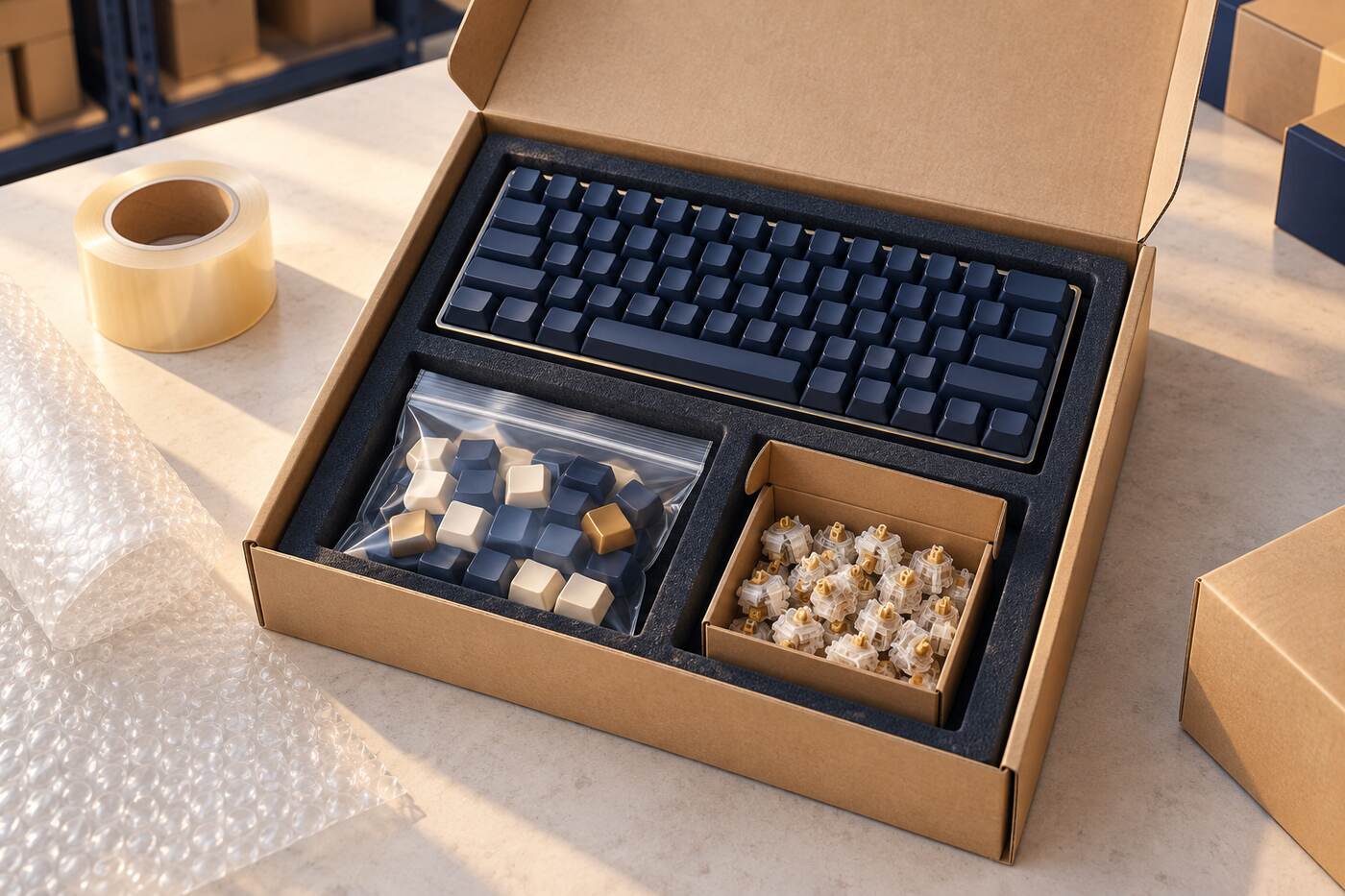
On-site compensation rules
HowBridge Terms of Service clause 7.1: no declared-value (cargo transport insurance) service is provided; for a lost parcel, compensation is up to three times the freight of that parcel; breakage of fragile items or battery-powered goods is not compensated, and other breakage is decided case by case; complaints must be filed within 7 days after signing for the parcel (clauses 6.3 and 8.2). Clause 4.2 lists high-value items as requiring advance declaration and recommends reinforced packing and split shipments; the terms do not list keycaps or switches as fragile items and have no keyboard-specific rule.
Bluetooth keyboards with batteries
Clause 4.2 of the Terms of Service lists battery products (lithium batteries, power banks, etc.) as requiring advance declaration and approval before transport, and they must comply with IATA rules. Whether a keyboard with a built-in lithium battery can go by air must be confirmed item by item according to battery specifications and carrier conditions; the full texts of Taiwan's Civil Aviation Act and the Regulations on the Air Transport of Dangerous Goods do not mention lithium batteries, and primary rules on the cargo side and the Customs Administration's rules for express cargo containing lithium batteries are not found in the sources checked on this page, so please send customer service the model, battery location, capacity and product page, and confirm the carrier route before ordering.
Combining boxes, storage and photos
Combining and packing boxes is free, and the Shenzhen warehouse stores parcels free of charge for 366 days; reinforced packing for fragile items such as glass and ceramics is free (please ask customer service whether it applies to keyboards and keycaps). Unboxing inspection and photo confirmation are charged separately, see the shipping rates page; take complete photos when the goods are received, and keep the seller's order and product page screenshots for customs valuation.
How is a keyboard charged? What is the difference between air freight, sea express and sea LCL cargo?
Rates follow the HowBridge shipping rates page; the formulas are listed here; sea LCL cargo freight varies by product, so please ask customer service for a quote:
| Method | Rate and formula | Transit time |
|---|---|---|
| Air freight | NT$100/kg, actual weight only, no volumetric weight; an extra NT$120 if actual weight is under 10 kg | 3–5 working days |
| Sea express | NT$50/kg; volumetric weight = length × width × height (cm) ÷ 10000, the higher of actual and volumetric weight applies; an extra NT$100 if under 10 kg | 5–10 working days |
| Sea LCL cargo (freight varies by product; please ask customer service for a quote) | From NT$25 per kg, or from NT$150 per volume unit; volume = length × width × height (cm) ÷ 28316 | 7–14 working days |
On-site measurement of 601 sea express parcels (billed in July–August 2026, months 7–8, from shipment in China to signed receipt in Taiwan): median 6 days, 90th percentile 9 days (last checked 2026-09-17); the on-site text does not say whether sea LCL cargo is included, and this is not air freight or keyboard-specific data. When keyboards and kit boxes are bulky, sea express takes the higher of actual and volumetric weight, while air freight counts actual weight only; for a single piece over 10 cai (volume units) or 40 kg, home delivery in Taiwan carries an extra oversize fee, so check with customer service before ordering.
How do you ship a keyboard bought in China to Taiwan?
The following 5 steps apply to keyboards, keycaps and switches bought on Chinese e-commerce platforms and sent to the HowBridge Shenzhen warehouse.
1Choose a store and confirm the specifications
Place the order yourself on Taobao, Tmall, JD.com or Pinduoduo; prefer official flagship stores or authorized sellers; confirm whether it is wired or wireless, whether it has a built-in battery, whether it is new or second-hand, and whether it is in stock or a pre-order; keep screenshots of the product page and the order.
2Enter the Shenzhen warehouse as the delivery address
Enter the HowBridge Shenzhen consolidation warehouse address and your member number as the recipient details; HowBridge does not buy on your behalf or pay sellers for you. The seller delivers to the warehouse by domestic logistics in China.
3Ask customer service first about wireless, battery and custom-kit items
For wireless keyboards, keyboards with a built-in battery and DIY custom kits, send customer service the model, specifications and whether a receiver is included, and confirm how BSMI and NCC apply; for inspection and classification questions on wired keyboards, keycaps and switches, see above.
4Parcels arrive at the warehouse: wait until everything is in, then combine
Parcels that arrive in batches stay at the warehouse, stored free for 366 days, and combining and packing is free; once pre-ordered items have all arrived, create a consolidation order, check the weight and dimensions measured by the warehouse, then decide whether to combine and ship; take complete photos when receiving goods.
5Declare truthfully and complete the entrustment
Declare item names, quantities and amounts truthfully, buy for self-use, and do not resell. According to the on-site notes, individual express cargo that uses online real-name entrustment must first complete pre-confirmed entrustment (advance customs-broker authorization) in EZ WAY, but the Customs Administration has clarified that the regulations do not oblige the public to use the EZ WAY App; see the EZ WAY tutorial.
Which studies can serve as background reading?
The studies below only provide background on switches, typing performance, crowdfunding delivery times and small-value duty exemptions; none of them concerns Taiwan's import rules, and they cannot prove that any particular keyboard is tax-free or safe:
- Switches and typing performance: Li et al. (2024) had 33 participants type English on keyboards with four switch types; in the paired comparison of blue and red switches, the tactile characteristic beat linear in typing speed, accuracy and subjective crispness; English typing only, short-term laboratory test, and the conclusion of a single study cannot be used directly as a buying guide.
- Switches and muscle activity: Miller et al. (2018) compared five switches with 64 participants while recording forearm electromyography; the linear switch had a lower net typing speed, and the switch with the longest travel and highest bottoming force required a slightly higher peak muscle activity; there was no comparison with membrane keyboards, and no injury or disease can be inferred.
- Switch types: the Cherry official page divides MX STANDARD switches into linear, tactile and clicky by the colour of the cross-shaped stem, and the classification of other brands follows each manufacturer's description.
- Crowdfunding delivery times: Mollick (2014) analysed more than 48,500 crowdfunding projects and more than 75% delivered late; published in 2014, with the abstract not stating the platforms or range of years.
- Small-value duty exemptions: Fajgelbaum and Khandelwal (2024, NBER working paper) concerns only the US system; Yeleussizova et al. (2024) concerns Kazakhstan and confirms that abuse of the threshold exists there.
- Direct literature: direct comparisons of mechanical and membrane keyboards, thematic studies of counterfeit keyboards, switches and keycaps, Taiwanese master's and doctoral theses, and the official catalogues of Kailh and Gateron are not found as verifiable sources on this page.
What are common keyboard import terms?
- Switch (key switch)
- The mechanical switch installed under each key; the Cherry official page divides MX STANDARD switches into linear, tactile and clicky.
- Dutiable value (CIF)
- The basis for calculating tax, being the CIF value of the imported goods, including freight, loading and unloading charges, handling charges and insurance to the port of entry (Customs Act, Article 29).
- Half-year period
- Refers to January to June and July to December each year (months 1–6 and 7–12), not a rolling six months; more than 6 duty-free releases counts as frequent and the duty exemption no longer applies.
- Commodities subject to mandatory inspection
- Commodities announced by the Bureau of Standards, Metrology and Inspection, Ministry of Economic Affairs that must be inspected before import; C02 in the import regulation column of the tariff means some commodities under that tariff line are subject to mandatory inspection.
- Inspection exemption clearance code CI000000000010
- One of BSMI's commonly used inspection exemption clearance codes, for information equipment commodities: total value per declaration for the same specification and model of US$1,000 or less, or above that with a quantity of not more than 5 units, for non-sale use only; whether keyboards are information equipment commodities is not expressly stated.
- Regulated telecommunications radio-frequency equipment
- Wireless telecommunications terminal equipment and low-power radio-frequency equipment announced by the National Communications Commission that may be imported only with approval; 602 in the import regulation column of the tariff relates to this.
- Distance sale
- A contract that a business operator concludes with a consumer by internet or similar means without the consumer being able to inspect the goods (Consumer Protection Act, Article 2); the seven-day right of withdrawal is in Article 19.
- Sea LCL cargo
- Consolidated goods carried by sea container (LCL); freight varies by product, so please ask customer service for a quote; from NT$25 per kg, or from NT$150 per volume unit, with volume ÷ 28316.
- Pre-confirmed entrustment
- Before the goods arrive in Taiwan, the recipient checks the items and declared amount through the EZ WAY App and taps "declaration matches" to complete the pre-confirmation; according to the on-site notes, this applies to those using online real-name entrustment.
What are the sources and the scope of the fact-check?
The sources below were consulted on 2026-09-30; document dates and consultation dates are shown separately, and no date is invented where an update date is not stated.
Government and official primary sources
- Customs Administration import tariff open data | Document date: not stated (downloaded on the consultation date 2026-09-30); wired keyboards 8471.60.30.90-6 (other keyboards) have a first-column rate of 0% and a blank import regulation; wireless keyboards 8471.60.30.10-3 have a first column of 0% and import regulation 602 and C02; computer parts 8473.30.00.00-6 are 0%; printed circuits 8534 are 0%; other switches 8536.50.90.00-7 are 0% with import regulation C02 and MP1 (the classification of switches is not found in advance rulings); other articles of aluminium 7616.99.90.00-5 and other articles of plastics 3926.90.90.90-8 are 5%; lubricating grease 3403 is 3.5%; USB cables 8544.42.10.00-5 are 0% and 8544.42.90.90-9 is 5%; the tariff has no dedicated tariff line for mechanical keyboards, keyboard kits, switches, wrist rests or keycap pullers; MW0 is not on the keyboard-related tariff lines; the definitions of the codes such as Z in the collection/enforcement column and F02 in the import regulation column are not found and are not explained. Actual rates follow the Customs tariff in force at the time of declaration.
- Open Government Data Platform: Customs advance tariff ruling cases | Document date: cases in the dataset are from 2008 to 2018; keycaps (keyboard-specific keycaps (unprocessed), ABS, 2016-01-06, case no. 105AA0022) are classified under 8473.30.00.00-6; a wired keyboard connected to a medical computer host (2011, case no. 100AA0348) under 8471.60.30.90-6; a wireless three-axis accelerometer remote control (2014, with the wireless keyboard as its main characteristic, case no. 103CA0112) under 8471.60.30.10-3; a wireless keyboard gamepad with a touchpad (2017, case no. 106CA0311) under 8471.60.90.90-3; the core of a commercial keyboard (PCBA and plastic keycaps, 2018, case no. 107AA0176) under 8473.29.00.00-9, for analogy only; a membrane key circuit board (2012) under 8534.00.00.20-5; a USB Bluetooth/2.4GHz module (2016) under 8517.62.00.00-5; advance rulings for finished mechanical keyboards, custom kits, switches, plates, cases, keyboard circuit boards, lubricant, wrist rests and keycap pullers are not found.
- Customs Administration: What taxes and fees are payable on imported goods? | Document date: 2026-07-13; duty = dutiable value × rate; business tax = (dutiable value + duty + commodity tax, etc.) × 5%; trade promotion service fee is dutiable value × 0.04%, waived at NT$100 or less; the dutiable value is the CIF value of the imported goods; items not subject to commodity tax under the Commodity Tax Act are exempt from commodity tax.
- Customs Administration: Express cargo | Document date: 2026-07-08; a batch with a dutiable value of NT$2,000 or less is exempt from duty and from the business tax and commodity tax collected by Customs, except where the frequency is determined to be frequent; where the same taxpayer has had duty-free releases more than 6 times within a half-year period, the exemption does not apply; a half-year period means January to June and July to December each year (months 1–6 and 7–12), and the count restarts on January 1 (1/1) and July 1 (7/1) each year.
- Laws & Regulations Database of Taiwan: Regulations Governing Customs Clearance of Import and Export Postal Parcels | Document date: amended on ROC year 109, month 4, day 1; Article 3: gross weight of 30 kg or less per piece (bag); Article 7: where the dutiable value is NT$2,000 or less, duty, commodity tax and business tax are exempt; Article 8: amounts above the limit are taxed in full; Article 12: where the same recipient has had releases under the Article 7, paragraph 1 exemption more than six times within a half-year period, the frequency is frequent and the exemption does not apply; a half-year period means January to June and July to December each year.
- Laws & Regulations Database of Taiwan: Regulations Governing Customs Clearance of Air Express Cargo | Document date: amended on ROC year 115, month 2, day 23; Article 6: express cargo must not be goods prohibited from import under the Customs Act, controlled goods, goods infringing intellectual property rights, etc., and must be 70 kg or less gross weight per piece (bag); Article 11: a dutiable value of NT$2,000 or less is low-value duty-free, NT$2,001 to NT$50,000 is low-value dutiable, and above NT$50,000 is high-value express; Article 12: cargo involving import and export regulations must be handled with a formal import declaration (except special circumstances announced by Customs); Article 14: the same batch of imported express cargo must not be declared separately, except where the total does not exceed the duty-free limit or taxes and fees are declared and paid voluntarily; the body of the regulations has no definition of "more than 6 times".
- Laws & Regulations Database of Taiwan: Customs Act | Document date: amended on ROC year 111, month 5, day 11; Article 15: goods infringing patent rights, trademark rights and copyright may not be imported; Article 29: the dutiable value is based on the transaction price of the imported goods and must include freight, loading and unloading charges, handling charges and insurance to the port of entry; Article 49, paragraph 2: goods at or below the limit announced by the Ministry of Finance are duty-free, but the exemption does not apply where imports are frequent; the original text of the limit announced by the Ministry of Finance was not obtained on this page.
- Laws & Regulations Database of Taiwan: Value-added and Non-value-added Business Tax Act | Document date: amended on ROC year 114, month 5, day 28; Article 10: the business tax rate shall be no less than five percent and no more than ten percent, and the collection rate is set by the Executive Yuan; Article 20: business tax on imported goods is calculated on the amount of the dutiable value plus import duty; the source of the figure 5% is the Customs Administration's taxes-and-fees page, and the original Executive Yuan announcement is not found in the sources checked.
- Laws & Regulations Database of Taiwan: Commodity Tax Act | Document date: amended on ROC year 114, month 12, day 30; the taxable items listed under the electrical appliances category in Article 11 are refrigerators, air conditioners and heaters, dehumidifiers, audio sets and electric ovens; computers, motherboards, graphics cards, monitors and SSDs are not listed; whether individual audio products count as an "audio set" is not found in any case, and this page does not write it.
- Laws & Regulations Database of Taiwan: Regulations Governing Exemption from Commodity Inspection | Document date: amended on ROC year 108, month 11, day 21; Article 5, paragraph 1, subparagraph 7: information equipment commodities, total value per declaration for the same specification and model of US$1,000 or less, or exceeding US$1,000 with a quantity of not more than five units; Article 8: for non-sale articles for self-use, commercial samples, exhibition items or items for research and testing, exemption for the same specification and model is limited to once within six months; Article 11: large computers with a rated power of 30 kVA or more may not be exempted; Article 15: samples and exhibition items must be marked not for sale; Articles 16 and 17: exempted commodities turned into ones circulated in the domestic market must undergo inspection with the inspection authority, and except where inspected and found compliant they may not be sold in the domestic market.
- Bureau of Standards, Metrology and Inspection: Commonly Used Inspection Exemption Clearance Codes | Document date: PDF updated 2018-12-26 (effective ROC year 108, month 4, day 1); CI000000000010 is for information equipment commodities: total value per declaration for the same specification and model of US$1,000 or less, or exceeding US$1,000 with a quantity of not more than 5 units.
- Bureau of Standards, Metrology and Inspection: Inspection exemption Q&A (5 laptops) | Document date: 2023-09-26; scenario is commercial samples: up to 5 laptops may be entered directly with CI000000000010 on the import declaration, while 6 require prior special-case approval.
- Bureau of Standards, Metrology and Inspection: Inspection exemption Q&A (once per six months) | Document date: 2023-09-26; the same specification and model on the same declaration may be used only once within 6 months; where there are 2 declarations for the same specification and model on the same import date, exemption must be applied for together and the exemption clearance code may not be entered directly.
- Bureau of Standards, Metrology and Inspection: Inspection exemption Q&A (express imports) | Document date: 2023-09-26; commodities subject to mandatory inspection imported by cargo express may not use a simplified declaration and must be declared with a formal import declaration; if commodities subject to mandatory inspection are imported without completing the inspection procedure and are caught, an administrative fine is imposed.
- Bureau of Standards, Metrology and Inspection: Inspection exemption Q&A (use after import; the scenario is travellers carrying goods) | Document date: 2023-09-26; non-sale articles for self-use, samples, etc. imported under exemption may not be used for sale or gifting (the answer in the same series, xItem=85306, is also "no").
- Bureau of Standards, Metrology and Inspection: Item list of electronic commodities subject to mandatory inspection | Document date: Certification Registration and Type Approval batch-inspection table 2026/9/23, Declaration of Conformity table 2026/3/8, batch-inspection table 2020/3/19; Certification Registration and Type Approval table (2026/9/23) item 19 "wireless keyboard", reference tariff code 8471.60.30.10-3; Declaration of Conformity table (2026/3/8) item 6 "wired keyboard", reference tariff code 8471.60.30.90-6; both items give the item category as "information products", and the standard column limits both to products powered by AC mains, rechargeable lithium-type batteries or an additional power conversion device; the "3C secondary lithium power bank" (item 9) is a power bank, not a keyboard; no dedicated items for keycaps, switches, DIY kits, keyboard circuit boards, USB cables or lubricant are found in the three electronics lists, but the tariff code of keycaps, 8473.30.00.00-6, is also a reference tariff code of item 14 of the Declaration of Conformity table (motherboards and add-in cards with I/O), and whether it is covered is not expressly stated; other category lists were not checked on this page; whether custom kits fall under the wired keyboard item is not expressly stated.
- Laws & Regulations Database of Taiwan: Regulations Governing the Manufacture, Import and Declaration of Regulated Telecommunications Radio-Frequency Equipment | Document date: amended on ROC year 114, month 2, day 3; Article 9: for applications to import Class 2 regulated telecommunications radio-frequency equipment, wireless telecommunications terminal equipment or low-power radio-frequency equipment for self-use is for the applicant's own use only and may not be transferred or used commercially; where imported by mail or other means not carried personally, no more than two units at a time may be imported by written undertaking without applying for an import approval certificate; three to ten units by mail require an application; the limit is ten units per natural person or legal entity per year, and a natural person must be at least eighteen years old; the provision does not name express or consolidation shipping.
- Laws & Regulations Database of Taiwan: Telecommunications Management Act | Document date: currently effective text (the page shows an amendment date of ROC year 115, month 8, day 5); Article 65: regulated telecommunications radio-frequency equipment announced by the competent authority may be manufactured or imported only after approval; Article 66: except by special-case approval, regulated telecommunications radio-frequency equipment may be sold only if it meets the technical specifications and has passed type approval; Article 80: whoever imports regulated telecommunications radio-frequency equipment without approval is subject to an administrative fine of NT$100,000 to NT$1,000,000 (10 wan to 100 wan) and an order to correct within a time limit, and the equipment may be confiscated regardless of who owns it.
- Customs Administration: Which mainland China goods are permitted to be imported? | Document date: 2026-07-09; where the import regulation column of the tariff lists neither MW0 nor MP1, the mainland China goods under that item are permitted to be imported and no import permit is needed; where another code is shown, other regulations must be followed at declaration; the Customs Administration's "Import regulations for each product" (2026-09-03) states that items listing MW0 are not permitted for import.
- International Trade Administration, Ministry of Economic Affairs: Rules permitting small-quantity mainland China goods to be imported without an import permit | Document date: ROC year 111, month 8, day 19 (Jing-Mao-Zi No. 11104603570); exclusion list announced on ROC year 115, month 3, day 10 (Jing-Mao-Zi No. 11550200230, https://www.trade.gov.tw/Pages/Detail.aspx?nodeid=39&pid=812458); for mainland China industrial products in tariff chapters 25 to 97 and outside the Table of Restricted Import Goods, where the CIF value assessed by Customs for the whole declaration is NT$32,000 or less and a single product is 24 pieces or fewer (40 kg or less for goods that cannot be counted in pieces), release without a permit is allowed and the import need not follow the MXX rules; a single product is determined by model and may not be split by size, specification or colour; specified articles are excluded by announcement; item 3 of the notice states that other import regulations must still be followed.
- Laws & Regulations Database of Taiwan: Commodity Inspection Act | Document date: the amendment date at the top of the database page is ROC year 96, month 7, day 11, which is inconsistent with the content of the provisions; this page uses the compilation date at the foot of the page, 115-09-18, as its reference (whether there have been later amendments to the current text is not confirmed); Article 6: commodities subject to mandatory inspection that do not meet the inspection requirements may not leave the factory or be exported or imported (except commodities that BSMI has determined to be of low hazard risk); Article 8: for commodities produced abroad, the party obliged to apply for inspection is the importer (the principal, where sold in the name of a domestic principal); Article 9, paragraph 1, subparagraph 3: non-sale articles for self-use, commercial samples, exhibition items or items for research and testing that are exported or imported may be exempted from inspection; Article 60: a party obliged to apply for inspection who imports or exports commodities that do not meet the inspection requirements is subject to an administrative fine of NT$200,000 to NT$2,000,000 (20 wan to 200 wan); Article 60-1: where the total price of the commodities is less than NT$100,000 (10 wan), an administrative fine of up to 2 times the total price may be imposed, but not less than NT$10,000 (1 wan).
- Laws & Regulations Database of Taiwan: Trademark Act | Document date: most recent amendment ROC year 112, month 5, day 24; the effective date of Articles 68, 70 and 95 to 97 amended on ROC year 111, month 5, day 4 is still to be set by the Executive Yuan; Article 95 (currently effective text): anyone who, for marketing purposes and without the consent of the trademark owner, uses on identical goods or services a trademark identical to a registered trademark, etc., is subject to imprisonment of up to three years, detention, or a criminal fine of up to NT$200,000 (20 wan), imposed alternatively or cumulatively; Article 97 (currently effective text): anyone who knowingly sells goods of the preceding two articles made by another, or with intent to sell possesses, displays, exports or imports them, is subject to imprisonment of up to one year, detention, or a criminal fine of up to NT$50,000 (5 wan), imposed alternatively or cumulatively, and the same applies where done through electronic media or the internet; the Article 97 shown on the main page of the database is the version amended in ROC year 111 and not yet in effect, and this page does not cite it; the provision makes no separate rule for purely personal use, and this page does not draw a conclusion.
- Laws & Regulations Database of Taiwan: Civil Aviation Act and Regulations on the Air Transport of Dangerous Goods | Document date: Civil Aviation Act 112-06-28; Regulations on the Air Transport of Dangerous Goods 107-12-10; the full texts of both regulations contain no reference to lithium; air transport of dangerous goods must comply with the classification, packaging, marking and declaration rules approved by the Civil Aeronautics Administration; the original text of the notices and technical specifications on whether lithium batteries may go by air is not found in the sources checked, and the Customs Administration's rules for express cargo containing lithium batteries are also not found, so this page does not state which route battery-containing goods take.
- Laws & Regulations Database of Taiwan: Copyright Act | Document date: the currently effective version on the historical-law page is the ROC year 108, month 5, day 1 version (date of the whole-act amendment); the effective date of Articles 91, 91-1 and 100 amended on ROC year 111, month 5, day 4 is still to be set by the Executive Yuan; Article 87, paragraph 1 (current): importing reproductions made without authorization of the copyright owner is deemed infringement of copyright (subparagraph 3); importing without consent the original of a work or its lawfully made reproductions from abroad is also deemed infringement (subparagraph 4, with an exception for non-distributive personal use in Article 87-1); Article 93, subparagraph 3: anyone who infringes another's copyright by the means in Article 87, paragraph 1, subparagraph 3, etc., is subject to imprisonment of up to two years, detention, or a criminal fine of up to NT$500,000 (50 wan), imposed alternatively or cumulatively; Article 91-1, paragraph 2 (currently effective text): anyone who knowingly distributes reproductions that infringe economic rights in a work, or with intent to distribute publicly displays or possesses them, is subject to imprisonment of up to three years and may also be given a criminal fine of NT$70,000 to NT$750,000 (7 wan to 75 wan); Articles 91, 91-1 and 100 shown on the main page of the database are the versions amended in ROC year 111 and not yet in effect, and this page does not cite them; whether the collaboration artwork on custom keycaps is a protected work and whether it is licensed is not found in any primary determination on this page.
- Laws & Regulations Database of Taiwan: Consumer Protection Act and the Standards for Reasonable Exceptions to the Right of Withdrawal in Distance Sales | Document date: Consumer Protection Act amended on ROC year 104, month 6, day 17; the Standards took effect on ROC year 105, month 1, day 1 (https://law.moj.gov.tw/LawClass/LawAll.aspx?pcode=J0170012); Consumer Protection Act Article 19, paragraph 1: in a distance sale the consumer may rescind the contract within seven days after receiving the goods, except where the distance sale has reasonable exceptional circumstances; Standards Article 2, subparagraph 2: customized (made-to-order) performance at the consumer's request is an exception (the business operator must have informed the consumer that the right of withdrawal is excluded); the provisions do not state a territorial scope, and whether they apply when a consumer in Taiwan buys from a Chinese e-commerce seller, and whether pre-orders and group buys (Group Buy) count as customized performance, is not found in any competent authority's interpretation on this page.
- Cherry: official MX STANDARD switch page | Document date: consultation date 2026-09-30; the official page states that MX STANDARD switches are divided by the colour of the cross-shaped stem into linear, tactile and clicky, and rates up to 100 million (1×10^8) actuations per key (the manufacturer's own claim, applying only to Cherry MX STANDARD and not transferable to other brands); the colour-by-colour mapping of codes to types was not obtained on this page and is not written.
Research literature
Effect of Mechanical Keyboard Switch and Backlight Status on Typing Performance and User Experience
33 participants did English typing tasks on keyboards with four types of switches, with speed, accuracy and subjective experience on a 7-point scale recorded; in the paired comparison of blue and red switches, the tactile characteristic beat linear in typing speed, accuracy and subjective crispness, and turning on the backlight improved speed, crispness and pleasantness; n=33, English typing only, short-term laboratory test, no electromyography or long-term musculoskeletal risk, and unrelated to Taiwan's import rules.
The Effect of 5 Mechanical Gaming Keyboard Key Switch Profiles on Typing and Gaming Muscle Activity, Performance and Preferences
64 participants did modified Fitts and typing tasks on five mechanical switches with different force-displacement profiles while forearm surface electromyography was recorded; the linear-curve switch had a lower net typing speed than the two switches with tactile feedback (p<0.05), the switch with the longest travel and highest bottoming force required a slightly higher peak muscle activity, and shorter travel and lower bottoming force were preferred; a conference paper from a single laboratory test, with no comparison with membrane keyboards, so no injury or disease can be inferred, and unrelated to Taiwan's import rules.
The dynamics of crowdfunding: An exploratory study
Analysed data on more than 48,500 crowdfunding projects raising a combined total of more than US$237 million (2.37 × 10^8), and found that most founders seem to fulfil their obligations to backers, but more than 75% of projects delivered products later than expected; published in 2014, the abstract does not state the platforms or range of years, nor whether it is limited to electronics or keyboards, and it does not concern cross-border shipping to Taiwan.
The Value of De Minimis Imports
Using data from three global logistics providers and US Customs to analyse small-value shipments, it finds that low-income ZIP codes import small-value shipments more often, especially from China; it estimates that eliminating the US Section 321 provision would reduce total welfare by US$10.9 to 13.0 billion (109 to 130 × 100 million); it concerns only the US system and does not apply to Taiwan's duty-free amount.
Cross-border Retail E-Commerce and De Minimis: The Case of Kazakhstan
Analyses cross-border e-commerce and small-value duty-exemption thresholds in Kazakhstan, finds that changes to the threshold had a partial effect on higher retail e-commerce import volumes and on fewer misdeclared values, and confirms that abuse of the threshold exists in that country; a single country, the abstract does not give a sample size, and it has no direct bearing on Taiwan's rules.
The tariff file shows no publication date, and the definitions of Z in the collection/enforcement column and F02 in the import regulation column are not found; no advance rulings exist for finished mechanical keyboards, custom kits, switches, plates, cases, keyboard circuit boards, lubricant, wrist rests or keycap pullers, which switch tariff line switches actually fall under is not found, and the full summary table of MP1 conditions is not found; the three BSMI electronics item lists have no dedicated items for keycaps, switches, DIY kits, circuit boards, USB cables or lubricant (the tariff code of keycaps is also the reference tariff code of item 14, motherboards and add-in cards, and whether it is covered is not expressly stated), other category lists were not checked, and whether custom kits fall under the keyboard items, and whether BSMI requires a separate battery item for a battery built into a keyboard, is not expressly stated; whether keyboards are "information equipment commodities" under the exemption regulations is not expressly stated; the original Executive Yuan announcement of the 5% business tax and the original of the duty-free limit announced by the Ministry of Finance are not found, and the former relies on the Customs Administration's taxes-and-fees page; the express "more than 6 times" rule appears only on the Customs Administration page and the body of the regulations does not define it; whether the NT$2,000 exemption can be used for goods that need a formal import declaration is not spelled out tariff line by tariff line and is not found; the announced list and technical specifications on the NCC website could not be retrieved in original (access denied), the NCC's interpretation for consolidation is not found, and whether Bluetooth and 2.4G keyboards and USB receivers require type approval, and how many units a keyboard plus a receiver counts as, is not expressly stated; the Civil Aeronautics Administration's cargo dangerous-goods announcements, the prohibited-items list in the International Mail Processing Rules, the Customs Administration's rules for express cargo containing lithium batteries, and rules on the China export side are not found; special import rules for second-hand computers and information products, advance rulings on second-hand components, determinations on the copyright of collaboration artwork, determinations on patents for individual keyboard structures, and provisions on the import scope of design patents are not found; the application of Article 19 of the Consumer Protection Act to cross-border purchases from Chinese e-commerce sellers, and whether pre-orders and group buys count as customized performance, is not found, and the pre-order and refund rules of Chinese e-commerce platforms were not checked; the amendment date shown on the Commodity Inspection Act page is earlier, and whether there have been later amendments to the current text is not confirmed; Articles 68, 70 and 95 to 97 of the Trademark Act and Articles 91, 91-1 and 100 of the Copyright Act as amended in ROC year 111 are not yet in effect, and this page cites only the currently effective text; from the Cherry official page only the names of the three switch types were obtained, and the colour mapping and the official catalogues of Kailh and Gateron are not found; the paper abstracts were taken from database records and the full texts were not read, and direct comparisons of mechanical and membrane keyboards, thematic literature on counterfeit keyboard parts, and Taiwanese master's and doctoral theses are not found; what route the site's other pages give for battery-containing goods is not stated on this page, and item-by-item confirmation by customer service governs.
What are the common questions about shipping mechanical keyboards from China to Taiwan?
Can a mechanical keyboard bought in China be shipped to Taiwan?
What is the duty on a mechanical keyboard?
How does the NT$2,000-or-less exemption work? What does more than 6 times mean?
Do wired and wireless keyboards need BSMI inspection?
Do Bluetooth or 2.4G wireless keyboards need NCC certification?
Do keycaps, switches and custom kits need inspection?
Will collaboration artwork on custom keycaps be treated as piracy?
Do pre-ordered or group-buy keyboards have the seven-day right of withdrawal?
Can second-hand or refurbished keyboards be shipped?
How are Bluetooth keyboards with a built-in battery shipped?
How is freight calculated?
Further reading
Overview of China-to-Taiwan consolidation shipping
Shipping computer components to Taiwan after COMPUTEX
Importing 3C electronics into Taiwan
BSMI commodity inspection application process
Lithium battery shipping guide
Taobao consolidation shipping to Taiwan
Tmall consolidation shipping to Taiwan
Pinduoduo consolidation shipping to Taiwan
EZ WAY online entrustment tutorial
Mechanical keyboards bought in China, consolidated to Taiwan
HowBridge has warehouses only in Shenzhen and Taoyuan and provides mainland China→Taiwan consolidation; before ordering, confirm whether the item is wired or wireless, whether it has a built-in battery, and whether the seller is official or authorized.
View China-to-Taiwan shipping