Buying a stand-up paddleboard in China and shipping it to Taiwan: how to consolidate the inflatable board, paddle and life jacket?
Can a stand-up paddleboard bought in China be shipped to Taiwan?
Yes. Inflatable paddleboards (SUP), sectional paddles, pumps and life jackets bought on Chinese e-commerce platforms can be sent to HowBridge's Shenzhen warehouse and then consolidated to Taiwan. The Customs Administration tariff has no 11-digit code specific to stand-up paddleboards, and there is no official classification note or tariff pre-ruling case for “inflatable paddleboards” either; the actual classification is decided by Customs based on the goods. The closest headings in the tariff are “water-skis, surfboards and other water-sport equipment” (Column 1: 2.5%) and the inflatable boats and rowing boats of 8903 (5%, 6%); this is not this page's classification conclusion for paddleboards. The import-regulation field of these related codes is blank, with no MW0, so Mainland China goods are permitted for import. HowBridge's Terms of Service list lithium batteries as restricted shipments that require prior declaration and approval; please ask customer service first about whether a complete electric pump can be accepted. The Regulations Governing the Management of Water Recreational Activities do not expressly require individuals doing SUP to wear a life jacket (the Maritime and Port Bureau and local self-government rules were not checked one by one on this page), and each water-area management authority may announce bans or restrictions on activities. Tax rates follow the Customs tariff in force at the time of declaration.
No. HowBridge offers only Mainland China→Taiwan consolidation, does not purchase on your behalf, and does not offer services from Japan, Korea, the United States or Europe to Taiwan. HowBridge's only warehouses are the Shenzhen consolidation warehouse and the Dayuan operations warehouse in Taoyuan; this page covers only paddleboards bought on Chinese e-commerce platforms and sent to the Shenzhen warehouse, and it does not compare brands or price differences.
What is a stand-up paddleboard? What should you confirm before buying from China?
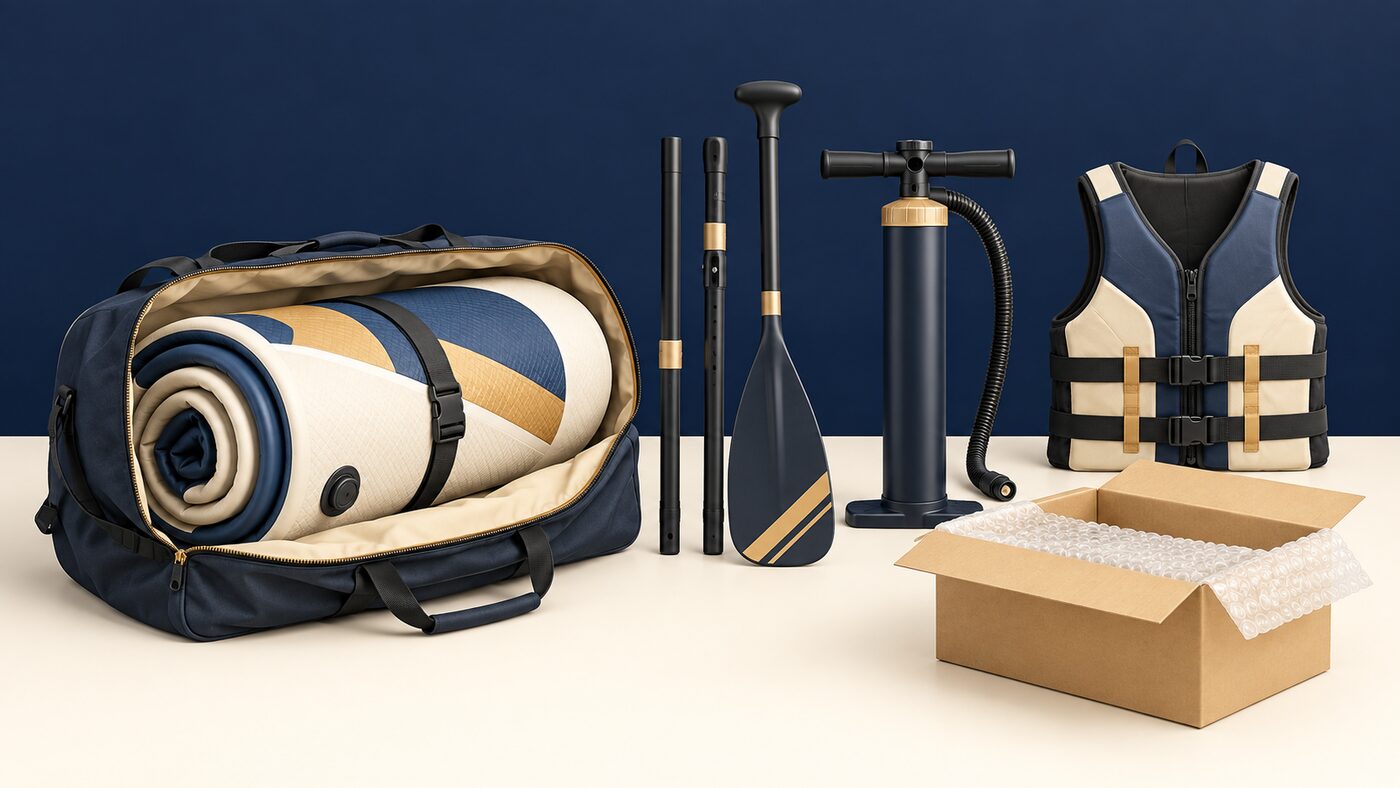
Stand-up paddling (SUP) is a water sport in which you stand on a flotation device and move with a paddle. Article 3 of the Regulations Governing the Management of Water Recreational Activities lists “stand-up paddling” as a type of flotation device; an article in a Taiwanese journal presents it as an emerging water leisure activity combining surfing and canoeing, and a low-impact sport.
| Confirm before buying | Why | Source |
|---|---|---|
| Board type: inflatable or rigid | Affects the packed volume and length; this site warns that light bulky cargo (including long, slender sports gear) is the easiest to underestimate in freight cost | Shipping cost guide |
| Whether the pump has a battery | Lithium batteries are restricted shipments that need prior declaration and approval and must comply with IATA rules | Terms of Service, Article 4.2 |
| Whether the life jacket has a gas cylinder | The site's terms do not mention gas cylinders or pressurized containers; the restricted list only says they may be refused by carriers, which does not mean import is prohibited by law | Prohibited and restricted imports list |
| Packed size and weight | Freight applies the formulas to measured data after packing; long items also follow the site's size recommendations | Shipping rates |
What are the tariff codes and duty for stand-up paddleboards?
The tariff has no 11-digit code specific to stand-up paddleboards. The table below shows the closest headings in the tariff, used only to explain how officials classify; they are not a classification conclusion for paddleboards; the import-regulation field is blank throughout:
| 11-digit code | Official description (excerpt) | Column 1 duty | Import regulation |
|---|---|---|---|
9506.29.00.00-8 | Water-skis, surfboards and other water-sport equipment | 2.5% | Blank |
8903.12.10.00-6 | Inflatable boats not designed for use with a motor and with an unladen weight not exceeding 100 kg, for pleasure or sports | 5% | Blank |
8903.93.10.20-4 | Other rowing boats and canoes, length not exceeding 7.5 meters, for pleasure or sports | 6% | Blank |
8414.20.00.00-0 | Hand- or foot-operated air pumps | 4% | Blank |
6307.20.00.00-4 | Life jackets and life belts | 10% | Blank |
Is there an official classification case for paddleboards?
No. A search of the entire open-data file of Customs tariff pre-ruling cases for paddleboard, stand-up paddling and SUP found no case, and the latest case in that dataset was issued in 2018. The closest case is the “stand-up pedal surfboard” classified under 9506.29.00.00-8, which is a different product from a paddleboard and is for reference only.
How are electric pumps and paddles classified?
Classification of electric air pumps has no official case; the tariff also has no separate heading for “paddles”, and the whole file has only the rowing boats and canoes of 8903. All of these are decided by Customs based on the goods; when declaring, state the product name, material and use clearly.
Date of the tariff data
The server time of the open-data file is 2025-04-24, which cannot prove that there have been no revisions since; the actual tax rate and import regulations follow the Customs tariff in force at the time of declaration.
Do stand-up paddleboards from China need an import permit?
Not for the related codes. The Customs Administration explains: where the import-regulation field of the tariff “does not list either of the codes MW0 or MP1, that Mainland China item is permitted for import and exempt from an import permit”. The import-regulation field of all five codes in the table above is blank, with no MW0; the lithium-ion battery code (for example 85076000900, Column 1: 2.5%) lists code C02 in its import-regulation field, whose meaning this page did not find, so the lithium battery in an electric pump must be confirmed with Customs and customer service.
“No MW0” only means Mainland China goods may be imported. Tax still has to be paid, transport restrictions such as those for lithium batteries and gas cylinders and carrier rules still apply, and it must not be written as “exempt from a permit, therefore legally cleared”.
The Simplified Classification Table of Commodities Subject to Inspection of the Bureau of Standards, Metrology and Inspection (BSMI) (updated 2026/09/17, for reference only) does not list life jackets, inflatable paddleboards or pumps, and lists only items such as 3C secondary lithium batteries. But this page did not compare against the formal item list one by one, so it cannot be written as “no inspection needed”; whether a product is subject to inspection follows the announcements of the Bureau of Standards, Metrology and Inspection.
How much tax is due on an imported paddleboard? Does the NT$2,000-or-below exemption apply?
Start with the formulas published by the Customs Administration: duty = dutiable value × tax rate; business tax = (dutiable value + duty + commodity tax, etc.) × 5%; trade promotion service fee = dutiable value × 0.04%, waived at NT$100 or less. The dutiable value is the CIF price of the imported goods, so the freight up to the Taiwan port is also included. Which tax rate applies to a paddleboard is decided by Customs, and this page states no tax-rate conclusion.
Formula example (not a quote)
Suppose Customs sets the dutiable value at NT$20,000 with duty at 2.5% (2.5% is only an example and does not represent the paddleboard's tax rate), and there is no commodity tax or other additional tax item: duty NT$500; business tax (20,000+500)×5%=NT$1,025; trade promotion service fee 20,000×0.04%=NT$8, which is waived at NT$100 or less. The example excludes declaration, inspection, delivery, storage or handling fees.
NT$2,000 or below is tax-exempt
The Customs Administration's “express cargo” page: where the dutiable value is NT$2,000 or below, duty and the business tax and commodity tax collected by Customs are waived; if the same taxpayer uses exempt release more than 6 times in the same half-year, the exemption no longer applies. This is a rule of the express cargo page; HowBridge's shipping rates page states that when the dutiable value exceeds NT$2,000, tax is levied in full. Whether the exemption can apply to the consolidation route, this page draws no conclusion; follow customer service and the declaration result.
Does Taiwan law require wearing a life jacket for SUP?
For individuals doing SUP, the law does not expressly require a life jacket or a leash. The Regulations Governing the Management of Water Recreational Activities (amended on ROC year 113, month 4, day 16) expressly require life jackets for personal watercraft (Article 14), canoes (Article 23) and river rafting (Article 27); SUP is not among them. Article 3 of the Regulations also says that the safety of flotation devices and equipment and of operating personnel is handled under the rules of the Maritime and Port Bureau, Ministry of Transportation and Communications and local self-government rules, which this page did not check one by one. Rules for individuals and for operators who take customers must be read separately:
| Who | Rule | Article |
|---|---|---|
| All participants (including individuals) | Must not violate the prohibited-activity areas announced by the managing authority, or its announced restrictions on activity types, scope, time and conduct | Article 8 |
| Managing authority | For scenic special areas and national parks, that special-area managing authority; otherwise the municipal, county or city government; it may announce areas where water recreational activities are prohibited | Articles 4 and 6 |
| Operators who take customers or provide venues or equipment | The managing authority may require qualified lifeguards and life-saving (boat) equipment | Article 9 |
| Operators who take customers (other flotation-device activities; SUP is included by the wording of the provision) | Report to the managing authority before the activity and give participants activity safety education | Article 27-1 |
| For-profit operators | Must take out liability insurance, with a bodily-injury liability amount of NT$3,000,000 per person | Article 10 |
Whether SUP is banned or restricted in a given water area has no nationwide list; it depends on the announcements of each managing authority, and this page found no nationwide written list, so it does not list “where you can play”. Safety advice (such as wearing a life jacket) is advice, not a legal obligation.
What to watch for with lithium-battery pumps, gas-cylinder life jackets and long items?
The board itself is mostly not the problem; the trouble is batteries, gas cylinders and size. Below, the parts are marked as what “the site says” and what “this page found nothing on”:
Lithium batteries in electric pumps
HowBridge's Terms of Service, Article 4.2, list battery products (lithium batteries, power banks, etc.) as restricted shipments that require prior declaration and approval and must comply with IATA rules; see Lithium batteries and power banks to Taiwan. Whether a complete electric pump can be accepted is not stated on the site; please ask customer service before ordering. The site's shipping guide also explains that goods containing lithium batteries cannot go by air under dangerous-goods rules for air transport, so they must go by sea express or sea LCL cargo; the Civil Aeronautics Administration's power bank rules are rules for passengers' carry-on and cannot be applied to cargo shipping.
Life jackets with gas cylinders
The site's terms do not mention gas cylinders or pressurized containers; the restricted list only says that lithium batteries, perfume, pressurized containers and the like may be refused because of dangerous-goods rules of the transport mode or carrier, which does not mean import is prohibited by law. Whether a gas-cylinder life jacket can be accepted has no written statement on the site; please ask customer service first.
Long items and convenience-store pickup
The site's FAQ has only one length recommendation: for air express, a single piece of no more than 30 kg and no side longer than 150 cm; sea LCL cargo can accept larger and heavier goods (freight varies by product; ask customer service for a quote). For convenience-store store-to-store shipping, the whole bag (including the packaging bag) is limited to 5 kg, 105 cm for the sum of three sides and 45 cm for the longest side; exceeding any one means switching to home delivery. Whether a paddleboard and sectional paddle fit follows the measured size after packing.
Damage compensation
HowBridge's Terms of Service, Article 7.1: no declared-value (cargo transport insurance) service is provided; for a lost parcel, compensation is at most three times the freight of that piece; damage to fragile or battery-powered items is not compensated, and other damage is decided case by case.
How is a paddleboard charged? Air freight, sea express or sea LCL cargo?
Rates follow HowBridge's shipping rates page; the formulas are listed here; freight for sea LCL cargo varies by product, so ask customer service for a quote:
| Method | Rate and formula | Transit time |
|---|---|---|
| Air freight | NT$100/kg, actual weight only, no volumetric weight; NT$120 surcharge if the actual weight is under 10 kg | 3–5 working days |
| Sea express | NT$50/kg; volumetric weight = length × width × height (cm) ÷ 10000, the higher of actual and volumetric weight applies; NT$100 surcharge if under 10 kg; gross weight per piece limited to 70 kg | 5–10 working days |
| Sea LCL cargo (freight varies by product; ask customer service for a quote) | From NT$25 per kg, or from NT$150 per volume unit; volume = length × width × height (cm) ÷ 28316 (the volume unit “cai” is the one commonly used in Taiwan) | 7–14 working days |
For a single piece over 10 cai (volume units) or 40 kg, home delivery in Taiwan has an extra oversize fee, graded by county or city and by cai and weight; check with customer service before ordering.
How do you consolidate a paddleboard bought in China back to Taiwan?
The following 5 steps apply to paddleboards and accessories bought on Chinese e-commerce platforms and sent to HowBridge's Shenzhen warehouse.
1Choose a seller and confirm specifications
Place the order yourself on Taobao, Tmall, 1688 or similar platforms; on the product page confirm the board type (inflatable or rigid), whether the pump has a battery and whether the life jacket has a gas cylinder.
2Use the Shenzhen consolidation warehouse as the delivery address
Fill in HowBridge's Shenzhen consolidation warehouse address and your member number as the recipient details; HowBridge does not purchase on your behalf.
3Ask customer service first if there is a battery or gas cylinder
For electric pumps and gas-cylinder life jackets, ask customer service whether they can be accepted before ordering; restricted shipments need prior declaration and approval.
4Declare the product name and amount truthfully
State the product name, quantity and actual purchase amount clearly, for example “inflatable stand-up paddleboard × 1” and “sectional paddle × 1”; classification is decided by Customs.
5Measure the packed size and choose a shipping method
Apply the formulas to measured data after packing; rates and transit times for air freight, sea express and sea LCL cargo are on the shipping rates page. For the way to authorize declaration, see the EZ WAY tutorial.
Which studies can be consulted? What are SUP injury rates and life jacket use rates in foreign research?
The studies below explain only the sport and safety background; they cannot prove the situation in Taiwan, nor the quality of any particular paddleboard:
- Injuries: the Furness et al. (2017) questionnaire showed 3.63 injuries per 1,000 hours, with the shoulder and upper arm injured most often; a questionnaire of 438 players in German-speaking regions (Balke et al. 2021) gave 1.95; 330 competitive athletes (Yan et al. 2026) had 5.39 per 1,000 training hours, with the shoulder and lower back most common. All three are self-reported questionnaires, not from Taiwan.
- Life jacket use: of the 438 players in German-speaking regions in Balke et al. (2021), 27 “always wear” a life jacket, 201 “depending on the situation” and 202 “never wear” one. After Victoria, Australia introduced a compulsory-wear rule, flotation device use on small powered vessels rose from 22% to 63% (Cassell, Newstead 2015), but those were powered boats. Paddle sport deaths in Maine, USA were linked to inexperience, alcohol and not using a personal flotation device (CDC 2008), covering canoes and kayaks, not SUP.
- Exercise intensity: in Willmott et al. (2020), 10 participants paddling 20 or more strokes per minute reached moderate intensity (3.0–5.9 METs); the sample is very small.
- Taiwan: the introductory article by Lu Yancheng et al. (2022) presents SUP as a low-impact water leisure activity combining surfing and canoeing; this page found no academic literature on Taiwan-specific SUP drowning or life jacket statistics.
What are common stand-up paddleboard terms?
- SUP (stand-up paddling)
- Short for Stand-Up Paddle: moving with a paddle while standing on a flotation device; Article 3 of the Regulations Governing the Management of Water Recreational Activities lists stand-up paddling as a flotation device.
- Inflatable paddleboard
- A paddleboard that can be rolled up and inflated for use; the tariff has no specific code for it, and classification is decided by Customs.
- MW0
- A tariff import-regulation code; Mainland China goods that list MW0 are not permitted for import; on this page the import-regulation field of the related codes is blank, with no MW0.
- Dutiable value
- The basis for calculating tax, being the CIF price of the imported goods, including freight and insurance up to the Taiwan port.
- Sea LCL cargo
- Consolidated cargo moved by sea container; freight varies by product, so ask customer service for a quote; from NT$25 per kg, or from NT$150 per volume unit, with volume ÷ 28316.
- Volume (cai)
- Volume converted from length, width and height; the volumetric weight for sea express is length × width × height (cm) ÷ 10000, and the volume for sea LCL cargo is ÷ 28316.
- Personal flotation device (PFD)
- Personal Flotation Device, i.e. buoyancy equipment such as life jackets; the Regulations Governing the Management of Water Recreational Activities expressly require life jackets only for personal watercraft, canoes and river rafting, and SUP has no specific article.
What are the sources and the scope of checking?
The sources below were consulted on 2026-09-30; document dates and the consultation date are marked separately, and where no update date is stated none has been made up.
Government and official primary sources
- Customs Administration import tariff open data | Document date: not stated (server file time 2025-04-24); the tariff has no 11-digit code specific to stand-up paddleboards; closest headings: 95062900008 water-skis, surfboards and other water-sport equipment 2.5%; 89031210006 inflatable boats 5%; 89039310204 rowing boats and canoes 6%; 84142000000 hand- or foot-operated air pumps 4%; 63072000004 life jackets and life belts 10%; 85076000900 other lithium-ion batteries 2.5%; the import-regulation field of the first five codes listed above is blank, and the lithium-ion battery code lists code C02 in its import-regulation field (its meaning was not found on this page). The file date is old; actual tax rates follow the Customs tariff in force at the time of declaration.
- Government Open Data Platform: Customs tariff pre-ruling cases | Document date: latest case in the dataset issued 2018/06/08; a full-file search for paddleboard, stand-up paddling and SUP found no case; the closest case is the “stand-up pedal surfboard” classified under 9506.29.00.00-8, a different product from a paddleboard, for reference only.
- Customs Administration: Import regulations for Mainland China goods (determining whether an import permit is exempt) | Document date: 2026-07-09; Mainland China goods that list neither “MW0” nor “MP1” are permitted for import and exempt from an import permit.
- Customs Administration: What taxes and fees are payable on imported goods? | Document date: 2026-07-13; duty = dutiable value × tax rate; business tax = (dutiable value + duty + commodity tax, etc.) × 5%; trade promotion service fee is dutiable value × 0.04%, waived at NT$100 or less; dutiable value is the CIF price of the imported goods.
- Customs Administration: Express cargo | Document date: 2026-07-08; for express cargo with a dutiable value of NT$2,000 or below, duty and the business tax and commodity tax are waived; if the same taxpayer uses exempt release more than 6 times within a half-year, it no longer applies; this is a rule of the express cargo page.
- Laws & Regulations Database of Taiwan: Regulations Governing the Management of Water Recreational Activities | Document date: amended on ROC year 113, month 4, day 16; Article 3: the various flotation devices include stand-up paddling; Article 8: those engaging in water recreational activities must not violate the managing authority's announcements of prohibited areas and activity restrictions; Articles 9, 10 and 27-1: lifeguards and life-saving equipment, liability insurance, reporting and safety education apply only to operators who take customers or provide venues or equipment; Articles 14, 23 and 27: the activities expressly requiring life jackets are personal watercraft, canoes and river rafting, and SUP is not among them.
- Bureau of Standards, Metrology and Inspection (BSMI), Ministry of Economic Affairs: item lookup (Simplified Classification Table of Commodities Subject to Inspection) | Document date: the Simplified Classification Table of Commodities Subject to Inspection updated 2026/09/17; this simplified table is for reference only, and its text does not show life jackets, inflatable paddleboards or pumps, listing only items such as 3C secondary lithium batteries; the PDF text was read by the researcher, and this page did not compare the formal item list one by one, so it cannot be written as “no inspection needed”.
Research literature
Epidemiology of Injuries in Stand-Up Paddle Boarding
Online questionnaire of 240 SUP participants: 3.63 injuries per 1,000 hours, with the shoulder and upper arm most common; a self-reported questionnaire with an international sample, not Taiwan, and not specific to inflatable boards.
Injuries and Use of Safety Equipment in Stand-up Paddle Boarding
438 SUP players in German-speaking regions: 17% were injured in the past 12 months, 1.95 injuries per 1,000 hours; life jacket “always worn” by 27, “depending on the situation” by 201, “never worn” by 202; a self-reported questionnaire, with no drowning outcomes.
Epidemiological characteristics of injury among stand-up paddleboarding athletes
330 competitive SUP athletes: 5.39 injuries per 1,000 training hours, with the shoulder and lower back most common; competitive athletes with retrospective self-report, not representative of recreational players.
The physiological and perceptual responses of stand-up paddle board exercise in a laboratory- and field-setting
10 participants: paddling 20 or more strokes per minute reached moderate intensity (3.0–5.9 METs); the sample is very small, and intensity varies with the paddling rate.
Paddle sports fatalities--Maine, 2000-2007
Paddle sport deaths in Maine were linked to inexperience, alcohol and not using a personal flotation device; covers canoes, kayaks and rubber rafts, not SUP.
Did compulsory wear regulations increase personal flotation device (PFD) use by boaters in small power recreational vessels? A before-after observational study conducted in Victoria, Australia
After the 2005 compulsory-wear rule in Victoria, Australia, flotation device use on small powered vessels rose from 22% to 63%; powered boats in Australia, not paddle sports.
A Preliminary Introduction to Stand-Up Paddling as a Water Leisure Sport
Presents SUP as an emerging water leisure activity combining surfing and canoeing, with high mobility, quick to learn and low impact; this is an introductory article, and only the abstract page was read.
The tariff has no paddleboard-specific code and no pre-ruling case, and the tariff file date is 2025-04-24; the BSMI simplified classification table is a “for reference only” summary, the formal table of items subject to inspection was not compared one by one, and the real-time pre-ruling lookup of the Customs Single Window was not tested; for shipping of electric pumps and gas-cylinder life jackets, the site's own rules on gas cylinders, whether commodity tax applies, the list of bans or restrictions for each water area, and the outreach articles of the Coast Guard Administration and the Ocean Affairs Council on individual SUP, this page found no primary written statement; Taiwan-specific SUP drowning and life jacket statistics were not found; whether the consolidation route can use the low-value express exemption, this page draws no conclusion.
What are the common questions about shipping stand-up paddleboards from China to Taiwan?
Can an inflatable paddleboard bought in China be shipped to Taiwan?
What is the import duty on a stand-up paddleboard?
Do I need an import permit to buy a paddleboard?
The electric pump has a lithium battery. Can it be shipped?
Does Taiwan law require wearing a life jacket for SUP?
The paddleboard is long. How do I ship it, and how is freight calculated?
Can I buy overseas-brand paddleboards such as iROCKER SUP or Red Paddle through HowBridge?
If a paddleboard is damaged or lost, how does HowBridge compensate?
Further reading
Paddleboards bought on Chinese e-commerce, consolidated to Taiwan
HowBridge has only the Shenzhen and Taoyuan warehouses and offers Mainland China→Taiwan consolidation; before shipping, confirm the battery, gas cylinder, product name and declared amount.
View China-to-Taiwan services