Does Taobao Appliance Shipping to Taiwan Mean Commodity Tax? Check Whether It Is One of These 5
Does an appliance bought on Taobao and shipped to Taiwan incur commodity tax?
Yes, but only for the 5 electrical appliance items in Article 11 of the Commodity Tax Act: refrigerators 13%, air conditioners and heaters 20% (central-system type 15%), dehumidifiers 15%, electric ovens 15%, audio component systems 10%. If the dutiable value of the same batch (including freight and insurance) exceeds NT$2,000, Customs collects commodity tax together with duty and 5% business tax. Color TVs, video recorders, record players and tape recorders were deleted from 2026-01-01 and are no longer subject to commodity tax. Washing machines, vacuum cleaners and rice cookers are not listed and carry no commodity tax; if the dutiable value of the same batch exceeds NT$2,000, duty and 5% business tax still apply.
It is for people who have found a dehumidifier, electric oven, air fryer, Bluetooth speaker, refrigerator or air conditioner on Taobao, Pinduoduo or JD.com and want to ship it to Taiwan for personal use. Whether we can accept appliances that contain refrigerant, such as refrigerators, air conditioners and compressor dehumidifiers, please ask customer service first. HowBridge only offers consolidation from mainland China to Taiwan, operating from the Shenzhen consolidation warehouse and the Dayuan, Taoyuan operations warehouse. Clearance is handled by partner customs brokers; HowBridge is not a customs broker. This page does not recommend brands or models.
Which appliances are subject to commodity tax? From 2026 only 5 electrical items remain
From 2026-01-01 the electrical category in Article 11 of the Commodity Tax Act has only 5 items left: refrigerators 13%, air conditioners and heaters 20% (central-system type 15%), dehumidifiers 15%, audio component systems 10%, electric ovens 15%. The 4 items color TVs, video recorders, record players and tape recorders were deleted in the amendment promulgated on 2025-08-19 (ROC 114-08-19), effective 2026-01-01.
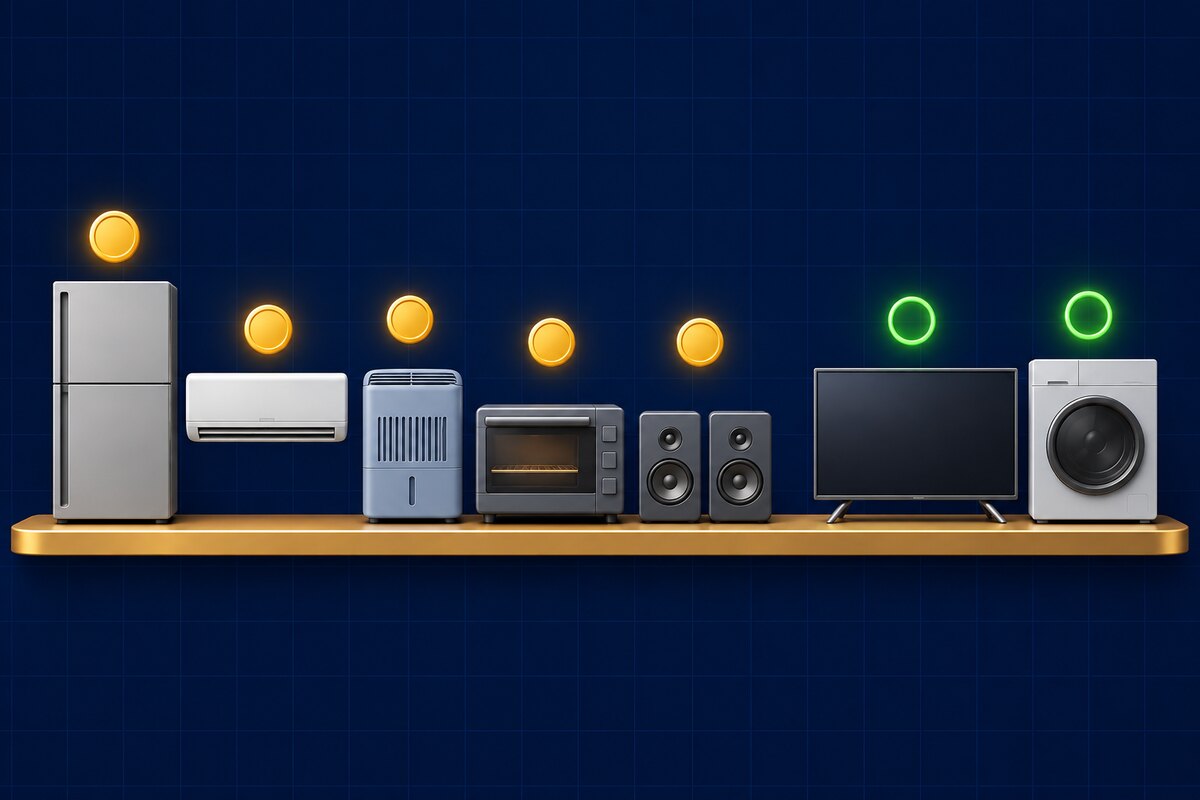
| Appliance | Commodity tax rate | Key points of the provision |
|---|---|---|
| Refrigerators | 13% | Article 11, paragraph 1, subparagraph 1 |
| Air conditioners and heaters (air conditioners, heaters) | 20%; central-system type 15% | All kinds of air conditioners, heaters and the like that regulate temperature by electricity |
| Dehumidifiers | 15% | All devices that regulate indoor air humidity by electricity; humidity regulators used in factories are exempt |
| Audio component systems | 10% | Separate audio components, including turntables, tuners, receiver-amplifiers, tape decks, amplifiers, speakers and the like and their combinations |
| Electric ovens | 15% | All appliances that roast food by electric heat or microwave |
| Color TVs, video recorders, record players, tape recorders | Not taxed (deleted from 2026-01-01) | Duty and business tax still apply |
| Washing machines, vacuum cleaners, rice cookers | Not taxed (not listed in Article 11) | Duty and business tax still apply |
- Combined goods take the highest rate: when a taxable appliance and non-taxable goods are combined into one unit, or the parts carry different rates, the whole dutiable value is taxed at the highest rate (Article 11, paragraph 2).
- T and T* on the tariff code: in the tariff column "special levy note", T means commodity tax applies on import and T* means commodity tax applies to part of the imports; the Ministry of Finance says these codes are for reference only and that levying depends on whether the goods actually received belong to a taxable category. On the declaration, the "inspection method" field can be filled with code 8 (document review). In the HowBridge tariff database, color TVs under 8528.72.00.00-0 no longer carry a T mark, which is consistent with the 2026 deletion, but the mark is for reference only and the provision decides whether tax applies.
- Voltage and commodity inspection are separate: see "What else should I check before shipping appliances?" below and Mainland China appliance voltage and commodity inspection.
How is tax on imported appliances calculated?
The taxes are stacked in order: duty = dutiable value × duty rate; commodity tax = (dutiable value + duty) × commodity tax rate; business tax = (dutiable value + duty + commodity tax) × 5%. All three are collected by Customs in one go on import. Take a dehumidifier with a dutiable value of NT$10,000 (assuming it is classified under 8479.89.10.00-8): the taxes and fees total NT$3,041.

| Step | Formula | Amount |
|---|---|---|
| (1) Duty (8479.89.10.00-8, column 1 rate 8%) | 10,000 × 8% | NT$800 |
| (2) Commodity tax (15%) | (10,000 + 800) × 15% | NT$1,620 |
| (3) Business tax (5%) | (10,000 + 800 + 1,620) × 5% | NT$621 |
| (4) Trade promotion service fee | 10,000 × 0.04% = 4; exempt at 100 or below | NT$0 |
| Total | (1) + (2) + (3) + (4) | NT$3,041 |
- Dutiable value: it is based on the transaction price plus freight to Taiwan, handling charges and insurance, that is, the cost, insurance and freight (CIF) value; foreign currency is converted at the rate announced by the Customs Administration (Customs Act, Article 29 and Article 39).
- Legal basis: commodity tax is calculated under Article 18 of the Commodity Tax Act, on the dutiable value plus import taxes and duties; business tax is calculated under Article 20 of the Value-added and Non-value-added Business Tax Act, on the dutiable value plus import duty, plus commodity tax where commodity tax is payable, and is collected by Customs.
- Other appliances (same dutiable value of NT$10,000): a split-type air conditioner (8415.10.10.20-5, duty 10%, commodity tax 20%) totals NT$3,860; a fully automatic washing machine (8450.11.30.00-0, duty 8%, no commodity tax) totals NT$1,340.
- Calculate it yourself: use the import tax calculator or the Taobao tax estimator with your tariff code; for business tax see the import declaration business tax guide. For business tax collected by Customs, amounts below one New Taiwan dollar are dropped.
Is there no tax at or below a dutiable value of NT$2,000?
If the dutiable value of the same batch is NT$2,000 or below, duty and the business tax and commodity tax collected by Customs are waived; above NT$2,000, tax is calculated on the whole dutiable value, not just the excess. The dutiable value of a refrigerator, air conditioner or dehumidifier almost always exceeds NT$2,000, so budget on the basis that tax will apply.
- Legal basis: Article 49, paragraph 2 of the Customs Act provides that goods in the same batch whose combined dutiable value is at or below the limit announced by the Ministry of Finance are exempt, except for frequent imports or specific goods announced by the Ministry of Finance; under Ministry of Finance notice No. 1061018778 of 106-09-07 the limit is NT$2,000, covering duty and the business tax and commodity tax collected by Customs.
- 6 times per half-year: if the same taxpayer uses the low-value exemption release more than 6 times within a half-year (months 1–6 and months 7–12, that is, January–June and July–December), it counts as frequent importing, and afterwards tax is levied even when a single shipment is NT$2,000 or below; the count follows the import date on the declaration (Ministry of Finance order No. 1061011007 of 106-05-26). You can check this in the Customs-Port-Trade Single Window under "frequent import data inquiry" (GB377, certificate login required).
- The same batch must not be split: for express cargo of the same batch (the same shipper, the same voyage, to the same consignee), the express operator may not declare it separately (Regulations Governing the Clearance of Sea Express Cargo, Article 15); air express has a proviso, under which cases where the total does not exceed the tax-exempt limit or the tax is declared voluntarily are excepted (Regulations Governing the Clearance of Air Express Cargo, Article 14). Falsely declaring the name, quantity or value when clearing imports can bring a fine of up to 5 times the import tax evaded, or confiscation of the goods (Customs Anti-Smuggling Act, Article 37, paragraph 1); a false declaration that involves evading controls (for example, declaring a false product name for an MW0 appliance that does not meet the small-quantity exemption conditions) is handled under Article 36 by way of Article 37, paragraph 3, with a fine of up to 3 times the value of the goods and confiscation.
- Further reading: for the threshold and cross-border shopping rules see cross-border online shopping import tax rules.
Under which tariff code does Customs put dehumidifiers, air fryers and Bluetooth speakers?
Among the advance tariff classification rulings published by the Customs Administration, Ministry of Finance, 3 household dehumidifiers were classified under 8509.80.90.00-4 "other household electromechanical appliances", which differs from 8479.89.10.00-8, where the tariff itself says "dehumidifier"; air fryers and 2-in-1 air fryer ovens were classified under 8516.60.90.00-9 and 8516.60.10.00-6 respectively; wireless and Bluetooth speakers are spread over 6 codes (including 1 old code that has since been revised). Which code applies is determined by Customs based on the actual goods. The following come from the Customs Administration open data held in the HowBridge tariff database; they are all individual cases from 2016–2018 for specific models, and brands and models are not listed.
| Ruling no. | Goods (per declaration) | Code determined | Current column 1 | Special levy note |
|---|---|---|---|---|
| 105AA0621 (2016) | Dehumidifier (20 liters, with built-in motor and compressor) | 8509.80.90.00-4 | 5% | T* |
| 105AA0622 (2016) | Dehumidifier (10 liters, with built-in motor and compressor) | 8509.80.90.00-4 | 5% | T* |
| 106BA0141 (2017) | Electronic mini dehumidifier (thermoelectric chip) | 8509.80.90.00-4 | 5% | T* |
| 105AA0387 (2016) | Air fryer | 8516.60.90.00-9 | 5% | T* |
| 107AA0225 (2018) | 2-in-1 air fryer oven (oven mode + air fry mode) | 8516.60.10.00-6 | 3.7% | T* |
| 107AA0210 (2018) | Bluetooth speaker (single speaker, no radio function) | 8518.21.00.00-4 | 0% | T* |
| 107AA0248 (2018) | Bluetooth speaker (with radio function, memory card slot) | 8527.13.00.00-3 | 0% | (none) |
| 106AA0367 (2017) | Upright freezer | 8418.40.90.00-3 | 3.5% | T* |
- The same name "dehumidifier" can mean different codes: the 2 compressor dehumidifiers from 2016 (10 liters, 20 liters) and the mini dehumidifier from 2017 were all classified under 8509.80.90.00-4 in advance rulings, which differs from 8479.89.10.00-8, where the tariff itself says dehumidifier; which code applies and which import regulations apply are determined by Customs based on the actual goods.
- The mark on a code is only a reference: a Bluetooth speaker with a radio function is classified under 8527.13.00.00-3, and this code carries neither T nor T*; the Ministry of Finance says the marks are for reference only, and whether commodity tax applies depends on Article 11 of the Commodity Tax Act and Customs' determination, so you cannot infer it yourself from whether a code has a mark.
- Look up your own goods: the code is whatever the current tariff and Customs' determination say; you can check first with tariff lookup.
An advance ruling is valid only for the specific goods in the application and does not mean your goods are necessarily classified under the same code; the cases are from 2016–2018 and the tariff has been revised since. The code is whatever Customs determines; declare according to the actual goods, and do not change the code yourself to pay less tax or avoid import regulations.
Which declaration do appliances subject to commodity tax need?
Under Article 12 of the Regulations Governing the Clearance of Air Express Cargo and of Sea Express Cargo, goods taxable under the Commodity Tax Act must be cleared with a formal import declaration, not a simplified declaration; when creating a consolidation order with HowBridge, choose "formal customs declaration" (under the current settings the declaration fee is NT$800 per batch, taxes extra).
- The same applies when import regulations are involved: if an appliance is subject to import and export regulations (for example, goods subject to mandatory inspection by the Bureau of Standards, Metrology and Inspection), a formal import declaration is likewise required, except for special cases announced by Customs (Article 12, paragraph 1, subparagraph 2 of both regulations). Taipei Customs also reminds that goods taxable under the Commodity Tax Act must not be declared with a simplified declaration.
- Who pays: the taxpayer of commodity tax on imported goods is the consignee, the holder of the bill of lading or the holder of the goods (Commodity Tax Act, Article 2). Taxes and fees are paid according to the tax bill assessed by Customs.
- HowBridge is not a customs broker: clearance is handled by partner customs brokers.
What else should I check before shipping appliances?
Four more things to check: the legal frequency of AC power in Taiwan is 60Hz; the codes for most appliances carry a C02 requirement from the Bureau of Standards, Metrology and Inspection; the codes for refrigerators and window air conditioners are marked MW0 (mainland China goods not permitted), and an import permit is waived only if the whole declaration is within CIF NT$32,000 and each item is within 24 units; the codes for dehumidifiers and color TVs are marked MP1, which permits only some models.
| Item | Tariff code | Column 1 duty | Commodity tax | Import regulation |
|---|---|---|---|---|
| Other compression-type household refrigerators | 8418.21.90.00-6 | 8% | 13% | C02, MW0 |
| Household combined refrigerator-freezers (under 500 liters) | 8418.10.13.00-3 | 3.5% | 13% | C02, MW0 |
| Self-contained air conditioners such as window units (with a cooling unit) | 8415.10.10.10-7 | 10% | 20% | 555, C02, MW0 |
| Split-type air conditioners (with a cooling unit) | 8415.10.10.20-5 | 10% | 20% | 555, C02 |
| Air humidifiers, dehumidifiers | 8479.89.10.00-8 | 8% | 15% | C02, MP1 (only models without a compressor) |
| Electric ovens | 8516.60.10.00-6 | 3.7% | 15% | C02 |
| Color TVs | 8528.72.00.00-0 | 10% | Not taxed | C02, MP1 (except high-definition models of 21 inches or more and with a horizontal resolution of 1000 lines or more) |
- Voltage and frequency: the legal frequency of AC power in Taiwan is 60Hz (Standards for Electricity Supply Voltage and Frequency, Article 3), and low-voltage supply comes in forms such as 110V and 220V (same standards, Article 4). If the nameplate of an appliance only shows 220V and 50Hz, confirm that it can be used in Taiwan before shipping.
- Commodity inspection: C02 means some goods under the code are subject to mandatory import inspection by the Bureau of Standards, Metrology and Inspection. For non-sale personal-use goods, under Article 5 of the Regulations Governing Exemption from Commodity Inspection, inspection can be waived if the total value of the same specification and type on the same declaration is US$1,000 or less, or exceeds that but the quantity is within 2 units; at US$1,000 or less the inspection exemption clearance code can be filled in on the declaration, and other cases must apply first; the exemption is limited to 1 time within 6 months for the same specification and type. For the general rules see BSMI commodity inspection.
- MW0 small-quantity exemption: MW0 means mainland China goods are not permitted; but for mainland China industrial products in Chapters 25 to 97 of the tariff, an import permit is waived if the whole declaration is within CIF NT$32,000 and each item is within 24 units (within 40 kilograms for goods that cannot be counted by units), and an item is identified by model. 3 codes, including electric motorcycles, electric bicycles and their controllers, are excluded. Waiving the import permit does not waive commodity inspection and other import regulations.
- MP1 does not permit everything: MP1 means mainland China goods are permitted conditionally. Among the items permitted by the International Trade Administration, dehumidifiers classified under 8479.89.10.00-8 are listed only as "dehumidifiers without a compressor", and color TVs exclude high-definition models of 21 inches or more and with a horizontal resolution of 1000 lines or more; mainland China products outside the permitted items can be imported without a permit only if they meet the small-quantity exemption conditions above. Customs advance rulings have classified household dehumidifiers under 8509.80.90.00-4; the actual code and import regulations are whatever Customs determines.
- 555: importing air conditioners of 7.1kW or less that contain HCFC-22 refrigerant requires a consent document from the Ministry of Environment.
How are large appliances shipped, and how is the shipping fee calculated?
For large appliances or those containing refrigerant, such as refrigerators, air conditioners and compressor dehumidifiers, ask customer service first whether we can accept them and which transport method to use; for a dehumidifier in a 38×32×62 cm carton weighing 15.2 kilograms, sea express comes to about NT$880 (an estimate only). HowBridge sea express is NT$55 per unit and air freight is NT$110 per kilogram (from 2026-11-11); large or heavy goods go by LCL sea container (ask customer service for a quote based on the goods); the actual charge follows the bill issued after measurement at the warehouse.
| Method | How it is priced | Surcharge | Transit time |
|---|---|---|---|
| Sea express | NT$55 per unit, where the unit is the larger of actual weight and volumetric weight (length × width × height in cm ÷ 10000), rounded up | NT$100 added if the billing units are under 10 (judged on the value before rounding up) | About 4 working days measured from warehouse dispatch, 90% within 6 working days |
| Air freight | NT$110 per kilogram, actual weight only | NT$120 added if actual weight is under 10 kilograms | About 3–5 working days |
| LCL sea container | Ask customer service for a quote based on the goods | — | About 7–14 days |
- Dehumidifier: volumetric weight = 38×32×62÷10000 = 7.54; the larger actual weight of 15.2 is rounded up to 16 units; 16×NT$55 = NT$880, no surcharge.
- Small electric oven: carton 52×40×35 cm, 9.3 kilograms, volumetric weight 7.28, rounded up to 10 units; 10×NT$55 + NT$100 = NT$650 (the unrounded 9.3 is used to judge the surcharge). Both estimates match the shipping estimator and exclude the Hsinchu Logistics oversize fee for the Taiwan leg (charged separately above 10 cai or 40 kilograms).
- Appliances with lithium batteries (for example, cordless vacuum cleaners): accepted only with a UN38.3 certificate and no more than 300Wh per battery, and only by sea express; above 300Wh they are not accepted. See the lithium battery consolidation guide.
These appliances are mostly bulky and have a compressor and refrigerant, and the codes for refrigerators and window air conditioners are also marked MW0; the gross weight limit for express cargo is 70 kilograms per piece (bag) (Regulations Governing the Clearance of Air Express Cargo and of Sea Express Cargo). Whether we can accept them and whether they go by sea express or LCL sea container, please ask customer service first, and do not order first and ask afterwards.
For items that individuals send to Hong Kong, Macao and Taiwan, China Customs sets a limit of RMB 800 per shipment (General Administration of Customs of China Announcement No. 43 of 2010; it is still 800 after Announcement No. 176 of 2024); above the limit the item must be returned or cleared under the rules for goods, and a parcel containing only one indivisible item that is genuinely for personal use can be handled as a personal item. This is a rule for personal postal items sent through postal channels, and whether it applies to consolidation is not stated in any provision; for appliances above RMB 800, ask customer service before sending.
Can I apply for the commodity tax reduction on a Grade 1 energy-efficiency appliance bought on Taobao?
By the provisions it is hard to qualify: the energy-saving reduction in Article 11-1 of the Commodity Tax Act requires applying to the National Taxation Bureau for a refund with a uniform invoice or receipt issued by the seller (a business entity), and documents from mainland China platforms are usually not that kind of voucher (this page's inference; no case-specific confirmation was obtained from the National Taxation Bureau). For individual cases, contact the National Taxation Bureau.
- Conditions of the reduction: for new refrigerators, air conditioners and heaters and dehumidifiers bought from 2025-06-15 to 2029-12-31 and registered as Grade 1 or Grade 2 in Taiwan's energy efficiency grading and labeling management system, the reduction is capped at NT$2,000 per unit, and the application must be made to the National Taxation Bureau within 6 months from the day after purchase (Article 11-1 of the Commodity Tax Act; Regulations for Refund of Reduced Commodity Tax on Purchases of Refrigerators, Air Conditioners and Dehumidifiers, Articles 2–4). From 2026, dehumidifiers use the new energy efficiency grading standard.
- This page's judgment is an inference: it is inferred from the voucher and registration requirements in Article 2 and Article 4 of the regulations (mainland China models are usually not in Taiwan's energy efficiency grading system), and no case-specific confirmation was obtained from the National Taxation Bureau.
Before shipping appliances, check these 5 steps
Confirm in order whether it is a taxable appliance, the tariff code and import regulations, the voltage, the transport method and the taxes and fees; for refrigerators, air conditioners and appliances with refrigerant, ask customer service before ordering.
1See whether it is one of the 5 taxable appliances
Refrigerators, air conditioners and heaters, dehumidifiers, electric ovens and audio component systems are subject to commodity tax; color TVs are not taxed from 2026-01-01; washing machines, vacuum cleaners and rice cookers are not in the list.
2Look up the tariff code and import regulations
Use tariff lookup to see the column 1 duty and C02, MW0, MP1 and 555; for MW0 or items outside the MP1 permitted list, an import permit is waived only if the whole declaration is within CIF NT$32,000 and each item is within 24 units, and commodity inspection must still be met separately.
3Check voltage and frequency
Look at the rated voltage and frequency on the nameplate; AC power in Taiwan is 60Hz.
4Choose the transport method
For refrigerators, air conditioners, compressor dehumidifiers and other large appliances or those with refrigerant, ask customer service first; appliances with lithium batteries go only by sea express; for appliances subject to commodity tax, choose "formal customs declaration" when creating the consolidation order.
5Work out the taxes and fees, and declare truthfully
Commodity tax = (dutiable value + duty) × rate, and business tax is then calculated on top of commodity tax; declare the name, quantity and amount as you bought them, and do not split the declaration or under-declare.
How should I read the research on energy-saving subsidies, refrigerants and low-value exemption thresholds?
The research provides background on these rules: Mexico's refrigerator replacement program saved about a quarter of the electricity predicted in advance, and air conditioner electricity use actually rose; among applicants for US state-level energy-efficient appliance rebates, 70% would have bought anyway; the hydrofluorocarbon refrigerants used in air conditioners and refrigerators are being phased down under an international agreement, and some replacement refrigerants are flammable; the exemption threshold for low-value parcels faces adjustment in the e-commerce era, and Taiwan's is still NT$2,000. None of the following studies is about imports into Taiwan; they are background only, and this page does not recommend any product on that basis.
| Study | Finding | Limitation |
|---|---|---|
| Davis et al. (2014) | In 2009–2012 Mexico helped 1,900,000 households replace refrigerators and air conditioners; refrigerator replacement cut electricity use by 8%, about a quarter of what was predicted in advance; air conditioner replacement instead increased electricity use | Covers a single program in Mexico only |
| Houde and Aldy (2017) | Among applicants for US state-level energy-efficient appliance rebates, 70% would have bought anyway, and another 15%–20% only brought their purchase forward by a few weeks | Covers only that US program and the market of that time |
| Zhang and Tao (2020) | Analyzing data on 1612 refrigerators from a Chinese e-commerce platform, energy efficiency labels and attributes such as brand have a significant effect on price | A single platform, a specific point in time |
| Höglund-Isaksson et al. (2017) | Estimates that the Kigali Amendment could cut about 61% of global baseline hydrofluorocarbon emissions in 2018–2050 | Model scenario estimate |
| Yang et al. (2021) | Compiles the refrigerating capacity, safety and environmental performance of nearly 40 alternative refrigerants; flammable hydrocarbon refrigerants are harder to keep from burning than halocarbons | A literature review, not about specific finished products |
| Holloway and Rae (2012) | Most APEC economies have low-value exemption thresholds, ranging from under US$1 to over US$1,000 | Assesses only 6 economies |
| Van der Meiren and Jerzewska (2026) | As e-commerce grows, low-value exemption thresholds are shifting from fixed amounts toward risk-based, technology-assisted systems | Policy commentary, not a data estimate |
The studies provide background only; how much tax is due and whether you can ship still depend on Taiwan's Commodity Tax Act, Customs Act, Business Tax Act and Customs' determination.
What terms will I meet when shipping appliances to Taiwan?
- Commodity tax
- A tax levied under the Commodity Tax Act on specific goods; on imported goods Customs collects it together with duty on import, and the taxpayer is the consignee, the holder of the bill of lading or the holder of the goods.
- Dutiable value
- The value on which Customs calculates tax: it is based on the transaction price plus freight to Taiwan, handling charges and insurance (cost, insurance and freight, CIF).
- T / T*
- Marks in the tariff column "special levy note": T means commodity tax applies on import and T* means commodity tax applies to part of the imports; the official note is for reference only, and whether tax is levied depends on the provision and Customs' determination.
- Formal import declaration
- The declaration used for formal customs declaration; express cargo that is subject to commodity tax or involves import regulations must use it and cannot use a simplified declaration (except for special cases announced by Customs where import regulations are involved).
- MW0 / MP1
- MW0 means mainland China goods are not permitted and MP1 means mainland China goods are permitted conditionally; for mainland China industrial products in Chapters 25–97 of the tariff, an import permit is waived only if the whole declaration is within CIF NT$32,000 and each item is within 24 units (within 40 kilograms for goods that cannot be counted by units); waiving the permit does not waive commodity inspection and other import regulations.
- C02
- Import regulation code: some goods under this item are subject to mandatory import inspection announced by the Bureau of Standards, Metrology and Inspection.
- 555
- Import regulation code: importing air conditioners of 7.1kW or less that contain HCFC-22 refrigerant requires a consent document from the Ministry of Environment.
- Advance tariff classification ruling
- Before import, an application to Customs for a tariff code answer on specific goods; the answer is valid only for that case.
- Trade promotion service fee
- Charged on import at 0.04% of the dutiable value, and waived when the amount is 100 or below.
What sources and checking scope does this page rely on?
The following sources were consulted on 2026-11-18; document dates and consultation dates are shown separately, and dates not stated are not supplied. Customs classification cases come from the Customs Administration, Ministry of Finance open data held in the HowBridge tariff database; brands and models are not listed.
Government and official data
- Laws & Regulations Database: Commodity Tax Act | Document date: 2025-12-30; Article 11, paragraph 1: 5 electrical items, refrigerators 13%, air conditioners and heaters 20% (central-system type 15%), dehumidifiers 15%, audio component systems 10%, electric ovens 15% (all appliances that roast food by electric heat or microwave); paragraph 2: combined goods take the highest rate; Article 2: the taxpayer on imported goods is the consignee, the holder of the bill of lading or the holder of the goods; Article 18: the dutiable value of imported taxable goods is the customs dutiable value plus import taxes and duties; Article 23: collected by Customs on import; Article 11-1: for Grade 1 or Grade 2 new refrigerators, air conditioners and heaters and dehumidifiers bought from 2025-06-15 to 2029-12-31, the reduction is capped at NT$2,000 per unit.
- Laws & Regulations Database: Commodity Tax Act, amendment history | Document date: 2025-11-14; Articles 8, 11 and 37 amended and promulgated on ROC 114-08-19; Executive Yuan Order No. 1141031473 of 114-11-14 sets effect from 115-01-01.
- Laws & Regulations Database: Commodity Tax Act, historical provisions (ROC 114-06-13 version), Article 11 | Document date: 2025-06-13; before the amendment the electrical category also included color TVs 13%, video recorders 13%, record players 10% and tape recorders 10%.
- Ministry of Finance: 9 people-friendly measures implemented in ROC year 115 | Document date: 2025-12-26; the 4 electrical taxable items color TVs, video recorders, record players and tape recorders are deleted, effective 2026-01-01.
- Ministry of Finance (issued by the Customs Administration, Ministry of Finance): urging businesses to note the 7 categories of goods that must declare commodity tax to avoid penalties | Document date: 2024-07-02; the codes T (commodity tax applies on import) and T* (commodity tax applies to part of the imports) in the tariff are for reference only, and levying depends on whether the goods actually received belong to a taxable category; when unsure, code 8 can be filled in the "inspection method" field of the declaration.
- Customs Administration, Ministry of Finance, Customs-Port-Trade Single Window: GC411 comprehensive tariff and rate inquiry (explanation of the "special levy note" column and each code) | Document date: not stated; (queried 2026-11-18) the special levy note column is "for reference only; where in doubt, the original regulation prevails"; the codes for refrigerators, air conditioners, dehumidifiers, electric ovens, microwave ovens, toasters and speakers are marked T*, while color TVs and fully automatic washing machines are not marked; column 1 rates and import regulations for each code were queried on 2026-11-18.
- Ministry of Finance (issued by the Customs Administration, Ministry of Finance): air fryers and box-type toasters are both subject to commodity tax on import | Document date: 2025-01-23; the main function of an air fryer is the same as that of an electric oven subject to commodity tax, and 15% commodity tax is levied on import as required; box-type toasters likewise.
- Ministry of Finance: box-type toasters are classed as electric ovens and subject to commodity tax (MOF Tax Ruling No. 34031 of 71-05-31) | Document date: 1982-05-31; enclosed box-type appliances that bake food by electricity are classed as electric ovens and are subject to commodity tax.
- Taipei Customs, Customs Administration, Ministry of Finance: under which tariff code should imported small computer speaker boxes be classified, and is commodity tax payable | Document date: 2025-06-27; a speaker box containing a single loudspeaker, whether or not it has a built-in amplifier, is classified under 8518.21.00, duty-free, commodity tax 10%.
- Taipei Customs, Customs Administration, Ministry of Finance: points to note and cooperate on for simplified declaration of imported express cargo | Document date: 2024-07-09; goods taxable under the Commodity Tax Act must not be declared with a simplified declaration.
- Laws & Regulations Database: Customs Act | Document date: 2022-05-11; Article 29: dutiable value is based on the transaction price, including freight to the port of entry, handling charges and insurance; Article 39: foreign currency is converted at the rate announced by the Customs Administration; Article 49, paragraph 2: goods of the same batch whose combined dutiable value is at or below the limit announced by the Ministry of Finance are exempt, except for frequent imports or specific goods that have been announced.
- Ministry of Finance: tax-exempt limit under Article 49, paragraph 2 of the Customs Act (Ministry of Finance notice No. 1061018778 of 106-09-07) | Document date: 2017-09-07; the limit is NT$2,000, exempting duty and the business tax and commodity tax collected by Customs.
- Ministry of Finance: principles for determining frequent imports (Ministry of Finance order No. 1061011007 of 106-05-26) | Document date: 2017-05-26; if the same taxpayer uses the tax-exempt release more than 6 times in a half-year (months 1–6 and months 7–12), it no longer applies, based on the import date on the declaration.
- Customs Administration, Ministry of Finance: Customs service for inquiring about frequent imports | Document date: 2020-08-25; GB377 of the Customs-Port-Trade Single Window can check the number of imports, with certificate login required.
- Customs Administration, Ministry of Finance: how does Customs levy business tax on imported goods? | Document date: 2026-07-09; commodity tax = (dutiable value + import duty) × commodity tax rate; business tax = (dutiable value + import taxes + commodity tax or tobacco and alcohol tax + tobacco health and welfare surcharge) × business tax rate.
- Customs Administration, Ministry of Finance: what taxes and fees are payable on imported goods? | Document date: 2026-07-13; dutiable value means cost, insurance and freight (CIF); trade promotion service fee = dutiable value × 0.04%, waived at 100 or below.
- Ministry of Finance: Operating manual for business tax collected by Customs | Document date: 2018-05-22; for business tax collected by Customs, amounts below one New Taiwan dollar are dropped.
- Laws & Regulations Database: Value-added and Non-value-added Business Tax Act | Document date: 2025-05-28; Article 20: business tax on imported goods is calculated on the customs dutiable value plus import duty, plus commodity tax where commodity tax is payable; Article 41: business tax on imported goods is collected by Customs.
- Laws & Regulations Database: Regulations Governing the Clearance of Air Express Cargo | Document date: 2026-02-23; Article 12, paragraph 1, subparagraphs 2 and 9: goods subject to import and export regulations and goods taxable under the Commodity Tax Act are cleared with a formal import declaration; Article 14: the same batch must not be declared separately, except where the total does not exceed the tax-exempt limit or the tax is declared voluntarily; Article 6: gross weight of 70 kilograms or less per piece (bag).
- Laws & Regulations Database: Regulations Governing the Clearance of Sea Express Cargo | Document date: 2026-02-23; Article 12, paragraph 1, subparagraphs 2 and 7: goods subject to import and export regulations and goods taxable under the Commodity Tax Act are cleared with a formal import declaration; Article 15: express operators must not declare express cargo of the same batch separately; Article 3: pieces (bags) with a gross weight over 70 kilograms may not be cleared in the designated zone.
- Laws & Regulations Database: Customs Anti-Smuggling Act | Document date: 2018-05-09; Article 37, paragraph 1: falsely declaring the name, quantity or value and the like carries a fine of up to 5 times the import tax evaded, or confiscation or additional confiscation of the goods; Article 36: smuggling goods into the country carries a fine of up to 3 times the value of the goods, and confiscation.
- International Trade Administration, Ministry of Economic Affairs: import regulation codes (C02, MW0, MP1, 555) | Document date: not stated; C02: some goods are subject to mandatory import inspection by the Bureau of Standards, Metrology and Inspection; MW0: mainland China goods are not permitted; MP1: mainland China goods are permitted conditionally; 555: importing air conditioners of 7.1kW or less that contain HCFC-22 refrigerant requires a consent document from the Ministry of Environment.
- International Trade Administration, Ministry of Economic Affairs: items of mainland China goods conditionally permitted for import (MP1) | Document date: not stated; for dehumidifiers under code 8479.89.10.00-8 only "dehumidifiers without a compressor" are listed; for color TVs under 8528.72.00.00-0 the permitted items exclude high-definition models with a horizontal resolution of 1000 lines or more and models of 21 inches or more (downloaded 2026-11-18).
- International Trade Administration, Ministry of Economic Affairs: announcement of the rules on importing small quantities of mainland China goods with an import permit waived (Trade notice No. 11104603570 of 111-08-19) | Document date: 2022-08-19; mainland China industrial products not in the table (Chapters 25 to 97 of the tariff), CIF NT$32,000 or less, 24 units or less per item (40 kilograms or less for goods that cannot be counted by units) are permitted without a permit; an item is identified by model; other import regulations must still be followed.
- International Trade Administration, Ministry of Economic Affairs: items excluded from the small-quantity permit exemption (Trade notice No. 11550200230 of 115-03-10) | Document date: 2026-03-10; excludes 3 codes including electric bicycles (the controller under 8543.70.99.50-4 has been excluded since 2022).
- Laws & Regulations Database: Regulations Governing Exemption from Commodity Inspection | Document date: 2019-11-21; Article 5, paragraph 1, subparagraph 1: non-sale personal-use goods with a total value of US$1,000 or less for the same specification and type on the same declaration, or above that but not more than 2 units; Article 3, paragraph 2: at US$1,000 or less the inspection exemption clearance code can be filled in directly; Article 8: the exemption is limited to 1 time within 6 months for the same specification and type.
- Laws & Regulations Database: Regulations for Refund of Reduced Commodity Tax on Purchases of Refrigerators, Air Conditioners and Dehumidifiers | Document date: 2019-06-13; Article 2: registration as Grade 1 or Grade 2 in the energy efficiency grading and labeling management system is required and the seller must be a business entity; Article 3: apply to the National Taxation Bureau within 6 months from the day after purchase; Article 4: attach a copy of the uniform invoice or receipt issued by the seller.
- Taipei National Taxation Bureau, Ministry of Finance: new energy-saving standard takes effect in ROC year 115, only the right dehumidifier qualifies for a commodity tax refund | Document date: 2026-01-29; from 2026-01-01 the energy efficiency grading of dehumidifiers uses the new standard, and only compliant units can apply for a refund.
- Laws & Regulations Database: Standards for Electricity Supply Voltage and Frequency | Document date: 2017-06-12; Article 3: AC frequency is 60 hertz; Article 4: low-voltage supply includes 110V single-phase two-wire, 110V/220V single-phase three-wire and 220V single-phase two-wire.
- Reposted on the website of China's Ministry of Commerce: General Administration of Customs of China Announcement No. 176 of 2024 | Document date: 2024-11-29; the limit for items that individuals send to Hong Kong, Macao and Taiwan is still RMB 800 per shipment, effective 2024-12-01.
- Wuhan Customs, China: special page on clearance of personal postal items | Document date: not stated; personal postal items entering or leaving China above the limit must be returned or cleared under the rules for goods; a parcel with only one indivisible item that is genuinely for personal use can be handled as a personal item; personal postal items means parcels and small packets sent through postal channels.
- Customs Administration, Ministry of Finance: advance tariff classification rulings on imported goods (Open Government Data Platform 6713, held in the HowBridge tariff database) | Document date: not stated; dehumidifiers 105AA0621, 105AA0622 and 106BA0141 classified under 8509.80.90.00-4; air fryer 105AA0387 under 8516.60.90.00-9; 2-in-1 air fryer oven 107AA0225 under 8516.60.10.00-6; Bluetooth speakers 107AA0210 under 8518.21.00.00-4 and 107AA0248 under 8527.13.00.00-3; upright freezer 106AA0367 under 8418.40.90.00-3.
Research literature
Cash for Coolers: Evaluating a Large-Scale Appliance Replacement Program in Mexico
Evaluates the Mexican program that in 2009–2012 helped 1,900,000 households replace old refrigerators and air conditioners; using electricity bill data for all residential users, it finds that refrigerator replacement cut electricity use by 8%, about a quarter of what was predicted in advance, while air conditioner replacement instead increased electricity use; the limitation is that it covers only this single program in Mexico and the years 2009–2012. This page uses it only as background on how appliance energy-saving subsidy policies perform.
Consumers' Response to State Energy Efficient Appliance Rebate Programs
Evaluates the US state-level energy-efficient appliance rebate programs under the 2009 Recovery Act and finds that 70% of consumers who applied for a rebate would have bought anyway, and another 15%–20% only brought their purchase forward by a few weeks, and that consumers tended to upgrade to higher-quality but less energy-efficient models, so the effect on long-term energy demand may be very small; the limitation is that it covers only that US program and the market of that time. This page uses it only as background on how appliance rebate and subsidy policies perform.
Will energy efficiency affect appliance price? An empirical analysis of refrigerators in China based on hedonic price model
Uses a hedonic price model to analyze 1612 refrigerator records scraped and compiled from a large Chinese e-commerce website, and finds that attributes such as the energy efficiency label and brand have a significant effect on refrigerator prices; the limitation is that the sample is only refrigerators in China on a single e-commerce platform, at a specific point in time. This page uses it only as background on the relationship between appliance energy efficiency labels and price.
Cost estimates of the Kigali Amendment to phase-down hydrofluorocarbons
Hydrofluorocarbons (HFCs) are used mainly for cooling and have a strong greenhouse effect; the study estimates that the Kigali Amendment could cut 39 Pg CO2eq in 2018–2050, about 61% of global baseline HFC emissions, and estimates the global cost of meeting the target at between a net saving of EUR 240,000,000,000 and a net cost of EUR 350,000,000,000; the limitation is that these are model scenario estimates and the results depend on technological progress and on whether energy savings materialize. This page uses it only as background on refrigerant controls.
Analysis of lower GWP and flammable alternative refrigerants
High-GWP refrigerants are being phased out; the paper classifies nearly 40 alternative refrigerants by environmental and safety properties, compares their refrigerating capacity, COP, safety and environmental performance, and summarizes the application characteristics of R32, natural refrigerants and others; experimental and theoretical work by the authors' team on flammable refrigerants such as R290 and R600a found that hydrocarbons are harder to keep from burning than halocarbons; the limitation is that it is a literature review and comparison, not a risk assessment of specific finished products or use scenarios. This page uses it only as background on refrigerant flammability and safety.
De Minimis Thresholds in APEC
Points out that de minimis systems provide simplified clearance and exemption from duty and other taxes, can move the center of public revenue toward more efficient sources, lower importers' costs and speed up delivery of imports; most APEC economies have such a system, with thresholds ranging from under US$1 to over US$1,000, and the study assesses six economies in detail: Canada, Indonesia, Japan, Malaysia, the Philippines and Thailand; the limitation is that the sample is only six economies and the systems are those of 2012. This page uses it only as background on the design of exemption thresholds.
De Minimis Thresholds in the Digital Age: Evolution, Challenges, and Policy Implications
Reviews how global de minimis thresholds have evolved and what challenges they face as e-commerce grows rapidly, noting that thresholds were originally an administrative tool to exempt low-value goods from duty and procedures, that recent years show a shift from fixed-amount thresholds toward risk-based, technology-assisted systems, and recommending a balance between trade facilitation, revenue protection and consumer safety; the limitation is that it is policy commentary and a literature review, not an estimate of tax revenue loss from data. This page uses it only as background on exemption thresholds and the management of e-commerce parcels.
Whether household microwave ovens, non-box-type toasters and Bluetooth speakers with a radio or memory card playback function are subject to commodity tax, no specific ruling was found this time, and Customs' determination prevails. Whether self-imported appliances qualify for the energy-saving reduction is inferred from the provisions. Whether the RMB 800 limit on the China export side applies to consolidation is not stated in any provision. The advance ruling cases are individual cases from 2016–2018.
What are the common questions about shipping appliances to Taiwan?
Is commodity tax still payable on TVs shipped to Taiwan?
A dehumidifier with a dutiable value of NT$1,800: is tax payable?
Is a Bluetooth speaker subject to commodity tax?
Are air fryers, toasters and microwave ovens subject to commodity tax?
Can I apply for the commodity tax reduction on a Grade 1 energy-efficiency refrigerator bought on Taobao?
If one appliance is sent in several boxes, how is the NT$2,000 threshold calculated?
How is the 6 times per half-year counted?
Can a refrigerator be shipped from Taobao to Taiwan?
Can appliances subject to commodity tax use a simplified declaration?
Is HowBridge a customs broker?
Further reading
Ask customer service first about appliances with refrigerant; estimate shipping first for small appliances
For refrigerators, air conditioners, compressor dehumidifiers and other appliances with refrigerant, please ask customer service first whether we can accept them and which transport method to use; for electric ovens and air fryers you can estimate shipping first.
Estimate shipping