How to Play Customs Tycoon: Roll the Dice and Learn Taiwan Import Customs Rules
What is Customs Tycoon, and can you learn real rules from it?
Customs Tycoon is a free browser game from HowBridge, with no login and no download: roll the dice around a 32-tile board and compete with computer opponents on assets and compliance score. All 35 Chance and Fate cards come with a rule note and source; on 2026-11-21 this page checked 32 of them against the legal text. Game amounts are not real taxes or fees and cannot be used as a basis for customs declaration.
It is for people looking for a free browser roll-and-move board game, people who want to get to know Taiwan import customs rules through a game, and people who have played it and want to know whether the card rules are real. Customs Tycoon is an original roll-and-move game by HowBridge and has no partnership or licensing relationship with any commercial roll-and-move board games or computer games of this type. It is for getting to know the rules; it is not customs declaration advice and not legal advice. HowBridge provides consolidation from mainland China (Shenzhen consolidation warehouse) to Taiwan, with operations at the Shenzhen consolidation warehouse and the Taoyuan Dayuan operations warehouse; customs clearance of parcels is handled by partner customs brokers.
How do you play Customs Tycoon?
Open the Customs Tycoon game page, enter a name, choose your opponents and press "Stamp to Start" to play; no login and no download. The board has 32 tiles, of which 16 are product nodes (for example books, sneakers, electric ovens and skincare), plus Chance, Fate, EZ WAY, Product Lab, Inspection Zone and tax and fee tiles.
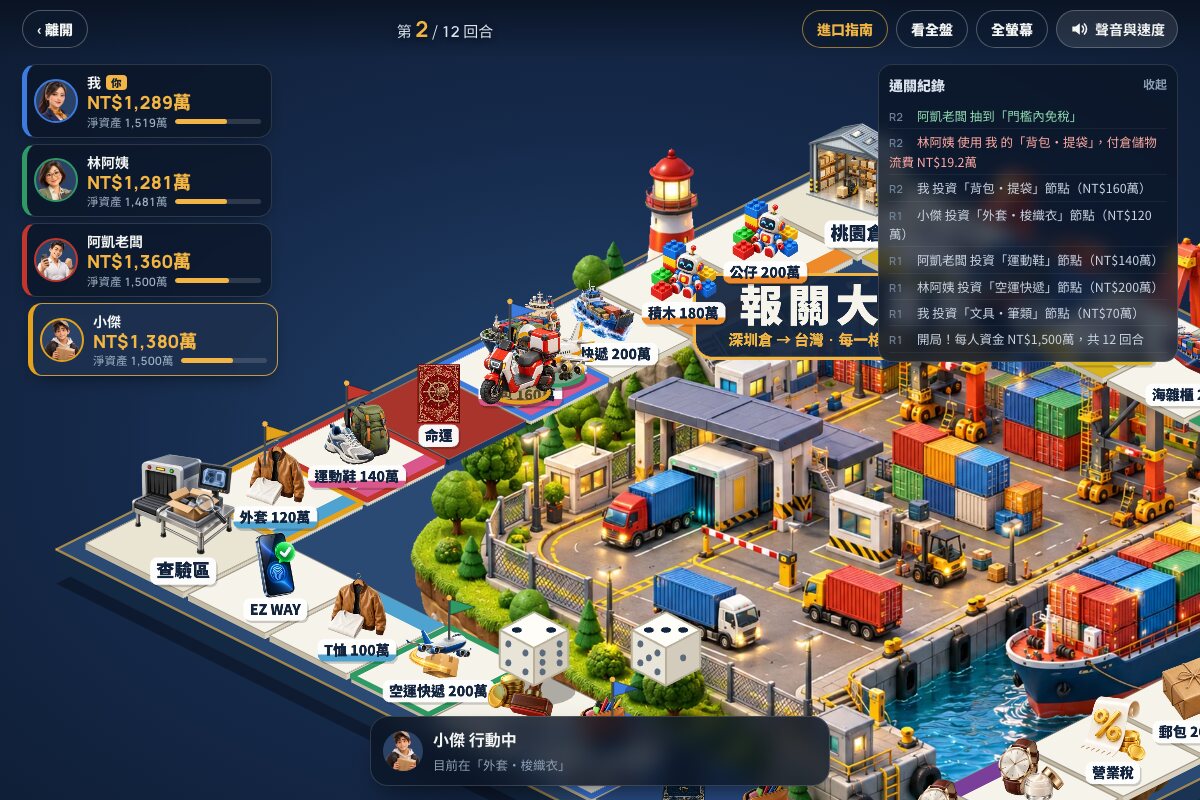
1Game setup
Go to Play Customs Tycoon, enter a consignee name, pick a transport piece (cargo plane, cargo ship, container truck or delivery scooter), then choose 1 to 3 opponents, the opponent level (lenient, standard or strict) and the number of rounds to settlement (12, 20 or 30 rounds).
2Roll and move
Take turns rolling two dice and moving forward. If you land on a product node nobody has invested in, you can invest; if another player lands on your node, they pay a warehousing and logistics fee. Once you own a whole set of nodes, you can upgrade them to a warehouse, a bonded warehouse and a smart logistics center.
3Draw cards and answer questions
Landing on Chance or Fate draws a card (35 cards, 17 of which ask you to make a choice); landing on an EZ WAY tile asks a true-or-false question (14 questions); landing on Product Lab asks you to judge whether a product, by its country of origin (for example made in mainland China or in another country), can be imported into Taiwan for personal use (the import guide covers 48 products). Every card and every question comes with a rule note and source.
4Ask the customs advisor
On a card that asks you to make a choice, you can first pay 20,000 game coins to ask the "customs advisor" to explain the rule before you answer.
5Shipment clearance and settlement
Each time you pass the "Shenzhen Warehouse" start tile it counts as one shipment clearance, and you draw C1, C2 or C3. When the rounds run out, players are compared on "net worth + compliance score × 50,000 game coins" and the highest score wins; a player who runs out of cash is eliminated early.
For your first game you can pick 12 rounds and the "lenient" opponent level. The lobby shows about 10, 20 and 30 minutes for 12, 20 and 30 rounds; that is the game's own estimate, and this page did not time real players.
Are the rules on the cards real?
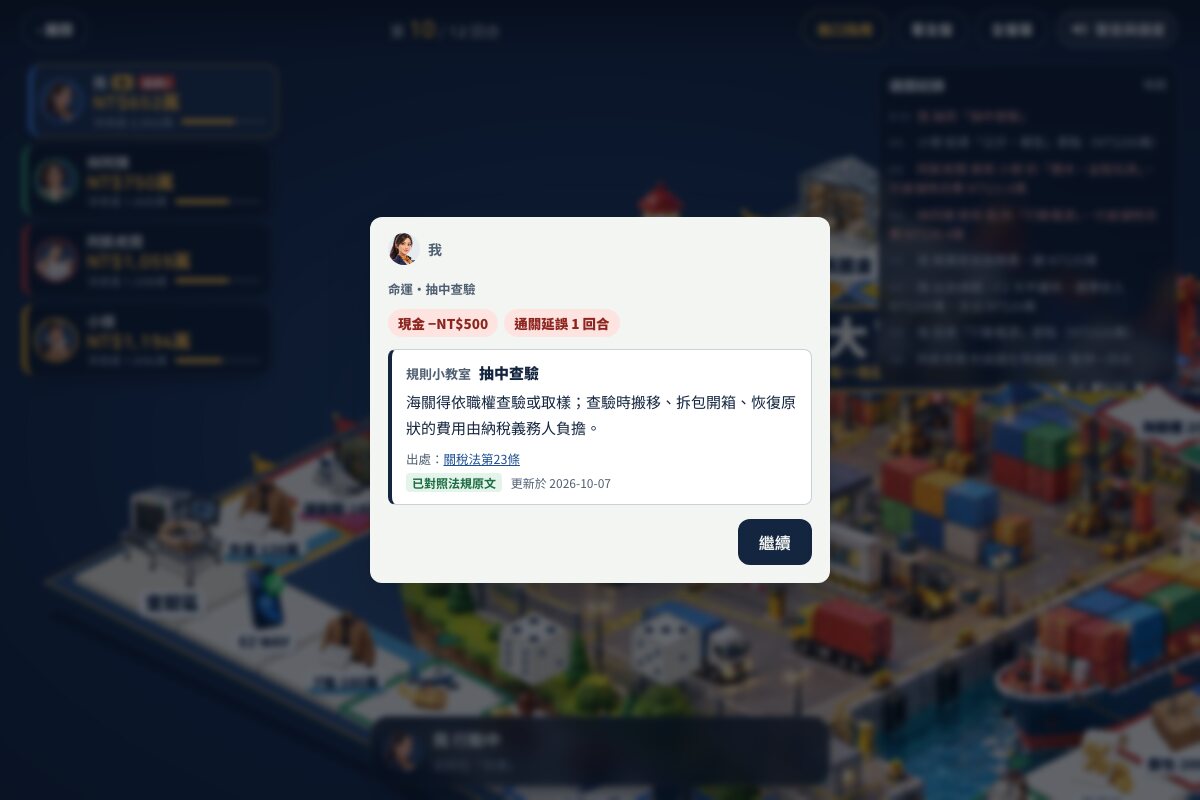
Each of the 35 Customs Tycoon cards links to a rule note that shows its source, reliability level and update date (all 2026-10-07); the game marks 28 as "checked against the legal text" and 7 as "based on verification notes". On 2026-11-21 this page re-fetched the primary texts and checked them sentence by sentence, covering 32 cards, including 4 that the game marks "based on verification notes". The table below covers cards about taxes, fees, tax exemptions and declarations; the cards on EZ WAY, import rules and prohibited items are in the next section. The table gives only the key points of the texts checked this time, with conditions and provisos kept as in the original.
| Card and game scenario | Real rule (key points of the text) | Source |
|---|---|---|
| Chance · Tax-free within the threshold Parcel with a dutiable value of NT$1,800 | Postal parcel: where the dutiable value is up to and including NT$2,000, customs duty, commodity tax and business tax are not levied; this does not cover tobacco and alcohol or agricultural products subject to tariff quotas, and the trade promotion service fee is also outside the exemption; the Ministry of Finance may, in response to emergencies, announce that specific items are not eligible for this exemption for a given period. Express consignment: the Ministry of Finance explains that where the dutiable value of the same consignment of imported goods is NT$2,000 or less, customs duty, commodity tax and business tax are not levied, again excluding tobacco and alcohol and agricultural products subject to tariff quotas; the Regulations Governing Customs Clearance Procedures for Air Express Consignments call express cargo of NT$2,000 or less "low-value duty-free imported express cargo". | Regulations Governing Customs Clearance Procedures for Importing and Exporting Postal Parcels, Article 7; Ministry of Finance, "Notes on Online Transactions (Imports)"; Regulations Governing Customs Clearance Procedures for Air Express Consignments, Article 11 |
| Fate · Over the threshold Dutiable value NT$2,100, wrongly assuming only the excess NT$100 is taxed | Postal parcel: where the dutiable value exceeds the duty-free limit, import duties and taxes are levied on the full amount. NT$2,000 is a threshold, not an allowance. | Regulations Governing Customs Clearance Procedures for Importing and Exporting Postal Parcels, Article 8 |
| Chance · Half-year reset / Fate · 7th duty-free parcel The count restarts on 1 July; the 7th low-value parcel in the first half of the year | Postal parcel: for postal parcels sent to the same addressee, if duty-free release has applied more than 6 times within a half-year, that counts as frequent and the exemption no longer applies; a half-year means months 1–6 or 7–12 of each year. Express consignment: the Ministry of Finance explains that where the same taxpayer has used the exemption under Article 49, paragraph 2 of the Customs Act more than 6 times within a half-year, it does not apply from the 7th time, and the count restarts on 1 January and 1 July each year. | Regulations Governing Customs Clearance Procedures for Importing and Exporting Postal Parcels, Article 12; Ministry of Finance, "Notes on Online Transactions (Imports)"; Customs Act, Article 49 |
| Fate · Splitting the shipment Someone suggests splitting one consignment into three parcels, each kept at NT$2,000 or less. The game uses it to demonstrate the consequences of a violation | Splitting is not a compliant way to save tax and runs into the following rules. Express consignment: the Ministry of Finance explains that the same consignment of imported express cargo may not be declared separately; postal parcels have their own rule on combining dutiable values. Falsely declaring the value or quantity of the goods carried may, under the Customs Anti-smuggling Act, depending on the seriousness of the case, be punished with a fine of up to and including 5 times the import duties and taxes evaded, or the goods may be confiscated instead of, or in addition to, the fine. | Ministry of Finance, "Notes on Online Transactions (Imports)"; Regulations Governing Customs Clearance Procedures for Importing and Exporting Postal Parcels, Article 11; Customs Anti-smuggling Act, Article 37 |
| Chance · Freight must be counted Should the declared price include freight? | For ad valorem duty, the dutiable value is based on the transaction price; freight to the port of entry, loading and unloading and handling charges, and insurance, if not already included, must be added to the dutiable value. | Customs Act, Article 29 |
| Fate · Commodity tax on an electric oven You bought an electric oven for NT$3,000 | Electric ovens (appliances that grill or bake food by electric heating or microwave) are subject to a commodity tax of 15% ad valorem. Import business tax is calculated on the dutiable value plus customs duty, commodity tax and so on, and the levy rate the Ministry of Finance explains is 5% (the Value-added and Non-value-added Business Tax Act sets the rate at a minimum of 5% and a maximum of 10%, with the levy rate set by the Executive Yuan). Express cargo that is taxable under the Commodity Tax Act must be cleared with a regular customs declaration. | Commodity Tax Act, Article 11; Value-added and Non-value-added Business Tax Act, Article 20; Ministry of Finance, "Notes on Online Transactions (Imports)"; Value-added and Non-value-added Business Tax Act, Article 10; Regulations Governing Customs Clearance Procedures for Air Express Consignments, Article 12 |
| Fate · Two bottles of liquor Sending two bottles of liquor to Taiwan by post | The NT$2,000 duty-free scope for postal parcels does not include tobacco and alcohol, which are taxed as prescribed. Alcohol imported without a license under the Tobacco and Alcohol Administration Act is illicit alcohol; importing illicit alcohol is punishable by imprisonment of up to and including 3 years, and a fine of NT$200,000 or more and up to and including NT$10,000,000 may also be imposed, but this penalty does not apply to quantities not exceeding the amount announced by the central competent authority and meant for personal use. Whether alcohol made in mainland China may be imported depends on the import rules for its tariff number. | Regulations Governing Customs Clearance Procedures for Importing and Exporting Postal Parcels, Article 7; Tobacco and Alcohol Administration Act, Article 6; Tobacco and Alcohol Administration Act, Article 45 |
| Chance · Declarations can be corrected You notice the declared quantity is missing one digit | If a customs declaration contains an error, the taxpayer may apply to Customs for correction with supporting documents; the items, time limits and documents for correction follow the measures set by the Ministry of Finance. | Customs Act, Article 17 |
| Chance · Supplementary documents have a deadline / Fate · What goes in the product name Customs asks you to supply an invoice; whether the product name needs to be written clearly | An import declaration must be filed with the invoice, packing list and other necessary documents; the packing list and documents such as an import or export permit that must be presented under the rules may be added before Customs releases the goods. If they are not supplied within 2 months from the day after Customs gives notice, then, except where a violation is involved and is handled separately, the goods will be ordered to be re-exported within a time limit, and where the importer declares abandonment or fails to re-export by the deadline, Article 96 of the Customs Act applies. Product names and quantities must be declared truthfully item by item; falsely declaring the name or quantity of goods may, under Article 37 of the Customs Anti-smuggling Act, depending on the seriousness of the case, be punished with a fine of up to and including 5 times the import duties and taxes evaded, or the goods may be confiscated instead of, or in addition to, the fine. | Customs Act, Article 17; Customs Anti-smuggling Act, Article 37 |
| Chance · Return before release The seller sent the wrong item and you no longer want it | Where, before Customs releases the goods, the taxpayer applies to re-export them and Customs approves, no customs duty is levied. | Customs Act, Article 50 |
| Fate · Picked for inspection Your parcel is selected for opening and inspection | Customs may inspect goods on its own initiative or on application; moving, unpacking or opening, restoring to the original state and similar matters during inspection, and their costs, are borne by the taxpayer. | Customs Act, Article 23 |
| Fate · Declared value The seller suggests declaring NT$6,000 goods as NT$1,500. The game uses it to demonstrate the consequences of a violation | Falsely declaring the value of goods carried into the country may, depending on the seriousness of the case, be punished with a fine of up to and including 5 times the import duties and taxes evaded, or the goods may be confiscated instead of, or in addition to, the fine. | Customs Anti-smuggling Act, Article 37 |
| Fate · False declaration involving controls Declaring prohibited goods under another product name. The game uses it to demonstrate the consequences of a violation | Where a false declaration involves evading controls, the offender shall instead be punished under Article 36, paragraphs 1 and 3 of the Customs Anti-smuggling Act: a fine of up to and including 3 times the value of the goods, and the goods are confiscated. | Customs Anti-smuggling Act, Article 37; Customs Anti-smuggling Act, Article 36 |
The cards on under-declaring, splitting shipments and declaring under another product name are used by the game to demonstrate what happens after a violation; in the game, "not getting inspected this time" is only a probability setting. In real life, declare truthfully. The table lists only the provisions most directly related to each card and is not the full legal liability; the consequences of a violation follow the legal text and the decisions of the competent authority and Customs.
Which rules do the cards on EZ WAY, import rules and prohibited items correspond to?
This group of cards on EZ WAY, import rules and prohibited items covers customs declaration authorization, whether goods from mainland China may be imported, and the rules on food, medicine, wireless products, toys, quarantine objects, e-cigarettes and counterfeits. Whether something can be shipped depends first on the import rules for the product's tariff number (look up to 11 digits); not finding a rule does not mean that rule does not apply.
| Card and game scenario | Real rule (key points of the text) | Source |
|---|---|---|
| Chance · EZ WAY real-name first Your parcel is still at the Shenzhen warehouse; download EZ WAY and complete real-name authentication first | EZ WAY is a real-name authentication app for express consignees promoted by the Customs Administration; when an express consignment is declared with a simplified declaration, an online case-by-case authorization can be handled through the real-name authentication platform, and the consignee confirms by replying with the real-name-authenticated mobile number or by logging in with a Citizen Digital Certificate. It applies to simplified declarations for imported express cargo (not involving import rules and with a dutiable value not exceeding NT$50,000), and to nationals of the Republic of China and foreign nationals holding a resident certificate. | Customs Administration EZ WAY press release; Real-name authentication operating guidelines; Customs Administration notes on real-name authentication; Regulations Governing Customs Clearance Procedures for Air Express Consignments, Article 17 |
| Chance · Authorize in advance If authorization is not completed before declaring, Customs may refuse to accept the declaration | Where customs declaration authorization has not been completed by any one of the methods (in writing, the Customs-Port-Trade Single Window or the real-name authentication platform) and recorded in the Customs clearance information system, Customs may refuse to accept the declaration. This applies from 2026-03-01 and appears in both the Regulations Governing Customs Clearance Procedures for Air Express Consignments and the Regulations Governing Customs Clearance Procedures for Maritime Express Consignments. | Regulations Governing Customs Clearance Procedures for Air Express Consignments, Article 17; Regulations Governing Customs Clearance Procedures for Air Express Consignments, Article 29; Regulations Governing Customs Clearance Procedures for Maritime Express Consignments, Article 18; Regulations Governing Customs Clearance Procedures for Maritime Express Consignments, Article 32 |
| Chance · Long-term authorization You ship often and want to authorize a customs broker once | Customs declaration authorization may be made in any one of three ways: written case-by-case or long-term authorization, online case-by-case or long-term authorization through the Customs-Port-Trade Single Window, or online case-by-case authorization through the real-name authentication platform. | Regulations Governing Customs Clearance Procedures for Air Express Consignments, Article 17 |
| Fate · No response to the push notification 7 days after the EZ WAY push notification you have still not tapped to authorize | If the consignee does not complete online authorization within 7 days from the day after the platform sends the customs declaration authorization message, the platform creates an exception record and notifies the express customs broker to contact the consignee to complete online authorization, or to obtain a paper customs declaration authorization letter as required. | Real-name authentication operating guidelines |
| Chance · MW0 small-quantity exemption Hardware tools made in mainland China (Chapter 82) marked MW0, whole declaration CIF NT$8,000, 3 pieces of one item | Goods from mainland China may not be imported except in cases allowed by law, such as an announced permission to import or special approval. For industrial products from mainland China outside the table of restricted import goods (tariff Chapters 25–97), where the whole declaration is CIF NT$32,000 or less and each item is 24 pieces or fewer (40 kilograms or less for items that cannot be counted in pieces), an import permit need not be applied for; items excluded by announcement are not covered, Chapters 1–24 are outside the scope, and other import rules such as those on the goods classification table still apply (for example inspection and quarantine). Being exempt from the import permit does not necessarily mean the goods will clear Customs. | Regulations Governing Trade between the Taiwan Area and the Mainland Area, Article 7; MOEA announcement on small-quantity exemption from the import permit (2022-08-19); Customs Administration FAQ (permitted imports of mainland China goods) |
| Fate · Electric bicycle You want to ship an electric bicycle from mainland China to Taiwan | The Ministry of Economic Affairs announced that from 2026-03-10, three items made in mainland China are excluded from the small-quantity exemption from the import permit: controllers for electric motorcycles or electric bicycles (8543.70.99.50-4), motorcycles fitted with an electric motor (8711.60.10.00-9) and bicycles fitted with an electric motor (8711.60.20.00-7); a special import permit document must be applied for from the International Trade Administration, and if it cannot be obtained, the goods are re-exported or abandoned. Which tariff number a product actually falls under is determined by Customs. | Keelung Customs explanation (3 exclusions including electric bicycles); Regulations Governing Trade between the Taiwan Area and the Mainland Area, Article 7 |
| Chance · Food for personal use From the Shenzhen consolidation warehouse, sending yourself 4 kilograms, about US$200, of biscuits made in Thailand (not made in mainland China) | Ordinary food for personal use with a value of US$1,000 or less and a total weight of 6 kilograms or less requires no application for import inspection to the Taiwan Food and Drug Administration; it is for personal use only and may not be sold. This only waives the food import inspection; whether food made in mainland China may be imported depends separately on whether the tariff number is marked MW0 (the small-quantity exemption from the import permit applies only to Chapters 25–97). | Taiwan Food and Drug Administration explanation (2025-06-25); MOEA announcement on small-quantity exemption from the import permit (2022-08-19) |
| Chance · Health food limits Sending capsule-form health food to Taiwan for yourself | Tablet and capsule food for personal use, at most 12 bottles (boxes, cans, packs or bags) of each kind and no more than 36 bottles in total, requires no application for import inspection. This only waives the food import inspection; for goods made in mainland China, check separately whether the tariff number is marked MW0, and Chapters 1–24 are not covered by the small-quantity exemption from the import permit. | Taiwan Food and Drug Administration explanation (2025-06-25); MOEA announcement on small-quantity exemption from the import permit (2022-08-19) |
| Chance · No bottle limit for cosmetics Online it says cosmetics for personal use can only be sent up to 12 bottles | On 2024-07-01 the Ministry of Health and Welfare announced the repeal of the "quantity limits for importing specific-purpose cosmetics for personal use without applying for inspection and registration". Cosmetics imported for personal use still may not be sold; to import personal-use cosmetics in glass ampoules, you must first apply to the Taiwan Food and Drug Administration and obtain approval. | Ministry of Health and Welfare announcement (2024-07-01); Taiwan Food and Drug Administration explanation (2025-06-25) |
| Chance · Apply for medicine first You ask a friend to send over-the-counter medicine from mainland China back to Taiwan for your own use | Sending ordinary medicines back to Taiwan requires application to and approval by the Taiwan Food and Drug Administration; controlled drugs may not be sent by post or express consignment. Medicines imported without approval are prohibited drugs under the Pharmaceutical Affairs Act (except medicines carried for personal use by travelers or by crew serving on a means of transport); importing prohibited drugs is punishable by imprisonment of up to and including 10 years, and a fine of up to and including NT$100,000,000 may also be imposed, and negligent offenders are punished by imprisonment of up to and including 3 years, short-term detention, or a fine of up to and including NT$10,000,000. | Taiwan Food and Drug Administration explanation (2025-06-25); Pharmaceutical Affairs Act, Article 22; Pharmaceutical Affairs Act, Article 82 |
| Chance · 2 Bluetooth earphones Sending Bluetooth earphones to yourself by post | For wireless telecommunications terminal equipment or low-power radio-frequency devices for personal use imported by post or other means not carried personally, up to 2 units at a time may be imported with a written undertaking in place of an import approval certificate; sending 3 or more units by post (up to and including 10) requires an import approval certificate; one natural person is limited to 10 units a year and must be 18 or older. This is the rule for Class 2 controlled telecommunications radio-frequency devices, and whether a product falls within it is determined by the National Communications Commission. | Administrative Regulations on Manufacturing, Import and Report of the Controlled Telecommunications Radio-Frequency Devices, Article 9 |
| Chance · Toy inspection exemption allowance You ordered a batch of children's toys subject to inspection for yourself | For toy products not for sale and for personal use, where the total amount of the same specification and model in one declaration is US$1,000 or less and the quantity does not exceed 5 pieces, or exceeds US$1,000 with only 1 piece, exemption from inspection is granted after review by the inspection authority (the Bureau of Standards, Metrology and Inspection, MOEA) finds it compliant; exemption for the same specification and model is limited to once within 6 months. | Regulations Governing Exemption from Inspection of Commodities, Article 5; Regulations Governing Exemption from Inspection of Commodities, Article 8 |
| Chance · Cheap goods still follow the rules Thinking that goods worth under NT$2,000 need no attention at all | Postal parcel items that fall under categories subject to inspection or quarantine or are subject to other import and export rules must, unless the law provides otherwise, follow those rules; the Ministry of Finance also explains for imported express consignments that those under categories subject to inspection (quarantine) must follow the relevant rules. Duty-free does not mean exempt from inspection or quarantine. | Regulations Governing Customs Clearance Procedures for Importing and Exporting Postal Parcels, Article 13; Ministry of Finance, "Notes on Online Transactions (Imports)" |
| Fate · Dried pork stopped A parcel from mainland China contains a pack of dried pork | The importer of quarantine objects or their agent must apply for quarantine when the objects arrive at the announced port or station, and failing to apply is punished with a fine of NT$50,000 or more and up to and including NT$1,000,000. Quarantine objects may not be imported by post; those imported by post shall be returned, confiscated or destroyed. Under the Ministry of Agriculture penalty standards, importing pork products by post from countries (regions) with African swine fever is punished with NT$200,000 for the first time, and NT$1,000,000 for a repeat violation within 3 years from the day after the previous penalty decision was served. Importing, without authorization, quarantine objects whose import is prohibited is punishable by imprisonment of up to and including 7 years, and a fine of up to and including NT$3,000,000 may also be imposed. | Act on the Prevention and Control of Infectious Animal Diseases, Article 34; Act on the Prevention and Control of Infectious Animal Diseases, Article 43; MOA penalty standards for importing pork products by post from African swine fever countries; Act on the Prevention and Control of Infectious Animal Diseases, Article 41 |
| Fate · Fresh fruit and seeds You sent a pack of seeds and fresh fruit | The importer or their agent must apply for quarantine when the quarantine objects arrive at the port or station. Quarantine objects may not be imported by post, and those imported by post shall be returned or destroyed; the only exceptions are where the announcement exempts presenting a quarantine certificate, or the addressee has applied in advance to the plant quarantine authority and been approved. Importing, without authorization, quarantine objects whose import is prohibited by announcement, or items that may not be imported such as pests, soil and plants with soil attached, is punishable by imprisonment of up to and including 3 years, short-term detention, or a fine, or both, of up to and including NT$150,000. | Plant Protection and Quarantine Act, Article 17; Plant Protection and Quarantine Act, Article 22; Plant Protection and Quarantine Act, Article 14; Plant Protection and Quarantine Act, Article 15 |
| Fate · E-cigarettes Ordering an e-cigarette device and pods online and sending them to Taiwan | No one may import tobacco-like products or their component parts; the legal definition of tobacco-like products includes electronic or non-electronic delivery compositions, with or without nicotine. A person other than a manufacturer or importer who violates this is fined NT$50,000 or more and up to and including NT$5,000,000 (for manufacturers or importers it is NT$10,000,000 or more and up to and including NT$50,000,000). | Tobacco Hazards Prevention Act, Article 3; Tobacco Hazards Prevention Act, Article 15; Tobacco Hazards Prevention Act, Article 26 |
| Fate · Suspected counterfeit bag Customs finds a bag that appears to infringe a trademark | Where Customs finds that imported goods clearly may infringe a trademark right, it shall notify the trademark owner and the importer or exporter; where the trademark owner presents evidence of infringement and the importer or exporter does not present proof of non-infringement, Customs may withhold release. Criminal liability requires selling or intending to sell: imprisonment of up to and including 1 year, short-term detention, or a fine, or both, of up to and including NT$50,000. | Trademark Act, Article 75; Trademark Act, Article 97 |
For "Check duty-free count" (a query service of the Customs-Port-Trade Single Window) and "Mainland green tea" (the import rules for the green tea tariff number), no primary text that could be checked sentence by sentence was obtained this time; the source for "Gold necklace" is an operating rule of industry operators, not the legal text. All three cards still appear in the game, and for their rule notes please rely on the current announcements of the competent authority.
What do the C1, C2 and C3 clearance lights mean in real life?
In real life, after an import declaration is filed online, the Customs computer expert system determines C1 no document review or inspection, C2 document review or C3 physical inspection according to screening conditions such as the trader's clearance record, the origin of the goods, the nature of the goods and the customs broker (Customs Administration FAQ). The game has none of these screening conditions and uses the "compliance score" to simulate "people who follow the rules get C1 more often". The table below is the Customs Administration's explanation for ordinary online declarations; for the actual handling of simplified express declarations, follow the notices from Customs and the customs broker.
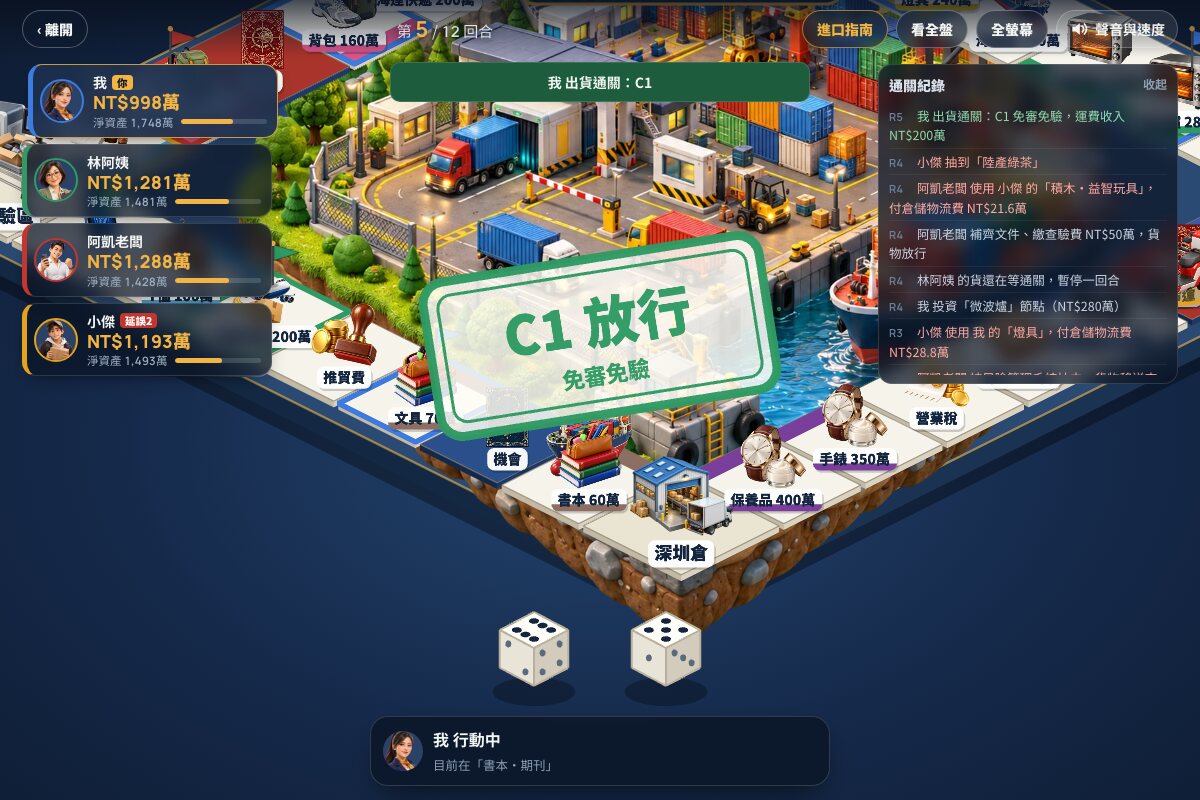
| Clearance method | In real life (Customs Administration explanation) | In the game |
|---|---|---|
| C1 no document review or inspection | Once the taxes and fees on the import goods are paid, the goods can be collected from the cargo terminal with the release notice and bill of lading documents; the written declaration and original documents are kept by the declarant for one year, and Customs may require them to be supplied or checked when necessary. | Collect shipment income of 2,000,000 game coins; with a compliance score of 80 or more, add 500,000 game coins. |
| C2 document review | The declarant must supply the written declaration and original documents before the end of Customs office hours on the day after the online declaration, and the goods are released after the review finds them consistent. | Collect shipment income, but pay 200,000 game coins. |
| C3 physical inspection | In addition to supplying documents, the declarant must, within 10 days from the declaration date, apply for the goods to be inspected in the presence of a Customs inspection officer, and the goods are released after review, classification and valuation. | Collect shipment income, but pay 600,000 game coins and lose 1 round. |
- How the game draws: The compliance score runs from 0 to 100, starting at 60. According to the source-code formula, at a score of 60 there is about a 61% chance of C1 and 9% of C3; at 100 it is 85% C1 and 4% C3; at 0 it is 25% C1 and 30% C3.
- These are game probabilities: they are not Customs' actual proportions. There is no compliance score in real life, and playing the game cannot earn you a C1.
- Inspection costs: In real life the costs of moving, unpacking or opening, and restoring to the original state during inspection are borne by the taxpayer (Article 23 of the Customs Act), and there is no fixed amount like in the game.
How do game amounts differ from real ones?
Every amount on the Customs Tycoon screen is labeled "NT$", and the lobby states that "all amounts in the game are fictional game coins". These amounts fall into three types: the board economy is a game mechanic; a few cards are designed around statutory amounts; and the other card deductions are scenario illustrations. Whichever type, real taxes, fees and penalties follow the legal text and the determinations of the competent authority and Customs.
| Type of amount | Examples in the game (source code) | Relation to real life |
|---|---|---|
| ① Board economy (shown in units of 10,000 on screen) | Starting funds 15,000,000 game coins; shipment income each time you pass the Shenzhen Warehouse (written "freight income" in the game log) 2,000,000 game coins; investing in a product node 600,000 to 4,000,000, transport route tiles 2,000,000; the warehousing and logistics fee; C2 pays 200,000, C3 pays 600,000, and being sent to the Inspection Zone costs 500,000; the trade promotion service fee tile 300,000; the business tax settlement tile pays 5% of cash (at least 200,000). | Game mechanics, not market rates for freight, warehousing, inspection fees or taxes. Route tiles do not mean HowBridge offers every shipping method; HowBridge's only route is mainland China (Shenzhen consolidation warehouse) to Taiwan. |
| ② Card deductions designed around statutory amounts | Fate "Dried pork stopped" deducts NT$200,000; Fate "E-cigarettes" deducts NT$50,000. | NT$200,000 is the first-offense fine in the Ministry of Agriculture penalty standards for "importing pork products by post from countries (regions) with African swine fever" (under Article 43, item 8 of the Act on the Prevention and Control of Infectious Animal Diseases); NT$50,000 is the lower limit of the fine in Article 26, paragraph 2 of the Tobacco Hazards Prevention Act for persons other than manufacturers or importers (the upper limit is NT$5,000,000). Actual penalties are as determined by the competent authority. |
| ③ Card deductions as scenario illustrations | Fate "Picked for inspection" deducts NT$500, "Commodity tax on an electric oven" NT$760, "Electric bicycle" NT$15,000, "Declared value" under-declaration caught deducts NT$5,580, and so on. | The game designer worked these out from assumed tax rates or rough estimates; they are not quotes for inspection fees, taxes, payment for goods or fines. For example, NT$5,580 assumes the goods owe NT$930 in taxes and fees, plus a fine of 5 times that amount (NT$4,650); Article 37 of the Customs Anti-smuggling Act says "up to and including 5 times the import duties and taxes evaded", and the actual tax amount and multiple are determined by Customs. |
| Trade promotion service fee and business tax | The trade promotion service fee tile charges a fixed 300,000; the business tax settlement tile charges 5% of cash. | The statutory upper limit of the trade promotion service fee is 4.25 per 10,000 of the value of the goods, it may be waived for specified reasons, and the actual rate and the scope of waived items are drafted by the competent authority and submitted to the Executive Yuan for approval (Article 21 of the Foreign Trade Act). Import business tax is calculated on the dutiable value plus customs duty, commodity tax and so on, and the levy rate the Ministry of Finance explains is 5%. |
| Compliance score | 0–100, starting at 60; following the rules adds points and violations deduct points; at settlement each 1 point is worth 50,000 game coins. | There is no such score in real life. |
To estimate taxes, use the import duty calculator; penalties follow the legal text and the determinations of the competent authority and Customs.
Does following the rules really make you more likely to win?
In simulations from the Customs Tycoon source code, the computer opponent that never picks violation options has the highest win rate, but the gap is small; at 30 rounds it is almost tied with the most risk-taking opponent. This is a simulation run on 2026-11-21 with the game engine of 300 games with "3 computer opponents and no human player", not a test with real players.
| Rounds to settlement | Auntie Lin (never picks violation options) | Boss Kai (70% chance of picking violation options) | Xiao Jie (35% chance of picking violation options) |
|---|---|---|---|
| 12 rounds | 44.0% | 32.7% | 23.3% |
| 20 rounds | 40.7% | 32.7% | 26.7% |
| 30 rounds | 36.7% | 35.7% | 27.7% |
- Scoring: final score = net worth + compliance score × 50,000 game coins, so following the rules pays off at settlement; in the 20-round simulation, the three opponents' average compliance scores at the end were 67.2, 59.5 and 62.7.
- It is not only about following the rules: the three computer opponents also differ in the cash they hold back, their accuracy on true-or-false questions (90%, 55%, 65%), their accuracy at Product Lab (85%, 50%, 60%) and whether they pay to leave the Inspection Zone, so the win-rate gap cannot be credited entirely to following the rules.
- Method: opponent level "standard", random seeds 1–300, always 3 computer opponents per game; the game is designed so that following the rules pays off, but not overwhelmingly. Win rates of human players were not measured.
Where do I look up the real rules after playing?
To apply the rules on the Customs Tycoon cards to a real parcel, first look up the product's tariff number and import rules, then read the official guide for that type of product; where you are unsure, follow the announcements of the competent authority and Customs' determination. For the overall process, start with the complete guide to Taiwan import customs clearance.
- Tariff numbers and import rules: Tariff Search lets you enter a product name in Chinese to look up the CCC code and tax rate; a tariff number mark does not mean Customs will necessarily classify the goods that way, and Customs' determination prevails.
- Calculating taxes: Import duty calculator.
- Personal-use inspection exemption allowances: How the personal-use inspection exemption allowance works (6 kilograms, 12 / 36 bottles).
- EZ WAY authorization: How to set up EZ WAY pre-authorization.
- Things that cannot be shipped: Taiwan Customs list of prohibited and restricted imports, how to apply for an import permit.
- Food, medicine and medical devices: Can food be shipped to Taiwan?, Import permits for medicines and medical devices.
- Toys and counterfeits: Inspection and exemption for toys sent from China to Taiwan, Legal risks of importing counterfeit goods.
- How long clearance takes: Clearance time and how long delivery takes after clearance.
What are the limits of this game?
The Customs Tycoon interface is in Traditional Chinese only, its rule data stops at 2026-10-07, a game left midway is not saved, and many real-life procedures are simplified. Knowing this before you play makes it less likely that you treat the game as a customs manual.
- Traditional Chinese interface only: the title on the game screen is "報關大富翁"; this introduction page comes in 14 languages.
- Rule data has an update date: the update dates of the card rule notes are all 2026-10-07, so after a law is amended the game may not have been updated yet; read the "updated on" date on the card as well. The tables on this page give only the key points of the texts checked this time; where a card note has details the tables do not mention (for example quantities for sending medicine), follow the current announcements of the competent authority.
- Simplified procedures: customs declaration authorization, duty-free thresholds and inspections are all simplified into tiles and cards; the duty-free threshold is mostly illustrated with the postal parcel rules, while express consignments are covered by separate rules such as the Regulations Governing Customs Clearance Procedures for Air Express Consignments. The transport route tiles and the "Shenzhen Warehouse" and "Taoyuan Warehouse" on the board are game scenery and do not mean HowBridge offers every shipping method.
- Progress and records: no login is needed; if you leave the page midway through a game, progress is not saved. Best records (top 10), setup choices and unlocked products are stored only in the browser on this device, and disappear if you switch devices or clear browsing data; private browsing may not save them.
- Opponents are all computers: at most 3 computer opponents per game and no online play. The game needs JavaScript turned on, and music plays after you press "Stamp to Start"; you can adjust it under "Sound and speed".
- Not a basis for customs declaration: the game and this page are only for getting to know the rules; whether something can actually be imported and how much tax and fees apply follow the announcements of the competent authority and Customs' determination.
Which terms will you meet when playing Customs Tycoon?
- Dutiable value
- The value on which Customs calculates import duties and taxes; for ad valorem duty it is based on the transaction price, and freight to Taiwan, loading, unloading and handling charges, and insurance must be added.
- Simplified declaration and regular customs declaration
- The two ways to declare express cargo; a regular customs declaration is required where the dutiable value exceeds NT$50,000, import or export rules are involved (except special cases announced by Customs), or the goods are taxable under the Commodity Tax Act.
- Customs declaration authorization
- The consignee authorizes a customs broker to make the declaration for them; for simplified express declarations it can be done in writing, through the Customs-Port-Trade Single Window or on the real-name authentication platform.
- EZ WAY
- A real-name authentication app for express consignees promoted by the Customs Administration; consignees can confirm online customs declaration authorization by replying with a real-name-authenticated mobile phone; it applies to simplified declarations for imported express cargo.
- MW0
- One of the codes in the "import rules" column of the goods classification table; goods marked MW0 may in principle not be imported from mainland China. The exception is industrial products in Chapters 25–97 outside the table, where the whole declaration is CIF NT$32,000 or less and each item is 24 pieces or fewer (40 kilograms or less for items that cannot be counted in pieces), which may be imported without applying for an import permit; items excluded by announcement, such as electric motorcycles, electric bicycles and their controllers, and Chapters 1–24 are not covered, and other import rules such as inspection and quarantine still apply.
- Small-quantity exemption from the import permit
- For industrial products from mainland China outside the table (Chapters 25–97), where the whole declaration is CIF NT$32,000 or less and each item is 24 pieces or fewer (40 kilograms or less for items that cannot be counted in pieces), an import permit need not be applied for; items excluded by announcement are not covered, Chapters 1–24 do not apply, and other import rules such as inspection and quarantine still apply.
- C1, C2, C3
- The three clearance methods determined by Customs: C1 no document review or inspection, C2 document review, C3 physical inspection.
- Quarantine objects
- Items for which quarantine must be applied for under the Act on the Prevention and Control of Infectious Animal Diseases; they may not be imported by post.
- Trade promotion service fee
- A fee collected uniformly by Customs, with a statutory upper limit of 4.25 per 10,000 of the value of the goods; the actual rate and the scope of waived items are drafted by the competent authority and submitted to the Executive Yuan for approval. The NT$2,000 exemption for postal parcels does not include this fee.
- Compliance score (game term)
- A 0–100 score invented by the game, starting at 60; following the rules adds points and violations deduct points, and at settlement each 1 point is worth 50,000 game coins. There is no such score in real life.
What are the sources and the scope of the checks?
Laws and official explanations were consulted and compared sentence by sentence on 2026-11-21; the "document date" of a law is the latest amendment date shown in the Laws & Regulations Database, and for an official web page it is the publication or update date shown on the page; where none is shown, none is supplied. Game figures come from the Customs Tycoon source code (cards, rules, question bank, product data and engine) and were checked by actually playing one game on the live version.
Government and official sources
- Laws & Regulations Database of the Republic of China (Taiwan): Regulations Governing Customs Clearance Procedures for Air Express Consignments, Article 17 | Document date: 2026-02-23 (latest amendment date of the law or regulation); When an express consignment is declared with a simplified declaration, customs declaration authorization may be made by any one of three methods: in writing, the Customs-Port-Trade Single Window or the real-name authentication platform; where authorization has not been completed and recorded by the system, Customs may refuse to accept the declaration.
- Laws & Regulations Database of the Republic of China (Taiwan): Regulations Governing Customs Clearance Procedures for Air Express Consignments, Article 29 | Document date: 2026-02-23 (latest amendment date of the law or regulation); Paragraph 2 of Article 17 (Customs may refuse to accept a declaration where customs declaration authorization has not been completed) applies from 2026-03-01.
- Laws & Regulations Database of the Republic of China (Taiwan): Regulations Governing Customs Clearance Procedures for Air Express Consignments, Article 11 | Document date: 2026-02-23 (latest amendment date of the law or regulation); Express cargo is classified by dutiable value: NT$2,000 or less is low-value duty-free imported express cargo, NT$2,001 to NT$50,000 is low-value taxable, and more than NT$50,000 is high-value express cargo.
- Laws & Regulations Database of the Republic of China (Taiwan): Regulations Governing Customs Clearance Procedures for Air Express Consignments, Article 12 | Document date: 2026-02-23 (latest amendment date of the law or regulation); High-value express cargo, cargo involving import or export rules (except special cases announced by Customs) and cargo taxable under the Commodity Tax Act must be cleared with a regular customs declaration.
- Laws & Regulations Database of the Republic of China (Taiwan): Regulations Governing Customs Clearance Procedures for Maritime Express Consignments, Article 32 | Document date: 2026-02-23 (latest amendment date of the law or regulation); Paragraph 2 of Article 18 of the Regulations Governing Customs Clearance Procedures for Maritime Express Consignments (the equivalent customs declaration authorization rule) applies from 2026-03-01.
- Laws & Regulations Database of the Republic of China (Taiwan): Regulations Governing Customs Clearance Procedures for Importing and Exporting Postal Parcels, Article 7 | Document date: 2020-04-01 (latest amendment date of the law or regulation); Postal parcels with a dutiable value of NT$2,000 or less are exempt from customs duty, commodity tax and business tax; the exemption does not cover tobacco and alcohol or agricultural products subject to tariff quotas; in response to emergencies, the Ministry of Finance may announce that specific items are not eligible for a given period.
- Laws & Regulations Database of the Republic of China (Taiwan): Regulations Governing Customs Clearance Procedures for Importing and Exporting Postal Parcels, Article 8 | Document date: 2020-04-01 (latest amendment date of the law or regulation); Where the dutiable value of a postal parcel exceeds the duty-free limit, import duties and taxes are levied on the full amount.
- Laws & Regulations Database of the Republic of China (Taiwan): Regulations Governing Customs Clearance Procedures for Importing and Exporting Postal Parcels, Article 11 | Document date: 2020-04-01 (latest amendment date of the law or regulation); Postal parcels have their own rule on combining dutiable values.
- Laws & Regulations Database of the Republic of China (Taiwan): Regulations Governing Customs Clearance Procedures for Importing and Exporting Postal Parcels, Article 12 | Document date: 2020-04-01 (latest amendment date of the law or regulation); For postal parcels sent to the same addressee, if duty-free release has applied more than 6 times within a half-year, that counts as frequent and the exemption no longer applies; a half-year means months 1–6 or 7–12.
- Laws & Regulations Database of the Republic of China (Taiwan): Regulations Governing Customs Clearance Procedures for Importing and Exporting Postal Parcels, Article 13 | Document date: 2020-04-01 (latest amendment date of the law or regulation); Postal parcel items that fall under categories subject to inspection or quarantine or are subject to other import and export rules shall follow those rules.
- Laws & Regulations Database of the Republic of China (Taiwan): Customs Act, Article 17 | Document date: 2022-05-11 (latest amendment date of the law or regulation); An import declaration must be filed with documents such as the invoice and packing list; the packing list and documents such as an import or export permit that must be presented under the rules may be added before release; if not supplied within 2 months from the day after notice, the goods are ordered to be re-exported within a time limit, and where the importer declares abandonment or fails to re-export by the deadline, Article 96 applies; a declaration may be corrected on application with supporting documents.
- Laws & Regulations Database of the Republic of China (Taiwan): Customs Act, Article 23 | Document date: 2022-05-11 (latest amendment date of the law or regulation); Customs may inspect on its own initiative or on application; the costs of moving, unpacking or opening, and restoring to the original state during inspection are borne by the taxpayer.
- Laws & Regulations Database of the Republic of China (Taiwan): Customs Act, Article 29 | Document date: 2022-05-11 (latest amendment date of the law or regulation); For ad valorem duty, the dutiable value is based on the transaction price; freight to the port of entry, loading, unloading and handling charges, and insurance must be added.
- Laws & Regulations Database of the Republic of China (Taiwan): Customs Act, Article 49 | Document date: 2022-05-11 (latest amendment date of the law or regulation); Imported goods of the same consignment with a dutiable value at or below the limit announced by the Ministry of Finance are duty-free, but this does not apply to frequent imports; the criteria for frequency are set by the Ministry of Finance.
- Laws & Regulations Database of the Republic of China (Taiwan): Customs Act, Article 50 | Document date: 2022-05-11 (latest amendment date of the law or regulation); Where, before release, the taxpayer applies to re-export the goods and Customs approves, no customs duty is levied.
- Laws & Regulations Database of the Republic of China (Taiwan): Customs Anti-smuggling Act, Article 37 | Document date: 2018-05-09 (latest amendment date of the law or regulation); Falsely declaring the name, quantity, value and so on of goods may, depending on the seriousness of the case, be punished with a fine of up to and including 5 times the import duties and taxes evaded, or the goods may be confiscated instead of, or in addition to, the fine; where evading controls is involved, the offender shall instead be punished under Article 36, paragraphs 1 and 3.
- Laws & Regulations Database of the Republic of China (Taiwan): Customs Anti-smuggling Act, Article 36 | Document date: 2018-05-09 (latest amendment date of the law or regulation); Smuggling goods into the country is punished with a fine of up to and including 3 times the value of the goods, and the smuggled goods are confiscated.
- Laws & Regulations Database of the Republic of China (Taiwan): Regulations Governing Trade between the Taiwan Area and the Mainland Area, Article 7 | Document date: 2024-02-19 (latest amendment date of the law or regulation); Goods from the Mainland Area may not be imported into the Taiwan Area except in cases allowed by law, such as an announced permission to import by the competent authority or special approval.
- Ministry of Economic Affairs (International Trade Administration announcements): MOEA announcement "Provisions on the exemption from applying for an import permit for small quantities of mainland goods" (Jing-Mao-Zi No. 11104603570) | Document date: 2022-08-19; For industrial products from mainland China outside the table (tariff Chapters 25–97), where the whole declaration is CIF NT$32,000 or less and each item is 24 pieces or fewer (40 kilograms or less for items that cannot be counted in pieces), an import permit need not be applied for; other rules such as the goods classification table must still be followed.
- Keelung Customs, Customs Administration, Ministry of Finance: Cross-border online shopping notice: 3 tariff numbers including electric bicycles made in mainland China are excluded from the small-quantity exemption rule | Document date: 2026-05-04 (page update date); The Ministry of Economic Affairs announced that from 2026-03-10, 3 tariff numbers including electric bicycles made in mainland China are excluded from the small-quantity exemption from the import permit; a special import permit document must be applied for, otherwise the goods are re-exported or abandoned.
- Customs Administration, Ministry of Finance: Which items from mainland China are permitted to be imported? (FAQ) | Document date: 2026-07-09; Only goods from mainland China whose import rules column lists neither the code MW0 nor MP1 are permitted to be imported and exempt from the import permit.
- Taiwan Food and Drug Administration, Ministry of Health and Welfare: Food, drugs, medical devices and cosmetics carried on entry are for personal use only, and reselling them after returning home may break the law! | Document date: 2025-06-25; The quantities of personal-use food and tablet or capsule food exempt from inspection, the requirement to apply for approval to send ordinary medicines back to Taiwan, and the requirement to apply for approval for cosmetics in glass ampoules; all are for personal use only and may not be sold.
- Ministry of Health and Welfare (Taiwan Food and Drug Administration announcement): Repeal of the "quantity limits for importing specific-purpose cosmetics for personal use without applying for inspection and registration" (Wei-Shou-Shi-Zi No. 1131603792) | Document date: 2024-07-01; The Ministry of Health and Welfare announced the repeal of the "quantity limits for importing specific-purpose cosmetics for personal use without applying for inspection and registration", effective 2024-07-01.
- Laws & Regulations Database of the Republic of China (Taiwan): Administrative Regulations on Manufacturing, Import and Report of the Controlled Telecommunications Radio-Frequency Devices, Article 9 | Document date: 2025-02-03 (latest amendment date of the law or regulation); For wireless telecommunications terminal equipment or low-power radio-frequency devices for personal use imported by post, up to 2 units at a time may be imported with a written undertaking in place of an import approval certificate; one natural person is limited to 10 units a year and must be 18 or older.
- Laws & Regulations Database of the Republic of China (Taiwan): Regulations Governing Exemption from Inspection of Commodities, Article 5 | Document date: 2019-11-21 (latest amendment date of the law or regulation); For toy products not for sale and for personal use, where the same specification and model in one declaration is US$1,000 or less and does not exceed 5 pieces, or exceeds US$1,000 with only 1 piece, exemption from inspection is granted after review.
- Laws & Regulations Database of the Republic of China (Taiwan): Regulations Governing Exemption from Inspection of Commodities, Article 8 | Document date: 2019-11-21 (latest amendment date of the law or regulation); For products not for sale and for personal use, exemption from inspection for the same specification and model is limited to once within 6 months.
- Laws & Regulations Database of the Republic of China (Taiwan): Pharmaceutical Affairs Act, Article 22 | Document date: 2026-03-04 (latest amendment date of the law or regulation); Medicines imported without approval are prohibited drugs, except medicines carried for personal use by travelers or by crew serving on a means of transport.
- Laws & Regulations Database of the Republic of China (Taiwan): Act on the Prevention and Control of Infectious Animal Diseases, Article 34 | Document date: 2019-12-13 (latest amendment date of the law or regulation); The importer of quarantine objects must apply for quarantine when the objects arrive at the announced port or station; quarantine objects may not be imported by post, and those imported by post shall be returned, confiscated or destroyed.
- Laws & Regulations Database of the Republic of China (Taiwan): Act on the Prevention and Control of Infectious Animal Diseases, Article 41 | Document date: 2019-12-13 (latest amendment date of the law or regulation); Importing without permission quarantine objects whose import is prohibited is punishable by imprisonment of up to and including 7 years, and a fine of up to and including NT$3,000,000 may also be imposed.
- Animal and Plant Health Inspection Agency, Ministry of Agriculture (at the time of the press release, the Bureau of Animal and Plant Health Inspection and Quarantine of the Council of Agriculture): Guarding against African swine fever, penalty measures for international postal parcels start on May 20 to deter pork products being hidden in parcels | Document date: 2022-05-18; Background: on 2022-05-18 it was announced that from 2022-05-20 penalties would start for international postal parcels carrying pork products (the current basis is the Ministry of Agriculture penalty standards).
- Laws & Regulations Database of the Republic of China (Taiwan): Plant Protection and Quarantine Act, Article 17 | Document date: 2018-06-20 (latest amendment date of the law or regulation); Imported quarantine objects must be applied for quarantine when they arrive at the port or station; quarantine objects may not be imported by post, and those imported by post shall be returned or destroyed; except where the announcement exempts presenting a quarantine certificate or prior application has been approved.
- Laws & Regulations Database of the Republic of China (Taiwan): Tobacco Hazards Prevention Act, Article 3 | Document date: 2023-02-15 (latest amendment date of the law or regulation); The legal definition of tobacco-like products includes electronic or non-electronic delivery compositions, with or without nicotine.
- Laws & Regulations Database of the Republic of China (Taiwan): Tobacco Hazards Prevention Act, Article 15 | Document date: 2023-02-15 (latest amendment date of the law or regulation); No one may manufacture, import or sell tobacco-like products or their component parts.
- Laws & Regulations Database of the Republic of China (Taiwan): Tobacco Hazards Prevention Act, Article 26 | Document date: 2023-02-15 (latest amendment date of the law or regulation); A manufacturer or importer who violates this is fined NT$10,000,000 or more and up to and including NT$50,000,000; a person other than a manufacturer or importer is fined NT$50,000 or more and up to and including NT$5,000,000.
- Laws & Regulations Database of the Republic of China (Taiwan): Trademark Act, Article 75 | Document date: 2023-05-24 (latest amendment date of the law or regulation); Where Customs finds that imported goods clearly may infringe a trademark right, it shall notify the trademark owner and the importer or exporter; where the importer or exporter does not present proof of non-infringement, Customs may withhold release.
- Laws & Regulations Database of the Republic of China (Taiwan): Trademark Act, Article 97 | Document date: 2023-05-24 (latest amendment date of the law or regulation); Importing counterfeit-trademark goods for sale or with intent to sell is punishable by imprisonment of up to and including 1 year, short-term detention, or a fine, or both, of up to and including NT$50,000.
- Laws & Regulations Database of the Republic of China (Taiwan): Commodity Tax Act, Article 11 | Document date: 2025-12-30 (latest amendment date of the law or regulation); Electric ovens (appliances that grill or bake food by electric heating or microwave) are subject to a commodity tax of 15% ad valorem.
- Laws & Regulations Database of the Republic of China (Taiwan): Value-added and Non-value-added Business Tax Act, Article 20 | Document date: 2025-05-28 (latest amendment date of the law or regulation); Import business tax is calculated on the customs dutiable value plus import duties; where commodity tax is payable, commodity tax is added as well.
- Laws & Regulations Database of the Republic of China (Taiwan): Value-added and Non-value-added Business Tax Act, Article 10 | Document date: 2025-05-28 (latest amendment date of the law or regulation); The business tax rate is a minimum of 5% and a maximum of 10%, with the levy rate set by the Executive Yuan.
- Laws & Regulations Database of the Republic of China (Taiwan): Foreign Trade Act, Article 21 | Document date: 2019-12-25 (latest amendment date of the law or regulation); The trade promotion service fee is collected uniformly by Customs, with a statutory upper limit of 4.25 per 10,000 of the value of the goods, and it may be waived for specified reasons; the actual rate and the scope of waived items are drafted by the competent authority and submitted to the Executive Yuan for approval.
- Ministry of Finance (shared system for Ministry of Finance regulations): Operating guidelines for the trial of real-name authentication of express cargo consignees and online customs declaration authorization (Tai-Guan-Ye-Zi No. 1071013202 order) | Document date: 2018-06-15 (date of promulgation); Real-name authentication applies to simplified import declarations for express consignments; the consignee confirms online customs declaration authorization with a real-name-authenticated mobile phone or a Citizen Digital Certificate; if authorization is not given within 7 days, the platform creates an exception record and the express customs broker contacts the consignee or obtains a paper authorization letter instead.
- Customs Administration, Ministry of Finance: Real-name authentication app for express consignees has many benefits, customs declaration authorization in one tap, saving time, effort and money (press release) | Document date: 2018-07-04; The Customs Administration explains that the real-name authentication app is named "EZ WAY", and that online customs declaration authorization can be confirmed in one tap.
- Customs Administration, Ministry of Finance: Real-name authentication for express consignees: points the public should note | Document date: 2020-03-18; Real-name authentication applies to simplified declarations for imported express cargo (not involving import rules and with a dutiable value not exceeding NT$50,000), and to nationals of the Republic of China and foreign nationals holding a resident certificate.
- Customs Administration, Ministry of Finance: What is the difference between the three clearance methods C1, C2 and C3? (FAQ) | Document date: 2026-07-08; The Customs Administration explains the three clearance methods C1 (no document review or inspection), C2 (document review) and C3 (physical inspection), and that they are determined by the Customs computer expert system according to screening conditions.
- Laws & Regulations Database of the Republic of China (Taiwan): Regulations Governing Customs Clearance Procedures for Maritime Express Consignments, Article 18 | Document date: 2026-02-23 (latest amendment date of the law or regulation); The authorization methods for simplified declarations of express consignments imported under these Regulations; where authorization has not been completed and recorded by the system, Customs may refuse to accept the declaration (paragraph 2).
- Ministry of Finance (Ministry of Finance e-Tax Portal): Notes on Online Transactions (Imports) | Document date: 2026-09-11 (page update date); The Ministry of Finance explains for imported express consignments: the same consignment of imported express cargo may not be declared separately; where the dutiable value of the same consignment is NT$2,000 or less, customs duty, commodity tax and business tax are not levied (excluding tobacco and alcohol and agricultural products subject to tariff quotas); where the same taxpayer has used the exemption more than 6 times within a half-year, it does not apply from the 7th time; import business tax is calculated at a levy rate of 5%.
- Laws & Regulations Database of the Republic of China (Taiwan): Tobacco and Alcohol Administration Act, Article 6 | Document date: 2017-12-27 (latest amendment date of the law or regulation); Tobacco and alcohol imported without a license obtained under the Tobacco and Alcohol Administration Act are illicit tobacco and illicit alcohol.
- Laws & Regulations Database of the Republic of China (Taiwan): Tobacco and Alcohol Administration Act, Article 45 | Document date: 2017-12-27 (latest amendment date of the law or regulation); Importing illicit alcohol is punishable by imprisonment of up to and including 3 years, and a fine of NT$200,000 or more and up to and including NT$10,000,000 may also be imposed; this does not apply to quantities not exceeding the amount announced by the central competent authority and meant for personal use.
- Ministry of Agriculture (Ministry of Agriculture regulations query system): Penalty standards for violating the announcement under Article 28, paragraph 1, item 2 of the Act on the Prevention and Control of Infectious Animal Diseases that suspends importing pork products by post from countries (regions) with African swine fever (Fang-Jian-Er-Zi No. 1111482096 order) | Document date: 2022-06-13 (amendment date); For importing pork products by post from countries (regions) with African swine fever, the penalty under Article 43, item 8 of the Act on the Prevention and Control of Infectious Animal Diseases is NT$200,000 the first time, and NT$1,000,000 for a repeat violation within 3 years from the day after the previous penalty decision was served.
- Laws & Regulations Database of the Republic of China (Taiwan): Act on the Prevention and Control of Infectious Animal Diseases, Article 43 | Document date: 2019-12-13 (latest amendment date of the law or regulation); Violating a measure announced under Article 28, paragraph 1 (item 8), or an importer of quarantine objects failing to apply for quarantine under Article 34, paragraph 1 (item 11), is fined NT$50,000 or more and up to and including NT$1,000,000.
- Laws & Regulations Database of the Republic of China (Taiwan): Plant Protection and Quarantine Act, Article 22 | Document date: 2018-06-20 (latest amendment date of the law or regulation); Importing, without authorization, quarantine objects whose import is prohibited by announcement, or items that may not be imported such as pests, soil and plants with soil attached, is punishable by imprisonment of up to and including 3 years, short-term detention, or a fine, or both, of up to and including NT$150,000.
- Laws & Regulations Database of the Republic of China (Taiwan): Plant Protection and Quarantine Act, Article 14 | Document date: 2018-06-20 (latest amendment date of the law or regulation); The central competent authority may, according to the epidemic risk, announce measures such as prohibiting the import of quarantine objects.
- Laws & Regulations Database of the Republic of China (Taiwan): Plant Protection and Quarantine Act, Article 15 | Document date: 2018-06-20 (latest amendment date of the law or regulation); Pests, soil, and plants or plant products with soil attached and the like may not be imported.
- Laws & Regulations Database of the Republic of China (Taiwan): Pharmaceutical Affairs Act, Article 82 | Document date: 2026-03-04 (latest amendment date of the law or regulation); Importing prohibited drugs is punishable by imprisonment of up to and including 10 years, and a fine of up to and including NT$100,000,000 may also be imposed; negligent offenders are punished by imprisonment of up to and including 3 years, short-term detention, or a fine of up to and including NT$10,000,000.
Research literature
A meta-analysis of the cognitive and motivational effects of serious games
The research question is whether serious games (games made for learning) help people learn, remember or stay motivated better than conventional instruction. The authors pooled 77 learning comparisons (5,547 people) and 31 motivation comparisons (2,216 people) and found that serious games work better for learning and retention, but motivation is not significantly higher; people learned more when the game was combined with other instruction, when practice was not limited to one session, and when played in groups. Limits as judged by this page: the studies were not about customs or legal-rules games, and none studied this game. This page uses it only as background for the suggestion to treat the game as a supplement and then go back to read the official guides.
A meta-analytic examination of the instructional effectiveness of computer-based simulation games
The research question is whether computer-based simulation games are more effective than other instruction in workplace training. The authors pooled 65 comparisons (6,476 trainees) and found that trainees who used simulation games had 14% higher procedural knowledge and 9% higher retention; but they also note clear publication bias in this research, and that games work better as a supplement to other instruction and when they can be replayed, while if the comparison group's instruction also kept learners actively engaged, simulation games produced less learning. Limits as judged by this page: the studies are in workplace training settings, the results have publication bias, and none studied customs declaration or this game. This page uses it only as background for "the game can be replayed a few times, but cannot replace the official rules".
Digital Games, Design, and Learning: A Systematic Review and Meta-Analysis
The research question is whether digital games can help K-16 students learn, and what effect game design has. The authors ran a systematic review and meta-analysis: compared with conditions without games, digital games led to significantly better learning, and games with enhanced design did better than standard-design games, with effects varying by game mechanics, visuals and narrative, and study quality. Limits as judged by this page: the participants were students and the topic was not customs declaration, so it does not mean this game has been proven to teach. This page uses it only as background for the design of attaching a rule note and source inside the game.
This page checked only 32 of the 35 cards, plus the rules for C1, C2 and C3 and the two tax and fee tiles; the import guide for 48 products and the 14 true-or-false questions were not re-checked one by one. Whether "by post" in the Act on the Prevention and Control of Infectious Animal Diseases includes express consignments, whether the C2 and C3 time limits apply equally to simplified express declarations, the actual rate of the trade promotion service fee, and the "certain quantity" announced under the Tobacco and Alcohol Administration Act: no primary explanation was found for these, so no figures are given and no conclusions drawn. The simulation is the result of computer opponents playing each other and does not represent win rates of human players. None of the research literature is about this game, and this page does not claim that this game has been proven to have teaching effects.
What are the common questions about Customs Tycoon?
Does Customs Tycoon cost money? Do I need to log in or download anything?
What age can play Customs Tycoon?
Can I play Customs Tycoon with friends?
How long does a game of Customs Tycoon take?
Are the rules on the Customs Tycoon cards real?
Can I use Customs Tycoon or this introduction as a basis for customs declaration?
If the law changes, will Customs Tycoon change with it?
Are the fine amounts in Customs Tycoon real?
In Customs Tycoon under-declaring and splitting shipments sometimes go unchecked; does that happen in real life too?
Is progress in Customs Tycoon saved? Is it still there if I change phones?
Does Customs Tycoon come in English or other languages?
Will HowBridge declare customs for me? Are all the routes in Customs Tycoon HowBridge services?
Further reading
HowBridge Game Center
Complete guide to Taiwan import customs clearance
How the personal-use inspection exemption allowance works
How to set up EZ WAY pre-authorization
Taiwan Customs list of prohibited and restricted imports
Tariff Search
Import duty calculator
HowBridge Port Battle (a Roblox team game, ages 16 and up)
Roll the dice once and see if you can get C1 every time
A free browser game with no login. Every card you draw comes with a rule note and source; after playing, compare it with the tables on this page.
Play Customs Tycoon