Taiwan furniture designers: be your own boss with your own designs
What is HowBridge recruiting for?
HowBridge is recruiting Taiwan designers who want to use their own designs to launch their own furniture brand. Houjie Town, Dongguan has about 600 furniture manufacturers (Timedg (Dongguan Time Network), 2025-03-15) and more than 100,000 people working in the furniture industry (Timedg, 2023-11-30); Furniture Avenue runs about 5 km, and the International Famous Furniture Fair (Dongguan) has been held here since 1999. Chairs, tables, cabinets and other furniture imported from mainland China into Taiwan are permitted imports, with 0% duty under common tariff codes plus 5% business tax. You are responsible for design, the brand, choosing factories and payment; HowBridge receives goods at the Shenzhen warehouse, provides mainland China → Taiwan consolidated shipping, and works with partner customs brokers on customs clearance. Website building, an order system and single-item fulfillment from Taoyuan are still planned and not yet available.
Video: the designer recruitment program explained
It is for Taiwan designers and small studios who already have their own designs for chairs, tables, shelving, storage or upholstered furniture and want to sell them under their own brand. HowBridge is not a purchasing agent; it does not pay factories on your behalf, does not offer tax-inclusive shipping, and does not guarantee factory quality. It only provides mainland China → Taiwan consolidated shipping (the Shenzhen consolidation warehouse and the Taoyuan Dayuan operations warehouse). To check tariff codes and import regulations for furniture first, go straight to How much tax does imported furniture pay.
What is Houjie, Dongguan, and why is it a good place to make furniture?
Houjie is a town in Dongguan, Guangdong Province. It started out in the 1980s with small workshops and processing factories funded by Hong Kong investors; in 2001 it was named a "Guangdong Province Specialized Furniture Town", and the International Famous Furniture Fair (Dongguan) was founded here in 1999. In 2023 the China National Furniture Association and Dongguan began jointly building a "world-class furniture industry cluster", with Houjie and Dalingshan as the two core areas of Dongguan's furniture industry. The table below shows figures published by local official sources and state media:
| Item | Figure | Source |
|---|---|---|
| Furniture manufacturers | About 600 | Timedg 2025-03-15 |
| Furniture industry workers | More than 100,000 | Timedg 2023-11-30 |
| Output value of furniture manufacturing above designated size | CNY 7,170,000,000 in 2022 | Timedg 2023-11-30 |
| Brands and patents | More than 2,000 furniture brands and more than 6,000 valid furniture patents | Timedg 2025-03-15 |
| Furniture Avenue | About 5 km long, lined with experience centers, flagship stores and specialty stores of more than 200 Chinese and international furniture brands | Timedg 2023-11-30, 2025-04-04 |
| Specialized markets | More than 10 specialized furniture markets with a total area of more than 800,000 m² | Timedg 2025-04-04 |
| International Famous Furniture Fair | Founded in 1999; the 55th fair in March 2026 covered 530,000 m² with nearly 900 Chinese and overseas brands | Official fair website; Houjie Town People's Government 2026-04-03 |
| Industry cluster | In 2022 the Dongguan–Foshan pan-home-furnishing industry cluster was selected as an advanced manufacturing cluster by the Ministry of Industry and Information Technology (MIIT) | Timedg 2025-04-04 |
These are figures published by local official sources or state media in Houjie; HowBridge has not done its own on-site count. Company counts are defined differently across sources (from about 600 furniture manufacturers to "more than 1,000 furniture-related companies", the latter without a stated definition), and this page uses about 600. Counts of furniture companies above designated size contradict each other across sources (62, and more than 500), so this page does not use them. The exhibition area of the Famous Furniture Fair also differs between the organizer's website and various reports; this page uses the Houjie Town Government's 2026 closing report.
What links make up Houjie's furniture supply chain?
What sets Houjie apart is that materials, hardware, equipment, sampling factories and brand showrooms are all concentrated in the same town and its surroundings. The table below follows the order from design to market launch:
| Stage | What Houjie has | What it means for designers | Source |
|---|---|---|---|
| Materials and hardware | Furniture Avenue is a distribution hub for finished furniture, furniture machinery, furniture materials and accessories; across Dongguan, supporting industries such as chemicals, coatings, hardware, leather goods, timber and machinery are well established | You can look at boards, wood veneer, fabrics, leather and hardware locally, and switch materials on the spot during sampling | Timedg 2025-04-04 |
| Furniture machinery | The Dongguan International Furniture Machinery & Materials Fair is held alongside the Famous Furniture Fair | To understand what factories can process, you can see equipment and materials in one place at the fair | Sina Home 2026-08-17 |
| Sampling and mass production | About 600 furniture manufacturers; ELLE DECO reports that everything from timber and leather to factories, and from sampling to mass production, can be done within a radius of a few dozen kilometers | You can take your drawings to factories for sampling and revise them back and forth at close range | Timedg 2025-03-15, ELLE DECO 2026-03-13 |
| Brand showrooms | The Famous Furniture World Expo Park (Hall 9) covers about 400,000 m² with more than 600 brands; Hall 8 is the whole-home custom design hall | First look at the designs, materials and price ranges already on the market, and work out how your design is different | ELLE DECO 2026-03-13, Sina Home 2026-08-17 |
| Furniture malls | Large malls such as the Famous Furniture World Expo Park, Hengfeng Furniture, Meibao Furniture, Xingye Home and Mingdu Home; the 2025 Houjie Furniture Culture Festival ran from March to May | You can compare the workmanship and prices of finished furniture | Timedg 2025-03-15 |
| Trade fairs | The International Famous Furniture Fair is held every March; the 56th edition in 2027 is scheduled for March 16 to 20 | See factories, brands, materials and equipment in one trip; the best option for a first visit | Official fair website, Sina Home 2026-08-17 |
Houjie, Dalang and Xintang can be covered in one trip
From Houjie it is about 41 km to Dalang, Dongguan, about 36 minutes without traffic, and about 35 km to Xintang, Zengcheng, Guangzhou, about 30 minutes (estimated with OpenStreetMap routing on 2026-11-03). If you want to look at furniture, sweater and jeans brands on the same visit, you can fit all three industry belts into one trip; see Dalang sweater designer recruitment and Xintang denim designer recruitment.
Factories vary widely in quality, lead times, minimum order quantities and prices, so you need to look at samples and negotiate terms yourself. HowBridge does not vouch for any factory and does not collect referral fees from factories.
Why is it best to design furniture as knock-down from the start?
When shipping furniture to Taiwan, the biggest cost is often not the duty but the volume. HowBridge sea express costs NT$50 per unit; the number of units is the greater of the actual weight (kg) and the volumetric weight (L×W×H in cm ÷ 10,000), rounded up. For the same 8 kg wooden chair, the shipping cost differs a lot between a knock-down flat pack and a carton packed fully assembled:
| Packing method | Carton size | Sea express cost | Taiwan-leg Hsinchu Transport (HCT) oversize surcharge (Taipei City) |
|---|---|---|---|
| Knock-down flat pack (KD) | 90 × 50 × 15 cm | About NT$500 (8 units, including the NT$100 surcharge for actual weight under 10 kg) | 5 cai, within the standard range, no surcharge |
| Packed fully assembled | 60 × 58 × 95 cm | About NT$1,800 (34 units, including the NT$100 surcharge for actual weight under 10 kg) | 13 cai, small-oversize tier, NT$990 |
- Plan how it comes apart at the design stage: make the chair legs, backrest and seat separate parts, and put the hardware and assembly instructions in the box; add corner protectors and dividers between parts to reduce scratches in transit.
- Ask about sea LCL consolidation for large items: large items such as sofas, bed frames and full dining sets can go by sea LCL consolidation instead (from NT$25 per kg or from NT$150 per LCL volume unit, with a minimum of NT$3,500 per shipment; ask customer service for a quote based on your goods); sea LCL consolidation quotes already include the Taiwan-leg oversize surcharge.
- Oversize surcharge for the Taiwan leg: for sea express and air freight parcels, any single piece over 10 cai (cai is a Taiwanese volume unit; see the glossary) or 40 kg incurs an additional oversize surcharge from Hsinchu Transport (HCT) that varies by city or county; anything over 70 cai or 800 kg, or with any side longer than 320 cm, requires a dedicated-truck quote.
- No glass or ceramic parts: HowBridge does not accept furniture with glass, ceramic or other fragile parts, such as glass tabletops or ceramic countertops; at the design stage you can switch to materials such as wood or metal. For ordinary furniture you can add wooden crating for reinforcement (from NT$300, quoted by actual size; see Importing large furniture).
- Wooden crates and pallets need the IPPC mark: if you pack with solid-wood pallets or crates, they must be heat-treated or fumigated and stamped before export under International Standards for Phytosanitary Measures No. 15 (ISPM 15); packaging without the mark may have to be treated, destroyed or returned. See Importing large furniture for details.
The figures above are based on the HowBridge shipping cost calculator on 2026-11-03 (the same calculation as the shipping cost calculator); sea express rates follow the system's current rates and fluctuate, and the bill issued after your goods are measured at the warehouse is final.
How far is Houjie from the HowBridge Shenzhen warehouse, and where should you go?
From the Guangdong Modern International Exhibition Center on Houjie's Furniture Avenue to Fuhai Subdistrict, Bao'an District, where the HowBridge Shenzhen warehouse is located, it is about 39 km, about a 33-minute drive without traffic (estimated with OpenStreetMap routing on 2026-11-03; actual times depend on traffic). Common places to visit on a first trip to Houjie:
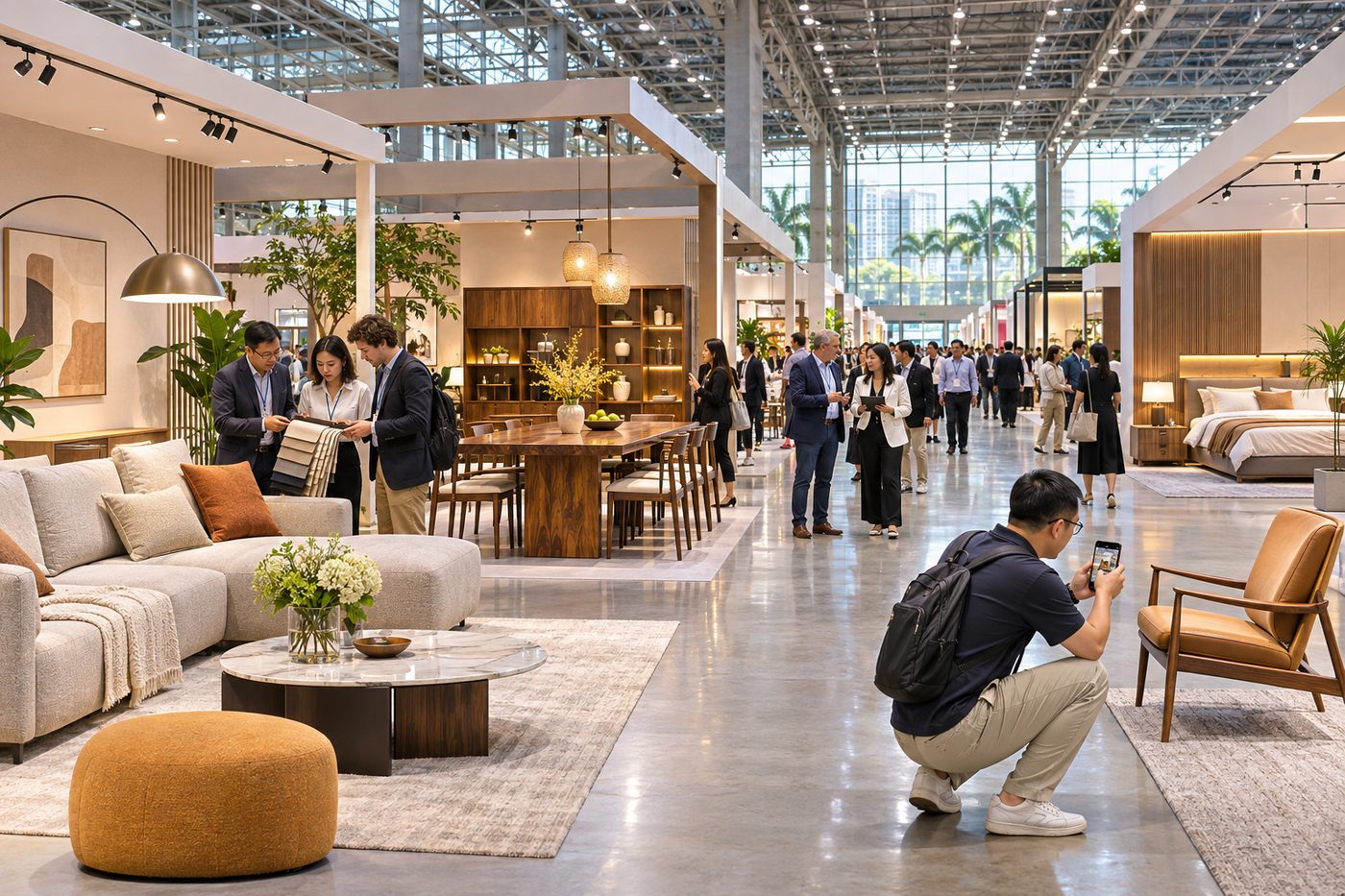
- Famous Furniture World Expo Park (Hall 9, Guangdong Modern International Exhibition Center): one of the main halls during the Famous Furniture Fair; outside fair dates it houses brand showrooms and flagship stores, where you can first see the designs and materials already on the market. The adjoining Hall 8 is the whole-home custom design hall.
- Furniture Avenue: about 5 km long and lined with experience centers and flagship stores of more than 200 furniture brands; it is also a distribution hub for furniture materials, hardware and machinery.
- Houjie furniture malls: the five major malls of the 2025 Houjie Furniture Culture Festival were the Famous Furniture World Expo Park, Hengfeng Furniture, Meibao Furniture, Xingye Home and Mingdu Home, which are good for comparing the workmanship and prices of finished furniture.
- International Famous Furniture Fair: held every March; the 56th edition in 2027 is scheduled for March 16 to 20, alongside the Dongguan International Furniture Machinery & Materials Fair. The fair used to be held twice a year, in March and August, but the August 2026 edition has been postponed (as reposted by the third-party trade fair platform Shifair on 2026-08-03); the organizer's announcements are final for actual dates.
The shipping method and cost for the domestic leg within mainland China, from the Houjie factory to the HowBridge Shenzhen warehouse, are agreed between you and the factory. Once the goods arrive at the Shenzhen warehouse, HowBridge consolidates them and ships them to Taiwan following the consolidated shipping process.
As a designer running your own business, what are you responsible for?
The most common pitfall when starting your own brand is "assuming someone else will take care of it". The table below spells out who is responsible for each step:
| Step | Who is responsible | Details |
|---|---|---|
| Drawings, material specifications, assembly instructions | Designer | Turn dimensions, wood species or boards, finishes, hardware, knock-down method and packing method into drawings and specifications a factory can understand. |
| Choosing a factory, negotiating, payment | Designer | Negotiate sampling and production terms directly with Houjie factories; you pay the factory directly. |
| Sampling and approval | Designer + factory | Check dimensions, structure and load capacity, finish color variation, hardware and assembly sequence before deciding whether to go into production. |
| Small-batch production | Factory | Production follows the approved sample. |
| Shipping to the Shenzhen warehouse | Arranged by the factory or the designer | The domestic leg within mainland China is agreed between you and the factory. |
| Mainland China → Taiwan consolidated shipping | HowBridge | Receiving at the Shenzhen warehouse, consolidation and shipping to Taiwan (sea express or air freight; ask about sea LCL consolidation for large items). |
| Customs clearance | partner customs broker | HowBridge is not a customs broker; clearance is handled by the partner customs broker. You must provide truthful product names, materials, quantities and prices. |
| Warehousing and shipping to customers | Designer (HowBridge single-item fulfillment from Taoyuan is planned) | For now you arrange this yourself; HowBridge plans to offer single-item fulfillment from the Taoyuan warehouse. |
| Website, payments, systems | Designer (HowBridge website building is planned) | For now you set these up yourself; HowBridge plans to offer website building and an order system. |
| Brand, marketing, customer service, assembly support and returns | Designer | You are the seller, so consumers' assembly questions, customer service and returns are your responsibility; HowBridge does not provide assembly or installation. |
What is the process from drawing to a buyer's home in Taiwan?
This is the usual order; finish each step before moving on to the next:

1Prepare drawings, material specifications and assembly instructions
Clearly state dimensions, wood species or boards, finishes, hardware, knock-down method and packing method. Materials must be expressible with the Chinese names used on Taiwan labels (see Labeling).
2Find a factory in Houjie for sampling
Take your drawings to Houjie to see factories and samples, and discuss sampling terms and costs; sampling costs and minimum order quantities depend on each factory's quote.
3Approve the sample, then produce a small batch
Check dimensions, structure and load capacity, finish color variation, hardware and assembly sequence, and actually pack, unpack and assemble it once; place a small-batch order only when everything checks out.
4Ship to the HowBridge Shenzhen warehouse
Ask the factory to ship the goods to the HowBridge Shenzhen warehouse, and create a consolidated shipping order in the member center, truthfully entering product names, materials, quantities and prices.
5Consolidated shipping to Taiwan and customs clearance
Knock-down pieces and small items can go by sea express or air freight; for large items, ask about sea LCL consolidation. A partner customs broker handles the customs declaration; whether you import as a company or as an individual depends on how you run your business. You can estimate shipping costs first with the shipping cost calculator.
6Labeling, listing and shipping
Before selling in Taiwan, label the country of origin, materials, dimensions and usage precautions as required, and include Chinese assembly instructions; after listing, handle shipping, customer service and returns.
What does HowBridge offer, and what is still planned?
Services available now and services still being planned are listed separately:
| Service | Status | Details |
|---|---|---|
| Receiving at the Shenzhen warehouse | Available | Goods from Houjie factories can be shipped to the HowBridge Shenzhen warehouse. |
| Mainland China → Taiwan consolidated shipping | Available | Sea express (NT$50 per unit) or air freight; for large items, ask for a sea LCL consolidation quote. Rates are subject to the shipping cost calculator and the bill issued after measurement at the warehouse. |
| Customs clearance | Available | Through partner customs brokers; HowBridge is not a customs broker. |
| Single-item fulfillment from Taoyuan | Planned (not yet available) | Planned: designers' stock is kept at the Taoyuan warehouse and shipped item by item as orders come in. |
| Website building | Planned (not yet available) | Planned: building brand websites for designers. |
| Order and inventory system | Planned (not yet available) | Planned: connecting website orders, inventory and shipping. |
What HowBridge does not do
No purchasing on your behalf, no paying factories on your behalf, no tax-inclusive shipping, no guarantees of factory quality, no furniture disassembly, assembly or installation, no furniture with glass, ceramic or other fragile parts, no relabeling or issuing of certificates of origin, and no routes other than mainland China → Taiwan.
There is no confirmed launch date yet. When they open, HowBridge will notify registered designers first.
Can furniture be imported from mainland China into Taiwan, and how much tax do you pay?
Yes. Seats (9401) and other furniture (9403) have no tariff codes at all on the International Trade Administration, Ministry of Economic Affairs (Taiwan) lists of "mainland Chinese goods not permitted for import (MW0)" and "conditionally permitted imports (MP1)" (downloaded and checked on 2026-11-03), so they are permitted imports. Common furniture carries 0% duty in column 1, plus 5% business tax; the import regulation is mostly C02, meaning "some goods under this item are subject to inspection by the Bureau of Standards, Metrology and Inspection (BSMI)", so not every item has to be inspected. The tariff codes below are classified by material, use and whether the item is coated; customs' determination is final:
| Item | Tariff code (HS/CCC code) | Duty | Import regulations |
|---|---|---|---|
| Wooden-frame chairs and sofas, upholstered | 9401.61.10.00-1 (uncoated) / 9401.61.90.00-4 | 0% | C02 |
| Wooden-frame chairs, not upholstered | 9401.69.10.00-3 (uncoated) / 9401.69.90.00-6 | 0% | C02 |
| Metal-frame chairs (upholstered / not upholstered) | 9401.71.00.00-1 / 9401.79.00.00-3 | 0% | C02 |
| Wooden seats convertible into beds (sofa beds) | 9401.41.00.00-8 | 0% | C02 |
| Wooden bedroom furniture (bed frames, wardrobes) | 9403.50.10.00-2 (uncoated) / 9403.50.90.00-5 | 0% | C02 |
| Other wooden furniture (dining tables, side tables, shelving, cabinets) | 9403.60.10.00-0 (uncoated) / 9403.60.90.00-3 | 0% | C02 |
| Other metal furniture | 9403.20.00.00-1 | 0% | C02 |
| Bamboo furniture | 9403.82.10.00-4 (uncoated) / 9403.82.90.00-7 | 0% | C02 |
| Wooden furniture parts | 9403.91.00.00-5 | 0% | None listed |
| Foam mattresses (of cellular rubber or plastics; bedding, not a furniture code) | 9404.21.00.00-9 | 6.8% | C02 |
| Mattresses of other materials (e.g. of textile materials) | 9404.29.00.10-9, etc. | 6.8% | C02 |
Furniture costing NT$500,000 or more per piece is also subject to the Specifically Selected Goods and Services Tax
Furniture tariff codes carry the special collection provision L*: furniture (tables, chairs, cupboards, cabinets and beds) with a sales price or dutiable value of NT$500,000 or more per piece is subject to an additional 10% Specifically Selected Goods and Services Tax on import (Articles 2 and 7 of the Specifically Selected Goods and Services Tax Act). Typical designer furniture usually does not reach this level.
Children's furniture and folding tables must be inspected first
Within C02, the items that actually require inspection beforehand are mainly children's and infant products announced by BSMI, such as children's chairs and stools (seat height 38 cm or less), children's high chairs, cribs and bedside cribs. Among adult furniture, folding tables with vertically crossed folding supports and a working height of 60 cm or more have also required registration of product certification beforehand since 2020-07-01. Ordinary adult chairs, dining tables, side tables, shelving and sofas were not found listed in BSMI's item data searched by tariff code (searched on 2026-11-03). For the first round, we recommend starting with ordinary adult furniture (excluding folding tables).
If you supply materials to the factory, their value must be included too
Under Article 29 of the Customs Act, raw materials that the buyer supplies to the seller free of charge or at a reduced price for use in production must be reasonably apportioned into the dutiable value. If you buy timber or hardware in Houjie and hand it to the factory to make your furniture, you must include the value of those materials in the customs declaration, not just declare the labor cost.
Timber cannot always be shipped to Taiwan
Finished furniture is a permitted import, but timber in Chapter 44 must be checked item by item: Chinese fir (Cunninghamia lanceolata) logs and lumber (the Chinese fir items under 4403.23, 4403.24 and 4407.12) are MW0 (mainland Chinese goods not permitted for import), and 19 wood products, including wooden doors and windows and wooden furniture not covered by Chapter 94 (4420.90.20), are conditionally permitted with a "Chinese fir excluded" condition. Small quantities can be exempt from an import permit, but for a brand we recommend having the furniture made as finished products in Houjie and then importing them.
According to Customs Administration, Ministry of Finance import statistics for ROC year 114 (2025), the top 20 source countries for each of the 41 tariff codes for seats (9401) and other furniture (9403) together totaled about 254,000 tonnes, of which mainland China accounted for about 212,000 tonnes, or about 83.5%, with Vietnam second at about 13,000 tonnes (compiled by HowBridge from the weights of the top 20 source countries for each code, including parts codes; it has not been confirmed whether the statistics include express shipments under simplified declaration).
How must furniture be labeled for sale in Taiwan?
If you import goods yourself and sell them in Taiwan, you are the party obliged to label them (the importer) under Article 5 of the Commodity Labeling Act. Before furniture goes on the market, note the following:
- Label the origin truthfully: furniture produced in Houjie has mainland China as its country of origin. Completing the design in Taiwan does not make Taiwan the origin; assembling knock-down furniture only after it arrives in Taiwan counts as "simple joining, fitting or assembly", which under Article 7, Paragraph 3, Subparagraph 4 of the Rules of Origin for Imported Goods does not constitute substantial transformation. You must not label the furniture MADE IN TAIWAN or imply it in your copy.
- Import documents must state the origin: under Article 11 of the Regulations Governing Trade between the Taiwan Area and the Mainland Area, import documents for permitted mainland Chinese goods must state "Made in Mainland China" or an equivalent in a foreign language.
- Required label information: there are no dedicated labeling standards for furniture, so the Commodity Labeling Act itself applies. Under Article 6, you must label the product name, the importer's name, address and service phone number, the country of origin, the main ingredients or materials (e.g. wood species, boards, finishes, fabrics), and measurements such as quantity or dimensions; imported goods must also show the foreign manufacturer's name in a foreign language.
- Label the product, its packaging or its instructions: labels must be on the product itself, its inner or outer packaging, or its instructions (Article 10), and an online product page cannot replace a physical label; text must be mainly in Chinese and may be supplemented with foreign languages (Article 11). We also recommend providing Chinese versions of the assembly instructions, load capacity and usage precautions. If labeling does not comply, you will be ordered to correct it within a deadline; if you fail to do so, a fine of NT$20,000 to NT$200,000 applies (Article 17).
- Low stools must be marked as not for children: if a stool with a seat height of 38 cm or less is meant for adults, the product itself must be marked "not for use by children aged 14 and under"; otherwise it may be deemed a children's chair or stool subject to inspection. Children's furniture such as children's chairs and stools, children's high chairs and cribs must pass inspection and carry the commodity inspection mark before going on the market.
Labeling goods made in mainland China as made in Taiwan may violate Article 255 of the Criminal Code (false marking of the country of origin), as well as the Commodity Labeling Act and the Fair Trade Act. For details on penalties, see Origin washing enforcement and criminal liability.
How do you handle returns when selling furniture online?
If you sell on a website or platform, you are a business operator under the Consumer Protection Act. Ordinary in-stock furniture is not excluded from the 7-day right of withdrawal, and the shipping cost of returning large furniture cannot be passed on to the consumer either:
- Returns without reason within 7 days: consumers may return goods or give written notice of cancellation within 7 days of receipt, without giving a reason and without bearing any cost (Article 19 of the Consumer Protection Act).
- Tell buyers how to return first: if cancellation information was not provided at delivery, the 7 days start from the day after the information is provided; however, the right of withdrawal lapses once more than 4 months have passed since the original 7-day period began.
- Collect within 15 days, refund within 15 days: after receiving written notice of cancellation, you must collect the goods within 15 days, and refund within 15 days from the day after collecting the goods or receiving the returned goods or cancellation notice (Article 19-2 of the Consumer Protection Act).
- Unboxing to inspect does not affect returns: the consumer's right of withdrawal does not lapse because of changes caused by necessary inspection (Article 17 of the Enforcement Rules of the Consumer Protection Act).
- Exceptions for made-to-order furniture must be disclosed in advance: exceptions to the 7-day right of withdrawal are listed in the Guidelines on Reasonable Exceptions to the Right of Withdrawal in Distance Sales, and the one most relevant to furniture is "customized performance made at the consumer's request". The Department of Consumer Protection, Executive Yuan explains that specifying or choosing from existing colors or specifications is not customization; a court has also held that a sofa bought in a color and style already offered on the website was not a customized product (Chiayi District Court, ROC year 108 Chia-Hsiao-Tzu No. 521). Exceptions must be disclosed to consumers in advance.
Furniture that can be taken apart and repacked in its original box is simpler to return or exchange than one-piece furniture. We recommend stating dimensions, materials, load capacity and assembly method clearly on product pages, and keeping stock in Taiwan so that exchanges and returns no longer have to cross borders.
What could a designer furniture brand look like?
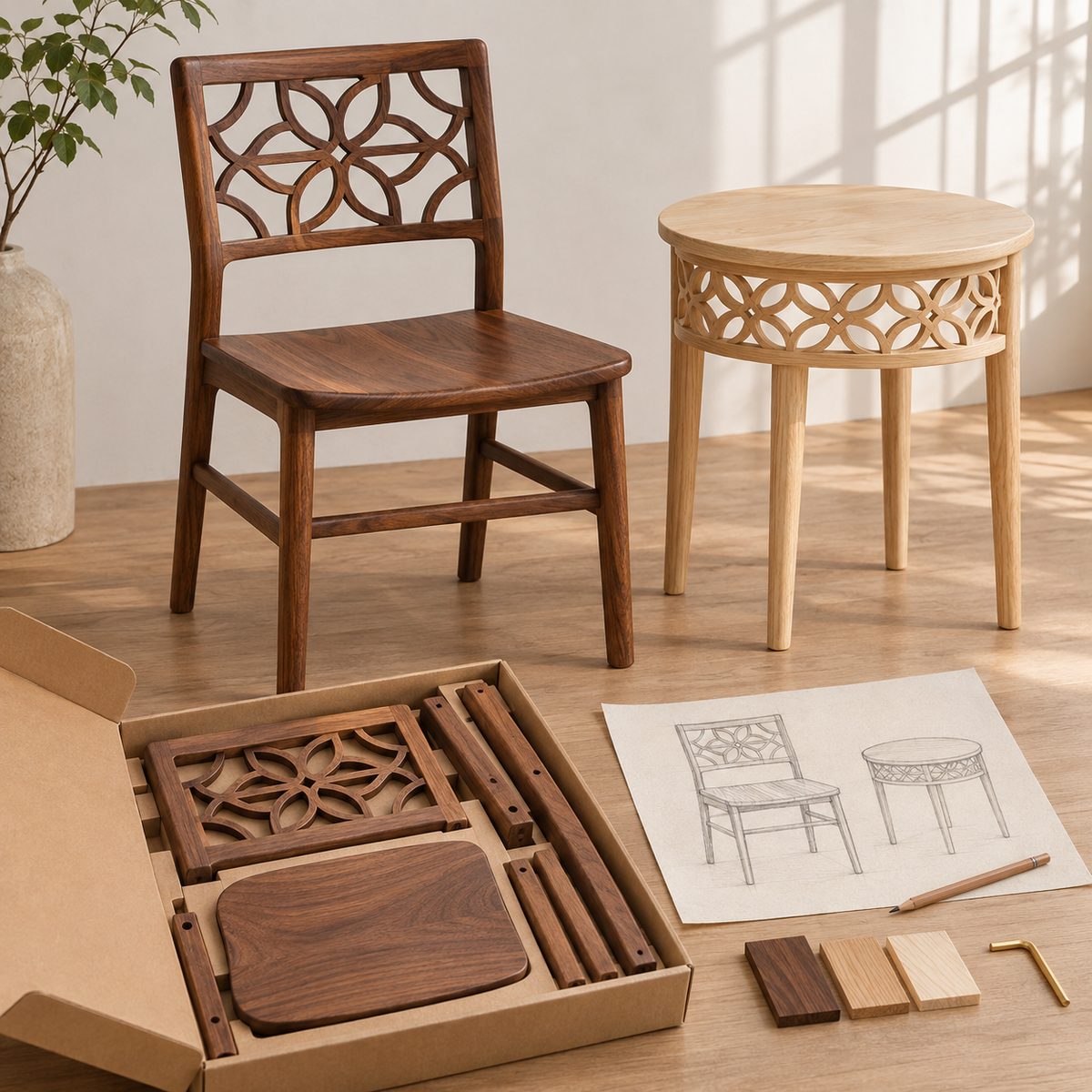
Below is the "Lattice Series", a HowBridge demonstration inspired by the Taiwanese iron window grilles of old houses in Taiwan; both pieces use the same lattice pattern to build recognition. The images are AI simulations, not actual production samples:
Dining Chair · Lattice Back
A solid dark walnut dining chair whose backrest is cut through with the four-petal lattice pattern of iron window grilles; the backrest, legs and seat come apart and pack flat.
Side Table · Lattice Apron
A round side table in light ash, with the apron under the top repeating the same lattice pattern; the legs are removable, and it is displayed as a set with the dining chair.
Who can register, and how?
The first round is open to Taiwan designers and small studios who have their own furniture designs and want to sell them under their own brand.
1Add the HowBridge LINE official account
Tap Register on LINE to add the HowBridge official account.
2Send the keyword「家具設計師招募」(Furniture designer recruitment) and a link to your work
Include a link to your portfolio or brand, and briefly describe the items you want to make (e.g. chairs, side tables, shelving) and the expected quantities.
3Wait for customer service to contact you
HowBridge customer service will contact you to explain the consolidated shipping process and the progress of the planned services.
This recruitment does not cover anyone looking for a purchasing agent, wanting HowBridge to pay factories on their behalf or provide tax-inclusive shipping, wanting HowBridge to handle assembly or installation, wanting to ship goods anywhere other than Taiwan, or wanting to label goods made in mainland China as made in Taiwan.
What does research say about furniture clusters and small-batch production?
The studies and reports below provide background; none of them is about HowBridge or any specific factory, and they cannot be used to infer outcomes for individual designers:
- The Houjie furniture cluster turned to the domestic market after the financial crisis: Yang, Fu and Li (2017) interviewed Houjie furniture makers and found that export tax rebate policies had a negative impact, while the Famous Furniture Fair helped firms break into China's domestic market; Yang and Fu (2017) point out that Dongguan's export furniture makers reconnected with domestic demand through chain retailers, directly operated stores and online stores.
- Knock-down shipping saves space, but switching has costs: Savchenko et al. (2020) note that knock-down furniture can save on warehousing, assembly labor and transport costs, but processes have to be redesigned; Yang, Vezzoli and Su (2025) assessed 25 furniture pieces and found that the distribution stage accounted for 9% of environmental impact on average and the raw material stage for 76%.
- Delivering large furniture is harder than delivering ordinary parcels: Alidaee et al. (2023) reviewed 195 publications and found that last-mile delivery of heavy, bulky and oversized products is harder than parcel delivery yet less studied; Zhang et al. (2022) note that delivery constrains online furniture shopping, that beds and wardrobes often need professional installation, and that consumers often simply do not return items because returns are inconvenient.
- Small design brands often grow non-linearly: Liu Li-hsiang (2016) interviewed Taiwanese design start-ups and found that design services and own brands support each other, growth is hard to predict, and lack of funding and counterfeiting are common obstacles; Lihra et al. (2008) found that in the US furniture industry, kitchen cabinets, the most customized segment, were not hit hard by imports.
- Taiwan's furniture industry has long relied mainly on OEM manufacturing: Wang Li-ching and Nieh Chih-kao (2004) analyzed 14 Taiwanese furniture companies over 1946–2001 and found that OEM manufacturing was the most common business model for decades; companies that moved to their own brands and reached maturity used markedly more solid wood, and those committed to handcraft were also mostly own-brand companies.
What are common furniture production terms?
- KD (knock-down furniture)
- Short for knock-down: furniture shipped disassembled into parts in flat packs and assembled on arrival; its small volume keeps shipping and warehousing costs lower.
- Flat-pack
- Disassembled parts stacked in a thin carton, protected by dividers and corner protectors between the parts.
- Solid-wood furniture
- Furniture whose main structure is made of solid wood; price, weight and grain vary widely between wood species.
- Panel furniture
- Furniture made from engineered boards (e.g. MDF, particleboard, plywood) finished with veneer or laminate; well suited to standardization and knock-down design.
- Upholstered furniture
- Furniture with padding covered in fabric or leather, such as sofas, upholstered chairs and headboards.
- Mortise-and-tenon joinery
- A joining technique in which a protruding tenon on one wooden part fits into a recessed mortise in another.
- Wood veneer
- A thin sheet cut from timber and bonded to the surface of a board to show real wood grain.
- Hardware (fittings)
- Metal fittings for furniture, such as screws, connectors, hinges, drawer slides and glides.
- Sampling / sample making
- A sample made before mass production to confirm dimensions, structure, finish and assembly sequence.
- Volumetric weight
- A weight calculated from a parcel's volume; HowBridge sea express uses L×W×H (cm) ÷ 10,000 and charges the greater of this and the actual weight.
- LCL volume unit
- The billing volume unit for sea LCL consolidation, calculated as L×W×H (cm) ÷ 28,316.
- Cai (Taiwanese volume unit)
- A volume unit commonly used in Taiwan logistics; for its oversize surcharge, Hsinchu Transport (HCT) calculates cai as L×W×H (cm) ÷ 27,000, with any side shorter than 30 cm counted as 30 cm.
- Tariff code (HS/CCC code)
- The classification code for imported goods; seats are in heading 9401 of Chapter 94, and other furniture in heading 9403.
- C02
- An import regulation code meaning that some goods under the code are subject to BSMI inspection; not every item has to be inspected.
- MW0
- An International Trade Administration import regulation code meaning "mainland Chinese goods not permitted for import".
- Single-item fulfillment
- The seller keeps stock at a warehouse, and after orders come in the warehouse ships items to buyers one by one (dropshipping from the warehouse); HowBridge single-item fulfillment from Taoyuan is currently planned and not yet available.
What are the sources and the scope of verification?
The sources below were consulted on 2026-11-03; document dates and consultation dates are shown separately, and no date is supplied where none is stated.
Government, official and state media sources
- Houjie Town People's Government, Dongguan: the 55th Famous Furniture Fair closes as Dongguan manufacturing aesthetics win fans worldwide | Document date: 2026-04-03; the 55th International Famous Furniture Fair (Dongguan) closed on 2026-03-19, covering 530,000 m² with nearly 900 Chinese and overseas brands, 8 themed halls and 7 curated IPs.
- Timedg (Dongguan Time Network, Dongguan Newspaper Media Group): "Talent Gathers in Southern Guangdong", industry series ⑤ | Dongguan furniture: setting out toward a world-class industry cluster | Document date: 2025-04-04; Dongguan has about 350 furniture manufacturers above designated size and more than 2,000 furniture brands; Houjie and Dalingshan are the two core areas of the furniture industry cluster; Houjie has more than 10 specialized furniture markets with a total area of more than 800,000 m², and Furniture Avenue, about 5 km long, is a distribution hub for finished furniture, furniture machinery, furniture materials and accessories; across Dongguan, supporting industries such as chemicals, coatings, hardware, leather goods, timber and machinery are well established; the Famous Furniture Fair was founded in 1999 and is held every March and August; in 2022 the Dongguan–Foshan pan-home-furnishing industry cluster was selected as an MIIT advanced manufacturing cluster.
- Timedg: an overall look at Dongguan's changes ⑤ | Houjie, Dongguan: the "Furniture Capital" climbs to new industrial heights | Document date: 2023-11-30; the town has nearly 600 furniture companies and more than 100,000 people working in the industry; in 2022 the gross industrial output value of furniture manufacturing above designated size was CNY 7,170,000,000; Furniture Avenue is lined with experience centers, flagship stores and specialty stores of more than 200 Chinese and international brands; there are more than 2,000 own brands and more than 6,000 valid furniture patents; in 1982 people jointly opened small furniture workshops, and the first modern furniture factory was a Hong Kong-invested "three-plus-one" (processing and compensation trade) enterprise; in January 2001 Houjie was named a Guangdong Province Specialized Furniture Town; in March 2023 the China National Furniture Association and Dongguan began jointly building a "world-class furniture industry cluster".
- Timedg: the 2025 Houjie Furniture Culture Festival opens, leading a new wave of home furnishing consumption | Document date: 2025-03-15; Houjie has about 600 furniture manufacturers, more than 2,000 furniture brands and more than 6,000 valid furniture patents; the festival ran from 2025-03-15 to 05-15, with five major malls taking part: the Famous Furniture World Expo Park, Hengfeng Furniture, Meibao Furniture, Xingye Home and Mingdu Home.
- 21st Century Business Herald: a close look at Dongguan's town economies | Houjie: the furniture industry heads onto a new digital track, and the exhibition economy drives the town's renewal | Document date: 2023-05-11; Houjie has more than 1,000 furniture-related companies and 62 furniture companies above designated size; 10 furniture and raw-material supply markets, including the Famous Furniture World Expo Park, have been built; more than 200 Chinese and international furniture brands are located along the 5 km Furniture Avenue.
- ELLE DECO China (NetEase account): in Dongguan, a 400,000 m² city living room is growing | Document date: 2026-03-13; the Famous Furniture World Expo Park is in Hall 9 of the Guangdong Modern International Exhibition Center and covers about 400,000 m²; Hall 8 is the whole-home custom design hall; the 55th Famous Furniture Fair ran from 2026-03-15 to 19. The report says that every link, from timber and leather to factories and from sampling to mass production, can be completed within a radius of a few dozen kilometers (the report's images were provided by the Famous Furniture World Expo Park).
- Official website of the International Famous Furniture Fair (Dongguan): About the fair | Document date: not stated; organized by Guangdong Modern Exhibition Management Co., Ltd. (with the Guangdong Modern International Exhibition Center and others as executing organizers); founded in March 1999, and the page says 54 editions have been held (the website has not been updated; the 55th edition closed on 2026-03-19); the 2027 fair will be held from March 16 to 20 at the Guangdong Modern International Exhibition Center in Houjie, Dongguan.
- Sina Home: the 2027 Famous Furniture Fair is set for March 16–20 | Document date: 2026-08-17; the page is marked as still in the scheduled-publication stage, with content for reference only; the 56th International Famous Furniture Fair (Dongguan) and the 2027 Dongguan International Furniture Machinery & Materials Fair will be held from 2027-03-16 to 20 at the Guangdong Modern International Exhibition Center; Hall 9 is a 400,000 m² combined exhibition and trading platform with more than 600 Chinese and international brands.
- Shifair: postponing our August appointment | the 2027 Famous Furniture Fair, a better reunion | Document date: 2026-08-03; the August 2026 edition of the Famous Furniture Fair has been postponed, and the next edition is from 2027-03-16 to 20 (reposted by a third-party trade fair platform).
- OpenStreetMap / OSRM public routing service: Guangdong Modern International Exhibition Center (Houjie) to Fuhai Subdistrict, Bao'an District, Shenzhen; Dalang Town, Dongguan; and Xintang Town, Zengcheng, Guangzhou | Document date: not stated; HowBridge estimated on 2026-11-03 under free-flow traffic (the link covers the Houjie–Fuhai leg; results for all three legs are archived in the research files): Houjie to Fuhai Subdistrict about 39 km, 33 minutes; to Dalang about 41 km, 36 minutes; to Xintang about 35 km, 30 minutes; excluding traffic congestion and toll stations.
- Customs Administration, Ministry of Finance: customs import and export statistics | Document date: not stated; import source countries and weights for the 41 tariff codes (including parts) under 9401 and 9403 for ROC year 114 (2025); compiled by HowBridge from the weights of the top 20 source countries for each code.
- HowBridge shipping cost calculator (the same calculation as 0523.tw/c) | Document date: 2026-11-03; sea express costs NT$50 per unit, where the number of units is the greater of the actual weight and the volumetric weight (L×W×H cm ÷ 10,000), rounded up, plus NT$100 if the actual weight is under 10 kg; sea LCL consolidation starts from NT$25 per kg or NT$150 per LCL volume unit, with a minimum of NT$3,500 per shipment, quoted by customer service based on the goods; the Taiwan-leg Hsinchu Transport (HCT) oversize surcharge follows the rules of 2025-12-01.
- Laws & Regulations Database of Taiwan: Commodity Labeling Act, Article 5 | Document date: 2022-05-18; the parties obliged to label are the manufacturer, commissioning manufacturer, importer or repackager, and labeling must be completed when the goods enter the market; a designer who commissions sampling and mass production from a factory in Houjie and imports and sells the goods under their own brand is the importer (or commissioning manufacturer).
- Laws & Regulations Database of Taiwan: Commodity Labeling Act, Article 6 | Document date: 2022-05-18; required label information: product name; name, address and service phone number of the importer or repackager; country of origin; main ingredients or materials; net weight, volume, quantity or measurements; other announced items. Paragraph 2: imported goods must also show the foreign-language name of the foreign manufacturer or foreign commissioning manufacturer. There are no dedicated labeling standards for furniture, so this Act applies.
- Laws & Regulations Database of Taiwan: Commodity Labeling Act, Article 11 | Document date: 2022-05-18; label text must be mainly in Chinese and may be supplemented with English or other foreign languages.
- Laws & Regulations Database of Taiwan: Regulations Governing Trade between the Taiwan Area and the Mainland Area, Article 7 | Document date: 2024-02-19; goods from the mainland area may not be imported into the Taiwan area except in listed cases such as items announced as permitted by the competent authority; items with MW0 in the import regulations column of the commodity classification table are not permitted (e.g. Chinese fir logs, 4403.23.00.50-7).
- Laws & Regulations Database of Taiwan: Regulations Governing Trade between the Taiwan Area and the Mainland Area, Article 11 | Document date: 2024-02-19; import documents for permitted mainland Chinese goods must state "Made in Mainland China" or an equivalent in a foreign language.
- Ministry of Economic Affairs (announcement Jing-Shou-Mao-Zi No. 09220021740): amended import management rules for mainland Chinese goods | Document date: 2003-07-21; official definition: MW0 in the "import regulations" column of the commodity classification table means mainland Chinese goods are not permitted, MP1 means conditionally permitted, and items with neither are permitted imports.
- International Trade Administration, Ministry of Economic Affairs (Taiwan) commodity classification management system: notes on the list of conditionally permitted mainland Chinese goods (general explanation) | Document date: not stated; the explanation of the MW0 / MP1 codes in the International Trade Administration's current search system, consistent with the ROC year 92 announcement.
- Laws & Regulations Database of Taiwan: Consumer Protection Act, Article 19 | Document date: 2015-06-17; consumers buying online (distance sales) may return goods or give written notice of cancellation within 7 days of receipt, without giving a reason and without bearing any cost.
- Laws & Regulations Database of Taiwan: Consumer Protection Act, Article 19-2 | Document date: 2015-06-17; on written cancellation, the business must collect the goods within 15 days from the day after receiving the notice, and refund within 15 days from the day after collecting the goods or receiving the returned goods.
- Laws & Regulations Database of Taiwan: Guidelines on Reasonable Exceptions to the Right of Withdrawal in Distance Sales, Article 2 | Document date: 2015-12-31; there are only 7 exceptions to the 7-day right of withdrawal, such as "customized performance made at the consumer's request", and the business operator must inform the consumer of them; ordinary in-stock furniture is not among the exceptions.
- Laws & Regulations Database of Taiwan: Customs Act, Article 29 | Document date: 2022-05-11; the dutiable value is based on the transaction value, and commissions, handling fees and packing costs borne by the buyer, as well as freight and insurance to the port of import, must be included. Paragraph 3, Subparagraph 2: the value of raw materials and components that the buyer supplies to the seller free of charge or at a reduced price for use in production must be reasonably apportioned and included.
- Laws & Regulations Database of Taiwan: Customs Act, Article 49 (Paragraphs 2 and 3) | Document date: 2022-05-11; the legal basis for the small-value duty exemption: a consignment whose dutiable value is at or below the limit announced by the Ministry of Finance is duty-free, but this does not apply to frequent importers, with what counts as frequent defined by the Ministry of Finance. Sample chairs and sample furniture are also assessed under this rule to determine whether tax is due.
- Ministry of Finance eTax portal: notes on buying foreign goods online | Document date: not stated; a dutiable value of NT$2,000 or less is exempt from customs duty, commodity tax and business tax; if the same taxpayer uses the exemption under Article 49, Paragraph 2 of the Customs Act more than 6 times within half a year, it no longer applies from the 7th time.
- International Trade Administration, Ministry of Economic Affairs (Taiwan) announcement (Jing-Mao-Zi No. 11104603570): rules exempting small quantities of mainland Chinese goods from import permits | Document date: 2022-08-19; mainland Chinese industrial products not on the "List of Restricted Import Goods" (tariff Chapters 25 to 97) may be imported without an import permit and without following MXX requirements if the whole declaration's CIF value is within NT$32,000 and each item is within 24 pieces (40 kg for goods not counted by piece); items may not be split by size, specification or color; all other import regulations must still be met. MW0 Chinese fir logs and sawn wood (4403.23, 4403.24, 4407.12) fall under Chapter 44, so this allowance can apply to them; any excess reverts to not permitted.
- International Trade Administration, Ministry of Economic Affairs (Taiwan) announcement (Jing-Mao-Zi No. 11550200230): items excluded from the "rules exempting small quantities of mainland Chinese goods from import permits" | Document date: 2026-03-10; the exclusion list has only 3 tariff codes: electric two-wheeler controllers 8543.70.99.50-4, electric motorcycles 8711.60.10.00-9 and electric bicycles 8711.60.20.00-7; wood and furniture are not on the exclusion list.
- Laws & Regulations Database of Taiwan: Regulations Governing Exemption from Commodity Inspection, Article 5 | Document date: 2019-11-21; non-sale personal-use items and commercial samples may be exempted from inspection after review if the total value for the same specification and model on one declaration is US$1,000 or less, or, if it is higher, if there are no more than 2 personal-use items or no more than 5 commercial samples. This only affects items subject to inspection (such as children's chairs and cribs).
- Laws & Regulations Database of Taiwan: Criminal Code of the Republic of China, Article 255 | Document date: 2026-07-22; anyone who, with intent to deceive others, falsely marks or otherwise misrepresents the country of origin or quality of goods is liable to imprisonment of up to one year, short-term detention or a fine of up to NT$30,000; the same applies to anyone who knowingly sells such goods, displays them for sale or imports them from abroad. (The date is that of the most recent amendment of the Criminal Code, not of this article.)
- Laws & Regulations Database of Taiwan: Enforcement Rules of the Consumer Protection Act, Article 17 | Document date: 2015-12-31; where goods are damaged, lost or altered because of necessary inspection or for reasons not attributable to the consumer, the right of withdrawal under Article 19, Paragraph 1 of the Consumer Protection Act does not lapse.
- Laws & Regulations Database of Taiwan: Rules of Origin for Imported Goods, Articles 5 and 7 | Document date: 2010-12-24; Article 5: where two or more countries are involved, the country of origin is the country where the last substantial transformation took place. Article 7, Paragraph 1: substantial transformation means a change in the first six digits of the tariff code, or the completion of a major manufacturing process or a value-added rate above 35%; Paragraph 3: mere sorting, grading, repackaging, packing, marking or relabeling (Subparagraph 2), or simple cutting, simple joining, fitting or assembly (Subparagraph 4), cannot be deemed substantial transformation, so knock-down furniture assembled only after arriving in Taiwan still has mainland China as its country of origin.
- Customs Administration, Ministry of Finance: rules of origin | Document date: 2023-11-15; Customs Administration explanatory page: for general goods, the country of origin is the country of the last substantial transformation, with the same definition as in the Rules of Origin for Imported Goods (page updated on 2026-10-19).
- Customs Administration, Ministry of Finance GC413 customs import tariff data (synced weekly to the HowBridge tariff database, searched on 2026-11-03): tariff codes for seats (9401) and other furniture (9403) | Document date: not stated; 9401 and 9403 have 41 tariff codes in total (including parts); apart from motor vehicle seats (9401.20.00.00-3) at 5% in column 1, all carry 0% duty in column 1; most have the import regulation C02 (some goods under the item are subject to import inspection announced by BSMI) and the special collection provision L* (Specifically Selected Goods and Services Tax, for some items); the parts codes 9401.91, 9401.99, 9403.91 and 9403.99 have no import regulations listed. Mattresses (9404.21.00.00-9) carry 6.8% in column 1 and C02.
- International Trade Administration, Ministry of Economic Affairs (Taiwan) commodity classification management system: download of the list of mainland Chinese goods not permitted for import (MW0) | Document date: not stated; the list downloaded on 2026-11-03 has 2,515 entries; Chapter 94 (including 9401 and 9403) has no tariff codes at all. Chapter 44 (wood and articles of wood) has only 3 entries: Chinese fir logs 4403.23.00.50-7 and 4403.24.00.50-6, and Chinese fir lumber 4407.12.00.50-6.
- International Trade Administration, Ministry of Economic Affairs (Taiwan) commodity classification management system: download of the list of conditionally permitted mainland Chinese goods (MP1) | Document date: not stated; the list downloaded on 2026-11-03 has 864 entries; Chapter 94 has no tariff codes at all; Chapter 44 has 19 entries, mostly conditionally permitted items with the condition "except those made of Chinese fir" (e.g. wooden doors and windows 4418, other articles of wood 4421.99).
- Laws & Regulations Database of Taiwan: Commodity Labeling Act, Articles 10 and 17 | Document date: 2022-05-18; labels must be placed on the product itself, its inner or outer packaging, or its instructions; where labeling does not comply, correction is ordered within a deadline, and failure to correct by the deadline is subject to a fine of not less than NT$20,000 and not more than NT$200,000. The amended Act took effect on 2023-05-18.
- Bureau of Standards, Metrology and Inspection (BSMI): Commodity Labeling Act FAQ (labeling of goods sold online) | Document date: not stated; for goods sold online, the physical goods must still be labeled as required, and web page information cannot be used as a substitute.
- BSMI: Inspection Requirements for Children's Chairs and Stools (Order Jing-Biao-Er-Zi No. 11020005910 of ROC 110-09-14) | Document date: 2021-09-14; scope of inspection: children's chairs and stools (limited to a seat height of 38 cm or less, where the product itself is not marked as not for use by children aged 14 and under); inspection standard CNS 16045; dual track of type approval with batch-by-batch inspection or registration of product certification; in force from 2022-12-01.
- BSMI: schedule listing folding tables as commodities subject to inspection | Document date: not stated; folding tables (limited to those with vertically crossed folding supports and a working height of 60 cm or more) have been subject to inspection of imports and of products made in Taiwan under CNS 15185 since 2020-07-01, by registration of product certification; import regulation code C02, with reference tariff codes covering 9403 furniture of wood, metal, plastics, bamboo and rattan.
- BSMI: Inspection Requirements for Children's High Chairs (amended ROC 115-07-22) | Document date: 2026-07-22; children's high chairs are commodities subject to inspection, under a dual track of type approval with batch-by-batch inspection or registration of product certification; some of the amended provisions take effect on 2027-07-01.
- BSMI Hsinchu Branch: Inspection Requirements for Household Cribs and Folding Cribs | Document date: 2020-02-27; inspection standard CNS 11676 "Household cribs and folding cribs", effective 2020-03-01 (point 7 amended on 2024-02-01).
- BSMI: search for commodities subject to inspection by commodity classification item (commodity inspection application service) | Document date: not stated; searched by tariff codes 9401, 9403 and 9404 on 2026-11-03: listed items are mainly children's and infant products (children's chairs and stools, children's high chairs, household cribs, bedside cribs, booster seats, table-mounted chairs, etc.), and among adult furniture only folding tables are listed; no listing was found for ordinary adult chairs, dining tables, side tables, shelving or sofas.
- Laws & Regulations Database of Taiwan: Specifically Selected Goods and Services Tax Act, Articles 2 and 7 | Document date: 2015-06-24; Article 2, Paragraph 1, Subparagraph 6: furniture with a sales price or dutiable value of NT$500,000 or more per piece; Article 7: tax rate of 10%; on import, the tax is levied on the consignee or other liable party at the time of import.
- Laws & Regulations Database of Taiwan: Enforcement Rules of the Specifically Selected Goods and Services Tax Act, Article 5 | Document date: 2011-05-27; "furniture" means tables, chairs, cupboards, cabinets and beds for everyday use, excluding antiquities as defined in the Cultural Heritage Preservation Act.
- Animal and Plant Health Inspection Agency, Ministry of Agriculture: quarantine requirements for wood packaging material (amended by announcement Nung-Shou-Fang-Zi No. 1101495349 of ROC 110-11-08) | Document date: 2021-11-08; before export, wood packaging material must be treated and stamped in accordance with International Standards for Phytosanitary Measures No. 15 (ISPM 15): heat treatment (core temperature of 56°C for at least 30 minutes), methyl bromide fumigation, dielectric heating or sulfuryl fluoride fumigation; material no more than 6 mm thick, glued under high temperature and pressure, or painted is not covered.
- Laws & Regulations Database (Ministry of Agriculture): Operational Directions for Quarantine of Imported Wood Packaging Material | Document date: 2025-02-05; material without the mark required by the quarantine requirements is judged non-compliant, and may, by choice, be quarantine-treated, destroyed or returned together with the imported goods.
- Department of Consumer Protection, Executive Yuan: article-by-article explanation of the Guidelines on Reasonable Exceptions to the Right of Withdrawal in Distance Sales | Document date: not stated; examples of customized performance include goods printed from photos supplied by the consumer and seals engraved according to the consumer's instructions; where the consumer specifies or chooses from existing colors or specifications, it is not customized performance.
- Consumer Protection Committee, Executive Yuan: compilation of judgments on the 7-day right of withdrawal for online shopping (including the Chiayi District Court sofa case, ROC year 108 Chia-Hsiao-Tzu No. 521) | Document date: 2025-07-30; sofa case: the consumer chose from the colors and styles already offered on the website and made no special requests for color, length or fabric, so the sofa was not a customized product; mattress case (ROC year 114 Pei-Chien-Tzu No. 1588): choosing from standard size options is also hard to regard as customized performance.
Research literature and reports
Emerging Adaptation of Local Clusters in China in a Shifting Global Economy: Evidence from the Furniture Cluster in Houjie Town, Dongguan
Based on fieldwork and in-depth interviews with firms from April 2012 to January 2014, analyzes how the Houjie furniture cluster adapted after the 2008 financial crisis: export-oriented path lock-in had both advantages and drawbacks, export tax rebate policies had a negative effect on firms, and the International Famous Furniture Fair had a positive effect in helping firms enter China's domestic market (abstract only).
From exports to sell in China: transformation of the export-oriented furniture firms in the Pearl River Delta
Based on in-depth interviews from May 2013 to April 2017 with Dongguan furniture makers, Chinese domestic retailers and government officials, shows that Dongguan's export-oriented furniture makers reconnected with China's domestic market by partnering with Chinese chain retailers, running their own stores and online shops, and bargaining with individual retailers (abstract only).
從全球到地方:東莞家具產業的綠色化升級路徑
Uses fieldwork and semi-structured interviews to analyze the green upgrading of Dongguan's furniture industry, arguing that greening driven by global buyers is limited in scope and puts cost pressure on local exporters, while China's domestic niche market for green furniture and its institutional environment are the key to local green upgrading (abstract only; the abstract gives no figures).
Shaping the process of unassembled furniture delivery(ФОРМУВАННЯ ПРОЦЕСУ ДОСТАВЛЕННЯ МЕБЛІВ У РОЗІБРАНОМУ ВИГЛЯДІ)
Using the export logistics of a Ukrainian furniture factory as a case and drawing on IKEA's experience, analyzes the pros and cons of switching to knock-down furniture: it can reduce warehouse space, in-factory assembly labor and delivery transport costs, with greater benefits the higher the share of transport costs; but warehousing and transport processes must be substantially redesigned, and both manufacturers and distributors bear switching costs (abstract only; the abstract gives no figures).
Comprehensive life cycle assessment of 25 furniture pieces across categories for sustainable design
Compares 25 furniture pieces in 8 categories using the same life cycle assessment method: the pre-production (raw material) stage accounts for 76% of environmental impact on average (42.25–99.98%), production 13%, distribution 9% on average (0.01–27%), end of life 2% and use 0.46%; among transport modes, air transport has the highest impact, followed by truck, rail and water transport, and the authors recommend reducing weight and using knock-down design to lower the impact of the distribution stage.
The Last-Mile Delivery of Heavy, Bulky, Oversized Products: Literature Review and Research Agenda
Reviews 195 articles and reports on last-mile delivery and heavy, bulky and oversized (HBO) products, finding that delivering HBO products is harder than delivering parcels in many respects, yet less researched than parcel delivery; it also recommends different delivery strategies for different customer groups, such as urban versus rural and older versus younger customers (abstract only).
Furniture online consumer experience: A literature review
Reviews research on consumer experience in online shopping for wooden furniture in China and proposes a framework with three dimensions: perceived risk, emotion and interaction with new technologies; it notes that delivery constrains online furniture shopping, that third-party logistics vary in reliability and responsiveness, that beds, wardrobes and the like often require professional installation, and that consumers often choose not to return items because returns are inconvenient (no quantitative figures for this part).
Load Securement and Packaging Methods to Reduce Risk of Damage and Personal Injury for Cargo Freight in Truck, Container and Intermodal Shipments
The fourth in a series of studies assessing damage in mixed-load and less-than-truckload (LTL) freight; the abstract identifies televisions, appliances, furniture, machinery, and doors and windows as goods with high freight damage and claims, notes that improper loading and lack of securement inside trailers damage packaging and goods, and offers recommendations on loading methods, pallets and unitization (abstract only).
台灣小型新創設計公司的成長歷程(The growth of small design firms in Taiwan)
Through in-depth interviews with Taiwanese design start-ups that were founded around the same time, had been in business for more than five years and aimed to develop their own brands (3 companies listed in the table of contents), finds that growth follows an opportunistic, unpredictable, non-linear pattern, with design services and own brands reinforcing each other; internal obstacles include insufficient funding and division of labor, and external obstacles include low brand awareness and counterfeiting (the study covers design firms, not furniture specifically).
Mass customisation of wood furniture as a competitive strategy
Using four US furniture sub-industries as examples, discusses whether mass customization can offset the cost disadvantage against low-cost overseas manufacturing: kitchen cabinets, the most customized segment, have so far been little affected by imports, while wooden household furniture, the least customized, has been hit hardest; the authors see customization as a strategy for US domestic manufacturers to compete against low-priced imports (abstract only).
Endogenous inclusive development of e-commerce in rural China: A case study
Taking as a case a base-of-the-pyramid (BoP) community in rural China that developed furniture e-commerce on its own, shows that e-commerce can start from a "seed business model" targeting a niche market with simple products and low cost and technical barriers, and then, through learning from pioneers and business model innovation, form a local value chain and e-commerce ecosystem (abstract only).
地方性要素對台灣光復後木製家具產業形態的影響
Selects 14 companies from the membership directory of the Taiwan Furniture Manufacturers' Association and analyzes the factors that shaped Taiwan's wooden furniture industry over 1946–2001, identifying three main factors: materials, production technology and management philosophy; OEM manufacturing was the most common business model over the past decades, companies that moved to their own brands and reached maturity used markedly more solid wood, and those committed to handcraft were also mostly own-brand companies (abstract only).
Houjie industry figures are as published by local official sources and state media; HowBridge has not done an on-site count. Company counts are defined differently (from about 600 to more than 1,000), and this page uses "about 600 furniture manufacturers"; no officially published output value was found for 2023 or later. The exhibition area of the Famous Furniture Fair differs between sources, and this page uses the Houjie Town Government's closing report. There are no public quotes for sampling costs or minimum order quantities that apply to individual factories, so this page does not give any. Tariff codes follow the Customs Administration, Ministry of Finance tariff data (synced weekly to the HowBridge database), and import regulations follow the International Trade Administration, Ministry of Economic Affairs (Taiwan) lists downloaded on 2026-11-03; import statistics follow Customs Administration, Ministry of Finance data for ROC year 114, compiled by HowBridge. Shipping costs follow the HowBridge shipping cost calculator on 2026-11-03, and sea express rates fluctuate. Legal provisions follow the Laws & Regulations Database of Taiwan. Website building, the order system and single-item fulfillment from Taoyuan are planned services with no confirmed launch date.
What are common questions about the furniture designer recruitment?
Will HowBridge find a factory in Houjie for me?
Can Houjie factories take small orders?
How much tax do you pay on furniture shipped from mainland China to Taiwan?
Why design furniture to be knock-down?
Can a large sofa be shipped to Taiwan?
Can furniture with glass tabletops or ceramic countertops be shipped?
If it is made in Houjie and assembled in Taiwan, can it be labeled Made in Taiwan?
Can I make children's furniture?
Is HowBridge a customs broker?
Will HowBridge pay factories on my behalf or advance taxes for me?
When will website building and single-item fulfillment from Taoyuan be available?
What do I need to do to register?
Can I refuse returns when selling furniture online?
Further reading
Dalang sweater designer recruitment: designers as business owners
Xintang denim designer recruitment: designers as business owners
Importing large furniture: duties, inspection and shipping costs
Origin washing enforcement and criminal liability: how to label origin when reselling in Taiwan
Rules of origin and origin washing
What is a CCC code, and how do you look it up?
Trade Administration import regulations and import permits
Taiwan import duty guide
First-round "furniture designer as business owner" registration now open
Add the HowBridge LINE official account and send the keyword「家具設計師招募」(Furniture designer recruitment) with a link to your work; HowBridge customer service will contact you.
Register on LINE