Taiwan jeans designers: be your own boss with your own designs
What is HowBridge recruiting for?
HowBridge is recruiting Taiwan designers who want to use their own designs to launch their own denim brand. In 2025 Xintang, Zengcheng, Guangzhou had an annual jeans capacity of about 330,000,000 pieces (Southern Metropolis Daily, 2026-04-23, incomplete statistics); from January to November (1–11) 2024 the output value of the denim apparel cluster exceeded CNY 10,000,000,000, and "Xintang Denim" was named to the MIIT's 2025 list of China Consumer Famous Brands. Jeans imported from mainland China into Taiwan are permitted imports, and cotton jeans carry 10.5% duty. You are responsible for design, the brand, choosing factories and payment; HowBridge receives goods at the Shenzhen warehouse, provides mainland China → Taiwan consolidated shipping, and works with AEO-certified partner customs brokers on customs clearance. Website building, an order system and single-item fulfillment from Taoyuan are still planned.
Video: the designer recruitment program explained
It is for Taiwan designers and small studios who already have their own designs for jeans, denim jackets or other denim apparel and want to sell them under their own brand. HowBridge is not a purchasing agent; it does not pay factories on your behalf, does not offer tax-inclusive shipping, and does not guarantee factory quality. It only provides mainland China → Taiwan consolidated shipping (the Shenzhen consolidation warehouse and the Taoyuan Dayuan operations warehouse). To check tariff codes and import regulations for jeans first, go straight to How much tax do imported jeans pay.
What is Xintang, Zengcheng, Guangzhou, and why is it suited to making jeans?
Xintang is a town in Zengcheng District, Guangzhou, Guangdong Province. It began in the 1980s when Hong Kong businesspeople returned to their hometown to open factories, and grew into an industrial cluster centered on denim apparel, earning the title "China's Famous Denim Apparel Town". According to the economic census, 2013 was the peak year for output; in 2017 and 2018 the local government closed the garment-washing and dyeing park in phases, and in recent years the town has shifted toward smart manufacturing and cross-border e-commerce. The table below shows figures published by Xintang local official sources and state media:
| Item | Figure | Source |
|---|---|---|
| Annual jeans capacity | About 330,000,000 pieces in 2025 (incomplete statistics); about 280,000,000 pieces in 2023; peak of about 900,000,000 pieces in 2013 | Southern Metropolis Daily, 2026-04-23 |
| Cluster output value | Total output value of the denim apparel cluster exceeded CNY 10,000,000,000 from January to November (1–11) 2024 | Ycwb.com (Yangcheng Evening News), 2024-11-29 |
| Textile and apparel companies | 2,415 in 2023 (economic census) | Southern Metropolis Daily, 2026-04-23 |
| Industrial chain | Spinning, weaving, printing, garment making, washing, bleaching and dyeing, shuttle weaving, trims | Guangzhou Municipal Government website, 2022-03-17 |
| Exports | About 80% of Zengcheng's denim apparel companies are engaged in exports | CNR (China National Radio), 2025-12-31 |
| Brand | "Xintang Denim" was named a regional brand on the MIIT's 2025 list of China Consumer Famous Brands | MIIT list, 2026-02-03 |
| Demonstration base | Zengcheng Denim Apparel Smart Manufacturing Demonstration Base, floor area about 345,000 m², already connected with more than 60 companies | CNR (China National Radio), 2025-12-31 |
These are figures published by Xintang local official sources or state media; HowBridge has not done its own on-site count. Company counts vary widely by source (about 2,000 to 6,000), and this page uses the economic census figure of 2,415; the often-quoted "2,500,000 pieces a day" is a figure from the peak years of output, not the current situation.
What stages does Xintang's denim supply chain cover?
A pair of jeans goes through more than 140 production steps (China Securities Journal, 2024-06-12). What sets Xintang apart is that fabric, sewing, garment washing and trims are all in the same town or nearby. The table below follows the production order:
| Stage | What Xintang has | What it means for designers | Source |
|---|---|---|---|
| Fabric | Local spinning, weaving and denim fabric companies; the Xintang Denim Fabric Center is planned to open in the second half of 2026 | You can see the fabric in person and choose color, weight and stretch | Guangzhou Municipal Government website, 2022-03-17; 21st Century Business Herald, 2026-04-22 |
| Pattern making and sampling | Guangzhou Dongdamen Fashion Center has designer studios and also houses the Zengcheng District Garment Designers Association; some companies use 3D scanning equipment to capture sample data across sizes | You can turn your design sketches into paper patterns and tech packs locally | CNR (China National Radio), 2025-12-31 |
| Cutting and sewing | Larger enterprises are digitizing their workshops to improve flexible manufacturing for "small orders with quick response" | Suited to testing styles in small quantities first, then deciding whether to reorder | CNR (China National Radio), 2025-12-31 |
| Garment washing | A shared garment-washing center of more than 30,000 m² with a licensed washing quota of 10,000 m³ per day, operated by a state-owned enterprise; companies move in with their own equipment | Effects such as brushing and stone washing must be done at a compliant washing plant; ask before sampling | CNR (China National Radio), 2025-12-31 |
| Shuttle weaving and trims | The local industrial chain includes shuttle weaving, trims and other processes | Confirm the source and specifications of hardware such as zippers, buttons and rivets with the factory item by item | Guangzhou Municipal Government website, 2022-03-17 |
| Wholesale market | Xintang International Denim Textile City is a large specialized denim wholesale market | You can first look at styles and price ranges on the market | China Securities Journal, 2024-06-12 |
| Trade events | China Guangzhou (Xintang) International Denim Culture Festival; the 16th edition was held on 28 December 2025 | Use the event to see factories, fabrics and platforms in one trip | Publicity Department of the CPC Zengcheng District Committee, 2025-12-28 |
Xintang and Dalang can fit in one trip
Xintang to Dalang, Dongguan is about 49 km, roughly 40 minutes without traffic (estimated on 2026-10-19 with OpenStreetMap routing). Brands that want to make both jeans and sweaters can visit the two industrial clusters on the same trip; for Dalang sweaters, see Dalang sweater designer recruitment.
Factories differ widely in quality, lead time and price, so you need to check samples and negotiate terms yourself. HowBridge does not vouch for any factory or washing plant, and does not take referral fees from factories.
What should you watch for in jeans garment washing?
Most of the color and fading effects of jeans are created in the garment washing stage, which is also the stage of the denim industry that draws the most environmental attention. Xintang has been through a clean-up in this area:
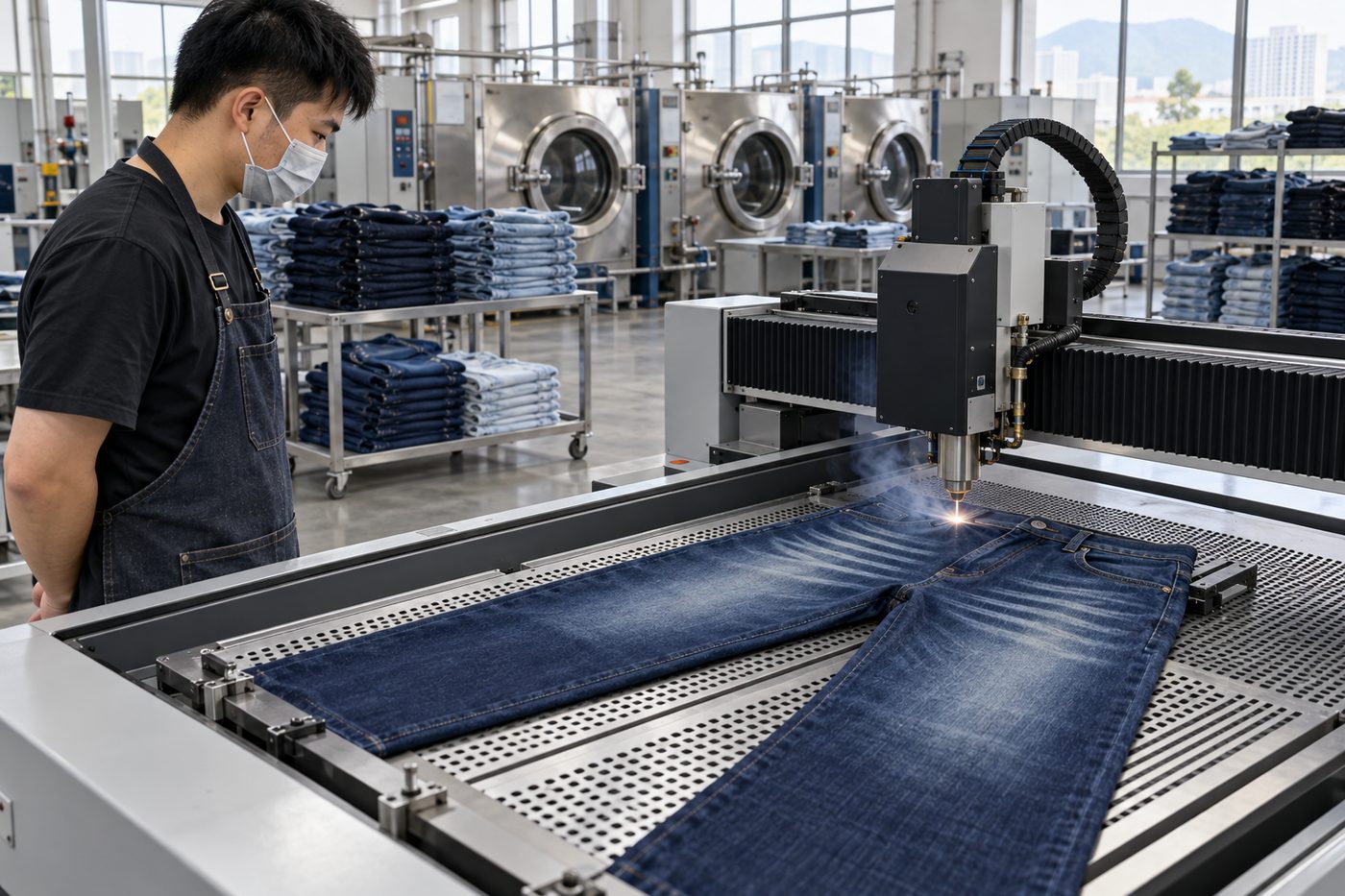
- The old park has closed: the Xintang Environmental Protection Industrial Park opened in 2002, and the 76 washing, bleaching, dyeing and oil depot companies inside and around it all stopped production on 10 February 2018 (Ministry of Ecology and Environment (China), 2018-12-20); Zengcheng District closed the park in phases in 2017 and 2018.
- Washing is now concentrated in a shared garment-washing center: the shared garment-washing center inside the Zengcheng Denim Apparel Smart Manufacturing Demonstration Base is operated by a state-owned enterprise and holds a licensed washing quota (CNR (China National Radio), 2025-12-31); companies that have moved in reportedly save close to 40% of water (21st Century Business Herald, 2026-04-22). The demonstration base has been completed, and Southern Metropolis Daily reported on 2026-04-23 that it is expected to start operating at the end of 2026.
- Ask where the washing is done before sampling: each garment factory works with different washing plants. When sampling, confirm whether the washing plant is compliant, whether samples and bulk orders are washed at the same plant, and what color variation is acceptable.
- Different processes use different amounts of water: in tests at a single factory, the same jeans used about 33.6 liters of water per piece with conventional washing, about 18.8 liters with ozone washing and about 15.6 liters with laser finishing (Nahid-Ull-Islam et al., 2024). If you want to make an environmental claim, you need the factory's actual data; do not just write "eco-friendly washing".
A 2010 Greenpeace report found heavy metals above standard levels in river sediment along the Xintang stretch (National Business Daily, 2010-12-03). In 2017 and 2018 the old park was closed in phases, and the official push now is the shared garment-washing center. Asking clearly where the washing is done when choosing a factory also protects your own brand.
How far is Xintang from the HowBridge Shenzhen warehouse? Where should you go?
From central Xintang to Fuhai Subdistrict, Bao'an District, where the HowBridge Shenzhen warehouse is located, is about 66 km, roughly a 51-minute drive without traffic (estimated on 2026-10-19 with OpenStreetMap routing; actual time depends on traffic). Common places to visit on a first trip to Xintang:
- Xintang International Denim Textile City: a large specialized denim wholesale market, good for first looking at styles, fabrics and price ranges on the market.
- Guangzhou Dongdamen Fashion Center: has designer studios, e-commerce and brand showrooms, and also houses the Zengcheng District Garment Designers Association.
- Zengcheng Denim Apparel Smart Manufacturing Demonstration Base (Yinsha Industrial Park): home of the shared garment-washing center; the 16th Denim Culture Festival was held here.
- Denim Culture Festival: held 3 years in a row from 2023 to 2025 (in both 2024 and 2025 it took place between November and December, i.e. months 11–12); there is no official announcement of the 2026 dates yet, so follow Zengcheng District announcements.
The domestic shipping cost and method from a Xintang factory to the HowBridge Shenzhen warehouse are agreed between you and the factory. Once the goods arrive at the Shenzhen warehouse, HowBridge consolidates them and ships them to Taiwan following the consolidated shipping process.
As a designer and business owner, what are you responsible for?
The most common problem with starting your own brand is "assuming someone else will handle it". The table below spells out who is responsible for each stage:
| Stage | Who is responsible | Details |
|---|---|---|
| Design, paper patterns, tech pack, size chart | Designer | Write the fit, fabric composition and weight, washing effect, hardware, thread color and sizes into a tech pack the factory can understand. |
| Choosing factories, negotiating, payment | Designer | Negotiate sampling and production terms directly with Xintang factories; you pay the factory directly. |
| Sampling and approval | Designer + factory | Check the fit, waist and inseam, washing color variation, shrinkage and hardware placement before deciding on production. |
| Small-batch production | Factory | Produces according to the approved sample. |
| Shipping to the Shenzhen warehouse | Arranged by the factory or designer | Domestic shipping is agreed between you and the factory. |
| Mainland China → Taiwan consolidated shipping | HowBridge | Receiving at the Shenzhen warehouse, consolidating and shipping to Taiwan (sea express or air freight). |
| Customs clearance | AEO-certified partner customs broker | HowBridge is not a customs broker; clearance is handled by a partner customs broker. You must provide truthful product names, materials, quantities and prices. |
| Storage and shipping to customers | Designer (HowBridge single-item fulfillment from Taoyuan is planned) | For now you arrange this yourself; HowBridge plans to offer single-item fulfillment (dropshipping from the Taoyuan warehouse). |
| Website, payments, systems | Designer (HowBridge website building is planned) | For now you set this up yourself; HowBridge plans to offer website building and an order system. |
| Brand, marketing, customer service, returns | Designer | You are the seller, so you are responsible for consumer returns and customer service. |
What is the process from design sketch to a buyer in Taiwan?
This is the usual order; finish each step before moving to the next:

1Prepare design sketches, paper patterns and a tech pack
Spell out the fit, size chart, fabric composition and stretch, washing effect and hardware. The composition must be convertible into the Chinese names used on Taiwan labels (see Labeling).
2Find a factory in Xintang for sampling
Bring your designs to Xintang to see factories and samples, negotiate sampling terms and costs, and confirm the washing plant they work with; sampling costs and minimum order quantities depend on each factory's quote.
3Approve the sample, then produce a small batch
Check the fit, sizes, shrinkage after washing, color variation and hardware placement; place a small-batch order only once everything checks out.
4Ship to the HowBridge Shenzhen warehouse
Ask the factory to send the goods to the HowBridge Shenzhen warehouse, and create a consolidated shipping order in the member center, filling in product names, materials, quantities and prices truthfully.
5Ship to Taiwan and clear customs
HowBridge ships the goods from Shenzhen to Taiwan, and an AEO-certified partner customs broker handles customs clearance; whether you import as a company or an individual depends on how you run your business. You can estimate shipping costs first with the shipping calculator.
6Label, list and ship
Before selling in Taiwan, label the country of origin, fiber composition, size and care instructions as required; after listing, handle shipping, customer service and returns.
What does HowBridge offer, and what is still planned?
Services available now and services still being planned are listed separately:
| Service | Status | Details |
|---|---|---|
| Receiving at the Shenzhen warehouse | Available | Goods from Xintang factories can be sent to the HowBridge Shenzhen warehouse. |
| Mainland China → Taiwan consolidated shipping | Available | Sea express or air freight; rates are based on the shipping calculator and the invoice issued after measurement at the warehouse. |
| Customs clearance | Available | Through AEO-certified partner customs brokers; HowBridge is not a customs broker. |
| Single-item fulfillment from Taoyuan | Planned | Planned: keeping designers' stock at the Taoyuan warehouse and shipping items one by one as orders come in. |
| Website building | Planned | Planned: building brand websites for designers. |
| Order and inventory system | Planned | Planned: linking website orders, inventory and shipping. |
What HowBridge does not do
No purchasing on your behalf, no paying factories on your behalf, no tax-inclusive shipping, no guaranteeing factory quality, no relabeling or issuing certificates of origin, and no routes other than mainland China → Taiwan.
There is no confirmed launch date yet. When they open, HowBridge will notify registered designers first.
Can jeans be imported from mainland China into Taiwan? How much tax applies?
Yes. Woven denim apparel falls under Chapter 62 of the tariff schedule, and common items imported from mainland China are permitted imports (their import regulations do not include MW0). There is no separate "denim" tariff code; items are classified by material and by men's or women's wear. Depending on the style, a denim jacket may be classified as a "jacket or blazer" or as a "windbreaker", so both sets are listed; the actual tariff code is as determined by customs. Duties in the table below use column 1 rates, plus 5% business tax:
| Item | Tariff code (HS/CCC code) | Duty | Import regulations |
|---|---|---|---|
| Men's cotton denim trousers and shorts | 6203.42.10.00-1 | 10.5% | Permitted |
| Women's cotton denim trousers and shorts | 6204.62.10.00-5 | 10.5% | Permitted |
| Men's trousers of synthetic fibers | 6203.43.10.00-0 | 10.5% | Permitted |
| Women's trousers of synthetic fibers | 6204.63.10.00-4 | 12% | Permitted |
| Cotton bib and brace overalls (men's / women's) | 6203.42.20.00-9 / 6204.62.20.00-3 | 12% | Permitted |
| Men's cotton denim jackets | 6203.32.00.00-5 or 6201.30.00.00-9 | 10.5% | Permitted |
| Women's cotton denim jackets | 6204.32.00.00-4 or 6202.30.00.00-8 | 12% | Permitted |
| Cotton denim skirts | 6204.52.00.00-9 | 12% | Permitted |
| Cotton denim shirts (men's / women's) | 6205.20.00.00-7 / 6206.30.00.00-4 | 10.5% | Permitted |
| Babies' garments of cotton (baby jeans) | 6209.20.00.00-3 | 12% | C02 (subject to BSMI mandatory inspection) |
How are stretch jeans declared?
Garments are classified by the fiber that predominates by weight. Common stretch jeans of 98% cotton + 2% elastane are still classified as cotton under 6203.42 or 6204.62; if there is more polyester than cotton, they move to the synthetic-fiber codes 6203.43 or 6204.63 (12% duty for women's). Declare product names and composition truthfully; the actual tariff code is as determined by customs.
If you supply fabric to the factory, its value counts too
Under Article 29 of the Customs Act, raw materials that the buyer provides to the seller free of charge or at a reduced price for use in production must be reasonably apportioned into the dutiable value. If you buy fabric in Xintang and hand it to the factory to sew, you must include the fabric value when clearing customs, not just the labor cost.
Denim fabric and trims cannot always be imported
Finished jeans are permitted imports, but upstream materials must be checked one by one: denim containing 85% or more cotton and weighing more than 200 g/m² (5209.42.00.00-9) is permitted; denim containing less than 85% cotton, mixed mainly with man-made fibers (5211.42.00.00-5), tubular rivets (8308.20.00.00-9), most cotton yarn (5205) and non-woven labels (5807.90.10.00-4) carry the import regulation MW0 (mainland Chinese goods not permitted). There are separate rules exempting small quantities from import permits, but for a brand we recommend making the garments into finished products in Xintang before importing.
According to import statistics from the Customs Administration, Ministry of Finance for ROC year 114 (2025), Taiwan imported about 9,864 tonnes of women's cotton trousers (6204.62.10), about 85% of it from mainland China; and about 4,957 tonnes of men's cotton trousers (6203.42.10), about 57% from mainland China (compiled by HowBridge from the weights of the top 20 source countries for each code; whether the statistics include express shipments under simplified declaration has not been confirmed).
How must jeans be labeled for sale in Taiwan?
If you import goods yourself and sell them in Taiwan, you are the party obliged to label them (the importer) under Article 5 of the Commodity Labeling Act. Jeans and denim skirts fall under lower-body garments in the BSMI Apparel Labeling Standards. Before putting them on the market, note the following:
- Label the origin truthfully: jeans produced in Xintang have mainland China as their country of origin. Completing the design in Taiwan does not make Taiwan the origin; adding leather patches and hang tags after arrival in Taiwan counts as "affixing marks or relabeling", which under Article 7 of the Rules of Origin for Imported Goods is not a substantial transformation either. You must not label or use copy that implies MADE IN TAIWAN.
- Import documents must state the origin: under Article 11 of the Regulations Governing Trade between the Taiwan Area and the Mainland Area, import documents for permitted mainland Chinese goods must state "Made in Mainland China" or an equivalent in a foreign language.
- Use standard Chinese fiber names: the mainland Chinese mill terms for polyester, elastane and viscose that often appear on factory hang tags must be replaced in Taiwan with the names announced by the competent authority, such as cotton, polyester, elastane (spandex) and rayon (viscose), in their standard Chinese forms, together with percentages by weight.
- Sew or print the label onto the jeans: as a rule, country of origin, fiber composition and care instructions must be sewn or printed onto the product itself, not only on a hang tag or product page; size must also be labeled.
- Importer and foreign manufacturer: label the name, address and phone number of your company or importer in Taiwan; imported goods must also show the foreign manufacturer's name in a foreign language (since 2023-05-18).
- Babies' clothing has separate inspection: the import regulations for baby jeans (6209.20) list C02, so they must be inspected under CNS 15290 (including items such as banned azo colorants); adult and ordinary children's jeans are not goods subject to mandatory inspection.
Labeling goods made in mainland China as made in Taiwan may violate Article 255 of the Criminal Code (false marking of country of origin), as well as the Commodity Labeling Act and the Fair Trade Act. For detailed penalties, see Origin washing enforcement and criminal liability.
How do you handle returns when selling jeans online?
If you sell on a website or platform, you are a business operator under the Consumer Protection Act. Jeans are not excluded from the 7-day right of withdrawal, and trousers are most often returned because the size does not fit:
- Returns without reason within 7 days: consumers may return goods or give written notice of cancellation within 7 days of receipt, without giving a reason and without bearing any cost (Article 19 of the Consumer Protection Act).
- Tell buyers how to return first: if cancellation information was not provided at delivery, the 7 days start from the day after the information is provided; however, the right of withdrawal lapses once more than 4 months have passed since the original 7-day period began.
- Collect within 15 days, refund within 15 days: after receiving written notice of cancellation, you must collect the goods within 15 days, and refund within 15 days from the day after collecting the goods or receiving the returned goods or cancellation notice (Article 19-2 of the Consumer Protection Act).
- Trying on does not affect returns: the consumer's right of withdrawal does not lapse because of changes caused by necessary inspection (Article 17 of the Enforcement Rules of the Consumer Protection Act).
- Exceptions must be disclosed in advance: exceptions to the 7-day right of withdrawal are listed in the Guidelines for Reasonable Exceptions to the Right of Withdrawal in Distance Sales; the one most relevant to jeans is customization at the consumer's request (for example, altering to the customer's inseam), and the consumer must be informed in advance.
Research indicates return rates for clothing bought online of about 25–40%, with poor size and fit as the top reason (Nestler et al., 2021). We recommend stating waist, hip, inseam, leg opening and fabric stretch clearly on the product page, and keeping stock in Taiwan so that size exchanges and returns are simpler.
What could a designer denim brand look like?
Below is the "Osmanthus Denim series" created as a HowBridge example: two pieces in the same indigo tone, made recognizable with hand stitching and embroidery. The images are AI simulations, not actual production samples:
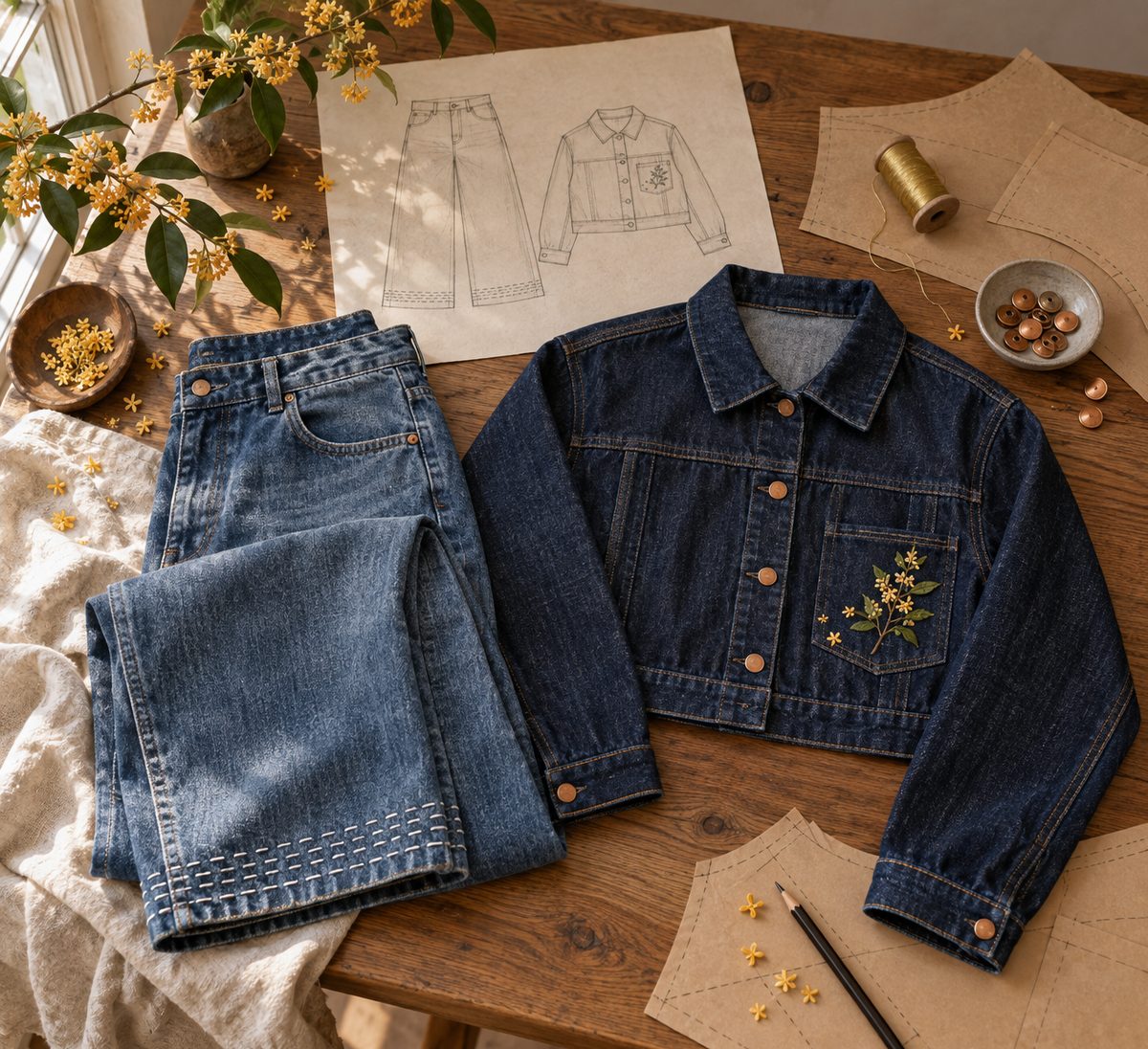
Wide-leg Jeans · Hand Stitch
Mid-blue washed wide-leg jeans with hems finished in white hand-sewn running stitch (sashiko style); high waist, straight wide cut, copper buttons.
Cropped Jacket · Osmanthus
Deep indigo cropped denim jacket with a sprig of osmanthus embroidered in gold thread on the left chest pocket; copper buttons, pairing as a set with the matching wide-leg jeans.
Who can register, and how?
The first round is for Taiwan designers and small studios who have their own jeans or denim apparel designs and want to sell them under their own brand.
1Add the HowBridge LINE official account
Tap Register on LINE to add the HowBridge official account.
2Send the keyword「牛仔設計師招募」(Denim designer recruitment) and a link to your work
Include a link to your portfolio or brand, and briefly describe the items you want to make and the expected quantities.
3Wait for customer service to contact you
HowBridge customer service will contact you to explain the consolidated shipping process and the progress of the planned services.
Looking for a purchasing agent, wanting HowBridge to pay factories for you or provide tax-inclusive shipping, wanting goods sent anywhere other than Taiwan, or wanting to label goods made in mainland China as made in Taiwan are all outside the scope of this recruitment.
The Ministry of Culture (Taiwan) offers an "International Fashion Event Subsidy" covering costs of participating in international fashion weeks and trade shows; applicants must be legally registered companies or firms, and self-funding must be at least 50% of the total project budget. Taipei Fashion Week also offers mentor consultations. Application periods follow Ministry of Culture announcements.
What does research say about denim clusters and small-batch production?
The studies and reports below provide background; none of them is about HowBridge or any specific factory, and they cannot be used to predict results for individual designers:
- Xintang is a cluster started by Hong Kong businesspeople that has kept upgrading: Chen Shuting et al. (2021) divided the innovation network of the Xintang denim cluster into four stages starting in 1980; by the development stage of 2012–2018, the technical capabilities of leading companies and business models combining online and offline had clearly improved. Liang Tianbao and Cheng Yanxia (2016) analyzed how policy and markets drove the upgrading of the Zengcheng denim cluster.
- Cooperation among local suppliers may improve working conditions: Jiang, Talluri and Yao (2012) used Xintang International Denim Textile City as a case to analyze local suppliers' strategies on price and lead time, concluding that cooperation among suppliers may be an effective way to improve working conditions.
- Most of the water used by jeans is not used at the factory: a life cycle assessment by Levi Strauss & Co. (2015) found that a pair of 501 jeans uses 3,781 liters of water in total: 68% in growing cotton, 23% in consumer washing, and only 1% in cutting, sewing and finishing (a corporate report, not a journal article).
- Washing processes affect water use and carbon emissions: in tests at a single factory, Nahid-Ull-Islam et al. (2024) found the same jeans used 33.60 liters of water per piece with conventional washing, 18.80 liters with ozone washing and 15.60 liters with laser finishing, though laser had slightly higher carbon emissions; Zhao et al. (2021) estimated that polyester-blend denim has a 72% smaller water footprint than pure cotton and a 5% larger carbon footprint.
- Producing small quantities and reordering based on sales is backed by research: in tests at a skiwear company, Fisher and Raman (1996) found that adjusting production to early sales cut costs enough to raise profits by about 60%; the model of Cachon and Swinney (2011) shows that when quick response and good design are combined, the effect is usually greater than the sum of the two separately.
- Moving from OEM to a brand is hard because of sunk costs and management: a 2022 National Chengchi University EMBA thesis interviewed Taiwan apparel companies that moved from OEM to their own brands and found sample costs, inventory and custom-ordered raw materials were costs they had to face after the transition; a 2018 National Taiwan University thesis described a "huge gap" between OEM and building your own brand; Malem (2008) interviewed 9 London designers and found the 5 still in business all followed 10 survival strategies; a 2019 Tamkang University thesis argued that Taiwan's "specialized OEM" capability is one foundation for brand development.
- Trousers are most vulnerable to poor fit: the SizeFlags study (Nestler et al., 2021) cites earlier research showing return rates for clothing bought online of about 25–40%, with poor size and fit as the top reason; a 400-person experiment by Chrimes et al. (2022) found that showing models of several body types on the product page helps shoppers judge fit.
What are common terms in jeans production?
- Garment washing
- Washing and processing garments after they are sewn to create shades of color, fading and a soft hand feel; most of the look of jeans is decided at this step.
- Stone washing
- Tumbling jeans with pumice stones to wear in a natural faded effect.
- Laser finishing
- Using a laser to burn fading, whiskers and other patterns onto the fabric surface; in single-factory tests it used less water than conventional washing but had slightly higher carbon emissions.
- Ozone washing
- Using ozone to fade indigo; in single-factory tests it used about 44% less water than conventional washing.
- Whiskers
- Radiating faded lines on both sides of the crotch, imitating creases from long wear.
- Stretch denim
- Denim with added elastane; the cotton share affects the tariff code and whether the fabric can be imported from mainland China.
- Paper pattern
- Pattern pieces drafted to size on paper; the factory cuts fabric according to the paper pattern.
- Tech pack
- Production instructions for the factory, including style, sizes, fabric, washing effect, hardware and thread color.
- Sampling
- Samples made before mass production to confirm fit, color variation and shrinkage after washing.
- Tariff code (HS/CCC code)
- The classification code for imported goods; woven jeans fall under headings 6203 (men's) and 6204 (women's) in Chapter 62.
- MW0
- An International Trade Administration import regulation code meaning "mainland Chinese goods not permitted".
- Single-item fulfillment
- The seller keeps stock at a warehouse, which ships items one by one to buyers as orders arrive; HowBridge single-item fulfillment from Taoyuan is currently planned.
What are the sources and the scope of verification?
The sources below were consulted on 2026-10-19; document dates and consultation dates are shown separately, and no date is supplied where none is stated.
Government, official and state media sources
- Southern Metropolis Daily: report on the Xintang denim apparel industry (annual jeans capacity of about 330,000,000 pieces in 2025) | Document date: 2026-04-23; according to incomplete statistics, Xintang's annual jeans capacity was about 330,000,000 pieces in 2025 and about 280,000,000 pieces in 2023 (fifth economic census), with a peak of 900,000,000 pieces in 2013 (third economic census); textile and apparel companies numbered 2,157 in 2013 and 2,415 in 2023; the environmental protection park was closed in phases in 2017 and 2018; the Denim Culture Festival has been held 3 years in a row since 2023.
- Ycwb.com (Yangcheng Evening News): report on the 15th Xintang Denim Culture Festival in 2024 | Document date: 2024-11-29; total output value of the town's denim apparel cluster exceeded CNY 10,000,000,000 from January to November (1–11) 2024; apparel companies are transforming through cross-border e-commerce, with exports up 26% year on year.
- Ministry of Industry and Information Technology (MIIT): 2025 list of China Consumer Famous Brands (attachment reposted on the Hunan Provincial People's Government website) | Document date: 2026-02-03; "Xintang Denim" was named a regional brand on the 2025 list of China Consumer Famous Brands, submitted by the People's Government of Zengcheng District, Guangzhou.
- CNR (China National Radio): the "second start-up" inside a pair of jeans (Zengcheng Denim Apparel Smart Manufacturing Demonstration Base) | Document date: 2025-12-31; the demonstration base is in Xintang's Yinsha Industrial Park, covering about 192 mu of land with a floor area of about 345,000 m²; the shared garment-washing center exceeds 30,000 m² with a licensed washing quota of 10,000 m³ per day, operated by a state-owned enterprise; it has connected with more than 60 companies, with 15 letters of intent signed; about 80% of Zengcheng's denim apparel companies are engaged in exports; Guangzhou Dongdamen Fashion Center has designer studios and a garment designers association.
- 21st Century Business Herald: Xintang denim ventures out to the world again | Document date: 2026-04-22; in 2018, 76 washing, bleaching, dyeing and oil depot companies stopped production, directly reducing the output value of industrial enterprises above designated size by CNY 3,059,000,000; the shared garment-washing center saves close to 40% of water; the Xintang Denim Fabric Center is planned to open in the second half of 2026; platforms' flexible "small orders with quick response" supply chains have connected with the Xintang industrial cluster.
- Ministry of Ecology and Environment (China) (reposted from Legal Daily): central environmental inspection and the Xintang Environmental Protection Industrial Park | Document date: 2018-12-20; the Xintang Environmental Protection Industrial Park opened in June 2002; a total of 76 companies inside and around it, 68 washing, bleaching and dyeing companies and 8 oil depots, all stopped production on 10 February 2018.
- People's Government of Zengcheng District, Guangzhou: the 15th China Guangzhou (Xintang) International Denim Culture Festival | Document date: 2024-12-02; Xintang holds the title "China's Famous Denim Apparel Town"; the 15th festival opened on 2024-11-28.
- Guangzhou Zengcheng Release (Publicity Department of the CPC Zengcheng District Committee, Guangzhou): the 16th Xintang Denim Culture Festival opens | Document date: 2025-12-28; the 16th festival opened on 2025-12-28 at the Zengcheng Denim Apparel Smart Manufacturing Demonstration Base, themed "Fashion Denim · Xintang Smart Manufacturing"; the promotion association and cross-border e-commerce platforms signed agreements on site.
- Guangzhou Municipal People's Government (reposted from Guangzhou Daily): "manufacturing-based city" series (Xintang denim) | Document date: 2022-03-17; Xintang has a complete industrial chain of spinning, weaving, printing, garment making, washing, bleaching and dyeing, shuttle weaving and trims; it is a national-level base for foreign trade transformation and upgrading.
- National Business Daily: the environmental debt of the "hometown of denim" | Document date: 2010-12-03; reports a 2010 Greenpeace report: 3 sediment samples from Xintang exceeded heavy metal standards, one of them exceeding the cadmium limit by 128 times.
- China Securities Journal (cs.com.cn): the fantastic journey of a pair of jeans | Document date: 2024-06-12; Xintang International Denim Textile City is a large specialized denim wholesale market; a pair of jeans requires more than 140 production steps; at its peak an average of 2,500,000 pieces were sold per day (a historical figure).
- OpenStreetMap / OSRM public routing service: Xintang to Fuhai Subdistrict, Bao'an District, Shenzhen, and to Dalang, Dongguan | Document date: not stated; HowBridge estimated on 2026-10-19 under free-flow traffic: Xintang to Fuhai Subdistrict about 66 km, 51 minutes; Xintang to Dalang about 49 km, 40 minutes; excluding traffic jams and toll stations.
- International Trade Administration, Ministry of Economic Affairs (Taiwan): commodity classification management system (import and export regulations search) | Document date: not stated; on 2026-10-19 the import regulations (permitted, MW0, MP1, C02) for codes including 6203, 6204, 6209, 5209.42, 5211.42, 5205, 8308.20 and 5807 were checked code by code.
- Customs Administration, Ministry of Finance: customs import and export statistics | Document date: not stated; source countries and weights of imports under 6203.42.10 and 6204.62.10 for ROC year 114 (2025); compiled by HowBridge from the weights of the top 20 source countries.
- Laws & Regulations Database of Taiwan: Commodity Labeling Act, Article 5 | Document date: 2022-05-18; the parties obliged to label are the manufacturer, commissioning manufacturer, importer or repackager, and labeling must be completed when the goods enter the market; a designer who commissions sampling and mass production from a factory in Xintang and imports the goods to sell under their own brand is the importer (or commissioning manufacturer).
- Laws & Regulations Database of Taiwan: Commodity Labeling Act, Article 6 | Document date: 2022-05-18; required label information includes the importer's name, address and phone number, the country of origin and main ingredients or materials; imported goods must also show the foreign manufacturer's or commissioning manufacturer's name in a foreign language.
- Laws & Regulations Database of Taiwan: Commodity Labeling Act, Article 11 | Document date: 2022-05-18; label text must be mainly in Chinese and may be supplemented with English or other foreign languages.
- Bureau of Standards, Metrology and Inspection (BSMI): Apparel Labeling Standards (amended by announcement Jing-Shang-Zi No. 11102427620 of ROC 111-10-24, effective ROC 112-05-18) | Document date: 2022-10-24; trousers, skirts and culottes are expressly listed as "lower-body garments" in the Apparel Labeling Standards; required information: ① name, address and phone number of the manufacturer / commissioning manufacturer (the importer for imported goods), plus the foreign manufacturer's or commissioning manufacturer's name in a foreign language ② country of origin ③ fiber composition ④ size ⑤ care instructions. Country of origin, fiber composition and care instructions must be shown on the product itself by sewn-in label, branding, heat transfer or printing (a hang tag is not enough); fibers making up 5% or more must be labeled by percentage by weight, with a tolerance of ±3% (no tolerance for items labeled 100%); auxiliary materials such as waistbands and labels are exempt. The standards do not require lower-body garments to be sized by waist or hip measurement.
- Ministry of Economic Affairs (announcement Jing-Shang-Zi No. 11102427850): table of examples of fiber composition and filling composition for the Apparel Labeling Standards | Document date: 2022-10-24; the standard Chinese fiber names announced by the competent authority include cotton, polyester, elastane (elastomeric or spandex), rayon (viscose) or polynosic, lyocell, modal and polyamide or nylon. The mainland Chinese mill terms for polyester, elastane, nylon and viscose often found on Chinese hang tags are mainland colloquial names not included in the table, and Taiwan labels should use the names in the table instead (the correspondence is common industry practice; no official correspondence table from a Taiwan authority was found).
- Bureau of Standards, Metrology and Inspection (BSMI): Textile Labeling Standards (version effective ROC 112.5.18.) | Document date: not stated; "fabrics and yarns" such as denim fabric and sewing thread fall under the Textile Labeling Standards; required information and rules on Chinese composition names are the same as in the apparel version, and yarn may be labeled with attached tags.
- Bureau of Standards, Metrology and Inspection (BSMI): general explanation and comparison table for the amendment of the Textile Labeling Standards | Document date: not stated; in line with the amendment of the Commodity Labeling Act, the foreign manufacturer's name in a foreign language was added, and fiber composition names and care symbols are now announced separately by the competent authority.
- BSMI Kaohsiung Branch: from 18 May of ROC year 112 (2023), Chinese labels on imported textiles must add the foreign-language name of the "foreign manufacturer" or "foreign commissioning manufacturer" | Document date: 2023-01-17; official BSMI explanation: the apparel and textile labeling standards took effect on ROC 112-05-18, and Chinese labels on imported textiles must add the foreign manufacturer's name in a foreign language.
- Laws & Regulations Database of Taiwan: Regulations Governing Trade between the Taiwan Area and the Mainland Area, Article 7 | Document date: 2024-02-19; goods from the mainland area may not be imported into the Taiwan area except in listed cases such as items announced as permitted by the competent authority; items with MW0 in the import regulations column of the commodity classification table are not permitted (e.g. denim 5211.42.00.00-5, tubular rivets 8308.20.00.00-9).
- Laws & Regulations Database of Taiwan: Regulations Governing Trade between the Taiwan Area and the Mainland Area, Article 11 | Document date: 2024-02-19; import documents for permitted mainland Chinese goods must state "Made in Mainland China" or an equivalent in a foreign language.
- Ministry of Economic Affairs (announcement Jing-Shou-Mao-Zi No. 09220021740): amended import management rules for mainland Chinese goods | Document date: 2003-07-21; official definition: MW0 in the "import regulations" column of the commodity classification table means mainland Chinese goods are not permitted, MP1 means conditionally permitted, and items with neither are permitted imports.
- International Trade Administration commodity classification management system: notes on the list of conditionally permitted mainland Chinese goods (general explanation) | Document date: not stated; the explanation of the MW0 / MP1 codes in the International Trade Administration's current search system, consistent with the ROC year 92 announcement.
- Laws & Regulations Database of Taiwan: Consumer Protection Act, Article 19 | Document date: 2015-06-17; consumers buying online (distance sales) may return goods or give written notice of cancellation within 7 days of receipt, without giving a reason and without bearing any cost.
- Laws & Regulations Database of Taiwan: Consumer Protection Act, Article 19-2 | Document date: 2015-06-17; on written cancellation, the business must collect the goods within 15 days from the day after receiving notice, and refund within 15 days from the day after collecting the goods or receiving the returned goods.
- Laws & Regulations Database of Taiwan: Guidelines for Reasonable Exceptions to the Right of Withdrawal in Distance Sales, Article 2 | Document date: 2015-12-31; there are only 7 exceptions to the 7-day right of withdrawal, such as "customized performance made at the consumer's request" (e.g. altering trouser length to the customer's measurements or embroidering text), and the business must inform the consumer in advance; ordinary in-stock jeans are not an exception.
- Laws & Regulations Database of Taiwan: Customs Act, Article 29 | Document date: 2022-05-11; the dutiable value is based on the transaction value, and commissions, handling fees and packing costs borne by the buyer, as well as freight and insurance to the port of import, must be included. Paragraph 3, Subparagraph 2: the value of raw materials and components that the buyer provides to the seller free of charge or at a reduced price for use in production must be reasonably apportioned and included.
- Laws & Regulations Database of Taiwan: Customs Act, Article 49 (Paragraphs 2 and 3) | Document date: 2022-05-11; the legal basis for small-value duty exemption: a consignment whose dutiable value is below the limit announced by the Ministry of Finance is duty-free, but this does not apply to frequent importers, with frequency defined by the Ministry of Finance. Sample garments and sample trousers are also assessed under this rule to determine whether tax applies.
- Laws & Regulations Database of Taiwan: Regulations Governing Customs Clearance of Air Express Consignments, Article 11 | Document date: 2026-02-23; classification of express consignments: "low-value duty-free express imports" have a dutiable value of NT$2,000 or less, and NT$2,001 to NT$50,000 is low-value dutiable.
- Ministry of Finance eTax portal: notes on buying foreign goods online | Document date: not stated; a dutiable value of NT$2,000 or less is exempt from customs duty, commodity tax and business tax; if the same taxpayer uses the exemption under Article 49, Paragraph 2 of the Customs Act more than 6 times within half a year, it no longer applies from the 7th time.
- Ministry of Culture (Taiwan) press release: Taipei Fashion Week SS27 moves to the Air Force Command HQ National Cultural Base for the first time, continuing to deepen its transformation | Document date: 2026-09-15; the Ministry of Culture organizes Taipei Fashion Week, offering one-on-one mentor consultations, cross-disciplinary design and the International Fashion Event Subsidy; SS27 held a showcase of 53 designer brands for the first time.
- Ministry of Culture grants portal: Ministry of Culture International Fashion Event Subsidy guidelines (applications for ROC year 116) | Document date: 2026-09-24; companies or firms in the designer-brand fashion industry can apply for subsidies to take part in international fashion weeks and trade shows; applications for ROC year 116 are accepted from 115/09/24 to 115/10/19 17:00 (ROC calendar), and self-funding must be no less than 50%.
- Customs Administration, Ministry of Finance GC413 customs import tariff data (updated 2026/10/07 11:16): codes for woven denim trousers | Document date: 2026-10-07; jeans (woven, Chapter 62) have no separate "denim" code and are classified by material and gender: men's cotton 6203.42.10.00-1 column 1 10.5%, women's cotton 6204.62.10.00-5 10.5%; men's synthetic-fiber 6203.43.10.00-0 10.5%, women's 6204.63.10.00-4 12%; bib and brace overalls of cotton 6203.42.20.00-9 / 6204.62.20.00-3 12%. The import regulations column for the four trouser codes above is blank (no MW0, no C02); synthetic-fiber overalls 6203.43.20.00-8 and 6204.63.20.00-2 are MP1. The column 2 rate of 0% applies only to agreement partners such as PA, GT, NI, SV, HN, NZ, SG, PY and SZ, not mainland China; mainland Chinese goods use column 1. Boys' and girls' wear (other than babies') uses the same codes.
- Customs Administration, Ministry of Finance GC413 customs import tariff data (updated 2026/10/07): codes for denim jackets, skirts, shirts and babies' garments | Document date: 2026-10-07; denim jackets: men's cotton 6203.32.00.00-5 10.5%, women's cotton 6204.32.00.00-4 12% (synthetic 6203.33.00.00-4 / 6204.33.00.00-3, both 10.5%); those classed as overcoats or windbreakers are 6201.30.00.00-9 (men's, 10.5%) / 6202.30.00.00-8 (women's, 12%). Cotton denim skirts 6204.52.00.00-9 12%. Cotton denim shirts, men's 6205.20.00.00-7 and women's 6206.30.00.00-4, both 10.5%. The import regulations for all of the above are blank. Babies' garments of cotton 6209.20.00.00-3 12%, import regulation C02 (subject to BSMI mandatory inspection). Knitted "denim-look" trousers (such as knit stretch trousers) fall under Chapter 61 instead: men's cotton 6103.42.10.00-2 and women's 6104.62.10.00-6, both 10.5%.
- Customs Administration, Ministry of Finance GC413 customs import tariff data (updated 2026/10/07): codes for denim fabric, yarn and trims | Document date: 2026-10-07; denim has two dedicated codes with different import regulations: denim containing 85% or more cotton and weighing more than 200 g/m², 5209.42.00.00-9, column 1 10%, import regulations blank (not MW0); denim containing less than 85% cotton, mixed mainly with man-made fibers, 5211.42.00.00-5, column 1 10%, import regulation MW0. Other twill of yarns of different colors in the same heading, 5209.43.00.00-8 and 5211.43.00.00-4, are also MW0. Most subheadings of cotton yarn 5205 are MW0 (except 5205.11, 5205.12 and 5205.48). Trims: tubular or bifurcated rivets 8308.20.00.00-9 10%, MW0; base metal buttons 9606.22.00.00-4 5%; press-fasteners and snap-fasteners 9606.10.00.00-8 5%; zippers with metal teeth 9607.11.00.00-6 3.4%; zipper parts 9607.20.00.00-5 2.5% (column 2 includes CN); leather labels 4205.00.10.00-3 7.5%; woven labels 5807.10.10.00-1 6.6% (other labels 5807.90.10.00-4 are MW0).
- International Trade Administration commodity classification management system: download of the list of mainland Chinese goods not permitted for import (MW0) | Document date: not stated; downloaded on 2026-10-19, 2,514 entries in total. Denim 5211.42.00.00-5 is listed, effective 0860601 (1 June of ROC year 86); tubular rivets 8308.20.00.00-9 effective 0780101; denim 5209.42.00.00-9 and the subheadings of 6203.42 and 6204.62 are not on the list, consistent with the Customs Administration tariff schedule.
- International Trade Administration commodity classification management system: download of the list of mainland Chinese goods conditionally permitted for import (MP1) | Document date: not stated; downloaded on 2026-10-19, 864 entries in total. The only denim-related items are synthetic-fiber overalls 6203.43.20.00-8 and 6204.63.20.00-2 (special provision M79) and babies' garments 6209.90.20 and 6209.90.90 (M78); cotton jeans, jackets, skirts and shirts are not on the list.
- International Trade Administration announcement (Jing-Mao-Zi No. 11104603570): rules exempting small quantities of mainland Chinese goods from import permits | Document date: 2022-08-19; mainland Chinese industrial products not on the "restricted import goods list" (tariff Chapters 25 to 97) are exempt from import permits and from MXX requirements when the whole declaration has a CIF value within NT$32,000 and each item is within 24 pieces (within 40 kg where pieces cannot be counted); items may not be split by size, specification or color; other import regulations must still be met. MW0 denim 5211.42 and rivets 8308.20 are in Chapters 52 and 83 and can use this allowance; beyond it, they revert to not permitted.
- International Trade Administration announcement (Jing-Mao-Zi No. 11550200230): items excluded from the "rules exempting small quantities of mainland Chinese goods from import permits" | Document date: 2026-03-10; the exclusion list has only 3 codes: electric two-wheeler controllers 8543.70.99.50-4, electric motorcycles 8711.60.10.00-9 and electric bicycles 8711.60.20.00-7; textiles and apparel trims are not on the exclusion list.
- Bureau of Standards, Metrology and Inspection (BSMI): comparison table for amended inspection rules on clothing and clothing accessories for infants subject to mandatory inspection | Document date: not stated; clothing for infants aged 24 months or under, 86 cm tall or under, or weighing 15 kg or under (including 6209.20.00.00-3) has been inspected under CNS 15290 (ROC year 108 edition) since 1 February of ROC year 110 (2021), covering free formaldehyde, banned azo colorants, cadmium, lead, organotin, nonylphenol and PFOS; inspection is by monitoring inspection, import regulation code C02. Baby jeans fall within this scope.
- Bureau of Standards, Metrology and Inspection (BSMI): introduction to the inspection system for 63 textile items (September of ROC year 106) | Document date: 2017-09; there are 63 textile items subject to mandatory inspection: infants' clothing and clothing accessories (6111, 6209; 12 items), towels (6302; 6 items), bedding (39 items) and underwear (6212; 6 items). Adult and ordinary children's jeans (6203, 6204) are outside this scope, and the current tariff codes 6203.42 and 6204.62 carry no C02. CNS 15290 limits azo colorants to no more than 30 ppm, but it is only mandatory for items announced as subject to inspection; no announcement applying azo colorant limits to adult jeans was found.
- Laws & Regulations Database of Taiwan: Regulations Governing Exemption of Commodities from Inspection, Article 5 | Document date: 2019-11-21; non-sale personal-use items and commercial samples may be exempted from inspection after review if the total value of the same specification and model on one declaration is US$1,000 or less, or, if above that, personal-use items do not exceed 2 pieces and commercial samples do not exceed 5 pieces. This only affects C02 items (such as baby jeans); adult jeans are not subject to mandatory inspection in the first place.
- Laws & Regulations Database of Taiwan: Criminal Code of the Republic of China, Article 255 | Document date: 2026-07-22; anyone who, intending to deceive others, falsely marks or otherwise misrepresents the country of origin or quality of goods is punishable by imprisonment of up to one year, detention or a fine of up to NT$30,000; the same applies to knowingly selling, displaying for sale or importing such goods. (The date is the Criminal Code's most recent amendment date, not the amendment date of this article.)
- Laws & Regulations Database of Taiwan: Enforcement Rules of the Consumer Protection Act, Article 17 | Document date: 2015-12-31; if goods are damaged, lost or altered because of the consumer's necessary inspection (such as trying on to check the size) or for reasons not attributable to the consumer, the right of withdrawal under Article 19, Paragraph 1 of the Consumer Protection Act does not lapse.
- Laws & Regulations Database of Taiwan: Rules of Origin for Imported Goods, Articles 5 and 7 | Document date: 2010-12-24; where two or more countries are involved, the country of origin is the one where the last substantial transformation took place; substantial transformation means a change in the first six digits of the tariff code, or completion of an important manufacturing process with value added exceeding 35%. Merely "sorting, grading, repacking, packaging, affixing marks or relabeling", or simple joining or assembly, cannot be deemed substantial transformation.
- Customs Administration, Ministry of Finance: rules of origin | Document date: 2023-11-15; Customs Administration explanatory page: for general goods, the country of origin is the country of the last substantial transformation, defined as in the Rules of Origin for Imported Goods (page updated 2026-10-19).
- Laws & Regulations Database of Taiwan: Regulations Governing Import of Commodities, Article 11 | Document date: 2023-12-26; for trade management purposes, the International Trade Administration may announce import items that must be labeled with their origin or that must present a certificate of origin at customs clearance; the origin labeling rules for imported textiles in Chapters 61 and 62 are based on this (the original text of that announcement could not be obtained from the International Trade Administration website; the official text is still to be added).
Research literature and reports
廣州新塘牛仔服裝製造業集群創新網絡的演化階段與特徵
Using first-hand data from questionnaires and in-depth interviews, divides the innovation network of the Xintang denim cluster into four stages: emergence (1980–1990), networking (1990–2000), growth (2000–2012) and development (2012–2018); by the development stage, the denim production capabilities of leading companies had improved, and business model innovation combining online and offline had become evident.
Improving supplier's situation through supplier cooperation: The case of Xintang jeans town
Working with the management of Xintang International Denim Textile City, the authors used operations research methods to analyze local suppliers' strategies on "price" and "delivery guarantees", the two main competitive dimensions in the garment industry, concluding that cooperation among local suppliers may be an effective way to improve working conditions.
傳統產業集群升級動力機制構建與分析
The authors build an upgrading framework "based on cluster policy, with the push of cluster self-optimization plus the pull of external market demand", and use it to analyze the drivers and effects of upgrading in the Zengcheng (the district where Xintang is located) denim industry cluster.
The Life Cycle of a Jean: Understanding the Environmental Impact of a Pair of Levi's® 501® Jeans
A pair of 501 jeans, from raw materials to disposal, uses 3,781 liters of water in total and emits 33.4 kg CO2e; 68% of the water is used for fiber (cotton) and 23% in consumer washing, with cutting, sewing and finishing accounting for only 1% (34 liters).
Sustainable Approaches of Ozone Wash and Laser Fading Over Conventional Denim Wash
For the same jeans, conventional washing used 33.60 liters of water per piece, ozone washing 18.80 liters (14.80 liters or about 44% less) and laser finishing 15.60 liters; however, laser emitted 0.45 kg CO2 per piece, slightly more than the conventional 0.42 kg.
Virtual carbon and water flows embodied in global fashion trade – a case study of denim products
From 2001 to 2018, carbon emissions embodied in global denim trade rose from 14.8 to 16.0 Mt CO2e, while embodied water fell from 5,600,000,000 to 4,700,000,000 cubic meters; polyester-blend denim has a 5% larger carbon footprint and a 72% smaller water footprint than pure cotton.
Reducing the Cost of Demand Uncertainty Through Accurate Response to Early Sales
In tests at a skiwear company, shortening lead times and scheduling production based on early sales (Quick Response) cut costs enough, compared with the previous informal approach, to raise profits by about 60%.
The Value of Fast Fashion: Quick Response, Enhanced Design, and Strategic Consumer Behavior
Model analysis shows that quick-response production and enhanced design are usually complementary: when used together, the profit gain is generally greater than the sum of using each separately.
Fashion designers as business: London
Interviews with 9 London fashion designers identified 10 survival strategies; the 5 still in business followed all of them, while those who had closed followed only 1 to 5.
台灣獨立品牌服裝設計師的創業歷程暨時尚產業的未來
Based on in-depth interviews with 9 respondents, including 5 Taiwan independent fashion brands, the author argues that Taiwan's long-standing textile technology and "specialized OEM" capability are one foundation for the garment industry's move into the fashion industry.
台灣代工產業如何從代工走向品牌企業轉型的SWOT策略分析—以服飾業為例
Interviews with two apparel companies that moved from OEM to their own brands: OEM experience saves costs and gives command of fabrics, but sample costs for developing styles, inventory and custom-ordered raw materials are sunk costs that must be faced after the transition, while automation makes many-styles, small-quantity production possible.
探討台灣紡織成衣業與品牌發展的關聯性-以H公司對越南柬埔寨成衣廠為例
The case Taiwan-owned garment factory built strategic links with brand owners through quality, delivery reliability and "a special ability to handle small, varied orders"; the author also notes that every industry faces "the huge gap between OEM production and building your own brand".
SizeFlags: Reducing Size and Fit Related Returns in Fashion E-Commerce
The paper cites earlier research showing overall return rates for clothing bought online of about 25–40%, reaching 75% for certain categories and brands; among the reasons for returns, poor size and fit ranks first.
Investigating how online fashion product page design affects the consumer's clothing fit appraisal
The authors note that fit is the main cause of high return rates for clothing bought online; a web experiment with 400 British women found that showing models of several body types on the product page improved fit judgments but did not increase purchase intention.
Xintang industry figures are as published by local official sources and state media; HowBridge has not done an on-site count. Company counts vary by source (about 2,000 to 6,000), and this page uses the economic census figure; there are no official employment figures after 2024. There are no public quotes for sampling costs or minimum order quantities that apply to individual factories, so this page does not give any. Tariff codes follow the Customs Administration, Ministry of Finance tariff data of 2026-10-07, and import regulations follow the International Trade Administration, Ministry of Economic Affairs lists of 2026-10-19; import statistics follow Customs Administration, Ministry of Finance data for ROC year 114, compiled by HowBridge. Legal provisions follow the Laws & Regulations Database of Taiwan. Website building, the order system and single-item fulfillment from Taoyuan are planned services with no confirmed launch date.
Frequently asked questions about the denim designer recruitment
Will HowBridge find a Xintang factory for me?
Can Xintang handle small orders?
How much tax do jeans shipped from mainland China to Taiwan pay?
Can I ship denim fabric to Taiwan and make the jeans myself?
If I produce in Xintang and sew on a leather patch after arriving in Taiwan, can I label it Made in Taiwan?
Are Xintang's washing plants legal?
Is HowBridge a customs broker?
Will HowBridge pay factories for me or advance my taxes?
When will website building and single-item fulfillment from Taoyuan be available?
What does registering involve?
Can I refuse returns when selling jeans online?
Further reading
Dalang sweater designer recruitment: designers as business owners
Origin washing enforcement and criminal liability: how to label origin when reselling in Taiwan
Rules of origin and origin washing
What is a CCC code, and how do you look it up?
Trade Administration import regulations and import permits
Taiwan import duty guide
Simplified declaration vs. formal customs declaration
EZ WAY tutorial
First-round "denim designer as business owner" registration now open
Add the HowBridge LINE official account and send the keyword「牛仔設計師招募」(Denim designer recruitment) with a link to your work; HowBridge customer service will contact you.
Register on LINE