Buying vinyl records and turntables in China and shipping them to Taiwan: what should you watch out for?
Quick answer: What should you watch out for when shipping vinyl records bought in China to Taiwan?
First, records are cheap; turntables are not. Vinyl records are generally classified under 8523.80.00.00-5, with 0% duty and no commodity tax; but turntables without built-in speakers carry 10% duty plus 10% commodity tax as "audio component systems". Second, China-made cartridges are MW0. In principle they may not be imported; in practice, individual consolidated shipments mainly rely on the Ministry of Economic Affairs' small-quantity permit exemption. Third, piracy has no personal-use exception. Shipping records into Taiwan while knowing, or having foreseen, that they may be pirated counts as importing pirated copies and may carry criminal liability; parallel imports of legitimate copies for personal use not involving distribution are limited to one copy per work per import. Fourth, records originating in mainland China are audio publications from the Mainland Area and are additionally subject to permission under the Act Governing Relations between the People of the Taiwan Area and the Mainland Area. Fifth, vinyl is sensitive to heat and pressure: ask the seller to pack records upright and rigidly, and wait until they are close to room temperature before unpacking.
HowBridge has only a Shenzhen consolidation warehouse and a Taoyuan operations warehouse, and provides consolidated shipping only from China → Taiwan. We have no warehouses in the US, Japan or Europe, and we do not provide proxy purchasing. The tariff, copyright and storage information on this page is general information on the Taiwan side; we cannot determine whether a particular record is a legitimate release, and we do not offer temperature-controlled shipping.
What taxes do you pay to ship vinyl records and turntables to Taiwan?
Things used for "listening to vinyl" are treated very differently in the tariff. The table below shows the results of a tariff lookup on the Customs-Port-Trade Single Window (import/export date 2026-09-17):
| Product | Tariff code | Column 1 duty | Import regulations | Commodity tax |
|---|---|---|---|---|
| Vinyl records | 8523.80.00.00-5 (general classification) | 0% | None | Not levied |
| Turntables (without built-in speakers) | 8519.30.00.00-2 | 10% | No code (a product under the Declaration of Conformity scheme of the Bureau of Standards, Metrology and Inspection, BSMI) | Audio component systems 10% |
| All-in-one vinyl players (with built-in speakers) | 8519.89.00.00-2 | 0% | C02 | No commodity tax code currently listed in the tariff; no Ministry of Finance interpretation was found on whether it is a combination unit under "audio component systems" |
| Cartridges (pickup heads) | 8522.10.00.00-1 | 7.5% | MW0 | Not levied |
| Parts and accessories of turntables and record players | 8522.90.10.00-2 | 0% | None | Not levied |
From 2026-01-01, Article 11 of the Commodity Tax Act deleted 4 taxable items: televisions, video recorders, record players and tape recorders (Ministry of Finance press release of 2025-11-27). However, Paragraph 1, Subparagraph 4 of the same Article, "audio component systems: separate audio components, including turntables, tuners, receiver-amplifiers, tape decks, amplifiers, speakers, etc., and combination units thereof", is still taxed at 10% ad valorem, so a turntable bought on its own is still taxable. Whether all-in-one units with built-in speakers count as "combination units": we found no Ministry of Finance interpretation. The commodity tax base is the customs dutiable value plus import duties and taxes (Article 18), which in ordinary cases means the dutiable value plus customs duty.
Customs Administration tariff advance ruling cases: a vinyl turntable that has no built-in sound device or audio amplifier and transmits via Bluetooth to external speakers is classified under 8519.30.00.00-2 (108AA0561); a vinyl player with built-in stereo speakers that can play directly is classified under 8519.89.00.00-2 (108AA0562). Advance rulings are case-specific and do not automatically apply to other models. In addition, the countries eligible for the 0% Column 2 rate under 8519.30 do not include mainland China, so China-made turntables are subject to the 10% Column 1 rate.
Article 12 of both the Regulations Governing Customs Clearance Procedures for Air Express Consignments and the Regulations Governing Customs Clearance Procedures for Sea Express Consignments provides that express consignments subject to tax under the Commodity Tax Act shall be cleared with a regular import declaration; those involving import or export regulations shall in principle also use a regular declaration (except in special cases announced by Customs). Turntables are subject to commodity tax, all-in-one players carry C02 and cartridges carry MW0, so documents and timelines may differ from those for ordinary small parcels; this page does not promise any particular number of days.
We searched tariff advance ruling cases on the Customs-Port-Trade Single Window for "records" and "vinyl" and found no Taiwanese ruling on vinyl records themselves; the classification is based on the international HS structure (the US tariff has a separate "Phonograph records" line under the same subheading). For comparison: recorded LDs, VCDs and DVDs with sound and images (8523.49.00.21-0) carry MP1, whereas 8523.80.00.00-5, where vinyl sits, has no import regulations. Customs' determination still prevails.
How much tax do you actually pay for a turntable plus a few records?
If the dutiable value of a single import shipment is NT$2,000 or less, customs duty, commodity tax and business tax are waived; above that, the exemption no longer applies, and taxes and fees are calculated by Customs' formula on the entire dutiable value (NT$2,000 is a threshold, not a deduction). Here is a worked example with transparent assumptions:
| Item | 3 vinyl records | 1 turntable | Shipment total |
|---|---|---|---|
| Dutiable value | 2,000 | 3,200 | 5,200 |
| Customs duty | 0 (0%) | 320 (10%) | 320 |
| Commodity tax | 0 | 352 ((3,200 + 320) × 10%) | 352 |
| Business tax 5% | 100 | 194 ((3,200 + 320 + 352) × 5% = 193.6, about 194) | 294 |
| Total taxes | 100 | 866 | 966 |
The business tax base is "dutiable value + customs duty + commodity tax" (Article 20 of the Value-added and Non-value-added Business Tax Act). The trade promotion service fee is 0.04% of the dutiable value, about NT$2 in this example, and is not levied if NT$100 or less. If you ship only vinyl records and the dutiable value of the shipment does not exceed NT$2,000, no tax is payable; but once the same taxpayer has used the exemption more than 6 times in a half-year period, it no longer applies.
The declared value must match the actual transaction. Under Article 37 of the Customs Anti-smuggling Act, falsely declaring the value of goods may be punished with a fine of up to five times the evaded import duties, or confiscation of the goods, or both; if the false declaration involves evading import controls (for example using an untrue declaration to get around the MW0 control), Paragraph 3 of the same Article applies Article 36, Paragraphs 1 and 3 instead: a fine of up to three times the value of the goods, and confiscation of the goods.
Could vinyl on Taobao be pirated, and do you break the law even if you only listen to it yourself?
This is the most important part of this page. The Copyright Act divides "importing from abroad" into two situations, with completely different consequences:
| Situation | Provision | Personal-use exception? | Possible liability |
|---|---|---|---|
| Importing pirated records or records reproduced without authorization | Article 87, Paragraph 1, Subparagraph 3: deemed to infringe copyright | None (the exception in Article 87-1 applies only to parallel imports under Subparagraph 4) | Article 93, Subparagraph 3: imprisonment of up to 2 years or short-term detention, or in lieu thereof or in addition thereto a fine of up to NT$500,000 |
| Importing legitimate foreign copies without the consent of the economic rights holder (parallel import) | Article 87, Paragraph 1, Subparagraph 4: deemed to infringe copyright | Yes: for personal use not involving distribution, limited to one copy per work per import (Ministry of the Interior announcement of 1993) | Exceeding the number of copies: the rights holder may claim civil damages; no criminal liability (explanation by the Intellectual Property Office) |
| Buying pirated copies from a shop within Taiwan | — | — | The purchase itself does not infringe copyright; knowingly reselling pirated copies infringes the distribution right (explanation by the Intellectual Property Office) |
The Ministry of Justice Laws & Regulations Database's explanation on "buying pirated goods from abroad" is blunt: when a pirate seller sends goods from abroad to Taiwan, it is no longer a mere purchase but an import, to which Article 87, Paragraph 1, Subparagraph 3 and Article 93, Subparagraph 3 apply. Criminal liability requires intent (Articles 12 and 13 of the Criminal Code: the actor knows of and intends the occurrence of the result, or foresees its occurrence and its occurrence is not contrary to the actor's intention); copyright offenses are in principle prosecuted only upon complaint by the injured party. The key point is therefore "knowing it is pirated, or having foreseen that it may be pirated and ordering anyway".
A 2025 submission by the Recording Industry Association of America (RIAA) to the Office of the United States Trade Representative states that counterfeit vinyl produced in China and Russia is finely made, replicating even tear strips, anti-counterfeiting seals and shrink wrap, making it hard for ordinary buyers to tell apart by appearance, and is often sold at full price alongside legitimate copies. Counterfeit types observed by the RIAA include "greatest hits" compilations the record label never released, vinyl editions of releases officially issued only digitally or on CD, color variants that do not exist officially, and unauthorized box sets. This is a statement by an industry group; the sales platforms named in the submission are Amazon, eBay, Vinted and others, and Taobao is not named.
A normal price does not mean a record is legitimate; the most reliable check is to compare against the official release records of the label or artist to confirm that the edition, color or box set really exists. The personal-use exception presupposes "personal use not involving distribution" and applies only to lawful foreign copies; whether mainland China licensed editions qualify, we could not confirm. It does not apply if you intend to resell. Pirated vinyl can be reported to the Recording Industry Foundation in Taiwan (RIT).
Are there special rules for records originating in mainland China?
The tariff code for vinyl records carries neither MW0 nor MP1, so trade controls do not block products made in mainland China; however, if a record's origin is mainland China, it is also an "audio publication from the Mainland Area", governed by Article 37 of the Act Governing Relations between the People of the Taiwan Area and the Mainland Area and the Ministry of Culture's permission regulations:
What counts as a "Mainland Area publication"?
Article 2 of the permission regulations: publications include audio publications; whether something is a Mainland Area publication is determined under the rules of origin; entering Taiwan by carrying, post, freight or any other means counts as "entering the Taiwan Area".
When may permission be granted?
Article 5: if inspection finds that the content does not fall under Article 4 (promoting communism or engaging in united front work, harming public order or good morals, violating mandatory or prohibitive provisions of law, or displaying Chinese Communist symbols, unless the content requires it), and the quantity does not exceed the quantity announced by the Ministry of Culture, entry may be permitted. Article 11: publications admitted under such permission may not be sold. The competent authority has been the Ministry of Culture since 2012-05-20.
What happens if permission is refused or the rules are violated?
If inspection results in refusal or the announced quantity is exceeded, the competent authority may order the owner or holder to return the items abroad or destroy them within a set period; if this is not done by the deadline, or if mailed items held for review are refused, the competent authority will handle them under the relevant rules (Article 23 of the permission regulations). Violations of Article 37 are subject to a fine of NT$40,000 to NT$200,000 under Article 88 of the Act, and the publications are confiscated regardless of who owns them.
For the quantity announced by the Ministry of Culture under Article 5, the inspection procedures for items entering by post referred to in Article 23, and how records mailed by individuals for personal use are actually inspected, we found no official explanation for any of them, so we do not give a figure for "how many records you can ship". Inferring from the definition of origin, pressed records sold on Taobao whose origin is Europe, the US or Japan are not Mainland Area publications, but the competent authority's determination prevails.
Can cartridges, styluses and cleaning products be shipped from China together?
Each accessory has its own tariff code, and cartridges are the easiest to get wrong:
| Product | Reference tariff code | Column 1 duty | Import regulations |
|---|---|---|---|
| Cartridges (pickup heads) | 8522.10.00.00-1 | 7.5% | MW0 |
| Record cleaning fluid (cleaning preparations put up for retail sale) | 3402.50.00.00-7 | 4% | 508 (for non-food use, enter DH999999999508 on the declaration to be exempted from that requirement) |
| Record cleaning brushes | 9603.90.90.00-5 | 3.3% | None |
| Paper record jackets | 4819.50.00.00-2 | 0% | None |
| Polyethylene (PE) inner sleeves | 3923.21.00.00-3 | 5% | F02 |
| Polypropylene (PP) outer sleeves | 3923.29.90.10-4 | 5% | F02 |
| Other plastic inner sleeves (not PE, PP or PVC) | 3923.29.90.90-7 | 5% | None |
MW0 means "Mainland China goods not permitted for import". A Ministry of Economic Affairs announcement (2012-03-06, Jing-Shou-Mao-Zi No. 10140004370) also provides a small-quantity permit exemption: for Mainland China industrial products in Chapters 25 to 97 of the tariff, such Mainland China goods on a declaration may be imported without a permit if their total CIF value is within NT$32,000 and each item is within 24 pieces (within 40 kg for goods that cannot be counted by piece). This allowance has no "personal use" requirement, and it does not mean other import regulations are waived; the announcement also has excluded items, and the competent authority's determination prevails. Other routes require a separate application to the International Trade Administration.
We found no tariff advance ruling cases for styluses or replacement stylus tips, and cannot confirm whether they fall under 8522.10 or 8522.90, so no tariff code is given; for larger amounts you can apply for a tariff advance ruling before importing. We have not verified how the F02 import regulation for PE inner sleeves and PP outer sleeves can be handled without a permit.
Vinyl is sensitive to heat and pressure: how can you reduce the risk of warping in transit?
International audio archiving institutions agree: vinyl is durable in a stable environment, but deforms when exposed to heat or pressure. The International Association of Sound and Audiovisual Archives (IASA) points out that thermoplastic materials exposed to high temperatures, or even sunlight, may suffer irreversible deformation, which is a specific threat to vinyl; the archival documents do not give a temperature at which vinyl deforms.
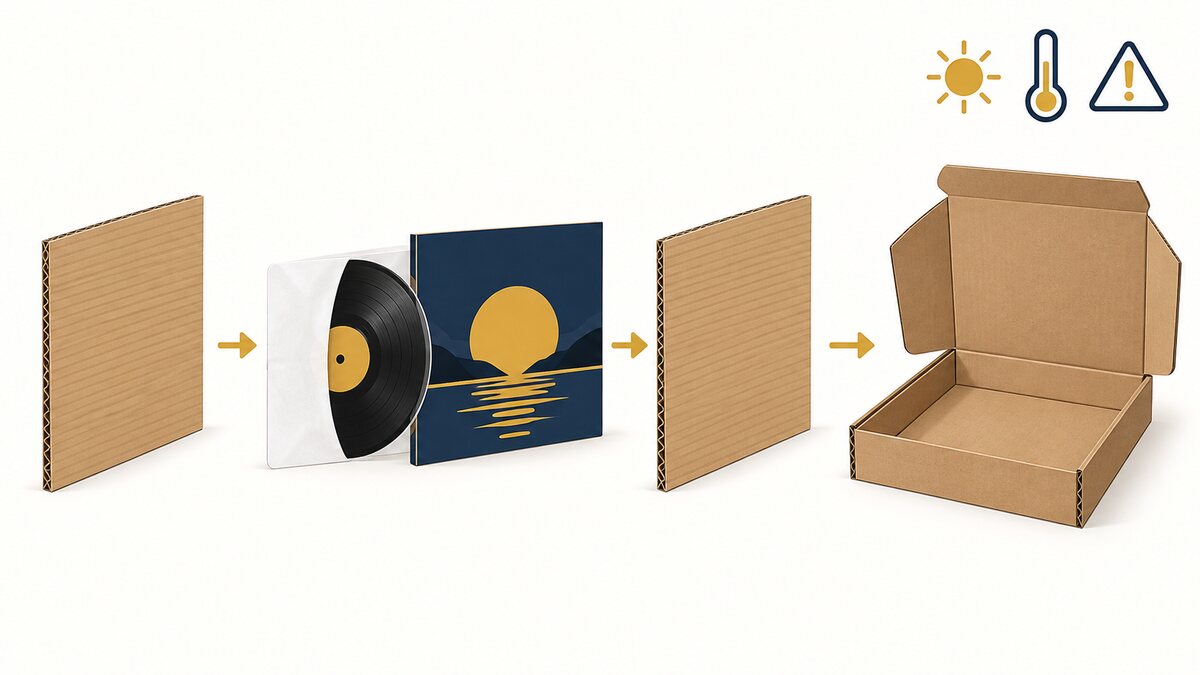
1Ask the seller to pack records upright and rigidly
The US National Archives and Records Administration (NARA) and IASA both recommend storing records upright, and NARA also advises not stacking them. When ordering, you can ask the seller to use a record mailer box with cardboard stiffeners to avoid pressure in transit.
2Think twice in hot seasons
IASA's shipping advice is to avoid extreme weather and to use insulated packaging. We do not offer temperature-controlled shipping and cannot promise temperatures in transit; if you buy rare editions during the summer heat, please assess the risk yourself.
3After delivery, wait until it is close to room temperature before unpacking
IASA recommends letting carriers air out after shipping and letting their temperature return to normal slowly (its advice to archives is a temperature change of no more than 3°C within 24 hours). Ordinary collectors can first leave the parcel in a cool, shaded place indoors, rather than putting it straight in front of an air-conditioner vent or playing it immediately.
4Recommended conditions for long-term storage
NARA recommends a temperature of 55–70°F (about 13–21°C) and relative humidity of 30–55%, avoiding large fluctuations in temperature and humidity, and not keeping records in uncontrolled environments such as attics or garages.
For the specific warping temperatures commonly quoted online, we found no original source in the NARA, IASA and ARSC preservation guides or the Library of Congress's 2005 preservation leaflet, so we do not cite them.
What do grades like NM and VG+ mean for secondhand vinyl?
Some secondhand record sellers use the Goldmine grading adopted by Discogs. Below is the gist of Discogs' official explanation (our summary, not a full translation):
| Grade | Condition (gist) | Value relative to NM, according to Discogs |
|---|---|---|
| M (Mint) | Perfect in every way, definitely never played, possibly still sealed; Discogs recommends using it sparingly | — |
| NM or M- (Near Mint) | Nearly perfect, plays flawlessly with no obvious wear; the sleeve has no creases, folds, seam splits or punch holes | Baseline |
| VG+ (Very Good Plus) | Shows signs of use but has been well cared for; light scuffs do not affect listening, and slight warps that do not affect the sound are acceptable | About 50% |
| VG (Very Good) | Surface noise is audible during play, and light scratches that can be felt with a fingernail affect the sound | About 25% |
| G or G+ (Good) | Plays through without skipping, but with noticeable surface noise, scratches and groove wear | About 10–15% |
| P or F (Poor/Fair) | Cracked or badly warped; skips or repeats when played | About 0–5% |
These standards are used on the Discogs marketplace and are assessed by sellers themselves; the value percentages are Discogs' statements, not a market guarantee. Before ordering, you can ask the seller for actual photos of the record surface and the sleeve.
Is vinyl really making a comeback, and how should you read the market data?
Official and industry statistics both show continued growth in vinyl, but pay attention to how each one is measured:
US: RIAA says vinyl has grown for 19 years
Recording Industry Association of America (RIAA) 2025 year-end report: US vinyl units of 46.8 million (up 7.9% year on year) and wholesale value of about USD 1.043 billion (up 9.3%); the RIAA also states that US vinyl accounts for nearly half of global vinyl revenue. Measured at wholesale value.
Taiwan: based on reporting companies
Recording Industry Foundation in Taiwan (RIT) 2025 physical sales report: vinyl of about 212,600 units (album units) and wholesale value of about NT$241 million; calculated against the same organization's 2024 data, units rose by about 32% and value by about 42%. The statistics cover only reporting companies, the set of reporting companies may differ between the two years, and the figures do not represent the whole market.
Research perspective: more than nostalgia
Cultural sociology research (Bartmanski & Woodward) argues that vinyl's revival in the digital age cannot be explained by nostalgia alone, but is also linked to vinyl's symbolism as a physical object, listening rituals, its "aura" and its coolness (we read only the abstract of the paper).
How should you order vinyl on Taobao or Xianyu?
Putting the rules above into an ordering sequence:
1First confirm the edition and licensing
Compare against official release records, and avoid compilations, color variants and box sets that were never officially released. If you suspect it may be pirated, do not order.
2Check whether the turntable has built-in speakers
Turntables without built-in speakers are subject to 10% duty plus 10% commodity tax; all-in-one players with built-in speakers have 0% duty, but their tariff code carries C02 (BSMI inspection requirement), and whether a particular model is subject to inspection depends on the BSMI lookup; whether commodity tax applies, we found no Ministry of Finance interpretation. When comparing prices, factor in both taxes and inspection procedures.
3Assess cartridges separately
China-made cartridges are MW0; in practice, individual consolidated shipments mainly rely on the Ministry of Economic Affairs' small-quantity permit exemption. Cartridges not made in China are assessed by their origin.
4Ask for rigid packaging and declare truthfully
Ask the seller to pack records upright with cardboard stiffeners; once the parcel reaches the Shenzhen consolidation warehouse, declare the value truthfully and complete the consignee real-name authentication (EZ WAY) as required by Customs.
5After delivery, wait until it is close to room temperature before unpacking, and store upright
First leave it in a cool, shaded place indoors, and unpack and play it only once it is close to room temperature; then store it upright, away from sunlight and heat.
Glossary
- 8523.80.00.00-5
- The "other media" code in the customs import tariff, under which vinyl records are generally classified; Column 1 duty 0%, no import regulations, no commodity tax.
- Audio component systems
- A taxable item under Article 11, Paragraph 1, Subparagraph 4 of the Commodity Tax Act: separate audio components, including turntables, tuners, receiver-amplifiers, tape decks, amplifiers, speakers, etc., and combination units thereof, taxed at 10% ad valorem; whether all-in-one record players qualify, no Ministry of Finance interpretation was found.
- MW0
- An import regulation code meaning Mainland China goods are not permitted for import; industrial products in Chapters 25 to 97 have a separate small-quantity permit exemption announced by the Ministry of Economic Affairs.
- Parallel import
- Importing the original or lawful foreign copies of a work without the consent of the economic rights holder; Article 87-1 of the Copyright Act allows a certain quantity to be imported for personal use not involving distribution, which the Ministry of the Interior has announced as one copy per work per import.
- Importing pirated copies
- Importing copies reproduced without the authorization of the economic rights holder, which the Copyright Act deems to infringe copyright, with no personal-use exception.
- Audio publications from the Mainland Area
- Audio publications originating in mainland China, which require permission from the Ministry of Culture to enter Taiwan under Article 37 of the Act Governing Relations between the People of the Taiwan Area and the Mainland Area.
- Goldmine grading
- The record condition grading standard used on the Discogs marketplace, from M, NM, VG+, VG and G down to P; grades are assessed by sellers themselves.
- Dutiable value
- The basis on which Customs calculates duty, commodity tax and business tax, including the transaction price, freight and insurance.
Sources and limits of verification
Statutes and regulatory provisions on this page were checked against the Laws & Regulations Database on 2026-09-17; announcements by competent authorities are taken from the agencies' websites (International Trade Administration of the Ministry of Economic Affairs, Ministry of Finance, Intellectual Property Office); tariffs and advance ruling cases from the Customs-Port-Trade Single Window; storage recommendations from the original texts of the US National Archives and Records Administration and the International Association of Sound and Audiovisual Archives; market data from the annual reports of the RIAA and RIT.
Laws and official sources
- Customs-Port-Trade Single Window tariff lookup (8523.80.00.00-5, 8519.30.00.00-2, 8519.89.00.00-2, 8522.10.00.00-1) and tariff advance ruling cases 108AA0561 and 108AA0562. portal.sw.nat.gov.tw
- Commodity Tax Act, Article 11 (version in force from 2026-01-01) and Article 18; Ministry of Finance press release of 2025-11-27. Laws & Regulations Database
- Regulations Governing Customs Clearance Procedures for Air Express Consignments, Article 12; Regulations Governing Customs Clearance Procedures for Sea Express Consignments, Article 12. Laws & Regulations Database
- Ministry of Finance announcement on the duty-free limit under Article 49, Paragraph 2 of the Customs Act (NT$2,000); Value-added and Non-value-added Business Tax Act, Article 20; Customs Anti-smuggling Act, Articles 36 and 37. Laws & Regulations Database
- Copyright Act, Articles 87, 87-1, 93 and 100; Criminal Code of the Republic of China, Articles 12 and 13. Laws & Regulations Database
- Ministry of the Interior Announcement Tai-(82)-Nei-Zhu-Zi No. 8284870 of 1993-04-24 on the "certain quantity"; Intellectual Property Office copyright Q&A (importing legitimate foreign copies; buying pirated copies in Taiwan). tipo.gov.tw
- Ministry of Justice Laws & Regulations Database smart search topic "Buying pirated goods from abroad". law.moj.gov.tw
- Act Governing Relations between the People of the Taiwan Area and the Mainland Area, Articles 37 and 88; Regulations Governing the Permission for Mainland Area Publications, Motion Pictures, Video Programs and Radio and Television Programs to Enter the Taiwan Area or to Be Distributed, Sold, Produced, Broadcast, Exhibited or Viewed in the Taiwan Area, Articles 2, 4, 5, 11, 23 and 24. Laws & Regulations Database
- Ministry of Economic Affairs announcement (2012-03-06, Jing-Shou-Mao-Zi No. 10140004370) on small-quantity permit-free imports of Mainland China industrial products; Customs Administration, Ministry of Finance, explanation of 2023-11-07. trade.gov.tw
- US National Archives and Records Administration, Audio Guidance: Condition of Materials and Storage; IASA-TC 05 Handling and Storage of Audio and Video Carriers. archives.gov
- Discogs Support "How To Grade Items". support.discogs.com
- RIAA Year-End 2025 Recorded Music Revenue Report; Recording Industry Foundation in Taiwan 2025 Physical Report. rit.org.tw
Research and authoritative literature
ARSC Guide to Audio Preservation (CLIR Publication No. 164)
Supports the statement that "vinyl is durable in a stable environment, but heat and ultraviolet light degrade the material, heat and pressure cause warping, and upright shipping is recommended". It is written for archival institutions and gives no warping temperature.
RIAA Submission to the 2025 Review of Notorious Markets for Counterfeiting and Piracy
Source of this page's "types of counterfeit vinyl". It is a statement by an industry group that lists types of methods but publishes no samples or data; the platforms it names do not include Taobao.
The vinyl: The analogue medium in the age of digital reproduction
A cultural sociology perspective: the vinyl revival is more than nostalgia. We read only the abstract, and use it only as background.
① For vinyl records themselves, no Taiwanese tariff advance ruling case was found, so this page says "general classification"; no classification ruling was found for styluses either, and we also found no advance ruling on how turntables with a built-in phono preamplifier but no speakers are classified.
② Whether all-in-one record players with built-in speakers are combination units under "audio component systems" for commodity tax purposes: no Ministry of Finance interpretation was found, and we do not assert that they are tax-exempt.
③ For the entry quantity of Mainland publications announced by the Ministry of Culture, the inspection procedure for mailed items and actual practice for items mailed by individuals, no official source was found.
④ Whether mainland China "licensed editions" count as "lawful foreign copies" under the Copyright Act, we could not confirm.
⑤ This page does not discuss increasing the number of copies by shipping in batches; what counts as "per import" is for the competent authority and the courts to decide.
⑥ For the specific temperature at which vinyl deforms, no source was found in the original texts of archival institutions; we do not promise shipping temperatures.
⑦ We did not open the original text of the latest amendment or the exclusion list of the Ministry of Economic Affairs' small-quantity permit exemption announcement; the rules described follow the Customs Administration, Ministry of Finance, explanation of 2023-11-07.
⑧ This page does not cite our own shipping data.
Frequently asked questions
Do I have to pay customs duty on vinyl records shipped to Taiwan?
8523.80.00.00-5, with 0% duty and no commodity tax. If the dutiable value of a single shipment exceeds NT$2,000, 5% business tax is payable on the entire dutiable value.Wasn't the record player tax item deleted? Why do turntables still carry commodity tax?
Is it illegal to buy pirated vinyl just to listen to it myself?
How many copies of the same legitimate vinyl album can I ship?
Can China-made cartridges be shipped to Taiwan?
8522.10.00.00-1 is MW0, so Mainland China goods are in principle not permitted; in practice, individual consolidated shipments mainly rely on the Ministry of Economic Affairs' small-quantity permit exemption (such Mainland China goods on a declaration totaling within NT$32,000 CIF, and each item within 24 pieces).Can records originating in mainland China be shipped?
Can vinyl deform in transit?
What condition does VG+ mean on secondhand vinyl?
Further reading
Shipping K-pop albums and photocards to Taiwan: tariffs and copyright red lines
Can you be fined for shipping counterfeit goods to Taiwan? Border enforcement and criminal liability
Xianyu consolidated shipping tutorial
Guide to shipping from secondhand marketplaces to Taiwan
Complete guide to shipping from Taobao to Taiwan
Import duty and commodity tax calculator
Complete guide to shipping consumer electronics to Taiwan
Complete guide to Taiwan import customs clearance
Turntables carry commodity tax, so estimate before you order
Enter the product amount and tariff code to estimate customs duty, commodity tax and business tax.
Estimate import taxes