Taiwan jewelry designers: be your own boss with your own designs
Who is HowBridge recruiting?
HowBridge is recruiting Taiwan designers who want to launch their own jewelry brand with their own designs. China is the world's largest exporter of imitation jewelry (HS 7117): in 2024 it exported about USD 4,510,000,000, roughly 46% of the combined exports of reporting countries (UN Comtrade). Chang'an, Dongguan, is a major source of the stainless steel jewelry among those exports. Its official title is "China's Famous Town of Machinery, Hardware and Molds"; in 2024, the output of its above-designated-size machinery, hardware and mold enterprises was CNY 47,370,000,000, and according to the Dongguan Hardware Jewelry Industry Association, the town has about 7,000 to 8,000 metal jewelry factories and shops. Jewelry made of alloys, brass or stainless steel is permitted for import from mainland China into Taiwan, with 0% duty plus 5% business tax (VAT). You are responsible for design, branding, choosing factories and paying them; HowBridge receives goods at its Shenzhen warehouse, handles mainland China → Taiwan consolidated shipping, and works with partner customs brokers on customs declaration. Website building, an order system and single-item fulfillment from Taoyuan are still being planned (not yet available).
Video: understanding the designer recruitment program
This page is for Taiwan designers and small studios who already have their own designs for earrings, necklaces, rings, bracelets, brooches or bag charms and want to sell them under their own brand. It focuses on base-metal jewelry such as stainless steel, alloys and brass; real gold, real silver and gemstone jewelry are subject to separate operating rules. HowBridge is not a purchasing agent: it does not pay factories on your behalf, does not offer tax-inclusive shipping and does not guarantee any factory's quality. It only provides consolidated shipping from mainland China → Taiwan (via the Shenzhen consolidation warehouse and the Taoyuan Dayuan operations warehouse). To check jewelry tariff codes first, go straight to How much tax do you pay to import jewelry?
What is Chang'an, Dongguan, and why is it suited to metal jewelry?
Chang'an is a town at the southern tip of Dongguan, Guangdong Province, bordering Shenzhen to the east. Its official positioning is "a major town for China's electronic information industry" and "China's Famous Town of Machinery, Hardware and Molds", the latter a title conferred by the China Machinery Industry Federation in 2005; phone brands such as OPPO and vivo are also based in Chang'an. In the early 1980s, the first Hong Kong and Taiwanese businesspeople set up jewelry factories in Jinxia Community, and Chang'an's metal jewelry industry grew from there; around 2000, medical-grade stainless steel became the mainstream jewelry material, putting Chang'an's existing tooling and processing supply chain to good use. The table below lists official figures and association claims separately:
| Item | Figure | Source |
|---|---|---|
| Area and population | 79.69 km²; resident population 815,000 | Dongguan Municipal Government, Chang'an Town profile, 2026-03-31 |
| Economic scale | 2025 GDP of CNY 110,670,000,000; 1,170 above-designated-size industrial enterprises | Dongguan Municipal Government, Chang'an Town profile, 2026-03-31 |
| Machinery, hardware and molds | 2024 output of above-designated-size enterprises CNY 47,370,000,000 (up 12.1% year on year), 14.7% of the town's total industrial output | Chang'an Town Government Work Report, 2025-03-06 |
| Hardware and mold enterprises and markets | More than 1,600 hardware and mold manufacturers and 5 specialized hardware and mold markets (the report does not state its data source) | Jiemian News, 2025-01-16 |
| Jewelry festival | Chang'an Fashion Jewelry Festival held since 2023; the 3rd edition in 2025 ran for 3 days with 135 booths | Timedg (Dongguan Time Network) 2023-03-24; Chang'an Town Government Work Report 2025-03-06; Guangzhou Daily 2025-09-19 |
| Metal jewelry factories (association and media claims) | About 7,000 to 8,000 factories and shops, including more than 5,000 stainless steel jewelry factories; about 100,000 workers | Hong Kong Commercial Daily 2026-09-23 (claim by the association's president); Guangzhou Daily 2025-09-19 (the report only says "according to briefings") |
| Export share | More than 80% (the report only says "according to briefings") | Guangzhou Daily 2025-09-19 |
| Components market (according to the association) | Nearly 1,000 findings and components stalls | Timedg (Dongguan Time Network) 2023-03-24; Hong Kong Commercial Daily 2026-09-23 |
The Chang'an Town Government's profile and work reports do not publish separate statistics for the jewelry industry. The number of jewelry factories, the number of workers and the claim that "9 out of every 10 stainless steel jewelry pieces in the world come from Chang'an" all come from the Dongguan Hardware Jewelry Industry Association (whose president also runs a jewelry business), and the counting basis (factories, shops, enterprises) differs from year to year, so this page uses only ranges and labels them "according to the association". Reported annual jewelry output values differ widely between reports, so this page does not use them. HowBridge has not carried out its own on-site count.
Where does Chang'an metal jewelry stand in the global market?
Fashion jewelry made of base metals such as stainless steel, alloys and brass is classified in international trade under HS 7117, "imitation jewelry". According to UN Comtrade data, China is the world's largest exporter of imitation jewelry, exporting about 5 times as much as the second-ranked exporter (in 2023, about 5.2 times second-placed France; in 2024, about 4.8 times second-placed Hong Kong, whose figure includes re-exports). Measured by weight, however, its price per kilogram is only a fraction of Italy's, Germany's or Thailand's. This is also the position of the industry Chang'an belongs to (these are figures for China as a whole; Chang'an has no separate export statistics): complete processes, large volumes and competitive prices, but mainly contract manufacturing with low unit prices. The table below shows imitation jewelry exports by country:
| Country or region | 2023 exports | 2024 exports | Base-metal imitation jewelry price per kg (2023, estimate) |
|---|---|---|---|
| China | USD 4,650,000,000 (No. 1, about 46.9%) | USD 4,510,000,000 (No. 1, about 45.8%) | About USD 28 |
| Hong Kong | USD 880,000,000 | USD 950,000,000 | — (Hong Kong unit price not checked for this page; Hong Kong exports include re-exports) |
| France | USD 900,000,000 | USD 860,000,000 | — (no breakdown returned) |
| Italy | USD 670,000,000 | USD 710,000,000 | About USD 114 |
| Germany | USD 430,000,000 | USD 470,000,000 | About USD 216 |
| Thailand | USD 310,000,000 | USD 320,000,000 | About USD 269 |
| Total of reporting countries | USD 9,910,000,000 (147 countries) | USD 9,860,000,000 (138 countries) | — |
Among China's jewelry clusters, Chang'an is where things get made
Shuibei, Shenzhen, focuses on gold and jewelry wholesale, and reports say more than half of the gold in China's domestic wholesale market is distributed from Shuibei (China News Service, 2024-06-17); Panyu, Guangzhou, focuses on gold and silver jewelry and gemstone setting (Yicai, 2021-08-21); Yiwu, Zhejiang, is a distribution hub for fashion jewelry, reportedly with nearly 10,000 jewelry companies (Zhejiang News, 2026-04-27). Chang'an, by contrast, is the manufacturing end for stainless steel and other base-metal jewelry; according to the association, every process from tooling to polishing can be done locally.
Real gold and silver jewelry is a different arena
Many countries are near the top in precious-metal jewelry (HS 7113) exports: in 2023, the UAE exported USD 14,620,000,000, China USD 14,350,000,000 (about 10%), Switzerland USD 13,870,000,000, France USD 13,750,000,000 and India USD 12,720,000,000, with only small gaps between them. In imitation jewelry, China clearly leads. Chang'an's strength lies in the latter.
The designer's way in: adding design value to the supply chain
In a 2023 interview, the association's president said that contract manufacturing adds very little value, that orders from Europe and the US were falling fast, and that the challenge now was how to help companies shift from exports to the domestic Chinese market (Southern Metropolis Daily, 2023-05-22). Chang'an has complete processes; what it lacks is its own design and brands, which is exactly what Taiwan designers can bring. Whether a factory is willing to take small orders still depends on each factory's quote.
According to UN Comtrade, China's imitation jewelry exports in 2025 were about USD 3,340,000,000, down 25.9% from 2024, with the decline concentrated in exports to Singapore and Malaysia; some countries have not yet reported their 2025 data, so this page does not speculate on the cause.
Estimates of the global retail market for fashion jewelry vary widely between market research firms: of the two checked for this page, Market Glass puts it at about USD 32,400,000,000 and IMARC at about USD 39,300,000,000 (both for 2025). These are retail market sizes and should not be compared with the export values in the table above.
How does Chang'an's metal industry chain support jewelry production?
What sets Chang'an apart is that the tooling, stamping, polishing, laser welding and surface finishing used in jewelry making can all be found locally or nearby. The table below follows the order from design to shipment:
| Stage | What Chang'an has | What it means for designers | Source |
|---|---|---|---|
| Molds and tooling | "China's Famous Town of Machinery, Hardware and Molds"; 2024 output of above-designated-size machinery, hardware and mold enterprises CNY 47,370,000,000 | For parts with a fixed shape that will be made in volume, you can make a mold first and then stamp or die-cast | Chang'an Town Government Work Report 2025-03-06 |
| Stamping, polishing, laser welding | Chang'an's 3C electronics and hardware and mold industry chains can share the processing techniques that stainless steel jewelry needs | The main processes for stainless steel jewelry can be completed in the same area | Timedg (Dongguan Time Network) 2023-03-24 |
| Division of processes (according to the association) | More than 1,000 finished-product factories share the capacity of more than 4,000 process subcontractors | For small batches, finished-product factories can outsource some processes to specialized workshops | Timedg (Dongguan Time Network) 2023-03-24 |
| Components (according to the association) | Nearly 1,000 findings and components stalls | During sampling, you can compare and swap components on the spot | Timedg (Dongguan Time Network) 2023-03-24; Hong Kong Commercial Daily 2026-09-23 |
| Electroplating and surface finishing | The Chang'an electroplating industrial base is one of Dongguan's 4 designated bases for electroplating and dyeing; in 2020, its Zone B had 4 metal electroplating companies whose products included metal jewelry | For styles that need plating, first ask which plating plant the factory works with and what the lead time is; raw or polished stainless steel styles can skip a plating step | Chang'an Town official WeChat account 2020-05-13 |
| Sampling speed (according to the association) | New designs from final drawing to finished piece in as little as 48 hours; components can be sourced within half an hour | Actual sampling time depends on each factory's quote and the style | Hong Kong Commercial Daily 2026-09-23 |
| Trade fairs | Chang'an Fashion Jewelry Festival (3rd edition in 2025); the China (Chang'an) Machinery, Hardware & Mold Exhibition, founded in 2001, had 459 exhibitors at its 26th edition in 2026 | See factories, components and processing capabilities in one trip | Guangzhou Daily 2025-09-19; Information Times 2026-10-30 |
Chang'an, Houjie and Dalang can fit into one trip
From Chang'an to the Guangdong Modern International Exhibition Center in Houjie is about 22 km, roughly 18 minutes without traffic; to Dalang, Dongguan, it is about 29 km, roughly 31 minutes (estimated with OpenStreetMap routing on 2026-11-03). If you want to see the jewelry, furniture and knitwear industry clusters together, you can fit them into the same trip; see Houjie furniture designer recruitment, Dalang knitwear designer recruitment and Xintang denim designer recruitment.
In a 2018 interview, the association's president said that stainless steel jewelry manufacturers in Chang'an are basically all small factories with weak resilience to risk (China Light Industry Network, 2018-02-09). Quality, lead times, minimum order quantities and prices vary widely from factory to factory, so you need to check samples and negotiate terms yourself. HowBridge does not vouch for any factory and does not charge factories introduction fees.
Which metal should you choose for jewelry, and why start with low-allergy designs?
Chang'an's mainstay is base-metal jewelry such as medical-grade 316L stainless steel. The material affects the feel, the cost, the allergy risk, whether you can sell abroad, and Taiwan's import rules:
| Material | Features | Watch out for | Taiwan import tariff code |
|---|---|---|---|
| 316L stainless steel | Chang'an's mainstream material; can be left raw, polished or surface-treated | Stainless steel itself contains nickel; to claim low allergy, you still need to test nickel release | 7117.19 (0% duty) |
| Brass, copper, zinc alloy | Chang'an's main jewelry materials in earlier years; allow free-form shapes | Usually need plating; check the plating and the lead and cadmium content | 7117.19 (0% duty) |
| Titanium | A base metal | Confirm processing methods and costs for each style | 7117.19 (0% duty) |
| Base-metal jewelry electroplated with gold, silver or rhodium (commonly called white-gold plating) | Still base-metal imitation jewelry | The base material shows once the plating wears off | 7117.19 (0% duty) |
| Gold-filled / rolled gold (precious metal clad by mechanical methods such as soldering or hot rolling) | Base-metal jewelry clad with precious metal | Declared under a different tariff code from plated styles | 7113.20 (0% duty) |
| 925 silver, karat gold, pure gold, and alloys containing 2% or more silver (some "Tibetan silver" falls into this group; rely on the factory's composition data) | Precious-metal jewelry | Under HowBridge operating rules, formal customs declaration only; see tariff codes | 7113.11/7113.19 (0% duty) |
- No mandatory standard for nickel, lead or cadmium in jewelry found in Taiwan: within the scope of HowBridge's verification on 2026-11-03, no mandatory product standard for nickel release or lead or cadmium content in jewelry was found in Taiwan, and adult base-metal jewelry is not among the items subject to mandatory BSMI inspection. Sellers nonetheless have product safety obligations under Article 7 of the Consumer Protection Act.
- EU: under REACH Annex XVII, nickel release from parts inserted into pierced ears and other pierced parts of the body must be below 0.2 µg/cm²/week, and parts in prolonged contact with the skin must not exceed 0.5 µg/cm²/week; jewelry in which any part contains 0.05% or more lead, or whose metal parts contain 0.01% or more cadmium, may not be placed on the market (follow the EU's latest publications).
- US: in children's products, accessible parts containing more than 100 ppm lead are banned hazardous substances (CPSIA); California's law on adult metal jewelry lists "stainless or surgical steel" as an allowed material.
- What research says about nickel allergy: Ahlström et al. (2017) reviewed European studies and found that after the EU Nickel Directive took effect, the prevalence of nickel allergy among women aged 18 to 35 was 11.4%, compared with 19.8% before it; Boonchai et al. (2015) tested 551 fashion jewelry items in Thailand and found 39.2% positive in nickel tests.
- Claims need evidence: false labels such as "nickel-free", "925" or "18K" on hang tags, packaging or the product itself may violate Article 9 of the Commodity Labeling Act; false claims such as "hypoallergenic" or "pure silver" on product pages or in ads may violate Article 21 of the Fair Trade Act.
Ask the factory for material and plating data during sampling, and send items to a third-party lab to test nickel release and lead and cadmium content before mass production; if you later want to sell in Europe or the US, run additional tests according to local rules and the latest standards.
How far is Chang'an from the HowBridge Shenzhen warehouse, and where should you go?
From the Chang'an Town Government to Fuhai Subdistrict, Bao'an District, where the HowBridge Shenzhen warehouse is located, is about 20 km, roughly a 17-minute drive without traffic (estimated with OpenStreetMap routing on 2026-11-03; actual times depend on traffic). For your first visit to Chang'an, you could plan it like this:
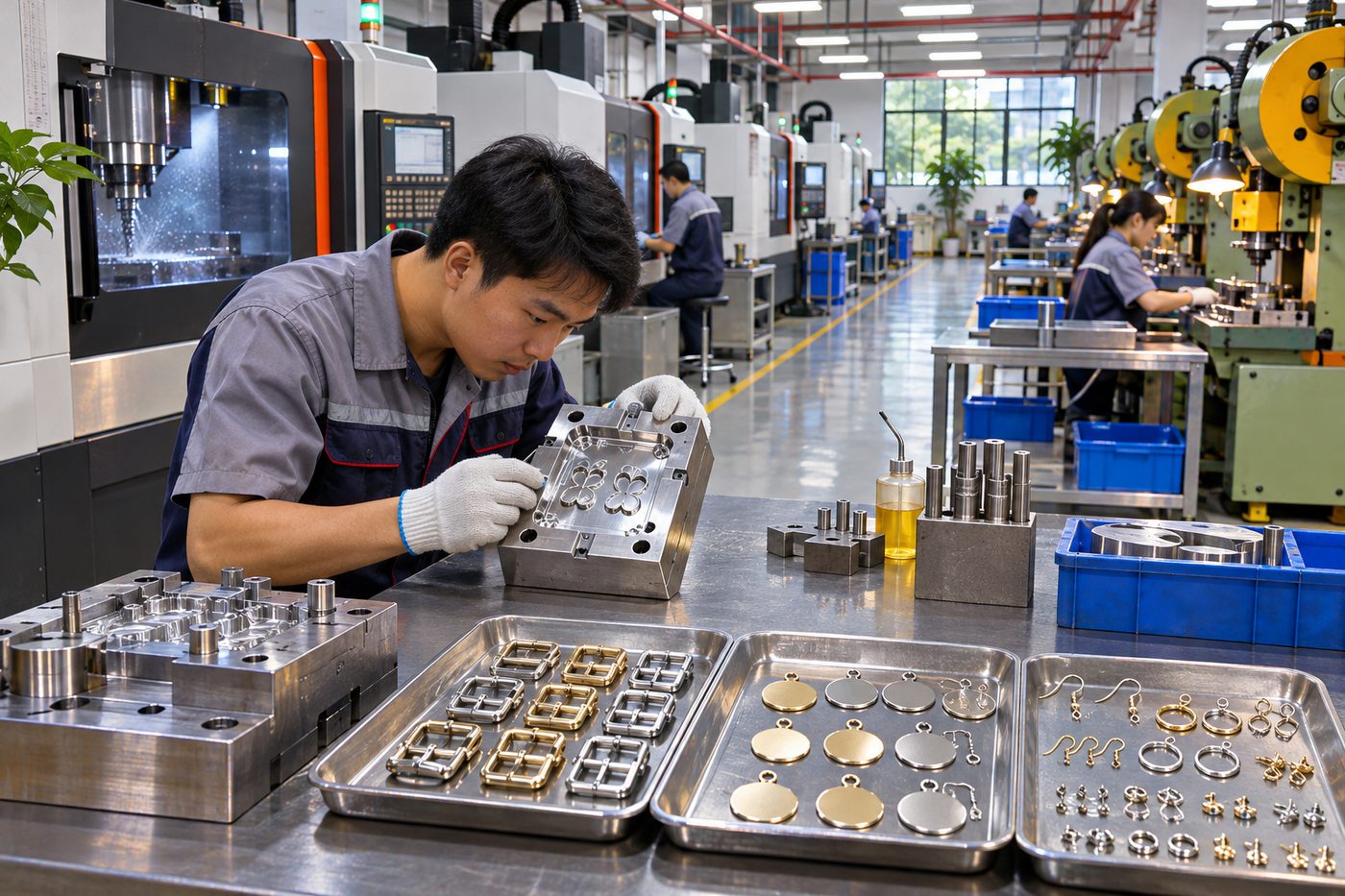
- Book factory visits to see samples and processes first: bring your drawings and the materials and colors you want, and ask the factory to explain which processes tooling, stamping, polishing and surface finishing involve and how long each takes.
- Findings and components stalls: according to the association, Chang'an has nearly 1,000 findings and components stalls, handy for comparing the styles and prices of ear hooks, clasps, chains and other components during sampling.
- Chang'an Fashion Jewelry Festival: held since 2023; the 3rd edition in 2025 opened on September 19, ran for 3 days and had 135 booths. This page found no dates for 2026 or later; follow the organizer's announcements.
- China (Chang'an) Machinery, Hardware & Mold Exhibition: founded in 2001; the 26th edition in 2026 closed in late October and is useful for learning about molds and processing equipment. This page found no dates for 2027; follow the organizer's announcements.
The cost and method of the domestic leg within China, from the Chang'an factory to the HowBridge Shenzhen warehouse, are agreed between you and the factory. Once the goods arrive at the Shenzhen warehouse, HowBridge consolidates them and ships them to Taiwan according to its consolidated shipping process.
How is freight calculated for shipping jewelry to Taiwan?
Jewelry is small and light, so freight is usually low. HowBridge sea express costs NT$50 per unit; the number of units is the greater of the actual weight (kg) and the volumetric weight (length × width × height in cm ÷ 10,000), rounded up, and a NT$100 surcharge applies if the actual weight is under 10 kg. Air freight counts actual weight only, at NT$100 per kg, with a NT$120 surcharge if the actual weight is under 10 kg. Based on calculations on 2026-11-03:
| Parcel | Weight and size | Sea express | Air freight |
|---|---|---|---|
| Small sample parcel | 0.5 kg | About NT$150 | About NT$220 |
| A box of about 200 pairs of earrings | 2 kg, 30 × 20 × 15 cm | About NT$200 | About NT$320 |
| A small-batch box | 8 kg, 40 × 30 × 30 cm | About NT$500 | About NT$920 |
- Tax estimate 1: for base-metal earrings worth CNY 3,000 (7117.19) shipped as 2 kg via sea express, the estimated dutiable value is about NT$14,891, duty is 0%, and business tax (VAT) is about NT$745.
- Tax estimate 2: for zinc alloy bag buckles also worth CNY 3,000 (8308.90.10) shipped as 8 kg via sea express, duty at 6.8% is about NT$1,033, plus business tax (VAT) of about NT$811, for a total of about NT$1,844. For the rates on bag and garment hardware, see tariff codes.
- Small sample parcels count too: shipments with a dutiable value of NT$2,000 or less are duty-free, but this no longer applies from the 7th import in each half-year (January to June, July to December) by the same taxpayer (Customs Act Article 49 and the Ministry of Finance rule on frequent imports).
The above is based on HowBridge's freight and tax calculations on 2026-11-03 (the same calculation as the freight calculator), using the customs ten-day exchange rate in effect at the time. Sea express rates fluctuate; actual charges follow the bill issued after measurement at the warehouse and the amount assessed by customs. Real gold, real silver and gemstone jewelry cannot use the ordinary shipping method above; see tariff codes.
As a designer running your own brand, what are you responsible for?
The most common pitfall when starting your own brand is "assuming someone else will take care of it". The table below spells out who is responsible for each stage:
| Stage | Who is responsible | Details |
|---|---|---|
| Drawings, materials and component specs | Designer | Turn size, weight, material, surface finish color, components (ear posts, ear hooks, clasps, chain length) and packaging into drawings and specs the factory can understand. |
| Choosing factories, negotiating, paying | Designer | Negotiate tooling, sampling and production terms directly with Chang'an factories; you pay the factory directly. |
| Sampling and approval | Designer + factory | Check size, weight, edges and corners, plating color variation, and whether ear posts and clasps are secure, then decide whether to go into production. |
| Material and safety testing | Designer | Ask the factory for material data and, if necessary, send items to a third-party lab yourself to test nickel release and lead and cadmium content. |
| Small-batch production | Factory | Produced according to the approved sample. |
| Shipping to the Shenzhen warehouse | Arranged by the factory or the designer | Shipping within China is agreed between you and the factory. |
| Mainland China → Taiwan consolidated shipping | HowBridge | Receiving at the Shenzhen warehouse, consolidating and shipping to Taiwan (sea express, air freight). |
| Customs declaration | Partner customs broker | HowBridge is not a customs broker; customs clearance is handled by partner customs brokers. You must provide truthful product names, materials, quantities and prices. |
| Storage and shipping to customers | Designer (HowBridge single-item fulfillment from Taoyuan is planned) | For now you arrange this yourself; HowBridge plans to offer single-item fulfillment from its Taoyuan warehouse. |
| Website, payments, systems | Designer (HowBridge website building is planned) | For now you set these up yourself; HowBridge plans to offer website building and an order system. |
| Brand, marketing, customer service, returns | Designer | You are the seller, so customer service and returns for consumers are your responsibility. |
What is the process from design drawing to a buyer in Taiwan?
Here is the usual order; finish each step before moving on to the next:

1Prepare drawings and material specs
Clearly state the size, weight, material, surface finish color, components and packaging. The materials should be expressible in the Chinese names used on Taiwan labels (see labeling).
2Find a factory in Chang'an for tooling and sampling
Bring your drawings to Chang'an to see factories and samples, and discuss tooling and sampling terms and costs; tooling fees, sampling fees and minimum order quantities follow each factory's quote. Tooling fees you pay the factory separately, or components you buy yourself and supply to the factory, must be reasonably apportioned and included in the dutiable value when declaring, under Article 29 of the Customs Act.
3Approve samples, test, then produce a small batch
Check the size, weight, plating color, ear posts and clasps, and test by actually wearing the pieces; send them to a third-party lab when needed. Place a small-batch order once everything checks out.
4Ship to the HowBridge Shenzhen warehouse
Ask the factory to send the goods to the HowBridge Shenzhen warehouse, and create a consolidated shipping order in the member center, filling in truthful product names, materials, quantities and prices.
5Consolidate, ship to Taiwan and clear customs
Base-metal jewelry can go via sea express or air freight, with customs declaration by a partner customs broker; you import in a company's or an individual's name, depending on how you run your business. Under HowBridge operating rules, real gold, real silver and gemstone jewelry can only go through formal customs declaration and must first be covered by an insurance company; if it is lost or damaged in transit, HowBridge accepts no liability and pays no compensation in any case, and you ship only if you agree to these conditions (see tariff codes). You can estimate freight first with the freight calculator.
6Label, list and ship
Before selling in Taiwan, label the origin, materials, date of manufacture and other required items as the rules require; small pieces such as earrings can be labeled on hang tags or packaging bags. After listing, handle shipping, customer service and returns.
What does HowBridge offer, and what is still being planned?
Services you can use now and services still being planned are listed separately:
| Service | Status | Details |
|---|---|---|
| Receiving at the Shenzhen warehouse | Available now | Goods from Chang'an factories can be sent to the HowBridge Shenzhen warehouse. |
| Mainland China → Taiwan consolidated shipping | Available now | Sea express (NT$50 per unit) or air freight. Rates follow the freight calculator and the bill issued after measurement at the warehouse. |
| Customs declaration | Available now | Through partner customs brokers; HowBridge is not a customs broker. |
| Single-item fulfillment from Taoyuan | Planned (not yet available) | The plan is to store designers' inventory at the Taoyuan warehouse and ship orders item by item. |
| Website building | Planned (not yet available) | The plan is to build brand websites for designers. |
| Order and inventory system | Planned (not yet available) | The plan is to connect website orders, inventory and shipping. |
What HowBridge does not do
No purchasing on your behalf, no paying factories for you, no tax-inclusive shipping, no guaranteeing factories' quality, no sending items for testing on your behalf, no relabeling or issuing certificates of origin, and no routes other than mainland China → Taiwan. Under HowBridge operating rules, real gold, real silver and gemstone jewelry can only go through formal customs declaration and must first be covered by an insurance company; if it is lost or damaged in transit, HowBridge accepts no liability and pays no compensation in any case, and you ship only if you agree to these conditions. Gold-plated, gold-filled, base-metal imitation jewelry and crystal fashion jewelry are not subject to this rule.
There is no confirmed launch date yet. When they open, HowBridge will notify registered designers first.
Can jewelry be imported from mainland China into Taiwan, and how much tax do you pay?
Yes. Earrings, necklaces, bracelets, rings and brooches made of base metals such as alloys, brass, stainless steel and titanium fall under 7117.19.00.00-5, "other imitation jewelry of base metal, whether or not plated with precious metal": column 1 duty is 0%, the import regulations field is blank, and the code is not on the International Trade Administration, Ministry of Economic Affairs (Taiwan) lists of "mainland Chinese goods not permitted for import (MW0)" or "conditionally permitted for import (MP1)" (checked against the lists downloaded on 2026-11-03). Business tax (VAT) of 5% and a trade promotion service fee of 0.04% (waived if under NT$100) are added. However, hardware for bags and garments is not 0%, and rivets and most screw-type codes are even MW0. The codes in the table below are classified by material and use; customs' assessment is final:
| Item | Tariff code | Duty | Import regulations |
|---|---|---|---|
| Base-metal earrings, necklaces, bracelets, rings, brooches (including gold- or silver-plated) | 7117.19.00.00-5 | 0% | None listed |
| Base-metal cufflinks and dress studs | 7117.11.00.00-3 | 0% | None listed |
| Imitation jewelry of other materials (e.g. leather cord mixed with glass beads) | 7117.90.00.00-7 | 0% | None listed |
| Gold-filled jewelry (precious metal mechanically clad) | 7113.20.00.00-6 | 0% | None listed |
| Silver jewelry (including 925 silver and alloys containing 2% or more silver) | 7113.11.00.00-7 | 0% | None listed (HowBridge operating rules: formal customs declaration only) |
| Gold, karat gold and platinum jewelry | 7113.19.00.00-9 | 0% | None listed (HowBridge operating rules: formal customs declaration only) |
| Bag buckles, belt buckles, clasps | 8308.90.10.00-2 | 6.8% | None listed |
| Hooks, eyes, eyelets | 8308.10.00.00-1 | 10% | None listed |
| Snap fasteners, press studs | 9606.10.00.00-8 | 5% | None listed |
| Base-metal buttons | 9606.22.00.00-4 | 5% | None listed |
| Zipper pullers (zipper parts) | 9607.20.00.00-5 | 2.5% | None listed |
| Zinc alloy charms, key rings (per an advance tariff ruling case) | 7907.00.90.00-1 | 2.5% | None listed |
| Tubular or bifurcated rivets | 8308.20.00.00-9 | 10% | MW0 |
| Iron or steel rivets, wood screws, self-tapping screws, nuts, washers | 7318.23.00.00-6, etc. | 5% | MW0 (7318.15.90, other iron or steel screws and bolts, is MP1 and open only to cast iron) |
Real gold, real silver and gemstone jewelry: formal customs declaration only
Under HowBridge operating rules, real gold, real silver, precious-metal jewelry and gemstone or pearl jewelry can only go through formal customs declaration, not simplified declaration, and must first be covered by an insurance company; if it is lost or damaged in transit, HowBridge accepts no liability and pays no compensation in any case, and you ship only if you agree to these conditions. Gold-plated, gold-filled, base-metal imitation jewelry and crystal fashion jewelry are not subject to this rule. Pure gold jewelry is exempt from business tax (VAT), while karat gold and silver jewelry are taxed at 5%. Under the Chapter 71 notes of the tariff, an alloy in which any precious metal makes up 2% or more by weight counts as a precious-metal alloy, so "Tibetan silver" containing 2% or more silver also falls under 7113.11; ask the factory for the material composition before ordering.
Rivets and most screws are MW0: attach them to finished products in Dongguan
MW0 means "mainland Chinese goods not permitted for import". For small imports of mainland Chinese goods in tariff Chapters 25 to 97, if the whole customs declaration is within CIF NT$32,000 and each item is within 24 pieces (within 40 kg for goods not counted by piece), an import permit is waived; however, items cannot be split by size or color to fit the limits, electric motorcycles, electric bicycles and the like are excluded, and other import regulations such as inspection must still be met. When building your brand, we recommend attaching rivets and screws directly to the finished bags or leather goods in Dongguan, rather than bringing bulk loose rivets back to Taiwan.
Children's jewelry may be classified as toys
Under BSMI's Principles for Determining Toy Products, any product designed, sold or labeled for play by children aged 14 or under is a toy, and imitation plastic necklaces are dress-up toys; jewelry necklaces that are decorative, made for adults or highly refined are not toys. Children's imitation jewelry must pass inspection under CNS 4797 before it can be sold. For the first batch, we recommend making adult jewelry only and not aiming copy or packaging at children.
Rhinestones are fine; check first before setting synthetic gemstones
The definition of imitation jewelry excludes natural, synthetic or reconstructed gemstones. Base metal set with glass rhinestones remains under 7117; styles set with synthetic gemstones may instead be classified under 7116.20 (also 0% duty). This page found no view from Taiwan customs on how cubic zirconia (CZ) is classified, so we recommend applying to customs for an advance tariff ruling before mass production (Customs Act Article 21). For styles set with natural or synthetic gemstones, please ask customer service first whether HowBridge's operating rules for real gold, silver and gemstone jewelry apply (formal customs declaration only; must first be covered by an insurance company).
According to import statistics from the Customs Administration, Ministry of Finance for ROC year 114 (2025), the top 20 source countries for the three 7117 tariff codes totaled about 1,169 tonnes, of which mainland China accounted for about 1,083 tonnes, or about 92.6%; for the three 7113 precious-metal jewelry codes, the total was about 42.6 tonnes, with mainland China accounting for about 35.2% (compiled by HowBridge from the weights of the top 20 source countries for each code; whether the statistics include express shipments under simplified declaration is unconfirmed).
How should jewelry be labeled for sale in Taiwan?
If you import goods yourself and sell them in Taiwan, you are the party obliged to label them (the importer) under Article 5 of the Commodity Labeling Act. Jewelry has no dedicated labeling standard, so the Commodity Labeling Act itself applies. Before going to market, note the following:
- Label the origin truthfully: jewelry produced in Chang'an has mainland China as its origin. Completing the design in Taiwan does not make Taiwan the origin; stringing, attaching ear hooks, assembly, boxing or labeling done only after arrival in Taiwan does not constitute substantial transformation under Article 7, Paragraph 3, Subparagraphs 2 and 4 of the Rules of Origin for Imported Goods. Do not label the goods as, or use copy implying, MADE IN TAIWAN.
- Import documents must state the origin: under Article 11 of the Regulations Governing Trade between the Taiwan Area and the Mainland Area, import documents for permitted mainland Chinese goods must state "Made in mainland China" (in Chinese) or equivalent wording in a foreign language.
- Required label items: under Article 6, the label must show the product name, the importer's name, address and service phone number, the origin, the main ingredients or materials (e.g. "316L stainless steel", "gold-plated brass"), the quantity or measurement, and the month and year or the year and week of manufacture; imported goods must also show the foreign manufacturer's name in its original language.
- Small items can be labeled on hang tags or packaging bags: labels must be on the product itself, its inner or outer packaging or its instructions; for products too small to label, such as earrings, hang tags, packaging bags or other means sufficiently noticeable to consumers can be used instead (Article 10). The text should be mainly in Chinese (Article 11). Online product pages cannot replace physical labels. Failure to label as required leads to an order to correct within a deadline, and failing to correct by the deadline incurs a fine of NT$20,000 to NT$200,000 (Article 17).
- Karat gold and silver jewelry must be labeled too: the Ministry of Economic Affairs announcement of 2023-11-09 exempting gold jewelry from labeling under the Commodity Labeling Act covers only gold bars, gold ingots, gold sheets, gold coins and pure gold jewelry; karat gold, silver, gold-plated and base-metal jewelry must all be labeled.
- Don't use other people's trademarks: unauthorized fasteners or logo hardware that counterfeit others' trademarks can, on import, be fined up to 3 times the value of the goods and confiscated under Article 39-1 of the Customs Anti-Smuggling Act.
Labeling goods made in mainland China as made in Taiwan, or gold-plated items as pure gold, may violate Article 255 of the Criminal Code (false marking), as well as the Commodity Labeling Act and the Fair Trade Act. For detailed penalties, see origin washing enforcement and penalties.
How should you handle returns when selling jewelry online?
If you sell on a website or a platform, you are a business operator under the Consumer Protection Act. Ordinary in-stock jewelry is not excluded from the 7-day right of withdrawal:
- No-reason returns within seven days: consumers may return the product or give written notice of cancellation within 7 days of receiving it, without giving a reason or bearing any cost (Consumer Protection Act Article 19), and a "jewelry is non-returnable once sold" term is void.
- Tell buyers how to cancel up front: if cancellation information was not provided at delivery, the 7 days start from the day after the information is supplied; however, the right of withdrawal expires once more than 4 months have passed since the original 7-day period began.
- Collect within 15 days, refund within 15 days: the product must be collected within 15 days from the day after the written notice of cancellation is received; the refund must be made within 15 days from the day after the product is collected or the consumer's returned product is received (Consumer Protection Act Article 19-2).
- Opening the package to inspect doesn't affect returns: changes caused by necessary inspection do not extinguish the consumer's right of withdrawal (Enforcement Rules of the Consumer Protection Act, Article 17).
- Engraving is a customization exception: jewelry engraved with text specified by the customer is close to the "seals engraved according to the consumer's instructions" described in the explanation of the Guidelines on Reasonable Exceptions to the Right of Withdrawal in Distance Sales, so you can argue it falls under the customization exception; pieces picked from existing styles, colors or sizes do not count. All exceptions must be disclosed to consumers in advance.
- Earrings can't be made non-returnable across the board: "opened personal hygiene products" are also an exception, but a 2016 letter from the Department of Consumer Protection, Executive Yuan, says whether earrings qualify must be decided case by case; both conditions, "opened" and "personal hygiene product", must be met, and disputes are ultimately decided by the courts. If you want pierced-ear earrings to fall under this exception, we recommend at least sealed packaging and telling customers in advance, and an individual case may still be found ineligible.
Jewelry is small, so the logistics cost of returns and exchanges is lower than for large items. We recommend stating the size, weight, material and care instructions clearly on product pages, and keeping your inventory in Taiwan so that exchanges and returns don't have to cross borders again.
What could a designer jewelry brand look like?
Below is HowBridge's sample "Majolica Tile Series", inspired by the majolica floor tiles of old Taiwanese houses; all three pieces use the same four-petal motif to build recognition. The images are AI-simulated, not actual production samples:
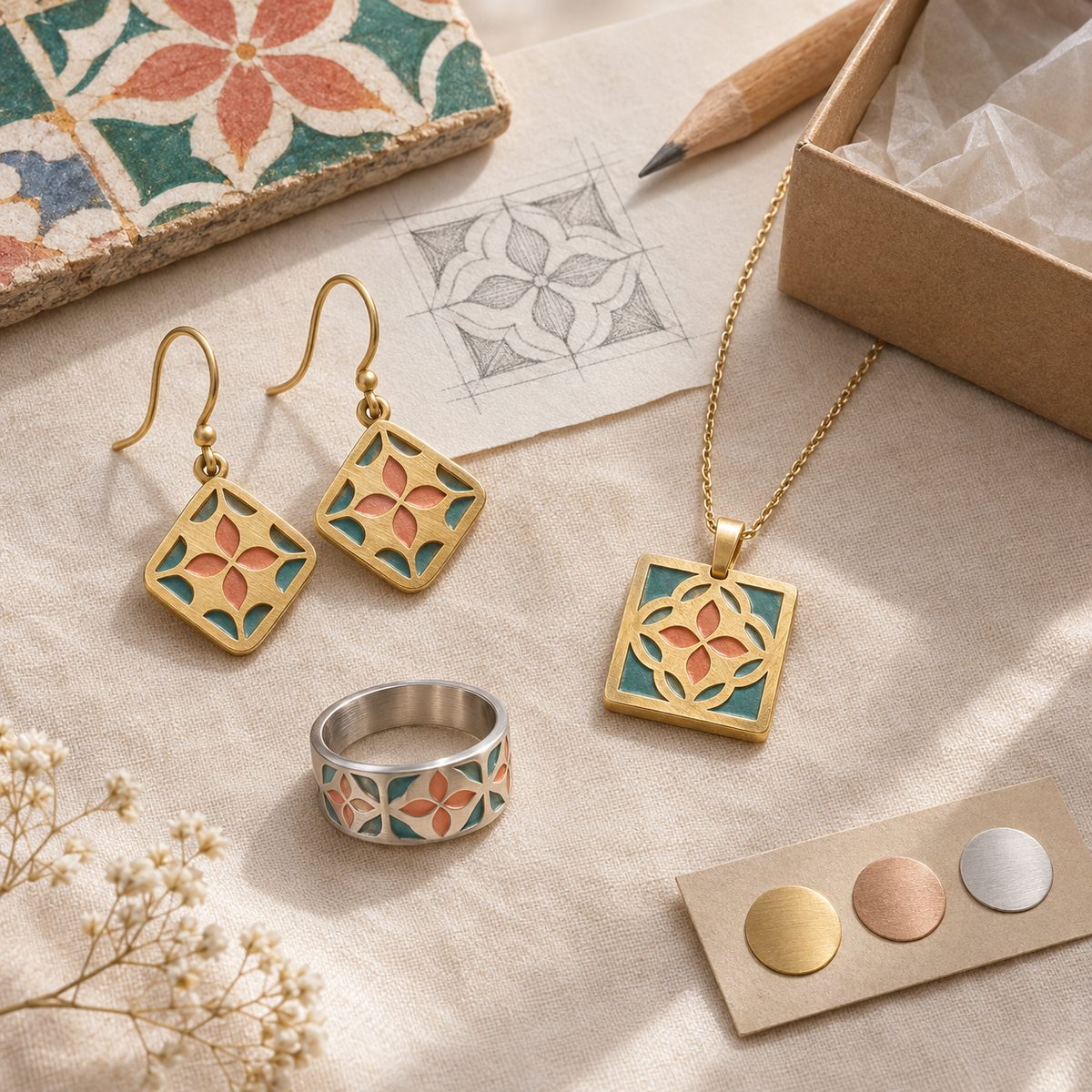
Earrings · Tile Cut-out
Gold square drop earrings with the tile's four-petal flower as a cut-out pattern, the petals and four corners filled with coral red and teal; the ear hooks are separate from the body, and the durability of the fill material must be confirmed before mass production.
Necklace · Tile Square Pendant
The same motif made into a square pendant on a fine chain, displayed as a set with the earrings.
Ring · Engraved Tile Band
A wide steel-toned band with the tile motif running all the way around; a raw stainless steel version can skip a plating step.
Who can register, and how?
The first round is open to Taiwan designers and small studios who have their own jewelry or metal component designs and want to sell under their own brand.
1Add the HowBridge LINE official account
Tap Register on LINE to add the HowBridge official account.
2Send the keyword「飾品設計師招募」(Jewelry designer recruitment) and a link to your work
Include your portfolio or brand link and briefly describe the items you want to make (e.g. earrings, necklaces, bag charms), the materials and the estimated quantities.
3Wait for customer service to contact you
HowBridge customer service will then contact you to explain the consolidated shipping process and the progress of the planned services.
Looking for a purchasing agent, wanting HowBridge to pay factories for you or provide tax-inclusive shipping, wanting goods sent anywhere other than Taiwan, wanting to label goods made in mainland China as made in Taiwan, or using counterfeits of other people's trademarks are all outside the scope of this recruitment.
What does research say about jewelry clusters, sampling and nickel allergy?
The studies below provide background; none of them is about HowBridge, Chang'an or any specific factory, and they cannot be used to predict outcomes for individual designers:
- Dongguan factories are upgrading, not just competing on labor costs: Sharif and Huang (2019) studied Dongguan's "Replacing Humans with Robots" policy, which uses incentives to encourage factories to adopt CNC machines and robots, and observed process, product and functional upgrading in the factories studied; Murphree and Breznitz (2020) found that Dongguan's trust-based collaborative spaces enabled foreign investment to drive local upgrading and brought new local suppliers and buyers into global value chains.
- Jewelry manufacturing has long clustered in Guangdong: Hsu et al. (2014) note that most of China's jewelry manufacturing is in Guangdong, with more than 2,000 companies in Shenzhen, citing a 2012 report that estimated this at over 70% of China's jewelry output, and that rising wages have been met with technology and a move upmarket; Liao (2009) quantified the agglomeration of Taiwanese-invested electronics factories in Dongguan and found specific distribution patterns across towns, partly related to supply links between firms.
- Even among jewelry clusters, outcomes can differ greatly: De Marchi, Lee and Gereffi (2014) compared three Italian gold jewelry clusters, Valenza, Arezzo and Vicenza, and found clearly different internationalization strategies in response to global competition and the 2008–2009 recession; Martinelli (2018), citing Zollo et al.'s study of Arezzo, notes that most small and medium-sized enterprises brought 3D printing into their own production, and also cites other studies noting that new roles such as designers emerged as a result.
- From wax models to 3D printing, sampling methods are changing: Pattnaik et al. (2012) reviewed lost-wax casting, noting that wax pattern properties and wax injection parameters affect surface finish and dimensional accuracy, and that rapid prototyping is already used in casting; Cooper (2016) argues that metal 3D printing can now be used in practice in the jewelry industry, and that both the design and manufacturing sides need to understand the changes it brings early on.
- Nickel allergy is still common, and in markets without nickel regulations, fashion jewelry often releases nickel: Ahlström et al. (2017) reviewed 46 European studies and found that after the EU Nickel Directive took effect, the prevalence of nickel allergy among women aged 18–35 was lower than before (11.4% vs 19.8%), but it remains 8–18% in the general population; Boonchai et al. (2015) tested 551 fashion jewelry items supplied by volunteers in Thailand and found 39.2% positive in nickel tests.
What common terms are used in jewelry production?
- Base metal
- Metals other than precious metals (gold, silver, platinum, etc.), such as iron and steel, copper, zinc, aluminum, nickel and titanium; stainless steel and brass jewelry are both base-metal jewelry.
- Imitation jewelry
- A tariff term for fashion jewelry made of base metal or other materials (heading 7117), whether or not plated with precious metal.
- 316L stainless steel
- A low-carbon austenitic stainless steel and a material commonly used for Chang'an jewelry; it contains nickel itself, so low-allergy claims still require actual nickel release testing.
- Electroplating
- Depositing a layer of metal on the surface by electrolysis, such as gold, silver or rhodium plating; it does not change the jewelry's base-metal classification.
- Gold-filled / rolled gold
- Precious metal clad onto a base-metal surface by mechanical methods such as soldering or hot rolling; classified under tariff code 7113.20, unlike electroplating.
- Tooling / mold making
- Making a dedicated mold for mass production; tooling fees follow each factory's quote, and tooling fees you pay separately must be reasonably apportioned and included in the dutiable value.
- Stamping
- Pressing sheet metal into shape with a die and a press; suited to mass-producing flat or shallow-relief parts.
- Lost-wax casting
- A casting method in which a wax model is made and invested in a mold, the wax is melted out, and metal is poured in; suited to three-dimensional shapes.
- Sampling / sample making
- Samples made before mass production to confirm size, weight, surface finish and components.
- Nickel release
- The amount of nickel released when jewelry is in contact with the skin; the EU sets limits in µg/cm²/week, and it is the main risk indicator for nickel allergy.
- Volumetric weight
- A weight calculated from the parcel's volume; HowBridge sea express uses length × width × height (cm) ÷ 10,000 and takes the greater of this and the actual weight; air freight counts actual weight only.
- Tariff code (HS/CCC code)
- The classification code for imported goods; base-metal jewelry is in heading 7117 of Chapter 71, precious-metal jewelry in heading 7113, and bag hardware mostly in headings 8308, 9606 and 9607.
- MW0
- An import regulation code of the International Trade Administration meaning "mainland Chinese goods not permitted for import". For small imports of mainland Chinese goods in tariff Chapters 25 to 97, if the whole customs declaration is within CIF NT$32,000 and each item is within 24 pieces (within 40 kg for goods not counted by piece), an import permit is waived; however, items cannot be split by size or color to fit the limits. Electric motorcycles, electric bicycles and their controllers are excluded, and other import regulations such as inspection must still be met.
- C02
- An import regulation code meaning that some goods under the tariff code are subject to mandatory BSMI inspection; not every item has to be inspected.
- Advance tariff ruling
- A procedure for asking customs to confirm the tariff code before import (Customs Act Article 21), suited to new products whose classification is uncertain.
- Single-item fulfillment
- The seller stores inventory at a warehouse, which ships each order item by item to buyers as orders come in (dropshipping from the warehouse); HowBridge single-item fulfillment from Taoyuan is currently planned and not yet available.
What are the sources and the scope of verification?
The sources below were consulted on 2026-11-03; document dates and access dates are shown separately, and no date is supplied where a source does not state one.
Government, official, official-media and statistical sources
- Dongguan Municipal People's Government: Chang'an Town profile | Document date: 2026-03-31; Chang'an Town lies at the southern end of Dongguan, bordering Shenzhen to the east, with an area of 79.69 km² and a resident population of 815,000; 2025 GDP of CNY 110,670,000,000 (up 5.4% year on year) and 1,170 above-designated-size industrial enterprises; officially positioned as "a major town for China's electronic information industry" and "China's Famous Town of Machinery, Hardware and Molds", with listed companies including OPPO and vivo.
- Chang'an Town People's Government, Dongguan: 2025 Government Work Report | Document date: 2025-03-06; 2024 GDP of CNY 105,070,000,000; output of above-designated-size machinery, hardware and mold enterprises CNY 47,370,000,000 (up 12.1% year on year), 14.7% of the town's total industrial output; the 2nd Chang'an Fashion Jewelry Festival and Cross-border E-commerce Trade Fair was held in 2024, with the 3rd edition to follow in 2025.
- Southern Daily (via Sina): Chang'an Town receives the plaque for the title "China's Famous Town of Machinery, Hardware and Molds" | Document date: 2005-09-15; the China Machinery Industry Federation presented the "China's Famous Town of Machinery, Hardware and Molds" plaque in Chang'an on September 14, 2005.
- Jiemian News: report on the hardware and mold industry in Chang'an Town, Dongguan | Document date: 2025-01-16; Chang'an has more than 1,600 hardware and mold manufacturers and 5 specialized hardware and mold markets with a total area of more than 500,000 square meters (the report says "data show" without citing the original source).
- Information Times (via East Money): the 26th China (Chang'an) Machinery, Hardware & Mold Exhibition closes | Document date: 2026-10-30; the exhibition was founded in 2001; its 26th edition in 2026 ran for 4 days with more than 50,000 square meters of exhibition space and 459 exhibitors; from January 1 to September 30, 2026, the output of Chang'an's above-designated-size machinery, hardware and mold enterprises was CNY 39,300,000,000 (up 12.3% year on year).
- Southern Metropolis Daily (page GA07): "Nine in ten of the world's stainless steel jewelry pieces are made in Chang'an, Dongguan" | Document date: 2023-05-22; Chang'an's metal jewelry industry began in the early 1980s in Jinxia Community, with Hong Kong and Taiwanese businesspeople as the first investors; the Dongguan Hardware Jewelry Industry Association was founded in Chang'an in July 2016; the report quotes the association's president: contract manufacturing adds very little value, orders from Europe and the US are falling, and companies are being guided from exports toward the domestic Chinese market.
- Timedg (Dongguan Time Network, Dongguan Newspaper Media Group): report on the first Chang'an Fashion Jewelry Festival | Document date: 2023-03-24; in earlier years, metal jewelry was mostly made of zinc alloy, copper and silver, and around 2000 medical-grade stainless steel came into wide use for jewelry; Chang'an's 3C electronics and hardware and mold industry chains can share processing techniques; according to the association, more than 1,000 finished-product factories share the capacity of more than 4,000 process subcontractors, and there are more than 1,000 findings and components stalls.
- Guangzhou Daily (page DGA9): the 3rd Chang'an International Fashion Jewelry Festival opens | Document date: 2025-09-19; the 3rd Chang'an International Fashion Jewelry Festival ran for three days with 135 booths; the report says Chang'an has more than 8,000 stainless steel jewelry manufacturers and shops and about 100,000 workers, with more than 80% of products exported.
- Hong Kong Commercial Daily: report on the stainless steel jewelry industry in Chang'an, Dongguan | Document date: 2026-09-23; the report mainly quotes the president of the Dongguan Hardware Jewelry Industry Association: the town has more than 7,000 metal jewelry factories, including more than 5,000 stainless steel jewelry factories; "9 out of every 10 stainless steel jewelry pieces in the world come from Chang'an"; a new product can go through the entire production process in as little as 48 hours; about 900 findings and components stalls. All of the above are the association's claims.
- Chang'an Town official WeChat account (via Dongguan Sunshine Network): clean-up of the Chang'an electroplating industrial base | Document date: 2020-05-13; the Chang'an electroplating industrial base is one of the 4 designated bases for the electroplating and dyeing industries set up by Dongguan; in 2020, its Zone B had 4 metal electroplating companies whose products included optical fiber modules, metal jewelry, phone case accessories and watch cases.
- China Light Industry Network (via Southcn.com): report on Chang'an's stainless steel jewelry industry | Document date: 2018-02-09; the report quotes the association's president: most stainless steel jewelry manufacturers are small factories with relatively weak resilience to risk.
- UN Comtrade: HS 7117 imitation jewelry exports (2023, 2024, 2025; partner = World) | Document date: not stated; compiled by HowBridge from a query on 2026-11-03: China exported USD 4,650,000,000 in 2023 (46.9% of the reporting-country total of USD 9,910,000,000) and USD 4,510,000,000 in 2024 (45.8% of USD 9,860,000,000), ranking No. 1 in both years; USD 3,340,000,000 in 2025, down 25.9% from 2024 (some countries had not yet reported for 2025). The denominator for shares is the total of countries reporting in that year; Hong Kong figures include re-exports and are not broken out.
- UN Comtrade: HS 711719 base-metal imitation jewelry export value and net weight (2023) | Document date: not stated; HowBridge estimated the price per kilogram by dividing export value by net weight: China about USD 28, Italy about USD 114, Germany about USD 216, Thailand about USD 269 (some net weights are Comtrade estimates; for order-of-magnitude reference only).
- UN Comtrade: HS 7113 precious-metal jewelry exports (2023) | Document date: not stated; in 2023: UAE USD 14,620,000,000, China USD 14,350,000,000 (about 10%, No. 2), Switzerland USD 13,870,000,000, France USD 13,750,000,000, India USD 12,720,000,000; many countries are near the top, with small gaps between them.
- China News Service: report on the gold and jewelry industry in Shuibei, Shenzhen | Document date: 2024-06-17; the one-square-kilometer core area of the Shuibei gold market hosts more than 10,000 gold and jewelry companies, and more than half of the gold in China's domestic wholesale market is wholesaled from Shuibei (the report says "official data show").
- Yicai: report on the jewelry industry in Panyu, Guangzhou | Document date: 2021-08-21; Panyu's gold and silver jewelry processing accounts for about 70% or more of Hong Kong's re-export trade volume and 30% of the global market share (figures from the report; relatively old data).
- Zhejiang News (Zhejiang Daily): report on Yiwu's jewelry industry | Document date: 2026-04-27; Yiwu has nearly 10,000 jewelry companies and more than 3,000 production factories, with annual output of more than CNY 100,000,000,000 (the report says "according to briefings").
- IMARC Group: Costume Jewelry Market report summary | Document date: not stated; the market research firm estimates the global fashion jewelry market at about USD 39,300,000,000 in 2025.
- Market Glass, Inc. (listed on MarketResearch.com): Costume Jewelry report summary | Document date: 2026-10-01; the market research firm estimates the global fashion jewelry market at about USD 32,400,000,000 in 2025, about 20% apart from IMARC's estimate.
- EUR-Lex: Commission Regulation (EC) No 552/2009 (REACH Annex XVII, entry 27, nickel) | Document date: 2009-06-26; post assemblies inserted into pierced ears and other pierced parts of the body must release less than 0.2 µg/cm²/week of nickel; parts in prolonged contact with the skin, such as earrings, necklaces, bracelets, rings, rivet buttons on clothing, zippers and metal tags, must not exceed 0.5 µg/cm²/week. The current version follows the EU's latest publications.
- EUR-Lex: Commission Regulation (EU) No 836/2012 (REACH Annex XVII, entry 63, lead) | Document date: 2012-09-19; jewelry in which any individual part contains 0.05% or more lead (by weight) may not be placed on the market.
- EUR-Lex: Commission Regulation (EU) No 494/2011 (REACH Annex XVII, entry 23, cadmium) | Document date: 2011-05-21; metal parts of jewelry and imitation jewelry containing 0.01% or more cadmium (by weight of the metal) may not be placed on the market.
- US Consumer Product Safety Commission (CPSC): Total Lead Content | Document date: not stated; accessible parts of children's products containing more than 100 ppm lead are banned hazardous substances (CPSIA).
- California Legislative Information: Health and Safety Code §25214.2 | Document date: not stated; adult metal jewelry in California must be made of listed materials, item 1 being "stainless or surgical steel"; electroplated and unplated metals must contain less than 0.05% lead.
- OpenStreetMap/OSRM public routing service: Chang'an Town Government to Fuhai Subdistrict (Bao'an District, Shenzhen), Houjie, Dalang and Songshan Lake | Document date: not stated; estimated by HowBridge on 2026-11-03 assuming free-flowing traffic (the link covers the Chang'an to Fuhai leg; the other results are archived in the research files): Chang'an to Fuhai Subdistrict about 19.8 km, 17 minutes; to the Guangdong Modern International Exhibition Center in Houjie about 21.7 km, 18 minutes; to Dalang about 29.4 km, 31 minutes; to Songshan Lake about 19.7 km, 21 minutes; excluding traffic congestion and toll stations.
- HowBridge freight calculator (same calculation as 0523.tw/c) | Document date: 2026-11-03; sea express NT$50 per unit, where the number of units is the greater of actual weight and volumetric weight (length × width × height in cm ÷ 10,000), rounded up, plus a NT$100 surcharge if the actual weight is under 10 kg; air freight counts actual weight only, at NT$100 per kg, plus a NT$120 surcharge if the actual weight is under 10 kg; sea LCL consolidation is quoted by customer service depending on the goods.
- Laws & Regulations Database: Commodity Labeling Act, Article 5 | Document date: 2022-05-18; the parties obliged to label are manufacturers, commissioning parties, importers or repackagers, who must complete labeling when the product enters the market; a designer who commissions factories in Chang'an, Dongguan to make samples and mass-produce, and imports and sells jewelry or metal components under their own brand, is an importer.
- Laws & Regulations Database: Commodity Labeling Act, Article 6 | Document date: 2022-05-18; labels must show the product name, the importer's name, address and service phone number, the origin, the main ingredients or materials (e.g. gold-plated brass, 316L stainless steel, titanium, zinc alloy), the quantity or measurement, and the month and year or the year and week of manufacture; Paragraph 2: imported goods must also show the foreign-language name of the foreign manufacturer or foreign commissioning party. Jewelry has no dedicated labeling standard, so this article applies.
- Laws & Regulations Database: Commodity Labeling Act, Article 7 | Document date: 2022-05-18; products that are hazardous, relate to hygiene and safety, or have special properties requiring special handling must be labeled with their uses, methods of use and storage, and other precautions; pierced-ear jewelry, jewelry with small parts, and jewelry whose plating is sensitive to sweat or perfume should come with precautions in Chinese.
- Laws & Regulations Database: Commodity Labeling Act, Articles 9 and 16 | Document date: 2022-05-18; labels must not be false or misleading; violators are ordered to correct within a deadline, and failing to correct by the deadline incurs a fine of NT$30,000 to NT$300,000, which may be imposed for each violation. Jewelry labeled "925", "18K" or "nickel-free" must be accurate.
- Laws & Regulations Database: Commodity Labeling Act, Articles 10, 11 and 17 | Document date: 2022-05-18; labels must be on the product itself, its inner or outer packaging, or its instructions; products that are too small, such as earrings, may instead use other conspicuous means sufficient to draw consumers' attention (e.g. hang tags, packaging bags); the text should be mainly in Chinese; failure to label as required leads to an order to correct within a deadline, and failing to correct by the deadline incurs a fine of NT$20,000 to NT$200,000.
- Ministry of Economic Affairs Announcement (Ref. Jing-Biao-Zi No. 11253500480): designating "publications and gold jewelry as specific goods exempt from labeling under the Commodity Labeling Act" | Document date: 2023-11-09; announced under Article 4 of the Commodity Labeling Act; "gold jewelry" here covers only gold bars, gold ingots, gold sheets, gold coins and pure gold jewelry or ornaments. Karat gold, silver, gold-plated and base-metal fashion jewelry are not exempt and must still be labeled under the Commodity Labeling Act.
- Bureau of Standards, Metrology and Inspection (BSMI): commodity labeling regulations (list) | Document date: not stated; 14 entries when consulted on 2026-11-03; specific labeling standards exist for clothing, textiles, footwear, toys, stationery, electrical and electronic products, cribs and others, but there is no dedicated labeling standard for jewelry or metal components.
- BSMI: Commodity Labeling Act FAQ (labeling of goods sold online) | Document date: not stated; for jewelry sold online, the physical product must still be labeled as required, and web page information cannot replace it.
- Laws & Regulations Database: Fair Trade Act, Articles 21 and 42 | Document date: 2017-06-14; businesses must not make false or misleading representations on products or in advertising about quality, content, origin, place of manufacture or other matters that may affect trading decisions; violators may be fined NT$50,000 to NT$25,000,000. Product pages stating "pure silver", "made in Taiwan" or "hypoallergenic" must be accurate.
- Laws & Regulations Database: Criminal Code of the Republic of China, Article 255 | Document date: 2026-07-22; anyone who, with intent to deceive others, falsely marks the country of origin or the quality of goods is punishable by imprisonment of up to one year, short-term detention or a fine of up to NT$30,000; the same applies to anyone who knowingly sells, displays or imports such goods from abroad. Labeling Dongguan-made jewelry as made in Taiwan, or gold-plated items as pure gold, carries this risk. (The date is the latest amendment date of the Criminal Code, not of this article.)
- Laws & Regulations Database: Rules of Origin for Imported Goods, Articles 5 and 7 | Document date: 2010-12-24; the origin is the country where the last substantial transformation took place; Article 7, Paragraph 3: mere sorting, repackaging, packing, marking or relabeling (Subparagraph 2), or simple joining, fitting or assembly (Subparagraph 4), does not constitute substantial transformation, so stringing beads, attaching ear hooks or boxing in Taiwan leaves the origin as mainland China.
- Laws & Regulations Database: Regulations Governing Trade between the Taiwan Area and the Mainland Area, Article 7 | Document date: 2024-02-19; goods from the mainland area may not be imported except in enumerated cases; rivet and screw-type hardware (8308.20, most 7318 codes, most 7415 codes, 7907.00.20) listed as MW0 is not permitted for import; 7318.15.90 and 7415.29.90 are MP1 and open only to the EX-listed items. Paragraph 1, Subparagraph 13 (special approval) is one of the legal bases for the announcement waiving import permits for small quantities of mainland goods.
- Laws & Regulations Database: Regulations Governing Trade between the Taiwan Area and the Mainland Area, Article 11 | Document date: 2024-02-19; import documents for permitted mainland goods must state "Made in mainland China" (in Chinese) or equivalent wording in a foreign language; this applies to jewelry and metal components produced in Chang'an, Dongguan.
- International Trade Administration commodity classification system: notes to the list of mainland goods conditionally permitted for import (general explanation) | Document date: not stated; MW0 in the import regulations means mainland goods not permitted for import, MP1 means conditionally permitted, and codes with neither are permitted for import; codes marked EX are open only to goods matching that description, for example 7616.10 aluminum rivets are open only to blind rivets, and 7415.29.90 only to copper hollow rivets.
- International Trade Administration commodity classification system: list of mainland goods not permitted for import (MW0), download | Document date: not stated; 2,515 entries when downloaded on 2026-11-03: no codes under 7113, 7117, 9606, 9607, 9615, 9113 or 8306; under 8308, only tubular or bifurcated rivets 8308.20; also listed are 7318 iron or steel screws, nuts, washers and rivets, 7415.10/7415.21/7415.29.10/7415.33 copper fasteners, 7907.00.20 zinc fasteners, 5807.90.10 non-woven labels and 5810 embroidery.
- International Trade Administration commodity classification system: list of mainland goods conditionally permitted for import (MP1), download | Document date: not stated; 864 entries when downloaded on 2026-11-03: none under 7113, 7117, 8308, 9606 or 9607; the hardware-related entries are EX items, such as 7318.15.90 (cast-iron bolts and nuts only), 7415.29.90 (copper hollow rivets only), 7616.10 (aluminum blind rivets only) and 8301.40 (including locks designed for luggage and bags).
- International Trade Administration Announcement (Ref. Jing-Mao-Zi No. 11104603570): rules waiving import permits for small quantities of mainland goods | Document date: 2022-08-19; for mainland industrial products in tariff Chapters 25 to 97 that are not on the "Restricted Import Goods List", if the whole customs declaration is within CIF NT$32,000 and each item is within 24 pieces (within 40 kg for goods not counted by piece), an import permit is waived and the goods are exempt from MXX rules; items may not be split by size, specification or color; other import regulations must still be met. MW0 rivets such as 8308.20 can be imported in small quantities without an import permit if these conditions are met; whether they can clear customs by simplified declaration, and other routes (such as special approval), should be checked with a partner customs broker first.
- International Trade Administration Announcement (Ref. Jing-Mao-Zi No. 11550200230): items excluded from the "rules waiving import permits for small quantities of mainland goods" | Document date: 2026-03-10; the exclusion list contains only electric two-wheeler controllers 8543.70.99.50-4, electric motorcycles 8711.60.10.00-9 and electric bicycles 8711.60.20.00-7; jewelry and bag or garment hardware are not on the exclusion list.
- Customs Administration, Ministry of Finance GC413 customs import tariff data (synced weekly to the HowBridge tariff database, queried 2026-11-03): codes 7117/7113/8308/9606/9607 and others | Document date: not stated; 7117.11, 7117.19, 7117.90 and 7113.11, 7113.19, 7113.20 all have 0% column 1 duty and no import regulations; 8308.10 is 10%, 8308.90.10/8308.90.20 are 6.8%, 9606.10/9606.22 are 5%, 9607.11 is 3.4%, 9607.20 is 2.5% (column 2 includes CN at 0%, which requires an ECFA certificate of origin), 9615.19 is 5% and 9113.20 is 1.2%; 8306.29 and 7326.90.90 are listed as C02.
- World Customs Organization (WCO) HS 2022: Chapter 71 notes (Notes 4, 5, 7, 9, 11) | Document date: 2022-01-01; Note 7: "clad with precious metal" means covered with precious metal by mechanical methods such as soldering or hot rolling (electroplating is excluded); Note 5: an alloy containing 2% or more of any precious metal is a precious-metal alloy; Note 9(a): jewelry includes earrings, brooches and badges; Note 11: imitation jewelry excludes synthetic gemstones, as well as 9606 buttons and 9615 hair slides. Taiwan's tariff follows the HS, and advance ruling 106CA0211 cites Note 9(a) to Chapter 71.
- World Customs Organization (WCO) HS 2022: Chapter 83 (heading 83.08) | Document date: 2022-01-01; heading 83.08 covers base-metal clasps, buckles, hooks, eyes and eyelets for clothing, footwear, jewelry, watches, leather goods and travel goods, as well as tubular or bifurcated rivets and base-metal beads and spangles; separately imported bag buckles and metal beads mostly fall under this heading (6.8% to 10%), and jewelry clasps and ear hooks may also fall under it rather than 0%. No advance ruling cases were found in Taiwan, so we recommend applying for an advance tariff ruling before mass production.
- World Customs Organization (WCO) HS 2022: Section XV notes (Notes 3, 7) | Document date: 2022-01-01; Note 3: base metals include iron and steel, copper, nickel, aluminum, zinc, tin, titanium and others, so stainless steel and titanium jewelry are both base-metal jewelry; Note 7: articles of two or more base metals are classified by the metal predominating by weight (e.g. a zinc alloy charm with an aluminum clasp ring is classified as an article of zinc).
- HowBridge tariff page 7117.19.00.00-5 (with advance tariff ruling cases from the Customs Administration, Ministry of Finance and ROC year 114 import sources) | Document date: not stated; rulings: a stainless steel bracelet (104CA0229, 2015-10-20), a lead-antimony-tin alloy ring (106AA0266, 2017-04-17) and an iron badge patch for necklaces (106CA0211, 2017-08-02) are all classified under 7117.19. In 2025, imports from mainland China were 957.33 tonnes, a 92.85% share.
- HowBridge tariff page 7117.90.00.00-7 (with advance tariff ruling cases from the Customs Administration, Ministry of Finance) | Document date: not stated; rulings: a necklace of sheepskin cord with stainless steel ends (104CA0252, 2015-11-17) and a waist chain of glass beads with metal and artificial gemstones (097CA0078, 2008-06-06) are classified under 7117.90; jewelry mixing leather cord, ceramics or glass beads mostly falls under this code, also at 0% duty. In 2025, mainland China accounted for 91.17%.
- HowBridge tariff page 7907.00.90.00-1 (with advance tariff ruling cases from the Customs Administration, Ministry of Finance) | Document date: not stated; ruling 103AA0427 (2014-05-30): a key ring with an aluminum clasp ring and a zinc alloy decorative charm, in which the zinc alloy weighs more than the aluminum ring, is classified under 7907.00.90 "other articles of zinc" (2.5%) per Note 7 to Section 15 (XV); alloy key rings and bag charms are not necessarily 7117.
- HowBridge tariff page 7326.90.90.90-6 (with advance tariff ruling cases from the Customs Administration, Ministry of Finance) | Document date: not stated; ruling 101AA0356 (2012-05-04): a key ring with only a very weak LED lighting function, whose essential character is an iron or steel key ring, is classified under 7326.90.90.90-6 (6.2%); the C02 requirement for this code covers inspection only of children's bed rails, charms with attached metal toys and similar items.
- HowBridge tariff page 9606.10.00.00-8 (with advance tariff ruling cases from the Customs Administration, Ministry of Finance) | Document date: not stated; ruling 103AA0351 (2014-05-06): a copper button assembly (cap, socket, stud and post) is a press stud and is classified under 9606.10 (5%), which applies to snap fasteners and rivet buttons for bags and jackets; in 2025, mainland China accounted for 87.63%.
- HowBridge tariff page 8308.10.00.00-1 (with advance tariff ruling cases from the Customs Administration, Ministry of Finance) | Document date: not stated; ruling 103AA0337 (2014-05-05): a copper eyelet and washer set is classified under 8308.10 (10%) and permitted for import; also bag hardware, tubular or bifurcated rivets under 8308.20 are MW0 (ruling 104BA0158 classifies aluminum alloy blind rivets under 8308.20).
- Laws & Regulations Database: Customs Act, Article 21 | Document date: 2022-05-11; taxpayers may apply to customs for an advance ruling on tariff classification before goods are imported; for items whose code is uncertain, such as CZ-set jewelry, jewelry clasps and bag chains, we recommend applying before mass production.
- Laws & Regulations Database: Customs Act, Article 29 | Document date: 2022-05-11; the dutiable value is based on the transaction value; Paragraph 3, Subparagraph 2: materials and components (Item 1) and tools, dies and molds needed for production (Item 2) supplied by the buyer to the seller free of charge or at a reduced price must be included after reasonable apportionment, so tooling fees paid separately by the designer and self-supplied beads and components must be declared; freight and insurance are also included.
- Laws & Regulations Database: Customs Act, Article 49 (Paragraphs 2 and 3) | Document date: 2022-05-11; a single shipment with a dutiable value within the limit announced by the Ministry of Finance (NT$2,000) is duty-free, but this does not apply to frequent importers; the Ministry of Finance tax portal explains that it no longer applies from the 7th import in each half-year by the same taxpayer. Small sample parcels may be duty-free but count toward the number of imports.
- Laws & Regulations Database: Customs Anti-Smuggling Act, Articles 37 and 39-1 | Document date: 2018-05-09; misdeclaring the name, quality or value of goods is punishable by a fine of up to 5 times the evaded import duty or by confiscation; imported goods infringing trademark rights, patents or copyrights that are not genuine parallel imports are punishable by a fine of up to 3 times the value of the goods and confiscation, which covers unauthorized fasteners counterfeiting others' logos and imitation designer-brand hardware.
- BSMI: search for commodities subject to inspection by tariff code (synced by HowBridge from Government Open Data Platform dataset 7078, 2026-11-03) | Document date: not stated; no items subject to inspection were found under 7113, 7117, 8308, 9606 or 9607; under 8306.29, inspection covers only toys regulated by CNS 4797 such as children's imitation jewelry and figurines, and under 7326.90.90 only charms with attached metal toys, children's bed rails and similar items. Adult base-metal jewelry and bag hardware do not require commodity inspection.
- BSMI: Principles for Determining Toy Products (6th edition) | Document date: 2023-06-19; any product designed, manufactured, sold, displayed or labeled for play by children aged 14 or under is a toy; imitation plastic necklaces are dress-up toys, and imitation items of the fashion jewelry type are imitation toys; highly refined jewelry necklaces designed as decorations or for adult use are not toys. Children's jewelry must pass inspection under CNS 4797.
- BSMI: briefing slides for businesses on updated inspection standard versions for toys subject to inspection | Document date: 2013-09-24; key rings with non-human-figure ornamental dolls used only for hanging keys, souvenirs, and ordinary accessories collected by fans of pop idols at concerts are not subject to inspection; among decorative items, ordinary hair accessories and hair clips are also not subject to inspection. For charms with attached toys, the toy part must still meet CNS 4797.
- Laws & Regulations Database: Consumer Protection Act, Article 7 | Document date: 2015-06-17; business operators must ensure that products meet the safety reasonably expected under the technical or professional standards of the time, and must provide warning labels where products may cause harm; no mandatory product standard for nickel release, lead or cadmium in jewelry is currently found in Taiwan, so jewelry safety falls back on the general obligation in this article.
- Laws & Regulations Database: Consumer Protection Act, Article 19 | Document date: 2015-06-17; for jewelry bought online, consumers may return it or cancel in writing within 7 days of receipt without giving a reason or bearing any cost; agreements contrary to this article are void, so "jewelry is non-returnable once sold" is void.
- Laws & Regulations Database: Consumer Protection Act, Article 19-2 | Document date: 2015-06-17; upon written cancellation, the business must collect the product within 15 days from the day after receiving the notice, and refund within 15 days from the day after collecting the product or receiving the return.
- Laws & Regulations Database: Enforcement Rules of the Consumer Protection Act, Article 17 | Document date: 2015-12-31; if the product is damaged, lost or altered because of the consumer's necessary inspection, the right of withdrawal does not lapse, so opening jewelry packaging to inspect it does not affect returns.
- Laws & Regulations Database: Guidelines on Reasonable Exceptions to the Right of Withdrawal in Distance Sales, Article 2 | Document date: 2015-12-31; there are only 7 exceptions to the 7-day right of withdrawal, and the business must inform consumers of them; those relevant to jewelry are Subparagraph 2, "customized performance made at the consumer's request" (engraving), and Subparagraph 6, "opened personal hygiene products".
- Department of Consumer Protection, Executive Yuan: article-by-article explanation of the Guidelines on Reasonable Exceptions to the Right of Withdrawal in Distance Sales | Document date: not stated; customization includes, for example, seals engraved according to the consumer's instructions (engraved jewelry is comparable), while choosing from existing colors or specifications is not customization; the examples of personal hygiene products are "goods sealed for hygiene reasons (e.g. underwear, briefs or razors)", and earrings are not listed.
- Department of Consumer Protection, Executive Yuan letter (Ref. Tai-Xiao-Bao-Zi No. 1050006941): questions on Article 2, Subparagraph 6 of the Guidelines on Reasonable Exceptions to the Right of Withdrawal in Distance Sales | Document date: 2016-02-15; on whether goods such as "earrings (on earring cards, hung or pinned)" are opened personal hygiene products, the letter says this must be decided case by case, that both "opened" and "personal hygiene product" must be met, and that specific disputes are decided by the courts; it did not find that earrings can always be excluded from the 7-day right of withdrawal.
- Laws & Regulations Database: Value-added and Non-value-added Business Tax Act, Article 8 (Paragraph 1, Subparagraph 30) | Document date: 2025-05-28; gold bars, gold ingots, gold sheets, gold coins and pure gold jewelry or ornaments are exempt from business tax (except processing fees); karat gold, silver, gold-plated and base-metal fashion jewelry are not exempt and are subject to 5% business tax (VAT) on import.
- Customs Administration, Ministry of Finance: customs import and export statistics | Document date: not stated; for ROC year 114 (2025), the top 20 source countries for the three 7117 codes totaled about 1,169 tonnes, of which mainland China accounted for about 1,083 tonnes, or about 92.6%; the three 7113 codes totaled about 42.6 tonnes, with mainland China at about 35.2% (the top source for 7113.19 is Hong Kong at 42.02%); for the five 8308 codes, mainland China accounted for about 81.1%. Compiled by HowBridge from the weights of the top 20 source countries for each code; whether the statistics include express shipments under simplified declaration is unconfirmed.
Research literature and reports
Achieving Industrial Upgrading Through Automation in Dongguan, China
Studies the Dongguan municipal government's "Replacing Humans with Robots" policy, under which the city uses incentives to encourage manufacturers to adopt automation equipment such as CNC machine tools and industrial robots. Using a mixed method of ethnography and document analysis, and following Humphrey and Schmitz's typology of upgrading, the authors observed process, product and functional upgrading in the factories studied. Takeaway for designers: Dongguan factories are moving toward automation and higher value added, so when choosing a factory you can ask about equipment and process capabilities rather than just comparing labor costs. The data reflect the views of factory owners and managers, and the authors note that the impact on workers needs further research (abstract only).
Collaborative public spaces and upgrading through global value chains: The case of Dongguan, China
Studies foreign direct investment (FDI) and global value chain participation in Dongguan and proposes the mechanism of a "collaborative public space" (CPS): a trust-based social space in which previously separate actors are willing to share difficulties and information. It enables foreign investment to bring sustained local upgrading, improves the performance of foreign subsidiaries, and changes the structure of global value chains by bringing in new local suppliers and buyers and raising value added. Takeaway for designers: in Dongguan, trust and information exchange within the industrial community are a resource in themselves (abstract only; the abstract does not say which specific organization the CPS is, so we do not speculate).
Industrial Agglomeration of Taiwanese Electronics Firms in Dongguan, China: A Town-Level Analysis
Calculates the Ellison–Glaeser (EG) agglomeration index from firm-level statistics to quantify the geographic concentration of Taiwanese-invested electronics firms in Dongguan; the author argues that their agglomeration across Dongguan's towns shows specific spatial patterns and is, to some extent, related to supply links between firms. Takeaway for designers (an inference, not a finding of the study): Taiwanese-invested supply chains in Dongguan cluster by town, so location may affect efficiency when looking for plating, component and packaging suppliers. The abstract does not name the towns or mention Chang'an; the subject is the electronics industry, not jewelry; and it was published in 2009, slightly outside the last 15 years (abstract only).
Globalization, Recession and the Internationalization of Industrial Districts: Experiences from the Italian Gold Jewellery Industry
Compares three Italian gold jewelry industrial districts, Valenza Po, Arezzo and Vicenza, from a global value chain (GVC) perspective: facing two shocks, intensified global competition in the early 2000s and the 2008–2009 recession, the three districts showed clear differences in their upstream and downstream internationalization strategies. The authors explain this with three factors: structural differences between the districts, different firm strategies, and the way each district is linked into the gold jewelry global value chain. Takeaway for designers: jewelry clusters in the same country and industry can end up with different outcomes from the same shock, so production locations and cooperation models are worth comparing (abstract only).
Exploring the Chinese Gem and Jewelry Industry
A broad survey of China's gem and jewelry industry by a research team from the Gemological Institute of America (GIA). The full text notes that most of China's jewelry manufacturing is in Guangdong Province, with more than 2,000 companies in Shenzhen and annual output of USD 8,000,000,000, estimated at over 70% of China's actual jewelry production (this figure is cited from a 2012 report and is an estimate); Guangdong (including Shenzhen and Panyu) has jewelry-related special economic zones, and products are mostly exported via Hong Kong; rising wages are a concern for jewelry manufacturing, but adopting technology and moving into the high-end market have kept the industry internationally competitive; Chinese consumers are also increasingly open to contemporary and Western designs. Takeaway for designers: the Pearl River Delta already has a mature jewelry manufacturing cluster, and the photo captions also mention factories using modern processes such as wax models and casting (full text read on the GIA website).
Prevalence of nickel allergy in Europe following the EU Nickel Directive – a review
A systematic PubMed search summarizing 46 studies published in 2005–2016 on the prevalence of nickel allergy in EU countries (10 in the general population and 36 in patch-tested dermatitis patients). After the EU Nickel Directive took effect, the prevalence of nickel allergy among women aged 18–35 was significantly lower than before (11.4% vs 19.8%), as it was among female dermatitis patients aged 17 and under (14.3% vs 29.2%) and dermatitis patients aged 18–30 (women: 20.2% vs 36.6%); however, overall prevalence remains high, about 8–18% in the general population, and higher in southern than in northern Europe. Takeaway for designers: after the EU Nickel Directive, nickel allergy prevalence fell in some groups, but nickel allergy is still common, so choosing nickel-free or low-nickel-release materials for jewelry worn against the skin makes sense. This is a review comparing before and after implementation and cannot be taken directly as proof of a single cause (abstract only).
Assessment of Nickel and Cobalt Release From Jewelry From a Non–Nickel Directive Country
The authors note that neither Thailand nor the US had regulations limiting nickel release from jewelry at the time. The study collected 551 used fashion jewelry items (belt buckles, bracelets, earrings, necklaces, rings, watches) from volunteers and tested them with dimethylglyoxime (DMG) nickel spot tests and cobalt spot tests: 216 items (39.2%) were nickel-positive and 206 (37.4%) cobalt-positive; place of purchase and price were factors affecting nickel and cobalt release, and cobalt-containing jewelry could be identified by its dark appearance. Takeaway for designers: in markets without nickel regulations, fashion jewelry very often releases nickel or cobalt; to claim low allergy, both incoming materials and finished products should actually be tested (abstract only).
Bioavailability of Cadmium in Inexpensive Jewelry
Used X-ray fluorescence (XRF) to screen 57 low-cost jewelry items with very high cadmium content (over 10,000 ppm), 86 components in total, and measured cadmium leaching by simulating children mouthing them (saline at 37°C for 6 hours) and swallowing them (dilute hydrochloric acid at 37°C for 6–96 hours): up to 2,200 µg leached in saline over 6 hours, and more than 20,000 µg in dilute hydrochloric acid over 24 hours; damaging the outer coating usually (but not always) increased leaching; the amount leached was not directly correlated with the total cadmium content. Takeaway for designers: low-cost jewelry may contain high levels of cadmium, and total content alone cannot predict the leaching risk, so materials need to be controlled at the source, especially for products children may come into contact with (abstract only).
Developments in investment casting process—A review
A literature review of investment casting (also commonly called lost-wax casting): used since ancient times to make weapons, jewelry and art castings, and still used today for jewelry and art castings, turbine blades and more. The article reviews in turn wax pattern properties (blending, additives, fillers), how wax injection parameters affect the surface finish and dimensional accuracy of wax patterns, the strength of ceramic shells, dewaxing methods (microwave dewaxing changes wax properties less than autoclave dewaxing), and the use of rapid prototyping in investment casting (such as rapid investment casting). Takeaway for designers: the quality of jewelry samples depends largely on each stage of wax modeling and casting, so you can ask specific questions when talking with factories (abstract only).
Sintering and additive manufacturing: “additive manufacturing and the new paradigm for the jewellery manufacturer”
Discusses the use of sintering technology combined with powder metallurgy for metal additive manufacturing (3D printing) in the jewelry industry. The author argues that the technology has moved from theory and experimentation to a stage where the jewelry industry can actually use it, and that the entire jewelry supply chain and value chain, especially design and manufacturing, should quickly understand the disruption it may bring; the article also discusses its design potential, how the Birmingham School of Jewellery teaches the next generation of designers, and possible new business models and economics. Takeaway for designers: digital design and direct metal printing may change how sampling and small-batch production are done; but this is the author's argument, not a measured cost study (abstract only).
Customer centric innovation: adoption of 3D printing in the Italian jewellery sector
Uses literature, industry desk research and expert interviews, plus a case study of a 3D printer SME founded in Vicenza in 2007 (anonymized as Company Alfa), to study the key factors in the Italian jewelry industry's adoption of 3D printing. The full text cites Zollo et al. (2016) on the Arezzo district: most SMEs brought 3D printing into their own production processes rather than outsourcing it, and 3D printing allowed new players such as printer manufacturers and service providers to enter; it also cites Versteeg et al. (2016), who note that designers, virtual designers and engineers have become new professional roles; in the jewelry industry, 3D printing is used not only for prototyping but also for production. Takeaway for designers: in mature jewelry clusters, 3D printing is already a common tool between design and production (full-text PDF read; the main case is a qualitative study of a single firm).
Innovative and sustainable business models in the fashion industry: Entrepreneurial drivers, opportunities, and challenges
Combines a systematic literature review, interviews with 6 experts in sustainability, business model innovation and the fashion industry, and case studies of 8 fashion startups the authors call "born sustainable" to study innovative fashion business models with sustainability as the core value proposition; it proposes a framework organizing trends and drivers and identifies opportunities and challenges for researchers and entrepreneurs. The abstract mentions emerging practices such as the circular economy, fair trade, lowsumerism and the sharing economy. Takeaway for designers: small brands can build material and sustainability claims directly into their value proposition; but this study covers apparel fashion startups, not jewelry brands specifically (abstract only).
Chang'an's overall economic figures follow releases from the Dongguan Municipal Government and the Chang'an Town Government. For the jewelry industry's number of factories and workers, the "90% of the world" claim and sampling speed, the government has no corresponding statistics, only claims by the Dongguan Hardware Jewelry Industry Association, so this page always labels them "according to the association" and does not use annual jewelry output values. Global export figures follow public UN Comtrade data; the denominator for shares is the total of countries that reported in that year, and Hong Kong figures include re-exports. Unit prices are estimated by dividing export value by net weight and serve only as an order-of-magnitude reference. Global fashion jewelry market sizes exist only as estimates by market research firms. There are no public quotes for tooling fees, sampling fees or minimum order quantities that apply to individual factories, so this page does not state any. Tariff codes follow the tariff data of the Customs Administration, Ministry of Finance (synced weekly to the HowBridge database), and import regulations follow the International Trade Administration, Ministry of Economic Affairs (Taiwan) lists downloaded on 2026-11-03; no Taiwan advance ruling cases were found for codes such as cubic zirconia jewelry or separately imported jewelry clasps. Import statistics follow Customs Administration, Ministry of Finance data for ROC year 114, compiled by HowBridge. EU REACH values follow the original amending regulation texts and have not been checked against the latest consolidated version. Freight and taxes follow HowBridge calculations on 2026-11-03; sea express rates fluctuate. Legal provisions follow the Laws & Regulations Database of the Republic of China (Taiwan). Website building, an order system and single-item fulfillment from Taoyuan are planned services with no confirmed launch date.
What are common questions about the jewelry designer recruitment?
Will HowBridge find factories in Chang'an for me?
Can Chang'an factories handle small orders?
How much tax do I pay to ship stainless steel or alloy jewelry from mainland China to Taiwan?
Are bag hardware and buttons also 0%?
Can 925 silver and karat gold jewelry be shipped as well?
Roughly how much does it cost to ship jewelry?
How far is Chang'an from the HowBridge Shenzhen warehouse?
If the jewelry is produced in Chang'an and only strung or packaged in Taiwan, can it be labeled as made in Taiwan?
Can I make children's jewelry?
Does Taiwan have rules saying jewelry must not contain nickel?
Is HowBridge a customs broker?
Will HowBridge pay the factory for me or advance my taxes?
When will website building and single-item fulfillment from Taoyuan be available?
What does registration involve?
If I sell earrings online, can I refuse returns?
Further reading
Houjie furniture designer recruitment: designers as brand owners
Dalang knitwear designer recruitment: designers as brand owners
Xintang denim designer recruitment: designers as brand owners
Importing jewelry into Taiwan: duties and customs valuation
Do you pay tax to import gold and gold jewelry into Taiwan?
Origin washing enforcement and penalties: how to label origin when reselling in Taiwan
What is a CCC code and how do you look it up?
Taiwan import tariff guide
First-round "Jewelry Designers as Brand Owners" registration is open
Add the HowBridge LINE official account and send the Chinese keyword「飾品設計師招募」(Jewelry designer recruitment) with a link to your work; HowBridge customer service will then contact you.
Register on LINE