Christmas gifts from China to Taiwan: check the tariff code before you order
Are Christmas gifts sent from China to Taiwan taxed? What can't be sent?
When you send Christmas gifts from mainland China to Taiwan, a shipment with a customs value of NT$2,000 or less is tax-free (this no longer applies from the 7th time within a half-year period); artificial Christmas trees, Christmas-specific ornaments, plush toys and candles carry 0% duty, and lighting strings for Christmas trees 3.3%. Plug-in string lights and toys require inspection; fresh-cut Christmas trees, sweet biscuits (cookies) and filled chocolate may not be imported from mainland China, and fireworks and spray snow cannot be sent.
This page sets out the tariff codes, duty rates, import regulations and shipping restrictions you will run into when you buy Christmas gifts on mainland Chinese e-commerce platforms such as Taobao, Tmall, Pinduoduo, JD.com and 1688 and ship them to Taiwan through HowBridge. HowBridge currently offers only mainland China → Taiwan consolidated shipping (a Shenzhen consolidation warehouse and the Taoyuan Dayuan operations warehouse); HowBridge is not a customs broker, and customs declarations are handled by HowBridge's partner customs broker. This page is a summary of the rules, not legal or tax advice; the tariff code, the amount of tax and whether goods clear customs are as determined by Customs.
Which tariff code do Christmas trees, string lights, ornaments and plush toys go under, and what is the duty?
Artificial Christmas trees are declared under 9505.10.00.10-8 (0% duty); ornaments designed specifically for Christmas, baubles, artificial wreaths and other Christmas articles under 9505.10.00.90-1 (0%); lighting strings for Christmas trees under 9405.31.00.00-6 or 9405.39.00.00-8 (3.3%); plush toys under 9503.00.61.00-0 (0%); and candles under 3406.00.00.00-4 (0%). Mugs, socks and sweaters printed with Christmas designs do not count as festive articles; they go back to their own tariff codes according to their material. The duty in the table below is the Column 1 duty rate of the Customs Import Tariff (Taiwan); when a shipment's customs value exceeds NT$2,000, 5% business tax (VAT) is added on top; the numbers in the image correspond one-to-one to the rows of the table.
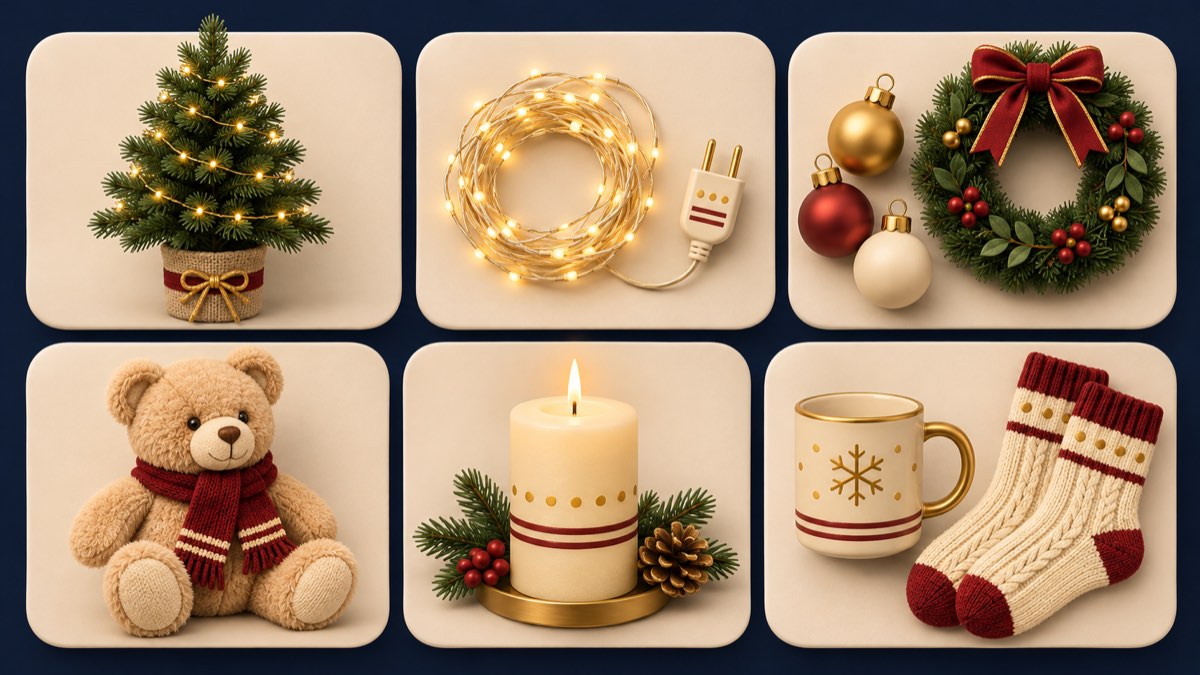
| Number and item | Tariff code (11 digits) | Customs duty | Import regulations | Know before you send |
|---|---|---|---|---|
| ① Artificial Christmas tree (PVC or PE tree) | 9505.10.00.10-8 | 0% | None | Bulky; sea express is usually charged by volumetric weight |
| ② Lighting strings for Christmas trees | For LED light sources only: 9405.31.00.00-6; other: 9405.39.00.00-8 | 3.3% | C02 | Plug-in string lights are goods subject to mandatory inspection by BSMI; models powered by USB 5V or dry-cell batteries have separate exclusion conditions, see the next section |
| ③ Ornaments, baubles, artificial wreaths, Christmas stocking hangers and other Christmas articles | 9505.10.00.90-1 | 0% | C02 | Ornaments not designed specifically for Christmas are classified by material, and wreaths made from dried natural plants go under 0604.90.90.00-2 (10% duty, import regulation code B01, quarantine required), see the advance ruling cases below the table; under this code BSMI only regulates prank toys, dress-up toys, false beards, costume outfits, hand-held lanterns and similar items; HowBridge does not accept fragile glass or ceramic items for carriage |
| ④ Plush toys (stuffed toys representing animals or non-human creatures) | 9503.00.61.00-0 | 0% | C02 | Toys are goods subject to mandatory inspection; the inspection exemption for personal-use goods has value and quantity conditions |
| ⑤ Candles and small candles | 3406.00.00.00-4 | 0% | None | The Chapter Notes to Chapter 95 exclude candles from festive articles, and candles are declared under 3406; battery-powered or plug-in LED electronic candles are not candles, so check their code separately |
| ⑥ Mugs and socks with Christmas designs | By material: ceramic tableware other than porcelain 6912.00.10.00-3 (porcelain tableware goes under another code); cotton knitted socks 6115.95.00.00-6 | 10%; 12% | F02; MP1 | Mugs are fragile ceramics, which HowBridge does not accept for carriage; socks are listed MP1 (goods from mainland China permitted for import subject to conditions) |
- Why aren't mugs and socks with Christmas designs declared under 9505?Note 1 to Chapter 95 of the Customs Import Tariff states that Chapter 95 does not cover candles (heading 3406), fireworks (heading 3604) or lighting strings of any kind (heading 9405), nor tableware, kitchenware, toilet articles, carpets, clothing, bed linen, table linen and similar articles “having a utilitarian function”; these are classified according to their constituent material. The Explanatory Notes to heading 95.05 also list what the heading covers: Christmas tree decorations (tinsel, coloured balls), artificial Christmas trees, Christmas stockings, garlands and the like. This classification comes from the World Customs Organization's HS 2022 Chapter 95, and the first 6 digits of Taiwan's tariff codes are identical to it.
- “For Christmas” does not automatically mean 9505: In the advance tariff classification ruling cases published by the Customs Administration, a 4-foot LED Christmas tree (with transformer) was classified under 9505.10.00.10-8 as an artificial Christmas tree; soft PVC ornaments that can be hung on a Christmas tree under 3926.40.00.00-7 as plastic ornamental articles (5% duty); metal bells, because they are not traditional articles used specifically for Christmas, under 8306.10.00.00-3 (8%); foam berries with fabric leaves under 6702.10.00.00-7 as artificial fruit (2.5%); and dried pine cones for Christmas decoration, as well as wreaths made from dried plants, under 0604.90.90.00-2 (10%, import regulation code B01). Which code an ornament goes under depends on its material and on whether it is designed specifically for Christmas.
- Why do string lights have their own codes?HS 2022 Chapter 94 created dedicated subheadings for “lighting strings of a kind used for Christmas trees” under heading 9405: 9405.31 (for use solely with LED light sources) and 9405.39 (other); the 2017 edition had a single subheading, 9405.30, and the amendments for the 2022 edition split it into two.
- Other items often given as gifts: festive and party articles (not specifically for Christmas) 9505.90.00.00-3, 0%, C02; plastic artificial flowers and foliage 6702.10.00.00-7, 2.5%, no import regulation; plastic statuettes and ornamental articles 3926.40.00.00-7, 5%, C02 (figures that are toys mostly fall under heading 9503 at 0% duty, as determined by Customs); perfume 3303.00.00.00-8, 0%, no import regulation (a liquid, so not eligible for compensation if lost or damaged); headphones without a microphone 8518.30.20.00-9, 0%, C02; headphones and earphones combined with a microphone 8518.30.32.00-5, 0%, C02.
- Where the import regulations come from, and how to check them yourself: The import regulation codes for each tariff code are listed in the Classification of Import and Export Commodities published by the International Trade Administration, Ministry of Economic Affairs (Taiwan). Paste the product name from the shop listing into the tariff lookup and it shows the 11-digit code, the Column 1 duty rate and the import regulation codes; the same kind of product can fall under a different code if its material or function differs, and the final classification is as determined by Customs.
String lights and toys are marked C02: do they need inspection if you use them yourself or give them away?
C02 means that “some goods” under the code are goods subject to mandatory import inspection announced by the Bureau of Standards, Metrology and Inspection (BSMI), Ministry of Economic Affairs (Taiwan). For lighting strings for Christmas trees (9405.31.00.00-6, 9405.39.00.00-8), the regulated product description is “string lights and tube lights” (commonly called Christmas string lights, string lights, light strips, tube lights), and toys are also within the regulated scope; artificial Christmas trees have no import regulation, and what is regulated under 9505.10.00.90-1 is prank toys, dress-up toys, false beards, costume outfits, hand-held lanterns and similar items, so ordinary ornaments and artificial wreaths are not among the regulated product names. Goods subject to mandatory inspection can be imported without inspection as “personal-use goods not for sale”, but there are value and quantity conditions; moreover, according to BSMI's FAQ, personal-use goods imported under the exemption may not be sold or given as gifts.
| Product category | Exemption conditions (same declaration, same specification and model) | Frequency limit |
|---|---|---|
| Toys (plush toys, building blocks, remote-control toys, etc.) | Total value of US$1,000 or less and no more than 5 pieces; or over US$1,000 with a quantity of 1 piece | Limited to 1 time per 6 months for the same specification and model |
| Other goods not given a separate category in the Regulations | Total value of US$1,000 or less; above US$1,000, personal-use goods are limited to 2 pieces | Limited to 1 time per 6 months for the same specification and model |
- Which string lights are outside the regulated scope? According to BSMI's search for goods subject to mandatory inspection, the inspection scope for string lights is limited to a rated voltage of 300V or less, and the following are outside the scope of mandatory inspection: products that have a USB port, a body input voltage of DC 5V, no power adapter supplied, and are not powered by secondary (rechargeable) batteries; products powered solely by primary (dry-cell) batteries; and products powered only by a car power supply that come with a car cigarette-lighter power plug and are not powered by rechargeable batteries. String lights that plug directly into a wall socket are within the regulated scope; light-up products that are toys subject to mandatory inspection follow the rules for toys instead. The C02 for 9505.10.00.90-1 and 9505.90.00.00-3 only covers products governed by the national toy safety standard CNS 4797 and intended for play by children aged 14 or under.
- Goods exempted from inspection for personal use cannot be given away: In BSMI's FAQ (2023-09-26), the answer to “If goods are imported as personal-use goods not for sale, may they be given as gifts?” is “No”; to change their use to sale or gifting, another BSMI FAQ entry (how exempted goods can be changed to sale or gifting) states that you must apply to the BSMI office or branch that granted the original exemption for a change of use, and complete the inspection procedure once it is approved. So for gifts you intend to give, choose items outside the scope of mandatory inspection: artificial Christmas trees, candles, ornaments classified under 9505.10.00.90-1 that are not toys, and string lights powered solely by dry-cell batteries, or powered by USB 5V with no power adapter supplied and no rechargeable battery. If an ornament is classified under 3926.40.00.00-7 or 8306.10.00.00-3, those two codes are also marked C02, so ask customer service first. Alternatively, buy toys and plug-in string lights in Taiwan that already carry the commodity inspection mark.
- Goods subject to mandatory inspection cannot use the simplified declaration when shipped by express: BSMI's FAQ (2023-09-26): goods subject to mandatory inspection imported as air or sea express cargo may not be cleared with a simplified declaration and must be declared on a general import declaration; the corresponding provisions are Article 12 of the Regulations Governing Customs Clearance of Air Express Cargo (Taiwan) and Article 12 of the Regulations Governing Customs Clearance of Sea Express Cargo (Taiwan), under which goods “involving import or export regulations” must be cleared with a general declaration. At HowBridge, the general declaration option is called “Formal declaration”, with a customs declaration fee of NT$800 per declaration; if you have bought toys or plug-in string lights subject to mandatory inspection, ask customer service on LINE before you submit your consolidation order.
- Legal basis, and who is penalized: Articles 6, 8 and 9 of the Commodity Inspection Act (Taiwan): goods subject to mandatory inspection that do not meet the inspection requirements may not be imported; for goods produced abroad, the party obligated to apply for inspection is the importer of the goods; personal-use goods not for sale may be exempted from inspection. The Regulations Governing Exemption from Commodity Inspection set the values and quantities in the table above. Articles 60 and 60-1 of the Commodity Inspection Act penalize the party obligated to apply for inspection: importing goods that do not meet the inspection requirements is subject to an administrative fine of not less than NT$200,000 and not more than NT$2,000,000; where the total price of the goods is below NT$100,000, the fine may be up to 2 times the total price, but not less than NT$10,000.
- Buying to resell, or ordering for other people: If it is not for your own use, the inspection exemption for personal-use goods does not apply. A BSMI press release points out that a business that orders goods from abroad on behalf of consumers and then imports them in the consumers' names under the personal-use exemption is the actual importer, that is, the party obligated to apply for inspection, and importing goods that have not completed the inspection procedure will be penalized under the Commodity Inspection Act.
- Voltage and plugs: Mains electricity in mainland China is 220 volts, while in Taiwan it is 110 volts; the same press release reminds consumers that people who buy electrical appliances from foreign websites themselves bear responsibility for product safety, and may run into problems with an incompatible voltage or plug type. For plug-in string lights, check the rated voltage carefully before you order.
- Further reading: For inspection details on toys, see Toys from China to Taiwan; for goods subject to mandatory inspection, see the BSMI regulated goods list.
Which Christmas gifts cannot be sent from mainland China, or need a check with customer service first?
Spray snow, and fireworks such as sparklers and party poppers, cannot be sent; fresh-cut Christmas trees are listed MW0 (goods from mainland China are not permitted for import) and also require plant quarantine; sweet biscuits and filled chocolate are listed MW0; for wireless products such as Bluetooth headphones imported by post or express for personal use, the exemption from applying for an import approval certificate by signing a declaration covers at most 2 units at a time; HowBridge does not accept fragile items such as glass and ceramics for carriage. The numbers in the image correspond one-to-one to the 5 items below.
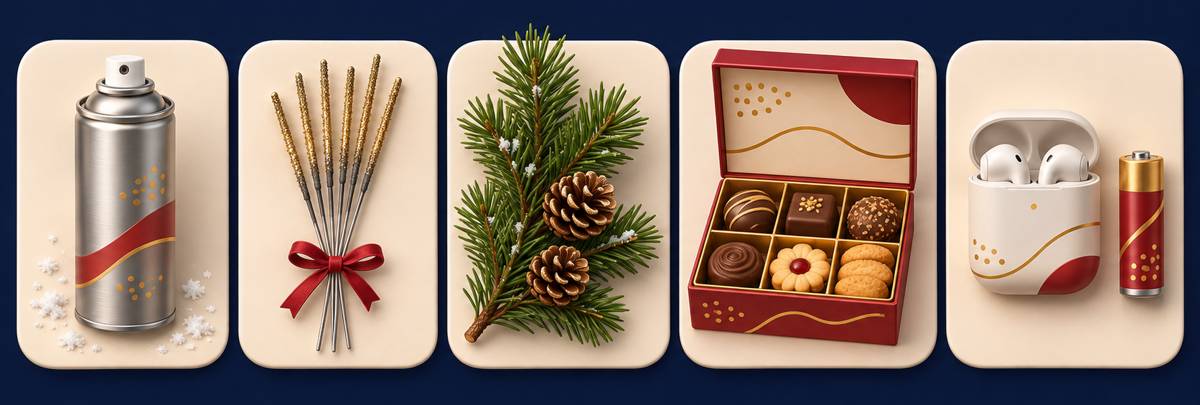
1Spray snow and streamer spray (aerosol cans): cannot be sent
Mainland China's Guiding Catalogue of Items Prohibited from Delivery lists aerosols as items prohibited from delivery, so a courier may refuse them as soon as the seller hands them over. Taiwan's Civil Aviation Act, Articles 43 and 112-2 provide that dangerous goods, except those that meet the rules for the air transport of dangerous goods, may not be carried onto or consigned for carriage on aircraft; a shipper who falsely declares them and is caught before they are loaded onto the aircraft is subject to an administrative fine of not less than NT$20,000 and not more than NT$100,000. HowBridge does not accept aerosol cans for carriage.
2Sparklers, party poppers and fireworks: cannot be sent
Toy fireworks 3604.10.10.00-0 and fireworks other than toys 3604.10.20.00-8 carry import regulation code 366: you must attach a consent document issued by the Ministry of the Interior (Taiwan), or documents proving that the item is not regulated under Taiwan's Fireworks and Firecrackers Control Act. The Fireworks and Firecrackers Control Act requires anyone importing general fireworks and firecrackers to first apply to the Ministry of the Interior for a permit document, and a person who imports them without permission is subject to an administrative fine of not less than NT$300,000 and not more than NT$1,500,000. Mainland China's catalogue of items prohibited from delivery also names fireworks, firecrackers, snap pops and party poppers.
3Fresh-cut Christmas trees and fresh pine branches: cannot be sent
“Christmas trees, coniferous” 0604.20.20.00-2 carries 10% duty and import regulation codes B01 and MW0: it is listed as goods from mainland China not permitted for import, and because it falls in Chapter 6 of the tariff, the rule exempting small quantities from the import permit requirement does not apply. Articles 17 and 24 of the Plant Protection and Quarantine Act (Taiwan) further provide that regulated articles subject to plant quarantine may not, in principle, be imported by post; under Article 24, an importer or recipient who fails to apply for quarantine is subject to an administrative fine of not less than NT$30,000 and not more than NT$150,000, which may be reduced or waived in minor cases. If you want a tree, buy an artificial Christmas tree. Dried plant decorations such as dried pine cones, dried flowers and wreaths made from dried plants are exempt, under an announcement by the Animal and Plant Health Inspection Agency (APHIA, Taiwan), from presenting a phytosanitary certificate from the exporting country (except seeds capable of germination), but they are still regulated articles subject to plant quarantine, and their tariff code 0604.90.90.00-2 is listed B01; ask customer service before sending them. For the rules on sending plants by post, see APHIA's explanation.
4Chocolate, cookies and candy: check them one by one
The import regulations for these foods all include F01 (import inspection). Sweet biscuits 1905.31.00.00-7 (25% duty) and filled chocolate in blocks 1806.31.00.00-7 (10%) are additionally listed MW0 and cannot be sent from mainland China; unfilled chocolate in blocks 1806.32.00.00-6 (10%) has no MW0; sugar confectionery not containing cocoa 1704.90.00.90-9 (27.5%) is listed MP1 (permitted for import subject to conditions). Under a Taiwan Food and Drug Administration (TFDA) announcement, food is exempt from applying for import inspection if it is not for sale and is for personal use, and each line item on the declaration is worth US$1,000 or less and weighs 6 kg or less, but this only exempts it from inspection and does not lift MW0. For details, see Snacks to Taiwan.
5Bluetooth headphones and battery-powered gifts: quantity and shipping limits
The tariff code for headphones depends on whether they have a microphone: headphones without a microphone 8518.30.20.00-9 and headphones and earphones combined with a microphone 8518.30.32.00-5 both carry 0% duty and import regulation code C02; the code is as determined by Customs. For products with Bluetooth or other wireless functions, Article 9 of the Regulations Governing the Manufacture, Import and Declaration of Controlled Telecommunications Radio-Frequency Devices (Taiwan) sets the quantities that may be imported for personal use by signing a declaration, without applying for an import approval certificate: by post or any other means than carrying them yourself, at most 2 units at a time, and no more than 10 units per person per year; a natural person must be at least 18 years old, and the devices are for the applicant's own use only and may not be transferred; if you intend to give Bluetooth headphones as a gift, ask customer service before you order. Products containing lithium batteries can only go by sea express at HowBridge; ask customer service first about power banks and separate batteries.
- What MW0 means, and whether there are exceptions: MW0 means goods from mainland China are not permitted for import (import regulation code table; Article 7 of the Regulations Governing Permission for Trade between the Taiwan Area and the Mainland Area). A Ministry of Economic Affairs (Taiwan) announcement also allows industrial products from mainland China that are not on the “List of Restricted Import Goods” and fall in Chapters 25 to 97 of the tariff, when imported in small quantities, to be exempt from the import permit requirement: the CIF value of the entire declaration must be within NT$32,000, and each individual product must be within 24 pieces; for goods that cannot be counted by the piece, within 40 kg. Electric motorcycles, electric bicycles and their controllers are excluded (Ministry of Economic Affairs announcement of 2026-03-10); agricultural products and food in Chapters 1 to 24 of the tariff are not covered. Inspection, quarantine and other import regulations still apply as usual. A press release by Keelung Customs (Taiwan) warns that goods not meeting the conditions require an application for a special import permit document, and if none is obtained, the goods must be returned or abandoned; in addition, where the description of the goods is falsely declared, Customs may, under the Customs Anti-Smuggling Act (Taiwan), impose an administrative fine of up to 3 times the value of the goods and confiscate the goods.
- Fragile items: Glass Christmas baubles, snow globes, ceramic mugs and glass candle holders are glass, ceramic or other easily breakable items, which HowBridge does not accept for carriage under its terms of service; if they are sent without prior notice, no compensation will be paid.
- Perfume and liquids: Perfume 3303.00.00.00-8 carries 0% duty and has no import regulation code; however, HowBridge does not pay compensation for the loss of or damage to liquids, so ask customer service before you order whether it can be accepted.
- Current status of lithium battery export controls: The Announcement No. 58 of 2025 of the Ministry of Commerce and the General Administration of Customs (mainland China) covers rechargeable lithium-ion batteries with a gravimetric energy density of 300 Wh/kg or more, and related equipment and materials; Announcement No. 58 of 2026 stated that its implementation remains suspended from 2026-11-11 to 2027-01-10. Air transport classifies lithium batteries as Class 9 dangerous goods (International Air Transport Association (IATA) battery guidance).
- Counterfeits: Goods that infringe trademark rights or copyright may not be imported. A Customs Administration press release notes that counterfeit wireless Bluetooth headphones are very common, and it makes no difference if the importer says they were “bought for personal use with no intention to sell”: as long as the right holder identifies them as counterfeit, Customs may, under Article 39-1 of the Customs Anti-Smuggling Act, impose an administrative fine of up to 3 times the value of the goods and confiscate them, and the case may be referred to the judicial authorities for investigation. Do not buy branded goods priced far below the market rate.
- Full list: Taiwan's list of prohibited and restricted imports; for items you are unsure about, paste the shop link to customer service before you order.
How much tax do you pay on Christmas gifts? Is there a tax exemption for gifts?
If the customs value of a single shipment of imported goods is NT$2,000 or less, it is exempt from customs duty and from the business tax and commodity tax collected by Customs; once it exceeds NT$2,000, tax is charged on the full amount, not only on the part above the threshold. There is no separate tax-free allowance for gifts: the tax-exempt goods listed in Article 49 of the Customs Act (Taiwan) do not include “gifts from relatives or friends”, so gifts are taxed like any other imported goods, and the taxpayer is the consignee in Taiwan.
| Case | Customs duty | Business tax 5% | Tax payable |
|---|---|---|---|
| A batch of ornaments, customs value NT$1,500 | 0% | Exempt | NT$0 (tax-free at NT$2,000 or less) |
| One artificial Christmas tree, customs value NT$3,000 | NT$3,000×0% = NT$0 | NT$3,000×5% = NT$150 | NT$150 |
| A batch of LED lighting strings for Christmas trees, customs value NT$3,000 | NT$3,000×3.3% = NT$99 | (NT$3,000 + NT$99)×5% = NT$155 | NT$254 |
- Legal basis: Article 49, Paragraph 2 of the Customs Act provides that a single shipment whose customs value is at or below the limit announced by the Ministry of Finance is tax-free; a Ministry of Finance announcement sets the limit at NT$2,000, and the exemption does not apply to tobacco and alcohol or to agricultural products subject to tariff quotas.
- 6 times per half-year: Under a Ministry of Finance order, if the same taxpayer uses this tax-free release more than 6 times within a half-year period (months 1–6 or months 7–12), it counts as frequent importing, and the exemption no longer applies from the 7th time onward; the count is based on the import date on the declaration and resets every year on 1 January and 1 July. If you often order at the end of the year, check before December how many times you have used it in the second half of the year: a Customs Administration press release explains that you can check this in the “通關e便捷” app (Taiwan Customs' clearance app).
- How the customs value is calculated: The customs value is based on the price actually paid to the seller, plus the freight and insurance to Taiwan, and is finally determined by Customs. Parcels on the same consolidation order are declared together, and the total for the whole order decides whether it exceeds NT$2,000; a Keelung Customs press release also explains that even if you buy from different online shops, as long as the goods are dispatched from the same fulfillment center, carried on the same voyage or flight and sent to the same consignee, the customs values of the parcels are still combined.
- You cannot split the declaration: Article 14 of the Regulations Governing Customs Clearance of Air Express Cargo and Article 15 of the Regulations Governing Customs Clearance of Sea Express Cargo provide that express carriers may not declare a single shipment of imported express cargo separately; a single shipment means goods sent by the same shipper on the same flight or voyage to the same consignee. Splitting orders to avoid tax is not a way to save money.
- Tax-free does not mean exempt from other rules: A customs value of NT$2,000 or less only exempts the goods from tax; inspection, quarantine and the import regulations for goods from mainland China still apply as usual.
- Calculate before you buy: The import tax calculator guide and the shipping and tax estimator let you estimate by product name or tariff code.
How does it work from ordering to delivery, and how many days should you allow before Christmas?
The process has 6 steps: register to get the Shenzhen warehouse address, order on an e-commerce platform, pre-alert your parcels, consolidate them once they reach the warehouse, submit a consolidation order and complete the EZ WAY authorization, and receive home delivery after customs clearance. For HowBridge's 1,087 sea express shipments from 2026-08-06 to 2026-10-24, the median time from dispatch at the Shenzhen warehouse to signed delivery in Taiwan was 4 working days, and 90% were delivered within 6 working days (excluding weekends, national holidays and typhoon closure days). This is a past statistic, not a delivery promise; December is peak season, and both seller dispatch and customs clearance may be slower than usual.
1Register as a HowBridge member and get the Shenzhen consolidation warehouse address
Create an account on the registration page; your member center will show the receiving address of the Shenzhen consolidation warehouse and your recipient details.
2Order on Taobao, Tmall, Pinduoduo, JD.com or 1688, with the Shenzhen warehouse as the delivery address
Before you order, use the tariff lookup to check the item's import regulations; do not buy fragile glass and ceramic items, fireworks or aerosol cans to send.
3After the seller ships, pre-alert the courier tracking number in your member center
Pre-alert the courier tracking number and product name so that the parcel can be matched to your account when it reaches the warehouse.
4Consolidate your parcels after they reach the Shenzhen warehouse
Parcels from several sellers can be combined into one box; consolidation and packing at the Shenzhen warehouse are free, and storage is free for 366 days, so there is no need to rush and send parcels one by one.
5Submit the consolidation order: choose sea express or air freight, declare truthfully and complete the EZ WAY authorization
Fill in the declared product names and values truthfully. For parcels cleared with a simplified declaration, the consignee must complete real-name verification in the EZ WAY app (Taiwan's real-name customs authorization app) and tap to confirm the authorization; see the EZ WAY guide for the steps.
6Home delivery after customs clearance; check the outer box when you sign for it
You can track the shipment status in your member center. If anything is lost or damaged, report it to customer service within 7 days of signing for the delivery.
- How to count back from your date: Start from the date you need the gift, subtract “the days the seller takes to ship to the Shenzhen warehouse (see the shop listing)”, then subtract the sea express transit time, and finally leave a few days of buffer. Taking 2026-12-24 (Thursday) as the date you need it, and allowing 6 working days for transit: a sea express shipment dispatched from the Shenzhen warehouse on 2026-12-15 (Tuesday) would, by this estimate, be signed for around 2026-12-23 (Wednesday); this is an estimate, not a promise, and to be on the safe side, submit your consolidation order a few working days earlier.
- In a hurry: Air freight reaches Taiwan in 3 to 5 working days (a description of typical cases, not a delivery promise) and is charged on actual weight only, which suits light, urgent gifts; products containing lithium batteries can only go by sea express at HowBridge.
- Real-name authorization: Article 17 of the Regulations Governing Customs Clearance of Air Express Cargo and Article 18 of the Regulations Governing Customs Clearance of Sea Express Cargo provide that a customs declaration authorization must be completed before a simplified declaration is filed (in writing, online through the Customs-Port-Trade Single Window, or online through the real-name authentication platform); from 2026-03-01, Customs may refuse to accept the declaration if the authorization has not been completed. A Customs Administration press release explains that pre-confirmation of authorization was fully implemented from the same date: when you receive the EZ WAY push notification, check the items and the declared value, tap “Declaration matches” if everything is correct, and tap “Declaration does not match” if anything is wrong or someone has used your name.
- Sending gifts directly to a friend: Whoever you enter as the consignee is the taxpayer, so that person must confirm in EZ WAY, and the shipment also counts toward their 6 times per half-year; for details, see Sending gifts to friends in Taiwan.
How is shipping calculated, and what is the difference between sea express and air freight?
From 2026-11-11, sea express costs NT$55 per billable unit: the billable units are the greater of the actual weight (kg) and the volumetric weight (length×width×height in cm÷10000), rounded up, with a surcharge of NT$100 if the billable units are under 10; air freight costs NT$110 per kg, charged on actual weight only, with a surcharge of NT$120 if the actual weight is under 10 kg. Large, light items such as Christmas trees and wreaths are charged by volumetric weight under sea express; for small, light gifts the two methods differ little.
| Item | Sea express | Air freight |
|---|---|---|
| Pricing | NT$55 per unit; billable units = the greater of actual weight and volumetric weight (length×width×height in cm÷10000), rounded up | NT$110 per kg; actual weight only, rounded up |
| Surcharge | NT$100 if the billable units are under 10 | NT$120 if the actual weight is under 10 kg |
| Transit time | Median of 4 working days from Shenzhen warehouse dispatch to signed delivery, 90% within 6 working days (1,087 shipments, 2026-08-06 to 2026-10-24) | 3 to 5 working days to Taiwan |
| One box of gifts: 50×40×30 cm, actual weight 3 kg | Volumetric weight 6, billed as 6 units: 6×NT$55 + NT$100 = NT$430 | 3 kg: 3×NT$110 + NT$120 = NT$450 |
| One artificial Christmas tree: 120×25×25 cm, actual weight 5 kg | Volumetric weight 7.5, rounded up to 8 units: 8×NT$55 + NT$100 = NT$540 | 5 kg: 5×NT$110 + NT$120 = NT$670 |
| Products containing lithium batteries | Accepted | Not accepted |
- Oversize surcharge for the Taiwan leg: If a sea express or air freight parcel exceeds 10 cai in volume (cai is a Taiwanese volume unit) or 40 kg in weight, an oversize surcharge is charged for delivery within Taiwan; for a large artificial Christmas tree, ask the seller for the outer box dimensions before you order.
- Bulk company purchases of decorations: For large quantities that are not urgent, you can ask about LCL sea freight consolidation (quote on request from customer service, depending on the goods): from NT$25 per kg or from NT$150 per cubic foot (cubic feet = length×width×height in cm÷28316), with the actual cost depending on the product category.
- Estimates and explanations: Enter the dimensions and weight in the shipping estimator; for billing rules and ways to save on shipping, see Mainland China to Taiwan shipping costs and How shipping costs are calculated. Shipping costs are as shown on the bill after measurement at the warehouse.
Why do most Christmas goods ship from mainland China, and when is peak season?
Yiwu in Zhejiang is the main export base for Christmas goods in mainland China: the official website of the Yiwu municipal government, citing data from Yiwu Customs, reports that Yiwu exported RMB 5,650,000,000 of Christmas goods in the whole of 2025, up 17.0% on the previous year. Export shipments are concentrated before December: according to Hangzhou Customs statistics, Zhejiang Province exported RMB 9,110,000,000 of Christmas goods from 1 January to 31 July 2025, of which RMB 6,640,000,000, or 72.9%, was exported in the two months of June and July (months 6 and 7); Xinhua Finance reported on 2026-10-04 that Yiwu was at that time entering its export peak.
| Period | Scope | Export value (RMB) | Change on the same period of the previous year | Source |
|---|---|---|---|---|
| Full year 2025 | Yiwu City | RMB 5,650,000,000 | Up 17.0% | Yiwu municipal government website (citing Yiwu Customs) |
| 1 January–31 July 2025 | Zhejiang Province | RMB 9,110,000,000 | Up 23.0% | CCTV.com report, republished by Guangming Online (citing Hangzhou Customs) |
| First three quarters of 2025 | Yiwu City | RMB 5,170,000,000 | Up 22.9% | Xinhua News Agency (citing customs data) |
| 1 January–31 August 2026 | Yiwu City | RMB 4,750,000,000 | Up 10.9% | Xinhua Finance (citing Yiwu Customs) |
- Sources: Yiwu Municipal People's Government website, CCTV.com report (republished by Guangming Online), Xinhua News Agency, Xinhua Finance.
- Who said “80% of the world market”? A Xinhua report of 2019-10-20 quoted the secretary-general of the Yiwu Christmas Products Industry Association as saying that 80% of the world's Christmas goods come from China, and that Yiwu in turn accounts for 80% of the national total. More recent reports put it as “Yiwu accounts for nearly 80% of the global market”. The two claims are measured on different bases, and both are statements by an industry association or in news reports, not figures published by customs or a statistics agency.
- What this means for buyers in Taiwan: The big export orders have already shipped before December; if you only buy in December, you are buying the stock sellers have on hand. It is best to order the styles you want early, to leave time for the seller to ship and for consolidated shipping.
- Where HowBridge's warehouses are: HowBridge has no warehouse in Yiwu. Wherever the seller ships from, parcels first go by domestic courier within mainland China to the Shenzhen consolidation warehouse, and are then consolidated and shipped to Taiwan.
- What research says about gift-giving: Waldfogel (1993) used a survey of US university students to estimate that recipients value holiday gifts at between one-tenth and one-third less than what the giver paid; List and Shogren (1998) measured it instead with real-money auctions and found that recipients' valuations were actually 121% to 135% of the cost. The two papers reach opposite conclusions; List and Shogren point out that measuring with hypothetical questionnaires produces a loss, while measuring with auctions in which real money is paid produces a gain, so the measurement method affects the conclusion.
- Research in Taiwan: Hung and Liu (2009) analyzed 168 questionnaires and found that the stronger the identification with the image of Christmas and the higher the level of involvement, the stronger the intention to buy Christmas gifts. Liu's master's thesis (2022) cites a survey of Taiwanese consumers in 2021 by the Market Intelligence & Consulting Institute (MIC) of the Institute for Information Industry: Taobao/Tmall ranked first for cross-border shopping in Taiwan (19%); this is a second-hand figure, and this page has not checked the original report.
- Research on de minimis thresholds: Thresholds vary widely between countries; Holloway and Rae (2012) compiled thresholds across Asia-Pacific Economic Cooperation (APEC) economies ranging from under US$1 to over US$1,000 (a study commissioned by an express industry association); Fajgelbaum and Khandelwal (2024) found that US de minimis imports in 2023 totaled US$54,500,000,000 across about 1,000,000,000 shipments; and an Organisation for Economic Co-operation and Development (OECD) report (2021) points out that small cross-border parcels let individuals take part in trade directly. Taiwan's threshold is a customs value of NT$2,000 per shipment.
What safety issues should you watch for when buying string lights, toys and ornaments?
For plug-in string lights, check the rated voltage and the commodity inspection mark; for gifts for young children, avoid small parts, button batteries and small metal ornaments of unknown origin. An explanatory page by BSMI's Keelung Branch (page last edited 2026-03-06) advises buying Christmas string lights that carry the “commodity inspection mark” and checking the labeling for the manufacturer's name, address, voltage, power consumption or current, and model number; do not plug in or remove bulbs while the lights are switched on; and string lights labeled for indoor use must not be used outdoors.
| Risk | Data | What to do when buying |
|---|---|---|
| Spot checks of toys sold in Taiwan | In 2024, BSMI randomly bought 30 toys from department stores, bookstores and online shopping platforms for testing: 1 failed on quality items, and 6 in total failed on the commodity inspection mark or Chinese-language labeling | Buy toys that have the commodity inspection mark and Chinese-language labeling |
| Fires started by Christmas trees and string lights | In the US, Christmas trees were the first item ignited in an average of 160 home fires a year in 2016–2020, and 44% of these involved electrical distribution or lighting equipment (National Fire Protection Association, 2022) | Do not buy string lights that do not state their rated voltage and specifications; unplug them before going to bed and before going out |
| Overheating string lights | On 2023-12-07 the U.S. Consumer Product Safety Commission recalled about 34,600 sets of LED mini string lights made in China (battery- or USB-powered models), because the bulbs can overheat when plugged directly into an outlet | Read the voltage and the instructions for use on the product page carefully |
| Button batteries | On 2026-02-05 the U.S. Consumer Product Safety Commission recalled LED Christmas headbands made in China: each contains 3 button batteries, which children can easily remove | For small light-up ornaments, those whose battery cover needs a tool to open are safer |
| Young children swallowing ornaments | The emergency department of a US children's hospital saw 76 children injured by holiday ornaments over 13 years; the median age was 2, and 43 of the cases involved swallowing (2009) | Do not hang small bulbs or fragile ornaments at heights young children can reach |
| Heavy metals in small metal ornaments | Of 72 toys and children's jewelry items sold in North America, 20 of the 24 metal items had total concentrations above the EU migration limits (2013) | Do not buy metal children's jewelry of unknown origin |
| Plasticizers in soft plastics | Of 49 toys bought in New Zealand, 65% had at least one phthalate at a concentration above 0.1%; at the time, there were no local regulations on plasticizers in toys (2018) | For children's toys, buy ones that carry the commodity inspection mark |
| Lead in string light wiring | A 2008 US study found lead on the surface of every Christmas light sample tested; whether this affects blood lead levels in people is “unknown” | Wash your hands after handling string lights |
- Sources: BSMI press release on its 2024 sample testing of toys on the market, National Fire Protection Association, “Christmas Tree Fires”, U.S. Consumer Product Safety Commission recall record 24-733, recall record 26-249, Kimia et al. (2009), Guney and Zagury (2013), Ashworth et al. (2018), Laquatra et al. (2008).
- EU notifications: European Commission Safety Gate 2025 annual report: in 2025 a total of 4,671 notifications of dangerous non-food products were validated, with toys accounting for 16% and electrical appliances for 11%; according to the data in Figure 4 of the report, 2,006 of them had the People's Republic of China as the country of origin. The report has no breakdown for Christmas lights or Christmas ornaments.
- International standard for string lights: IEC 60598-2-20:2022 covers lighting chains for indoor or outdoor use with a supply voltage not exceeding 250 V; inspection requirements in Taiwan follow BSMI's rules.
- HowBridge's role: HowBridge is a shipping company; it does not test product safety and does not apply for inspection of products on anyone's behalf; what to buy and who will use it is for the buyer to decide.
What does HowBridge do in all this, and what does it not do?
HowBridge receives goods at the Shenzhen warehouse, consolidates them, ships parcels to Taiwan by sea express or air freight, passes your declaration information to its partner customs broker, handles delivery within Taiwan, and provides tariff lookup and estimate tools; HowBridge is not a customs broker, does not place orders with or pay sellers on your behalf, and makes no promises about customs clearance results or delivery dates.
- Not accepted for carriage: glass, ceramic or other easily breakable items (glass Christmas baubles, snow globes, ceramic mugs, glass candle holders), as well as dangerous goods such as fireworks and aerosol cans, and prohibited goods.
- Categories not eligible for compensation: Under the terms of service, fragile items, liquids, powders, batteries (including products with batteries), dangerous goods and prohibited goods are not eligible for compensation if lost or damaged, whether or not declared-value protection was purchased; for other parcels that are lost or damaged, compensation is capped at three times the shipping fee for that parcel.
- Battery-powered gifts: Products containing lithium batteries can only go by sea express at HowBridge; for power banks and separate batteries, please ask customer service first, and do not send them to the warehouse until this is confirmed. For details, see the lithium battery product shipping guide.
- Not covered here: under-declaring the value, splitting orders to avoid tax, or giving items that cannot be sent a different product name. A declaration simply means filling in the facts truthfully.
- Customer service hours: AI customer service is available 24 hours a day; human customer service is available Monday to Friday, 09:00–18:00 (Taiwan time), and is closed on weekends and public holidays. December brings a high volume of enquiries, so if you have questions about import regulations, please ask before you order.
What do the codes and terms on this page mean?
- Tariff code (11-digit CCC code)
- The goods numbering of Taiwan's Customs Import Tariff, 11 digits in total; the first 6 digits are the same as the World Customs Organization's HS classification, and the rest are Taiwan's own subdivisions and a check digit. The code determines the customs duty rate and the import regulations.
- Column 1 duty rate
- The general duty rate column of the Customs Import Tariff, which applies to goods from World Trade Organization members; all the customs duties on this page are Column 1 duty rates.
- Customs value (duty-paying value)
- The value Customs uses to calculate customs duty; it includes the price of the goods plus the freight and insurance to Taiwan, as determined by Customs.
- C02
- An import regulation code meaning that “some goods” under the code are goods subject to mandatory import inspection announced by the Bureau of Standards, Metrology and Inspection, Ministry of Economic Affairs; not every product under the code needs inspection.
- MW0
- An import regulation code meaning that goods from mainland China are not permitted for import. Industrial products from mainland China in Chapters 25 to 97 of the tariff may be exempt from the import permit requirement if the CIF value of the entire declaration is within NT$32,000 and each individual product is within 24 pieces; for goods that cannot be counted by the piece, within 40 kg; electric motorcycles, electric bicycles and their controllers are excluded; agricultural products and food in Chapters 1 to 24 are not covered; inspection, quarantine and other import regulations still apply as usual.
- MP1
- An import regulation code meaning that goods from mainland China are permitted for import subject to conditions; the conditions are listed in the International Trade Administration's table of mainland Chinese goods permitted for import subject to conditions.
- B01
- An import regulation code: on import, the goods must be handled according to the list of animals and plants subject to quarantine and the quarantine rules of the Animal and Plant Health Inspection Agency, Ministry of Agriculture (Taiwan).
- F01
- An import regulation code: imported food requires an application for import inspection to the Taiwan Food and Drug Administration (TFDA), Ministry of Health and Welfare.
- 366
- An import regulation code: fireworks-type goods must be accompanied by a consent document issued by the Ministry of the Interior, or by documents proving that they are not regulated under the Fireworks and Firecrackers Control Act.
- Inspection exemption for personal-use goods
- The exemption from inspection that the Regulations Governing Exemption from Commodity Inspection grant to “personal-use goods not for sale”; there are value and quantity conditions depending on the product category, and it is limited to 1 time per 6 months for the same specification and model.
- Simplified declaration and general declaration
- The two ways of declaring express cargo. Goods with a customs value over NT$50,000, or goods involving import or export regulations, must in principle use a general import declaration; the “Formal declaration” option on HowBridge's consolidation screen is the general declaration.
- EZ WAY
- The app that individual consignees use for real-name verification and online customs declaration authorization; parcels declared with a simplified declaration must be confirmed in it.
- Billable units and volumetric weight
- Sea express billable units are the greater of the actual weight (kg) and the volumetric weight; volumetric weight = length×width×height (cm)÷10000, rounded up.
What are the sources, and how far does the verification go?
The sources below were consulted on 2026-11-16; laws follow the current text in the Laws & Regulations Database of the Republic of China (Taiwan), and document dates and consultation dates are shown separately. Tariff codes, duty rates and import regulations are taken from the tariff data of the Customs Administration, Ministry of Finance (Taiwan) (the same data used by this site's tariff lookup). HowBridge's shipping rates and terms of service are as currently announced on the site.
Official sources
- Customs Act (Taiwan), Articles 6, 29 and 49 (2022-05-11; consulted 2026-11-16): the taxpayer for customs duty is the consignee, the holder of the bill of lading or the holder of the goods; the customs value is calculated on the basis of the transaction value; a single shipment with a customs value at or below the limit announced by the Ministry of Finance is tax-free, but this does not apply to frequent imports or to specific goods announced by the Ministry of Finance.
- Ministry of Finance (Taiwan) announcement “Tax-Exemption Limit under Article 49, Paragraph 2 of the Customs Act” (Tai-Cai-Guan-Zi No. 1061018778) (2017-09-07; consulted 2026-11-16): imported goods in a single shipment with a customs value of NT$2,000 or less are exempt from customs duty and from the business tax and commodity tax collected by Customs; this does not apply to tobacco and alcohol or to agricultural products subject to tariff quotas.
- Ministry of Finance (Taiwan) order “Principles for Determining Frequent Imports” (Tai-Cai-Guan-Zi No. 1061011007) (2017-05-26; consulted 2026-11-16): if the same taxpayer uses the tax-free release more than 6 times within a half-year period (months 1–6 or months 7–12), this counts as frequent importing; the count is based on the import date stated on the declaration and resets every year on 1 January and 1 July.
- Regulations Governing Customs Clearance of Imported and Exported Postal Items (Taiwan), Articles 7, 8, 11, 12 and 13 (2020-04-01; consulted 2026-11-16): postal parcels with a customs value within NT$2,000 are exempt from customs duty, commodity tax and business tax, and those above it are taxed on the full amount; the exemption does not apply where the same recipient has used the tax-free release more than 6 times within a half-year period; postal parcels subject to inspection, quarantine or other import regulations are still handled according to those regulations.
- Regulations Governing Customs Clearance of Air Express Cargo (Taiwan), Articles 11, 12, 14, 15, 17 and 29 (2026-02-23; consulted 2026-11-16): high-value express cargo with a customs value over NT$50,000, and cargo involving import or export regulations, must be cleared with a general declaration; a single shipment may not be declared separately; a simplified declaration requires a completed customs declaration authorization, and Customs may refuse to accept the declaration if it has not been completed (Article 17, Paragraph 2 in force from 2026-03-01).
- Regulations Governing Customs Clearance of Sea Express Cargo (Taiwan), Articles 12, 18 and 32 (2026-02-23; consulted 2026-11-16): sea express cargo involving import or export regulations must be cleared with a general declaration; a simplified declaration requires a completed customs declaration authorization, and Customs may refuse to accept the declaration if it has not been completed (Article 18, Paragraph 2 in force from 2026-03-01).
- Commodity Inspection Act (Taiwan), Articles 6, 8, 9, 60, 60-1 and 60-2 (2007-07-11; consulted 2026-11-16): goods subject to mandatory inspection that do not meet the inspection requirements may not be imported; for goods produced abroad, the party obligated to apply for inspection is the importer of the goods; personal-use goods not for sale may be exempted from inspection. A party obligated to apply for inspection that imports, or places on the market, goods not meeting the inspection requirements is subject to an administrative fine of not less than NT$200,000 and not more than NT$2,000,000; where the total price of the goods is below NT$100,000, the fine may be up to 2 times the total price, but not less than NT$10,000; a seller that displays or sells goods not meeting the inspection requirements and fails to make corrections within the period set after being notified is subject to an administrative fine of not less than NT$10,000 and not more than NT$100,000.
- Regulations Governing Exemption from Commodity Inspection (Taiwan), Articles 2, 3, 5, 6 and 8 (2019-11-21; consulted 2026-11-16): personal-use goods not for sale may be exempted from inspection if the total value of goods of the same specification and model on the same declaration is US$1,000 or less; above that amount, general goods are limited to 2 pieces; for toys, the limit is US$1,000 or less and no more than 5 pieces, or over US$1,000 with a quantity of 1 piece; values are calculated on the CIF value; the exemption for the same specification and model is limited to 1 time per 6 months.
- Customs Administration, Ministry of Finance (Taiwan), “Section, Chapter and Subheading Notes and Additional Notes of the HS 2022 Customs Import Tariff”, Note 1 to Chapter 95, and the Chinese edition of the Explanatory Notes to the Harmonized Commodity Description and Coding System, headings 94.05 and 95.05 (2024-09-01; consulted 2026-11-16): Chapter 95 does not cover candles (heading 3406), fireworks (heading 3604), lighting strings of any kind (heading 9405), or articles having a utilitarian function such as tableware, kitchenware, clothing, bed linen and table linen (which are classified by their constituent material); heading 95.05 covers Christmas tree decorations, artificial Christmas trees, Christmas stockings and the like, but not natural Christmas trees or candles; heading 94.05 includes lighting strings combined with decorative lights for decorating Christmas trees.
- International Trade Administration, Ministry of Economic Affairs (Taiwan), “Classification of Import and Export Commodities of the Republic of China”, Chapters 6, 34, 36, 94 and 95 (2026-11-16; consulted 2026-11-16): the import regulation column for each code is blank for artificial Christmas trees 9505.10.00.10-8 and candles 3406.00.00.00-4; C02 for other Christmas articles 9505.10.00.90-1, festive articles 9505.90.00.00-3 and lighting strings for Christmas trees 9405.31.00.00-6 and 9405.39.00.00-8; B01 and MW0 for fresh-cut Christmas trees 0604.20.20.00-2; and 366 for toy fireworks 3604.10.10.00-0.
- Bureau of Standards, Metrology and Inspection (BSMI, Taiwan), “Search for Goods Subject to Mandatory Inspection” (by tariff code) (2026-11-16; consulted 2026-11-16): for string lights and tube lights (commonly called Christmas string lights, string lights, light strips and tube lights), only those with a rated voltage of 300V or less are inspected, and cases such as USB DC 5V without a power adapter and not powered by secondary batteries, or power solely from primary batteries, are outside the scope of mandatory inspection; for 9505.10.00.90-1 and 9505.90.00.00-3, only products governed by the national toy safety standard CNS 4797 and intended for play by children aged 14 or under are inspected; dolls and construction toys are listed as toys subject to mandatory inspection.
- BSMI FAQ (commodity inspection exemption): whether personal-use goods may be given as gifts (another question in the same series: how exempted goods can be changed to sale or gifting) (2023-09-26; consulted 2026-11-16): to the question of whether goods imported as personal-use goods not for sale may be given as gifts, the answer is “No”; to change their use to sale or gifting, you must apply to the BSMI office or branch that granted the original exemption for a change of use, and complete the inspection procedure once it is approved.
- BSMI FAQ (commodity inspection exemption): whether goods subject to mandatory inspection imported as air or sea express cargo may be cleared with a simplified declaration (2023-09-26; consulted 2026-11-16): the answer is “No”; goods subject to mandatory inspection imported as express cargo must be declared on a general import declaration.
- BSMI press release: the risks of cross-border online shopping, and a reminder to buy products that have passed inspection (2020-11-09; consulted 2026-11-16): consumers who buy goods subject to mandatory inspection from foreign websites themselves may import them under the inspection exemption for personal-use goods, but they bear responsibility for product safety; a business that orders on behalf of consumers and then imports the goods in the name of personal-use goods is the actual importer, that is, the party obligated to apply for inspection.
- BSMI Keelung Branch, “Use Christmas string lights correctly to create a colorful lighting atmosphere” (2026-03-06; consulted 2026-11-16): buy Christmas string lights that carry the commodity inspection mark, and check the labeling for the manufacturer's name, address, voltage, power consumption or current, and model number; do not plug in or remove bulbs while the lights are switched on, and string lights labeled for indoor use must not be used outdoors.
- Ministry of Health and Welfare (Taiwan) announcement “Conditions for Imported Food and Related Products to Be Exempt from Applying for Import Inspection, and the Applicable Customs Clearance Codes” (Wei-Shou-Shi-Zi No. 1081300310) (2019-04-16; consulted 2026-11-16): imported food that is not for sale and is for personal use (excluding tablet and capsule forms) may be exempt from applying for import inspection if each line item on the declaration is worth US$1,000 or less and weighs 6 kg or less.
- Ministry of Economic Affairs (Taiwan) announcement of the items excluded from the “Rules Permitting Small Quantities of Mainland Chinese Goods to Be Imported Exempt from the Import Permit” (Jing-Mao-Zi No. 11550200230) (2026-03-10; consulted 2026-11-16): on 2026-03-10 the Ministry of Economic Affairs re-announced the items excluded from the rule exempting small quantities from the import permit requirement.
- Keelung Customs, Customs Administration, Ministry of Finance (Taiwan) press release: 3 tariff lines of goods, including electric bicycles made in mainland China, excluded from the small-quantity import permit exemption (2026-04-21; consulted 2026-11-16): the excluded goods require a special import permit document from the International Trade Administration, Ministry of Economic Affairs before duty can be assessed and the goods released, and if the document cannot be obtained, the goods are returned or abandoned; where the description of the goods is falsely declared, Customs may, under the Customs Anti-Smuggling Act, impose an administrative fine of up to 3 times the value of the goods and confiscate the goods.
- Customs Administration, Ministry of Finance (Taiwan), “Combined Search of Advance Tariff Classification Ruling Cases” (GC431): cases related to Christmas decorations (2026-11-16; consulted 2026-11-16): published advance ruling cases: a 4-foot LED Christmas tree (with transformer) classified under 9505.10.00.10-8; soft PVC ornaments that can be hung on a Christmas tree under 3926.40.00.00-7; metal bells, as they are not traditional articles used specifically for Christmas, under 8306.10.00.00-3; foam berries with fabric leaves under 6702.10.00.00-7; and dried pine cones for Christmas decoration under 0604.90.90.00-2.
- Animal and Plant Health Inspection Agency, Ministry of Agriculture (Taiwan), “Rules and Explanations on Importing Plant Quarantine Articles by Post” (2019-06-20; consulted 2026-11-16): regulated articles subject to plant quarantine may not, in principle, be imported by post, and those sent by post are to be returned or destroyed; the exceptions are items announced as exempt from presenting a quarantine certificate, or cases where the recipient has obtained a permit for import by post in advance.
- Animal and Plant Health Inspection Agency, Ministry of Agriculture (Taiwan) announcement “Items of Imported Plant Quarantine Articles Exempt from Presenting a Phytosanitary Certificate of the Exporting Country” (2021-07-28; consulted 2026-11-16): regulated articles subject to plant quarantine that have been dried or ground are exempt from presenting a phytosanitary certificate from the exporting country; this does not apply to seeds capable of germination.
- Civil Aviation Act (Taiwan), Articles 43 and 112-2 (2023-06-28; consulted 2026-11-16): dangerous goods may not be carried onto or consigned for carriage on aircraft; a shipper who falsely declares dangerous goods and is caught before they are loaded onto the aircraft is subject to an administrative fine of not less than NT$20,000 and not more than NT$100,000.
- Customs Administration, Ministry of Finance (Taiwan) press release: Customs fully implements pre-confirmation of authorization from 1 March (2026-02-24; consulted 2026-11-16): from 2026-03-01, pre-confirmation of authorization is fully implemented for express cargo declared with a simplified declaration where an individual has given the authorization online through real-name verification: after receiving the EZ WAY push notification, check the items and the declared value and tap “Declaration matches” or “Declaration does not match”.
- Customs Administration, Ministry of Finance (Taiwan) press release: checking the number of tax-free uses in the “通關e便捷” app (2026-07-22; consulted 2026-11-16): the same taxpayer is entitled to 6 tax exemptions per half-year period (months 1–6 or months 7–12) for single shipments of imported goods with a customs value of NT$2,000 or less, and the number of times already used can be checked in the “通關e便捷” app (Taiwan Customs' clearance app).
- Keelung Customs, Customs Administration, Ministry of Finance (Taiwan) press release: there are rules on tax exemption for cross-border online shopping (2020-05-26; consulted 2026-11-16): even when goods are bought from different online shops, as long as they are dispatched from the same fulfillment center, carried on the same voyage or flight and sent to the same consignee, the customs values of the parcels are still combined; for more than 6 imports within half a year, the exemption does not apply from the 7th time onward.
- Customs Administration, Ministry of Finance (Taiwan) press release: counterfeit goods seized at the border by Customs in the first half of 2023 (2023-08-02; consulted 2026-11-16): where the right holder identifies goods as counterfeit, Customs may, under Article 39-1 of the Customs Anti-Smuggling Act, impose an administrative fine of up to 3 times the value of the goods and confiscate the goods, and the case may be referred to the judicial authorities; counterfeit wireless Bluetooth headphones are very common.
- BSMI press release: 2024 sample testing of toys on the market (2024-04-02; consulted 2026-11-16): in 2024 BSMI randomly bought 30 toys for testing; 1 failed on quality items, and 6 in total failed on the commodity inspection mark or Chinese-language labeling; children's toys are goods subject to mandatory inspection and may only be sold on the market after completing the inspection procedure.
- International Trade Administration, Ministry of Economic Affairs (Taiwan), “Import Regulation Code Table” (2026-11-16; consulted 2026-11-16): C02 means that some goods under the code are goods subject to mandatory import inspection announced by BSMI; B01 means the goods must be handled according to APHIA's list of items subject to quarantine and its quarantine rules; MW0 means goods from mainland China are not permitted for import; 366 means that a consent document issued by the Ministry of the Interior, or documents proving that the item is not regulated under the Fireworks and Firecrackers Control Act, must be attached; F01 means that food requires an application for import inspection to the TFDA.
- Regulations Governing Permission for Trade between the Taiwan Area and the Mainland Area (Taiwan), Articles 7 and 9 (2024-02-19; consulted 2026-11-16): goods from the mainland area may not be imported into the Taiwan area except in the cases listed, such as items the competent authority has announced as permitted for import; items the competent authority has announced as exempt from the import permit requirement do not need a permit application.
- Ministry of Economic Affairs (Taiwan) announcement “Rules Permitting Small Quantities of Mainland Chinese Goods to Be Imported Exempt from the Import Permit” (Jing-Mao-Zi No. 11104603570) (2022-08-19; consulted 2026-11-16): industrial products from mainland China that are not on the list of restricted imports (Chapters 25 to 97 of the tariff), with a CIF value within NT$32,000 and each individual product within 24 pieces (within 40 kg for goods that cannot be counted by the piece), are permitted to be exempt from the import permit requirement, except for items excluded by announcement; other import regulations must still be met.
- Plant Protection and Quarantine Act (Taiwan), Articles 16, 17, 22, 24 and 25-2 (2018-06-20; consulted 2026-11-16): imported regulated articles must be accompanied by a phytosanitary certificate from the exporting country, and quarantine must be applied for on arrival; regulated articles may not, in principle, be imported by post, and those sent by post are to be returned or destroyed; an importer or postal parcel recipient who fails to apply for quarantine is subject to an administrative fine of not less than NT$30,000 and not more than NT$150,000, which may be reduced or waived in minor cases.
- Fireworks and Firecrackers Control Act (Taiwan), Articles 3, 9, 11, 27, 29 and 30 (2010-06-02; consulted 2026-11-16): articles that produce sparks or explosive sounds when the gunpowder reacts, and are used for festivals, entertainment and viewing, are fireworks and firecrackers; anyone importing general fireworks and firecrackers must apply to the Ministry of the Interior for a permit document, and a person who imports them without permission is subject to an administrative fine of not less than NT$300,000 and not more than NT$1,500,000; general fireworks and firecrackers without an approval mark may not be sold, possessed or displayed.
- Regulations Governing the Manufacture, Import and Declaration of Controlled Telecommunications Radio-Frequency Devices (Taiwan), Article 9 (2025-02-03; consulted 2026-11-16): for wireless telecommunications terminal equipment or low-power radio-frequency devices for personal use, the quantity that may be imported by signing a declaration, without applying for an import approval certificate, is, by post or any other means than carrying them yourself, at most 2 units at a time and no more than 10 units per person per year, and a natural person must be at least 18 years old; the devices are for the applicant's own use only and may not be transferred or used commercially.
- World Customs Organization, HS 2022 Edition, Chapter 94 (in English) (2022-01-01; consulted 2026-11-16): heading 9405 has dedicated subheadings for lighting strings of a kind used for Christmas trees: 9405.31 (for use solely with LED light sources) and 9405.39 (other).
- World Customs Organization, HS 2022 Edition, Chapter 95 (in English) (2022-01-01; consulted 2026-11-16): 9505.10 covers articles for Christmas festivities; Note 1 to the chapter excludes from Chapter 95 candles (3406), fireworks (3604), lighting strings of any kind (9405), and articles with a utilitarian function such as tableware, kitchenware, toilet articles, carpets, clothing, bed linen and table linen, the latter being classified by their constituent material.
- World Customs Organization, HS 2022 amendments (recommended on 2019-06-28, in force from 2022-01-01) (2019-06-28; consulted 2026-11-16): the amendments split the former subheading 9405.30 into two subheadings for lighting strings of a kind used for Christmas trees, 9405.31 and 9405.39, and renamed the “electric garlands” in the Chapter 95 Note as “lighting strings”.
- State Post Bureau, Ministry of Public Security and Ministry of State Security (mainland China), “Regulations on the Administration of Items Prohibited from Delivery” and “Guiding Catalogue of Items Prohibited from Delivery” (Guo You Fa [2016] No. 107) (2016-11-07; consulted 2026-11-16): the guiding catalogue lists fireworks and firecrackers (naming fireworks, firecrackers, snap pops, party poppers and cap bangers), aerosols, lighters, flammable liquids and other items as items prohibited from delivery.
- Ministry of Commerce and General Administration of Customs (mainland China), Announcement No. 58 of 2026 (2026-11-09; consulted 2026-11-16): six export control announcements, including Announcement No. 58 of 2025, remain suspended from 2026-11-11 to 2027-01-10.
- Ministry of Commerce and General Administration of Customs (mainland China), Announcement No. 58 of 2025 (2025-10-09; consulted 2026-11-16): the export controls cover rechargeable lithium-ion batteries (including cells and battery packs) with a gravimetric energy density of 300 Wh/kg or more, and related equipment, materials and technology.
- Yiwu Municipal People's Government website, “Yiwu's two-way drive in ‘buying from the world, selling to the world’ in 2025” (source: Yiwu Business Daily) (2026-01-20; consulted 2026-11-16): citing Yiwu Customs data: Yiwu exported RMB 5,650,000,000 of Christmas goods in the whole of 2025, up 17.0% on the previous year.
- Xinhua News Agency, “‘World supermarket’ Yiwu decorates festive celebrations around the globe” (2025-12-24; consulted 2026-11-16): the report cites customs data: Yiwu exported RMB 5,170,000,000 of Christmas goods in the first three quarters of 2025, up 22.9% year on year, with orders starting to grow as early as April; “nearly 80% of the global market” is a statement in the body of the report, with no statistical source given.
- Xinhua Finance, “‘World supermarket’ Yiwu sees peak in Christmas goods exports” (2026-10-04; consulted 2026-11-16): the report cites Yiwu Customs statistics: Yiwu exported RMB 4,750,000,000 of Christmas goods from 1 January to 31 August 2026, up 10.9% year on year, and from June onward the share of Christmas goods in exported goods rose markedly.
- CCTV.com report “Christmas goods shipping season comes early, with strong production and sales” (republished by Guangming Online) (2025-08-14; consulted 2026-11-16): the report cites Hangzhou Customs statistics: Zhejiang Province exported RMB 9,110,000,000 of Christmas goods from 1 January to 31 July 2025, up 23.0% year on year, of which RMB 6,640,000,000, or 72.9%, was exported in the two months of June and July (months 6 and 7).
- Xinhua News Agency, “Christmas can't do without ‘Made in Yiwu’” (republished by CCTV.com) (2019-10-20; consulted 2026-11-16): the report quotes the secretary-general of the Yiwu Christmas Products Industry Association as saying that 80% of the world's Christmas goods come from China, and that Yiwu in turn accounts for 80% of the national total.
- European Commission Safety Gate 2025 annual report (2026-03-05; consulted 2026-11-16): in 2025 a total of 4,671 notifications of dangerous non-food products were validated, with toys accounting for 16% and electrical appliances for 11%; according to the data in Figure 4 of the report, 2,006 of them had the People's Republic of China as the country of origin.
- U.S. Consumer Product Safety Commission recall record 24-733 (LED mini string lights) (2023-12-07; consulted 2026-11-16): on 2023-12-07, about 34,600 sets of LED mini string lights made in China were recalled because the bulbs can overheat when plugged directly into an outlet, posing burn and fire hazards.
- U.S. Consumer Product Safety Commission recall record 26-249 (LED Christmas headbands) (2026-02-05; consulted 2026-11-16): on 2026-02-05, LED Christmas headbands made in China were recalled: each contains 3 button batteries, which children can easily remove, posing an ingestion hazard.
- IEC 60598-2-20:2022 Luminaires – Part 2-20: Particular requirements – Lighting chains (2022-01-31; consulted 2026-11-16): the International Electrotechnical Commission's safety standard for lighting chains, applicable to lighting chains for indoor or outdoor use with a supply voltage not exceeding 250 V.
- International Air Transport Association (IATA), “Lithium Battery Guidance Document” (2026 edition) (2026-02-05; consulted 2026-11-16): lithium batteries are Class 9 dangerous goods; lithium-ion batteries shipped on their own are UN 3480, and those contained in or packed with equipment are UN 3481.
Research literature
Waldfogel, J. (1993). The Deadweight Loss of Christmas. American Economic Review, 83(5), 1328–1336.
Using a survey of students at Yale University in the US, the author estimated that recipients value holiday gifts at between one-tenth and one-third less than what the giver paid.
List, J. A., & Shogren, J. F. (1998). The Deadweight Loss of Christmas: Comment. American Economic Review, 88(5), 1350–1355.
Measuring the same question with real-money auctions instead, recipients valued gifts at 121% to 135% of their cost, the opposite conclusion to the previous paper; the sample was 244 gifts from 36 participants at a US university.
Fajgelbaum, P. D., & Khandelwal, A. (2024). The Value of De Minimis Imports. NBER Working Paper No. 32607.
A US study: in 2023, US de minimis imports totaled US$54,500,000,000 across about 1,000,000,000 shipments, and lower-income areas received such parcels more often; Taiwan's threshold and tax system are different, so this can only serve as indirect evidence of how thresholds affect small parcels.
Holloway, S., & Rae, J. (2012). De minimis thresholds in APEC. World Customs Journal, 6(1), 31–62.
De minimis thresholds across APEC economies range from under US$1 to over US$1,000; this study was commissioned by an express industry association, so keep its position in mind when citing it.
López González, J., & Sorescu, S. (2021). Trade in the time of parcels. OECD Trade Policy Papers, No. 249.
The abstract points out that small cross-border parcels let individuals and small and medium-sized enterprises take part in trade directly, and that automated border procedures and transparent information help parcel trade even more than traditional trade.
Campbell, R. (2022). Christmas Tree Fires. National Fire Protection Association (NFPA Research).
In the US, Christmas trees were the first item ignited in an average of 160 home fires a year in 2016–2020, and 44% of these involved electrical distribution or lighting equipment; the figures are estimates based on reports from US fire departments, not figures for Taiwan.
Kimia, A., Lee, L., Shannon, M., Capraro, A., Mays, D., Johnston, P., Hummel, D., & Shuman, M. (2009). Holiday ornament-related injuries in children. Pediatric Emergency Care, 25(12), 819–822.
The emergency department of a US children's hospital saw 76 children injured by holiday ornaments over 13 years; the median age was 2, and 43 of the cases involved swallowing; these are data from a single hospital and do not represent an incidence rate.
Laquatra, J., Coyne, L. M., & Pierce, M. R. (2008). Lead in Christmas lights. Journal of Environmental Health, 71(5), 8–11.
A US study found lead on the surface of every Christmas light sample tested; the authors state that whether this affects blood lead levels in people is unknown; the samples were products sold in the US in 2008.
Guney, M., & Zagury, G. J. (2013). Contamination by ten harmful elements in toys and children’s jewelry bought on the North American market. Environmental Science & Technology, 47(11), 5921–5930.
Of 72 toys and children's jewelry items sold in North America, 20 of the 24 metal items had total concentrations above the EU migration limits; few plastic toys exceeded the limits.
Ashworth, M. J., Chappell, A., Ashmore, E., & Fowles, J. (2018). Analysis and assessment of exposure to selected phthalates found in children’s toys in Christchurch, New Zealand. International Journal of Environmental Research and Public Health, 15(2), 200.
Of 49 toys bought in New Zealand, 65% had at least one phthalate at a concentration above 0.1%; at the time, there were no local regulations on plasticizers in toys, which differs from the situation in Taiwan.
洪敘峰、劉晏孜(2009)。節日形象認同感與涉入對於消費者性格特質及購買意圖之中介效果研究─以聖誕節為例。人文及管理學報,6,133–154。
A study in Taiwan: an analysis of 168 questionnaires found that the stronger the identification with the image of Christmas and the higher the level of involvement, the stronger the intention to buy Christmas gifts; it cannot be used to estimate purchase amounts or proportions.
劉慧娟(2022)。跨境電商場景體驗研究:以天貓淘寶海外市場為例〔碩士論文,國立政治大學經營管理碩士學程〕。
The thesis abstract cites a survey of Taiwanese consumers in 2021 by the Market Intelligence & Consulting Institute (MIC) of the Institute for Information Industry: Taobao/Tmall ranked first for cross-border shopping in Taiwan (19%); this is a second-hand figure, and this page has not checked the original report.
This page does not cover: which tariff code an individual product finally falls under (determined by Customs); the time sellers take to ship and the time taken by domestic couriers within mainland China; whether products of each brand have obtained Taiwan's commodity inspection mark; or the determination of trademark or copyright infringement. The claim that Yiwu's Christmas goods account for “nearly 80% of the global market” appears only in the narrative of official media reports; we found no official source that comes with a statistical method, and this page labels it as such.
What other questions come up about sending Christmas gifts to Taiwan?
I'm only buying small things worth NT$500 for a gift exchange. Do I have to pay tax?
If I buy Christmas string lights to hang in my own home, do they need inspection?
Can I buy a toy on Taobao and give it to a friend at a gift exchange?
Can I send a fresh-cut Christmas tree or fresh pine branches?
Can chocolate and cookies be sent together with gifts?
Can I send glass Christmas baubles or snow globes?
Can I send battery-powered lights or music boxes?
My company wants to buy a batch of Christmas gifts for employees or clients. What should we watch out for?
By what date in December do I need to submit my consolidation order for it to arrive in time?
Can I send it directly to a friend and have it received under my friend's name?
Further reading
Sending gifts to friends in Taiwan while you are abroad
Toys from China to Taiwan: inspection, exemptions and restrictions
BSMI regulated goods list and consolidated shipping pitfalls
Taiwan's prohibited and restricted imports list and pitfalls
Snacks to Taiwan: MW0 for mainland Chinese products and quarantine rules
Complete guide to consolidated shipping of lithium battery products
Socks from China to Taiwan: tariff codes and import regulations
Complete EZ WAY guide
Complete guide to Taobao consolidated shipping to Taiwan
Complete guide to Pinduoduo consolidated shipping to Taiwan
Shipping Chinese e-commerce sale purchases to Taiwan
Mainland China to Taiwan shipping cost estimator
Tariff lookup (11-digit codes and import regulations)
Guide to the import tax calculator
Estimate shipping and taxes first, then decide what to buy
Enter the gifts' dimensions, weight and value in the estimator to see the sea express and air freight shipping costs, and roughly how much tax you will pay; if you have questions about import regulations, ask customer service before you order.
Estimate shipping and taxes