How Are the Five Grids Calculated? Name Analysis Back to Kumazaki's 1939 Book
What is the Five-Grid method, and how is it calculated?
The Five-Grid method is a name-stroke calculation devised by the Japanese author Kumazaki Ken'ō: the strokes of the surname add up to the Heaven Grid, the last character of the surname plus the first character of the given name make the Person Grid, the strokes of the given name add up to the Earth Grid, and all strokes together make the Total Grid. A one-character surname or a one-character given name gets an added "1" (kasei no ichi) on the Heaven Grid or Earth Grid. The Outer Grid is the Heaven Grid plus the Earth Grid minus the Person Grid (equal to the Total Grid minus the Person Grid, plus the added "1"). Each grid is then checked against the 81 numbers for good or bad. There is no scientific evidence that name strokes can affect a person's life.
It is for people who want to name a baby, check the five-grid strokes of their own name, or find out where the Five-Grid method actually comes from. The naming tool is a free small tool made by HowBridge and is unrelated to HowBridge's freight-forwarding service: no member registration is needed, no fee is charged, and the tool's screens are in Traditional Chinese only. HowBridge's main business is forwarding from mainland China to Taiwan: parcels that members buy online in China are first sent to HowBridge's Shenzhen warehouse and then shipped to Taiwan.
How are the Heaven, Person, Earth, Outer and Total Grids calculated?
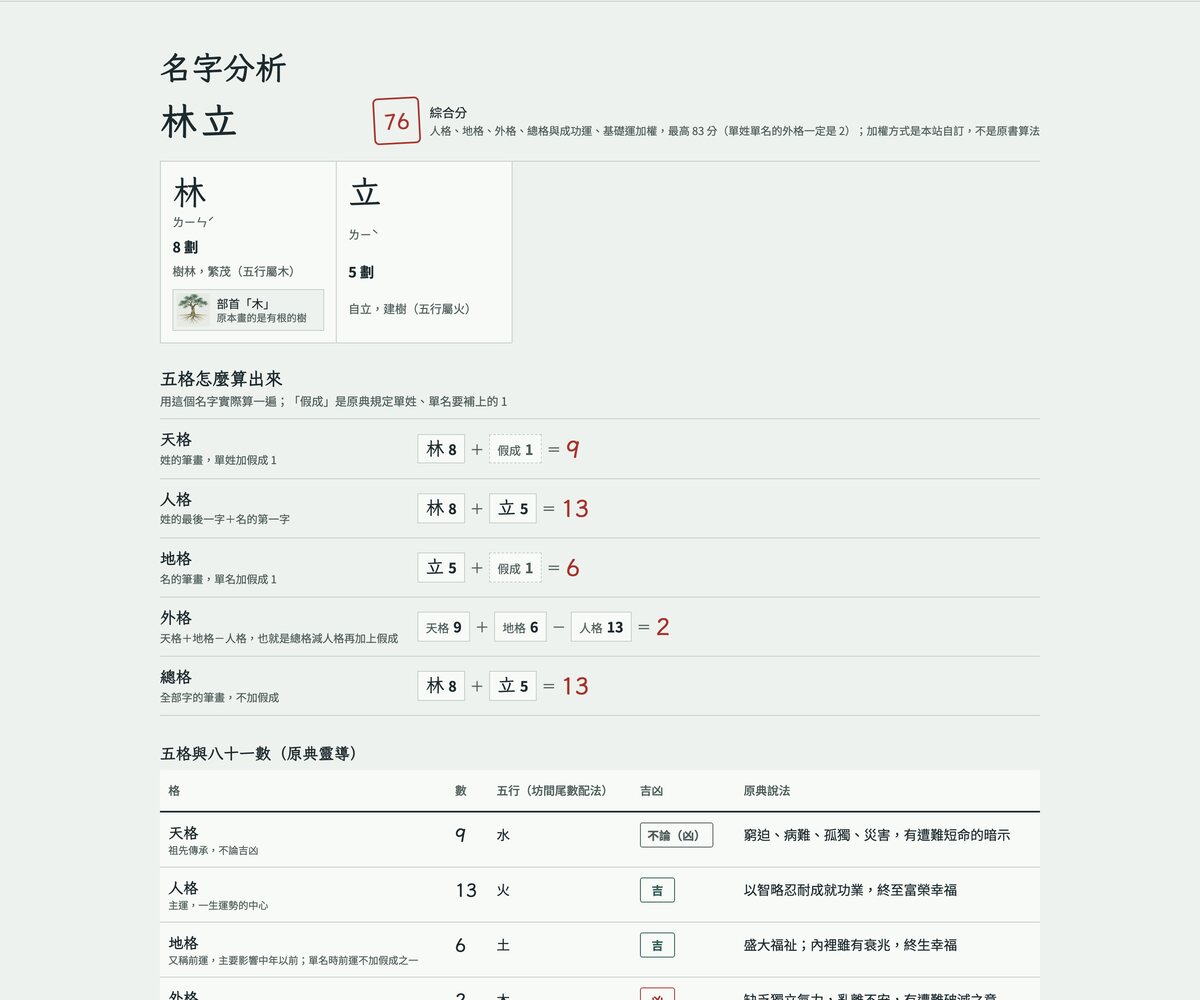
The five grids are calculated as in Kumazaki's 1939 book (p.42, p.43): the strokes of the surname add up to the Heaven Grid; the last character of the surname plus the first character of the given name make the Person Grid; the strokes of the given name add up to the Earth Grid; all strokes together make the Total Grid; the Outer Grid is the Heaven Grid + the Earth Grid − the Person Grid, which equals the Total Grid minus the Person Grid, plus the added "1" (kasei no ichi). A one-character surname gets 1 added to the Heaven Grid and a one-character given name gets 1 added to the Earth Grid; the book calls this the added "1". The Outer Grid includes this 1; the Total Grid does not. The table below works through the naming tool's default name 陳思潔 and the example 林立, a one-character surname with a one-character given name. The numbers are the ones the tool calculates.
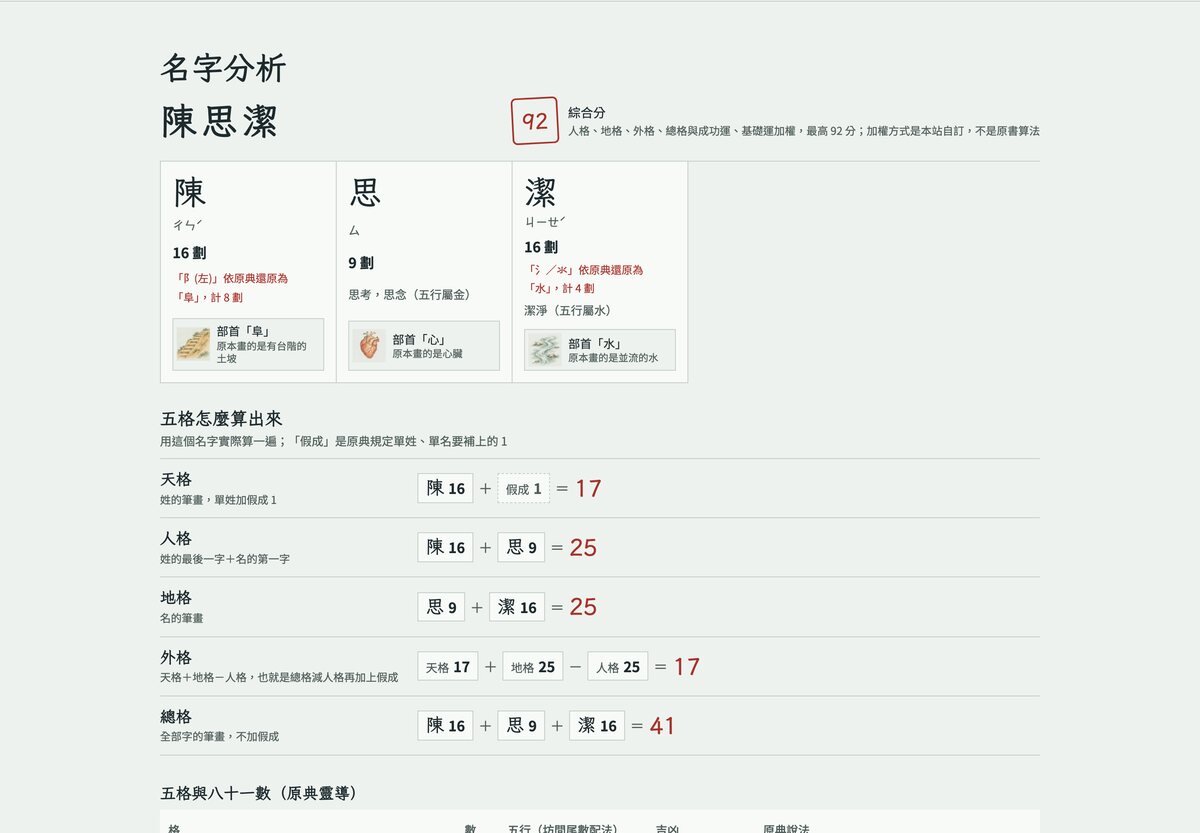
| Grid | How it is calculated | 陳思潔 | 林立 (one-character surname, one-character given name) |
|---|---|---|---|
| Heaven Grid | Strokes of the surname; a one-character surname gets the added "1" | 陳 16+1=17 | 林 8+1=9 |
| Person Grid | Last character of the surname + first character of the given name | 陳 16+思 9=25 | 林 8+立 5=13 |
| Earth Grid | Strokes of the given name; a one-character given name gets the added "1" | 思 9+潔 16=25 | 立 5+1=6 |
| Outer Grid | Heaven Grid + Earth Grid − Person Grid (= Total Grid − Person Grid + the added "1") | 17+25-25=17 | 9+6-13=2 |
| Total Grid | All strokes together, without the added "1" | 16+9+16=41 | 8+5=13 |
- How the Outer Grid is calculated: The book defines it as "Total Grid minus Person Grid" (p.43, p.117), but when a one-character surname or given name receives the added "1", the book's examples all include that 1 in the Outer Grid. For example, the example name 吉田茂 has Total Grid 22, Person Grid 16 and Outer Grid 7 (p.119), and the example name 乾新兵衛 has Total Grid 47, Person Grid 24 and Outer Grid 24 (pp.120–121). The method actually used is therefore "Heaven Grid + Earth Grid − Person Grid", that is, the Total Grid minus the Person Grid plus the added "1"; the tool's screen uses this method. However long the name is, only the two characters of the Person Grid are subtracted.
- The Outer Grid of a one-character surname and one-character given name is always 2: The book says that when the surname and the given name each have one character, the Heaven Grid and Earth Grid each get the added "1" and the Total Grid does not, so the Person Grid and Total Grid are the same number and the Outer Grid is always 2: "however good the Person Grid and Total Grid are, one side of the person's fortune will surely not escape misfortune and ruin" (pp.120–121). When the tool suggests names for a one-character surname with a one-character given name, it does not filter by the Outer Grid, and it says so on screen.
- The tool recalculates the book's examples: The book prints 12 examples on pp.118–121. Recalculated with the program of the naming tool as revised on 2026-11-22, 11 of them have the same five grids as the book, for example the example name 原敬 with Heaven Grid 11, Person Grid 23, Earth Grid 14, Outer Grid 2 and Total Grid 23 (p.123, pp.120–121), and the example name 廣田弘毅 with Heaven Grid 20, Person Grid 10, Earth Grid 20, Total Grid 40 and Outer Grid 30 (p.118). The only difference is the example name 乾新兵衛: the book counts the character 衛 as 16 strokes (the printed form makes it hard to tell whether it is the variant form 衞), while the tool counts 15 strokes, so the Earth Grid, Outer Grid and Total Grid each differ by 1 (pp.118–121). The book counts the character 郞 as 良 7 + 邑 7 = 14 strokes (p.119); the tool's character table has the character 郎 (it does not have 郞), and the revised tool counts it as 14 strokes, the same as the book.
- Two-character surnames: Enter the whole two-character surname in the tool's 姓 field (for example 歐陽 or 張簡); the Heaven Grid is the total strokes of the two characters, with no added "1".
How are the 81 numbers judged, and what about numbers above 81?
Each number from the five grids is checked against the 81 numbers (hachijūichi sū) of Kumazaki's book for good or bad. Numbers of 81 or above, subtract 80 and look up the result (the book says 81 itself has the same meaning as 1; p.223), so 82 equals 2 and 90 equals 10. The Heaven Grid is not checked against the 81 numbers; the book says its role is to be read together with the Person Grid for "success fortune" (p.44, pp.127–128). The book says the reasoning behind the 81 numbers is "nine times nine" (p.106, p.197).
| Level (arranged by HowBridge) | Count | Numbers |
|---|---|---|
| Good | 35 | 1, 3, 5, 6, 7, 8, 11, 13, 15, 16, 17, 18, 21, 23, 24, 25, 29, 31, 32, 33, 35, 37, 39, 41, 45, 47, 48, 52, 57, 61, 63, 65, 67, 68, 81 |
| Half-good | 6 | 30, 38, 58, 71, 73, 77 |
| Bad | 32 | 2, 9, 12, 19, 22, 26, 27, 28, 36, 40, 42, 43, 46, 49, 50, 51, 53, 55, 56, 59, 60, 62, 66, 69, 70, 72, 74, 75, 76, 78, 79, 80 |
| Very bad | 8 | 4, 10, 14, 20, 34, 44, 54, 64 |
- The four levels in the tool: The tool translated the book's explanation of each number into Chinese and then arranged them into four levels: good, half-good, bad and very bad. Good: 35 numbers; half-good: 6 numbers; bad: 32 numbers; very bad: 8 numbers (81 numbers in all). The four levels are HowBridge's own arrangement based on the book's explanations; the table above shows the level of each number. The "original wording" column on the tool's screen is a Chinese translation of the explanations in the book's chapter "Brief Guide to the 81 Numbers" (Kanmei na hachijūichi sū reidō) (p.46 onward). The summary table marks only 21 and 23 as "bad for women", so the original-wording column has that note only for those two numbers; 33 and 39 are treated as leader numbers together with them on the basis of the account on p.45, and the tool's leader-number notice on screen covers them.
- The Heaven Grid is not judged as good or bad: The book says the surname is a sacred position handed down from the ancestors, which descendants may not change at will (p.122), so even if the Heaven Grid is a bad number, "it does not hinder one's fortune" (p.42). For example, the Heaven Grid of 林立 is 9, a bad number among the 81 numbers, but the tool still marks it "not judged" and leaves it out of the overall score.
- Leader numbers 21, 23, 33, 39: The 1939 book says these four numbers are "good for men but very bad for women", and that a woman who has these numbers among the four grids other than the Heaven Grid "will surely ruin her husband's fortune" (p.45); the explanation of number 21 also says "women have an innate promise that they must follow men" (p.206), and the summary table of the 81 numbers marks 21 and 23 as "bad for women" (p.48). This is the view of gender in the 1939 book, not HowBridge's position.
- How the tool treats leader numbers: The "four grids" in the book are the four grids other than the Heaven Grid: the Person, Earth, Outer and Total Grids (p.44). The tool follows the book: when analysing a girl's name it marks these four numbers as bad, and when suggesting names for a girl it always avoids these four numbers; there is currently no option to turn this off. The notice on screen says this is the book's wording. For example, the Total Grid of 林美文 is 21, which is good for a boy and bad for a girl. Whether or not you mind this, you can check a name yourself with 看這個名字.
How does Kumazaki's book differ from the usual name-analysis teachings?
Compared with what is commonly taught, Kumazaki's 1939 book differs in several ways: the Heaven Grid is not judged as good or bad; the Three Powers (sansai: Heaven, Person, Earth) look at the Person Grid's "success fortune" against the Heaven Grid and "foundation fortune" against the Earth Grid (the book also calls the Heaven, Person and Earth Grids the "Three Powers of Heaven, Person and Earth" on p.117), not a Five Elements arrangement table; the Five Elements of the sound spirit (onrei, the pronunciation) follow how the name is actually read (for a Japanese name, the Japanese reading), and the book itself says their power is far weaker than the numbers; and the book has its own stroke dictionary at the end and does not tell the reader to look up the Kangxi Dictionary. The table below sets the book's wording beside what the naming tool does; the page numbers link to the page images at the National Diet Library.
| Item | What the 1939 book says | What the naming tool does |
|---|---|---|
| Heaven Grid | The surname is the position of the ancestors, and its number is not judged as good or bad (p.42, pp.127–128), but it has "absolute power to decide success or failure" over the Person Grid and Earth Grid (p.44) | Marked "not judged" and left out of the overall score; used only to read success fortune |
| Outer Grid | Total Grid minus Person Grid, with the added "1" of a one-character surname or given name counted into the Outer Grid (p.43, p.119, pp.120–121); with a one-character surname and given name it is always 2 | Heaven Grid + Earth Grid − Person Grid, the same as the book's examples; names with a one-character surname and given name are not filtered by the Outer Grid |
| Three Powers (Heaven, Person, Earth) | The Person Grid's last digit is divided into five groups (1–2, 3–4, 5–6, 7–8, 9–10); it is read against the Heaven Grid for success fortune and against the Earth Grid for foundation fortune, and the tens (10, 20) are dropped so that only the last digit is used (p.129, p.130) | Uses these two tables of the book, translating each of the 25 combinations one by one, with the levels arranged by HowBridge; the Five Elements arrangement table for Heaven, Person and Earth that is common in the market (five elements across three grids give up to 125 combinations) is not used |
| 81 numbers | Nine times nine is eighty-one (p.106); numbers of 81 or above, subtract 80 and look up the result, and 81 itself has the same meaning as 1 (p.223) | Same as the book |
| Leader numbers | 21, 23, 33, 39: good for men, very bad for women (p.45) | Shown in the analysis; avoided when naming a girl |
| Radicals | Restored according to the "soul of the character" (moji no tamashii); only the radical that decides the classification is restored (pp.45–46, p.113) | 13 radicals are restored (in addition, the radical 爿 is counted as 4 strokes as in the book, with no change in strokes); radicals are determined from Unicode Unihan. The book's dictionary radical table also counts 耂 as 老, 6 strokes (pp.230–231); the tool does not restore 耂 |
| Sound-spirit Five Elements | Five Elements are assigned by how the name is actually read (for Japanese names, the Japanese reading; the book says assigning them by the Chinese-style on-yomi readings of the characters is a big mistake), with a list of which element each group of kana belongs to (p.190); but it says the power of the sound spirit is "very weak compared with the number theory of the five grids", and the details are omitted (p.192) | Not used; the tool's "Five Elements of the character" uses the radical and the meaning of the character instead (not from the original book) |
| Which dictionary to use | The book ends with the "Kumazaki-Style Name Analysis Applied Dictionary" (Kumazaki-shiki seimeigaku ōyō jiten; Part 7, from p.227) and says a reliable dictionary is a must for naming; the main text says that which radical a character belongs to can be found by looking it up in a dictionary (p.111) and that other parts are counted by the printed form (p.113); a search of the full text finds no occurrence of the two characters for "Kangxi" | The radical and non-radical strokes come from the kRSUnicode field of Unicode Unihan (roughly following the Kangxi Dictionary's conventions); for characters whose radical need not be restored, the Unihan total stroke count is the basis, and 226 characters have been corrected by cross-checking with the Ministry of Education (MOE) and Kangxi counts; the tool has not been checked character by character against the book's dictionary |
- The Three Powers in the market: The "Three Powers" commonly taught look at the Five Elements pairing of the three numbers of the Heaven, Person and Earth Grids, for example "metal–water–metal" (Wikiversity entry on name studies (Xingmingxue); the entry title is in Simplified characters); five elements across three grids give at most 5×5×5 = 125 combinations. The book's Part 4, "Branching Points of Fortune Centred on the Person Grid" (Jinkaku chūshin no kikkyō bunkiten), uses a different comparison: only the Person Grid is compared with the Heaven Grid and with the Earth Grid (p.130).
- The two tables of success fortune and foundation fortune: The tool translated the book's explanation for each of the 25 cells one by one, and HowBridge then divided them into four levels, good, half-good, bad and very bad, based on the explanations (the book has only text explanations, with no levels): the success-fortune table has 9 good, 6 half-good, 5 bad and 5 very bad cells, and the foundation-fortune table has 9 good, 3 half-good, 8 bad and 5 very bad cells. For example, when the Person Grid and Heaven Grid both end in 1 or 2, the book says "success goes smoothly, and one's hopes are achieved peacefully" (p.130).
- The book's assessment of itself: The book says Kumazaki-style name analysis is "completely reasonable, scientific and proven, with not the slightest room for doubt" (pp.192–193), but the book presents no evidence that can be tested: it says it will not discuss why numbers can sway fortune (p.106), and what it offers in support is the sales of the author's books and readers' praise (pp.192–193); this page does not adopt that claim.
How are name strokes counted? Which character does a radical restore to?
Kumazaki's book holds that strokes should be counted by the "soul of the character" (moji no tamashii): a radical is restored to the character it originally was, for example 氵 counts as 水 with 4 strokes, 艹 as 艸 with 6 strokes, and 辶 as 辵 with 7 strokes; numerals count by their value, so 四 counts as 4 and 九 as 9; and only the radical that decides the classification is restored, while the other parts are counted by their printed form (pp.45–46, p.110, p.113). The naming tool's method is: the radical counts by the strokes it has after restoration as in the book, plus the strokes outside the radical; the radical and the non-radical strokes come from the kRSUnicode field of the Unicode Unihan database (Unicode 17), roughly following the conventions of the Kangxi Dictionary. For example, 河 is 氵 restored to 水 with 4 strokes, plus 可 with 5 strokes, 9 strokes in all; 芳 is 艹 restored to 艸 with 6 strokes, plus 方 with 4 strokes, 10 strokes in all. For characters whose radical need not be restored, the Unihan total stroke count is the basis; among them, for 226 characters the Unihan total stroke count differs from both the MOE Concised Mandarin Chinese Dictionary and the Kangxi count while those two agree, and the tool now uses the strokes of those two, for example 健 11 strokes and 吸 7 strokes. 13,064 Traditional Chinese characters are included in all.
| Radical | Restored to | Counted as strokes | Example characters (tool strokes) |
|---|---|---|---|
| 氵, 氺 (for example 泰) | 水 | 4 | 江 7 strokes, 泰 9 strokes |
| 扌 | 手 | 4 | 打 6 strokes |
| 忄 | 心 | 4 | 情 12 strokes |
| 犭 | 犬 | 4 | 猛 12 strokes |
| 王 (the jade radical) | 玉 | 5 | 玲 10 strokes |
| 礻 | 示 | 5 | 福 14 strokes |
| 艹 | 艸 | 6 | 花 10 strokes |
| 月 (the meat radical) | 肉 | 6 | 胡 11 strokes |
| 衤 | 衣 | 6 | 補 13 strokes |
| 罒 | 网 | 6 | 羅 20 strokes |
| 辶 | 辵 | 7 | 這 14 strokes |
| 阝 (right) | 邑 | 7 | 郭 15 strokes |
| 阝 (left) | 阜 | 8 | 陳 16 strokes |
- Only the radical that decides the classification is restored: As its example the book gives the character 酒: it does not belong under 氵 but mainly under 酉, and is counted by its printed form as 10 strokes; in the character 蓮 the grass top counts as 6 strokes, while 辶 is a secondary part and is counted by its printed form as 4 strokes (p.113). The tool gives 酒 10 strokes and 蓮 17 strokes, which agrees with the book's method; but not every character matches the book, for example the character 衛 (see the section on the five grids).
- Numerals count by their value: The numerals one to ten count by value (四 4, 五 5, 九 9, 十 10); the book says that by printed form 四 has five strokes and 五 has four, exactly the opposite, so printed form is not used (p.110, p.46); 百, 千 and 萬 are no longer numerals and count as ordinary characters.
- Non-radical strokes follow the Kangxi-style non-radical strokes in Unihan: For example 流: 氵 is restored to 水 with 4 strokes, and the non-radical part has 6 strokes, 10 strokes in all (the Kangxi Dictionary files 流 under the 水 section with 6 more strokes, Unihan kKangXi page 623; in the MOE Concised Mandarin Chinese Dictionary 流 also has 6 strokes outside the radical). 淵 has 8 non-radical strokes, 12 strokes in all (Unicode Unihan).
- Characters whose radical need not be restored: The Unihan total stroke count is the basis, then cross-checked against the Ministry of Education standard forms and the Kangxi method (the Kangxi radical strokes plus the non-radical strokes). Of 9,406 characters, 9,073 use the Unihan total stroke count; 333 do not, and of these 297 match the MOE standard and the Kangxi count, including 226 characters that on 2026-11-22 were switched to the MOE and Kangxi strokes (for example 健 11 strokes, 吸 7 strokes, 御 11 strokes; the Unihan total strokes are 10, 6 and 12 respectively); 23 characters match the Kangxi count (the Concised Dictionary does not list them or differs), and 5 characters match the MOE standard (for example 初 8 strokes, which the Concised Dictionary files under the 衣 section; the Kangxi Dictionary files 初 under the 刀 section, which makes 7 strokes by Kangxi); 2 characters, 萬 and 蒸, are filed under the 艸 section in the Kangxi Dictionary, so 艹 is restored to 艸 with 6 strokes (萬 15 strokes, 蒸 16 strokes); the 6 characters 成, 暑, 煮, 盛, 者 and 臾 fit none of these methods, and HowBridge has not yet found where their values come from.
- How characters that use the Unihan total stroke count differ from the Kangxi stroke table: Among the 9,073 characters that use the Unihan total stroke count, 642 still differ from the Kangxi count, mostly by only 1 stroke (of these, 538 are not listed in the Concised Dictionary and 93 match the MOE standard; for example 朗 has 10 strokes in both the tool and the MOE, while under Kangxi the 月 section gives 4 + 7 = 11 strokes), so the tool may differ from the Kangxi stroke tables found in the market. The tool's strokes are not "all according to the Kangxi Dictionary".
- What the book says about "the other parts": The book says only that the radical that decides the classification is restored by the "soul of the character" and that the other parts are counted "by the printed form". It gives examples: the small hook at the end of 龍, and the small hook-dots that the natural stroke movement brings out in characters such as 雅 or 韋, are not counted, while the smallest parts of 骨 and 鍋 are counted (p.113). The book has its own stroke dictionary at the end (p.227), which the tool does not adopt character by character; a search of the book's full text also finds no occurrence of the two characters for "Kangxi". Which form to use when counting non-radical strokes is a choice made by the tool, not a rule of the book.
- Different from the MOE standard strokes: The tool's strokes follow the name-analysis method and are not the stroke counts of the MOE standard forms. Of the 13,064 characters, 6,019 are also listed in the MOE Concised Mandarin Chinese Dictionary, and of these 1,448 have a total stroke count different from the Concised Dictionary: 1,386 belong to radicals that are restored, 7 are numerals, and in the remaining 55 the radical need not be restored: for 28 characters the tool uses the Unihan total stroke count and matches the Kangxi count, but the MOE differs (for example 充 is 6 strokes in the tool and 5 in the Concised Dictionary), and for 11 characters, the tool (which uses the Unihan total stroke count), the Concised Dictionary and Kangxi give three different counts (for example 誕 is 13 in the tool, 15 in the Concised Dictionary and 14 in Kangxi); 16 characters are other cases.
- Examples: 花 is 10 in the tool and 8 in the Concised Dictionary (艹 is restored to 艸); 陳 is 16 in the tool and 11 in the Concised Dictionary (the left-hand 阝 is restored to 阜); 胡 is 11 in the tool and 9 in the Concised Dictionary (the meat-radical form of 月 is restored to 肉). For practising writing and counting stroke order, please follow school textbooks and the MOE Concised Mandarin Chinese Dictionary.
- The character 王 itself counts as 4 strokes: The book says the radical form 王 "counts as five strokes like the character 玉 even without the dot" (p.112); the tool restores 王 to 玉 with 5 strokes only when it is used as a radical, and the character 王 itself is counted by its printed form as 4 strokes.
- Zhuyin: The Zhuyin (Bopomofo) on the tool's character cards comes from the Taiwan readings in Unihan; for characters with several readings only one is listed, so please confirm the reading before naming.
Who invented the Five-Grid method and the 81 numbers?
The Five-Grid method is generally believed to have been devised by the Japanese author Kumazaki Ken'ō (1881–1961); the 81 numbers are Kumazaki's own claim to originality, and the earliest primary source HowBridge has found is Kumazaki's own book. He published Seimei no Shinpi in June 1929, and in his 1939 book Saishin Seimeigaku: Kaiun no Ishizue he describes both the Five-Grid method and the "81 numbers of the number-spirit guide" as "uniquely Kumazaki-style" methods (p.116, p.197). The book also mentions that before him there was already an "old name judgment" that counted strokes (p.46). It is often said that the 81 numbers come from Cai Shen (Cai Jiufeng) of the Southern Song, but the 81 in Cai Shen's Hongfan Huangji Neipian is a numerical framework of "nine times nine developed into eighty-one categories", while for divination it separately uses the yarrow-stalk method to reach 6,561; the Siku Quanshu abstract (tiyao), Cai Shen's own preface and the whole text do not mention names or strokes.
- Seimei no Shinpi of 1929: The catalogue of the National Diet Library of Japan records that it was published in June 1929 by Jitsugyō no Nihon Sha; the public scope of the digital collection is marked "only inside the National Diet Library; library and individual transmission only" (the NDL digital collection page), which means it can be read only inside the National Diet Library, through a participating library with the library transmission service, or through the individual transmission service as a registered NDL user, and it is not open to general online reading. HowBridge has not read this book; this page and the naming tool use a different book by Kumazaki, from 1939.
- The 1939 book is a retitled reissue: The note at the front of the book, "On the Retitled Edition" (Kaidai hakkō ni tsuite), says the book was originally issued in March 1937 (Shōwa 12) under the title Akachan no Nazuke Dokuhon (the baby naming reader), and that for the new printing the title was changed to the present one with Kumazaki's consent (front matter, "On the Retitled Edition"); the National Diet Library also holds the March 1937 book (catalogued as 赤ちゃんの名附読本). The 1939 book is in the public domain, and the National Diet Library publishes its full-text images.
- Kumazaki's own account: Numbers take one to ten as their base and nine as their limit, so the 81 numbers, nine times nine, are the standard for judging good and bad (p.106); he also declares that the 81 numbers are "strictly forbidden to be copied or reprinted without permission" (p.197).
- Cai Shen's eighty-one: The Siku Quanshu abstract (tiyao) of the Hongfan Huangji Neipian says Cai Shen "developed nine times nine into eighty-one categories" and "his yarrow-stalk method takes three as its outline, and the accumulated number is six thousand five hundred and sixty-one", and lists it among the arts-of-number works; Cai Shen's own preface says "nine nines make eighty-one, eighty-one leads to six thousand five hundred and sixty-one, and the numbers have come full circle". Both passages are about the development of numbers and divination, and neither mentions names or strokes; HowBridge also searched the whole text of the Wikisource Siku Quanshu edition and found neither 姓名 nor 筆畫 (the whole Hongfan Huangji Neipian). As for the popular claim that "Cai Jiufeng originated the 八十一名數圖" (see Wikiversity's entry on name studies), HowBridge has found no primary source.
- Arrival in Taiwan: The popular account is that in 1936 (ROC year 25) Bai Huiwen, who had studied in Japan, introduced it to Taiwan with Kumazaki's consent by translating it into Chinese as 姓名之命運學 and other books (for example, Wikiversity's entry on name studies). HowBridge has found no primary source for this history (for example, a catalogue record of the publications of that time), so it is presented only as a circulating claim.
How do I use HowBridge's five-grid naming tool?
Open 0523.tw/naming/ in a browser and enter the surname and given name to see the five-grid analysis; scroll down to 幫寶寶取名, enter the surname, the gender and the number of characters in the given name, and press 開始取名 to list suggested names. It is free, needs no login, and the screens are in Traditional Chinese only.
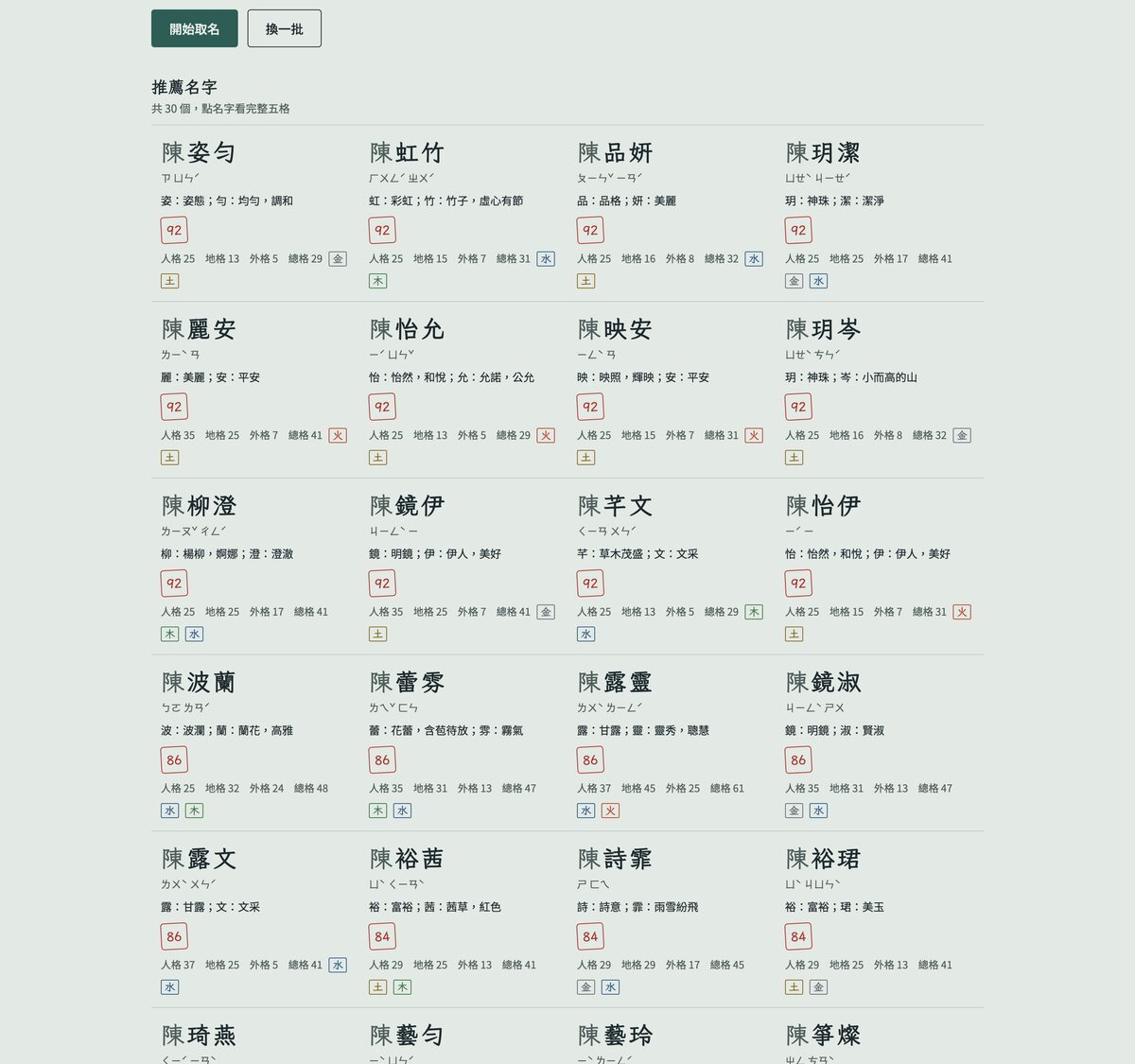
- How suggested names are picked: The tool first works out every combination of 1 to 30 strokes for each character of the name and keeps only combinations in which the Person, Earth, Outer and Total Grids are none of them bad or very bad and success fortune and foundation fortune are not very bad (the Outer Grid is ignored for a one-character surname with a one-character given name); it then picks characters from the naming pool of 513 characters and lists at most 30 names, with the same character appearing at most 2 times (only the 80 highest-scoring stroke combinations are used; 42 characters whose meanings are too general, such as 一, 人 and 大, are not placed in the automatic suggestions, but can still be chosen by hand from the stroke-combination table).
- Overall score: The score at the top right of the screen is the tool's own weighting (see the next section), with a maximum of 92 (when every item is good); for a one-character surname with a one-character given name the maximum is 83, because the Outer Grid is always 2. The same conditions always give the same names; they change only when you press 換一批.
- Stroke-combination table: Below the suggested names the good stroke combinations are listed; clicking one lists the characters in the naming pool that fit those strokes, and you can choose among them yourself.
1See the five grids of one name
Enter the name in the 姓 and 名 fields at the top of the page and press 看這個名字. The five-grid diagram on the right marks the Heaven, Person, Earth, Outer and Total Grids; enter a two-character surname whole in 姓.
2Read the "name analysis"
The card of each character shows the strokes the tool counted, and characters with radical restoration are noted, for example 陳 is annotated with the left-hand 阝 restored to 阜 as in the original book, counted as 8 strokes. Below it, 五格怎麼算出來 lists the calculation of each grid, and further down are the table of five grids and 81 numbers, success fortune and foundation fortune.
3Name a baby
In 幫寶寶取名, enter the surname, choose boy or girl and 兩字名 or 單名; birthday and birth hour are optional, and if entered, the Five Elements needed by the Eight Characters (bazi) are given priority. You can also enter 指定用字 (for example a generation character) and 不要用的字; press 開始取名, and press 換一批 to see other combinations.
4Look at the zodiac if you need it
Choose a zodiac animal in 生肖 and the name analysis marks the zodiac likes and dislikes character by character; when naming, enter a birthday (or choose the zodiac directly) and characters that violate the taboos are avoided. Zodiac likes and dislikes are a different school and do not affect the five grids or the overall score.
Which parts of the naming tool are not from Kumazaki's book?
The overall score, the Eight Characters Five Elements supplement, the Five Elements of characters, the Five Elements of grid numbers, the naming pool and the zodiac likes and dislikes in the naming tool are not from Kumazaki's book; they are reference features that HowBridge added. Only the five grids, radical restoration, the 81 numbers, and success fortune and foundation fortune follow the 1939 book.
- Overall score: The "overall score" on the tool's screen is not the book's method but a weighting set by HowBridge: Person Grid 30%, Total Grid 20%, Earth Grid 18%, Outer Grid 14%, success fortune 9%, foundation fortune 9%; good, half-good, bad and very bad are given 92, 66, 30 and 8 points respectively, and the Heaven Grid is not scored; when every item is good the score is 92, so the maximum is 92.
- Eight Characters Five Elements supplement: The book mentions looking at "innate fortune" from the year, month, day and hour of birth (p.190); the tool's Eight Characters is a simplified method HowBridge added separately, using the simplified "support and suppress" method common in Taiwan (weighting the heavenly stems and the hidden stems of the earthly branches, with extra weight on the month), and the open-source lunar-javascript (MIT licence) for calendar conversion; it is calculated only if a birthday is entered, and the result serves only as a reference for choosing characters.
- Five Elements of characters: The tool decides them from the radical and the meaning of the character (the usual practice in Taiwan). What Kumazaki's book discusses is the "sound-spirit Five Elements" (onrei), assigned by how the name is actually read (for a Japanese name, the Japanese reading), and the book itself says its power is far weaker than the numbers (p.192).
- Five Elements of grid numbers: The "Five Elements" column of the five-grid table and the labels such as "1–2 (wood)" next to success fortune and foundation fortune use the pairing common in the market, "last digit 1–2 is wood, 3–4 is fire …"; the book's chapter on success fortune uses only last-digit groups and assigns no Five Elements (p.129, p.130).
- Naming pool: 513 characters commonly used in names; the explanations of meaning were written by HowBridge; each character is marked as suitable for boys, for girls or for both (209 for boys, 143 for girls, 161 for both), so a boy's name does not use characters marked for girls only, and vice versa.
- Zodiac likes and dislikes: Zodiac name analysis is a different school and has nothing to do with Kumazaki's system. For the 12 zodiac animals the tool includes 87 preferred and 95 avoided character components and 4 quantity limits (for the horse 口 and 人 at most 1 each, for the dog 人 at most 1, for the rooster 日 at most 1). The tool's notice says "only rules on which at least three sources agree are included", but the schools often say opposite things, and not one of the rules is settled.
- The rooster's 日, at most one: HowBridge found only one source for this rule of the tool (a fortune-teller's blog), which does not meet the tool's own standard of "at least three sources agree"; and that blog's own wording is that 口 or 日 together may appear only once. In the component table of Wikiversity's entry on zodiac name analysis, the rooster's column for "containing 日" is marked O (in the same table O means usable in the other columns). The tool currently restricts only 日, so please treat it as the view of one school.
- Characters from pictures: The passages in the tool that explain the pictographic origins of Chinese characters are background to help understand radical restoration, not Kumazaki's account; the illustrations of objects were drawn by ChatGPT according to the meaning of the character and show only what the character depicts, and the oracle-bone, bronze and seal-script forms come from Wikimedia Commons' "Ancient Chinese characters project". The "what the radical originally drew…" notes in the name analysis cover 20 pictographic radicals and 5,727 characters.
Are the names and birthdays I enter sent anywhere?
The name, birthday and birth time you enter are calculated only in your browser and are not sent to HowBridge's servers. The naming tool's fonts are provided by Google Fonts, and the browser downloads font files from Google according to the characters that appear on screen. The following are the results of HowBridge's own test on 2026-11-22, before launch, of the revised naming tool, run locally with an automated browser.
- Test method: One round each at phone width (390) and desktop width (1440), entering test names, birthdays and birth times, analysing names, naming, and choosing a zodiac; plus extra tests with rare characters and a 40-second session of actions. All requests sent by the page were GET with no body; comparing them one by one against the test name, birthday and time strings (including URL-encoded forms), 0 requests carried any of them.
- Requests to HowBridge: only the page itself, the program and style files, 5 data files (strokes, the naming pool, the radical table, ancient character forms, zodiac character splits), the illustrations, and the usage-statistics reports. The parameters of a statistics report are only the event type (open, play, leave), the tool code, a random code for this load, the referrer, whether it was opened from the Home Screen, the seconds, and the number of actions.
- Requests to other sites: only Google Fonts (fonts.googleapis.com, fonts.gstatic.com). After you enter a rare character, the browser downloads a few more font slices; the request does not contain the text itself, but Google could in theory infer which batch of characters appeared on screen; and as with any ordinary web request, Google also sees the IP address and browser information. HowBridge therefore does not say "never connects to anything outside".
- Usage statistics: The naming page reports openings (including whether it was opened from a Home Screen icon), the referring page, play time and number of actions to HowBridge, to see which games are being played. These reports carry no cookies and contain no name or account; but, as with any ordinary web request, the server logs record the IP address and browser information.
What are the rules for changing a name in Taiwan?
Under the Name Act (Taiwan) (amended 2024-05-29), a Taiwanese national's registered name is their legal name and is limited to one; a name change must fit one of the cases listed in Article 9, and an application on the grounds of "a vulgar or inelegant meaning, an overly long transliteration, or a special reason" is limited to three times, with a minor's second change possible only after reaching adulthood. The text does not list name-analysis strokes as a reason for a name change; whether they can be accepted as a "special reason" is up to the household registration office.
- Cases in which Article 9 allows a name change: having exactly the same full name as another person serving or studying at the same public or private enterprise, agency, organisation or school at the same time; having exactly the same given name as a lineal ascendant within the third degree of kinship; having exactly the same full name as another person while both have had household registration in the same special municipality, county or city at the same time for at least six months; having exactly the same full name as a wanted fugitive; being acknowledged, having an acknowledgment revoked, being adopted, or having an adoption revoked or terminated; a vulgar or inelegant meaning, an overly long transliteration or a special reason; and Taiwanese indigenous peoples on the basis of cultural custom.
- Cases in which a name cannot be changed: Article 15 provides that a person who is wanted or detained, who has a final judgment of compulsory labour, or who has a final judgment of imprisonment or heavier without a suspended sentence or without permission to commute to a fine or to community service (except for negligent offences) may not apply to change the surname or given name or to alter the name; for the last two, the period runs from the day the judgment becomes final until three full years after the sentence has been served.
- Characters allowed in names: Article 2 provides that a Chinese name in the household register must use characters found in commonly used dictionaries such as Ciyuan, Cihai and the Kangxi Dictionary, or in the Mandarin dictionaries compiled by the Ministry of Education. Here the Kangxi Dictionary defines "which characters may be used" and is not the stroke method of name analysis.
- Source of the text: The Name Act (Taiwan) in the Laws and Regulations Database of the Republic of China; this page only restates the text and is not legal advice on any individual case.
What are the limits of this tool and this guide?
There is no scientific evidence that name strokes can affect a person's life; this guide and the naming tool are folk-culture references and cannot predict or change fortune. When choosing a name, a good meaning, a pleasant sound and a good look in writing often matter more than strokes.
- The book's claims are not facts: The book calls itself "completely reasonable, scientific and proven" (pp.192–193) but presents no testable evidence; terms in the book such as "short-life numbers" (p.44) and what it says about women are the language and ideas of the 1930s, and this page repeats them as they are only to stay faithful to the original source.
- Traditional Chinese only: The naming tool's screens are in Traditional Chinese only, and its character list contains Traditional characters; a character not in the list cannot be calculated, and the tool says so. This guide comes in 14 languages.
- Strokes are not the MOE standard: The tool's strokes follow the name-analysis method, and 1,448 characters have a total stroke count different from the Concised Dictionary; for practising writing or looking up strokes, please use the Ministry of Education's materials.
- May differ from other stroke tables: For characters whose radical is restored, the non-radical strokes follow the Kangxi-style non-radical strokes in Unihan (for example 流 10 strokes); for characters whose radical need not be restored, the Unihan total strokes are the basis and 226 characters have been corrected by cross-checking the MOE and Kangxi counts, but 642 characters still differ from the Kangxi count and may differ from the Kangxi stroke tables found in the market (mostly by 1 stroke); in addition, HowBridge has not yet found where the values of 6 characters come from.
- Fonts connect to Google: The tool's fonts are provided by Google Fonts, and the browser downloads font files from Google; the name and birthday you enter are not sent to HowBridge's servers.
- Zhuyin and zodiac: For characters with several readings only one reading is listed; the schools of zodiac likes and dislikes disagree, and the tool includes only some of their rules.
- The edition this page reads: Quotations are taken from the 1939 book (a retitled reissue of Akachan no Nazuke Dokuhon of 1937). Kumazaki's Seimei no Shinpi of 1929 is a different book and is not open to general online reading (the National Diet Library marks it as viewable only inside the library, or through its library transmission or individual transmission service); HowBridge has not read it, and cannot confirm whether the methods of the two books are exactly the same.
- Data date: The number of characters and rules in the tool follow the version revised on 2026-11-22, and this page will be updated together with the tool when the tool is revised again.
Which terms do you meet in five-grid name analysis?
- Five-Grid method (gokaku bōshō-hō)
- A name-stroke calculation devised by Kumazaki Ken'ō that divides a name into the five grids, Heaven, Person, Earth, Outer and Total, and checks each against the 81 numbers for good or bad.
- Heaven Grid (tenkaku)
- The total strokes of the surname (with the added "1" for a one-character surname); the book says the Heaven Grid is not checked against the 81 numbers for good or bad, but has "absolute power" over whether the Person Grid and Earth Grid succeed (p.44). The tool uses it only to read success fortune against the Person Grid.
- Person Grid (jinkaku)
- The last character of the surname plus the first character of the given name; the book calls it the "main fortune" (shuun), and it is the most important of the five grids.
- Earth Grid (chikaku)
- The total strokes of the given name (with the added "1" for a one-character given name); the book says it mainly affects the years before middle age.
- Outer Grid (gaikaku)
- Heaven Grid + Earth Grid − Person Grid, equal to the Total Grid minus the Person Grid plus the added "1"; the book calls it the "secondary fortune" (fukuun); with a one-character surname and given name it is always 2.
- Total Grid (sōkaku)
- The total strokes of the whole name, without the added "1".
- The added "1" (kasei no ichi)
- The 1 added to the Heaven Grid for a one-character surname and to the Earth Grid for a one-character given name; the book writes it as 假定の一 on p.43 and as 假成の一 on p.120.
- 81 numbers (hachijūichi sū)
- The explanation of good and bad that Kumazaki's book writes for each number from 1 to 81; for numbers of 81 or above, subtract 80 and look up the result (81 itself has the same meaning as 1).
- Leader numbers (tōryō-un)
- In the book, the four numbers 21, 23, 33 and 39, said to be good for men and very bad for women; this is the view of the 1939 book.
- Success fortune
- The combination of last digits of the Heaven Grid seen from the Person Grid, which the book calls success fortune; the Person Grid and Heaven Grid are each divided into five groups, giving 25 combinations.
- Foundation fortune
- The combination of last digits of the Earth Grid seen from the Person Grid, which the book calls foundation fortune, again with 25 combinations.
- Radical restoration
- Replacing a radical with the character it originally was in order to count strokes, for example 氵 counts as 水 with 4 strokes and 艹 as 艸 with 6 strokes; the book's reason is that strokes should be counted by the "soul of the character" (moji no tamashii).
- Sound spirit (onrei)
- In the book, the power of pronunciation, with Five Elements assigned by how the name is actually read (for a Japanese name, the Japanese reading); the book says it is much weaker than the numbers of the five grids, and omits the details.
What are the sources and the scope of checking?
The following sources were consulted on 2026-11-22; the page numbers of the book are the numbers printed in the book and link to the page images in the digital collection of the National Diet Library of Japan (the 1939 book is in the public domain). The book is in Japanese, and the quotations on this page are HowBridge's own translations; the Japanese original and the page-by-page checking records are kept in HowBridge's research files. The tool's numbers are calculated by a program reading the data files of the naming tool as revised on 2026-11-22, and the tool's own program was used to recalculate the 12 examples on pp.118–121 of the book (11 the same, 1 different).
Original sources, official materials and other sources
- Kumazaki Ken'ō, Saishin Seimeigaku: Kaiun no Ishizue (1939), front matter (the NDL catalogue gives 最新姓名学) | Document date: 1939; translation: This book was originally issued in March of Shōwa 12 (1937) under the title Akachan no Nazuke Dokuhon (the baby naming reader); for this reissue, with the special consent of the author Mr. Kumazaki, the title was changed to Kaiun no Ishizue: Saishin Seimeigaku and it was bound anew and published.
- Kumazaki Ken'ō, Saishin Seimeigaku: Kaiun no Ishizue (1939), p.42 | Document date: 1939; translation: All the strokes of the surname together are the Heaven Grid, and even if it is a bad number, it does not hinder one's fortune. The last character of the surname and the first character of the given name, with only the strokes of these two characters added together, are the most important part that governs a person's whole life, and are also called the main fortune. (The Earth Grid) is the part made only of the strokes of the given name, which has a large influence mainly before middle age.
- Kumazaki Ken'ō, Saishin Seimeigaku: Kaiun no Ishizue (1939), p.43 | Document date: 1939; translation: The number left after subtracting the Person Grid from the Total Grid is the Outer Grid; however long the name is, only the two characters of the Person Grid are subtracted, and all that remains is the Outer Grid. The Outer Grid is also called the secondary fortune, and is the most important part after the main fortune. When the surname has one character and the given name also has one character, only the Person Grid is left, and the Heaven Grid and Earth Grid cannot be formed. In this case, a hypothetical 1 is placed above the surname as the Heaven Grid, and in the same way a hypothetical 1 is placed below the given name as the Earth Grid. The Outer Grid is 2, made of the two hypothetical 1s; the Total Grid does not add the hypothetical numbers, so it is the same as the Person Grid.
- Kumazaki Ken'ō, Saishin Seimeigaku: Kaiun no Ishizue (1939), p.44 | Document date: 1939; translation: The number theory of the Heaven Grid has nothing to do with good or bad, but it has the absolute power to decide the success or failure of the Person Grid and Earth Grid. Therefore the four grids other than the Heaven Grid must all have good numbers. (The next section, "Evil Numbers and Auspicious Numbers", Kyōaku na kazu to kisshō no kazu) If the four grids other than the Heaven Grid include numbers such as 2, 4, 9, 10, 12, 14, 19, 20, 22, 26, 27, 28 and 34, they bring all kinds of misfortune: poor health, things not going as wished, separation from, or the death of, one's wife and children, or failure, hardship in adversity, loneliness, poverty and unemployment, and in serious cases a short life and violent death. Among them 9, 10, 19 and 20 are called short-life numbers, and 4, 14 and 34 are called destructive fortune, with the greatest evil power of suggestion.
- Kumazaki Ken'ō, Saishin Seimeigaku: Kaiun no Ishizue (1939), p.45 | Document date: 1939; translation: Numbers such as 21, 23, 33 and 39 are called "leader numbers" (tōryō-un): they are good for men but very bad for women; a woman who has these numbers among the four grids (those other than the Heaven Grid) will surely ruin her husband's fortune, and through separation or death will become a widow.
- Kumazaki Ken'ō, Saishin Seimeigaku: Kaiun no Ishizue (1939), pp.45–46 | Document date: 1939; translation: A person's fortune is swayed not by the strokes visible on paper but by the number theory that becomes the "soul of the character". Therefore 氵 is 水 and counts four strokes; 艹 is 艸 and counts six strokes; 忄 is 心 and counts four strokes; 犭 is 犬 and counts four strokes; the ordinary 月 counts four strokes, while the 月 of the meat-radical form is 肉 and counts six strokes; 辶 is 辵 and counts seven strokes; 扌 is 手 and counts four strokes; 王 (the jade-radical form) is 玉 and counts five strokes; 礻 is 示 and counts five strokes; 衤 is 衣 and counts six strokes; the 阝 on the left is 阜 and counts eight strokes; the 阝 on the right is 邑 and counts seven strokes.
- Kumazaki Ken'ō, Saishin Seimeigaku: Kaiun no Ishizue (1939), p.46 | Document date: 1939; translation: In the old style of name judgment, the numerals 二, 七, 八, 九 and 十 were all counted as two strokes, which is a great mistake; numerals follow the number theory itself, so 七 is seven strokes, 八 is eight strokes and 十 is ten strokes. ("Brief Guide to the 81 Numbers", Kanmei na hachijūichi sū reidō) The 81 numbers, which are the standard of Kumazaki-style name analysis, will be listed in detail in Part 6; for convenience, the simple spirit guidance is listed below first.
- Kumazaki Ken'ō, Saishin Seimeigaku: Kaiun no Ishizue (1939), p.48 | Document date: 1939; translation: (21) A great leader fortune, respected and incomparably rich and noble; bad for women. (23) The greatest rising fortune, becoming a chief with a flourishing air of power; bad for women.
- Kumazaki Ken'ō, Saishin Seimeigaku: Kaiun no Ishizue (1939), p.106 | Document date: 1939; translation: Based on the base numbers one to ten, whose activity reaches its limit at nine, the spirit movement of the eighty-one numbers, nine times nine, is the standard for judging the good and bad of a name. This book does not discuss difficult questions such as why numbers can sway fortune, and tries only to show how to apply them in practice, …
- Kumazaki Ken'ō, Saishin Seimeigaku: Kaiun no Ishizue (1939), p.110 | Document date: 1939; translation: (Laypeople) often want to count strokes by the shape seen with the eyes, but that often goes wrong, so first remember the "soul of the character" and then count the strokes. By shape, 四 has five strokes and 五 has four, exactly the opposite. Needless to say, without being bound by shape, counting 四 as four strokes and 五 as five is only natural. 百, 千, 萬, 億 and 兆 are no longer numerals but ordinary characters that stand for large numbers, so their strokes may be counted in the ordinary way for characters.
- Kumazaki Ken'ō, Saishin Seimeigaku: Kaiun no Ishizue (1939), p.111 | Document date: 1939; translation: (Which radical a character belongs to) can be found at once by looking it up in a dictionary, and it is not hard if you roughly remember the following standards. 爿 (the 爿 radical): there is only one turning stroke on top, so it is four strokes. 氺 ("water below"): used in characters such as 泰, it looks like five strokes by shape, but it means 水 written at the bottom and is counted as four strokes.
- Kumazaki Ken'ō, Saishin Seimeigaku: Kaiun no Ishizue (1939), p.112 | Document date: 1939; translation: (The 王 radical) even without the dot counts as five strokes like the character 玉. (罒) used in characters such as 羅, it is the character 网 (the net top) and counts as six strokes.
- Kumazaki Ken'ō, Saishin Seimeigaku: Kaiun no Ishizue (1939), p.113 | Document date: 1939; translation: The character 酒 does not belong under 氵; it means brewing and is mainly under 酉, so it is counted by shape as ten strokes. Whether in the top part or the side part, only the basic part of a character (the part that decides its classification) is counted by the number of strokes of the "soul", and the other parts are counted by shape. For example, in 蓮, the grass top counts as six strokes and 辶 is a secondary part, counted by shape as four strokes. 敬 belongs under the 文 (攵) section and is not the grass top. The small hook at the end of 龍, and the small hook-dots in characters such as 雅 or 韋, come naturally from the movement of the brush and are not counted in the strokes; the smallest parts of characters such as 骨 and 鍋 are counted.
- Kumazaki Ken'ō, Saishin Seimeigaku: Kaiun no Ishizue (1939), p.116 | Document date: 1939; translation: The fundamental method of judging the good and bad of a name is the "five-grid analysis" explained earlier, a method unique to Kumazaki-style name analysis.
- Kumazaki Ken'ō, Saishin Seimeigaku: Kaiun no Ishizue (1939), p.117 | Document date: 1939; translation: (The Heaven Grid, Earth Grid and Person Grid) These are called the Three Powers of Heaven, Person and Earth, the foundation that everything must have, whatever it is. The strokes of all the characters of the name added together are the Total Grid, and what remains after subtracting the Person Grid from the Total Grid is the Outer Grid.
- Kumazaki Ken'ō, Saishin Seimeigaku: Kaiun no Ishizue (1939), pp.120–121 | Document date: 1939; translation: However, this added "1" (kasei no ichi) is not added to the Total Grid. In the example above the surname is a single character, so the added 1 goes to the Heaven Grid, and this 1 is likewise not added to the Total Grid. In a name where the surname and given name have one character each, as above, one added "1" goes to each of the Heaven Grid and Earth Grid, but the Total Grid does not count the added numbers and uses only the numbers of the two characters, so the Person Grid and Total Grid have the same number and the Outer Grid is always 2. Therefore, in a plain two-character name the Outer Grid is always a bad number; however good the Person Grid and Total Grid are, one side of the person's actual fortune will surely not escape misfortune and ruin.
- Kumazaki Ken'ō, Saishin Seimeigaku: Kaiun no Ishizue (1939), p.122 | Document date: 1939; translation: (The surname) is where the divine spirit of the ancestors dwells, so it is taken as the Heaven Grid and seen as a sacred position that descendants may not change at will and about which they cannot say whether they like it or not.
- Kumazaki Ken'ō, Saishin Seimeigaku: Kaiun no Ishizue (1939), pp.127–128 | Document date: 1939; translation: In fact the Heaven Grid is not judged as good or bad in number theory. (The Heaven Grid) is not given the good-or-bad interpretation of the 81 numbers. Then does the Heaven Grid have no important value? No: the number of the surname bears the most important task of governing the whole name.
- Kumazaki Ken'ō, Saishin Seimeigaku: Kaiun no Ishizue (1939), p.129 | Document date: 1939; translation: The Heaven Grid seen from the Person Grid is called the quality of success fortune; the Earth Grid seen from the Person Grid is called the strength of foundation fortune.
- Kumazaki Ken'ō, Saishin Seimeigaku: Kaiun no Ishizue (1939), p.130 | Document date: 1939; translation: Next, with the number of the Person Grid at the centre, the standards of good and bad against the Heaven Grid and Earth Grid are listed. Round numbers such as ten, twenty and thirty are left out, and only the last digit is used for comparison. So when it says "nine or ten", it applies equally to nine, ten, nineteen, twenty, twenty-nine, thirty and so on; when it says "three or four", it applies equally to three, four, thirteen, fourteen, twenty-three, twenty-four, thirty-three, thirty-four and so on; please remember this. When the Person Grid is one or two and the Heaven Grid is also one or two, success goes smoothly and one's hopes are achieved in peace.
- Kumazaki Ken'ō, Saishin Seimeigaku: Kaiun no Ishizue (1939), p.190 | Document date: 1939; translation: (To give a child the best name,) one must look into the star of destiny of innate fortune from relations such as the year, month, day and hour of birth, … the fifteen sounds ア、イ、ウ、エ、オ、ヤ、イ、ユ、エ、ヨ、ワ、ヰ、ウ、ヱ、ヲ (a, i, u, e, o, ya, i, yu, e, yo, wa, wi, u, we, wo) belong to earth.
- Kumazaki Ken'ō, Saishin Seimeigaku: Kaiun no Ishizue (1939), p.192 | Document date: 1939; translation: The old name analysis does not follow the actual pronunciation of a name but assigns the Five Elements by the Chinese-style on-yomi readings of the characters (the original uses the prewar Japanese term for China), which is a great mistake. The name 吉屋信子 should be assigned the Five Elements according to ヨシヤノブコ (Yoshiya Nobuko; the Japanese reading); the elements assigned from キチオクシンシ (Kichioku Shinshi; the on-yomi) have no reason to produce a power of suggestion and guidance. The sound spirit of a name is very difficult to investigate, and its guiding power is very weak compared with the number theory of the five grids, so it is omitted here.
- Kumazaki Ken'ō, Saishin Seimeigaku: Kaiun no Ishizue (1939), pp.192–193 | Document date: 1939; translation: In short, please consider the fact that name analysis has come to be known to the world, that my books have been read and loved in several hundred thousand copies, and that they have won the praise of "a hundred hits in a hundred shots, ten thousand hits in ten thousand shots" and absolute trust. Kumazaki-style name analysis is never an uncertain thing that plays with sophistry; it is completely reasonable, scientific and proven, with not the slightest room for doubt. Attached below are the spirit guidance of the eighty-one numbers and the dictionary that is indispensable for naming, with which this book ends.
- Kumazaki Ken'ō, Saishin Seimeigaku: Kaiun no Ishizue (1939), p.197 | Document date: 1939; translation: In addition, these "81 numbers of the number-spirit guide", the five-grid analysis, the way of reading a person's personality and so on are all methods unique to the Kumazaki style, and copying or reprinting them without permission is strictly forbidden. Eighty-one is the extreme number of yang, the number that results from nine times nine.
- Kumazaki Ken'ō, Saishin Seimeigaku: Kaiun no Ishizue (1939), p.206 | Document date: 1939; translation: However, because it is a great leader fortune, it instead brings great disaster to a woman. Originally women have an innate promise that they must follow men, …
- Kumazaki Ken'ō, Saishin Seimeigaku: Kaiun no Ishizue (1939), p.223 | Document date: 1939; translation: The number eighty-one reverts to the same number as the base number one, so the number eighty-two equals the single number two in spirit movement, and eighty-three returns to the single number three. Therefore numbers of eighty-one or above must have the round number eighty subtracted, …
- Kumazaki Ken'ō, Saishin Seimeigaku: Kaiun no Ishizue (1939), p.118 | Document date: 1939; translation: In this way, the 20 of 廣田 is the Heaven Grid, the 10 of 田 and 弘 is the Person Grid, and the 20 of the two characters 弘毅 is the Earth Grid; the Total Grid is 40, and the 30 of 廣 and 毅 is the Outer Grid.
- Kumazaki Ken'ō, Saishin Seimeigaku: Kaiun no Ishizue (1939), p.123 | Document date: 1939; translation: For example, for the example name 原敬, the Heaven Grid is eleven, the Person Grid twenty-three and the Earth Grid fourteen.
- National Diet Library (NDL): NDL Digital Collections IIIF manifest: pid 1107089 | Document date: 1939; NDL catalogue record of the 1939 edition: Fujokai-sha, Shōwa 14 (1939), access restriction marked PDM (public domain), full-text images open to the public.
- National Diet Library (NDL): NDL Digital Collections item API: pid 11576654, Seimei no Shinpi: Unmei Handan | Document date: 1929.6; Seimei no Shinpi was published by Jitsugyō no Nihon Sha in June 1929; the authority record for the author reads "Kumazaki, Ken'ō, 1881-1961". Its access setting in the digital collection is "only inside the National Diet Library; library and individual transmission only" (see the capture of the NDL digital collection page), which means it can be viewed only inside the National Diet Library, or through the library transmission service or the individual transmission service; it is not open to general online reading (a query of the IIIF image list on 2026-11-22 returned 404), so this page and the tool read a different book, from 1939.
- National Diet Library (NDL Search): NDL Search OpenSearch: author "Kumazaki Ken'ō" | Document date: 1937-03; Akachan no Nazuke Dokuhon published in March 1937 (the NDL catalogue writes 赤ちゃんの名附読本; publisher 朗文社) is the book from before the retitling of the 1939 edition.
- Laws and Regulations Database of the Republic of China (Ministry of Justice): Name Act (Taiwan) (amended on: 2024-05-29, Republic of China year 113) | Document date: 2024-05-29; the current text of Taiwan's rules on characters for names (Article 2), name changes (Article 9) and the bar on name changes (Article 15), amended on 2024-05-29 (Republic of China year 113, 5th month, 29th day).
- Unicode Consortium: Unihan Database (Unicode 17.0.0), the header and sample characters of Unihan_IRGSources.txt | Document date: 2025-07-24; the Unicode 17.0.0 release (header date 2025-07-24) on which the naming tool's character table is based for radicals and non-radical strokes (kRSUnicode) and total strokes (kTotalStrokes), and the Kangxi Dictionary position kKangXi (page 623 for 流, page 632 for 淵).
- Ministry of Education: Public-licence site of the MOE Mandarin Dictionary: download of the Concised Mandarin Chinese Dictionary data | Document date: 2026-10-01; the version 2014_20260929 of the text database of the Concised Mandarin Chinese Dictionary used for this page's comparison of "tool strokes versus MOE total strokes".
- Wikisource (Siku Quanshu edition): Abstract (tiyao) of the Hongfan Huangji Neipian | Document date: not given (respectfully proofread and submitted in the ninth month of the 46th year of Qianlong); the Siku Quanshu abstract (tiyao): Cai Shen developed nine times nine into eighty-one categories and used the yarrow-stalk method of divination (casting yarrow stalks) to work out numbers, filed under the arts-of-number works of the Masters branch; the abstract does not mention names or strokes.
- Wikisource (Siku Quanshu edition): Original preface of the Hongfan Huangji Neipian (Cai Shen's preface) | Document date: not given; Cai Shen's own preface: "nine nines make eighty-one, eighty-one leads to six thousand five hundred and sixty-one, and the numbers have come full circle", which concerns the development of numbers; the original preface does not mention names or strokes.
- Wikiversity (user-edited, revid 129302, 2019-04-02): Wikiversity entry on name studies (the entry title is written in Simplified characters: 姓名学) | Document date: 2019-04-02; examples of popular claims: the 81 numbers originate from Cai Jiufeng, Bai Huiwen introduced it in 1936, and the Three Powers look at the Five Elements arrangement (for example "metal–water–metal"). The entry gives no sources for these statements, and this page uses it only to show what is commonly said.
- Wikiversity (user-edited, revid 237817, 2023-04-10): Wikiversity entry on zodiac name analysis: the row "containing 日" in the list of character components liked and avoided by the 12 zodiac animals | Document date: 2023-04-10; example of a popular claim: in the row "containing 日" of the "list of character components liked and avoided by the 12 zodiac animals", the Rooster column is marked O (liked), the opposite of "people born in the Year of the Rooster should avoid more than one 日".
- 張定瑋 (a fortune-teller's personal blog): "Rooster: naming traits" (published 2018-09-12, modified 2022-02-23) | Document date: 2018-09-12; the only source for the naming tool's "at most one 日 in a rooster's name"; the blog's own wording is that 口 or 日 together may appear only once.
- HowBridge (this site's tool): explanatory text of the page 0523.tw/naming/ (version revised on 2026-11-22) | Document date: 2026-11-22; the page's own explanations in the naming tool (version revised on 2026-11-22) about the zodiac rules, leader numbers, Eight Characters, character counts, stroke method and source of illustrations; this page also recalculates the tool's data with a program.
- 6tail / HowBridge: licence file of lunar-javascript (self-hosted by the tool as vendor/lunar.js 1.7.7) | Document date: 2018; the calendar library lunar-javascript (MIT licence) that the naming tool uses to convert dates for the Eight Characters.
- cjkvi-ids / CHISE / HowBridge: licence note for the zodiac character-split data zcomp.json | Document date: 2026-11-21; the source of the naming tool's zodiac character-split data (CHISE / cjkvi-ids) and its GPLv2 licence.
- HowBridge (this site's own test): record of the naming tool's network-request test (on 2026-11-22, using the automated browser Playwright against the version revised on 2026-11-22, before launch and run locally, one round each at phone and desktop width, plus extra tests with rare characters and interaction) | Document date: 2026-11-22; record of the naming tool's network-request test (2026-11-22, one round each at phone and desktop width plus extra tests): all requests were GET with no body, 0 carried a test name or birthday; the only outside site was Google Fonts.
- HowBridge (this site's program): game statistics program /game-app/stats.js (fetched 2026-11-22) | Document date: 2026-11-21; the game statistics program: reports by GET without cookies (credentials: omit), and does not read or write identifiers, cookies or localStorage.
- Kumazaki Ken'ō, Saishin Seimeigaku: Kaiun no Ishizue (1939), p.119 | Document date: 1939; translation: (The Earth Grid of the example name 永田秀次郞) why is it twenty-seven? Because by the stroke-counting method explained earlier, the character 郞 is not counted by shape as ten strokes but, by the soul, as 良 plus 邑, fourteen strokes. What the five-grid analysis must handle specially is the case of a one-character surname or given name. As in the example above, 吉田 is the Heaven Grid and 田 with 茂 is the Person Grid with no problem, but the Earth Grid cannot be formed from the single character 茂.
- Kumazaki Ken'ō, Saishin Seimeigaku: Kaiun no Ishizue (1939), p.227 | Document date: 1939; translation: To choose the best name, a reliable dictionary is absolutely necessary. This part (Part 7, the "Kumazaki-Style Name Analysis Applied Dictionary", Kumazaki-shiki seimeigaku ōyō jiten) is attached specially for that need.
- Kumazaki Ken'ō, Saishin Seimeigaku: Kaiun no Ishizue (1939), pp.230–231 | Document date: 1939; translation: Radical table of "Names and Stroke Counts of the Side, Left, Top and Bottom Parts" (Tsukuri-hen-kanmuri-ashi no meishō to kakusū): under four strokes are listed 忄 (心), 扌 (手), 氵 (水), 犭 (犬), 氺 (水), 爿 and others; under five strokes 王 (玉) and 礻 (示); under six strokes 衤 (衣), 罒 (网), 耂 (老, the top form) and 艹 (艸, the grass top); under seven strokes 辶 (辵) and the right-hand 阝 (邑); under eight strokes the left-hand 阝 (阜).
- Wikisource (Siku Quanshu edition): Hongfan Huangji Neipian, the whole text (summary, original preface, volume 1, volume 2, and the sections of volumes 3 to 5) | Document date: not given; the whole text of the Hongfan Huangji Neipian in the Wikisource Siku Quanshu edition (summary, original preface, volumes 1 to 5): HowBridge searched the full text on 2026-11-22 and found none of 姓名, 筆畫, 筆劃 or 名字; 姓 appears only in phrases such as 異姓之親 and 百姓.
- Kumazaki Ken'ō, Saishin Seimeigaku: Kaiun no Ishizue (1939), pp.118–121 | Document date: 1939; translation: 廣田弘毅: 廣 15, 田 5, 弘 5, 毅 15 → Heaven 20, Person 10, Earth 20, Total 40, Outer 30 (p.118); 賴母木桂吉: 賴 16, 母 5, 木 4, 桂 10, 吉 6 → Heaven 25, Person 14, Earth 16, Total 41, Outer 27 (p.118); 永田秀次郞: 永 5, 田 5, 秀 7, 次 6, 郞 14 → Heaven 10, Person 12, Earth 27, Total 37, Outer 25 (p.118); 有田八郞: 有 6, 田 5, 八 8, 郞 14 → Heaven 11, Person 13, Earth 22, Total 33, Outer 20 (p.119); 吉田茂: 吉 6, 田 5, 茂 11 + added 1 → Heaven 11, Person 16, Earth 12, Total 22, Outer 7 (p.119); 乾新兵衛: added 1 + 乾 11; 新 13, 兵 7, 衛 16 → Heaven 12, Person 24, Earth 36, Total 47, Outer 24 (p.120); 星亨: added 1 + 星 9; 亨 7 + added 1 → Heaven 10, Person 16, Earth 8, Total 16, Outer 2 (p.121); 原敬: 原 10, 敬 13 → Heaven 11, Person 23, Earth 14, Total 23, Outer 2 (p.121); 森格: 森 12, 格 10 → Heaven 13, Person 22, Earth 11, Total 22, Outer 2 (p.121); 田昌: 田 5, 昌 8 → Heaven 6, Person 13, Earth 9, Total 13, Outer 2 (p.121); 東武: 東 8, 武 8 → Heaven 9, Person 16, Earth 9, Total 16, Outer 2 (p.121); 岡實: 岡 8, 實 14 → Heaven 9, Person 22, Earth 15, Total 22, Outer 2 (p.121).
- HowBridge (this site's tool): program app.js of the naming tool (version revised on 2026-11-22) | Document date: 2026-11-22; the screen text of the naming tool (version revised on 2026-11-22): the explanation of the overall score (maximum 92, weighting set by HowBridge and not the book's method), the maximum overall score of 83 for a one-character surname and given name, the leader-number notice (the gender view of 1939, not HowBridge's position), and the heading of the Five Elements column (the pairing common in the market by last digit).
- HowBridge (this site's tool): calculation core engine.js of the naming tool (version revised on 2026-11-22) | Document date: 2026-11-22; the calculation core of the naming tool (version revised on 2026-11-22): the points and weighting of the overall score, and the leader-number marking for girls' names (stating that it is the gender view of 1939, not HowBridge's position); the 2026-11-22 revision removed "bad for women" from the "original wording" of numbers 33 and 39 (the book's summary table marks only 21 and 23 as bad for women).
- National Diet Library (NDL): NDL Digital Collections, page-rendered text of Seimei no Shinpi: Unmei Handan (pid 11576654) (captured on 2026-11-22 at 10:12 Taipei time by rendering with an automated browser) | Document date: 2026-11-22; the "public availability" field on the NDL digital collection page of Seimei no Shinpi (1929): "viewable via the transmission service / only inside the National Diet Library; library and individual transmission only", meaning it can be viewed only inside the National Diet Library, or through the library transmission service or the individual transmission service (captured on 2026-11-22 by rendering the page with an automated browser).
This page explains the calculation in Kumazaki's book and what HowBridge's naming tool does; it is not fortune-telling advice and does not prove that a name affects fortune. On 2026-11-22 HowBridge searched Crossref with 5 sets of English keywords and found no peer-reviewed study testing name strokes against life outcomes, so this page lists no research literature. Claims such as that Bai Huiwen introduced the method to Taiwan in 1936 and the popular claim that "the 81 numbers come from Cai Jiufeng", for which no primary source was found, are presented only as circulating claims. When the tool is revised, the number of characters, the number of rules and the stroke comparisons will be updated with it.
What are the common questions about five-grid name analysis?
Does the five-grid naming tool cost money? Do I need to log in?
Who invented the Five-Grid method?
Does it matter if the Heaven Grid is a bad number?
Why is the Outer Grid of a one-character given name always 2?
Must strokes be counted by the Kangxi Dictionary?
Why do the tool's strokes differ from the textbook?
Can't a girl's name contain 21, 23, 33 or 39?
Did Cai Jiufeng invent the 81 numbers?
Does name analysis have a scientific basis?
Are the names and birthdays I enter recorded?
How does zodiac name analysis differ from the five grids?
How many times can I change my name in Taiwan?
Does the tool have screens in other languages?
Is the five-grid naming tool related to HowBridge's freight-forwarding service?
Further reading
See your name with the book's method
Enter a surname and given name to see the calculation of each of the five grids, the 81 numbers, and success fortune and foundation fortune; free, no login.
Open the five-grid naming tool