Hidden Characters: a free game where you tap strokes to find Chinese characters
What is Hidden Characters, and how do you play?
Hidden Characters is a free Chinese character game from HowBridge: tap the strokes of a big character to build the common characters hidden inside, then press 蓋章 (Stamp) to count the find. There are 56 levels in four groups, each level has 6–23 answers (including the big character itself), every character found shows its Zhuyin, and 233 characters play recordings from the Ministry of Education's Concised Mandarin Chinese Dictionary.
This page is for parents, primary-school teachers and Chinese learners looking for a free game to practise Chinese characters, character recognition or Zhuyin. Hidden Characters is a small free game made by HowBridge. It is unrelated to HowBridge's consolidation service: you do not register as a member to play, it costs nothing, and it gives no member points. HowBridge's actual business is consolidation shipping from mainland China to Taiwan: parcels that members buy online in mainland China go first to HowBridge's Shenzhen consolidation warehouse and are then sent on to Taiwan.
How do you play Hidden Characters?
To play, pick a level and tap the strokes of the big character to "pick them up"; the small preview box shows the shape you have chosen. Press 蓋章 (Stamp): if it is an answer, it flies into the answer boxes, gets a red circle and shows its Zhuyin. Finding half of the required characters earns 乙 (pass) and opens the next level; finding all of them earns 甲上 (top grade).
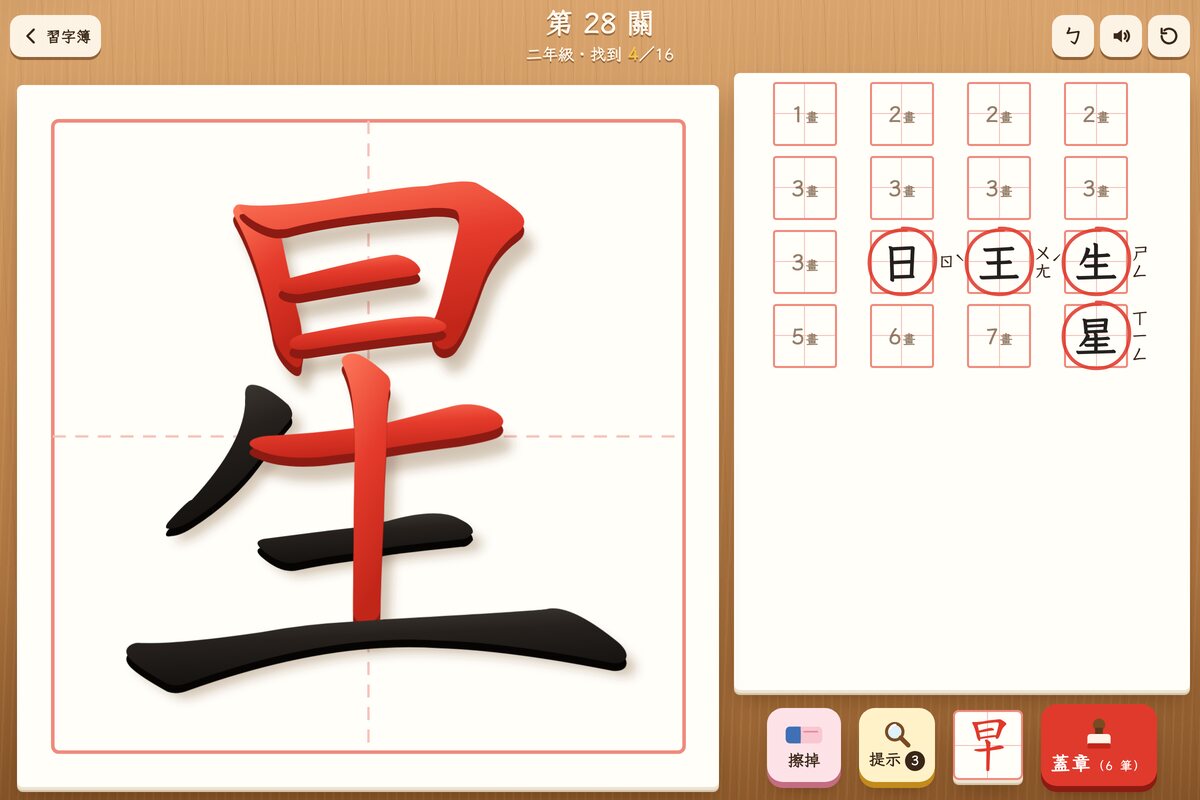
- The number in each answer box: each answer box shows the stroke count of the game's glyph, as a clue to how many strokes to tap, so you can start with the characters that have fewer strokes. Characters containing 艹, 辶 or 阝 have 1 fewer stroke than the Ministry of Education standard.
- The big character is an answer too: select all of its strokes and stamp, and you find the big character itself.
- Playing on a computer: you can click with the mouse, or use only the keyboard: press Tab to move to the big character, ←→ to move, Space to select a stroke, Enter to stamp and Esc to clear.
1Open the game and pick a level
Open 0523.tw/play/stroke-hunt in a browser and choose level 1 on the level map (the game calls it 習字簿). The first time you play, a 怎麼玩 (How to play) panel appears; after reading it, press 開始找字 (Start finding).
2Tap the strokes of the big character
Tap once and that stroke is picked up and turns red; you can also slide a finger across several strokes. If you tap the wrong one, tap it again to put it back, or press 擦掉 (Erase) to clear everything.
3Watch the preview box, then press "Stamp"
The small preview box shows what character the selected strokes look like. Press 蓋章 (Stamp): if it is an answer, its reading is spoken and it flies into the answer boxes; if the strokes do not make a common character, the screen suggests trying another combination.
4Find half to pass
Finding half of the required characters earns 乙 (pass) and opens the next level, three quarters earns 甲, and finding all of them earns 甲上. If you are stuck, press the magnifier 提示 (Hint); each level allows 3.
Are there really that many characters hidden inside one character?
Yes. The 56 levels of Hidden Characters hold 791 answers in total (748 required characters and 43 bonus characters that are less common), using 244 different characters; the level with the most answers is level 56, 積, with 23 (including the big character itself). The table below was calculated by HowBridge from the game's level data files, with 1–2 examples from each group; every set of answers includes the big character itself, and the stroke counts are those of the game's glyphs.
| Big character | Level | Strokes in the game | Answers | Characters hidden inside |
|---|---|---|---|---|
| 男 | The game's "Grade 1", level 6 | 7 strokes | 8 (8 required, 0 bonus) | 一 十 二 力 土 另 田 男 |
| 看 | The game's "Grade 2", level 21 | 9 strokes | 11 (11 required, 0 bonus) | 一 二 丁 三 口 日 手 目 右 有 看 |
| 星 | The game's "Grade 2", level 28 | 9 strokes | 16 (16 required, 0 bonus) | 一 十 二 丁 三 工 口 土 干 日 王 生 旦 早 呈 星 |
| 值 | The game's "Grade 3", level 33 | 10 strokes | 19 (19 required, 0 bonus) | 一 十 二 三 口 土 日 什 仁 曰 目 且 古 旦 伍 但 估 直 值 |
| 菜 | The game's "Grade 3", level 36 | 11 strokes (MOE standard: 12) | 14 (12 required, 2 bonus) | 一 十 二 八 丁 干 六 木 乎 米 采 菜; bonus characters 兀 丫 |
| 樹 | The game's "Grade 4", level 53 | 16 strokes | 18 (17 required, 1 bonus) | 一 十 二 八 三 口 土 寸 木 古 吉 吋 村 杜 豆 枯 樹; bonus characters 桔 |
| 積 | The game's "Grade 4", level 56 | 16 strokes | 23 (21 required, 2 bonus) | 一 十 二 八 三 口 千 土 日 木 只 目 古 貝 杜 和 相 枯 貢 責 積; bonus characters 禾 槓 |
- Most answers: level 56 積 has 23 and level 52 誰 has 22; level 46 演, level 47 構, level 50 儀, level 54 醒 and level 55 賴 have 20 each.
- Characters that appear most often: 一 appears in 56 levels, 二 in 55 levels, 三 in 46 levels, 十 in 41 levels and 口 in 32 levels.
- One character can be built in several ways: for example, in 星, the 二 can be built in 9 different ways of selecting strokes, and all count as correct; across the whole game, 264 answers can be built in more than one way, and the most has 13 ways.
- One set of strokes counts as only one character: within a level, the same strokes never match two answers (program check result: 0 duplicate sets).
- You are looking for shapes: many answers are shapes made from strokes and are not necessarily a component or radical of the character; for example, in 星, the 早 is built across both 日 and 生.
How are the 56 levels grouped, and how many characters do you need to pass?
The 56 levels of Hidden Characters are split into 4 groups by the stroke count of the big character in the game's glyph, 14 levels each: "Grade 1" has 6–7 strokes, "Grade 2" 8–9, "Grade 3" 10–11 and "Grade 4" 13–16. Finding half of the required characters in a level earns 乙 (pass) and opens the next level. Characters containing 艹, 辶 or 阝 have 1 fewer stroke in the game than the Ministry of Education standard; for example, 菜 has 11 strokes in the game and 12 strokes in the Ministry of Education standard. The "Grade" here is the game's difficulty grouping, not the character-learning progress of a textbook or the curriculum guidelines.
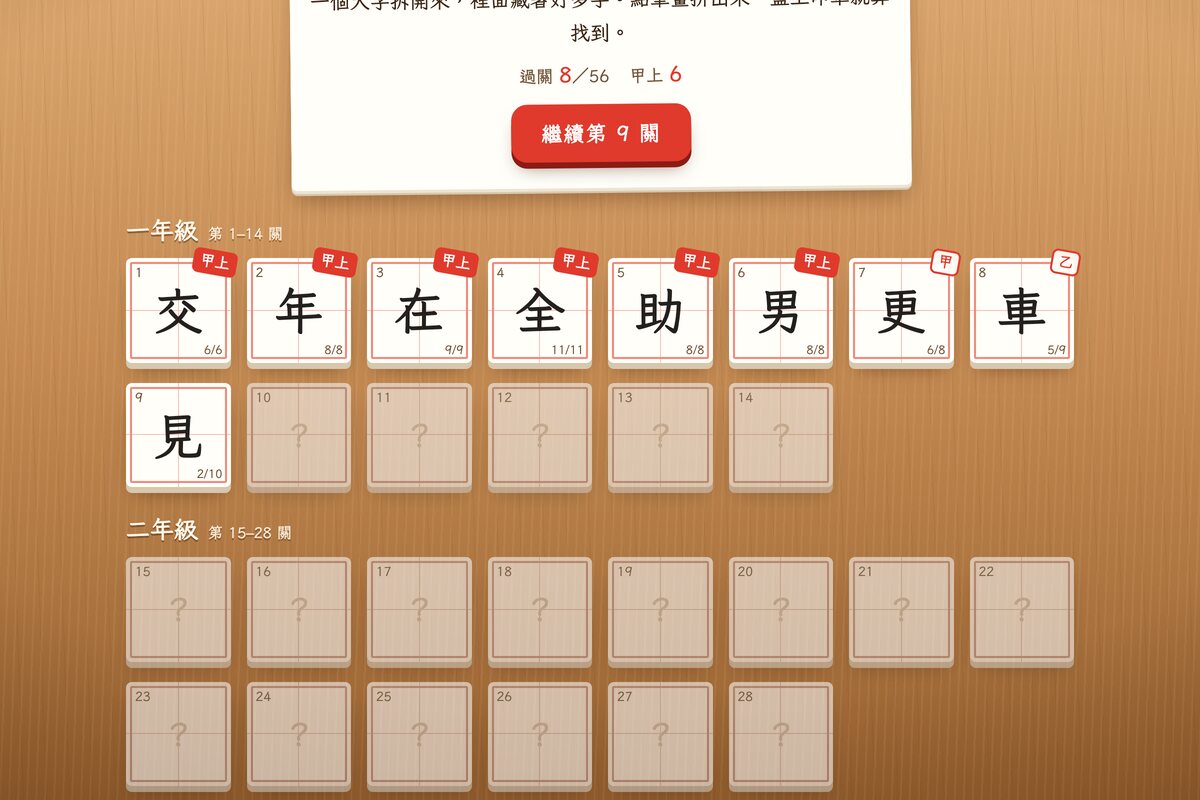
| Group | Level | Strokes of the big character (game glyph) | Answers per level | The 14 big characters |
|---|---|---|---|---|
| The game's "Grade 1" | Levels 1–14 | 6–7 strokes | 6–14 (average 9.4) | 交 年 在 全 助 男 更 車 見 束 告 走 里 住 |
| The game's "Grade 2" | Levels 15–28 | 8–9 strokes | 8–16 (average 13.0) | 法 直 東 注 指 城 看 待 便 頁 保 某 美 星 |
| The game's "Grade 3" | Levels 29–42 | 10–11 strokes | 12–19 (average 15.4) | 案 陳 真 隻 值 階 許 菜 著 理 掉 章 推 現 |
| The game's "Grade 4" | Levels 43–56 | 13–16 strokes | 13–23 (average 18.7) | 幕 預 蔡 演 構 導 樣 儀 懂 誰 樹 醒 賴 積 |
- Grades: finding half of the required characters earns 乙, three quarters earns 甲, and finding all of them earns 甲上; for example, level 6 男 has 8 required characters: finding 4 earns 乙 and 6 earns 甲.
- Bonus characters (less common): less frequent common characters are marked as bonus characters; their answer boxes have a gold dashed frame and the label "bonus", and you can pass without finding them; 30 of the 56 levels have bonus characters, 43 in total.
- Hints: 3 per level. A hint first reveals one required character that has not been found yet (starting with the ones with fewer strokes); once all are revealed, it makes the strokes of one character flash instead. Bonus characters are never given as hints.
- The level map (the level-selection screen): shows each level's grade stamp and "found / total".
- Restart: press the restart button at the top right of the level screen, then press it again within 3 seconds, and the level is cleared so you can start over.
Where do the characters and readings come from?
The answers in Hidden Characters use only the 4,808 common characters of the Ministry of Education's Chart of Standard Forms of Common National Characters; readings and Zhuyin come from the Ministry of Education's Concised Mandarin Chinese Dictionary; stroke shapes come from the open-source Make Me a Hanzi / hanzi-writer-data; character frequency comes from the McBopomofo input-method dictionary. Which strokes make up a character was calculated by HowBridge by comparing stroke shapes with component positions, and then checked by hand level by level.
- The common-character list: the Ministry of Education Language Resources Portal explains that "common characters" are the 4,808 characters in the Chart of Standard Forms of Common National Characters announced by the Ministry of Education on 1982-09-01 (ROC year 71, month 9, day 1) (Ministry of Education common-character download).
- Reading recordings: the game plays the Concised Mandarin Chinese Dictionary "single-character audio files" provided by the Ministry of Education Mandarin Dictionaries open-licence site (version 2014_20260929); the Ministry says that most entries of the Concised edition were read aloud by a person engaged for the purpose. The recordings are not edited or adapted; only the file format was converted from wav to AAC (m4a), and the game plays only the beginning of each recording, where the character is read. Of the 244 characters in the game, 233 have this recording, and the other 11 are not included in the single-character audio files.
- Licence of the readings: the Concised edition materials are released under "Creative Commons Attribution-NoDerivs 3.0 Taiwan", which allows reproduction, distribution and transmission (including commercial use) but not modification. The game ships with the public licence notice and, under 字從哪裡來 (Where the characters come from) in the game, credits the Ministry of Education of the Republic of China, the version number and the Concised edition website.
- Zhuyin: taken from the Concised Mandarin Chinese Dictionary, with one reading per character; for 7 of them (更, 埋, 占, 扛, 荼, 相, 和) the reading shown is not the first one listed in the Concised edition; the comparison table is in "What are the limits of this game?". The character readings in the Concised edition follow the Ministry of Education's published list of standardized readings for polyphonic characters, and were reviewed by a pronunciation review committee.
- Stroke shapes: from hanzi-writer-data 2.0.1 (data derived from Make Me a Hanzi, which takes it from two regular-script (kaishu) fonts, Arphic PL KaitiM GB and Arphic PL UKai, based on fonts that Arphic Technology released under a public licence in 1999), used under the Arphic Public License; the full licence text is included on this site as ARPHICPL.TXT.
- Character frequency: the dictionary character frequencies of McBopomofo (MIT License); answers with lower frequency are marked as bonus characters (less common).
How do you play most smoothly on iPad, phone and computer?
Hidden Characters opens in the browser of a phone, tablet or computer, with no app to install; on iPad, we suggest tapping Share → View More → Add to Home Screen in Safari (older iPadOS versions have no View More step), after which opening it from the Home Screen icon gives a full screen without the address bar.
- Sound: in Safari on iPad and iPhone you must tap the screen first before sound starts, so tap once after entering the game. The speaker button at the top right turns sound on and off, and the ㄅ button turns Zhuyin on and off. If the network is slow and a recording has not loaded within 1.2 seconds, the device's speech synthesis is used first.
- Hear a found character again: tap a character already found in the answer boxes and its reading is spoken again.
- Computer: clicking strokes with the mouse is the most direct; you can also use only the keyboard: Tab to move to the big character, the arrow keys to move, Space to select a stroke, Enter to stamp and Esc to clear.
- When there is no sound: add ?debug=speech to the end of the address (for example 0523.tw/play/stroke-hunt?debug=speech); the status of speech and sound effects is listed at the lower left of the screen, and you can take a screenshot and report it through Contact us.
- Progress: it is stored only in this browser on this device; if you switch phones, switch browsers or clear site data you start over, and a private window does not keep progress either.
How can parents and teachers use it?
Parents and teachers can treat Hidden Characters as a small character-shape exercise: first find the characters with fewer strokes, then the whole big character; for each character found, listen to the reading, look at the Zhuyin, and then make a word with it. The game looks for shapes built from strokes, which are not necessarily components or radicals of the character; it is only a practice tool, and no research has confirmed that it improves character recognition.
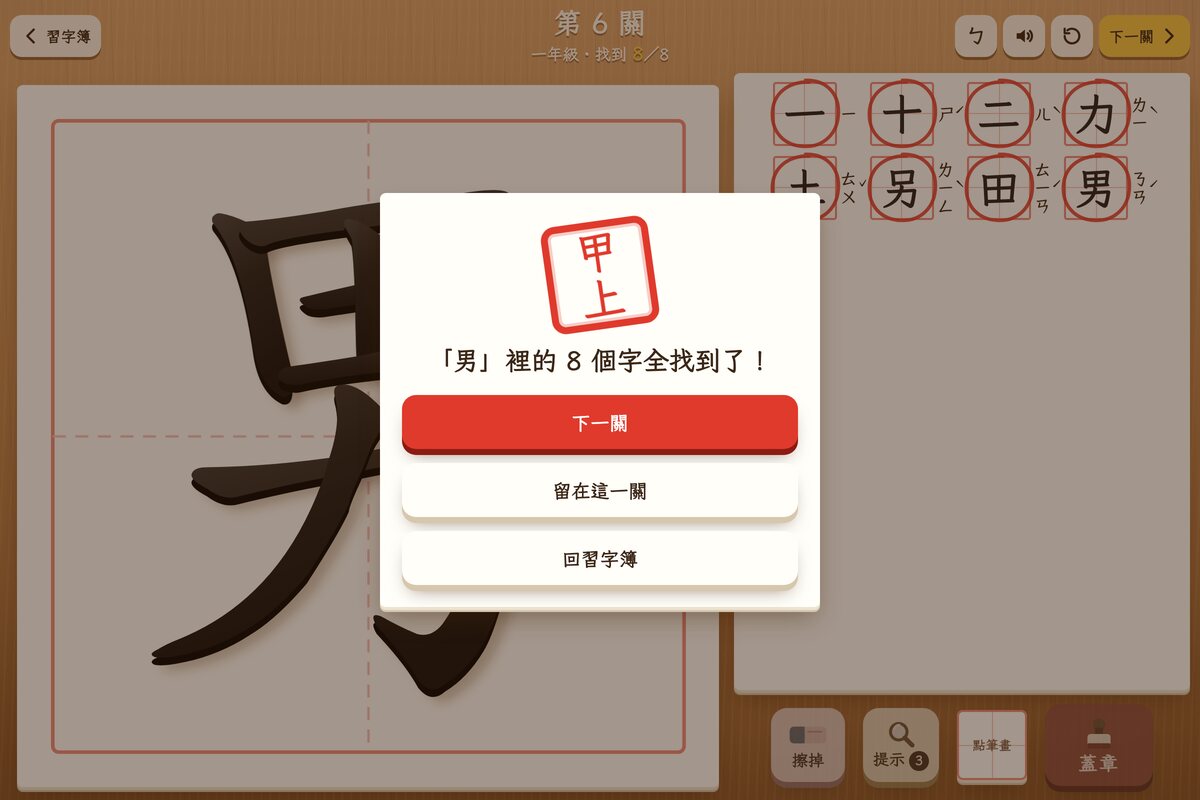
- The number in an answer box is not the standard stroke count: the number in an answer box is the stroke count of the game's glyph and is only a clue to how many strokes to tap; characters containing 艹, 辶 or 阝 have 1 fewer stroke than the Ministry of Education standard. Do not teach this number as the standard stroke count; for standard stroke counts, see the Ministry of Education Concised Mandarin Chinese Dictionary.
- Try first, then check: press the ㄅ button to hide the Zhuyin and let the child read it aloud first, then turn Zhuyin back on or tap the character to hear the reading and check; for 7 characters the Zhuyin is not the first reading listed in the Concised edition, so please go by the textbook.
- Make words with the characters found: for example, in 男, after finding 田 and 力, ask the child to make a word with each of the two characters, such as 田地 or 力氣.
- In class: you can project it from a computer and have the whole class point out which strokes to select; the game needs no account and has no feature for classes or teachers to view scores; progress is kept only in the browser of that computer.
- Age: the Game Center marks it as ages 6 and up; in the "Grade 1" levels the big characters have only 6–7 strokes in the game, and for children who have just started Zhuyin we suggest an adult plays along.
What are the limits of this game?
The glyphs in Hidden Characters come from regular-script fonts: characters containing 艹, 辶 or 阝 have 1 fewer stroke in the game than the Ministry of Education standard; 7 characters show a reading that is not the first one listed in the Concised edition; less common characters count only as bonus; the game has a Traditional Chinese screen only; progress is stored only on this device; and no member points are given. The table below lists the 7 characters whose Zhuyin in the game differs from the first reading listed in the Ministry of Education's Concised Mandarin Chinese Dictionary (2014_20260929); please go by the textbook.
| Character | Zhuyin shown in the game | First reading listed in the Concised edition | Appears in |
|---|---|---|---|
| 更 | ㄍㄥˋ | ㄍㄥ | Levels 7 and 23 |
| 埋 | ㄇㄢˊ | ㄇㄞˊ | Level 38 |
| 占 | ㄓㄢˋ | ㄓㄢ | Level 39 |
| 扛 | ㄎㄤˊ | ㄍㄤ | Level 41 |
| 荼 | ㄕㄨ | ㄊㄨˊ | Level 45 |
| 相 | ㄒㄧㄤˋ | ㄒㄧㄤ | Levels 55 and 56 |
| 和 | ㄏㄢˋ | ㄏㄜˊ | Level 56 |
- Stroke counts: the strokes in the game come from two regular-script fonts (Arphic PL KaitiM GB and Arphic PL UKai), not from the Ministry of Education's standard regular-script glyph files. Characters containing 艹, 辶 or 阝 are counted 1 stroke fewer in the game, so among the 244 characters, 17 have 1 fewer stroke than the Ministry of Education standard, and 8 of them are level big characters (陳 階 菜 著 幕 蔡 導 懂); for example, 菜 has 11 strokes in the game and 12 strokes in the Ministry of Education standard. The stroke counts in the answer boxes and in the hints are all the game's own counts; for practising writing and counting strokes, go by the textbook and the Ministry of Education standard forms.
- Display font: the characters in the answer boxes, the level map and the hints are shown in the LXGW WenKai TC font, which may also differ from the textbook's standard typeface.
- Readings: only one reading is shown per character, and the recording also speaks that reading; for the 7 characters in the table above, go by the textbook. Another 11 characters (交 只 唯 天 女 布 我 村 茶 車 辛) are not included in the Concised edition's single-character audio files, so the device's built-in speech synthesis is used, and it sounds different on different phones and tablets. The Ministry of Education also states that the dictionary is a language reference work and was not compiled as a teaching standard.
- Common characters only: answers use only characters from the Chart of Standard Forms of Common National Characters; less frequent characters are marked as bonus and do not count toward passing. The character 乙 itself is not included among the answers (any stroke with a turn would be mistaken for it; this has nothing to do with the grade stamp 乙 (pass)). If the combination you make is not among the answers, the screen asks you to try another combination.
- Grades are not textbook progress: the "Grade" is a difficulty grouping by the stroke count of the big character in the game's glyph; the whole game has only 244 different characters, far fewer than the "recognize at least 1,000 common characters" of Learning Stage I in the curriculum guidelines, so it suits only as supplementary practice.
- Traditional Chinese only: the game screen is in Traditional Chinese only, with no Simplified Chinese version and no screen in other languages.
- Progress and points: progress is stored only in the browser on this device and does not sync to other devices; the game needs no member login and gives no HowBridge points or offers of any kind.
- Learning effect: the research cited on this page is about the link between knowledge of components and radicals and character recognition, not about the effect of this game; no research has confirmed that playing Hidden Characters improves the number of characters a child recognizes.
What does research say about "taking a character apart to recognize it"?
The background from research is that children in the lower primary grades gradually become able to see Chinese characters as made of components, and that knowledge of radicals and components is related to reading characters, sentences and reading comprehension. None of the studies below is about Hidden Characters; they are background only and do not allow the conclusion that playing this game improves character recognition. Note that many answers in Hidden Characters are shapes built from strokes (for example, in 星, the 二 can be built in 9 ways, and 早 spans 日 and 生), not necessarily components or radicals of the character; the studies below are about components and radicals.
| Study | Finding | Limits as judged on this page |
|---|---|---|
| Shu and Anderson (1997) | Among 292 Chinese children in grades 1, 3 and 5, the grade 3 and 5 children could pick characters with the correct radical even when they did not know the whole character; when the radical was familiar and the word meaning not hard, they were better able to use the radical to work out the meaning of a new character; children who were better readers had higher radical awareness | It studied inferring meaning from radicals, not a stroke-finding game |
| Anderson et al. (2013) | Using delayed copying and component-finding tasks, it tested Chinese children in grade 1 (first and second term), grade 2 and grade 4: by the second term of grade 1 some children were already aware of the internal structure of characters; major components, and even sub-components that carry no sound or meaning, are units in which children perceive characters, and this ability develops gradually in the lower primary grades and is related to vocabulary and reading comprehension | A correlational study; it does not mean that character-finding practice causes better reading |
| Ho, Ng and Ng (2003) | Among Hong Kong children in grades 1, 3 and 5, knowledge of semantic radicals was significantly related to reading characters and sentence comprehension, and knowledge of phonetic radicals was significantly related to reading characters; children begin to recognize character structure and component positions around grade 1, but only around grade 3 do they understand that the semantic radical hints at the meaning | 20 children per group, a small sample |
The research provides only background on recognizing a character by taking it apart into components; the game's levels, character list and readings follow the game data files and the Ministry of Education's public data.
Which terms come up when you play Hidden Characters?
- Chart of Standard Forms of Common National Characters
- The list of common characters announced by the Ministry of Education on 1982-09-01 (ROC year 71, month 9, day 1), with 4,808 common characters; the answers in Hidden Characters use only characters in this list.
- Stroke
- The line made from the moment the pen touches down to the moment it lifts when writing a character; the Ministry of Education standard stroke count can be looked up in the Concised Mandarin Chinese Dictionary. The number on an answer box in the game is the stroke count of the game's glyph, and characters containing 艹, 辶 or 阝 have 1 fewer.
- Component
- A unit that makes up a Chinese character; for example, 男 is made of 田 and 力.
- Radical
- The component dictionaries use to classify characters; for example, 江汪注 all belong to the water radical (written 氵).
- Zhuyin (Bopomofo)
- The symbols used in Taiwan to mark the reading of Mandarin; for example, the Zhuyin of 星 is ㄒㄧㄥ; the game places the Zhuyin vertically to the right of each character found.
- Regular script (kaishu)
- A script with straight strokes and a square structure; the Ministry of Education provides "standard regular script" glyph files to present the standard forms correctly.
- Bonus characters (less common)
- Common characters with lower frequency; their answer boxes have a gold dashed frame, finding one earns a bonus, and you can pass without it.
- Grade stamp
- The game's grade: finding all required characters is 甲上, three quarters is 甲 and half is 乙; getting 乙 opens the next level.
- Level map
- The game's level-selection screen (the button reads 習字簿), showing each level's grade stamp and the number of characters found.
- Answer boxes
- The boxes on the level screen that list the characters to find; a character found flies into its answer box, gets a red circle and shows its Zhuyin, and tapping it speaks the reading again.
What are the sources, and how far were they checked?
The sources below were consulted on 2026-11-21; the document date and the date consulted are shown separately, and no date is invented where none is stated. The level figures come from the game data that went live on 2026-11-20 and was checked on 2026-11-21, and the rules were checked by operating the live game with Playwright; stroke counts and readings were also compared character by character with the text database of the Ministry of Education's Concised Mandarin Chinese Dictionary 2014_20260929.
Official data and licence documents
- Ministry of Education: MOE Language Resources Portal: common-character download|Document date: 2025-09-16; "common characters" are the 4,808 common characters in the Chart of Standard Forms of Common National Characters announced by the Ministry of Education on 1982-09-01 (ROC year 71, month 9, day 1); the game's answers use only characters in this list.
- Ministry of Education: MOE Mandarin Dictionaries open-licence site (home page)|Document date: 2026-10-01; the Concised Mandarin Chinese Dictionary is mainly intended for junior-high and primary-school students and people learning Chinese, and the latest version number is 2014_20260929; the materials are released under the Creative Commons Attribution-NoDerivs 3.0 Taiwan (CC BY-ND 3.0 TW) licence, which allows reproduction, distribution and transmission (including commercial use) but not modification.
- Ministry of Education: MOE Mandarin Dictionaries open-licence site: Concised Mandarin Chinese Dictionary data download|Document date: 2026-10-01; the download page lists "dict_concised_music_word_2014_20260929 single-character audio files" and "dict_concised_2014_20260929 text database"; the reading recordings played by the game come from the former, and the stroke-count and reading comparison on this page uses the latter.
- Ministry of Education Lifelong Education Division: Online Dictionaries, introduction|Document date: 2026-11-16; the Concised edition contains about 45,000 characters and words, its character readings follow the Ministry of Education's published list of standardized readings for polyphonic characters; the Ministry also states that the dictionary is a language reference work and was not compiled as a teaching standard.
- Ministry of Education (file published by the National Academy for Educational Research): 12-Year Basic Education Curriculum Guidelines, Mandarin Chinese (Language Arts), for Elementary, Junior High and General Senior High Schools (January 2018)|Document date: 2018-01; Learning Stage I (grades 1–2): "recognize at least 1,000 common characters and use 700"; Learning Stage II (grades 3–4): "recognize at least 1,800 common characters and use 1,200".
- Hanzi Writer (chanind): hanzi-writer-data README: License|Document date: not stated; the game's stroke-outline data comes from Make Me a Hanzi, whose original data was extracted from Arphic Technology fonts; it may be distributed and modified under the Arphic Public License.
- Make Me a Hanzi (Shaunak Kishore): Make Me a Hanzi README: Sources|Document date: not stated; the stroke graphics come from two regular-script fonts, Arphic PL KaitiM GB and Arphic PL UKai.
- McBopomofo (OpenVanilla): McBopomofo LICENSE.txt|Document date: not stated; McBopomofo uses the MIT License; the game uses its dictionary character frequencies to decide which answers are marked as bonus characters (less common).
- Ministry of Education English website attachment: introduction to the Concised Mandarin Chinese Dictionary (Word file)|Document date: not stated; the Ministry of Education says the Concised edition was compiled for junior-high and primary-school students and for foreigners beginning to learn Mandarin, and that most entries were read aloud in full by a person engaged for the purpose.
Research papers
Role of Radical Awareness in the Character and Word Acquisition of Chinese Children
The research question is whether children know that the "radical" in a Chinese character usually hints at its meaning. The authors had 292 Chinese children in grades 1, 3 and 5 choose characters from options in place of pinyin: the grade 3 and 5 children could pick characters with the correct radical even when they did not know the whole character; when the radical was familiar and the word meaning not hard, children were better able to use the radical to work out the meaning of a new character; children whom teachers rated as better readers also had higher radical awareness. Limits as judged on this page: the participants were Chinese children, and what was tested was inferring meaning from radicals, not the effect of a stroke-finding game. This page uses it only as background for the learning idea that Chinese characters can be split into meaningful components.
Learning to See the Patterns in Chinese Characters
The research question is how children "see" a Chinese character. Using delayed copying and component-finding tasks, the authors tested Chinese children in grade 1 (first and second term), grade 2 and grade 4: by the second term of grade 1 some children were already aware of the internal structure of characters; major components, and even sub-components that carry no sound or meaning, are units in which children perceive characters; this ability to see a character as made of units develops gradually in the lower primary grades and is related to vocabulary knowledge, reading comprehension and the reading level rated by teachers. Limits as judged on this page: the research shows correlation and does not mean that character-finding practice causes better reading; the participants were Chinese children. This page uses it only as background for the idea that children gradually come to see Chinese characters as made of components.
A “Radical” Approach to Reading Development in Chinese: The Role of Semantic Radicals and Phonetic Radicals
The research question is the relationship between radicals, phonetic-component knowledge and reading development. The two studies each used 20 Hong Kong children in each of grades 1, 3 and 5: knowledge of the position and category of semantic radicals was significantly related to reading characters and sentence comprehension; knowledge of the function and reading of phonetic components was significantly related to reading characters; children begin to recognize character structure, component positions and categories from around grade 1, but only around grade 3 do they understand that the semantic radical hints at the meaning. Limits as judged on this page: a small sample of Hong Kong children, and correlational. This page uses it only as background for the idea that knowledge of character structure develops gradually during the primary years, and it does not mean that this game has been shown by research to improve character recognition.
This page describes Hidden Characters, a free game made by HowBridge; its level figures follow the game data that went live on 2026-11-20 and was checked on 2026-11-21, and will be updated together with any new version of the game. This page is not proof of a teaching assessment or of a learning effect; for the standard of character forms, stroke counts, stroke order and readings, go by the textbook and the data published by the Ministry of Education.
Hidden Characters: frequently asked questions
Does Hidden Characters cost money? Do I need to log in or download anything?
Does the game have ads or in-app purchases?
Where is my progress stored? Is it still there if I switch phones?
Why is the Zhuyin of some characters different from what the textbook teaches first?
Why do the forms or stroke counts of some characters differ from the textbook?
Why do some characters sound like a machine?
What if there is no sound when I play on iPad?
Is the game's "Grade 1" the same as the characters taught in Grade 1 of school?
Does the game have a Simplified Chinese version or screens in other languages?
What age is it suitable for?
Can teachers use it in class?
Is Hidden Characters related to HowBridge's consolidation service?
Further reading
Start finding characters now
It plays as soon as it opens: the big character in level 1 has only 6 strokes and 6 answers including itself, a good level to get a feel for the game.
Play Hidden Characters