Buying a drone or RC car in China and shipping it to Taiwan: what do you need to clear?
Quick answer: Can a drone or RC car bought in China be shipped to Taiwan?
In most cases yes, but there are four hurdles. First, drone tariff codes all carry 602 (NCC) and 617 (Civil Aeronautics Administration), and codes for aircraft under 2 kg also carry C02 (BSMI). Under 617, models "without navigation equipment" or "with navigation equipment but a maximum take-off weight under 2 kg" only need the designated code on the declaration and are exempt from attaching a Civil Aeronautics Administration consent document. Second, radio-frequency devices such as remote controllers and receivers imported for personal use via consolidated shipping may be imported without applying for an import permit by signing a declaration, up to 2 units per shipment; 3 to 10 units require an import permit in advance, and each person is limited to 10 units per year. Third, children's RC toys fall under BSMI's inspection-exemption threshold for toys: for the same specification and model, USD 1,000 or less and no more than 5 pieces. Fourth, under our customer service rules, products containing lithium batteries are not sent by air express but by sea express; please ask customer service first whether a specific product can be accepted. Once it arrives, a privately owned drone weighing 250 g or more must be registered before it can fly.
HowBridge has only a Shenzhen consolidation warehouse and a Taoyuan operations warehouse, and provides consolidated shipping only from China → Taiwan. We have no warehouses in the US, Japan or Europe, and we do not provide proxy purchasing. The import regulations, inspection rules and aviation rules on this page are general information on the Taiwan side; the section on China's export controls only describes the content of official announcements and does not mean we can guarantee that any particular model can be exported.
Which import regulations does Customs check for a drone bought on Taobao?
Drones are usually classified under tariff heading 8806 "unmanned aircraft" and split into different tariff codes according to whether they are "designed to be remotely piloted only" and their maximum take-off weight (MTOW); toy drones may also fall under heading 9503, as determined by Customs case by case. The tariff codes that may be involved are:
| Tariff code | Description (excerpt) | Column 1 duty | Import regulations |
|---|---|---|---|
8806.21.00.00-5 | For remote piloting only, maximum take-off weight not more than 250 g | 0% | 602 617 C02 |
8806.22.00.10-2 | For remote piloting only, more than 250 g but less than 2 kg | 0% | 602 617 C02 |
8806.22.00.90-5 | For remote piloting only, 2 kg or more but not more than 7 kg | 0% | 602 617 |
8806.92.00.10-7 | Other unmanned aircraft, more than 250 g but less than 2 kg | 0% | 602 617 C02 |
602: radio-frequency device rules of the National Communications Commission (NCC); the personal-use quantity is explained in the "remote controllers and video transmitters" section below.617: the drone import rule of the Civil Aeronautics Administration (CAA), Ministry of Transportation and Communications, which, as announced by the International Trade Administration, has been added from 2025-12-01 to 14 8806 tariff codes.C02: some goods under the tariff code are commodities subject to inspection by the Bureau of Standards, Metrology and Inspection (BSMI). For drones, the inspection scope is limited to "maximum take-off weight under 2 kg, with a camera/video camera/positioning and navigation function or an interface for connecting one", in force since 2024-07-01 (July 1, ROC year 113).
The text of 617 itself sets out exemptions: models without navigation equipment are declared with AK0000000003, and models with navigation equipment and a maximum take-off weight under 2 kg with AK0000000004; both are exempt from attaching a CAA consent document.
Models with navigation equipment weighing 2 kg or more in principle require a consent document. However, for models that had not obtained type inspection or type approval at the time of import, within 12 months from the first customs release of that model type for the same importer, up to a cumulative 5 aircraft of 2 kg or more but under 15 kg, and up to a cumulative 2 aircraft of 15 kg or more but under 25 kg are exempt (AK0000000001/AK0000000002); beyond those quantities an application is required.
Personal-use imports must also follow the list: Article 9 of the Regulations Governing Import of Commodities provides that if goods imported without a permit are items on Customs' list of items checked on behalf of other agencies, the listed requirements shall still be followed at declaration.
Article 12 of both the Regulations Governing Customs Clearance Procedures for Air Express Consignments and the Regulations Governing Customs Clearance Procedures for Sea Express Consignments provides that express consignments "involving import or export regulations" shall in principle be cleared with a regular customs declaration (except in special cases announced by Customs). For goods carrying codes, such as drones and remote controllers, clearance documents and timelines may differ from those for ordinary small parcels; this page does not promise any particular number of days.
As far as import regulations are concerned, yes. A check of the International Trade Administration's "Import of Mainland China Goods" lookup (2026-09-17) shows that the tariff codes under heading 8806 carry neither MW0 (Mainland China goods not permitted) nor MP1 (conditionally permitted); they are Mainland China goods permitted for import.
Once you have the drone, what must you do before flying it?
Clearing customs is only the first step. Flying outdoors in open spaces in Taiwan (outside buildings) also requires compliance with Chapter 9-2 of the Civil Aviation Act and the Regulations of Drone. The same applies to RC airplanes, model aircraft and FPV racing drones: if privately owned with a maximum take-off weight of 250 g or more, they must be registered. For aircraft owned by natural persons, the obligations are broadly as follows:
| Situation | Registration required? | Operator certificate required? |
|---|---|---|
| Maximum take-off weight under 250 g | No (the registration threshold for natural-person owners is 250 g or more) | No |
| 250 g or more, under 2 kg | Yes: after registering, display the registration number in a conspicuous place on the outside of the aircraft | No |
| 2 kg or more, under 15 kg, with navigation equipment | Yes | Yes: basic operator certificate |
| 2 kg or more, under 15 kg, without navigation equipment | Yes | No (classed as a recreational aeromodel) |
| 15 kg or more | Yes | Yes: professional operator certificate |
An owner who is a natural person must be at least 14 years old; those under 18 must attach the consent of their legal representative (Article 6). The CAA states that registration can be done online with a citizen digital certificate or National Health Insurance card; a registration number is valid for 2 years and may be renewed within 30 days before expiry (Article 10). According to the CAA, aircraft flown only inside buildings or displayed statically on the ground do not need to be registered.
Article 99-13 of the Civil Aviation Act: flying is prohibited in prohibited areas, restricted areas and within a certain distance around airports or airfields; other areas below 400 ft above ground level are managed by announcements of special municipality and county (city) governments. Article 99-14 further provides that aircraft must not exceed 400 ft above ground or water level, must not fly between sunset and sunrise, must be operated within visual line of sight, and one person must not control two or more aircraft at the same time, among other rules. Article 28 of the Regulations of Drone requires keeping at least 30 meters away from freeways, railways, mass rapid transit systems, buildings and obstacles.
Under Article 118-2 of the Civil Aviation Act: operating without an operator certificate is subject to a fine of NT$60,000 to NT$300,000; failing to register or to display the registration number, violating Article 99-14, Paragraph 1, Subparagraphs 2 to 10 (for example flying at night, beyond visual line of sight or controlling two aircraft at once), or violating matters announced by local governments is subject to a fine of NT$30,000 to NT$150,000. In both cases the activity shall be prohibited, and in serious cases the drone may also be confiscated; the penalties are in principle imposed by local governments.
Flying in prohibited or restricted areas, around airports or above 400 ft is subject to a fine of NT$300,000 to NT$1,500,000 imposed by the CAA, and the drone may be confiscated (Article 118-1).
The commonly quoted "NT$10,000 to NT$1,500,000" is Article 118-3, which concerns radio frequency identification, inspection, approval and listing by manufacturers and importers, among other matters; it is not a general penalty for flight violations by individuals.
The party obliged to list products under Article 17, Paragraph 1 of the Regulations of Drone is "the manufacturer or importer before public sale" (in force since 2025-12-01); models built and used by the owners themselves are listed by the owner. Whether individuals who import ready-made models for personal use must list them themselves: we found no explicit CAA provision. The CAA's FAQ states that models without navigation equipment or under 2 kg must complete product listing before registration; if your model cannot be found when registering, please contact the CAA first.
Do RC cars and RC airplanes count as toys, and how do the inspection rules differ?
RC cars and RC models are commonly classified under tariff heading 9503, with a Column 1 duty of 0%. Whether an item is a "toy" determines whether it is a commodity subject to BSMI inspection under these tariff codes: only children's toys require inspection or may use the toy exemption threshold; non-toys (and items powered by fuel engines) are outside the inspection scope under these codes, but NCC's 602 rule still applies to the radio remote-control tariff codes.
| Tariff code | Description (excerpt) | Column 1 duty | Import regulations |
|---|---|---|---|
9503.00.92.10-1 | Radio remote-control toys and models, with motor | 0% | 602 C02 |
9503.00.91.20-0 | Radio remote-control toys, in sets or kits | 0% | 602 C02 |
9503.00.93.20-8 | Other radio remote-control toys | 0% | 602 C02 |
9503.00.41.00-5 | Reduced-size (scale) model assembly kits | 0% | C02 |
BSMI's inspection scope for the RC toy tariff codes is limited to products covered by CNS 4797 "intended for play by children under 14", excluding those powered by fuel engines. Under the Principles for Determining Toy Products, 6th edition (2023-06-19): RC airplanes, helicopters and drones with 3 control channels or fewer and RC cars with 2 channels or fewer that are designed for children's play, or products whose design, name or advertising claims they are for play by children under 14, are toys; RC airplanes, drones and RC cars claimed to be for consumers over 14 are not toys subject to inspection. However, the same principles also state that "reasonably foreseeable use" takes precedence over the designer's or manufacturer's statement, so a "14+" label on the box does not necessarily mean it is not a toy.
Amounts are calculated on the CIF value (including freight and insurance).
Toys: for the same specification and model on the same declaration, a total of USD 1,000 or less and no more than 5 pieces, or more than USD 1,000 with a quantity of 1 piece; the exemption code CI000000000005 may be entered on the declaration yourself.
General personal-use items: for the same specification and model, USD 1,000 or less with no limit on the number of pieces, and CI000000000002 may be entered yourself; for up to 2 pieces above USD 1,000, an exemption must be applied for with BSMI.
In addition, under Article 8, the same specification and model may be exempted only once within 6 months; under Article 5, Paragraph 2, if several declarations with the same import date are applied for at the same time, amounts and quantities are combined. Anything exceeding the Article 5 thresholds requires a separate case-by-case approval or inspection application as prescribed.
How many remote controllers, receivers and video transmitters does the NCC allow for personal use?
Remote controllers that emit radio waves, FPV video transmitters and receivers with a transmitting function are radio-frequency devices (import regulation 602). Article 65 of the Telecommunications Management Act in principle allows radio-frequency devices to circulate freely, but controlled telecommunications radio-frequency devices designated by announcement require approval before import; Article 67 provides that their use must not interfere with lawful communications or affect flight safety. Quantities for personal-use imports follow Article 9 of the Administrative Regulations on Manufacturing, Import and Report of the Controlled Telecommunications Radio-Frequency Devices:
| Import method | Quantity per shipment | Per person per year | Other conditions |
|---|---|---|---|
| By post or other means than carrying it in person (consolidated shipping and express delivery count as such) | Up to 2 units by signing a declaration, without applying for an import permit | 10 units | Natural persons must be at least 18; for personal use only, not to be transferred or used commercially |
| Carried in person when entering Taiwan | Up to 5 units by signing a declaration, without applying for an import permit | 10 units | Same as above |
| 3 to 10 units by post, 6 to 10 units carried in person | An import permit must be applied for | 10 units | Same as above |
For personal-use imports by signed declaration, the permit-exemption code CC000000000001 is entered on the declaration (NCC announcement of 2021-12-17; still listed in the Customs Administration's current table of exemption codes). In addition, according to an NCC announcement, wireless remote controllers that meet the technical specifications for low-power radio-frequency devices with a maximum RF output power of 1 milliwatt (mW) or less are not Class 2 controlled telecommunications radio-frequency devices. How the aircraft and remote controller of a drone set are counted as "units": we found no NCC interpretation.
The import regulations for 8526.92.90.00-9 "other radio remote control apparatus" are 602 MP1, and it is an EX item: from Mainland China, only the product names on the list are permitted. The list includes "remote controllers for models (including transmitters, receivers and servos)" and "accessories for remote controllers for models: transmitters, receivers" (since 2012-07-16), with the special provisions column left blank; remote controllers not on the list are not permitted. If a remote controller is sold as a set with a toy, classification is determined by Customs case by case.
The personal-use quantities in the table above apply only to low-power radio-frequency devices and wireless telecommunications terminal equipment. We did not find any interpretation or penalty decision by the competent authority concerning individuals using video transmitters that exceed low-power specifications, so we do not offer advice on "how to buy or use them". Before buying, check whether the product bears an NCC type-approval label; if unsure, ask the NCC directly.
Can lithium polymer (LiPo) batteries and spare batteries be shipped together?
The lithium polymer batteries commonly used in RC models are classed as lithium ion batteries under international air dangerous goods rules, and power banks are always classed as "batteries". Under the International Air Transport Association (IATA) 2026 Lithium Battery Guidance, air transport requirements are divided into three cases according to how they are packed:
| Situation | UN number / packing instruction | Air transport key points |
|---|---|---|
| Batteries or power banks on their own | UN3480/PI965 | In principle forbidden as cargo on passenger aircraft; state of charge (SoC) in principle must not exceed 30% (except with approval from the State of Origin and the State of the Operator) |
| Packed in the same box as the equipment (e.g. a drone plus spare batteries) | UN3481/PI966 | From 2026-01-01, SoC must not exceed 30% (under Section II, only for batteries above 2.7Wh); the number of batteries is limited to the minimum needed to power the equipment plus two spare sets |
| Contained in the equipment | UN3481/PI967 | SoC not exceeding 30% is recommended, not mandatory |
Our routes are "sea express" and "air express", and both charge the same rate for regular and special goods. Under our customer service rules, products containing lithium batteries or built-in batteries are not sent by air express but by sea express; to find out whether a specific product can be accepted, send the product page and battery specifications (Wh, quantity, built-in or not) to LINE customer service before ordering. Do not remove batteries to ship them separately, and do not conceal them in the declaration.
A summary of fire tests by the US Federal Aviation Administration (FAA) Technical Center found that the packaging used at the time could hardly stop fire from spreading between cells; pouch lithium polymer cells swell when heated until they rupture and release electrolyte all at once, causing the fire to grow rapidly (the report states it does not constitute FAA policy). Research by the OECD and the European Union Intellectual Property Office (EUIPO) also warns that unbranded batteries may not have been independently tested, and branded batteries with certification marks are counterfeited too; counterfeiters may fail to declare dangerous goods to avoid restrictions.
8507.60.00.90-0 "other lithium ion accumulators" has a Column 1 duty of 2.5% and import regulation C02, with no MW0/MP1. Although Column 2 lists 0% for Mainland China, this requires meeting the agreement's rules of origin as determined by Customs, and we do not claim it applies automatically.
Announcement No. 58 of 2025 by China's Ministry of Commerce and General Administration of Customs (controlling lithium ion batteries with a gravimetric energy density of 300Wh/kg or more, among other items, with exporters as the regulated parties) has been suspended until 2026-11-10 under Announcement No. 70 of 2025; we will check again after that date.
Will China block drone exports?
China currently regulates drone exports under the Dual-Use Items Export Control List (in force since 2024-12-01; on the same day 11 announcements including No. 31 of 2024 were repealed, while Nos. 27 and 28 of 2023 had already been repealed by No. 31 on 2024-09-01). What matters are the technical parameters, not whether something is a camera drone.
| Control code | Control conditions (excerpt) | Exceptions noted in the list |
|---|---|---|
9A012.a | Capable of controlled flight beyond the operator's natural line of sight, with a maximum endurance of 30 minutes or more but less than 1 hour and able to take off and fly stably in wind gusts of 46.3 km/h; or a maximum endurance of 1 hour or more | Model aircraft or model airships are not controlled |
9A501 | Unmanned aerial vehicles with a range of 300 km or more, etc. | Model aircraft specially designed for recreation or competition are not controlled |
| Unlisted models | Exporters must not export if they know or should know that the items will be used for proliferation of weapons of mass destruction, terrorism or military purposes | — |
Ministry of Commerce Announcement No. 34 of 2026 applies only to exports to the United States. General Administration of Customs Announcement No. 78 of 2026 regulates export declarations for drones and related items from 2026-06-30 (including outbound Class C express consignment declarations and cross-border e-commerce retail export declaration lists): the item description and the full name of the overseas consignee must be declared truthfully, and cross-border e-commerce lists must declare the complete tariff number; controlled items must be noted in the remarks field, while items that are not controlled but have parameters close to the thresholds, or whose use does not match the control requirements although their parameters do, must be marked "not an export-controlled item"; where information is doubtful, release may be withheld for the time being, which may affect shipping times. (The original Customs website for No. 78 could not be reached; this page relies on the full text republished by the Fujian Provincial Department of Commerce.)
It is not true that "all consumer drones are banned from export", nor that "China does not regulate them at all". Whether a particular model falls under 9A012 depends on its specifications, and we have not assessed models one by one. In addition, "export" under the Regulations on Export Control of Dual-Use Items also covers transfers such as gifts, and we found no exemption provision for personal use.
How much tax do you pay to ship a drone to Taiwan?
Drones (8806) and RC toys (9503) both have a Column 1 duty of 0%, but 0% duty does not mean no tax. If the dutiable value of a single import shipment exceeds NT$2,000, the tax exemption no longer applies, and taxes and fees are calculated by Customs' formula on the entire dutiable value (NT$2,000 is a threshold, not a deduction). Here is a worked example with transparent assumptions:
| Item | Amount (NT$) | How it is calculated |
|---|---|---|
| Dutiable value | 12,500 | Product price + freight + insurance |
| Customs duty | 0 | 12,500 × 0% |
| Business tax | 625 | (Dutiable value + duty) × 5% |
| Trade promotion service fee | 0 | Dutiable value × 0.04% = NT$5; not levied if NT$100 or less |
| Total | 625 | Subject to Customs' final assessment |
① Splitting into many small parcels so each shipment is under NT$2,000: once the same taxpayer has been granted duty-free release more than 6 times in a half-year period, the exemption no longer applies (proviso on "frequent imports" in Article 49, Paragraph 2 of the Customs Act, with determination criteria set by the Ministry of Finance).
② Undervaluing: the declared value must match the actual transaction. Under Article 37 of the Customs Anti-smuggling Act, falsely declaring the value of goods may be punished with a fine of up to five times the evaded import duties, or confiscation of the goods, or both; if the false declaration involves evading import controls, Paragraph 3 of the same Article applies Article 36, Paragraphs 1 and 3 instead: a fine of up to three times the value of the goods, and confiscation of the goods.
What is the recommended process from ordering in China to shipping to Taiwan?
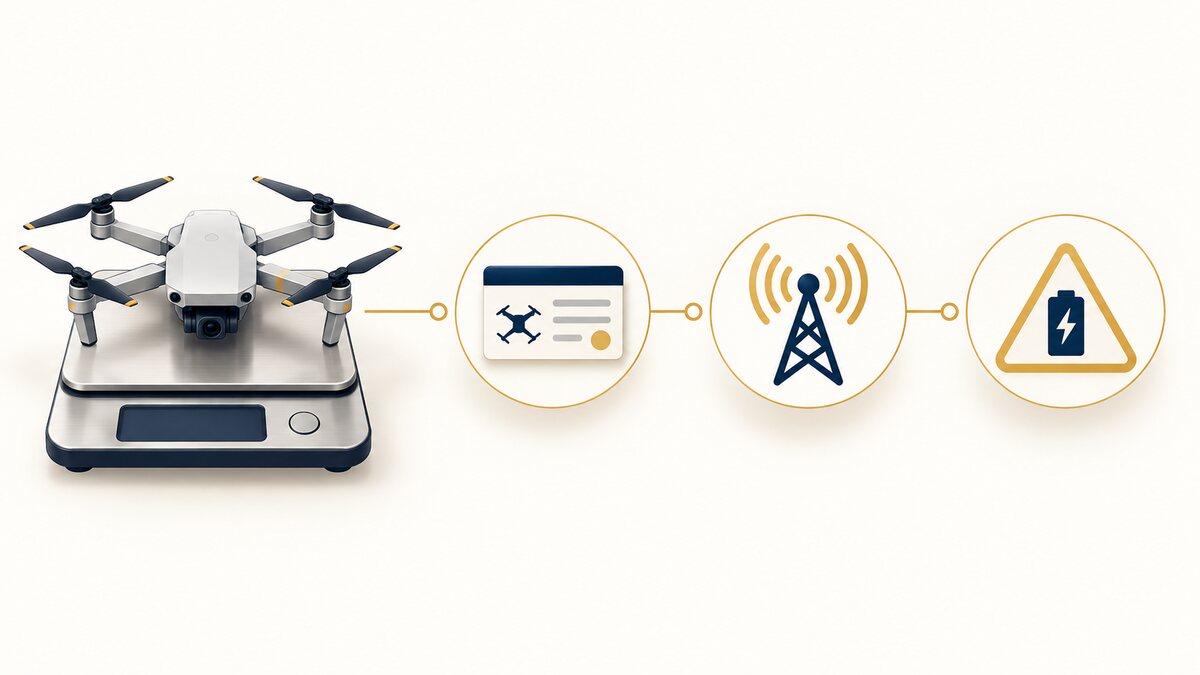
Putting the rules above into an ordering process, following this sequence gives you the best chance of avoiding holdups:
1Confirm the specifications first and keep screenshots
Confirm the maximum take-off weight, whether it has navigation equipment and whether it has a camera, as well as the battery Wh and quantity. Save screenshots of the product page and order; you will need them for customs declaration or inquiries.
2Check quantities and personal-use conditions
Radio-frequency devices imported via consolidated shipping may be imported up to 2 units per shipment by signing a declaration without applying for an import permit; children's toys of the same specification are exempt from inspection at USD 1,000 or less and no more than 5 pieces. For drones with navigation equipment weighing 2 kg or more, the exemption from a CAA consent document has a 12-month cumulative quantity limit (only for models without type inspection or approval at the time of import). Buying to resell is not personal use, and neither the NCC declaration nor BSMI's personal-use exemption applies.
3Ask customer service first about products with batteries
Send the product page and battery specifications (Wh, quantity, built-in or not) to LINE customer service to confirm whether it can be accepted; under our customer service rules, products with batteries are sent by sea express.
4Ship to the Shenzhen consolidation warehouse and declare truthfully
The declared value must match the order, and complete the consignee real-name authentication (EZ WAY) as required by Customs.
5After delivery, register first and check where you may fly
Register privately owned drones of 250 g or more and mark them with the registration number; before the first flight, check prohibited areas, restricted areas and activity areas announced by local governments.
Glossary
- Maximum take-off weight (MTOW)
- The maximum weight at which a drone can take off; it is the classification basis shared by tariff codes, registration, operator certificates and the 617 exemption conditions.
- Import regulation 617
- The import regulation code requiring a CAA consent document for importing drones, added to 14 tariff codes under 8806 from 2025-12-01; models without navigation equipment, or with navigation equipment and an MTOW under 2 kg, only need the designated code and are exempt from attaching the document.
- AK0000000004
- The designated code entered on the import declaration for drones with navigation equipment and an MTOW under 2 kg, exempting them from attaching a CAA consent document.
- Import regulation 602
- The import regulation for controlled telecommunications radio-frequency devices administered by the National Communications Commission; personal-use imports also follow Article 9 of the administrative regulations, allowing up to 2 units per shipment by signed declaration without applying for an import permit.
- Import regulation C02
- Indicates that some goods under the tariff code are commodities subject to import inspection announced by BSMI; it does not mean every item under that code must be inspected.
- UN3481
- The UN dangerous goods number for lithium ion batteries (including lithium polymer batteries) packed with or contained in equipment, subject to packing instructions PI966 and PI967 respectively.
- State of charge (SoC)
- The battery's current charge as a proportion of its rated capacity; international air transport in principle requires no more than 30% for lithium ion batteries shipped on their own (except with approval from the State of Origin and the State of the Operator); from 2026, no more than 30% is also required for lithium ion batteries above 2.7Wh packed in the same box as equipment.
- Basic operator certificate
- The operator certificate a natural person must obtain to operate a drone of 2 kg or more but under 15 kg with navigation equipment; valid for 3 years.
Sources and limits of verification
All legal provisions on this page were checked against the original texts in the Laws & Regulations Database on 2026-09-17; import regulation codes are taken from International Trade Administration announcements and its "Import of Mainland China Goods" lookup; inspection scopes from BSMI announcement annexes and its item lookup; duty rates from our tariff data table.
Laws and official sources
- International Trade Administration Announcement Mao-Guan-Li-Zi No. 1147038381 of 2025-11-06: import regulation code 617 added to 14 items including CCC 8806.21.00.00-5 from 2025-12-01. trade.gov.tw
- Civil Aeronautics Administration, Ministry of Transportation and Communications, Announcement Biao-Zhun-San-Zi No. 1135028583 of 2024-12-09, "Drones of Simple Form and Construction Exempt from Inspection or Approval", effective 2025-12-01. caa.gov.tw
- Civil Aviation Act, Articles 99-13, 99-14 and 118-1 to 118-3. Laws & Regulations Database
- Regulations of Drone, Articles 6, 10, 17, 19 and 28. Laws & Regulations Database
- Regulations Governing Import of Commodities, Articles 8 and 9. Laws & Regulations Database
- Telecommunications Management Act, Articles 65 and 67; Administrative Regulations on Manufacturing, Import and Report of the Controlled Telecommunications Radio-Frequency Devices, Article 9; NCC announcement on the permit-exemption code of 2021-12-17 and announcement on Class 2 controlled telecommunications radio-frequency devices of 2025-02-03. Laws & Regulations Database
- Regulations Governing Exemption from Inspection of Commodities, Articles 2, 3, 5 and 8; Customs Administration consolidated table of permit-exemption codes of reviewing agencies. Laws & Regulations Database
- BSMI announcement annex on drones subject to inspection (in force 2024-07-01). bsmi.gov.tw
- BSMI Principles for Determining Toy Products, 6th edition (2023-06-19). bsmi.gov.tw
- International Trade Administration "Import of Mainland China Goods" lookup: EX permitted product names for 8526.92.90.00-9; no MW0/MP1 for 8806 and 9503 (checked 2026-09-17). fbfh.trade.gov.tw
- Regulations Governing Customs Clearance Procedures for Air Express Consignments, Article 12; Regulations Governing Customs Clearance Procedures for Sea Express Consignments, Article 12. Laws & Regulations Database
- Customs Act, Article 49; Ministry of Finance announcement on the duty-free limit (NT$2,000); Customs Anti-smuggling Act, Articles 36 and 37. Laws & Regulations Database
- IATA Lithium Battery Guidance Document (Revised for the 2026 Regulations). iata.org
- China's Dual-Use Items Export Control List (Announcement No. 51 of 2024 by the Ministry of Commerce and other agencies); General Administration of Customs Announcement No. 78 of 2026 (as republished by the Fujian Provincial Department of Commerce); Ministry of Commerce Announcement No. 34 of 2026; Ministry of Commerce and General Administration of Customs Announcement No. 70 of 2025. exportcontrol.mofcom.gov.cn
Research literature
Summary of FAA Studies Related to the Hazards Produced by Lithium Cells in Thermal Runaway in Aircraft Cargo Compartments
Supports this page's statement that "the packaging used at the time could not stop thermal runaway from spreading, and pouch cells swell and rupture when heated". The study concerns bulk transport in aircraft cargo compartments and tested only one type of lithium polymer cell; the report states it does not constitute FAA policy. We read the abstract, executive summary and conclusions chapter.
Analyzing the violation of drone regulations in three VGI drone portals across the US, the UK, and France
The study compared the locations of works on aerial photo-sharing platforms with no-fly and restricted zones and found that in all three countries some shooting locations fell within restricted zones; the authors surmise that many recreational pilots are unaware of flight restrictions. The unit of analysis is the work, not the pilot, and there is no Taiwan sample; this page uses it only as a reminder to check where you may fly before taking off.
Dangerous Fakes: Trade in Counterfeit Goods that Pose Health, Safety and Environmental Risks
Supports the reminder that "branded batteries with certification marks are also counterfeited". The data come from customs seizure records and reflect cases that were detected, not the share of counterfeits on the market.
① Tariff classification is determined by Customs under the interpretative rules; the tariff codes on this page are possible classifications based on product descriptions, not the result of a case review.
② We did not find any Customs announcement on how express consignments carrying AK codes are handled in simplified declaration practice; we only found the provision in the express consignment regulations that items "involving import or export regulations are in principle cleared with a regular declaration".
③ Whether models imported for personal use must be product-listed by the individual, and how to register models not found in the model database, no explicit provision was found.
④ For the applicable rules and penalties for high-power video transmitters, and how the NCC counts the units of a drone set, no interpretation by the competent authority was found; for import regulation 602 we only obtained the text as published in the 2022 gazette.
⑤ The IATA guidance states that it should not be used for regulatory compliance; actual carriage conditions are set by carriers, and we do not promise that products with batteries can always be accepted.
⑥ For China's export controls we only summarize the announcements and have not assessed individual models; the suspension of No. 58 runs until 2026-11-10, and this page will be rechecked after it ends. Whether drones fall under the general personal-use items threshold or the information technology equipment threshold of the Regulations Governing Exemption from Inspection of Commodities, no explicit provision was found.
⑦ This page does not cite our own shipping data.
Frequently asked questions
Does a drone under 250 g need to be registered?
Do I need to attach a CAA consent document when shipping a drone to Taiwan?
617, models without navigation equipment are declared with AK0000000003, and models with navigation equipment and an MTOW under 2 kg with AK0000000004; neither needs a consent document. Models with navigation equipment weighing 2 kg or more in principle require a consent document; however, for models without type inspection or approval at the time of import, within 12 months from Customs' first release of that model type for the same importer, up to a cumulative 5 aircraft of 2 kg or more but under 15 kg and up to a cumulative 2 aircraft of 15 kg or more but under 25 kg are exempt, and beyond that an application is required.Can I ship two drones in one consolidated shipment?
Can I buy only a remote controller or receiver from Taobao?
8526.92.90.00-9 is open only to product names on the list, which include "remote controllers for models (including transmitters, receivers and servos)" and their transmitter and receiver accessories; remote controllers not on the list are not permitted. Radio-frequency devices imported via consolidated shipping for personal use may be imported up to 2 units per shipment by signed declaration without applying for an import permit.Can spare LiPo batteries be shipped together with a drone?
If the duty on drones is 0%, does that mean no tax is payable?
Is an RC car labeled "14 and up" not a toy?
Will China prohibit drones from being shipped out?
Further reading
Before you order, work out the taxes and fees
Enter the product amount and freight to estimate business tax and landed cost.
Estimate import taxes