What does bonded mean, and how do Free Trade Zones, bonded warehouses and logistics centers differ?
What does bonded mean?
Bonded = imported goods are first held in a customs-controlled site, and are not taxed for now. If they are exported in their original state or after reconditioning, they are duty-free; when they are sold into Taiwan’s domestic market (the taxable area), an import declaration is filed when they leave the warehouse (or zone), and the taxes are paid. Taiwan’s bonded sites include bonded warehouses, bonded factories, logistics centers, and 7 Free Trade Zones (six seaports and one airport). Operators must in principle be approved companies; personal online-shopping parcels do not go through bonded procedures.
This page explains the legal basis, the point at which tax is charged and the differences within Taiwan’s bonded and Free Trade Zone (FTZ, Taiwan) systems, and why personal online purchases follow a different set of rules. HowBridge provides mainland China → Taiwan consolidated shipping (a Shenzhen consolidation warehouse and an operations warehouse in Dayuan, Taoyuan). It does not operate bonded warehouses, logistics centers or Free Trade Zone business, and it is not a customs broker. Companies that want to apply for a bonded site should contact the Customs Administration, Ministry of Finance (Taiwan) or the Free Trade Zone management authority.
What do “bonded” and “inside the border but outside customs territory” mean?
Taiwan’s Customs Act places bonded arrangements in Section 2 of Chapter 3, “Preferential Treatment of Duties”, but the law does not separately define the word “bonded”; instead it sets separate rules for bonded warehouses, bonded factories, logistics centers and duty-free shops. The shared idea is this: even though the goods have already entered Taiwan’s territory, as long as they remain inside a customs-controlled bonded site, import duties and taxes are not yet charged.
- Which date sets the tax rate: when the Customs Act or the tariff schedule is amended, the applicable rate is decided by the “date of application for import upon release from the warehouse” for goods stored in a bonded warehouse, and by the “date of application for import upon release from the logistics center” for goods stored in a logistics center (Enforcement Rules of the Customs Act, Art. 2).
- Exported means duty-free: Article 58 of the Customs Act provides that imported goods stored in a bonded warehouse that, within the prescribed storage period, are “exported in their original state or after reconditioning are exempt from duty”; for logistics centers (Art. 60), goods exported in their original state or after reconditioning or processing are likewise duty-free.
- “Inside the border but outside customs territory”: the Maritime and Port Bureau, MOTC uses this phrase to describe Free Trade Zones: an area marked off within the national border but outside the customs territory, where goods move in and out without customs duty; only when goods leave the area to be used or consumed in other taxable areas of Taiwan are customs duties collected and import controls applied.
The relevant legal provisions use “taxable area” (domestic customs territory) for the ordinary areas of Taiwan outside bonded sites and FTZs, where incoming goods must be declared and taxed under import rules, and they refer collectively to the bonded scope of bonded warehouses, bonded factories, logistics centers and the various parks as the “bonded area”. Goods shipped from a Free Trade Zone to a taxable area or a bonded area must clear customs under the import and export regulations for goods (Act for the Establishment and Management of Free Trade Zones (Taiwan), Art. 17).
When are taxes due as goods move in and out of a bonded area?
Taking a Free Trade Zone as an example, a shipment arriving from abroad can take two different routes, with completely different tax results:
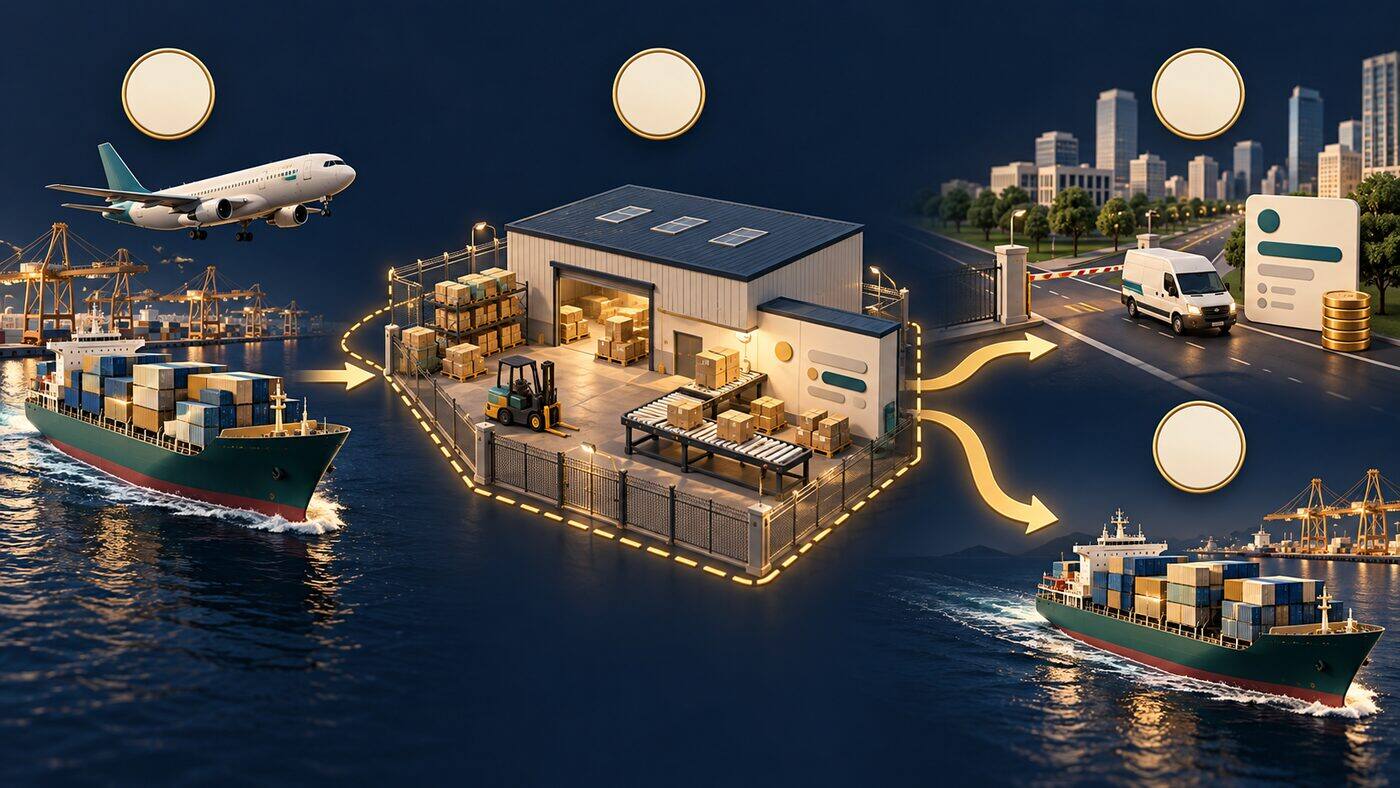
1Foreign goods enter the bonded area
Goods entering a Free Trade Zone are “notified” to customs and may move in and out once the customs computer system responds and records them; no import duties or taxes are charged at this point. Under Article 21 of the Act for the Establishment and Management of Free Trade Zones, goods that an FTZ enterprise brings into the zone from abroad for its operations are exempt from customs duty, commodity tax, business tax and other taxes and fees.
2Storage, reconditioning or processing inside the zone
A bonded warehouse may only carry out “reconditioning” such as inspection, testing, sorting, classification, splitting, assembly and repacking, and may not change the original nature or form of the goods; a logistics center may carry out “reconditioning and simple processing”; bonded factories and FTZ enterprises may process and manufacture.
3Sold into Taiwan: declare on leaving the zone and pay tax
When goods are shipped to a taxable area, the taxpayer files a customs declaration, and the goods may leave the zone only after clearing customs under the import regulations; customs duty, commodity tax, business tax and so on are then levied as for imported goods (clearance under Art. 6 of the Regulations Governing Customs Clearance of Goods in Free Trade Zones; taxation under Art. 23 of the Act). Goods released from a bonded warehouse for import are declared and taxed under ordinary import rules; when goods in a self-use bonded warehouse are sold to a business in the taxable area, their release from the warehouse is deemed importation, and tax is levied on the goods in the form in which they leave the warehouse.
4Re-export: duty-free
Goods re-exported in their original state or after reconditioning or processing are not charged Taiwan’s import duties and taxes. This is why the bonded system lets transshipment and international logistics distribution avoid paying tax first and claiming a refund later.
If an FTZ enterprise switches goods intended for its operations to non-operational use, it must declare this to customs in advance and pay the customs duty, commodity tax, business tax and other taxes and fees (Art. 30 of the Act); self-use machinery and equipment brought in from abroad are also back-taxed if shipped to a taxable area within 5 years of entry (Art. 21, para. 2).
How do bonded warehouses, bonded factories, logistics centers and FTZs differ?
All four kinds of site follow the rule “no tax for now, tax only on entry into Taiwan’s domestic market”; the differences lie in how much processing they allow, how long goods can stay and the eligibility thresholds:
| Type | Legal basis | What can be done inside | Storage period | Threshold |
|---|---|---|---|---|
| Bonded warehouse | Customs Act Art. 58; Regulations Governing the Establishment and Management of Bonded Warehouses | “Reconditioning” only: inspection, testing, sorting, classification, splitting, assembly, repacking; may not change the original nature or form, and may not use complex large machinery | Storage limited to 2 years, not extendable (exceptions for important raw materials, daily necessities, etc.) | Paid-in capital of NT$20,000,000 or more; NT$50,000,000 or more for a self-use bonded warehouse |
| Bonded factory | Customs Act Art. 59; Regulations Governing Customs Administration of Bonded Factories | Imported raw materials are manufactured or processed and then exported; domestic sales are back-taxed on import duties and taxes according to the form of the goods when they leave the factory | Managed under the regulations | Paid-in capital of NT$50,000,000 or more |
| Logistics center | Customs Act Art. 60; Regulations Governing Customs Clearance of Goods in Logistics Centers | Storage, transshipment and distribution of bonded goods; may carry out “reconditioning and simple processing” | In principle no limit; except where customs has announced a time limit, and for goods stored after clearance from the taxable area (2 years) | Company limited by shares with paid-in capital of NT$150 million or more; guarantee deposit of NT$20,000,000 |
| Free Trade Zone | Act for the Establishment and Management of Free Trade Zones | Trade, warehousing, logistics, transit, transshipment, reconditioning, packaging, repair, processing, manufacturing, inspection, testing, exhibition, etc. | Under the Act and the operation and management regulations | Must be a company or a Taiwan branch of a foreign company, approved by the management authority as an FTZ enterprise |
Taiwan’s laws use the term “logistics center” (Customs Act Art. 60), meaning a bonded site registered with customs approval that runs storage, transshipment and distribution of bonded goods. The term “bonded logistics center” often seen online is a mainland China term.
For duty-free shops under Article 61 of the Customs Act, bonded goods stored for sale are duty-free if, within the prescribed period, they are sold to travelers and carried out of the country in their original state. Duty-free shops are listed together with bonded warehouses, bonded factories and logistics centers in Section 2 (“Bonded”) of Chapter 3 of the Customs Act; FTZs are governed by a separate law.
Which Free Trade Zones does Taiwan have?
According to the Customs Administration, Ministry of Finance (Taiwan) and the Maritime and Port Bureau, MOTC, Taiwan currently has 7 Free Trade Zones (six seaports and one airport). The seaport FTZs are managed by the Maritime and Port Bureau, MOTC, while the Taoyuan Air Free Trade Zone is under the Civil Aeronautics Administration, MOTC:
| Zone | Type | Supervising customs office | Notes |
|---|---|---|---|
| Port of Keelung Free Trade Zone | Seaport | Keelung Customs | |
| Port of Taipei Free Trade Zone | Seaport | Keelung Customs | Keelung Customs explains that the Port of Taipei handles both Free Trade Zone movements and e-commerce cargo (sea express consignment) imports and exports |
| Port of Su-ao Free Trade Zone | Seaport | Keelung Customs | |
| Taoyuan Air Free Trade Zone | Airport | Taipei Customs | Built and operated by Farglory Free Trade Zone Co., Ltd. under commission from the Ministry of Transportation and Communications; in operation since 2006-01-01 |
| Port of Taichung Free Trade Zone | Seaport | Taichung Customs | Officially began operating on 2005-11-17 |
| Port of Anping Free Trade Zone | Seaport | Kaohsiung Customs | The operating zones listed in the Executive Yuan’s 2012-10-25 press release did not yet include the Port of Anping; it was added later |
| Port of Kaohsiung Free Trade Zone | Seaport | Kaohsiung Customs | The Maritime and Port Bureau lists LME metal futures trading and international logistics distribution as its representative business types |
The Pingtung Agricultural Biotechnology Park is governed by Taiwan’s Agricultural Technology Park Establishment and Management Act and offers bonded facilitation through a “bonded scope”; it is not on the official list of 7 Free Trade Zones. As for the dates on which the Executive Yuan approved each zone, no primary source text could be found except for Taoyuan Air (preparation approved by the Executive Yuan on 2005-05-25); for the Port of Taichung, only the official start of operations on 2005-11-17 was found.
How big are the Free Trade Zones?
Table 24 of the Maritime and Port Bureau, MOTC’s Maritime and Port Statistics Yearbook for ROC year 114 (2025): at the end of 2025 the seaport Free Trade Zones had 85 enterprises in total, with full-year trade value of about NT$888.8 billion and trade volume of 7,020,000 metric tons; trade value rose 39.83% from 2024. The yearbook attributes the growth to higher storage and transshipment volumes of machinery, electrical equipment and their products.
| Year | Enterprises (year-end) | Trade value | Trade volume |
|---|---|---|---|
| 2023 | 90 | about NT$599.1 billion | 4,713,091 metric tons |
| 2024 | 85 | about NT$635.6 billion | 6,307,706 metric tons |
| 2025 | 85 | about NT$888.8 billion | 7,024,147 metric tons |
- By port in 2025: the Port of Taichung was the largest at about NT$476.2 billion (29 enterprises), followed by the Port of Taipei at about NT$242.3 billion (8 enterprises) and the Port of Kaohsiung at about NT$168.4 billion (34 enterprises); the Port of Anping and the Port of Keelung recorded about NT$1.06 billion and NT$860 million respectively, and the Port of Su-ao had 1 enterprise with no value shown in the table.
- Taoyuan Air Free Trade Zone: the Civil Aeronautics Administration, MOTC reports that in Q1 2026 there were 34 FTZ enterprises in the value-added park, with Q1 trade value of NT$1,787.487 billion, up 85.81% from the same period of 2025.
The Maritime and Port Bureau’s seaport statistics exclude the Taoyuan Air Free Trade Zone, while the Civil Aeronautics Administration’s Taoyuan Air figures are a separately published quarterly cumulative total on a different basis; no combined seaport-plus-airport table published by the Ministry of Transportation and Communications could be found.
Which taxes are waived in an FTZ, and when must tax be paid back?
Many articles only say “FTZs are exempt from customs duty”, but Article 21 of the Act for the Establishment and Management of Free Trade Zones exempts more than customs duty, and the exemptions come with conditions:
- What is exempt: goods that an FTZ enterprise brings into the zone from abroad for its operations are exempt from customs duty, commodity tax, business tax, tobacco and alcohol tax, the health and welfare surcharge on tobacco products, the trade promotion service fee and the commercial port service fee (Art. 21, para. 1).
- Self-use machinery and equipment: self-use machinery and equipment brought in from abroad are exempt from customs duty, commodity tax, business tax, the trade promotion service fee and the commercial port service fee (but not from tobacco and alcohol tax or the health and welfare surcharge on tobacco products), but are back-taxed if shipped to a taxable area within 5 years of entry (Art. 21, para. 2).
- Taxed when sold into Taiwan: when goods are shipped to a taxable area, the various taxes and fees are levied under import rules; for goods processed, manufactured or reconditioned in the zone, the dutiable value is assessed as the price of the goods in the form in which they are shipped out, minus the value added in the zone (Art. 23).
- Shipped to other bonded areas: the related taxes and fees are exempt under the rules for bonded goods (Art. 27).
- Profit-seeking enterprise income tax: Article 29 provides that a profit-seeking enterprise that engages only in preparatory or auxiliary activities in Taiwan, and that purchases, imports, stores or transports goods in the zone itself or through an FTZ enterprise, is exempt from profit-seeking enterprise income tax on income from selling those goods once approved by the management authority; this applies until 2042-12-31 (ROC year 131, December 31). This is income tax, a separate matter from import duties and taxes.
According to its amendment history in the Laws and Regulations Database, the Act for the Establishment and Management of Free Trade Zones was enacted on 2003-07-23 and fully amended on 2009-07-08; the most recent amendment, on 2019-01-16, changed only Article 29, and there had been no further amendment as of the consolidation date of 2026-10-08.
Do Science Parks and Technology Industry Parks also count as bonded?
Besides FTZs, several other kinds of park in Taiwan also have designated bonded scopes: enterprises in these parks are exempt from import duties and taxes, commodity tax and business tax on raw materials and similar goods imported from abroad, and those taxes are levied under import rules when the goods are shipped to a taxable area:
| Park | Legal basis | Notes |
|---|---|---|
| Technology Industry Park (formerly Export Processing Zone) | Technology Industry Park Establishment and Management Act, Arts. 7 and 21 | Renamed from “Export Processing Zone” as of 2021-03-28; bonded goods of enterprises in the park shipped to a taxable area are handled in the same way as imported goods |
| Science Park | Science Park Establishment and Management Act, Arts. 22 and 23 | The competent authority may, with Executive Yuan approval, designate a bonded scope |
| Agricultural Technology Park | Agricultural Technology Park Establishment and Management Act, Arts. 21 and 22 | For example, the Pingtung Agricultural Biotechnology Park; enterprises within the bonded scope enjoy bonded facilitation |
Can cross-border e-commerce use a bonded warehouse for “bonded import”?
It is often said online that “cross-border e-commerce sellers can stock goods in a bonded warehouse in advance and release them from the zone once consumers order, balancing speed and tax efficiency.” “Bonded import” is an institutional term from mainland China’s cross-border e-commerce; no bonded import system or pilot program designed specifically for cross-border e-commerce in Taiwan could be found on the websites of the Ministry of Finance, the Customs Administration or the Maritime and Port Bureau. Companies can store goods in a bonded warehouse or logistics center under the general rules, but every release from the warehouse to a taxable area must be declared and taxed under ordinary import rules.
- In Taiwan, goods moving from a bonded warehouse, logistics center or FTZ to a taxable area must all be declared and taxed under ordinary import rules (Bonded Warehouse Regulations Arts. 24 and 29; Logistics Center Clearance Regulations Art. 10; FTZ Goods Clearance Regulations Art. 6).
- Whether goods imported out of a zone can qualify for the NT$2,000 low-value duty exemption: this page found no explicit official provision, so it cannot be treated as an established practice.
- Operators of bonded sites must in principle be approved companies (bonded warehouses have exceptions such as government agencies and state-owned enterprises), and individuals cannot apply; bonded warehouses, bonded factories and logistics centers also have paid-in capital thresholds (see the comparison table above).
- Xu et al. (2019, Sustainability) compared two models in mainland China’s cross-border e-commerce, “stocking a bonded warehouse in advance” and “switching to single-parcel direct mail when out of stock”. It is only a theoretical model and Taiwan’s system is different, so it can only be used by analogy to explain the trade-offs between the two stocking approaches.
The Regulations Governing the Establishment and Management of Bonded Warehouses were amended on 2026-07-20 to state expressly that bonded warehouses may store goods transferred (or sold) by FTZ enterprises; the Directions for Customs Clearance of Goods in Logistics Centers were amended on 2026-01-20 to bring goods moving in and out between logistics centers and FTZs under the rules. These rules govern the flow of bonded goods between businesses; they are not a duty-free channel for personal online purchases.
How do personal online purchases and consolidated parcels differ from bonded goods?
Items that individuals buy on platforms such as Taobao and Pinduoduo and ship back to Taiwan through consolidation or express services do not go through bonded procedures; they clear customs under the rules for express consignments, postal items or ordinary imports. Low-value express consignments (dutiable value of NT$50,000 or less) that are not subject to import regulation restrictions can clear customs by simplified declaration; from 2026-03-01, a customs declaration authorization must be completed before a simplified declaration (in writing, via the Customs-Port-Trade Single Window, or via the EZ WAY real-name authentication platform):
| Comparison | Bonded sites (businesses) | Personal online-shopping parcels (express / postal) |
|---|---|---|
| Who can use it | Companies approved by customs or the management authority | Ordinary recipients |
| When tax is charged | When goods leave the zone and are sold into Taiwan, under ordinary import rules | At import customs clearance |
| Small-value exemption | Whether imports out of a zone can use the NT$2,000 exemption: no explicit official provision found | Consignments with a dutiable value of NT$2,000 or less are exempt from customs duty, commodity tax and business tax (with limits on frequency and item types) |
| How long goods can be stored | Bonded warehouse 2 years; logistics center generally unlimited | Not stored; cleared directly |
- NT$2,000 is a threshold, not an allowance: a consignment is duty-free only if its dutiable value (including freight and insurance) is NT$2,000 or less; above that, the entire consignment is taxed under the rules.
- 6 times per half-year: once the same taxpayer has used the low-value exemption for release more than 6 times within a half-year period (months 1–6 or 7–12), the exemption no longer applies; the remaining count can be checked on the Customs-Port-Trade Single Window through the “Frequent Import Records Inquiry (GB377)”.
- Goods excluded: tobacco and alcohol, and agricultural products subject to tariff quotas, do not qualify for the low-value exemption.
- Goods subject to permits or inspection: pharmaceuticals, health foods, fresh agricultural, fishery and livestock products, live animals and plants, protected wildlife and products made from them, etc. may not clear customs by simplified express declaration (reminder from Taipei Customs, Customs Administration, Ministry of Finance).
- From 2026-03-01: customs may decline to accept the declaration of an express consignment under simplified declaration if a customs declaration authorization has not been completed first (Regulations Governing Customs Clearance of Air Express Consignments and of Sea Express Consignments, amended 2026-02-23).
As of 2026-10-17, no amendment notice adjusting the NT$2,000 threshold or the 6-times-per-half-year limit could be found from the Ministry of Finance, the Customs Administration or the Laws and Regulations Database; the duty-exemption limit announcement is still the 2017-09-07 version. Directions under study reported in the media are not established policy; rely on Ministry of Finance announcements.
What does research say about how well Free Trade Zones work?
The studies below provide background; none of them were conducted on HowBridge, and they can only illustrate general principles:
- The bottlenecks of Taiwan’s FTZs are customs procedures and fragmented management: Chang et al. (2014, Maritime Quarterly) used the analytic hierarchy process to compare four dimensions (operations, personnel, processing and customs affairs) and found that the dimension most in need of priority attention was “customs affairs”, followed by “operations”; Yu et al. (2016, Maritime Quarterly) surveyed the six seaport FTZs and found that operators most wanted a fully working single window, simpler permit and inspection documents, and a single management authority; Huang et al. (2020, Journal of Marine Science and Technology) also listed “coordinating and unifying regulations” as one of three main improvement measures. All three are questionnaire or expert-opinion studies that reflect the views of operators and officials, not quantitative assessments of the zones’ performance.
- Operators look at administrative efficiency, not just tax exemptions: Chiu et al. (2011, The Asian Journal of Shipping and Logistics) surveyed multinational companies operating in Taiwan’s FTZs and found the five most valued factors were government administrative efficiency, low charges, simplified customs procedures, clear regulations and tax incentives; Hsu et al. (2021, Promet), taking the Port of Kaohsiung FTZ as a case and the foreign investor’s perspective, found that the areas most in need of improvement were access to raw materials, local government efficiency, political stability and social security. The post-entry performance gains in the former study are operators’ self-assessments based on relatively old data, and only show operators’ perceptions.
- Free trade zones work, but the effect depends on conditions: Wang (2013, Journal of Development Economics) compared mainland Chinese cities that set up special economic zones earlier and later, finding that the zones increased foreign investment without crowding out domestic investment, but that the later a zone was set up, the smaller its benefits; Frick et al. (2019, Economic Geography) used night-time light data across several emerging countries and found that zone growth is hard to sustain, and that proximity to large cities and large markets matters more than tax incentives. Neither study is about Taiwan, so they can only be used by analogy to show that “setting up a zone does not guarantee success”.
- “Bonded” means taxes are suspended, not that goods are legally offshore: Chiu (2020, master’s thesis, Executive Master of Business Administration program, National Taiwan University) compared Taiwan and Singapore, explaining that in bonded areas customs duty, business tax and so on are usually suspended or exempted, while a free trade zone is the most complete kind of bonded area, where processing, storage, testing, labeling, packaging and similar activities can take place; Shadikhodjaev (2011, World Trade Review) analyzed international rules and noted that the Revised Kyoto Convention treats free zones as having some “extraterritorial” character, whereas WTO law does not treat them that way. The former is an institutional comparison and the latter an international-law analysis; neither estimates the amount of tax saved.
- Bonded stocking and direct mail each have pros and cons: Xu et al. (2019, Sustainability) used a game-theory model to compare two models for cross-border import e-commerce, “stocking everything in a bonded warehouse in advance” and “switching to single-parcel direct mail when the bonded warehouse is out of stock”; the results show the hybrid model may increase the overseas supplier’s profit and reduce the e-commerce seller’s profit. This is a theoretical model set in mainland China’s cross-border e-commerce, not actual data; Taiwan’s import system is different, so it can only be used by analogy to explain the trade-offs between the two stocking approaches.
What are the common terms for bonded status and FTZs?
- Bonded (customs duty suspended)
- While imported goods are held in a customs-controlled bonded site, import duties and taxes are not yet charged; they are duty-free if exported, and declared and taxed under the rules when they enter Taiwan’s domestic market.
- Inside the border but outside customs territory
- An area marked off within the national border but outside the customs territory; goods move in and out without customs duty, and are taxed only when moved to other taxable areas of Taiwan.
- Taxable area (domestic customs territory)
- The ordinary areas of Taiwan outside the bonded areas; goods entering them must be declared and taxed under import rules.
- FTZ enterprise
- A business approved to engage in trade, warehousing, logistics, transit, processing, manufacturing and similar activities in a Free Trade Zone; it must be a company or a Taiwan branch of a foreign company.
- Reconditioning
- The inspection, testing, sorting, classification, splitting, assembly and repacking permitted in a bonded warehouse; the original nature or form of the goods may not be changed.
- Logistics center
- A bonded site registered with customs approval that runs storage, transshipment and distribution of bonded goods; it may carry out reconditioning and simple processing.
- Deemed importation
- When goods in a self-use bonded warehouse are sold to a business in the taxable area, their release from the warehouse is treated as an import, and they are declared and taxed in the form in which they leave the warehouse.
- Dutiable value
- The base price for calculating customs duty: the transaction value, including freight and insurance to the port of import.
What are the sources and the scope of verification?
The sources below were consulted on 2026-10-17; document dates are shown separately from the consultation date, and no date has been added where a source does not state one.
Official and primary government sources
- Act for the Establishment and Management of Free Trade Zones (MOTC / Laws and Regulations Database) | Document date: 2019-01-16; original text of Art. 3 definitions, Art. 17 notification and clearance, Art. 21 exemption from customs duty and six other taxes and fees (seven in total), and Art. 23 taxation of goods shipped to taxable areas
- Amendment history of the Act for the Establishment and Management of Free Trade Zones (Laws and Regulations Database) | Document date: 2019-01-16; shows the most recent amendment was on ROC year 108, January 16, changing only Art. 29, with no amendment since
- Customs Act (Ministry of Finance / Laws and Regulations Database) | Document date: 2022-05-11; Art. 58 bonded warehouses, Art. 59 bonded factories, Art. 60 logistics centers, Art. 61 duty-free shops, Art. 49, para. 2 low-value exemption, Art. 29 dutiable value including freight and insurance
- Enforcement Rules of the Customs Act (Ministry of Finance / Laws and Regulations Database) | Document date: 2024-12-23; Art. 2: when the tariff schedule is amended, the applicable rate for goods in bonded warehouses and logistics centers is decided by the date of application for import upon release from the warehouse (or logistics center)
- Regulations Governing the Establishment and Management of Bonded Warehouses (Ministry of Finance / Laws and Regulations Database) | Document date: 2026-07-20; Art. 34 scope and limits of reconditioning, Art. 45 two-year storage, Art. 24 goods in a self-use bonded warehouse sold to the taxable area are deemed imported, Art. 29 import on release subject to the ordinary duty-payment deadline
- General explanation of the amendment to the Regulations Governing the Establishment and Management of Bonded Warehouses, 115.07.20 (Ministry of Finance) | Document date: 2026-07-20; new in the past year: bonded warehouses may store goods transferred (or sold) by FTZ enterprises
- Regulations Governing Customs Administration of Bonded Factories (Ministry of Finance / Laws and Regulations Database) | Document date: 2026-06-12; Art. 40 domestic sales back-taxed on import duties and taxes according to the form on leaving the factory; key points of the ROC year 115 (2026) June amendment
- Regulations Governing Customs Clearance of Goods in Logistics Centers (Ministry of Finance / Laws and Regulations Database) | Document date: 2025-01-14; Art. 3 definition of logistics center and reconditioning and simple processing, Art. 10 clearance required for shipment to taxable areas, Art. 18 storage period in principle unlimited
- Regulations Governing Customs Clearance of Goods in Free Trade Zones (Ministry of Finance / Laws and Regulations Database) | Document date: 2025-05-09; Art. 6 goods shipped from an FTZ to a taxable area are declared by the taxpayer and handled under the import regulations
- Regulations Governing the Operation and Management of FTZ Enterprises (MOTC / Laws and Regulations Database) | Document date: 2024-10-16; Art. 2: an FTZ enterprise must be a company or a Taiwan branch of a foreign company
- Technology Industry Park Establishment and Management Act (formerly the Export Processing Zone Establishment and Management Act) (Ministry of Economic Affairs / Laws and Regulations Database) | Document date: 2023-01-19; Export Processing Zones renamed as of ROC year 110, March 28; Arts. 7 and 21 bonded goods shipped to taxable areas back-taxed in the same way as imports
- Science Park Establishment and Management Act (National Science and Technology Council / Laws and Regulations Database) | Document date: 2018-06-06; Art. 22 designation of bonded scope, Art. 23 raw-material exemption and taxation on shipment to taxable areas
- Agricultural Technology Park Establishment and Management Act (Ministry of Agriculture / Laws and Regulations Database) | Document date: 2026-02-04; Arts. 21 and 22 bonded scope; shows that agricultural technology parks and FTZs are governed by different laws
- Regulations Governing Customs Clearance of Air Express Consignments (Ministry of Finance / Laws and Regulations Database) | Document date: 2026-02-23; Art. 11 low-value duty-free express = dutiable value of NT$2,000 or less; Art. 17 from 2026-03-01 simplified declaration requires a prior customs declaration authorization
- Regulations Governing Customs Clearance of Sea Express Consignments (Ministry of Finance / Laws and Regulations Database) | Document date: 2026-02-23; sea express consignments clear customs in the dedicated sea express consignment zone, not through FTZ bonded status; the ROC year 115 prior-authorization rule
- Regulations Governing Customs Clearance of Imported and Exported Postal Items (Ministry of Finance / Laws and Regulations Database) | Document date: 2020-04-01; Art. 7 postal parcels with a dutiable value within NT$2,000 are exempt from customs duty, commodity tax and business tax
- Announcement of the duty-exemption limit under Article 49, paragraph 2 of the Customs Act (Ministry of Finance) | Document date: 2017-09-07; original text of the official announcement that an import consignment with a dutiable value of NT$2,000 or less is duty-free
- Directions for Customs Clearance of Goods in Logistics Centers (Customs Administration, Ministry of Finance) | Document date: 2026-01-20; new in the past year: clearance procedures for goods moving in and out between logistics centers and Free Trade Zones brought under the rules
- Which Free Trade Zones currently exist, and which customs office supervises each? (Customs Administration, Ministry of Finance) | Document date: 2026-07-06; the official list of the 7 Free Trade Zones and their supervising customs offices
- Overseas online shopping is easy, but watch out for frequent imports (Ministry of Finance) | Document date: 2024-10-01; the full criteria for the NT$2,000 low-value exemption and the limit of 6 times per half-year
- Rules to note for cross-border online shopping (Taipei Customs, Customs Administration, Ministry of Finance) | Document date: 2025-02-12; online purchases subject to permits or inspection may not use simplified express declaration
- FAQ: What is a Free Trade Zone? (Maritime and Port Bureau, MOTC) | Document date: 2026-10-13; the “inside the border but outside customs territory” concept and the six-seaport, one-airport list
- Taoyuan Air Free Trade Zone (Civil Aeronautics Administration, MOTC) | Document date: 2026-05-19; approval of preparation in ROC year 94, the operating license, and the number of enterprises and trade value for Q1 of ROC year 115
- ROC Year 114 Maritime and Port Statistics Yearbook, Table 24: Seaport Free Trade Zones (Maritime and Port Bureau, MOTC) | Document date: 2026-07; (published July 2026) in ROC year 114 the seaport FTZs had 85 enterprises, trade value of about NT$888.8 billion and trade volume of 7,020,000 metric tons
Research literature
An Evaluation of Free Trade Port Zone in Taiwan
A questionnaire survey of multinational companies operating in Taiwan’s Free Trade Zones, using importance–performance analysis (IPA) to identify the five factors operators value most: government administrative efficiency, low charges, simplified customs procedures, clear regulations and tax incentives; operators also reported gains in reputation, investment, customer satisfaction and revenue after entering (self-assessed by operators). Supports the point that “an FTZ’s value lies in customs and administrative efficiency, not just tax exemptions”.
自由貿易港區跨部門協調障礙之探討(Discussing the Coordination Barriers between Divisions of Free Port Zones in Taiwan)
The abstract notes that Taiwan began planning Free Trade Zones in 2002, and more than a decade later the results fell short of original expectations, with overly complex management units and regulations an important cause of poor performance; using the analytic hierarchy process to compare four dimensions (operations, personnel, processing and customs affairs), it found that “customs affairs” should be addressed first, followed by “operations”, and among the issues “double taxation of foreign profit-seeking enterprises” received the most attention. Supports the point that “the bottlenecks of FTZs lie in customs affairs and cross-agency regulations”.
應用品質機能展開法於臺灣自由貿易港區政策改善
A quality function deployment (QFD) survey of operators and government in the six seaport FTZs; the abstract notes that earlier research had found problems in the zones such as poor cargo flow, excessive hiring restrictions and overly strict self-management rules. Operators considered the top two policy goals to be a fully working single window and profit-seeking enterprise income tax incentives, and the top two improvement measures to be simplifying permit and inspection documents and unifying the management authority for FTZ enterprises. Supports the point that “permit and inspection documents and fragmented management are pain points for operators”.
Service Quality Assessment of Free Trade Port Zone Using Multilayer Quality Function Deployment: An Empirical Study in Taiwan
Uses multilayer quality function deployment to assess the service quality of Taiwan’s FTZs from the perspectives of both users and service providers (such as the Maritime and Port Bureau), proposing three key technical solutions: strengthening information and technology systems, coordinating and unifying regulations, and building automated road and regulatory systems. Supports the point that “unified regulations and information systems are key to FTZ service quality”.
An Evaluation Model for Foreign Direct Investment Performance of Free Trade Port Zones
Uses the fuzzy analytic hierarchy process to build a model, from the foreign investor’s perspective, for evaluating the foreign direct investment (FDI) performance of FTZs, tested empirically at the Port of Kaohsiung FTZ; the results indicate that the Port of Kaohsiung’s top priorities for improvement are access to raw materials, local government efficiency, political stability and social security. Supports the point that “attracting foreign investment to a zone is about more than taxes”.
比較分析臺灣自由貿易港區和新加坡自由貿易區(A Comparative Analysis of Free Trade Zones in Taiwan & Singapore)
A master’s thesis written in English that compares free trade zones in Taiwan and Singapore through expert interviews and SWOT analysis; the abstract explains that in bonded areas customs duty, business tax and so on are usually suspended or exempted and customs supervision is minimized, while a free trade zone is the most complete kind of bonded area, allowing supply-chain activities such as manufacturing, processing, storage, testing, repair, labeling, packaging and display, which can help companies ease cash-flow pressure and improve logistics efficiency. Supports the explanation that “bonded = taxes suspended, not goods permanently duty-free”. The full text is available under a paid license.
The economic impact of Special Economic Zones: Evidence from Chinese municipalities
Compares cities that set up special economic zones earlier and later, finding that the zones raised foreign direct investment, not merely through firm relocation, without crowding out domestic investment, and that wage gains exceeded increases in local living costs; but later zones brought smaller benefits and greater distortion of firm location. The study covers mainland Chinese cities and can only be applied by analogy; it supports the point that “zones work, but with diminishing returns that depend on the conditions under which they are set up”.
Toward Economically Dynamic Special Economic Zones in Emerging Countries
Uses night-time light data to measure the growth of special economic zones in multiple countries, finding that zone growth is hard to sustain, that upgrading industrial technology through zones is often difficult, and that larger zones have an advantage; proximity to large cities and large markets and existing levels of industrialization help performance, while program variables such as tax incentives show no structural relationship with performance. The study covers emerging countries and can only be applied by analogy; it supports the point that “incentives alone do not guarantee success”.
International regulation of free zones: an analysis of multilateral customs and trade rules
Analyzes how the Revised Kyoto Convention and WTO rules regulate free zones: the former treats free zones as areas with some “extraterritorial” character, while WTO law gives them no such treatment, so the two sets of rules differ in flexibility; as of June 1, 2010, 63 of the Revised Kyoto Convention’s 69 contracting parties were WTO members. This is an analysis of international regulation, not an empirical study of Taiwan; it supports the point that “a free zone is not legally offshore”.
Supply Chain Analysis of Cross Border Importing E-Commerce Considering with Bonded Warehouse and Direct Mailing
Uses a Stackelberg game model to compare two models for cross-border import e-commerce, “pure bonded-warehouse stocking” and “bonded warehouse plus single-parcel direct mail when out of stock”; the analysis shows the hybrid model may raise the overseas supplier’s profit and lower the e-commerce seller’s profit. The study is a theoretical, non-empirical model of mainland China’s cross-border import e-commerce; Taiwan’s system is different, so it can only be used by analogy to explain the trade-offs between bonded stocking and direct mail.
Legal provisions follow the original texts in the Laws and Regulations Database (consolidated as of 2026-10-08); FTZ statistics follow Table 24 of the Maritime and Port Bureau, MOTC’s Maritime and Port Statistics Yearbook for ROC year 114 and the Civil Aeronautics Administration’s web pages. Except for Taoyuan Air, no primary source text could be found for the dates on which the Executive Yuan approved each zone (for the Port of Taichung, only the official start of operations was found); no explicit official provision could be found for an official system of cross-border e-commerce imports through bonded sites, nor on whether imports out of a zone can qualify for the NT$2,000 low-value exemption. None of the studies cited were conducted on HowBridge.
What are common questions about bonded status and Free Trade Zones?
What does bonded mean?
How is bonded different from duty-free?
How many Free Trade Zones does Taiwan have?
Which taxes are waived in a Free Trade Zone?
How long can goods stay in a bonded warehouse?
Can goods be processed in a bonded warehouse?
Is a “bonded logistics center” the same as a logistics center?
Can individuals store their online purchases in a bonded warehouse to save tax?
Does Taiwan have bonded import for cross-border e-commerce?
Do Export Processing Zones still exist?
Do consolidated shipments from China to Taiwan pass through a Free Trade Zone?
Further reading
Taiwan import customs: the complete process
Cross-border online shopping import tax rules (NT$2,000 and 6 times per half-year)
How express and postal customs clearance differ
How to complete EZ WAY prior authorization
Port of Taipei and sea express consignment clearance
How to use the Customs-Port-Trade Single Window
Import dutiable value and royalties
China to Taiwan shipping cost calculator
Shipping from China to Taiwan? Estimate shipping costs and taxes first
Personal online-shopping parcels do not go through bonded procedures and clear customs under express rules; use HowBridge to estimate sea express and air shipping costs, then use the tariff lookup to check import taxes and import regulation codes.
China to Taiwan shipping cost calculator